Cost Management
Knowledge Area
A Guide to the Project Management Body of Knowledge (PMBOK® Guide) 6th Edition
Presented by : Zaur Ahmadov, PMP®
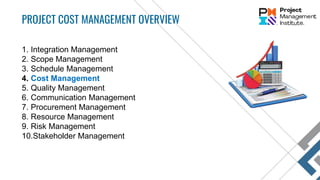
PROJECT COST MANAGEMENT OVERVIEW
1. Integration Management
2. Scope Management
3. Schedule Management
4. Cost Management
5. Quality Management
6. Communication Management
7. Procurement Management
8. Resource Management
9. Risk Management
10.Stakeholder Management
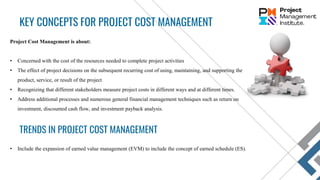
KEY CONCEPTS FOR PROJECT COST MANAGEMENT
Project Cost Management is about:
• Concerned with the cost of the resources needed to complete project activities
• The effect of project decisions on the subsequent recurring cost of using, maintaining, and supporting the
product, service, or result of the project
• Recognizing that different stakeholders measure project costs in different ways and at different times.
• Address additional processes and numerous general financial management techniques such as return on
investment, discounted cash flow, and investment payback analysis.
TRENDS IN PROJECT COST MANAGEMENT
• Include the expansion of earned value management (EVM) to include the concept of earned schedule (ES).
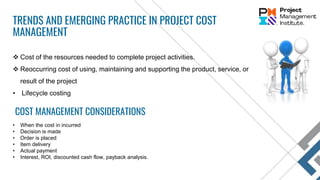
TRENDS AND EMERGING PRACTICE IN PROJECT COST
MANAGEMENT
 Cost of the resources needed to complete project activities.
 Reoccurring cost of using, maintaining and supporting the product, service, or
result of the project
• Lifecycle costing
COST MANAGEMENT CONSIDERATIONS
• When the cost in incurred
• Decision is made
• Order is placed
• Item delivery
• Actual payment
• Interest, ROI, discounted cash flow, payback analysis.
TAILORING PROJECT COST MANAGEMENT
 Knowledge management. Does the organization have a formal knowledge management and financial
database
 repository that a project manager is required to use and that is readily accessible?
 Estimating and budgeting. Does the organization have existing formal or informal cost estimating and
 budgeting-related policies, procedures, and guidelines?
 Earned value management. Does the organization use earned value management in managing projects?
 Use of agile approach. Does the organization use agile methodologies in managing projects? How does
this
 impact cost estimating?
 Governance. Does the organization have formal or informal audit and governance policies, procedures,
and guidelines?
Project Management Process Groups
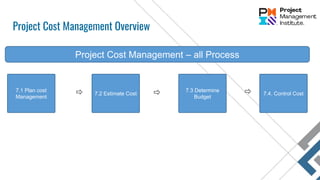
Project Cost Management Overview
Project Cost Management – all Process
7.1 Plan cost
Management
7.2 Estimate Cost
7.3 Determine
Budget
7.4. Control Cost
Project Cost Management Overview
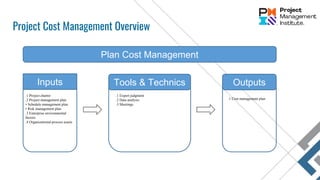
Plan Cost Management
Inputs Tools & Technics Outputs
.1 Project charter
.2 Project management plan
• Schedule management plan
• Risk management plan
.3 Enterprise environmental
factors
.4 Organizational process assets
.1 Expert judgment
.2 Data analysis
.3 Meetings
.1 Cost management plan
Plan Cost Management
 Plan Cost Management is the process of defining how the project costs will be estimated, budgeted, managed, monitored, and controlled.
 The key benefit of this process is that it provides guidance and direction on how the project costs will be managed throughout the project.
 Schedule management plan : process and controls that will impact cost estimation and management
 Risk Management plan : process and controls that will impact cost estimation and management
 Enterprise environmental factors :
• Culture and structure
• Market conditions
• Currency exchange rates
• Commercial Database
• Productivity in different level
Considerations / Inputs
Outputs : Cost Management Plan
 Unit of measure
 Level of precision
 Level of Accuracy
 Organizational procedure links
 Control Thresholds
 Cost estimating approach
 Rules of performance measurement
 Reporting formats
Project Cost Management Overview
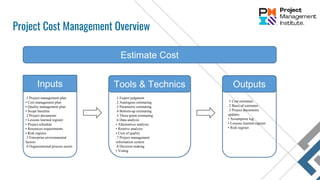
Estimate Cost
Inputs Tools & Technics Outputs
.1 Project management plan
• Cost management plan
• Quality management plan
• Scope baseline
.2 Project documents
• Lessons learned register
• Project schedule
• Resources requirements
• Risk register
.3 Enterprise environmental
factors
.4 Organizational process assets
.1 Expert judgment
.2 Analogous estimating
.3 Parametric estimating
.4 Bottom-up estimating
.5 Three-point estimating
.6 Data analysis
• Alternatives analysis
• Reserve analysis
• Cost of quality
.7 Project management
information system
.8 Decision making
• Voting
.1 Cost estimates
.2 Basis of estimates
.3 Project documents
updates
• Assumption log
• Lessons learned register
• Risk register
ESTIMATE PROJECT COST
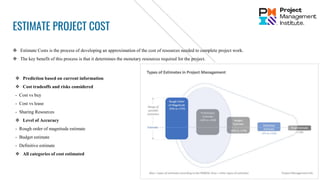
 Estimate Costs is the process of developing an approximation of the cost of resources needed to complete project work.
 The key benefit of this process is that it determines the monetary resources required for the project.
 Prediction based on current information
 Cost tradeoffs and risks considered
- Cost vs buy
- Cost vs lease
- Sharing Resources
 Level of Accuracy
- Rough order of magnitude estimate
- Budget estimate
- Definitive estimate
 All categories of cost estimated
ESTIMATE PROJECT COST
RISK AND COST ESTIMATING
 Risk Register
 Opportunity and Threat
 Contingency reserve - [known-unknown risks]
 Management reserve - [unknown-unknown risks] which affect time as well.
Scope Baseline in Cost Estimating
Scope Baseline includes :
 Project Scope statement: Reflects funding constraints
 WBS: shows relationships among the deliverables
 WBS dictionary: identification of the deliverables and description of the work in each component
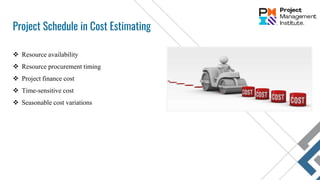
Project Schedule in Cost Estimating
 Resource availability
 Resource procurement timing
 Project finance cost
 Time-sensitive cost
 Seasonable cost variations
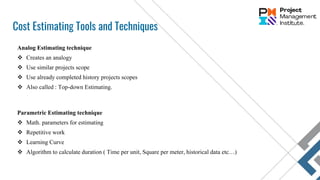
Cost Estimating Tools and Techniques
Analog Estimating technique
 Creates an analogy
 Use similar projects scope
 Use already completed history projects scopes
 Also called : Top-down Estimating.
Parametric Estimating technique
 Math. parameters for estimating
 Repetitive work
 Learning Curve
 Algorithm to calculate duration ( Time per unit, Square per meter, historical data etc…)
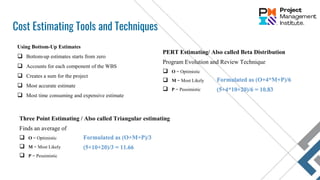
Cost Estimating Tools and Techniques
Three Point Estimating / Also called Triangular estimating
Finds an average of
 O = Optimistic
 M = Most Likely
 P = Pessimistic
Using Bottom-Up Estimates
 Bottom-up estimates starts from zero
 Accounts for each component of the WBS
 Creates a sum for the project
 Most accurate estimate
 Most time consuming and expensive estimate
PERT Estimating/ Also called Beta Distribution
Program Evolution and Review Technique
 O = Optimistic
 M = Most Likely
 P = Pessimistic
Formulated as (O+4*M+P)/6
(5+4*10+20)/6 = 10.83
Formulated as (O+M+P)/3
(5+10+20)/3 = 11.66
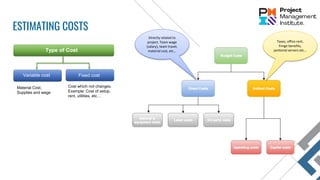
ESTIMATING COSTS
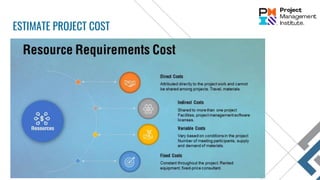
Type of Cost
Fixed cost
Variable cost
Material Cost,
Supplies and wage
Cost which not changes.
Example: Cost of setup,
rent, utilities, etc…
Directly related to
project. Team wage
(salary), team travel,
material cost, etc…
Taxes, office rent,
fringe benefits,
janitorial servers etc…
Project Cost Management Overview
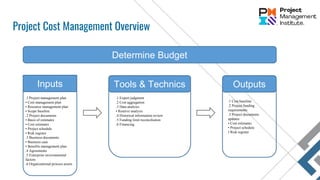
Determine Budget
Inputs Tools & Technics Outputs
.1 Project management plan
• Cost management plan
• Resource management plan
• Scope baseline
.2 Project documents
• Basis of estimates
• Cost estimates
• Project schedule
• Risk register
.3 Business documents
• Business case
• Benefits management plan
.4 Agreements
.5 Enterprise environmental
factors
.6 Organizational process assets
.1 Expert judgment
.2 Cost aggregation
.3 Data analysis
• Reserve analysis
.4 Historical information review
.5 Funding limit reconciliation
.6 Financing
.1 Cost baseline
.2 Project funding
requirements
.3 Project documents
updates
• Cost estimates
• Project schedule
• Risk register
Determine Project Budget
 Determine Budget is the process of aggregating the estimated costs of individual activities or work packages to establish an authorized cost baseline.
 The key benefit of this process is that it determines the cost baseline against which project performance can be monitored and controlled.
 Aggregating the estimated costs
 Cost of work packages and activities
 Authorized cost baseline
 Excludes management reserves, includes contingency reserves
 Pre-assigned budget
Relying of historical project data's
 Both parametric and analogous are historical based estimates
 The historical info affects the estimates
- Accuracy of historical information
- Quantifiable parameters
- Models are scalable for any size project
Finding Limit Reconciliation
 Reconcile planned and actual cost
 Cost variances
 Corrective actions
Determine Project Budget
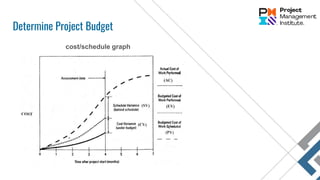
cost/schedule graph
Determine Project Budget (Creating Cost Baselines)
 Measures performance
 Predicts expenses over the project life
 Usually shown as an S-curve
 Predicts when the project will be spending monies
 Discrepancies early are a signal that the project is slipping
 May use multiple cost baselines for cots within each phase
 Predict spending plans
 Show cash flows of the project
 Overall project performance
Large Projects
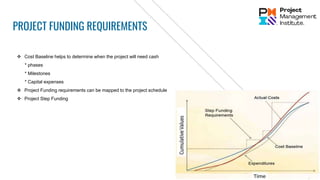
PROJECT FUNDING REQUIREMENTS
 Cost Baseline helps to determine when the project will need cash
* phases
* Milestones
* Capital expenses
 Project Funding requirements can be mapped to the project schedule
 Project Step Funding
Project Cost Management Overview
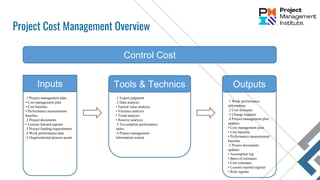
Control Cost
Inputs Tools & Technics Outputs
.1 Project management plan
• Cost management plan
• Cost baseline
• Performance measurement
baseline
.2 Project documents
• Lessons learned register
.3 Project funding requirements
.4 Work performance data
.5 Organizational process assets
.1 Expert judgment
.2 Data analysis
• Earned value analysis
• Variance analysis
• Trend analysis
• Reserve analysis
.3 To-complete performance
index
.4 Project management
information system
.1 Work performance
information
.2 Cost forecasts
.3 Change requests
.4 Project management plan
updates
• Cost management plan
• Cost baseline
• Performance measurement
baseline
.5 Project documents
updates
• Assumption log
• Basis of estimates
• Cost estimates
• Lessons learned register
• Risk register
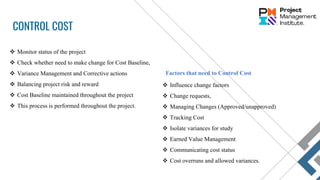
CONTROL COST
 Monitor status of the project
 Check whether need to make change for Cost Baseline,
 Variance Management and Corrective actions
 Balancing project risk and reward
 Cost Baseline maintained throughout the project
 This process is performed throughout the project.
 Influence change factors
 Change requests,
 Managing Changes (Approved/unapproved)
 Tracking Cost
 Isolate variances for study
 Earned Value Management
 Communicating cost status
 Cost overruns and allowed variances.
Factors that need to Control Cost
MEASURING PROJECT PERFORMANCE
• Earned Value Management
• Forecast
• Measure Performance
• Suite of Formula’s
• A few project management questions
Earned Value Management Basics
Project BAC $ 250,000
55% planned
Earned Value Management Basics (Foundation)
40% complete
Actual Cost
$ 112,000
EV = % completed * BAC
EV = 40% * 250K
EV = 100,000 $
PV = % planned * BAC
PV = 55% * 250K
PV = 137,500 $
Project BAC $ 250,000
55% planned
Earned Value Management Basics (Finding Variances)
40% complete
Actual Cost
$ 112,000
CV = EV - AC
CV = 100K- 112K
CV = -12k $
SV = EV - PV
SV = 100K – 137,500
SV = -37,500
Project BAC $ 250,000
55% planned
Earned Value Management Basics (Measuring Performance)
40% complete
Actual Cost
$ 112,000
CPI = EV / AC
CPI = 100K / 112K
CPI = 0.89
SPI = EV / PV
SPI = 100K / 137,500
SPI = 0.73
Predicting Feature
EAC = BAC / CPI
EAC = 250K / 0.89
EAC = 280K $
ETC = EAC - AC
EAC = 280K – 112K
EAC = 168K$
Project BAC $ 250,000
55% planned
EAC - Current Cost Performance
40% complete
Actual Cost
$ 112,000
Feature Work at planned cost formula (atypical)
EAC = AC + (BAC-EV)
EAC = 112K + (250K-100K)
EAC = 262K
Forecasts final project costs based on current performance
EAC = BAC / CPI
EAC = 250K / 0.89
EAC = 280K
Standard Formula
Current
Performance
Project BAC $ 250,000
55% planned
EAC : CPI and SPI factors considered
40% complete
Actual Cost
$ 112,000
EAC = AC + [(BAC-EV) / (CPI * SPI)]
EAC = 112K + [(250K-100K) / (0.89 * 0.73)
EAC = 342,769 $
Estimate at Completion (EAC)
Same efficiency rate for time and cost
EAC = BAC / CPI
EAC = 250K / 0.89
EAC = 280K
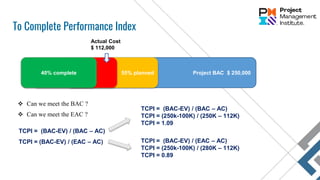
To Complete Performance Index
 Can we meet the BAC ?
 Can we meet the EAC ?
TCPI = (BAC-EV) / (BAC – AC)
TCPI = (BAC-EV) / (EAC – AC)
Project BAC $ 250,000
55% planned
40% complete
Actual Cost
$ 112,000
TCPI = (BAC-EV) / (BAC – AC)
TCPI = (250k-100K) / (250K – 112K)
TCPI = 1.09
TCPI = (BAC-EV) / (EAC – AC)
TCPI = (250k-100K) / (280K – 112K)
TCPI = 0.89
Good Luck !
Zaur Ahmadov, PMP®
IT / Telecom Project Manager
Email : zaur.ahmadov@gmail.com
Source used : PMBOK 6th Edition

PMP-Cost Management area

  • 1.
    Cost Management Knowledge Area AGuide to the Project Management Body of Knowledge (PMBOK® Guide) 6th Edition Presented by : Zaur Ahmadov, PMP®
  • 2.
    PROJECT COST MANAGEMENTOVERVIEW 1. Integration Management 2. Scope Management 3. Schedule Management 4. Cost Management 5. Quality Management 6. Communication Management 7. Procurement Management 8. Resource Management 9. Risk Management 10.Stakeholder Management
  • 3.
    KEY CONCEPTS FORPROJECT COST MANAGEMENT Project Cost Management is about: • Concerned with the cost of the resources needed to complete project activities • The effect of project decisions on the subsequent recurring cost of using, maintaining, and supporting the product, service, or result of the project • Recognizing that different stakeholders measure project costs in different ways and at different times. • Address additional processes and numerous general financial management techniques such as return on investment, discounted cash flow, and investment payback analysis. TRENDS IN PROJECT COST MANAGEMENT • Include the expansion of earned value management (EVM) to include the concept of earned schedule (ES).
  • 4.
    TRENDS AND EMERGINGPRACTICE IN PROJECT COST MANAGEMENT  Cost of the resources needed to complete project activities.  Reoccurring cost of using, maintaining and supporting the product, service, or result of the project • Lifecycle costing COST MANAGEMENT CONSIDERATIONS • When the cost in incurred • Decision is made • Order is placed • Item delivery • Actual payment • Interest, ROI, discounted cash flow, payback analysis.
  • 5.
    TAILORING PROJECT COSTMANAGEMENT  Knowledge management. Does the organization have a formal knowledge management and financial database  repository that a project manager is required to use and that is readily accessible?  Estimating and budgeting. Does the organization have existing formal or informal cost estimating and  budgeting-related policies, procedures, and guidelines?  Earned value management. Does the organization use earned value management in managing projects?  Use of agile approach. Does the organization use agile methodologies in managing projects? How does this  impact cost estimating?  Governance. Does the organization have formal or informal audit and governance policies, procedures, and guidelines?
  • 6.
  • 7.
    Project Cost ManagementOverview Project Cost Management – all Process 7.1 Plan cost Management 7.2 Estimate Cost 7.3 Determine Budget 7.4. Control Cost
  • 8.
    Project Cost ManagementOverview Plan Cost Management Inputs Tools & Technics Outputs .1 Project charter .2 Project management plan • Schedule management plan • Risk management plan .3 Enterprise environmental factors .4 Organizational process assets .1 Expert judgment .2 Data analysis .3 Meetings .1 Cost management plan
  • 9.
    Plan Cost Management Plan Cost Management is the process of defining how the project costs will be estimated, budgeted, managed, monitored, and controlled.  The key benefit of this process is that it provides guidance and direction on how the project costs will be managed throughout the project.  Schedule management plan : process and controls that will impact cost estimation and management  Risk Management plan : process and controls that will impact cost estimation and management  Enterprise environmental factors : • Culture and structure • Market conditions • Currency exchange rates • Commercial Database • Productivity in different level Considerations / Inputs Outputs : Cost Management Plan  Unit of measure  Level of precision  Level of Accuracy  Organizational procedure links  Control Thresholds  Cost estimating approach  Rules of performance measurement  Reporting formats
  • 10.
    Project Cost ManagementOverview Estimate Cost Inputs Tools & Technics Outputs .1 Project management plan • Cost management plan • Quality management plan • Scope baseline .2 Project documents • Lessons learned register • Project schedule • Resources requirements • Risk register .3 Enterprise environmental factors .4 Organizational process assets .1 Expert judgment .2 Analogous estimating .3 Parametric estimating .4 Bottom-up estimating .5 Three-point estimating .6 Data analysis • Alternatives analysis • Reserve analysis • Cost of quality .7 Project management information system .8 Decision making • Voting .1 Cost estimates .2 Basis of estimates .3 Project documents updates • Assumption log • Lessons learned register • Risk register
  • 11.
    ESTIMATE PROJECT COST Estimate Costs is the process of developing an approximation of the cost of resources needed to complete project work.  The key benefit of this process is that it determines the monetary resources required for the project.  Prediction based on current information  Cost tradeoffs and risks considered - Cost vs buy - Cost vs lease - Sharing Resources  Level of Accuracy - Rough order of magnitude estimate - Budget estimate - Definitive estimate  All categories of cost estimated
  • 12.
  • 13.
    RISK AND COSTESTIMATING  Risk Register  Opportunity and Threat  Contingency reserve - [known-unknown risks]  Management reserve - [unknown-unknown risks] which affect time as well. Scope Baseline in Cost Estimating Scope Baseline includes :  Project Scope statement: Reflects funding constraints  WBS: shows relationships among the deliverables  WBS dictionary: identification of the deliverables and description of the work in each component
  • 14.
    Project Schedule inCost Estimating  Resource availability  Resource procurement timing  Project finance cost  Time-sensitive cost  Seasonable cost variations
  • 15.
    Cost Estimating Toolsand Techniques Analog Estimating technique  Creates an analogy  Use similar projects scope  Use already completed history projects scopes  Also called : Top-down Estimating. Parametric Estimating technique  Math. parameters for estimating  Repetitive work  Learning Curve  Algorithm to calculate duration ( Time per unit, Square per meter, historical data etc…)
  • 16.
    Cost Estimating Toolsand Techniques Three Point Estimating / Also called Triangular estimating Finds an average of  O = Optimistic  M = Most Likely  P = Pessimistic Using Bottom-Up Estimates  Bottom-up estimates starts from zero  Accounts for each component of the WBS  Creates a sum for the project  Most accurate estimate  Most time consuming and expensive estimate PERT Estimating/ Also called Beta Distribution Program Evolution and Review Technique  O = Optimistic  M = Most Likely  P = Pessimistic Formulated as (O+4*M+P)/6 (5+4*10+20)/6 = 10.83 Formulated as (O+M+P)/3 (5+10+20)/3 = 11.66
  • 17.
    ESTIMATING COSTS Type ofCost Fixed cost Variable cost Material Cost, Supplies and wage Cost which not changes. Example: Cost of setup, rent, utilities, etc… Directly related to project. Team wage (salary), team travel, material cost, etc… Taxes, office rent, fringe benefits, janitorial servers etc…
  • 18.
    Project Cost ManagementOverview Determine Budget Inputs Tools & Technics Outputs .1 Project management plan • Cost management plan • Resource management plan • Scope baseline .2 Project documents • Basis of estimates • Cost estimates • Project schedule • Risk register .3 Business documents • Business case • Benefits management plan .4 Agreements .5 Enterprise environmental factors .6 Organizational process assets .1 Expert judgment .2 Cost aggregation .3 Data analysis • Reserve analysis .4 Historical information review .5 Funding limit reconciliation .6 Financing .1 Cost baseline .2 Project funding requirements .3 Project documents updates • Cost estimates • Project schedule • Risk register
  • 19.
    Determine Project Budget Determine Budget is the process of aggregating the estimated costs of individual activities or work packages to establish an authorized cost baseline.  The key benefit of this process is that it determines the cost baseline against which project performance can be monitored and controlled.  Aggregating the estimated costs  Cost of work packages and activities  Authorized cost baseline  Excludes management reserves, includes contingency reserves  Pre-assigned budget Relying of historical project data's  Both parametric and analogous are historical based estimates  The historical info affects the estimates - Accuracy of historical information - Quantifiable parameters - Models are scalable for any size project Finding Limit Reconciliation  Reconcile planned and actual cost  Cost variances  Corrective actions
  • 20.
  • 21.
    Determine Project Budget(Creating Cost Baselines)  Measures performance  Predicts expenses over the project life  Usually shown as an S-curve  Predicts when the project will be spending monies  Discrepancies early are a signal that the project is slipping  May use multiple cost baselines for cots within each phase  Predict spending plans  Show cash flows of the project  Overall project performance Large Projects
  • 22.
    PROJECT FUNDING REQUIREMENTS Cost Baseline helps to determine when the project will need cash * phases * Milestones * Capital expenses  Project Funding requirements can be mapped to the project schedule  Project Step Funding
  • 23.
    Project Cost ManagementOverview Control Cost Inputs Tools & Technics Outputs .1 Project management plan • Cost management plan • Cost baseline • Performance measurement baseline .2 Project documents • Lessons learned register .3 Project funding requirements .4 Work performance data .5 Organizational process assets .1 Expert judgment .2 Data analysis • Earned value analysis • Variance analysis • Trend analysis • Reserve analysis .3 To-complete performance index .4 Project management information system .1 Work performance information .2 Cost forecasts .3 Change requests .4 Project management plan updates • Cost management plan • Cost baseline • Performance measurement baseline .5 Project documents updates • Assumption log • Basis of estimates • Cost estimates • Lessons learned register • Risk register
  • 24.
    CONTROL COST  Monitorstatus of the project  Check whether need to make change for Cost Baseline,  Variance Management and Corrective actions  Balancing project risk and reward  Cost Baseline maintained throughout the project  This process is performed throughout the project.  Influence change factors  Change requests,  Managing Changes (Approved/unapproved)  Tracking Cost  Isolate variances for study  Earned Value Management  Communicating cost status  Cost overruns and allowed variances. Factors that need to Control Cost
  • 25.
    MEASURING PROJECT PERFORMANCE •Earned Value Management • Forecast • Measure Performance • Suite of Formula’s • A few project management questions
  • 26.
  • 27.
  • 28.
    Project BAC $250,000 55% planned Earned Value Management Basics (Foundation) 40% complete Actual Cost $ 112,000 EV = % completed * BAC EV = 40% * 250K EV = 100,000 $ PV = % planned * BAC PV = 55% * 250K PV = 137,500 $
  • 29.
    Project BAC $250,000 55% planned Earned Value Management Basics (Finding Variances) 40% complete Actual Cost $ 112,000 CV = EV - AC CV = 100K- 112K CV = -12k $ SV = EV - PV SV = 100K – 137,500 SV = -37,500
  • 30.
    Project BAC $250,000 55% planned Earned Value Management Basics (Measuring Performance) 40% complete Actual Cost $ 112,000 CPI = EV / AC CPI = 100K / 112K CPI = 0.89 SPI = EV / PV SPI = 100K / 137,500 SPI = 0.73 Predicting Feature EAC = BAC / CPI EAC = 250K / 0.89 EAC = 280K $ ETC = EAC - AC EAC = 280K – 112K EAC = 168K$
  • 31.
    Project BAC $250,000 55% planned EAC - Current Cost Performance 40% complete Actual Cost $ 112,000 Feature Work at planned cost formula (atypical) EAC = AC + (BAC-EV) EAC = 112K + (250K-100K) EAC = 262K Forecasts final project costs based on current performance EAC = BAC / CPI EAC = 250K / 0.89 EAC = 280K Standard Formula Current Performance
  • 32.
    Project BAC $250,000 55% planned EAC : CPI and SPI factors considered 40% complete Actual Cost $ 112,000 EAC = AC + [(BAC-EV) / (CPI * SPI)] EAC = 112K + [(250K-100K) / (0.89 * 0.73) EAC = 342,769 $ Estimate at Completion (EAC) Same efficiency rate for time and cost EAC = BAC / CPI EAC = 250K / 0.89 EAC = 280K
  • 33.
    To Complete PerformanceIndex  Can we meet the BAC ?  Can we meet the EAC ? TCPI = (BAC-EV) / (BAC – AC) TCPI = (BAC-EV) / (EAC – AC) Project BAC $ 250,000 55% planned 40% complete Actual Cost $ 112,000 TCPI = (BAC-EV) / (BAC – AC) TCPI = (250k-100K) / (250K – 112K) TCPI = 1.09 TCPI = (BAC-EV) / (EAC – AC) TCPI = (250k-100K) / (280K – 112K) TCPI = 0.89
  • 34.
    Good Luck ! ZaurAhmadov, PMP® IT / Telecom Project Manager Email : zaur.ahmadov@gmail.com Source used : PMBOK 6th Edition