Project Cost
Management
Project CostManagement
Coincides with PMBOK 7.0
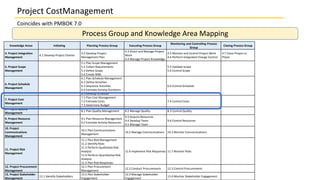
Process Group and Knowledge Area Mapping
Knowledge Areas Initiating Planning Process Group Executing Process Group
Monitoring and Controlling Process
Group
Closing Process Group
4. Project Integration
Management
4.1 Develop Project Charter
4.2 Develop Project
Management Plan
4.3 Direct and Manage Project
Work
4.4 Manage Project Knowledge
4.5 Monitor and Control Project Work
4.6 Perform Integrated Change Control
4.7 Close Project or
Phase
5. Project Scope
Management
5.1 Plan Scope Management
5.2 Collect Requirements
5.3 Define Scope
5.4 Create WBS
5.5 Validate Scope
5.6 Control Scope
6. Project Schedule
Management
6.1 Plan Schedule Management
6.2 Define Activities
6.3 Sequence Activities
6.4 Estimate Activity Durations
6.5 Develop Schedule
6.6 Control Schedule
7. Project Cost
Management
7.1 Plan Cost Management
7.2 Estimate Costs
7.3 Determine Budget
7.4 Control Costs
8. Project Quality
Management
8.1 Plan Quality Management 8.2 Manage Quality 8.3 Control Quality
9. Project Resource
Management
9.1 Plan Resource Management
9.2 Estimate Activity Resources
9.3 Acquire Resources
9.4 Develop Team
9.5 Manage Team
9.6 Control Resources
10. Project
Communications
Management
10.1 Plan Communications
Management
10.2 Manage Communications 10.3 Monitor Communications
11. Project Risk
Management
11.1 Plan Risk Management
11.2 Identify Risks
11.3 Perform Qualitative Risk
Analysis
11.4 Perform Quantitative Risk
Analysis
11.5 Plan Risk Responses
11.6 Implement Risk Responses 11.7 Monitor Risks
12. Project Procurement
Management
12.1 Plan Procurement
Management
12.2 Conduct Procurements 12.3 Control Procurements
13. Project Stakeholder
Management
13.1 Identify Stakeholders
13.2 Plan Stakeholder
Engagement
13.3 Manage Stakeholder
Engagement
13.4 Monitor Stakeholder Engagement
Project Cost Management
Coincides with PMBOK 7.0
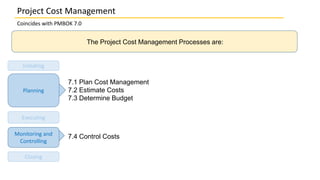
The Project Cost Management Processes are:
7.1 Plan Cost Management
7.2 Estimate Costs
7.3 Determine Budget
7.4 Control Costs
Planning
Monitoring and
Controlling
Executing
Initiating
Closing
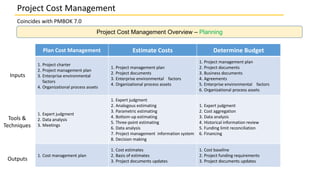
Project Cost Management Overview – Planning
Project Cost Management
Coincides with PMBOK 7.0
Plan Cost Management Estimate Costs Determine Budget
1. Project charter
2. Project management plan
3. Enterprise environmental
factors
4. Organizational process assets
1. Project management plan
2. Project documents
3. Enterprise environmental factors
4. Organizational process assets
1. Project management plan
2. Project documents
3. Business documents
4. Agreements
5. Enterprise environmental factors
6. Organizational process assets
1. Expert judgment
2. Data analysis
3. Meetings
1. Expert judgment
2. Analogous estimating
3. Parametric estimating
4. Bottom-up estimating
5. Three-point estimating
6. Data analysis
7. Project management information system
8. Decision making
1. Expert judgment
2. Cost aggregation
3. Data analysis
4. Historical information review
5. Funding limit reconciliation
6. Financing
1. Cost management plan
1. Cost estimates
2. Basis of estimates
3. Project documents updates
1. Cost baseline
2. Project funding requirements
3. Project documents updates
Inputs
Tools &
Techniques
Outputs
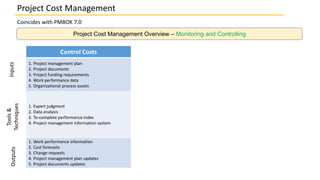
Project Cost Management Overview – Monitoring and Controlling
Project Cost Management
Coincides with PMBOK 7.0
Control Costs
1. Project management plan
2. Project documents
3. Project funding requirements
4. Work performance data
5. Organizational process assets
1. Expert judgment
2. Data analysis
3. To-complete performance index
4. Project management information system
1. Work performance information
2. Cost forecasts
3. Change requests
4. Project management plan updates
5. Project documents updates
InputsTools&
Techniques
Outputs
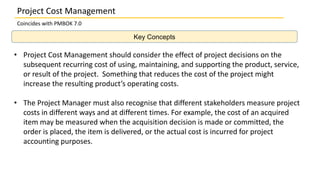
Key Concepts
Project Cost Management
Coincides with PMBOK 7.0
• Project Cost Management should consider the effect of project decisions on the
subsequent recurring cost of using, maintaining, and supporting the product, service,
or result of the project. Something that reduces the cost of the project might
increase the resulting product’s operating costs.
• The Project Manager must also recognise that different stakeholders measure project
costs in different ways and at different times. For example, the cost of an acquired
item may be measured when the acquisition decision is made or committed, the
order is placed, the item is delivered, or the actual cost is incurred for project
accounting purposes.
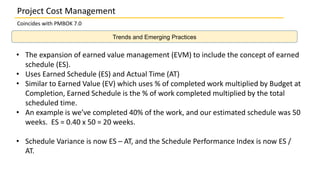
Trends and Emerging Practices
Project Cost Management
Coincides with PMBOK 7.0
• The expansion of earned value management (EVM) to include the concept of earned
schedule (ES).
• Uses Earned Schedule (ES) and Actual Time (AT)
• Similar to Earned Value (EV) which uses % of completed work multiplied by Budget at
Completion, Earned Schedule is the % of work completed multiplied by the total
scheduled time.
• An example is we’ve completed 40% of the work, and our estimated schedule was 50
weeks. ES = 0.40 x 50 = 20 weeks.
• Schedule Variance is now ES – AT, and the Schedule Performance Index is now ES /
AT.
Project Cost Management
Coincides with PMBOK 7.0
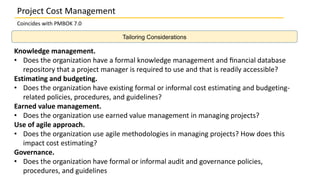
Knowledge management.
• Does the organization have a formal knowledge management and financial database
repository that a project manager is required to use and that is readily accessible?
Estimating and budgeting.
• Does the organization have existing formal or informal cost estimating and budgeting-
related policies, procedures, and guidelines?
Earned value management.
• Does the organization use earned value management in managing projects?
Use of agile approach.
• Does the organization use agile methodologies in managing projects? How does this
impact cost estimating?
Governance.
• Does the organization have formal or informal audit and governance policies,
procedures, and guidelines
Tailoring Considerations
Considerations for Agile or Adaptive Environments
Project Cost Management
Coincides with PMBOK 7.0
• Projects with high degrees of uncertainty or those where the scope is not yet
fully defined might use lightweight estimation methods.
• These can generate a fast, high-level forecast of project labour costs, which can
then be easily adjusted as changes arise.
• Detailed estimates are reserved for short-term planning horizons in a just-in-
time fashion.

7.0 Project Cost Management Overview

  • 1.
  • 2.
    Project CostManagement Coincides withPMBOK 7.0 Process Group and Knowledge Area Mapping Knowledge Areas Initiating Planning Process Group Executing Process Group Monitoring and Controlling Process Group Closing Process Group 4. Project Integration Management 4.1 Develop Project Charter 4.2 Develop Project Management Plan 4.3 Direct and Manage Project Work 4.4 Manage Project Knowledge 4.5 Monitor and Control Project Work 4.6 Perform Integrated Change Control 4.7 Close Project or Phase 5. Project Scope Management 5.1 Plan Scope Management 5.2 Collect Requirements 5.3 Define Scope 5.4 Create WBS 5.5 Validate Scope 5.6 Control Scope 6. Project Schedule Management 6.1 Plan Schedule Management 6.2 Define Activities 6.3 Sequence Activities 6.4 Estimate Activity Durations 6.5 Develop Schedule 6.6 Control Schedule 7. Project Cost Management 7.1 Plan Cost Management 7.2 Estimate Costs 7.3 Determine Budget 7.4 Control Costs 8. Project Quality Management 8.1 Plan Quality Management 8.2 Manage Quality 8.3 Control Quality 9. Project Resource Management 9.1 Plan Resource Management 9.2 Estimate Activity Resources 9.3 Acquire Resources 9.4 Develop Team 9.5 Manage Team 9.6 Control Resources 10. Project Communications Management 10.1 Plan Communications Management 10.2 Manage Communications 10.3 Monitor Communications 11. Project Risk Management 11.1 Plan Risk Management 11.2 Identify Risks 11.3 Perform Qualitative Risk Analysis 11.4 Perform Quantitative Risk Analysis 11.5 Plan Risk Responses 11.6 Implement Risk Responses 11.7 Monitor Risks 12. Project Procurement Management 12.1 Plan Procurement Management 12.2 Conduct Procurements 12.3 Control Procurements 13. Project Stakeholder Management 13.1 Identify Stakeholders 13.2 Plan Stakeholder Engagement 13.3 Manage Stakeholder Engagement 13.4 Monitor Stakeholder Engagement
  • 3.
    Project Cost Management Coincideswith PMBOK 7.0 The Project Cost Management Processes are: 7.1 Plan Cost Management 7.2 Estimate Costs 7.3 Determine Budget 7.4 Control Costs Planning Monitoring and Controlling Executing Initiating Closing
  • 4.
    Project Cost ManagementOverview – Planning Project Cost Management Coincides with PMBOK 7.0 Plan Cost Management Estimate Costs Determine Budget 1. Project charter 2. Project management plan 3. Enterprise environmental factors 4. Organizational process assets 1. Project management plan 2. Project documents 3. Enterprise environmental factors 4. Organizational process assets 1. Project management plan 2. Project documents 3. Business documents 4. Agreements 5. Enterprise environmental factors 6. Organizational process assets 1. Expert judgment 2. Data analysis 3. Meetings 1. Expert judgment 2. Analogous estimating 3. Parametric estimating 4. Bottom-up estimating 5. Three-point estimating 6. Data analysis 7. Project management information system 8. Decision making 1. Expert judgment 2. Cost aggregation 3. Data analysis 4. Historical information review 5. Funding limit reconciliation 6. Financing 1. Cost management plan 1. Cost estimates 2. Basis of estimates 3. Project documents updates 1. Cost baseline 2. Project funding requirements 3. Project documents updates Inputs Tools & Techniques Outputs
  • 5.
    Project Cost ManagementOverview – Monitoring and Controlling Project Cost Management Coincides with PMBOK 7.0 Control Costs 1. Project management plan 2. Project documents 3. Project funding requirements 4. Work performance data 5. Organizational process assets 1. Expert judgment 2. Data analysis 3. To-complete performance index 4. Project management information system 1. Work performance information 2. Cost forecasts 3. Change requests 4. Project management plan updates 5. Project documents updates InputsTools& Techniques Outputs
  • 6.
    Key Concepts Project CostManagement Coincides with PMBOK 7.0 • Project Cost Management should consider the effect of project decisions on the subsequent recurring cost of using, maintaining, and supporting the product, service, or result of the project. Something that reduces the cost of the project might increase the resulting product’s operating costs. • The Project Manager must also recognise that different stakeholders measure project costs in different ways and at different times. For example, the cost of an acquired item may be measured when the acquisition decision is made or committed, the order is placed, the item is delivered, or the actual cost is incurred for project accounting purposes.
  • 7.
    Trends and EmergingPractices Project Cost Management Coincides with PMBOK 7.0 • The expansion of earned value management (EVM) to include the concept of earned schedule (ES). • Uses Earned Schedule (ES) and Actual Time (AT) • Similar to Earned Value (EV) which uses % of completed work multiplied by Budget at Completion, Earned Schedule is the % of work completed multiplied by the total scheduled time. • An example is we’ve completed 40% of the work, and our estimated schedule was 50 weeks. ES = 0.40 x 50 = 20 weeks. • Schedule Variance is now ES – AT, and the Schedule Performance Index is now ES / AT.
  • 8.
    Project Cost Management Coincideswith PMBOK 7.0 Knowledge management. • Does the organization have a formal knowledge management and financial database repository that a project manager is required to use and that is readily accessible? Estimating and budgeting. • Does the organization have existing formal or informal cost estimating and budgeting- related policies, procedures, and guidelines? Earned value management. • Does the organization use earned value management in managing projects? Use of agile approach. • Does the organization use agile methodologies in managing projects? How does this impact cost estimating? Governance. • Does the organization have formal or informal audit and governance policies, procedures, and guidelines Tailoring Considerations
  • 9.
    Considerations for Agileor Adaptive Environments Project Cost Management Coincides with PMBOK 7.0 • Projects with high degrees of uncertainty or those where the scope is not yet fully defined might use lightweight estimation methods. • These can generate a fast, high-level forecast of project labour costs, which can then be easily adjusted as changes arise. • Detailed estimates are reserved for short-term planning horizons in a just-in- time fashion.

Editor's Notes

  • #4 The process of defining how the project costs will be estimated, budgeted, managed, monitored, and controlled. The process of developing an approximation of the monetary resources needed to complete project work. The process of aggregating the estimated costs of individual activities or work packages to establish an authorized cost baseline. The process of monitoring the status of the project to update the project costs and manage changes to the cost baseline.