Changing Student/Employer Attitudes and Requirements at the Placement Interface – An opportunity for discussion Ray Wallace,  School of Science & Technology, Nottingham Trent University
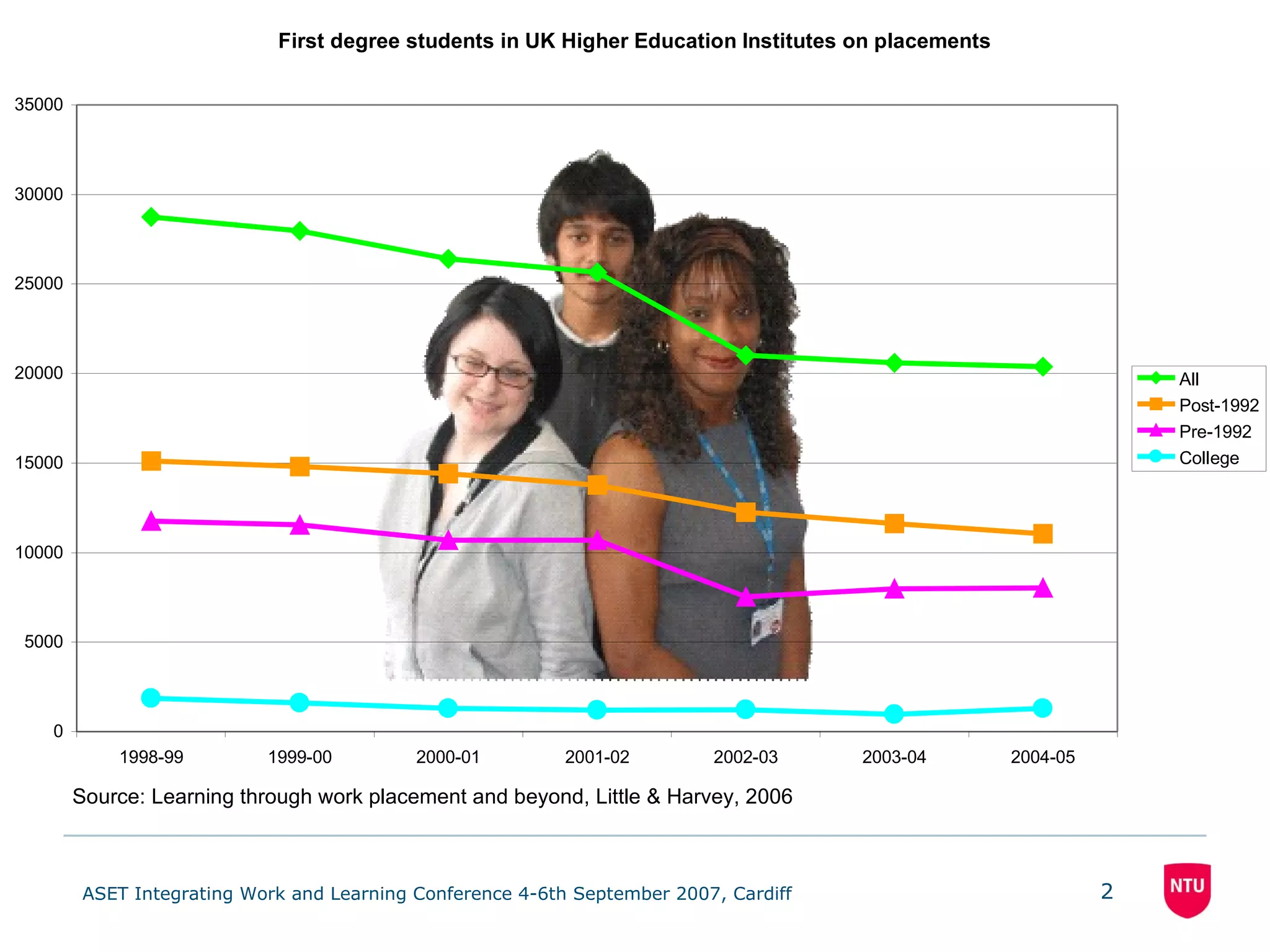
Source: Learning through work placement and beyond, Little & Harvey, 2006
Two interesting reports published recently Learning through work placements and beyond, Brenda Little & Lee Harvey, July 2006 A degree of concern?  UK first degrees in science, technology and mathematics, The Royal Society, October 2006
The first publication Investigates students’ perceptions of learning from placements Explores how values and ethical positions are developed on placement Investigates the extent to which students  try to transfer and build on such learning in subsequent stages of the taught curriculum
The second publication Describes, details  and incisively discusses a whole raft of topics and issues relating to first degrees in Science, Technology & Mathematics in the UK Pertinent to the sandwich training arena it examines STM first degrees : skills, knowledge and experience and what STM first degree graduates do
However what appears not to have been examined to any great degree with one or two notable exceptions are: The engagement of students with the placement process in the first place The expectations of employers that placement students will be literate, communicative have good subject knowledge etc The assumption that, for instance, with science in particular  but equally with students of other disciplines such as law, business etc that they will naturally embark upon a subject discipline based placement
In this session I would like to examine these 3 areas, calling upon delegates experiences to try to tease out the critical factors that affect: Student engagement Employer expectations Choice of placement field
Activities Split into 3 groups to brainstorm/discuss the issues 10 minutes Come together to prepare a bullet list of the key issues raised 15 minutes Discuss whether we want to take our pooled findings forward 5 minutes
Points to stimulate discussion –  student engagement with the placement process Nottingham Trent University – Some figures from 2004 DLHE data Over 112 graduates returned to graduate roles with their placement companies 2.4% placement students were employed in non-graduate level jobs 44.6% of non-placement students were employed in non-graduate level jobs.
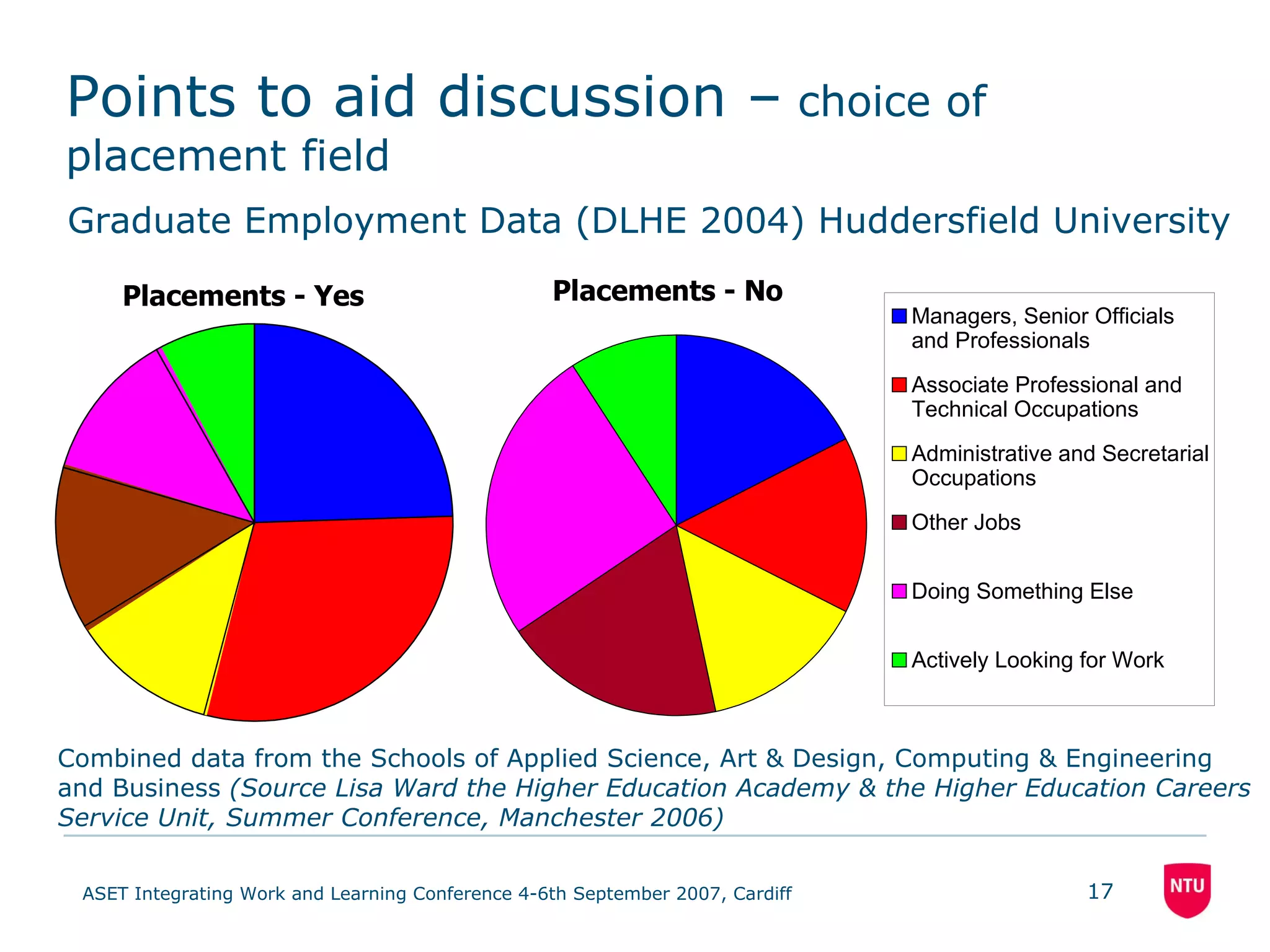
Points to stimulate discussion –  student engagement with the placement process Huddersfield University – Data from Lisa Ward, the Higher Education Academy & the Higher Education Careers Service Unit, Summer Conference, Manchester 2006 Fewer than 50% of students enrolled on sandwich courses are taking a placement year Students who do a placement are more likely to: Gain a managerial, professional or senior official post Gain an associate professional or technical post Get any job
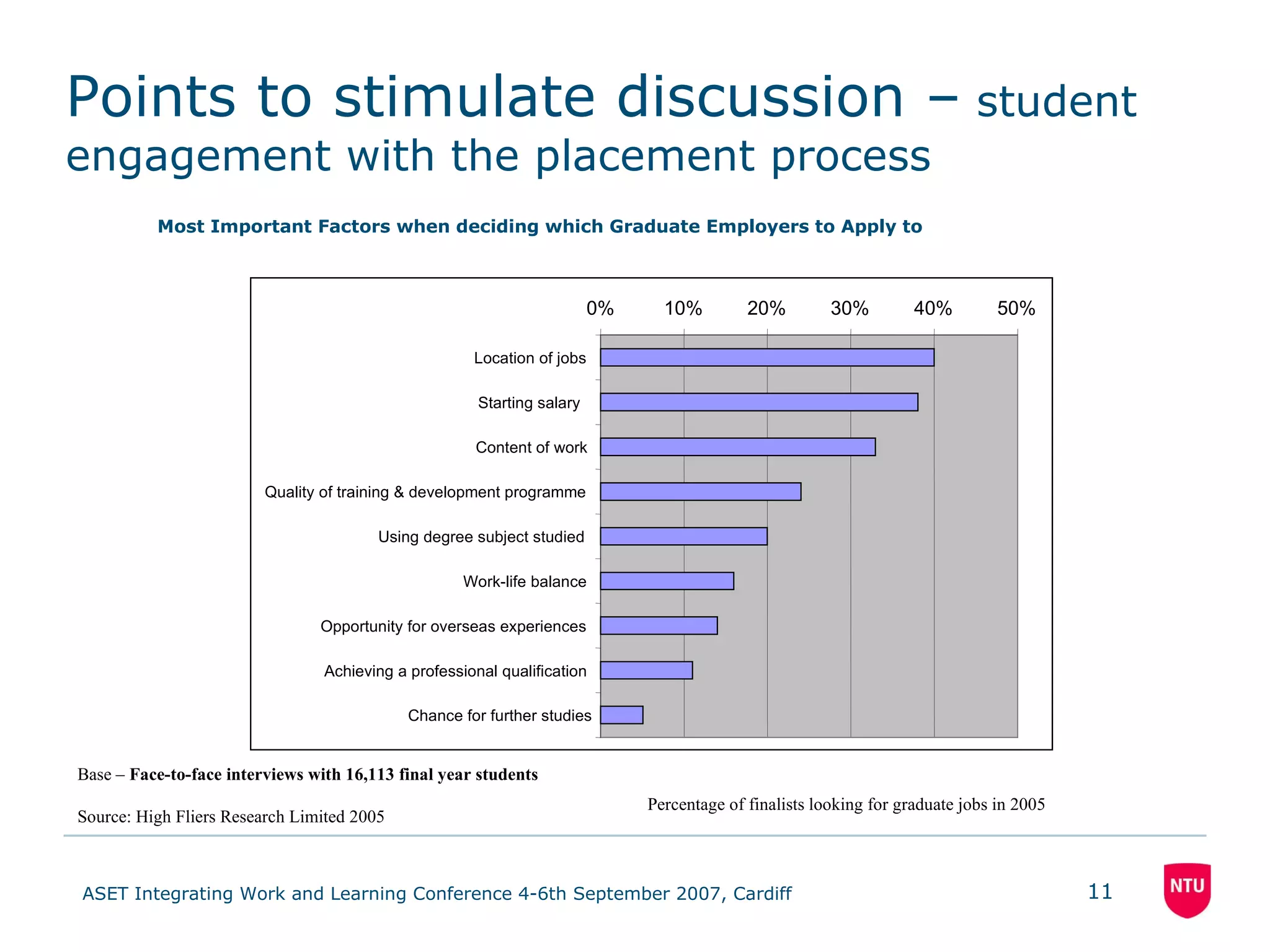
Points to stimulate discussion –  student engagement with the placement process Most Important Factors when deciding which Graduate Employers to Apply to Percentage of finalists looking for graduate jobs in 2005 Base –  Face-to-face interviews with 16,113 final year students Source: High Fliers Research Limited 2005 0% 10% 20% 30% 40% 50% Location of jobs Starting salary  Content of work Quality of training & development programme Using degree subject studied Work-life balance Opportunity for overseas experiences Achieving a professional qualification Chance for further studies
Points to aid discussion –  employer expectations
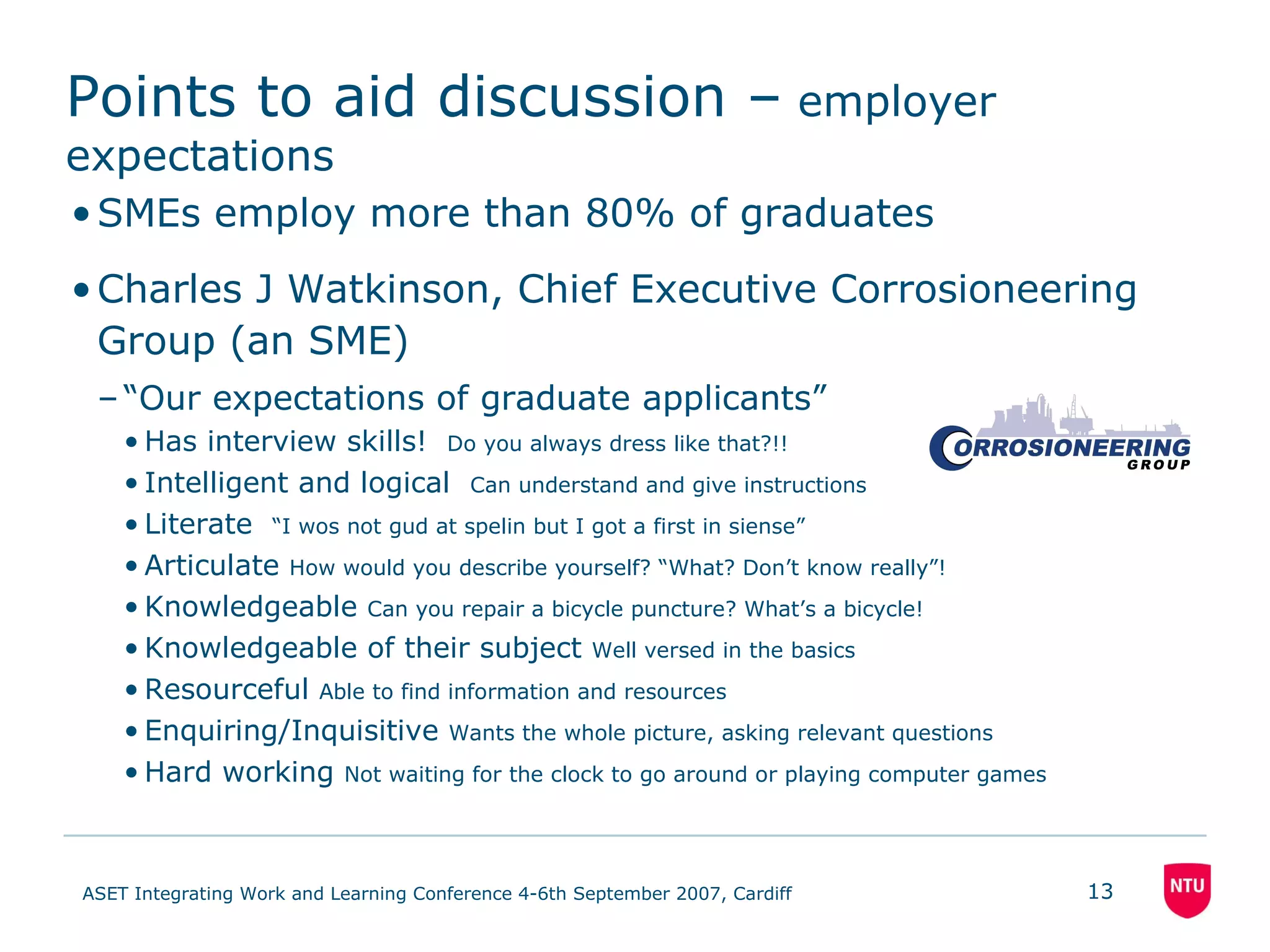
Points to aid discussion –  employer expectations SMEs employ more than 80% of graduates Charles J Watkinson, Chief Executive Corrosioneering Group (an SME) “ Our expectations of graduate applicants” Has interview skills!  Do you always dress like that?!! Intelligent and logical  Can understand and give instructions Literate  “I wos not gud at spelin but I got a first in siense” Articulate  How would you describe yourself? “What? Don’t know really”! Knowledgeable  Can you repair a bicycle puncture? What’s a bicycle! Knowledgeable of their subject  Well versed in the basics Resourceful  Able to find information and resources Enquiring/Inquisitive  Wants the whole picture, asking relevant questions Hard working  Not waiting for the clock to go around or playing computer games
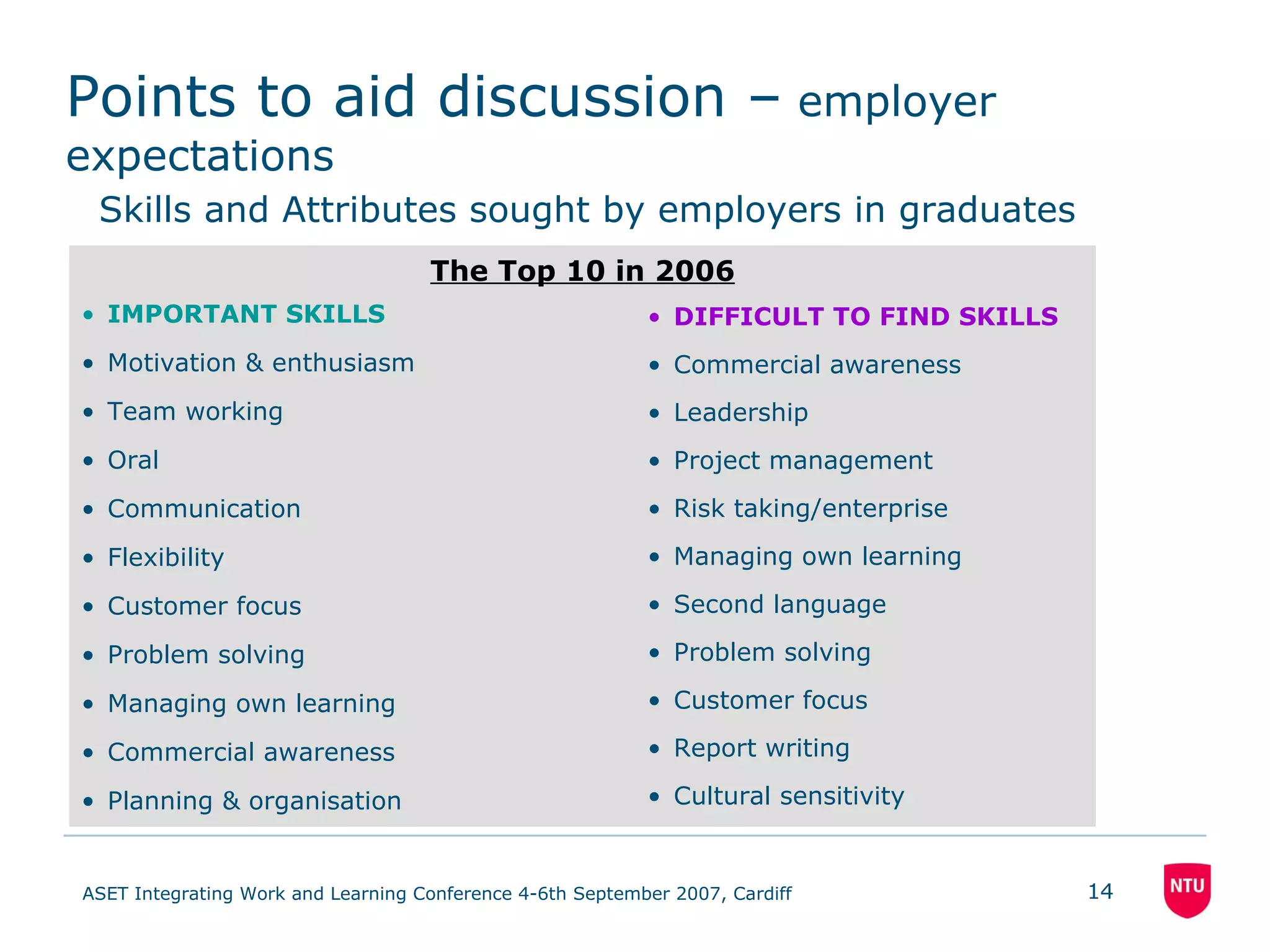
Points to aid discussion –  employer expectations IMPORTANT SKILLS Motivation & enthusiasm Team working Oral Communication Flexibility Customer focus Problem solving Managing own learning Commercial awareness Planning & organisation The Top 10 in 2006 Skills and Attributes sought by employers in graduates   DIFFICULT TO FIND SKILLS Commercial awareness Leadership Project management Risk taking/enterprise Managing own learning Second language Problem solving Customer focus Report writing Cultural sensitivity
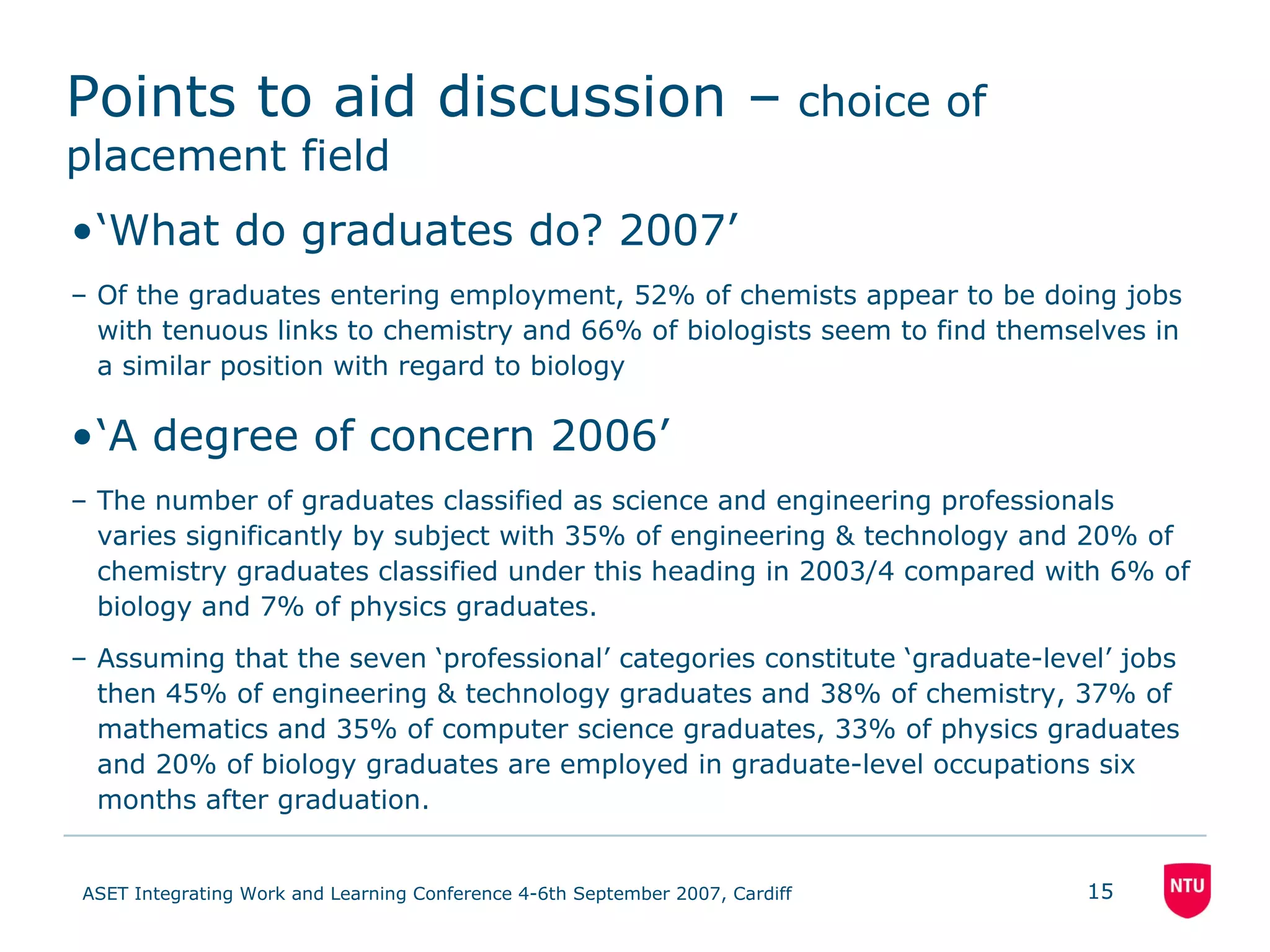
Points to aid discussion –  choice of placement field ‘ What do graduates do? 2007’ Of the graduates entering employment, 52% of chemists appear to be doing jobs with tenuous links to chemistry and 66% of biologists seem to find themselves in a similar position with regard to biology ‘ A degree of concern 2006’ The number of graduates classified as science and engineering professionals varies significantly by subject with 35% of engineering & technology and 20% of chemistry graduates classified under this heading in 2003/4 compared with 6% of biology and 7% of physics graduates. Assuming that the seven ‘professional’ categories constitute ‘graduate-level’ jobs then 45% of engineering & technology graduates and 38% of chemistry, 37% of mathematics and 35% of computer science graduates, 33% of physics graduates and 20% of biology graduates are employed in graduate-level occupations six months after graduation.
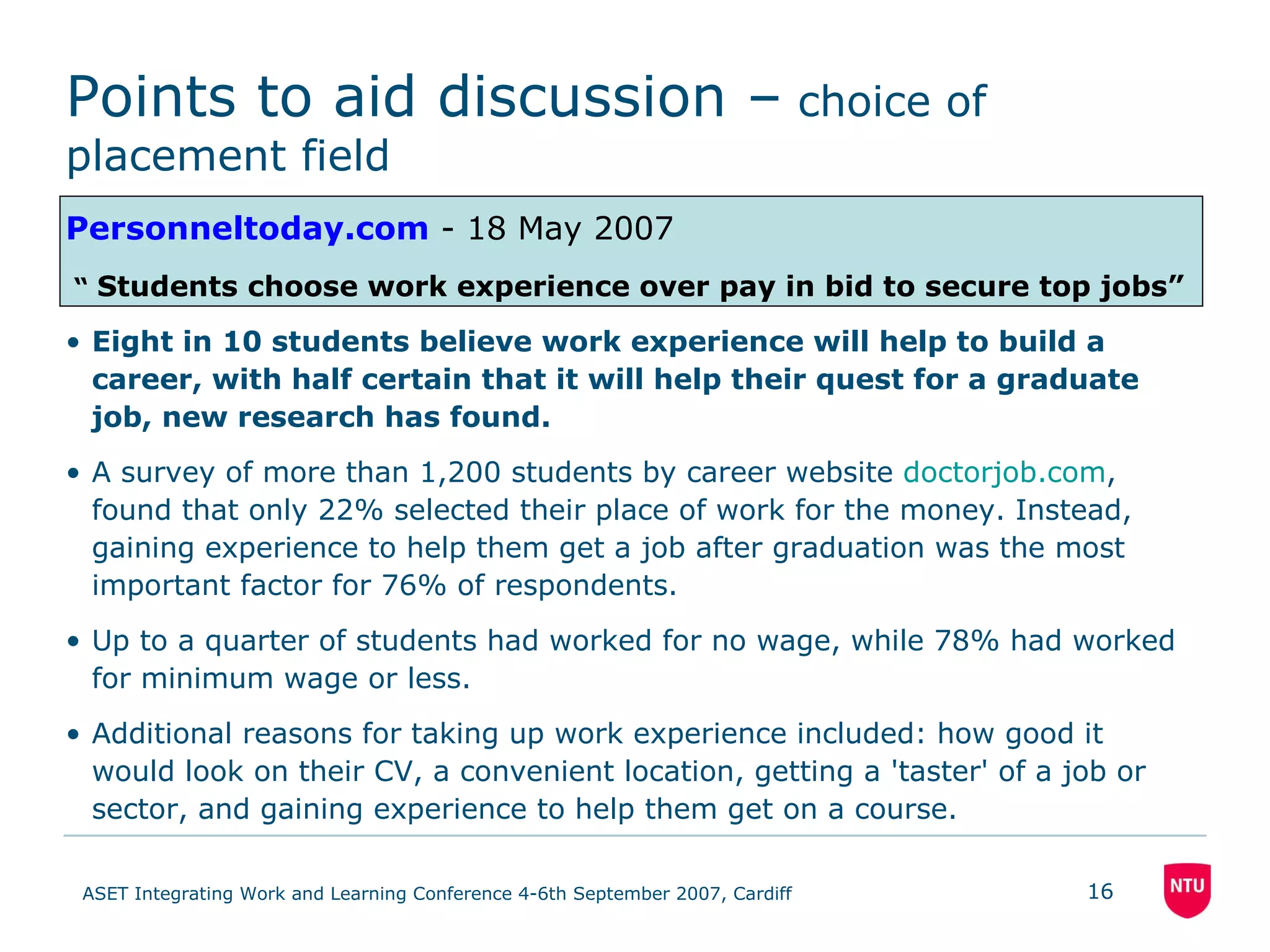
Points to aid discussion –  choice of placement field Personneltoday.com   - 18 May 2007  “  Students choose work experience over pay in bid to secure top jobs” Eight in 10 students believe work experience will help to build a career, with half certain that it will help their quest for a graduate job, new research has found. A survey of more than 1,200 students by career website  doctorjob.com , found that only 22% selected their place of work for the money. Instead, gaining experience to help them get a job after graduation was the most important factor for 76% of respondents. Up to a quarter of students had worked for no wage, while 78% had worked for minimum wage or less. Additional reasons for taking up work experience included: how good it would look on their CV, a convenient location, getting a 'taster' of a job or sector, and gaining experience to help them get on a course.
Points to aid discussion –  choice of placement field Placements - No Placements - Yes Combined data from the Schools of Applied Science, Art & Design, Computing & Engineering and Business  (Source Lisa Ward the Higher Education Academy & the Higher Education Careers Service Unit, Summer Conference, Manchester 2006) Graduate Employment Data (DLHE 2004) Huddersfield University
Thank you for your attention today I hope that you have enjoyed the workshop [email_address]

Changing Student Employer Attitudes

  • 1.
    Changing Student/Employer Attitudesand Requirements at the Placement Interface – An opportunity for discussion Ray Wallace, School of Science & Technology, Nottingham Trent University
  • 2.
    Source: Learning throughwork placement and beyond, Little & Harvey, 2006
  • 3.
    Two interesting reportspublished recently Learning through work placements and beyond, Brenda Little & Lee Harvey, July 2006 A degree of concern? UK first degrees in science, technology and mathematics, The Royal Society, October 2006
  • 4.
    The first publicationInvestigates students’ perceptions of learning from placements Explores how values and ethical positions are developed on placement Investigates the extent to which students try to transfer and build on such learning in subsequent stages of the taught curriculum
  • 5.
    The second publicationDescribes, details and incisively discusses a whole raft of topics and issues relating to first degrees in Science, Technology & Mathematics in the UK Pertinent to the sandwich training arena it examines STM first degrees : skills, knowledge and experience and what STM first degree graduates do
  • 6.
    However what appearsnot to have been examined to any great degree with one or two notable exceptions are: The engagement of students with the placement process in the first place The expectations of employers that placement students will be literate, communicative have good subject knowledge etc The assumption that, for instance, with science in particular but equally with students of other disciplines such as law, business etc that they will naturally embark upon a subject discipline based placement
  • 7.
    In this sessionI would like to examine these 3 areas, calling upon delegates experiences to try to tease out the critical factors that affect: Student engagement Employer expectations Choice of placement field
  • 8.
    Activities Split into3 groups to brainstorm/discuss the issues 10 minutes Come together to prepare a bullet list of the key issues raised 15 minutes Discuss whether we want to take our pooled findings forward 5 minutes
  • 9.
    Points to stimulatediscussion – student engagement with the placement process Nottingham Trent University – Some figures from 2004 DLHE data Over 112 graduates returned to graduate roles with their placement companies 2.4% placement students were employed in non-graduate level jobs 44.6% of non-placement students were employed in non-graduate level jobs.
  • 10.
    Points to stimulatediscussion – student engagement with the placement process Huddersfield University – Data from Lisa Ward, the Higher Education Academy & the Higher Education Careers Service Unit, Summer Conference, Manchester 2006 Fewer than 50% of students enrolled on sandwich courses are taking a placement year Students who do a placement are more likely to: Gain a managerial, professional or senior official post Gain an associate professional or technical post Get any job
  • 11.
    Points to stimulatediscussion – student engagement with the placement process Most Important Factors when deciding which Graduate Employers to Apply to Percentage of finalists looking for graduate jobs in 2005 Base – Face-to-face interviews with 16,113 final year students Source: High Fliers Research Limited 2005 0% 10% 20% 30% 40% 50% Location of jobs Starting salary Content of work Quality of training & development programme Using degree subject studied Work-life balance Opportunity for overseas experiences Achieving a professional qualification Chance for further studies
  • 12.
    Points to aiddiscussion – employer expectations
  • 13.
    Points to aiddiscussion – employer expectations SMEs employ more than 80% of graduates Charles J Watkinson, Chief Executive Corrosioneering Group (an SME) “ Our expectations of graduate applicants” Has interview skills! Do you always dress like that?!! Intelligent and logical Can understand and give instructions Literate “I wos not gud at spelin but I got a first in siense” Articulate How would you describe yourself? “What? Don’t know really”! Knowledgeable Can you repair a bicycle puncture? What’s a bicycle! Knowledgeable of their subject Well versed in the basics Resourceful Able to find information and resources Enquiring/Inquisitive Wants the whole picture, asking relevant questions Hard working Not waiting for the clock to go around or playing computer games
  • 14.
    Points to aiddiscussion – employer expectations IMPORTANT SKILLS Motivation & enthusiasm Team working Oral Communication Flexibility Customer focus Problem solving Managing own learning Commercial awareness Planning & organisation The Top 10 in 2006 Skills and Attributes sought by employers in graduates DIFFICULT TO FIND SKILLS Commercial awareness Leadership Project management Risk taking/enterprise Managing own learning Second language Problem solving Customer focus Report writing Cultural sensitivity
  • 15.
    Points to aiddiscussion – choice of placement field ‘ What do graduates do? 2007’ Of the graduates entering employment, 52% of chemists appear to be doing jobs with tenuous links to chemistry and 66% of biologists seem to find themselves in a similar position with regard to biology ‘ A degree of concern 2006’ The number of graduates classified as science and engineering professionals varies significantly by subject with 35% of engineering & technology and 20% of chemistry graduates classified under this heading in 2003/4 compared with 6% of biology and 7% of physics graduates. Assuming that the seven ‘professional’ categories constitute ‘graduate-level’ jobs then 45% of engineering & technology graduates and 38% of chemistry, 37% of mathematics and 35% of computer science graduates, 33% of physics graduates and 20% of biology graduates are employed in graduate-level occupations six months after graduation.
  • 16.
    Points to aiddiscussion – choice of placement field Personneltoday.com - 18 May 2007 “ Students choose work experience over pay in bid to secure top jobs” Eight in 10 students believe work experience will help to build a career, with half certain that it will help their quest for a graduate job, new research has found. A survey of more than 1,200 students by career website doctorjob.com , found that only 22% selected their place of work for the money. Instead, gaining experience to help them get a job after graduation was the most important factor for 76% of respondents. Up to a quarter of students had worked for no wage, while 78% had worked for minimum wage or less. Additional reasons for taking up work experience included: how good it would look on their CV, a convenient location, getting a 'taster' of a job or sector, and gaining experience to help them get on a course.
  • 17.
    Points to aiddiscussion – choice of placement field Placements - No Placements - Yes Combined data from the Schools of Applied Science, Art & Design, Computing & Engineering and Business (Source Lisa Ward the Higher Education Academy & the Higher Education Careers Service Unit, Summer Conference, Manchester 2006) Graduate Employment Data (DLHE 2004) Huddersfield University
  • 18.
    Thank you foryour attention today I hope that you have enjoyed the workshop [email_address]