Careers
Careers Beyond Academia

     Dr. Tracy Bussoli
     Careers Service
Careers
What will we cover?
• Why......do you need to
  consider careers outside
  academia?

• What……….else can you do?

• How……….do you go about
  securing a job outside
  academia?
Careers
       Why?

Why consider jobs outside
      academia?
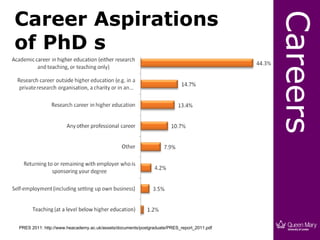
Career Aspirations


                                                                                           Careers
of PhD s


PRES 2011: http://www.heacademy.ac.uk/assets/documents/postgraduate/PRES_report_2011.pdf
Careers
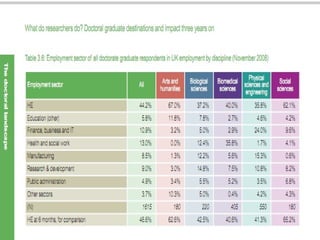
Questions…….

• What percentage of PhDs are working
  outside of academia three years after
  they have completed their PhD?

• Why is this the case?
Careers
Careers
Reasons…
• Competitive/saturated academic
  job market. The standard of
  research/publications required
  to secure lectureships is high!

• Academia does not suit
  everyone
Careers
        What?
What other jobs can you do?
Careers
•Teaching schools/colleges
                                                                  •Publishing books/journals
                                                                  •Project Manager
                                            •Research Institute   •Journalism
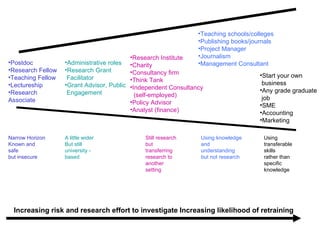
•Postdoc           •Administrative roles    •Charity              •Management Consultant
•Research Fellow   •Research Grant          •Consultancy firm
•Teaching Fellow    Facilitator                                                        •Start your own
                                            •Think Tank
•Lectureship       •Grant Advisor, Public                                               business
                                            •Independent Consultancy                   •Any grade graduate
•Research           Engagement                (self-employed)
Associate                                                                               job
                                            •Policy Advisor                            •SME
                                            •Analyst (finance)                         •Accounting
                                                                                       •Marketing

Narrow Horizon     A little wider                Still research    Using knowledge      Using
Known and          But still                     but               and                  transferable
safe               university -                  transferring      understanding        skills
but insecure       based                         research to       but not research     rather than
                                                 another                                specific
                                                 setting                                knowledge


  Increasing risk and research effort to investigate Increasing likelihood of retraining
Careers
         How?

Do I apply and secure a job
    beyond academia?
Careers
Research
Your Career Options and The Labour Market


• Time to research different
  jobs/sectors

• Making a transition from the academic
  sector to another sector/role is
  challenging and takes longer than you
  think. Find out how people have made
  the transition.
Doctoral Transitions:


                                                                                             Careers
  Careers Beyond Academia
    for STEM researchers
                       17.30-19.30
                   Thursday 22 March
                 Francis Bancroft FB 1.15

This is a panel session in which five QMUL PhD alumni give 15
    minute talks about how they made the transition from
  academia into roles beyond academic research. Speakers
 have a range of roles including Business Development,
      Management Consultancy, Medical Writing and
              Modelling for the Environment.

 To book please visit The Learning Institute Course Booking
System http://www.esdcourses.org.uk/userlistcourse.php and
                  enter the code RC301.

Follow us on www.Facebook.com/qmcareers or www.twitter.com/qmcareers to find out about all
                                      our events
How you are perceived by


                                              Careers
employers is everything

To make a successful non-academic
  application, you must:

• Understand how recruiters see PhDs
• Learn to identify and articulate your
  relevant strengths/skills/expertise using
  their language.
Careers
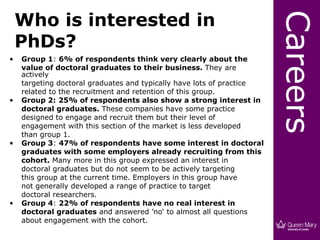
Who is interested in


                                                                       Careers
    PhDs?
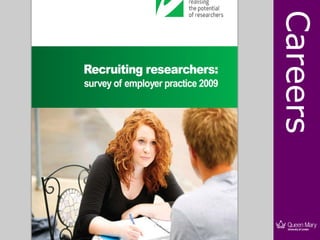
•   Group 1: 6% of respondents think very clearly about the
    value of doctoral graduates to their business. They are
    actively
    targeting doctoral graduates and typically have lots of practice
    related to the recruitment and retention of this group.
•   Group 2: 25% of respondents also show a strong interest in
    doctoral graduates. These companies have some practice
    designed to engage and recruit them but their level of
    engagement with this section of the market is less developed
    than group 1.
•   Group 3: 47% of respondents have some interest in doctoral
    graduates with some employers already recruiting from this
    cohort. Many more in this group expressed an interest in
    doctoral graduates but do not seem to be actively targeting
    this group at the current time. Employers in this group have
    not generally developed a range of practice to target
    doctoral researchers.
•   Group 4: 22% of respondents have no real interest in
    doctoral graduates and answered ’no‘ to almost all questions
    about engagement with the cohort.
Careers
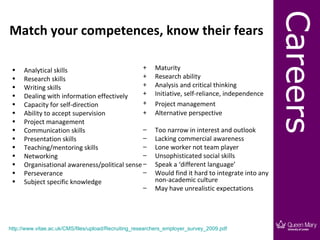
Match your competences, know their fears

 •    Analytical skills                        +          Maturity
 •    Research skills                          +          Research ability
 •    Writing skills                           +          Analysis and critical thinking
 •    Dealing with information effectively     +          Initiative, self-reliance, independence
 •    Capacity for self-direction              +          Project management
 •    Ability to accept supervision            +          Alternative perspective
 •    Project management
 •    Communication skills                     –          Too narrow in interest and outlook
 •    Presentation skills                      –          Lacking commercial awareness
 •    Teaching/mentoring skills                –          Lone worker not team player
 •    Networking                               –          Unsophisticated social skills
 •    Organisational awareness/political sense –          Speak a ‘different language’
 •    Perseverance                             –          Would find it hard to integrate into any
 •    Subject specific knowledge                          non-academic culture
                                               –          May have unrealistic expectations


http://www.vitae.ac.uk/CMS/files/upload/Recruiting_researchers_employer_survey_2009.pdf
Careers
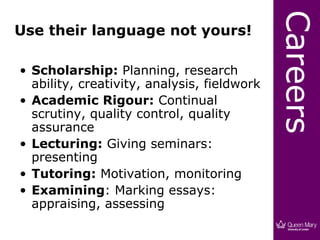
Use their language not yours!

• Scholarship: Planning, research
  ability, creativity, analysis, fieldwork
• Academic Rigour: Continual
  scrutiny, quality control, quality
  assurance
• Lecturing: Giving seminars:
  presenting
• Tutoring: Motivation, monitoring
• Examining: Marking essays:
  appraising, assessing
Careers
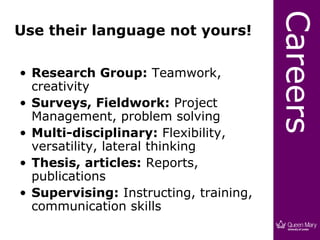
Use their language not yours!

• Research Group: Teamwork,
  creativity
• Surveys, Fieldwork: Project
  Management, problem solving
• Multi-disciplinary: Flexibility,
  versatility, lateral thinking
• Thesis, articles: Reports,
  publications
• Supervising: Instructing, training,
  communication skills
Careers
Identify and
articulate your skills
Careers
Careers
Careers
Job Hunting
• Newspapers – national,
  international
• Specialist magazines,
• Journals and trade press
• Press releases and news articles
  – hidden opportunities
• Linked In
Careers
Job Hunting……
• Speculative applications
• Your network
• Set up your own business:
   – research, consultancy, policy development, policy
     implementation
   – The benefit of a PhD is that you are an expert!
   – Consider what you offer and design your ideal
     product/role/service from there
• Dream Job:
   – How would it make you feel?
   – Plan a variety of routes to get there
   – What risks might you need to take?
Careers
Networking
• The power of word of mouth
  – Get your requirements into circulation
  – Promote yourself through others
  – Get opportunities and insight

• Map your network
  – Do you know who your contacts know?

• Maintain your network
  – Find a premise for reintroduction
  – Be strategic, organised, outward-looking
Careers
Applications……..
Careers
Basic Principles
• CVs are generally shorter
   – no longer than 1-2 pages for
     corporate role
   – no longer than 3 for research-related
• Emphasis on cover letter, especially for
  speculative applications.
• You are more than a PhD student now
• Relevant information and evidence
Careers
The non-academic CV
• Know the priorities of the recruiter
• Work experience and relevant skills are
  as important as education
• Choose information well (e.g. skills,
  relevant experience) to defuse
  prejudice about being ‘too academic’
• ‘Professional paragraph’ to open CV
Careers
Layout
• Education first, or work experience?

• Work experience can be split – Relevant,
  Other

• In summarising jobs or roles, highlight
  functions relevant to the new post with bullet
  points
Careers
Covering Letters: ‘My Shoes’
• Why do I want to work in this sector?
• Why would I do well in this job/career?
• What specifically do I offer in terms of
  skills and experience and how can I use
  them?
• What interests me about this particular
  role?
• What challenges in the job appeal to
  me?
Covering Letters: ‘Their


                                           Careers
Shoes’
With reference to the job specification:
• What evidence do I have of my
  suitability?
• What value can I (as a PhD) add?
• How can I (subtly) reassure them that
  my academic experience will be an
  asset not a hindrance?
• How will their business be enhanced by
  my contribution?
Careers
Speculative Applications
• Particularly suitable for small or highly specialised
  sectors
• Research the company well first – know them and
  what you can offer that they don’t have
• Introductory email or cover letter plus CV
• More emphasis on the cover letter to sell you
• Think of the reader:
   –   Why do you really want to work for them?
   –   What qualities and experience do they want?
   –   What specialism can you offer?
   –   What unique advantages do you bring them?
   –   In what role would you be an asset to them?
   –   Reference specific elements/outcomes of their work
Careers
Action Plan
• Start now…don’t put it off!

• Pursuing a career (academic or not) is an
  active process. Ensure that you have some
  plans....they can change!

• Look at some of the gaps in your CV and
  start to put together a plan for how to
  bridge them….consider internships!

• Keep options open and have a good spread
  of activities.
Careers Support for


                                             Careers
PhDs
• One to one advice for academic and
  non-academic careers (call Careers 8533)
  – CVs, cover letters, application forms
  – Interviews, presentations, assessment
    centres
  – Career planning and job search

• Careers Seminars, Workshops and
  Events

• Careers Blog
  http://qmresearcher.wordpress.com/
Careers

Careers beyond academia 14.3.2012

  • 1.
    Careers Careers Beyond Academia Dr. Tracy Bussoli Careers Service
  • 2.
    Careers What will wecover? • Why......do you need to consider careers outside academia? • What……….else can you do? • How……….do you go about securing a job outside academia?
  • 3.
    Careers Why? Why consider jobs outside academia?
  • 4.
    Career Aspirations Careers of PhD s PRES 2011: http://www.heacademy.ac.uk/assets/documents/postgraduate/PRES_report_2011.pdf
  • 5.
    Careers Questions……. • What percentageof PhDs are working outside of academia three years after they have completed their PhD? • Why is this the case?
  • 6.
  • 7.
    Careers Reasons… • Competitive/saturated academic job market. The standard of research/publications required to secure lectureships is high! • Academia does not suit everyone
  • 8.
    Careers What? What other jobs can you do?
  • 9.
  • 10.
    •Teaching schools/colleges •Publishing books/journals •Project Manager •Research Institute •Journalism •Postdoc •Administrative roles •Charity •Management Consultant •Research Fellow •Research Grant •Consultancy firm •Teaching Fellow Facilitator •Start your own •Think Tank •Lectureship •Grant Advisor, Public business •Independent Consultancy •Any grade graduate •Research Engagement (self-employed) Associate job •Policy Advisor •SME •Analyst (finance) •Accounting •Marketing Narrow Horizon A little wider Still research Using knowledge Using Known and But still but and transferable safe university - transferring understanding skills but insecure based research to but not research rather than another specific setting knowledge Increasing risk and research effort to investigate Increasing likelihood of retraining
  • 16.
    Careers How? Do I apply and secure a job beyond academia?
  • 17.
    Careers Research Your Career Optionsand The Labour Market • Time to research different jobs/sectors • Making a transition from the academic sector to another sector/role is challenging and takes longer than you think. Find out how people have made the transition.
  • 18.
    Doctoral Transitions: Careers Careers Beyond Academia for STEM researchers 17.30-19.30 Thursday 22 March Francis Bancroft FB 1.15 This is a panel session in which five QMUL PhD alumni give 15 minute talks about how they made the transition from academia into roles beyond academic research. Speakers have a range of roles including Business Development, Management Consultancy, Medical Writing and Modelling for the Environment. To book please visit The Learning Institute Course Booking System http://www.esdcourses.org.uk/userlistcourse.php and enter the code RC301. Follow us on www.Facebook.com/qmcareers or www.twitter.com/qmcareers to find out about all our events
  • 19.
    How you areperceived by Careers employers is everything To make a successful non-academic application, you must: • Understand how recruiters see PhDs • Learn to identify and articulate your relevant strengths/skills/expertise using their language.
  • 20.
  • 21.
    Who is interestedin Careers PhDs? • Group 1: 6% of respondents think very clearly about the value of doctoral graduates to their business. They are actively targeting doctoral graduates and typically have lots of practice related to the recruitment and retention of this group. • Group 2: 25% of respondents also show a strong interest in doctoral graduates. These companies have some practice designed to engage and recruit them but their level of engagement with this section of the market is less developed than group 1. • Group 3: 47% of respondents have some interest in doctoral graduates with some employers already recruiting from this cohort. Many more in this group expressed an interest in doctoral graduates but do not seem to be actively targeting this group at the current time. Employers in this group have not generally developed a range of practice to target doctoral researchers. • Group 4: 22% of respondents have no real interest in doctoral graduates and answered ’no‘ to almost all questions about engagement with the cohort.
  • 22.
    Careers Match your competences,know their fears • Analytical skills + Maturity • Research skills + Research ability • Writing skills + Analysis and critical thinking • Dealing with information effectively + Initiative, self-reliance, independence • Capacity for self-direction + Project management • Ability to accept supervision + Alternative perspective • Project management • Communication skills – Too narrow in interest and outlook • Presentation skills – Lacking commercial awareness • Teaching/mentoring skills – Lone worker not team player • Networking – Unsophisticated social skills • Organisational awareness/political sense – Speak a ‘different language’ • Perseverance – Would find it hard to integrate into any • Subject specific knowledge non-academic culture – May have unrealistic expectations http://www.vitae.ac.uk/CMS/files/upload/Recruiting_researchers_employer_survey_2009.pdf
  • 23.
    Careers Use their languagenot yours! • Scholarship: Planning, research ability, creativity, analysis, fieldwork • Academic Rigour: Continual scrutiny, quality control, quality assurance • Lecturing: Giving seminars: presenting • Tutoring: Motivation, monitoring • Examining: Marking essays: appraising, assessing
  • 24.
    Careers Use their languagenot yours! • Research Group: Teamwork, creativity • Surveys, Fieldwork: Project Management, problem solving • Multi-disciplinary: Flexibility, versatility, lateral thinking • Thesis, articles: Reports, publications • Supervising: Instructing, training, communication skills
  • 25.
  • 26.
  • 27.
  • 28.
    Careers Job Hunting • Newspapers– national, international • Specialist magazines, • Journals and trade press • Press releases and news articles – hidden opportunities • Linked In
  • 29.
    Careers Job Hunting…… • Speculativeapplications • Your network • Set up your own business: – research, consultancy, policy development, policy implementation – The benefit of a PhD is that you are an expert! – Consider what you offer and design your ideal product/role/service from there • Dream Job: – How would it make you feel? – Plan a variety of routes to get there – What risks might you need to take?
  • 30.
    Careers Networking • The powerof word of mouth – Get your requirements into circulation – Promote yourself through others – Get opportunities and insight • Map your network – Do you know who your contacts know? • Maintain your network – Find a premise for reintroduction – Be strategic, organised, outward-looking
  • 31.
  • 32.
    Careers Basic Principles • CVsare generally shorter – no longer than 1-2 pages for corporate role – no longer than 3 for research-related • Emphasis on cover letter, especially for speculative applications. • You are more than a PhD student now • Relevant information and evidence
  • 33.
    Careers The non-academic CV •Know the priorities of the recruiter • Work experience and relevant skills are as important as education • Choose information well (e.g. skills, relevant experience) to defuse prejudice about being ‘too academic’ • ‘Professional paragraph’ to open CV
  • 34.
    Careers Layout • Education first,or work experience? • Work experience can be split – Relevant, Other • In summarising jobs or roles, highlight functions relevant to the new post with bullet points
  • 35.
    Careers Covering Letters: ‘MyShoes’ • Why do I want to work in this sector? • Why would I do well in this job/career? • What specifically do I offer in terms of skills and experience and how can I use them? • What interests me about this particular role? • What challenges in the job appeal to me?
  • 36.
    Covering Letters: ‘Their Careers Shoes’ With reference to the job specification: • What evidence do I have of my suitability? • What value can I (as a PhD) add? • How can I (subtly) reassure them that my academic experience will be an asset not a hindrance? • How will their business be enhanced by my contribution?
  • 37.
    Careers Speculative Applications • Particularlysuitable for small or highly specialised sectors • Research the company well first – know them and what you can offer that they don’t have • Introductory email or cover letter plus CV • More emphasis on the cover letter to sell you • Think of the reader: – Why do you really want to work for them? – What qualities and experience do they want? – What specialism can you offer? – What unique advantages do you bring them? – In what role would you be an asset to them? – Reference specific elements/outcomes of their work
  • 38.
    Careers Action Plan • Startnow…don’t put it off! • Pursuing a career (academic or not) is an active process. Ensure that you have some plans....they can change! • Look at some of the gaps in your CV and start to put together a plan for how to bridge them….consider internships! • Keep options open and have a good spread of activities.
  • 39.
    Careers Support for Careers PhDs • One to one advice for academic and non-academic careers (call Careers 8533) – CVs, cover letters, application forms – Interviews, presentations, assessment centres – Career planning and job search • Careers Seminars, Workshops and Events • Careers Blog http://qmresearcher.wordpress.com/
  • 40.

Editor's Notes