work-wise Inspiration, skills and employability for young people Are you ready  for work?
work-wise Background Apprentice needs Why work-wise is needed How work-wise works Kick off Benefits Funding What work-wise offers Rollout Career advice Involves students, schools, teachers, employers and parents
Background Quality of pupils taking up apprentices Teachers understanding of work outside academia Pupils who are from 2 nd  generation unemployment Basic “Communication” skills of pupils Career guidance Obsession with University and FE for every pupil Focus on teaching academic subjects without practical applications Unemployable graduates Graduates with no career aspirations Graduates and parents with huge financial commitments Loss of “common sense skills”
Apprentice Needs Work ethic and will to learn Inquisitive and enquiring Enthusiastic and innovative Good practical understanding of maths and science Multi disciplined approach to academic subject selection Encouragement Career advice by people from outside education A belief that they have something to offer an employer
Why work-wise was needed 18 apprentices recruited three years ago All had GCSE “C” or equivalent None had an understanding of fractions or trigonometry  Most had studied “Craft Subjects” but were totally naïve as to how these related to the real world The best pupils had gone to 6 th  form, FE or University None had considered sponsorship for University or an apprenticeship as an alternative route All employers faced the same issues and were receiving no help from schools, advisors or agencies b&e, DavyMarkham  and  Newburgh decided that by employers leading a work experience program, it would be made to work
How work-wise works Employers sign a “Pledge” to commit to training young people Basic training for employers is provided by b&e Training packs and module documents are issued to employers Suitable pupils are selected from year 9 Each student is given a 2 / 2 œ   module totalling 15 days per year Visits are made to several business during this period Each pupil works through a flexible program focussing upon work: Awareness Attributes Capabilities Knowledge and skills Company considers the pupil as an employer or signs off a document stating that the pupil has achieved successes in each area covered by the training
Kick off “ Sold” to four local employers:- Forgemasters AESSeal Firth Rixson Newburgh Breakfast meeting held at the Cutlers Hall with MD’s, CEO’s launching the event Business & Education South Yorkshire (b&e) administered the project Team of employers designed the methods, packs, training, procedures Launched in April 2010 – large and small employers Regular quarterly breakfast meetings – 80 attendees!
Benefits No agreements or committee approvals required Almost seamless between employers and pupils Simple to establish and easy to run Introduces pupils into the work environment Gives pupils and understanding of what work involves Removes the “Industry Visit” syndrome Gives pupils specific work tasks so they will not become bored Establishes relationships so that apprentice selection becomes easier Prevents wasted University attendance Satisfies many employer and school objectives
Funding Development funding by b&e Costs are relatively modest  Funding available in schools Employers are providing the service free of charge Could the concept be financed by a contribution to b&e from academies / schools? Is the concept capable of being sold to other academies / academy groups / local authorities?
What work-wise offers Academies / Schools Confidence that pupils are being given unbiased career options Developing non-academic and communication skills Making more considered choices for subject selection Developing relationships with local businesses Modifying academic teaching in line with business needs Very little input required  Pupils Encouragement Practical understanding of work disciplines Career advice by people from outside education A belief that they have something to offer an employer Relating practical situations to academic subjects Possibility of being “sponsored” for a FE qualification or a degree Business Improved sources of apprentices Extended assessment of a pupil’s suitability
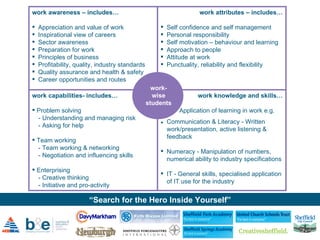
work awareness – includes
 Appreciation and value of work Inspirational view of careers Sector awareness Preparation for work Principles of business Profitability, quality, industry standards Quality assurance and health & safety Career opportunities and routes work attributes – includes
 Self confidence and self management Personal responsibility Self motivation – behaviour and learning Approach to people Attitude at work Punctuality, reliability and flexibility work capabilities- includes
 Problem solving  - Understanding and managing risk - Asking for help Team working - Team working & networking - Negotiation and influencing skills Enterprising - Creative thinking - Initiative and pro-activity work knowledge and skills
 Application of learning in work e.g.  Communication & Literacy - Written  work/presentation, active listening & feedback Numeracy - Manipulation of numbers, numerical ability to industry specifications IT - General skills, specialised application of IT use for the industry work-wise students
work-wise activities include: Work Placements  Industry Awareness Sessions in School Industry Visits Challenges & Competitions  e.g. Master Cutlers’ Made in Sheffield Innovation Competition STEM (Science Technology Engineering & Manufacturing) Awareness Events Ambassadors and Mentors Careers opportunities/events Activity range developing, with feedback from students, schools and employers AND 

.. NOW BEING DEVELOPED ACROSS OTHER SECTORS
work-wise Inspiring Skills and Employability The Ultimate Interview For Pupils and Employers

work-wise presentation - August 2010

  • 1.
    work-wise Inspiration, skillsand employability for young people Are you ready for work?
  • 2.
    work-wise Background Apprenticeneeds Why work-wise is needed How work-wise works Kick off Benefits Funding What work-wise offers Rollout Career advice Involves students, schools, teachers, employers and parents
  • 3.
    Background Quality ofpupils taking up apprentices Teachers understanding of work outside academia Pupils who are from 2 nd generation unemployment Basic “Communication” skills of pupils Career guidance Obsession with University and FE for every pupil Focus on teaching academic subjects without practical applications Unemployable graduates Graduates with no career aspirations Graduates and parents with huge financial commitments Loss of “common sense skills”
  • 4.
    Apprentice Needs Workethic and will to learn Inquisitive and enquiring Enthusiastic and innovative Good practical understanding of maths and science Multi disciplined approach to academic subject selection Encouragement Career advice by people from outside education A belief that they have something to offer an employer
  • 5.
    Why work-wise wasneeded 18 apprentices recruited three years ago All had GCSE “C” or equivalent None had an understanding of fractions or trigonometry Most had studied “Craft Subjects” but were totally naïve as to how these related to the real world The best pupils had gone to 6 th form, FE or University None had considered sponsorship for University or an apprenticeship as an alternative route All employers faced the same issues and were receiving no help from schools, advisors or agencies b&e, DavyMarkham and Newburgh decided that by employers leading a work experience program, it would be made to work
  • 6.
    How work-wise worksEmployers sign a “Pledge” to commit to training young people Basic training for employers is provided by b&e Training packs and module documents are issued to employers Suitable pupils are selected from year 9 Each student is given a 2 / 2 œ module totalling 15 days per year Visits are made to several business during this period Each pupil works through a flexible program focussing upon work: Awareness Attributes Capabilities Knowledge and skills Company considers the pupil as an employer or signs off a document stating that the pupil has achieved successes in each area covered by the training
  • 7.
    Kick off “Sold” to four local employers:- Forgemasters AESSeal Firth Rixson Newburgh Breakfast meeting held at the Cutlers Hall with MD’s, CEO’s launching the event Business & Education South Yorkshire (b&e) administered the project Team of employers designed the methods, packs, training, procedures Launched in April 2010 – large and small employers Regular quarterly breakfast meetings – 80 attendees!
  • 8.
    Benefits No agreementsor committee approvals required Almost seamless between employers and pupils Simple to establish and easy to run Introduces pupils into the work environment Gives pupils and understanding of what work involves Removes the “Industry Visit” syndrome Gives pupils specific work tasks so they will not become bored Establishes relationships so that apprentice selection becomes easier Prevents wasted University attendance Satisfies many employer and school objectives
  • 9.
    Funding Development fundingby b&e Costs are relatively modest Funding available in schools Employers are providing the service free of charge Could the concept be financed by a contribution to b&e from academies / schools? Is the concept capable of being sold to other academies / academy groups / local authorities?
  • 10.
    What work-wise offersAcademies / Schools Confidence that pupils are being given unbiased career options Developing non-academic and communication skills Making more considered choices for subject selection Developing relationships with local businesses Modifying academic teaching in line with business needs Very little input required Pupils Encouragement Practical understanding of work disciplines Career advice by people from outside education A belief that they have something to offer an employer Relating practical situations to academic subjects Possibility of being “sponsored” for a FE qualification or a degree Business Improved sources of apprentices Extended assessment of a pupil’s suitability
  • 11.
    work awareness –includes
 Appreciation and value of work Inspirational view of careers Sector awareness Preparation for work Principles of business Profitability, quality, industry standards Quality assurance and health & safety Career opportunities and routes work attributes – includes
 Self confidence and self management Personal responsibility Self motivation – behaviour and learning Approach to people Attitude at work Punctuality, reliability and flexibility work capabilities- includes
 Problem solving - Understanding and managing risk - Asking for help Team working - Team working & networking - Negotiation and influencing skills Enterprising - Creative thinking - Initiative and pro-activity work knowledge and skills
 Application of learning in work e.g.  Communication & Literacy - Written work/presentation, active listening & feedback Numeracy - Manipulation of numbers, numerical ability to industry specifications IT - General skills, specialised application of IT use for the industry work-wise students
  • 12.
    work-wise activities include:Work Placements Industry Awareness Sessions in School Industry Visits Challenges & Competitions e.g. Master Cutlers’ Made in Sheffield Innovation Competition STEM (Science Technology Engineering & Manufacturing) Awareness Events Ambassadors and Mentors Careers opportunities/events Activity range developing, with feedback from students, schools and employers AND 

.. NOW BEING DEVELOPED ACROSS OTHER SECTORS
  • 13.
    work-wise Inspiring Skillsand Employability The Ultimate Interview For Pupils and Employers