1Dr Ray WallaceSchool of Science & TechnologyNottingham Trent University, UK& ECTNA Label Committee, Brussels
Towards a Commonality of Standards in Higher Education in Europe?22nd UNICA Master Class, Dubrovnik 28 August – 01 September 2011
32nd UNICA Master Class, Dubrovnik 28 August – 01 September 2011
62nd UNICA Master Class, Dubrovnik 28 August – 01 September 2011The beginnings ……………TUNING
TUNING Educational Structures in Europe started in 2000 as a project to link the political objectives of the Bologna Process and at a later stage the Lisbon Strategy to the higher educational sector. Over time Tuning has developed into a Process, an approach to (re-)design, develop, implement, evaluate and enhance the quality of first, second and third cycle degree programmes. 52nd UNICA Master Class, Dubrovnik 28 August – 01 September 2011
62nd UNICA Master Class, Dubrovnik 28 August – 01 September 2011The ‘Tuning Project’ is the HE institutions’ answer to the political decisions underlying the Bologna processIt involves almost 150 HE institutions in 9 subject area groups; apart from chemistry, these are: physics, mathematics, history, earth sciences, business, education sciences, nursing, European studies....... which subsequently led to the Eurobachelor® Label introduced by European chemists
72nd UNICA Master Class, Dubrovnik 28 August – 01 September 2011The Eurobachelor® - timeline2001-2002: developed by Tuning Chemistry Subject Area GroupMay 2002: presented at Closing Meeting of Tuning Phase One in BrusselsApril 2003: adopted by ECTN Association Assembly in PragueOctober 2003: adopted by FECS (now EuCheMS) General Assembly (…from Cork to Vladivostok)April 2004: ECTN Association decides to offer ‘Eurobachelor Label’ to interested institutionsSeptember 2004: application to EU Commission for funding of pilot project for accreditation of the ‘Chemistry Eurobachelor Label’ acceptedMarch 2006: end of pilot projectSubsequent discussions with European accreditation agencies for franchising the award of the Eurobachelor® Label
82nd UNICA Master Class, Dubrovnik 28 August – 01 September 2011ECTN (now renamed as EC2E2N) is a network of chemists with over 120 members from 33 countries; apart from universities these include nine national chemical societies (DE, FR, GB, IT, NL, CS, SK, LT, SI)ECTN also exists in the form of an Association (ECTNA) under Belgian lawBoth the Network and the Association are open to the chemical community; further member institutions, chemical societies or other chemistry-interested organisations are always welcome to join the organisation
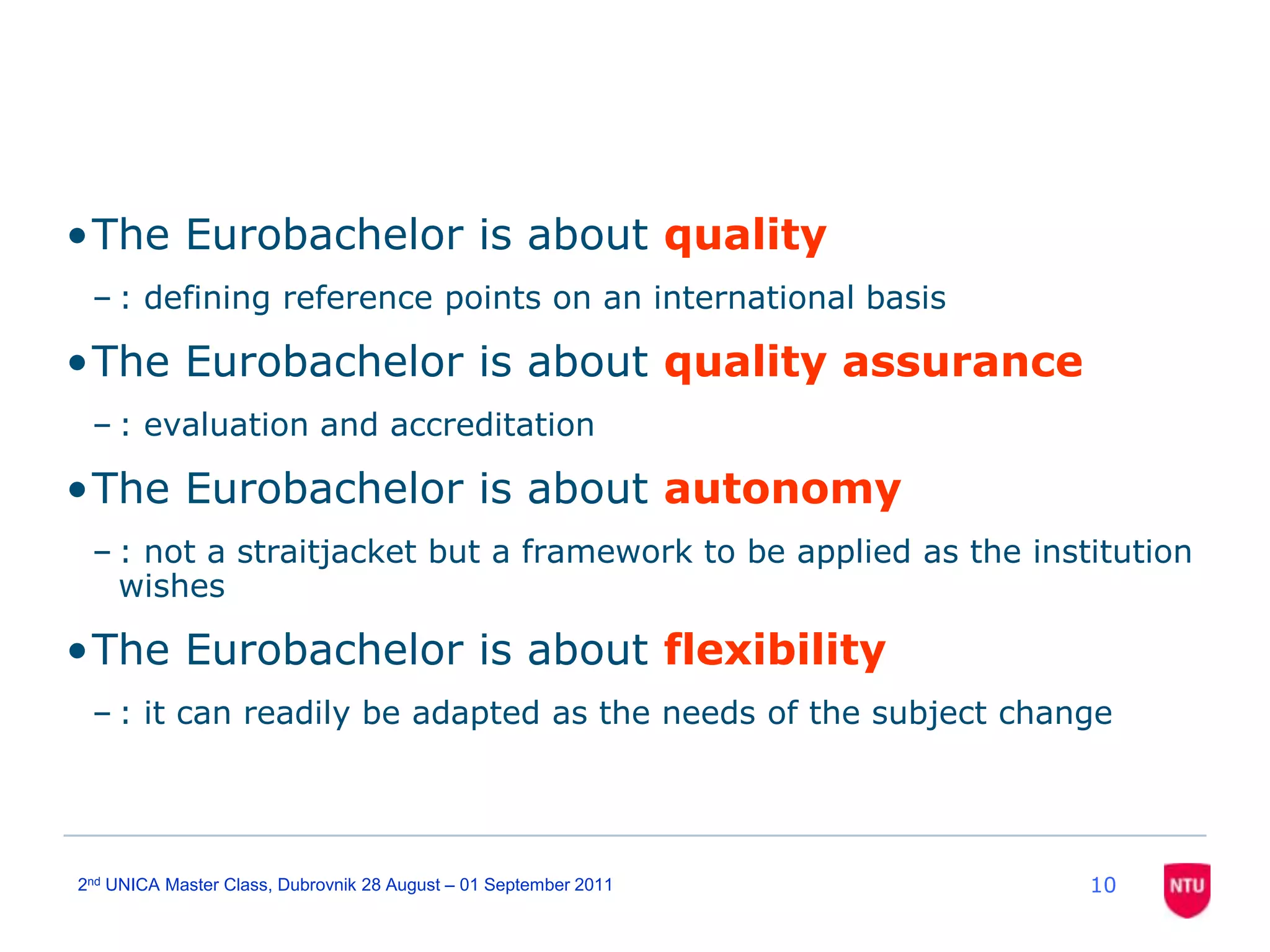
92nd UNICA Master Class, Dubrovnik 28 August – 01 September 2011Aspects of the degree programme considered in the Chemistry EurobachelorLearning outcomes (adapted from QAA benchmarks–UK)ModularisationCredit distributionECTS and student workloadMobilityMethods of Teaching and LearningAssessment, GradingQuality AssuranceLanguage requirement
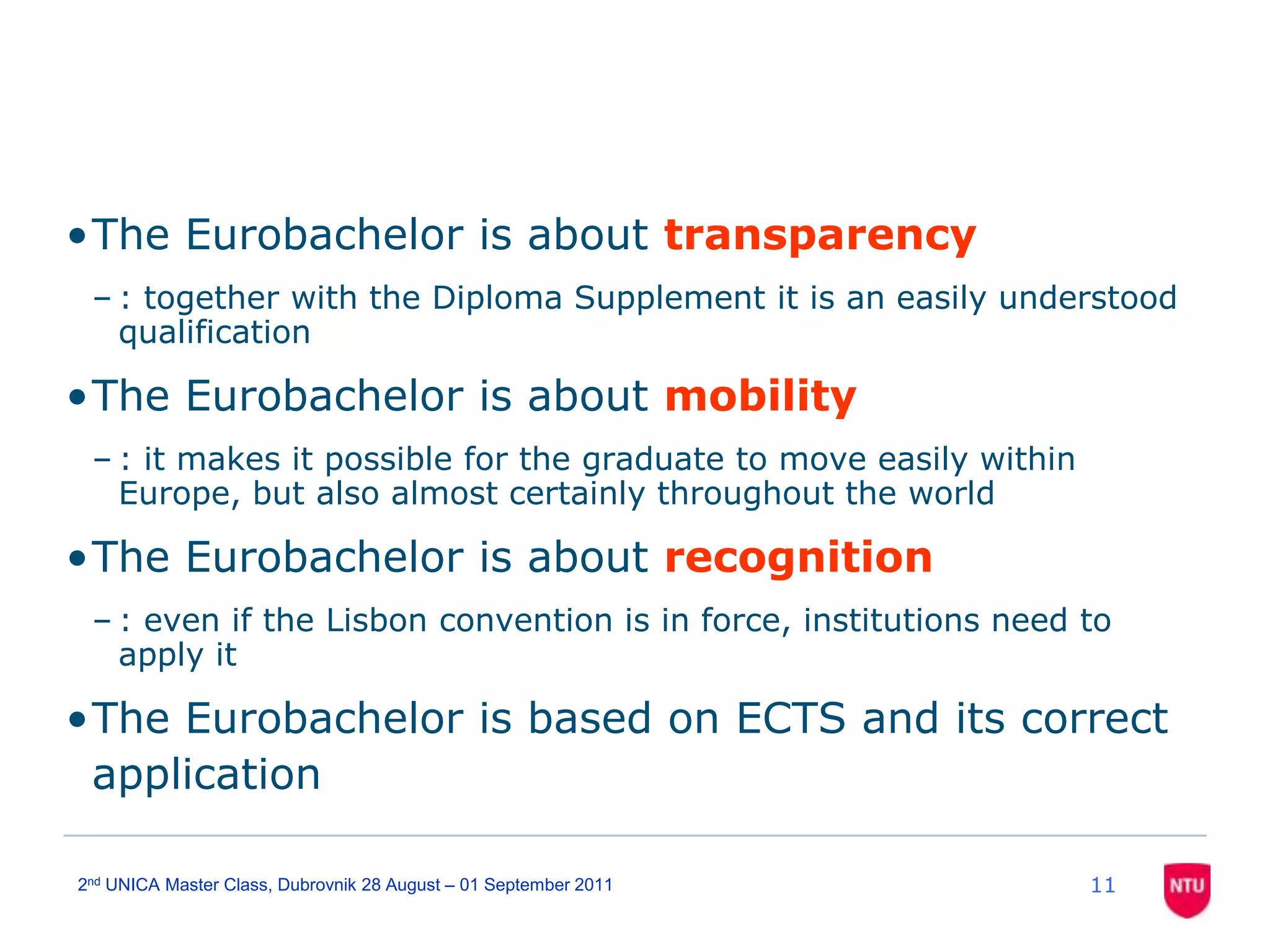
102nd UNICA Master Class, Dubrovnik 28 August – 01 September 2011The Eurobachelor is about quality: defining reference points on an international basisThe Eurobachelor is about quality assurance: evaluation and accreditationThe Eurobachelor is about autonomy: not a straitjacket but a framework to be applied as the institution wishesThe Eurobachelor is about flexibility: it can readily be adapted as the needs of the subject change
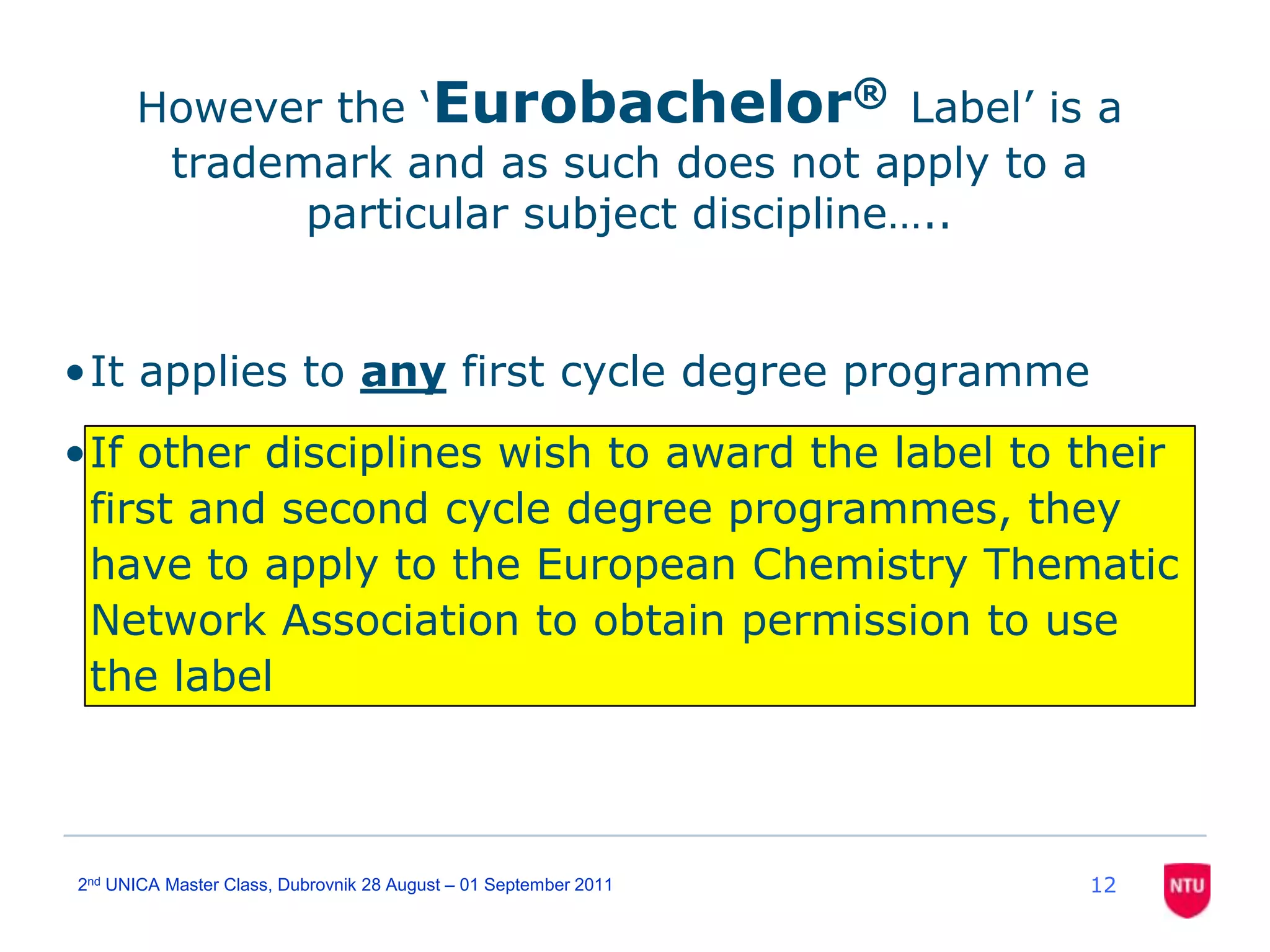
112nd UNICA Master Class, Dubrovnik 28 August – 01 September 2011The Eurobachelor is about transparency: together with the Diploma Supplement it is an easily understood qualificationThe Eurobachelor is about mobility: it makes it possible for the graduate to move easily within Europe, but also almost certainly throughout the worldThe Eurobachelor is about recognition: even if the Lisbon convention is in force, institutions need to apply it The Eurobachelor is based on ECTS and its correct application
122nd UNICA Master Class, Dubrovnik 28 August – 01 September 2011However the ‘Eurobachelor®Label’ is a trademark and as such does not apply to a particular subject discipline…..It applies to any first cycle degree programmeIf other disciplines wish to award the label to their first and second cycle degree programmes, they have to apply to the European Chemistry Thematic Network Association to obtain permission to use the label
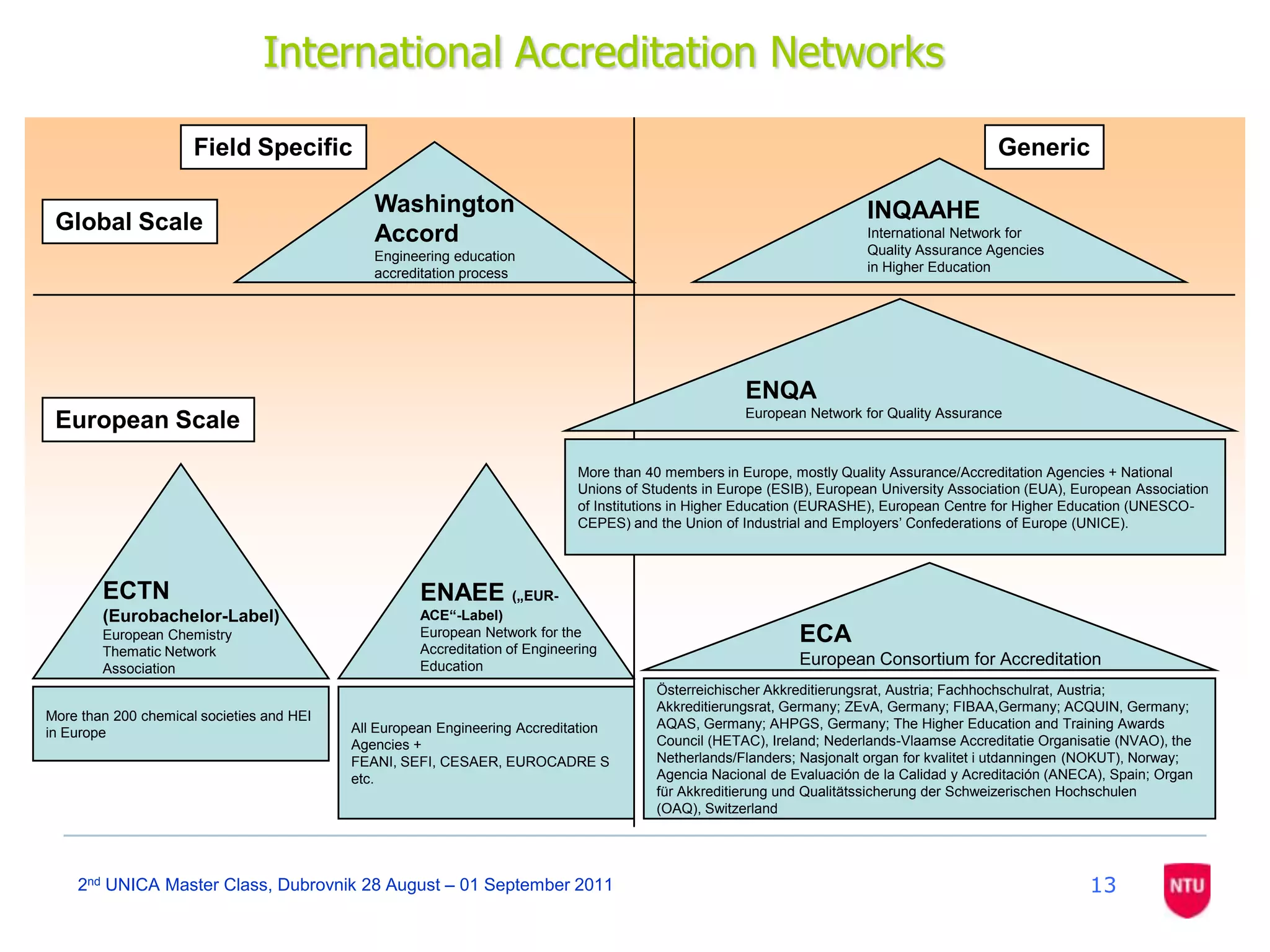
132nd UNICA Master Class, Dubrovnik 28 August – 01 September 2011International Accreditation NetworksField SpecificGenericWashington AccordEngineering education accreditation processINQAAHEInternational Network for Quality Assurance Agencies in Higher Education Global ScaleENQAEuropean Network for Quality AssuranceEuropean ScaleMore than 40 members in Europe, mostly Quality Assurance/Accreditation Agencies + National Unions of Students in Europe (ESIB), European University Association (EUA), European Association of Institutions in Higher Education (EURASHE), European Centre for Higher Education (UNESCO-CEPES) and the Union of Industrial and Employers’ Confederations of Europe (UNICE).ECAEuropean Consortium for AccreditationECTN (Eurobachelor-Label)European Chemistry Thematic Network AssociationENAEE („EUR-ACE“-Label)European Network for the Accreditation of Engineering EducationÖsterreichischer Akkreditierungsrat, Austria; Fachhochschulrat, Austria; Akkreditierungsrat, Germany; ZEvA, Germany; FIBAA,Germany; ACQUIN, Germany; AQAS, Germany; AHPGS, Germany; The Higher Education and Training Awards Council (HETAC), Ireland; Nederlands-Vlaamse Accreditatie Organisatie (NVAO), the Netherlands/Flanders; Nasjonalt organ for kvalitet i utdanningen (NOKUT), Norway; Agencia Nacional de Evaluación de la Calidad y Acreditación (ANECA), Spain; Organ für Akkreditierung und Qualitätssicherung der Schweizerischen Hochschulen (OAQ), SwitzerlandMore than 200 chemical societies and HEI in Europe All European Engineering Accreditation Agencies + FEANI, SEFI, CESAER, EUROCADRE S etc.
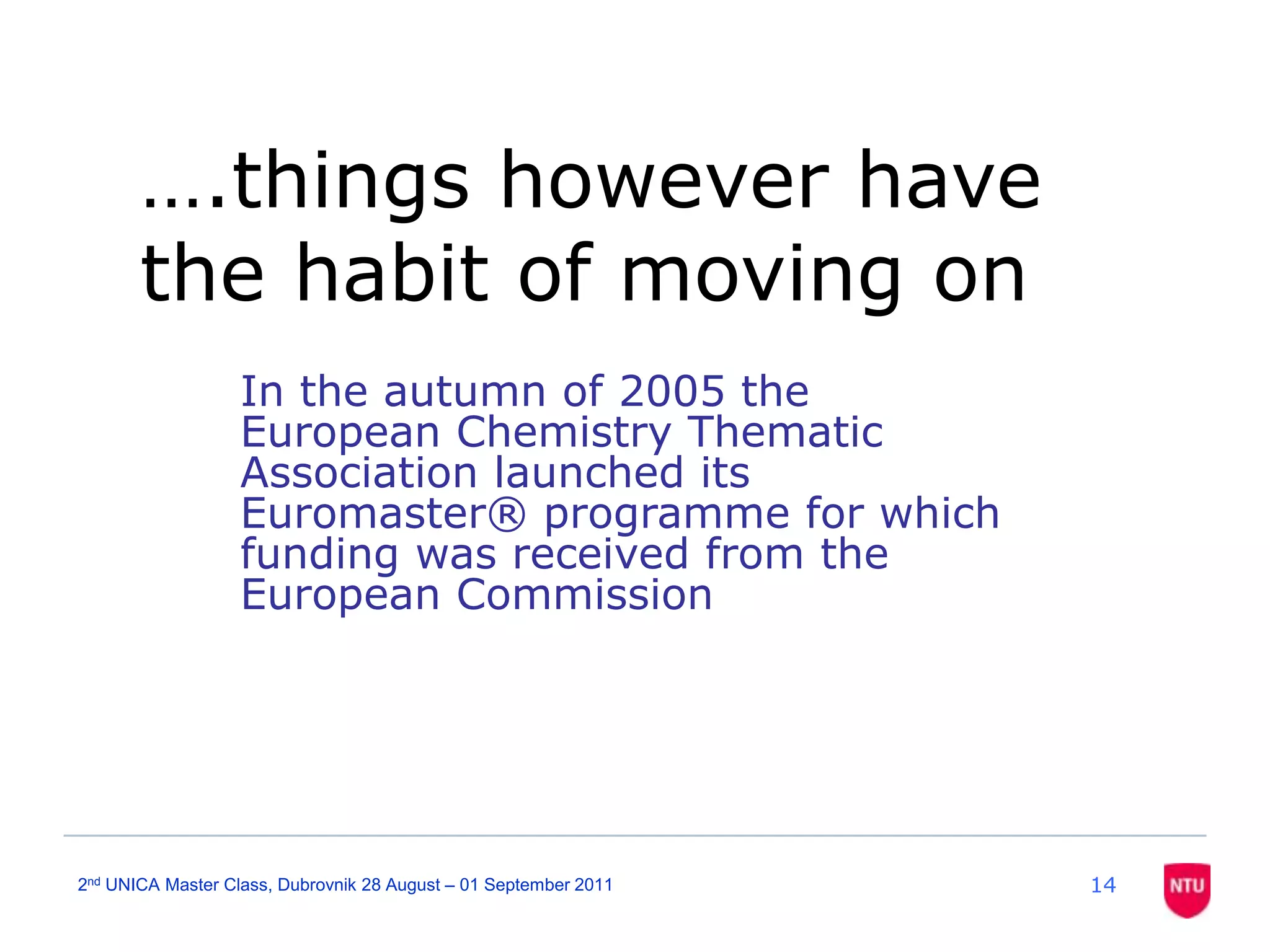
142nd UNICA Master Class, Dubrovnik 28 August – 01 September 2011….things however have the habit of moving onIn the autumn of 2005 the European Chemistry Thematic Association launched its Euromaster® programme for which funding was received from the European Commission
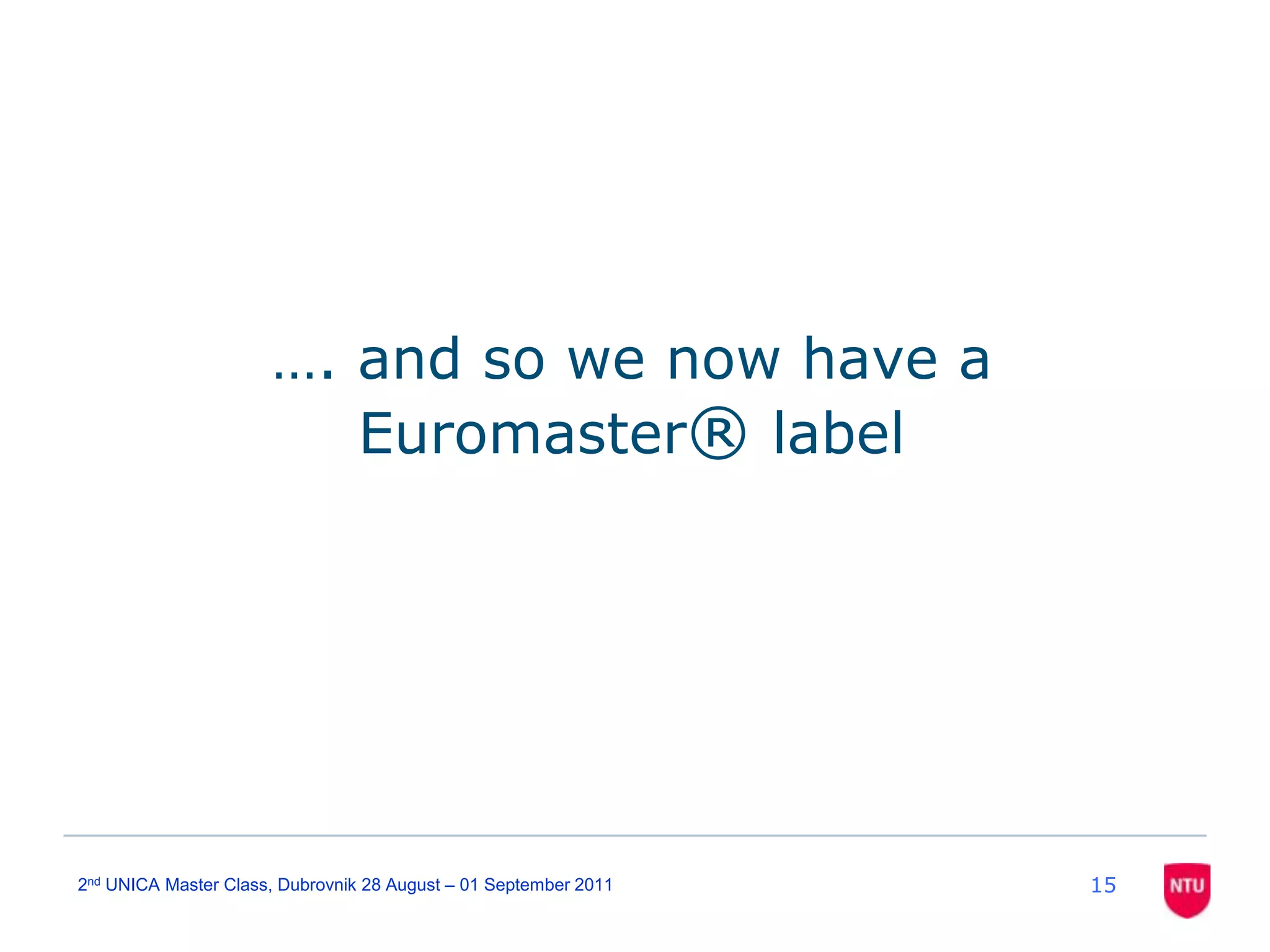
…. and so we now have a Euromaster® label152nd UNICA Master Class, Dubrovnik 28 August – 01 September 2011
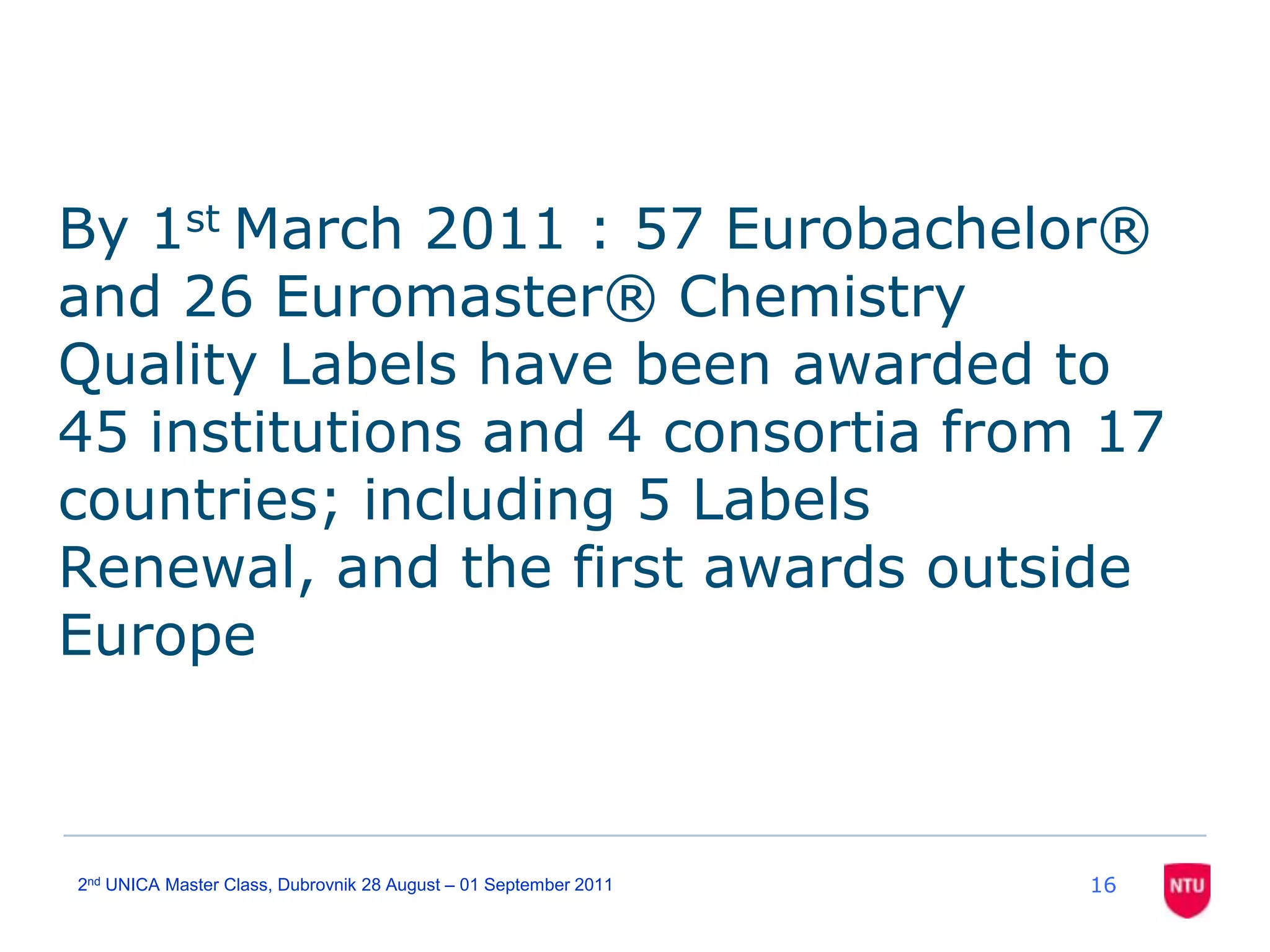
By 1st March 2011 : 57 Eurobachelor® and 26 Euromaster® Chemistry Quality Labels have been awarded to 45 institutions and 4 consortia from 17 countries; including 5 Labels Renewal, and the first awards outside Europe162nd UNICA Master Class, Dubrovnik 28 August – 01 September 2011
172nd UNICA Master Class, Dubrovnik 28 August – 01 September 2011
Towards a182nd UNICA Master Class, Dubrovnik 28 August – 01 September 2011
Subsequently a Eurodoctorate Framework was proposed by the ECTNA and the Chemistry Eurodoctorate Framework version 1 was published in November 2006192nd UNICA Master Class, Dubrovnik 28 August – 01 September 2011
Importantly in this document (Recommendations arising from Post-Dresden Discussions – see next slide) and of interest to this meeting is the following statement which appears under PhD supervision, “Few countries appear to have training for supervisors of PhD students, and this is something that is to be encouraged.” 202nd UNICA Master Class, Dubrovnik 28 August – 01 September 2011
Following subsequent discussions at a meeting in Dresden a commentary was added to the document“Too many regulations are to be avoided, as PhD students are adults, and should be responsible for their own development, but they must not be let to get on completely by themselves. It is not justifiable to assume that because a person is a good researcher he or she will automatically be a good supervisor of research students (although in Germany a professor with Habilitation is assumed to have gained a licence to teach, and thus to supervise students, his capabilities in this second area are never tested). The academic community should seek to ensure that the students get the best possible guidance, or at least guarantee a minimumstandard. Unfortunately institutions that have tried to impose regulations have been seen as interfering in academic freedom by some staff.” 212nd UNICA Master Class, Dubrovnik 28 August – 01 September 2011
Currently an ECTNA group is working ona Lifelong Learning Programme/Erasmus Accompanying Measures project, coordinated by Aristotle University of Thessaloniki (Greece) and entitled: Eurodoctorate - a Framework for a Third Cycle Qualification in Chemistry, which is serving as a pilot initiative for an accreditation labelhttp://phdchem.eu/222nd UNICA Master Class, Dubrovnik 28 August – 01 September 2011
….. and as they say, ‘watch this space’232nd UNICA Master Class, Dubrovnik 28 August – 01 September 2011
Any Questions?

Commonality of Standards

  • 1.
    1Dr Ray WallaceSchoolof Science & TechnologyNottingham Trent University, UK& ECTNA Label Committee, Brussels
  • 2.
    Towards a Commonalityof Standards in Higher Education in Europe?22nd UNICA Master Class, Dubrovnik 28 August – 01 September 2011
  • 3.
    32nd UNICA MasterClass, Dubrovnik 28 August – 01 September 2011
  • 4.
    62nd UNICA MasterClass, Dubrovnik 28 August – 01 September 2011The beginnings ……………TUNING
  • 5.
    TUNING Educational Structuresin Europe started in 2000 as a project to link the political objectives of the Bologna Process and at a later stage the Lisbon Strategy to the higher educational sector. Over time Tuning has developed into a Process, an approach to (re-)design, develop, implement, evaluate and enhance the quality of first, second and third cycle degree programmes. 52nd UNICA Master Class, Dubrovnik 28 August – 01 September 2011
  • 6.
    62nd UNICA MasterClass, Dubrovnik 28 August – 01 September 2011The ‘Tuning Project’ is the HE institutions’ answer to the political decisions underlying the Bologna processIt involves almost 150 HE institutions in 9 subject area groups; apart from chemistry, these are: physics, mathematics, history, earth sciences, business, education sciences, nursing, European studies....... which subsequently led to the Eurobachelor® Label introduced by European chemists
  • 7.
    72nd UNICA MasterClass, Dubrovnik 28 August – 01 September 2011The Eurobachelor® - timeline2001-2002: developed by Tuning Chemistry Subject Area GroupMay 2002: presented at Closing Meeting of Tuning Phase One in BrusselsApril 2003: adopted by ECTN Association Assembly in PragueOctober 2003: adopted by FECS (now EuCheMS) General Assembly (…from Cork to Vladivostok)April 2004: ECTN Association decides to offer ‘Eurobachelor Label’ to interested institutionsSeptember 2004: application to EU Commission for funding of pilot project for accreditation of the ‘Chemistry Eurobachelor Label’ acceptedMarch 2006: end of pilot projectSubsequent discussions with European accreditation agencies for franchising the award of the Eurobachelor® Label
  • 8.
    82nd UNICA MasterClass, Dubrovnik 28 August – 01 September 2011ECTN (now renamed as EC2E2N) is a network of chemists with over 120 members from 33 countries; apart from universities these include nine national chemical societies (DE, FR, GB, IT, NL, CS, SK, LT, SI)ECTN also exists in the form of an Association (ECTNA) under Belgian lawBoth the Network and the Association are open to the chemical community; further member institutions, chemical societies or other chemistry-interested organisations are always welcome to join the organisation
  • 9.
    92nd UNICA MasterClass, Dubrovnik 28 August – 01 September 2011Aspects of the degree programme considered in the Chemistry EurobachelorLearning outcomes (adapted from QAA benchmarks–UK)ModularisationCredit distributionECTS and student workloadMobilityMethods of Teaching and LearningAssessment, GradingQuality AssuranceLanguage requirement
  • 10.
    102nd UNICA MasterClass, Dubrovnik 28 August – 01 September 2011The Eurobachelor is about quality: defining reference points on an international basisThe Eurobachelor is about quality assurance: evaluation and accreditationThe Eurobachelor is about autonomy: not a straitjacket but a framework to be applied as the institution wishesThe Eurobachelor is about flexibility: it can readily be adapted as the needs of the subject change
  • 11.
    112nd UNICA MasterClass, Dubrovnik 28 August – 01 September 2011The Eurobachelor is about transparency: together with the Diploma Supplement it is an easily understood qualificationThe Eurobachelor is about mobility: it makes it possible for the graduate to move easily within Europe, but also almost certainly throughout the worldThe Eurobachelor is about recognition: even if the Lisbon convention is in force, institutions need to apply it The Eurobachelor is based on ECTS and its correct application
  • 12.
    122nd UNICA MasterClass, Dubrovnik 28 August – 01 September 2011However the ‘Eurobachelor®Label’ is a trademark and as such does not apply to a particular subject discipline…..It applies to any first cycle degree programmeIf other disciplines wish to award the label to their first and second cycle degree programmes, they have to apply to the European Chemistry Thematic Network Association to obtain permission to use the label
  • 13.
    132nd UNICA MasterClass, Dubrovnik 28 August – 01 September 2011International Accreditation NetworksField SpecificGenericWashington AccordEngineering education accreditation processINQAAHEInternational Network for Quality Assurance Agencies in Higher Education Global ScaleENQAEuropean Network for Quality AssuranceEuropean ScaleMore than 40 members in Europe, mostly Quality Assurance/Accreditation Agencies + National Unions of Students in Europe (ESIB), European University Association (EUA), European Association of Institutions in Higher Education (EURASHE), European Centre for Higher Education (UNESCO-CEPES) and the Union of Industrial and Employers’ Confederations of Europe (UNICE).ECAEuropean Consortium for AccreditationECTN (Eurobachelor-Label)European Chemistry Thematic Network AssociationENAEE („EUR-ACE“-Label)European Network for the Accreditation of Engineering EducationÖsterreichischer Akkreditierungsrat, Austria; Fachhochschulrat, Austria; Akkreditierungsrat, Germany; ZEvA, Germany; FIBAA,Germany; ACQUIN, Germany; AQAS, Germany; AHPGS, Germany; The Higher Education and Training Awards Council (HETAC), Ireland; Nederlands-Vlaamse Accreditatie Organisatie (NVAO), the Netherlands/Flanders; Nasjonalt organ for kvalitet i utdanningen (NOKUT), Norway; Agencia Nacional de Evaluación de la Calidad y Acreditación (ANECA), Spain; Organ für Akkreditierung und Qualitätssicherung der Schweizerischen Hochschulen (OAQ), SwitzerlandMore than 200 chemical societies and HEI in Europe All European Engineering Accreditation Agencies + FEANI, SEFI, CESAER, EUROCADRE S etc.
  • 14.
    142nd UNICA MasterClass, Dubrovnik 28 August – 01 September 2011….things however have the habit of moving onIn the autumn of 2005 the European Chemistry Thematic Association launched its Euromaster® programme for which funding was received from the European Commission
  • 15.
    …. and sowe now have a Euromaster® label152nd UNICA Master Class, Dubrovnik 28 August – 01 September 2011
  • 16.
    By 1st March2011 : 57 Eurobachelor® and 26 Euromaster® Chemistry Quality Labels have been awarded to 45 institutions and 4 consortia from 17 countries; including 5 Labels Renewal, and the first awards outside Europe162nd UNICA Master Class, Dubrovnik 28 August – 01 September 2011
  • 17.
    172nd UNICA MasterClass, Dubrovnik 28 August – 01 September 2011
  • 18.
    Towards a182nd UNICAMaster Class, Dubrovnik 28 August – 01 September 2011
  • 19.
    Subsequently a EurodoctorateFramework was proposed by the ECTNA and the Chemistry Eurodoctorate Framework version 1 was published in November 2006192nd UNICA Master Class, Dubrovnik 28 August – 01 September 2011
  • 20.
    Importantly in thisdocument (Recommendations arising from Post-Dresden Discussions – see next slide) and of interest to this meeting is the following statement which appears under PhD supervision, “Few countries appear to have training for supervisors of PhD students, and this is something that is to be encouraged.” 202nd UNICA Master Class, Dubrovnik 28 August – 01 September 2011
  • 21.
    Following subsequent discussionsat a meeting in Dresden a commentary was added to the document“Too many regulations are to be avoided, as PhD students are adults, and should be responsible for their own development, but they must not be let to get on completely by themselves. It is not justifiable to assume that because a person is a good researcher he or she will automatically be a good supervisor of research students (although in Germany a professor with Habilitation is assumed to have gained a licence to teach, and thus to supervise students, his capabilities in this second area are never tested). The academic community should seek to ensure that the students get the best possible guidance, or at least guarantee a minimumstandard. Unfortunately institutions that have tried to impose regulations have been seen as interfering in academic freedom by some staff.” 212nd UNICA Master Class, Dubrovnik 28 August – 01 September 2011
  • 22.
    Currently an ECTNAgroup is working ona Lifelong Learning Programme/Erasmus Accompanying Measures project, coordinated by Aristotle University of Thessaloniki (Greece) and entitled: Eurodoctorate - a Framework for a Third Cycle Qualification in Chemistry, which is serving as a pilot initiative for an accreditation labelhttp://phdchem.eu/222nd UNICA Master Class, Dubrovnik 28 August – 01 September 2011
  • 23.
    ….. and asthey say, ‘watch this space’232nd UNICA Master Class, Dubrovnik 28 August – 01 September 2011
  • 24.