
Change
Management
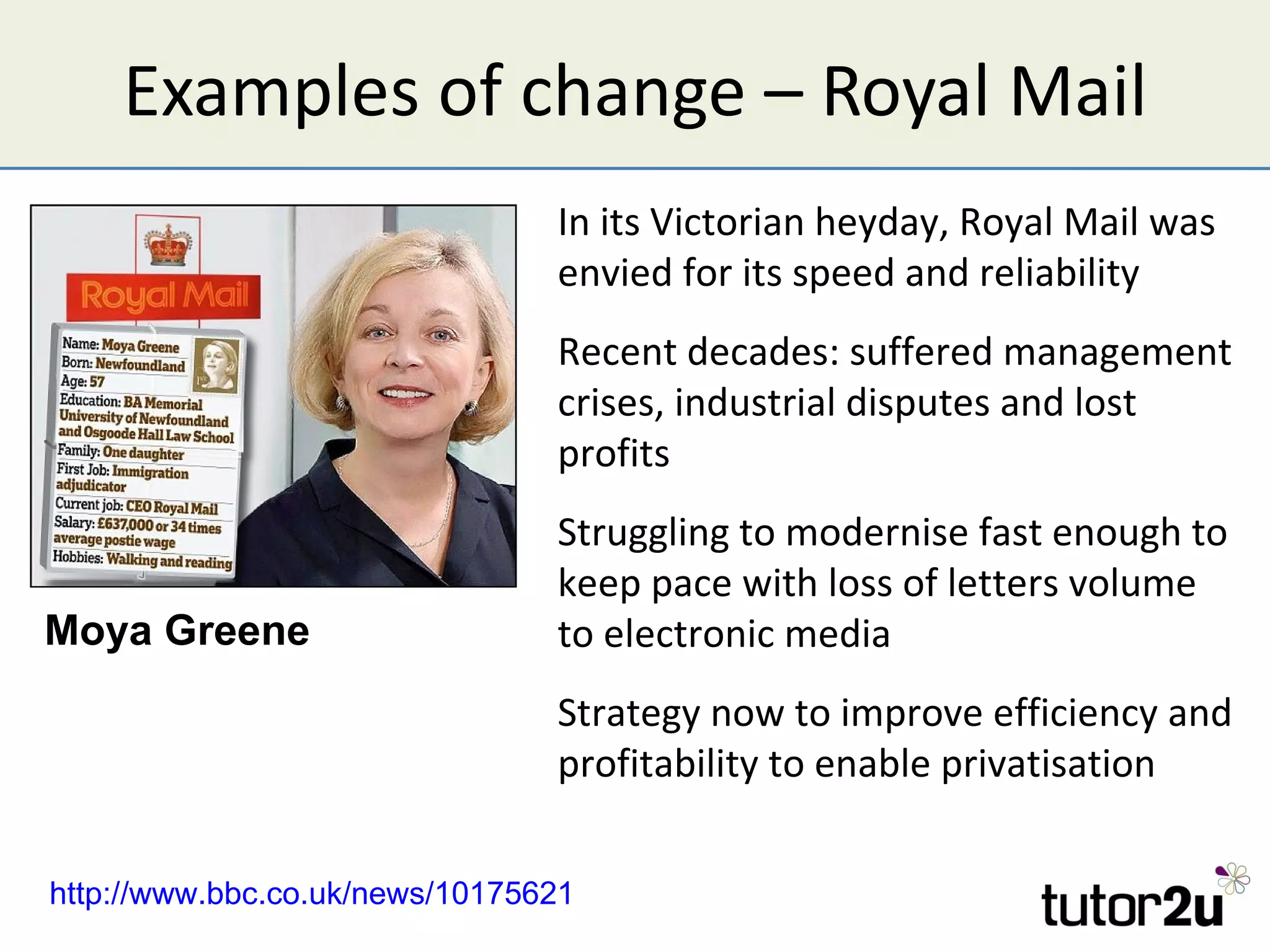
Examples of change – Royal Mail
                                In its Victorian heyday, Royal Mail was
                                envied for its speed and reliability
                                Recent decades: suffered management
                                crises, industrial disputes and lost
                                profits
                                Struggling to modernise fast enough to
                                keep pace with loss of letters volume
Moya Greene                     to electronic media
                                Strategy now to improve efficiency and
                                profitability to enable privatisation


http://www.bbc.co.uk/news/10175621
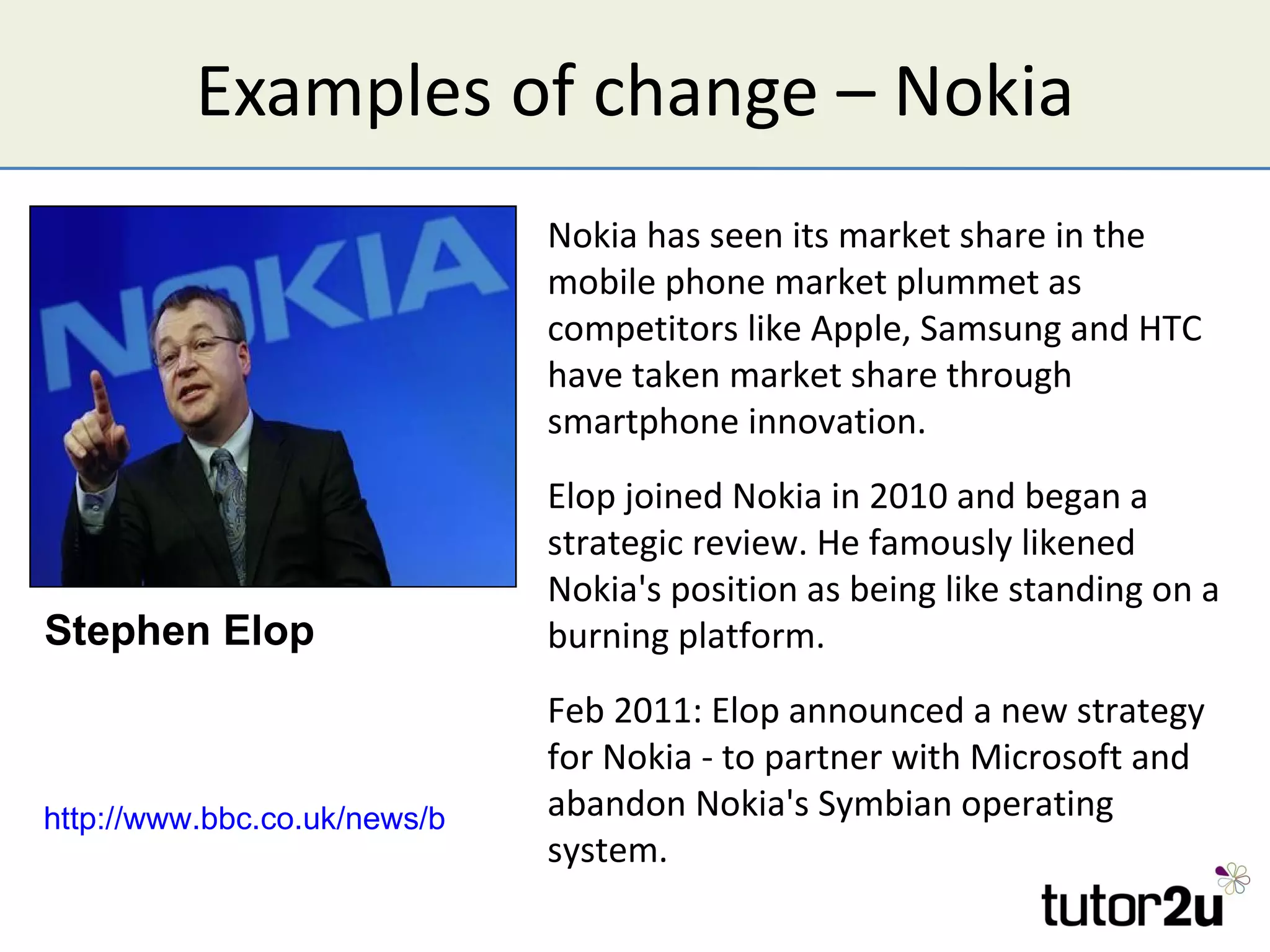
Examples of change – Nokia
                                Nokia has seen its market share in the
                                mobile phone market plummet as
                                competitors like Apple, Samsung and HTC
                                have taken market share through
                                smartphone innovation.
                                Elop joined Nokia in 2010 and began a
                                strategic review. He famously likened
                                Nokia's position as being like standing on a
Stephen Elop                    burning platform.
                                  Feb 2011: Elop announced a new strategy
                                  for Nokia - to partner with Microsoft and
                                  abandon Nokia's Symbian operating
http://www.bbc.co.uk/news/business-16953411
                                  system.
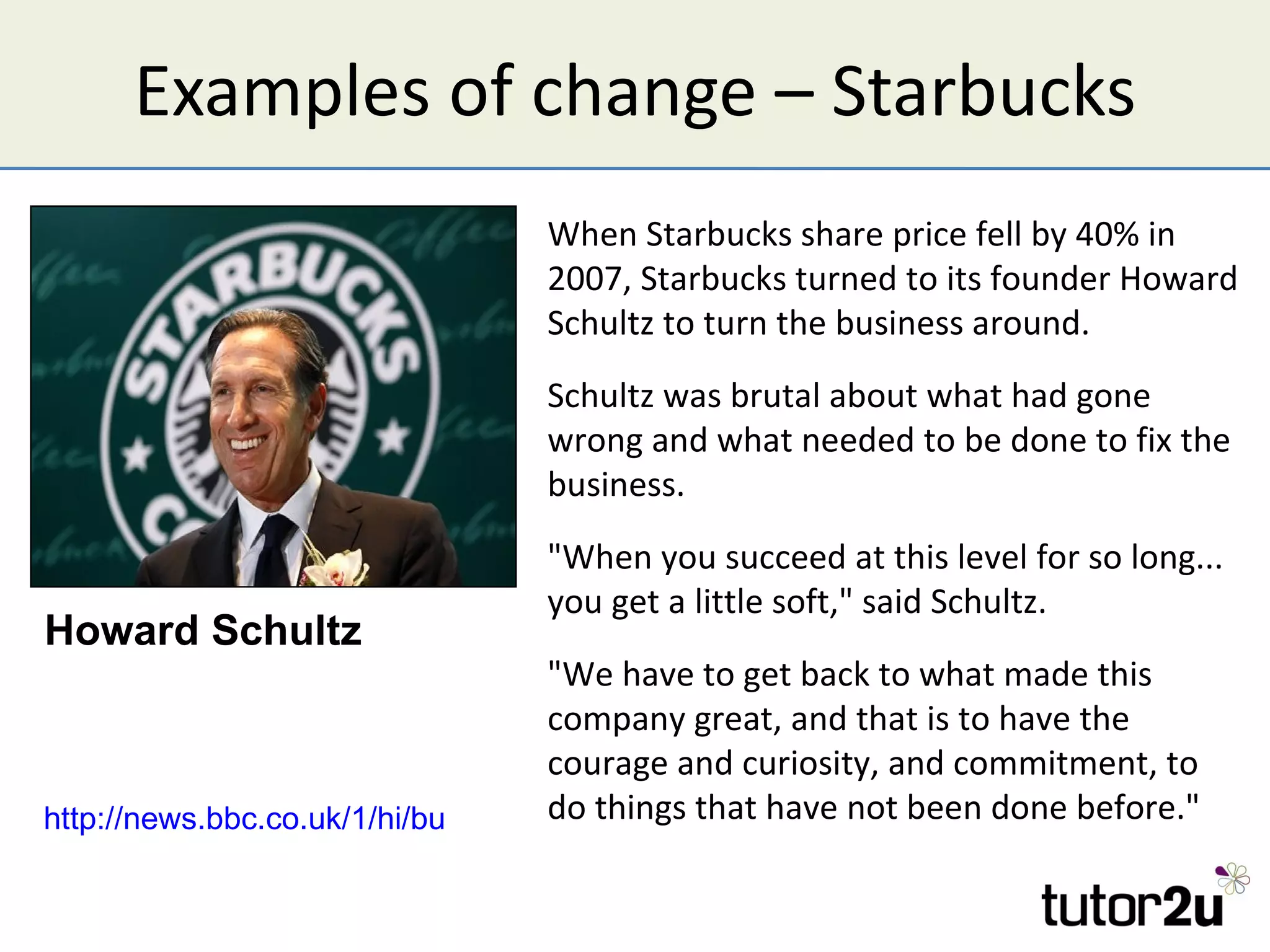
Examples of change – Starbucks
                                 When Starbucks share price fell by 40% in
                                 2007, Starbucks turned to its founder Howard
                                 Schultz to turn the business around.
                                 Schultz was brutal about what had gone
                                 wrong and what needed to be done to fix the
                                 business.
                                 "When you succeed at this level for so long...
                                 you get a little soft," said Schultz.
Howard Schultz
                                    "We have to get back to what made this
                                    company great, and that is to have the
                                    courage and curiosity, and commitment, to
http://news.bbc.co.uk/1/hi/business/7219458.stm have not been done before."
                                    do things that
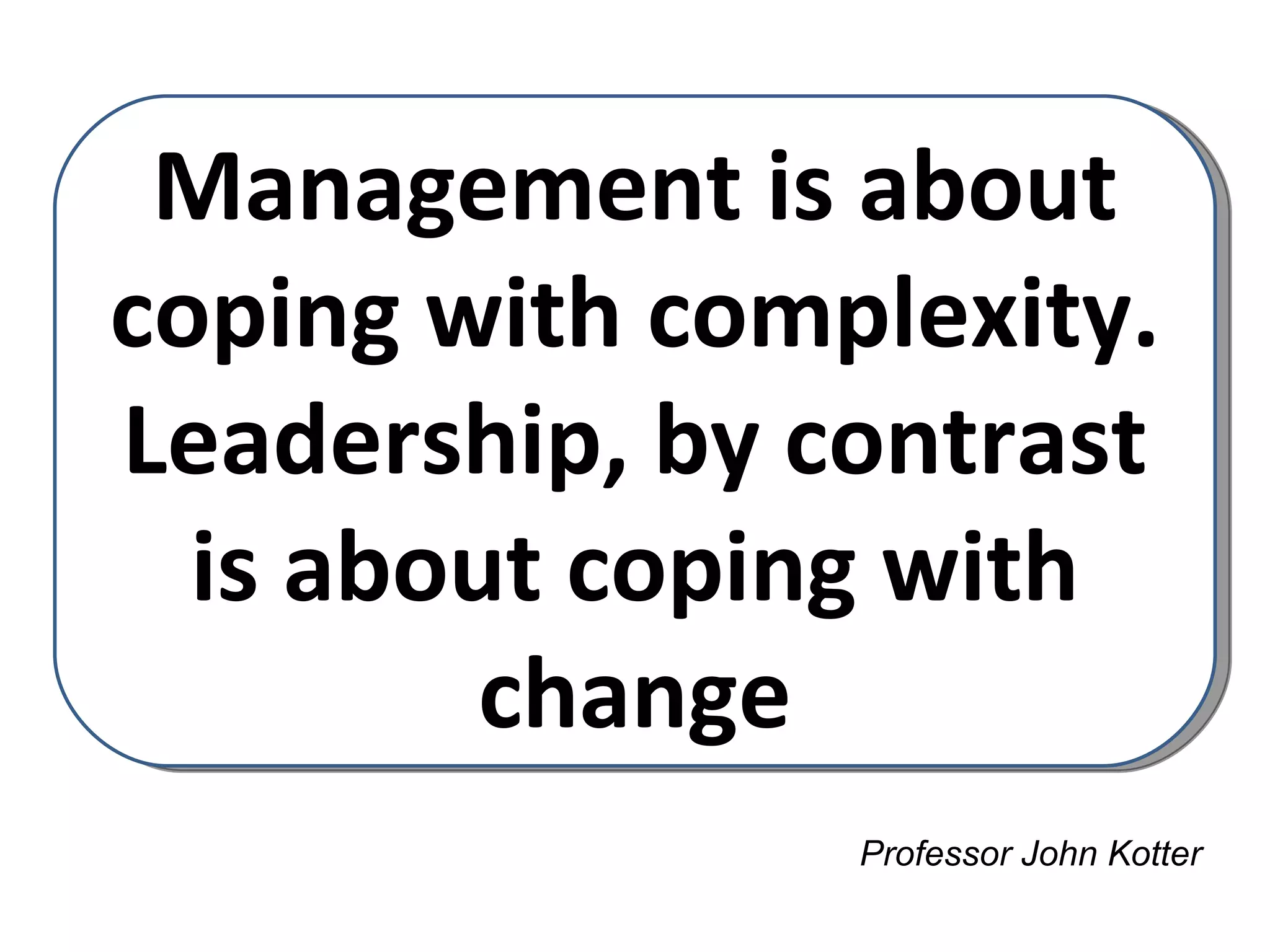
Management is about
coping with complexity.
Leadership, by contrast
  is about coping with
         change
                Professor John Kotter
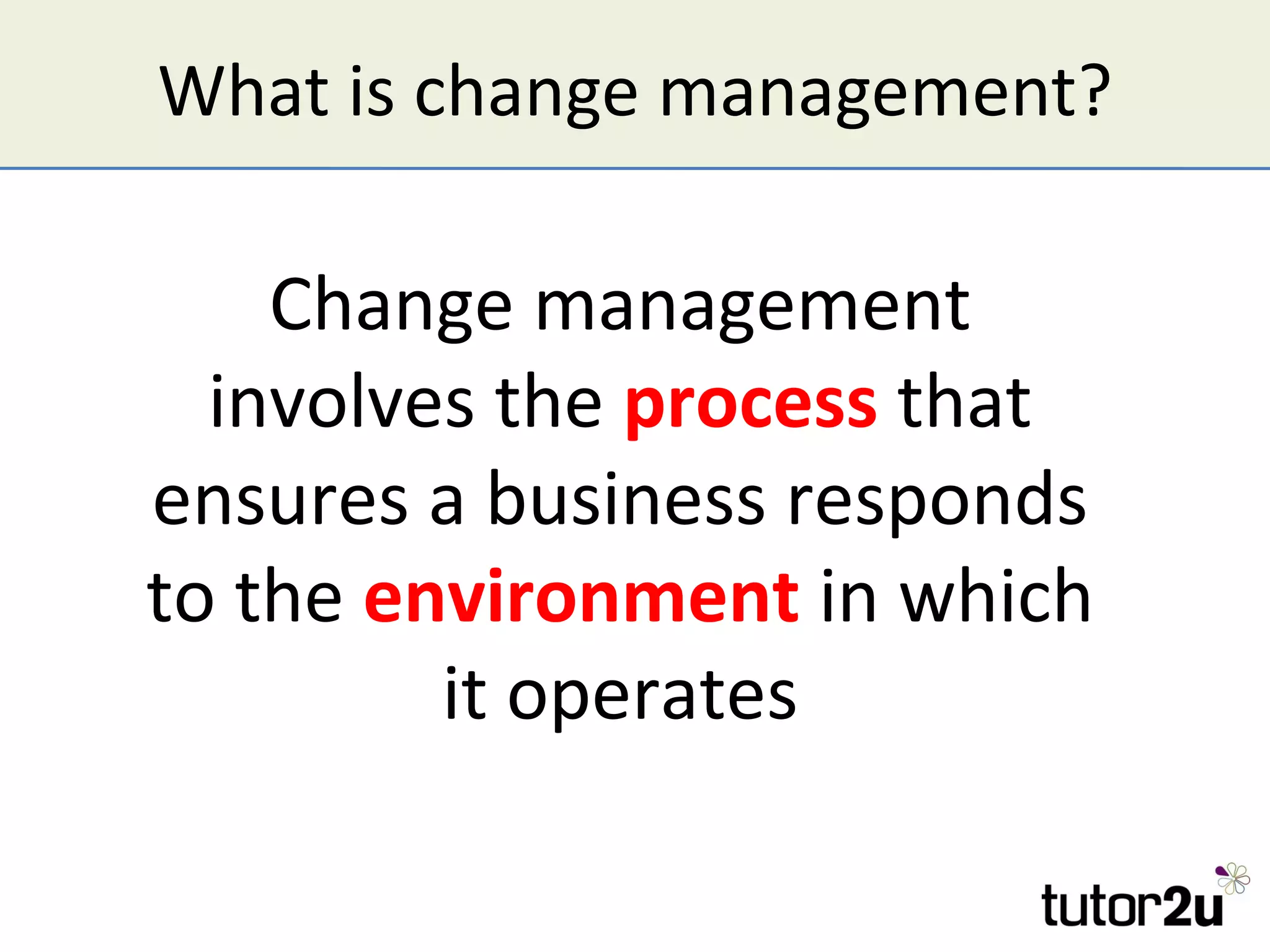
What is change management?

    Change management
  involves the process that
ensures a business responds
to the environment in which
         it operates
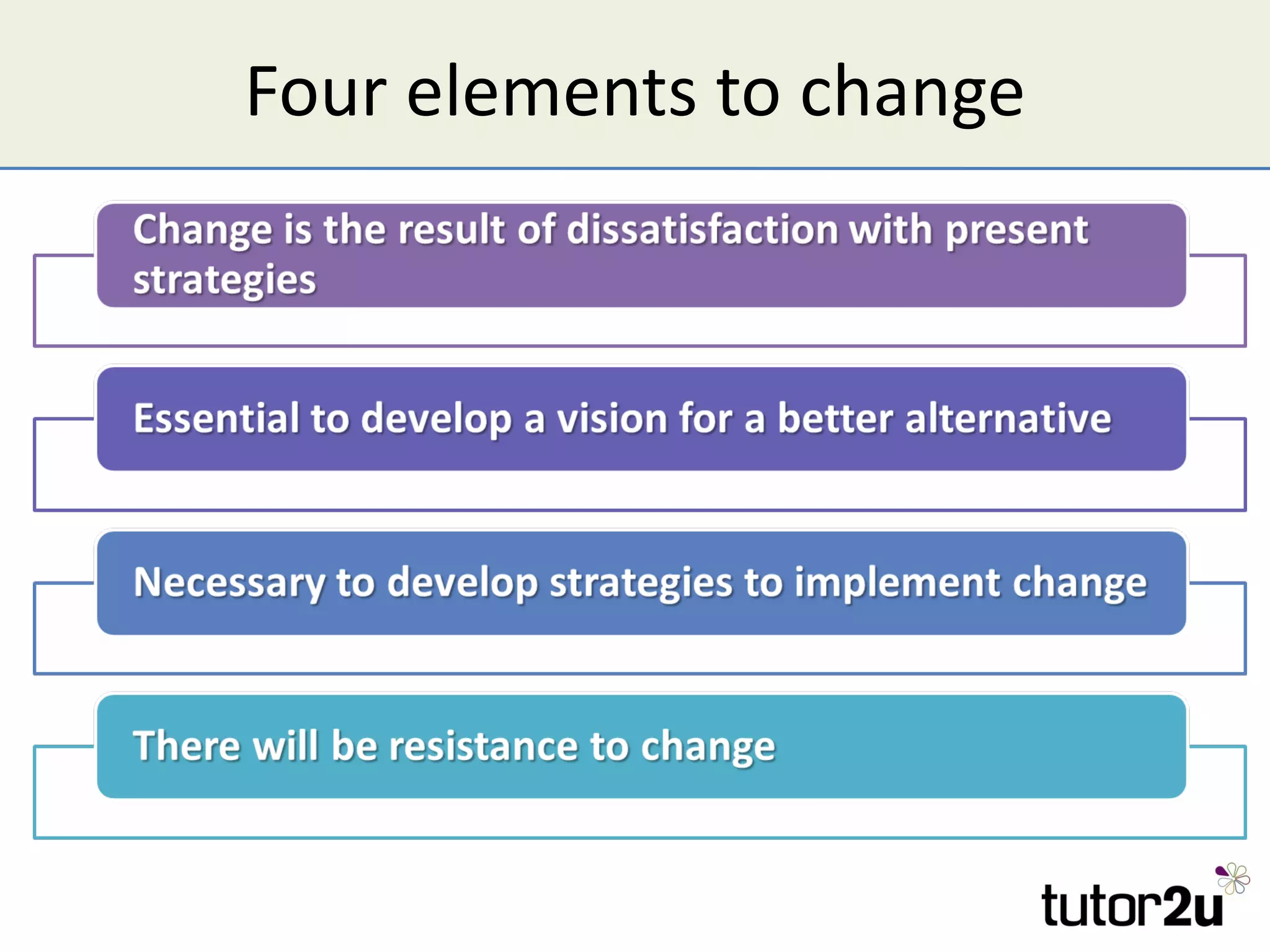
Four elements to change
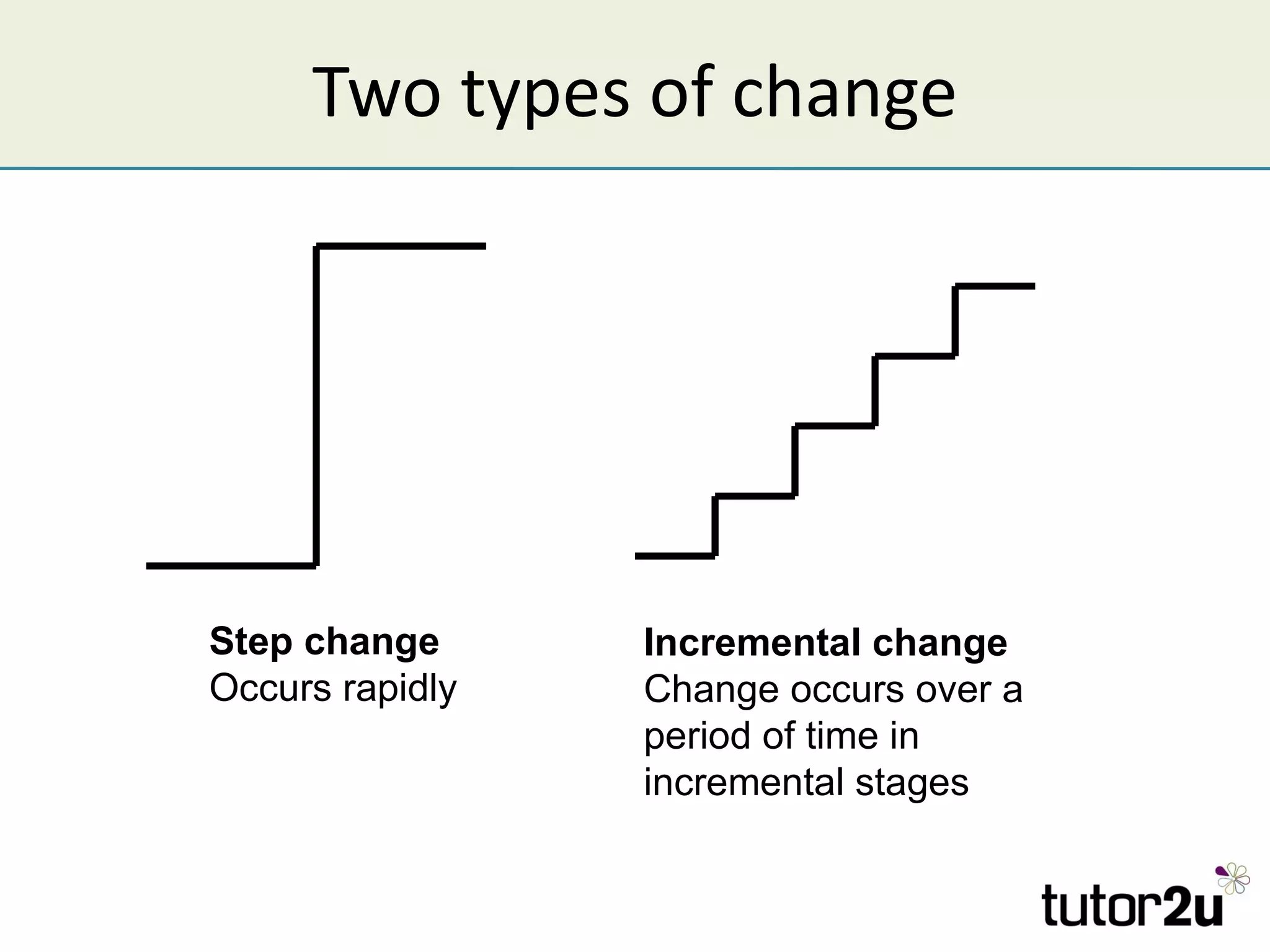
Two types of change


Step change      Incremental change
Occurs rapidly   Change occurs over a
                 period of time in
                 incremental stages
Step v incremental change
• Step change
  – Dramatic or radical change in one fell swoop
  – Radical alteration in the business
  – Gets it over with quickly
  – May require some coercion
• Incremental change
  – Ongoing piecemeal change which takes place
    as part of an organisation’s evolution and
    development
  – Tends to more inclusive
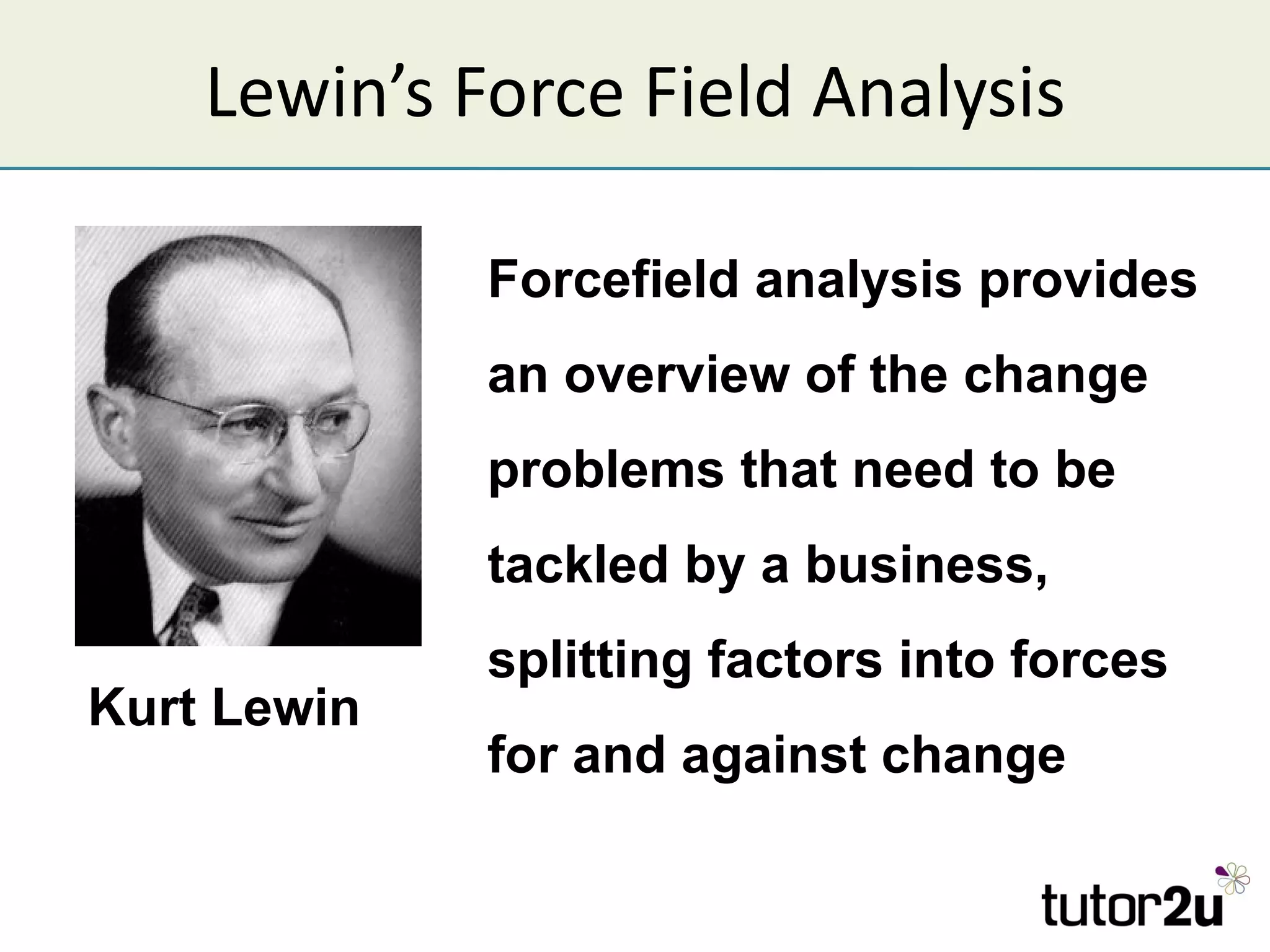
Lewin’s Force Field Analysis

             Forcefield analysis provides
             an overview of the change
             problems that need to be
             tackled by a business,
             splitting factors into forces
Kurt Lewin
             for and against change
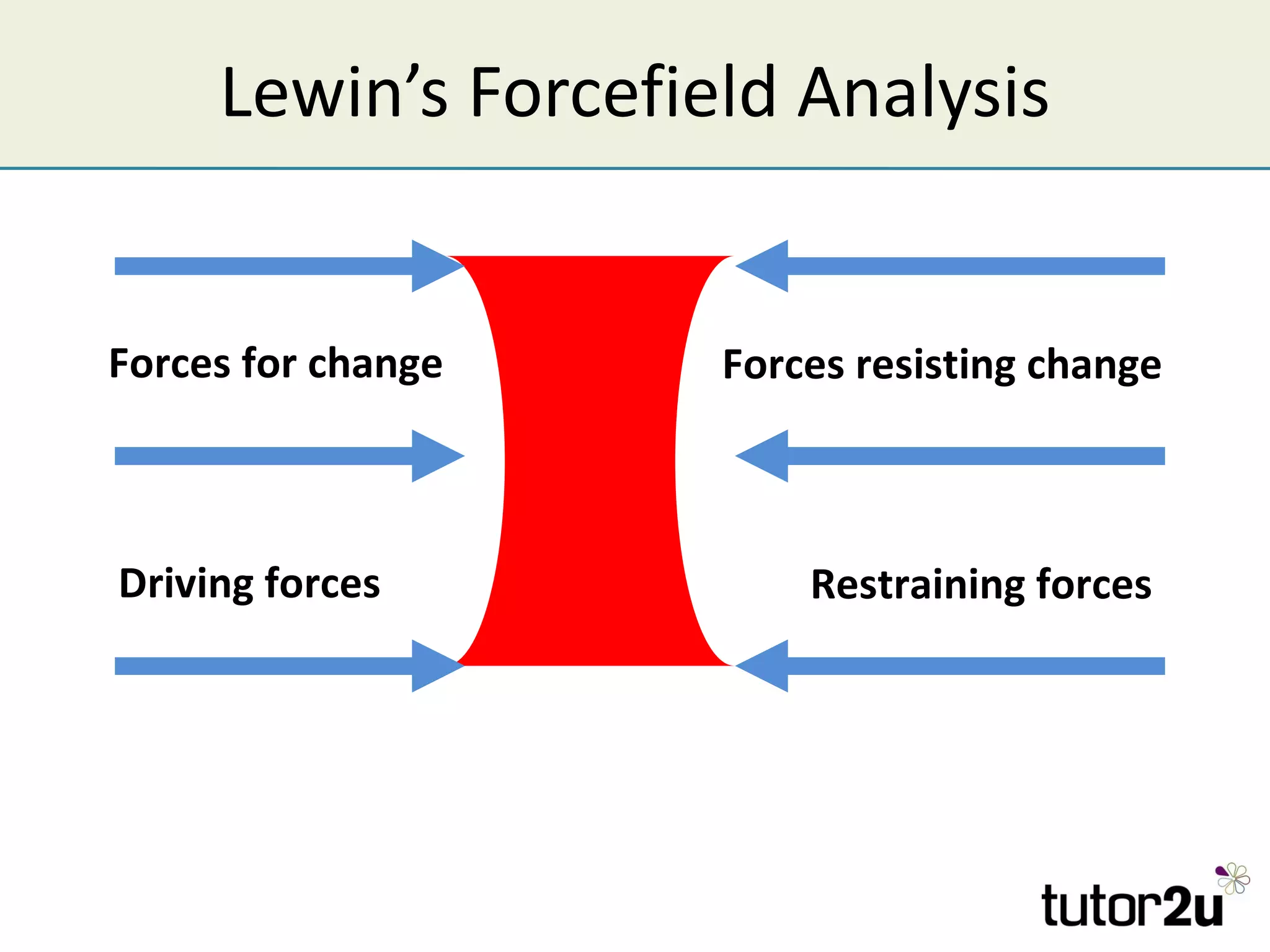
Lewin’s Forcefield Analysis


Forces for change    Forces resisting change


Driving forces           Restraining forces
Forcefield analysis
• There are forces driving change and forces
  restraining it
• Where there is an equilibrium between the two
  sets of forces there will be no change
• In order for change to occur the driving force
  must exceed the restraining force
• The analysis can be used to:
  –   Investigate the balance of power involved in an issue
  –   Identify the key stakeholders on the issue
  –   Identify opponents and allies
  –   Identify how to influence the target groups
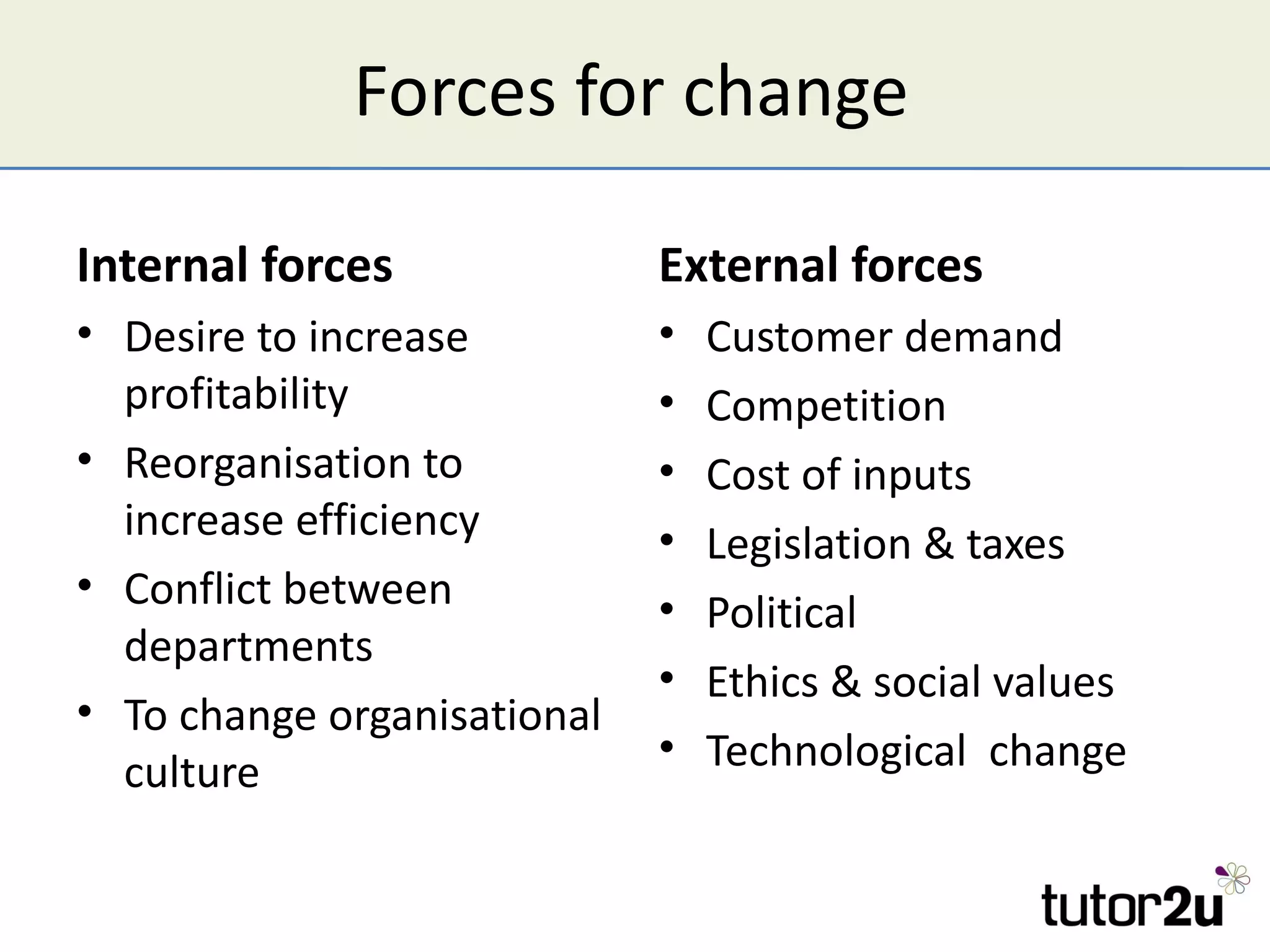
Forces for change

Internal forces              External forces
• Desire to increase         •   Customer demand
  profitability              •   Competition
• Reorganisation to          •   Cost of inputs
  increase efficiency        •   Legislation & taxes
• Conflict between           •   Political
  departments
                             •   Ethics & social values
• To change organisational
                             •   Technological change
  culture
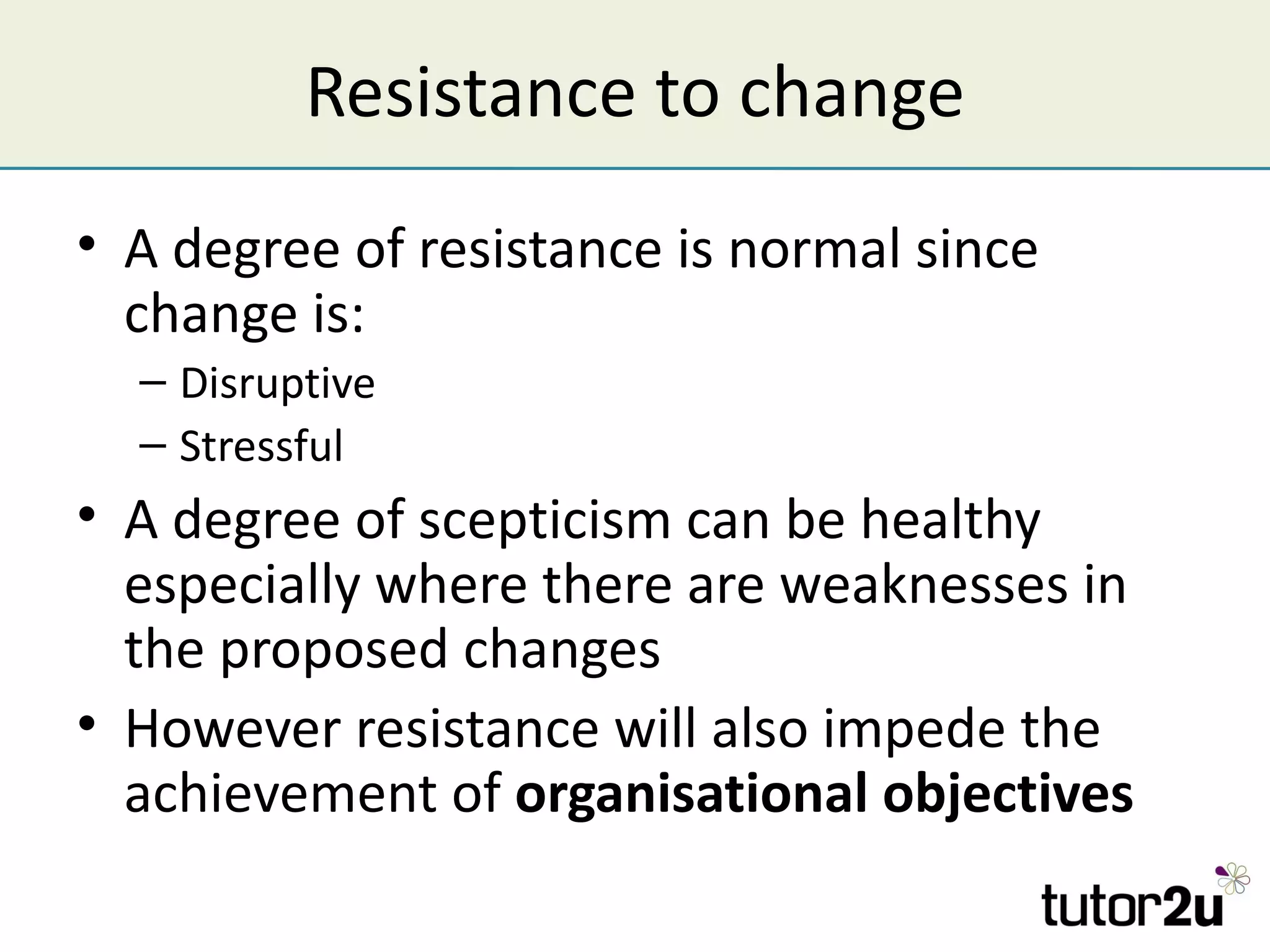
Resistance to change
• A degree of resistance is normal since
  change is:
  – Disruptive
  – Stressful
• A degree of scepticism can be healthy
  especially where there are weaknesses in
  the proposed changes
• However resistance will also impede the
  achievement of organisational objectives
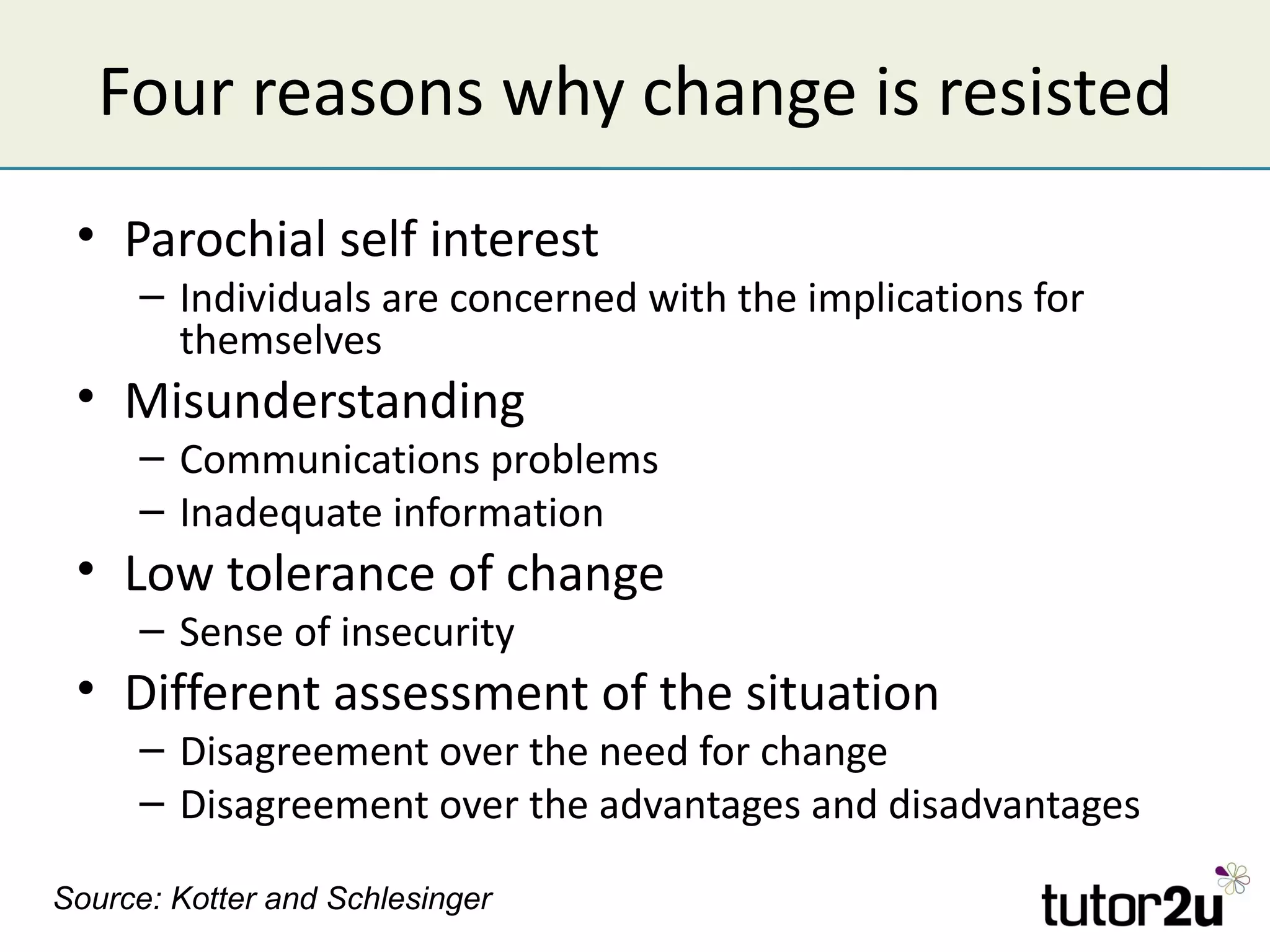
Four reasons why change is resisted
 • Parochial self interest
     – Individuals are concerned with the implications for
       themselves
 • Misunderstanding
     – Communications problems
     – Inadequate information
 • Low tolerance of change
     – Sense of insecurity
 • Different assessment of the situation
     – Disagreement over the need for change
     – Disagreement over the advantages and disadvantages

Source: Kotter and Schlesinger
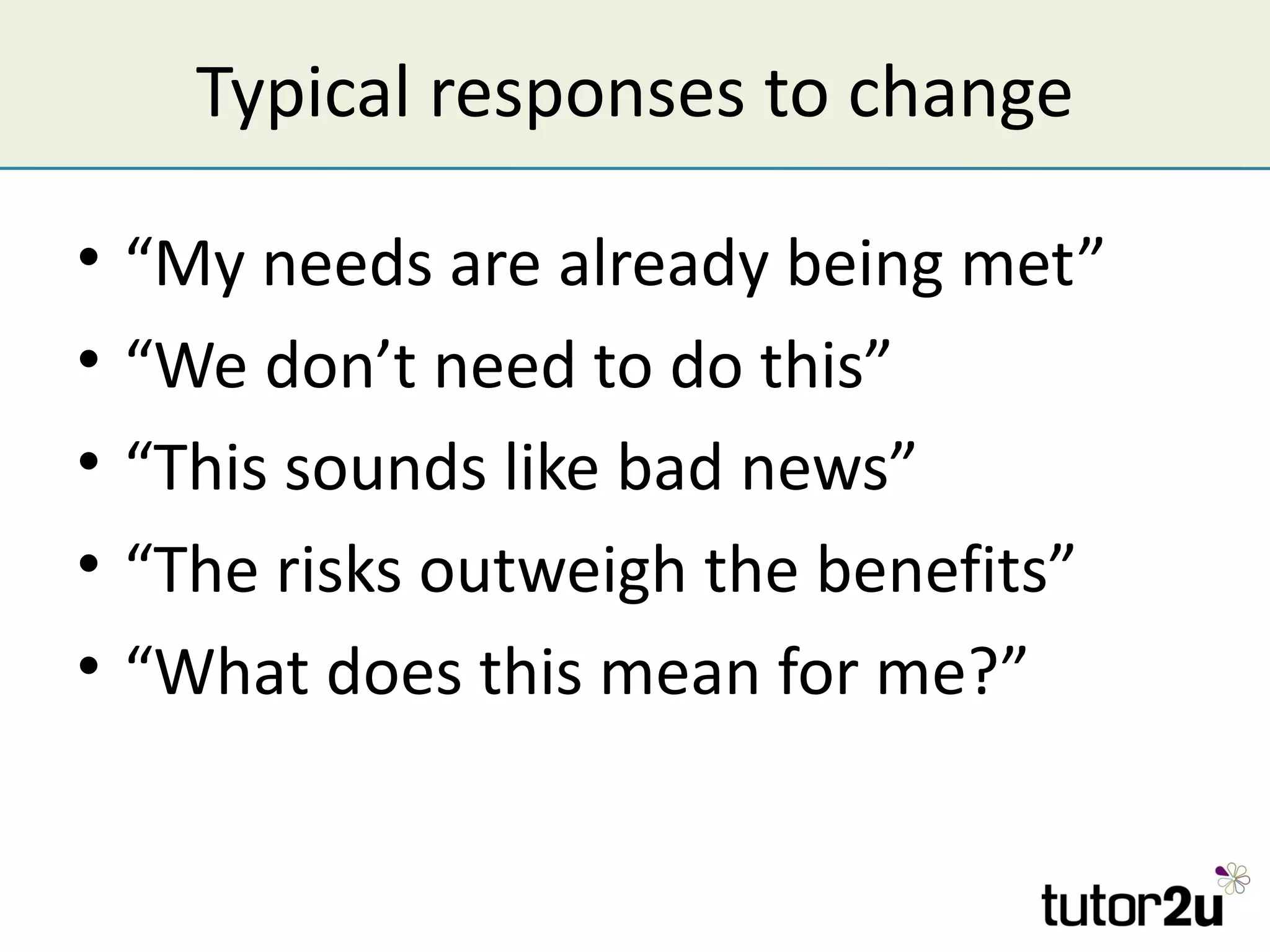
Typical responses to change

•   “My needs are already being met”
•   “We don’t need to do this”
•   “This sounds like bad news”
•   “The risks outweigh the benefits”
•   “What does this mean for me?”
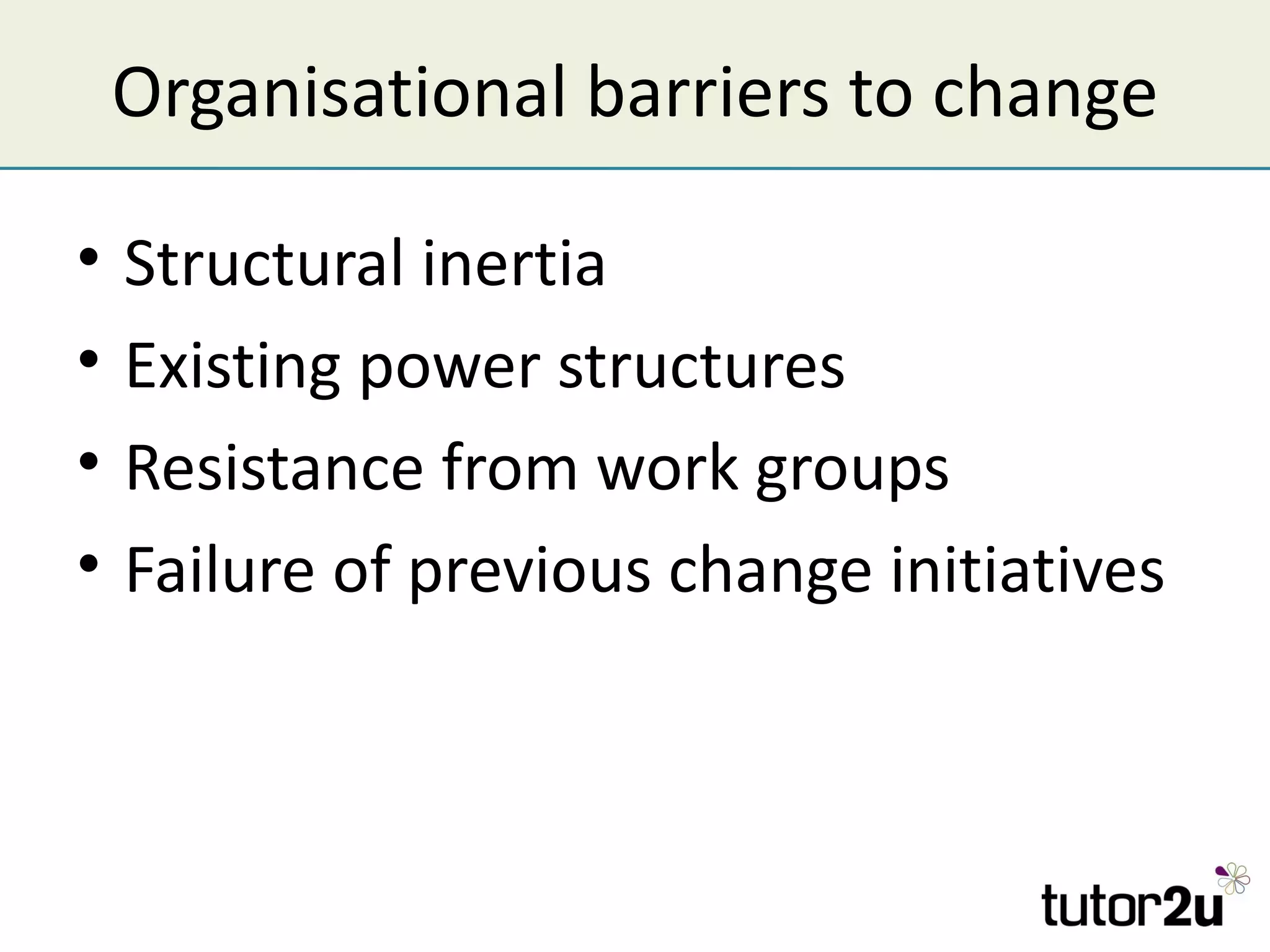
Organisational barriers to change

•   Structural inertia
•   Existing power structures
•   Resistance from work groups
•   Failure of previous change initiatives
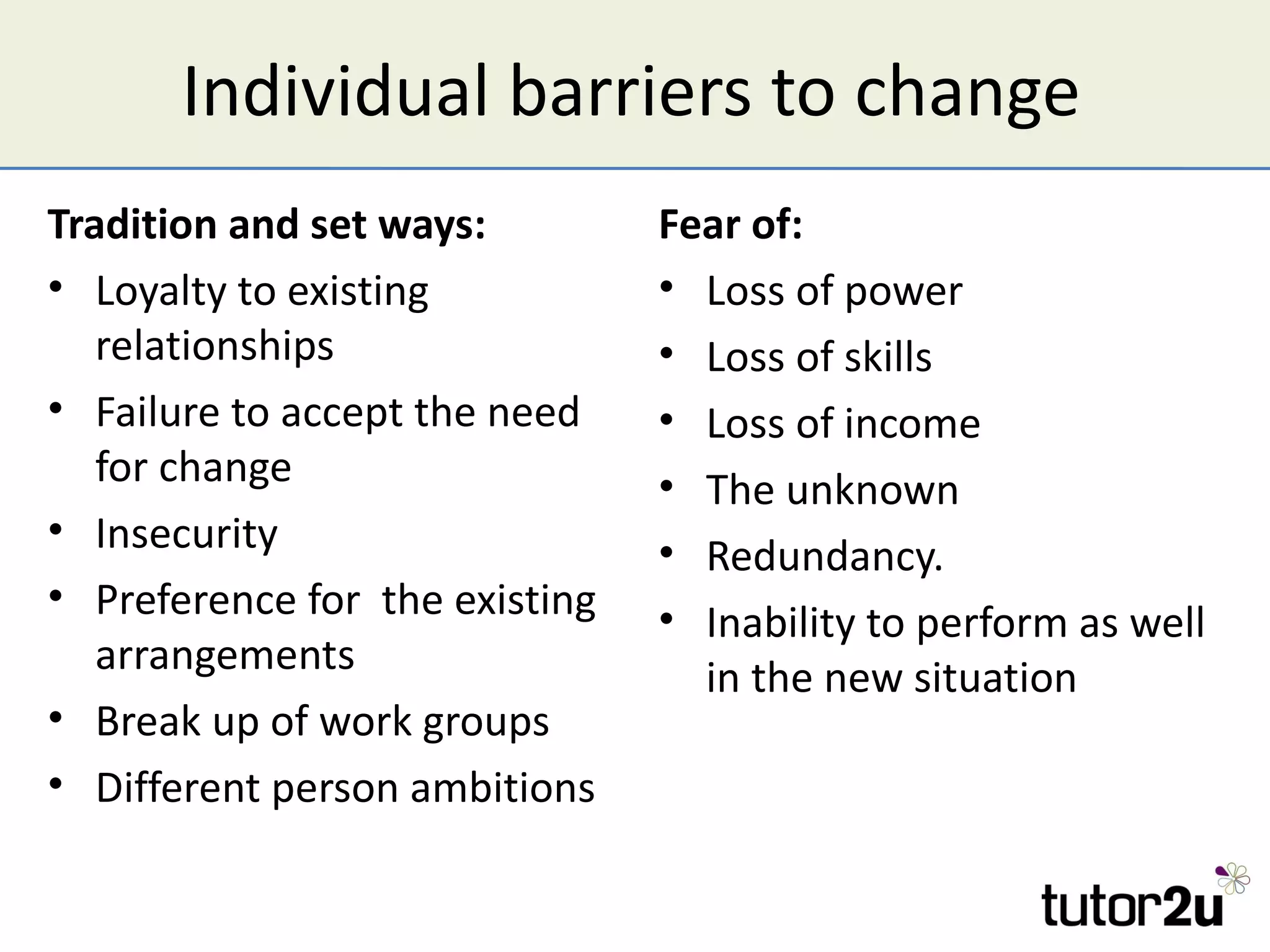
Individual barriers to change
Tradition and set ways:         Fear of:
• Loyalty to existing           • Loss of power
   relationships                • Loss of skills
• Failure to accept the need    • Loss of income
   for change                   • The unknown
• Insecurity                    • Redundancy.
• Preference for the existing   • Inability to perform as well
   arrangements                   in the new situation
• Break up of work groups
• Different person ambitions
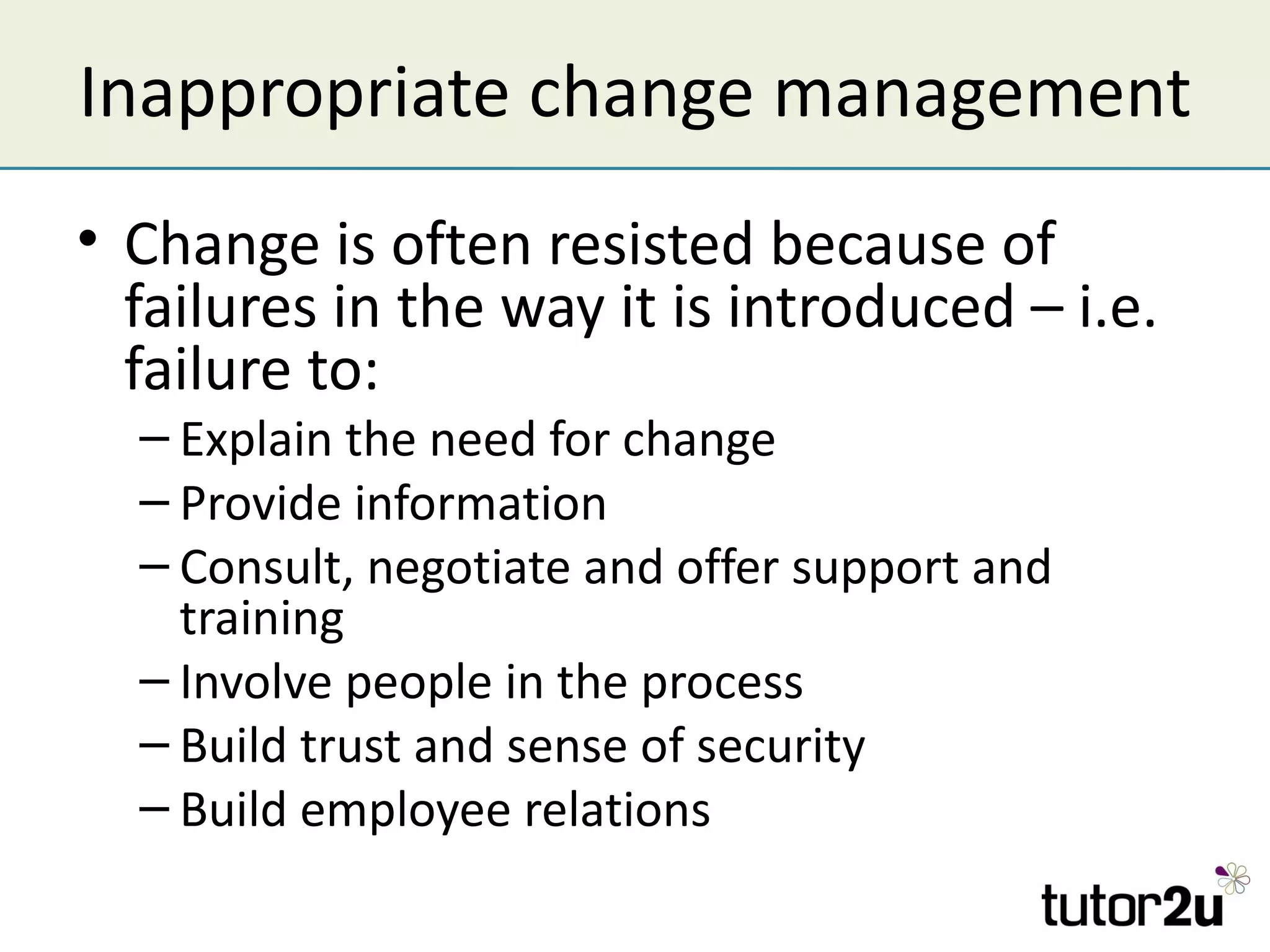
Inappropriate change management
• Change is often resisted because of
  failures in the way it is introduced – i.e.
  failure to:
  – Explain the need for change
  – Provide information
  – Consult, negotiate and offer support and
    training
  – Involve people in the process
  – Build trust and sense of security
  – Build employee relations
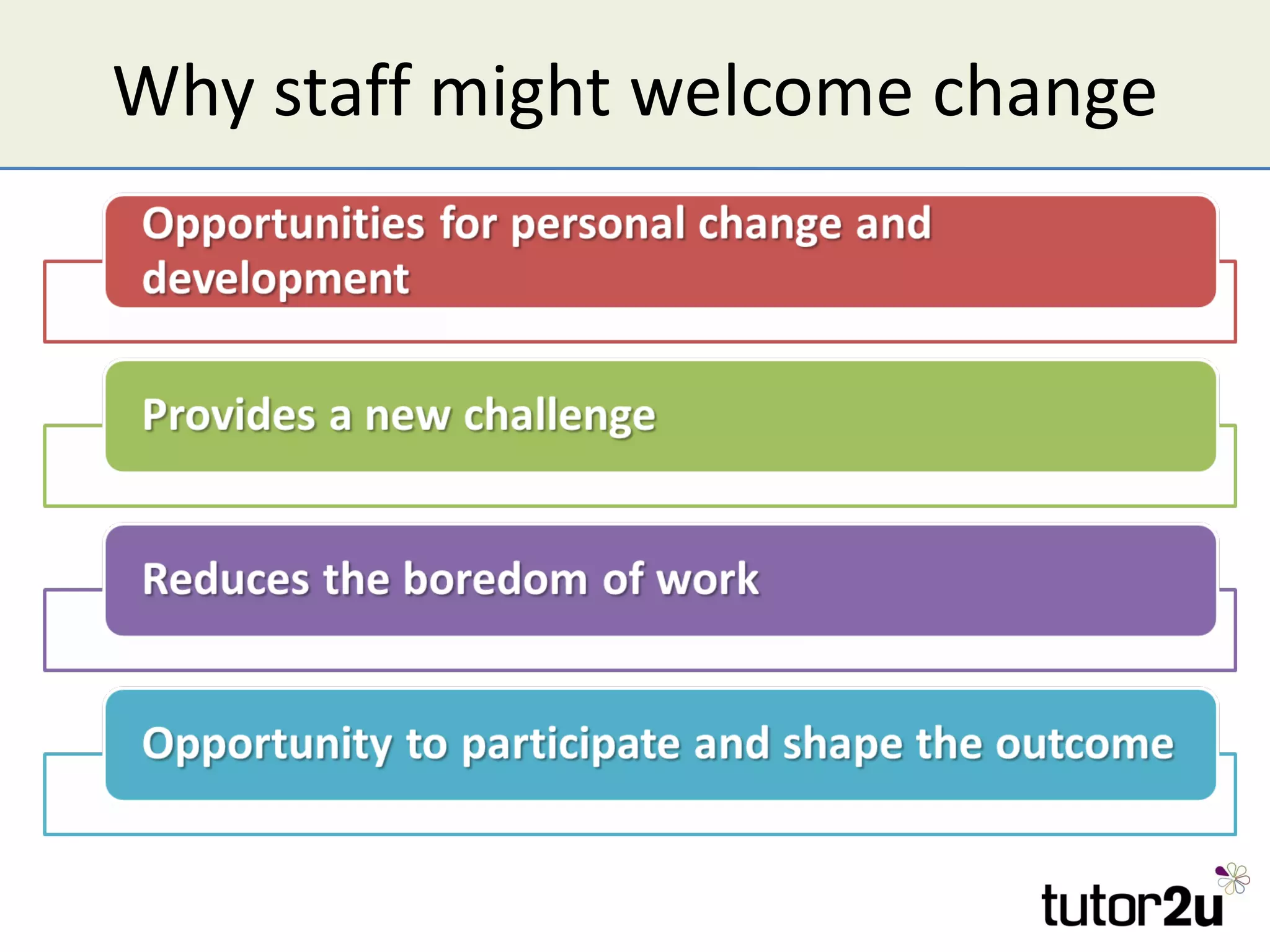
Why staff might welcome change
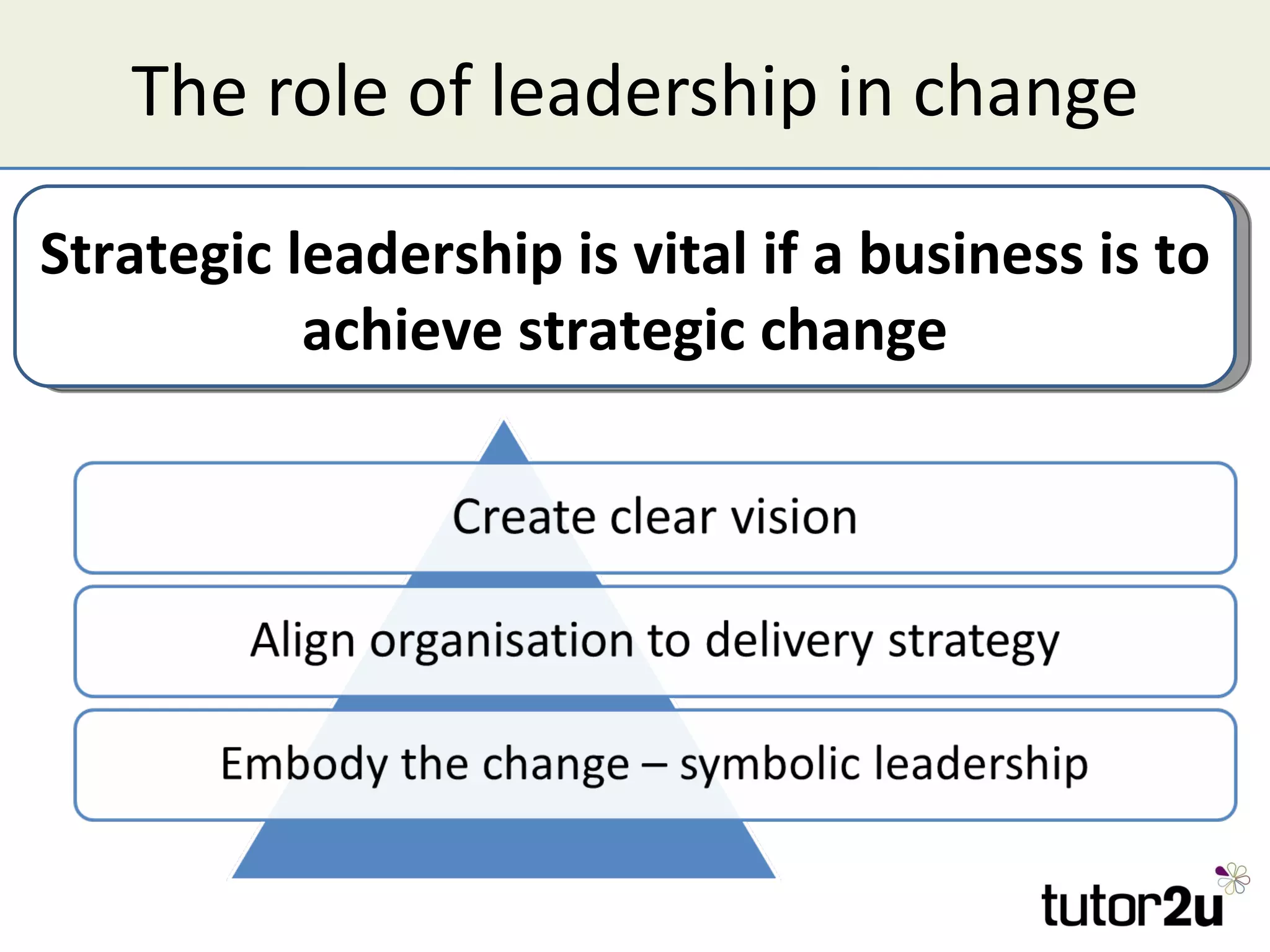
The role of leadership in change

Strategic leadership is vital if a business is to
           achieve strategic change
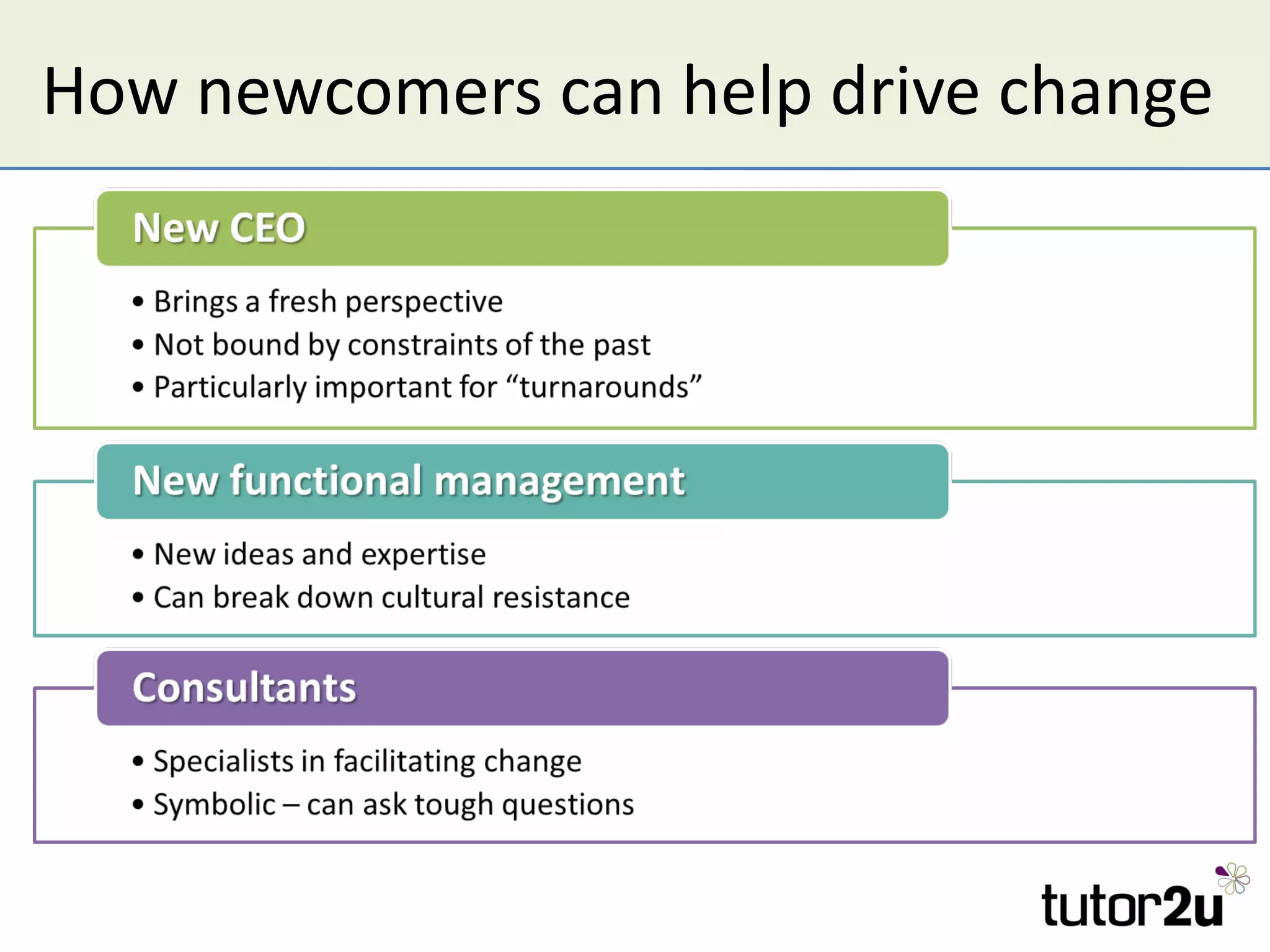
How newcomers can help drive change
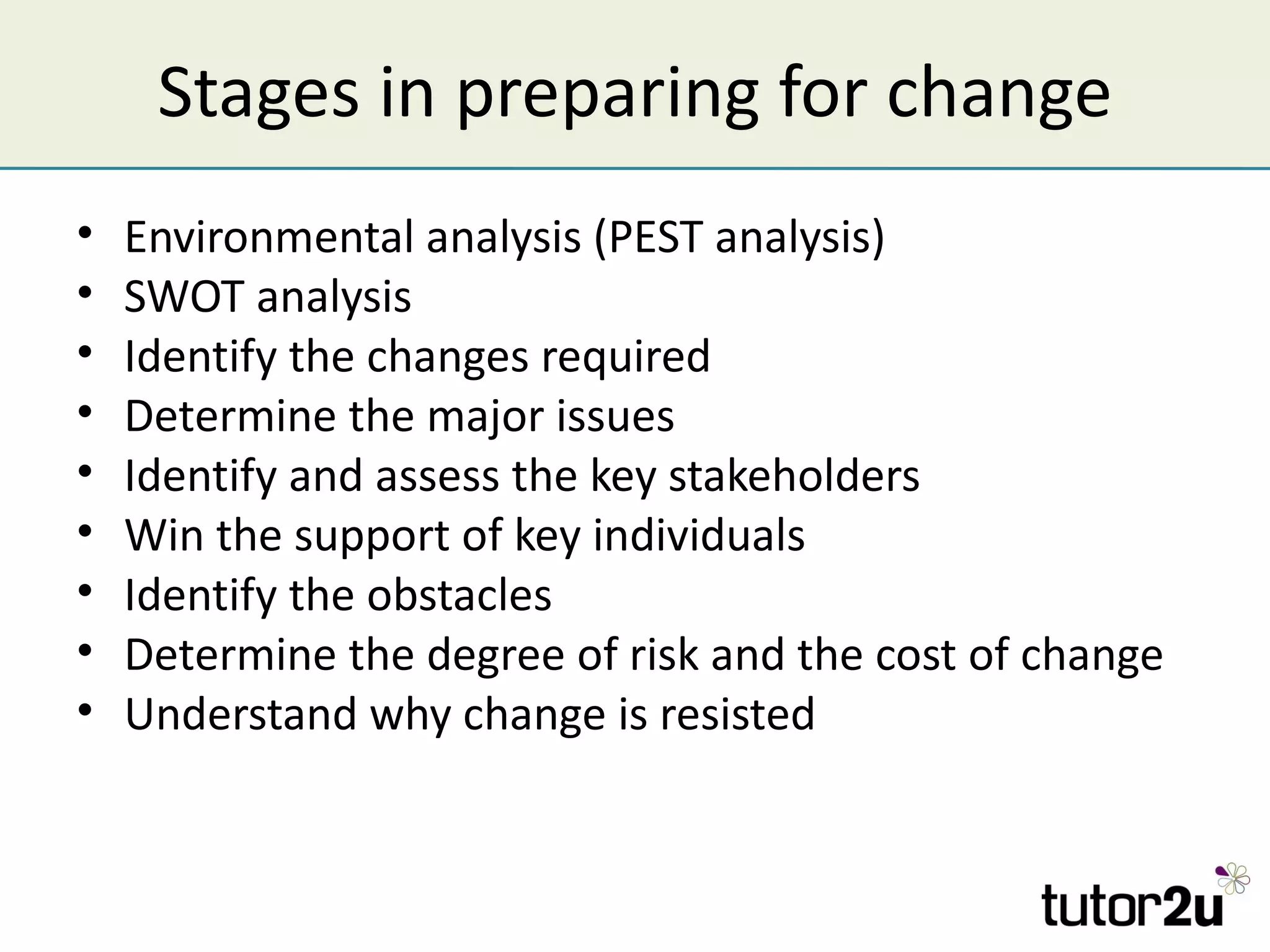
Stages in preparing for change
•   Environmental analysis (PEST analysis)
•   SWOT analysis
•   Identify the changes required
•   Determine the major issues
•   Identify and assess the key stakeholders
•   Win the support of key individuals
•   Identify the obstacles
•   Determine the degree of risk and the cost of change
•   Understand why change is resisted
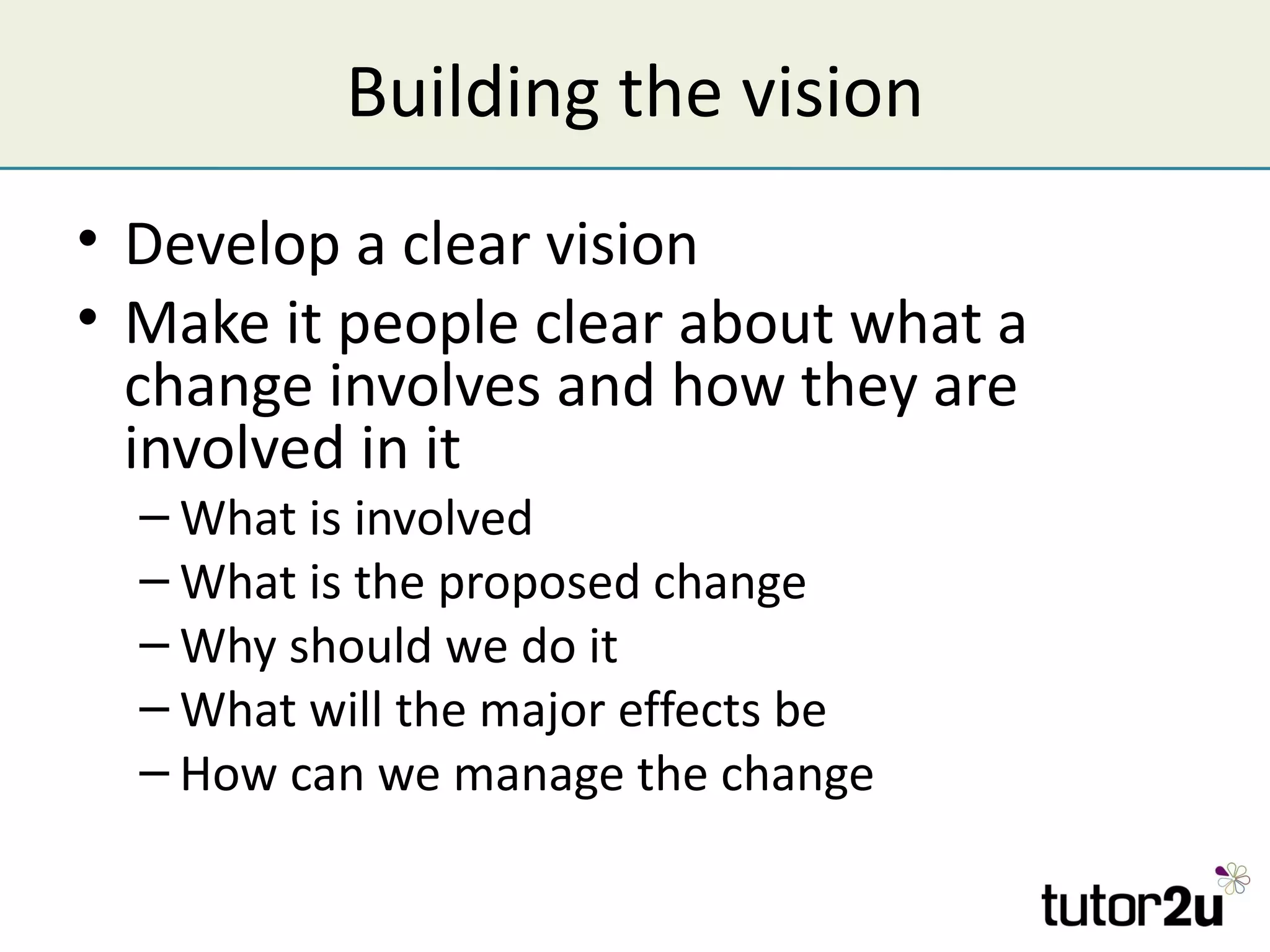
Building the vision
• Develop a clear vision
• Make it people clear about what a
  change involves and how they are
  involved in it
  – What is involved
  – What is the proposed change
  – Why should we do it
  – What will the major effects be
  – How can we manage the change
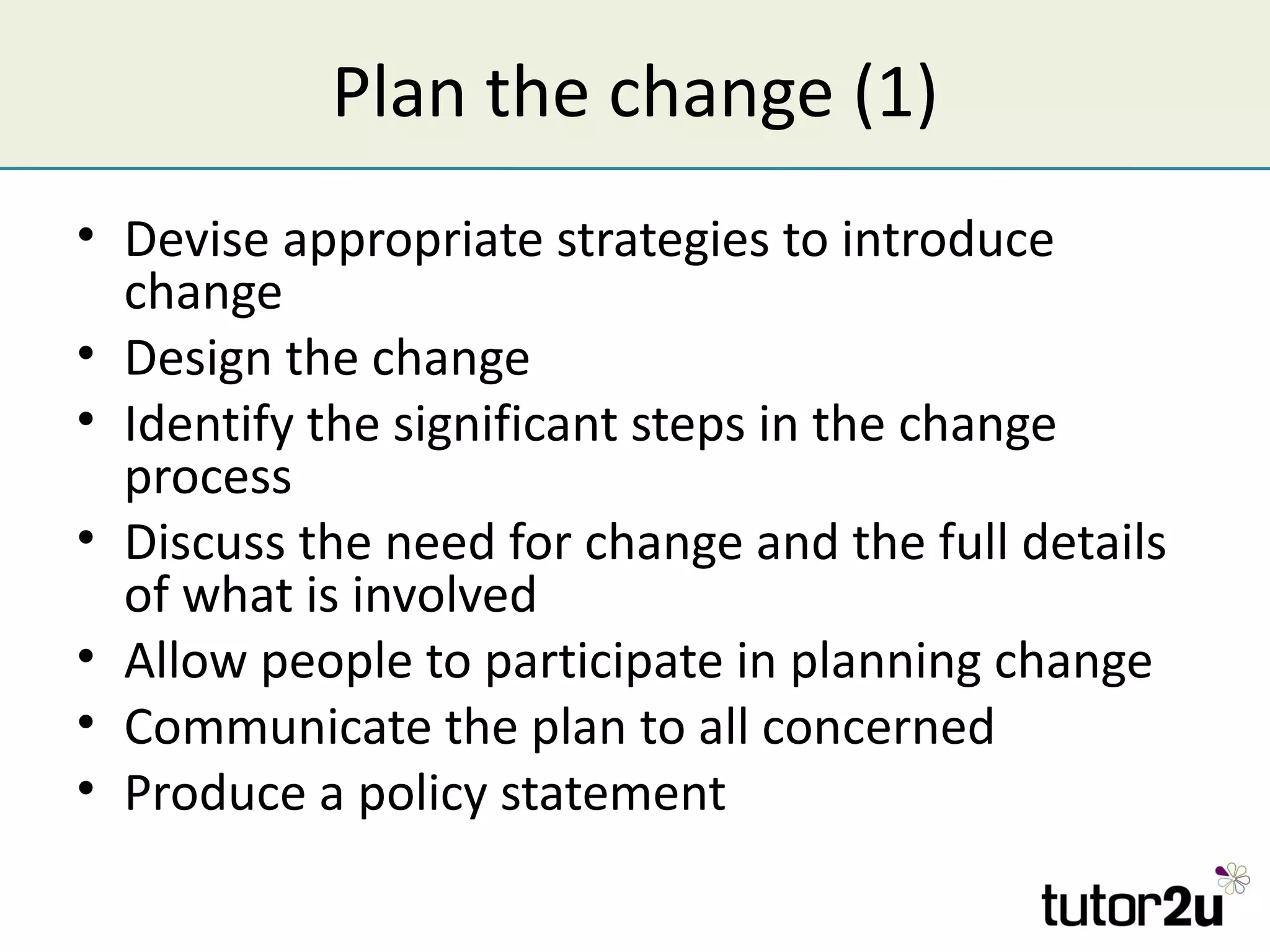
Plan the change (1)
• Devise appropriate strategies to introduce
  change
• Design the change
• Identify the significant steps in the change
  process
• Discuss the need for change and the full details
  of what is involved
• Allow people to participate in planning change
• Communicate the plan to all concerned
• Produce a policy statement
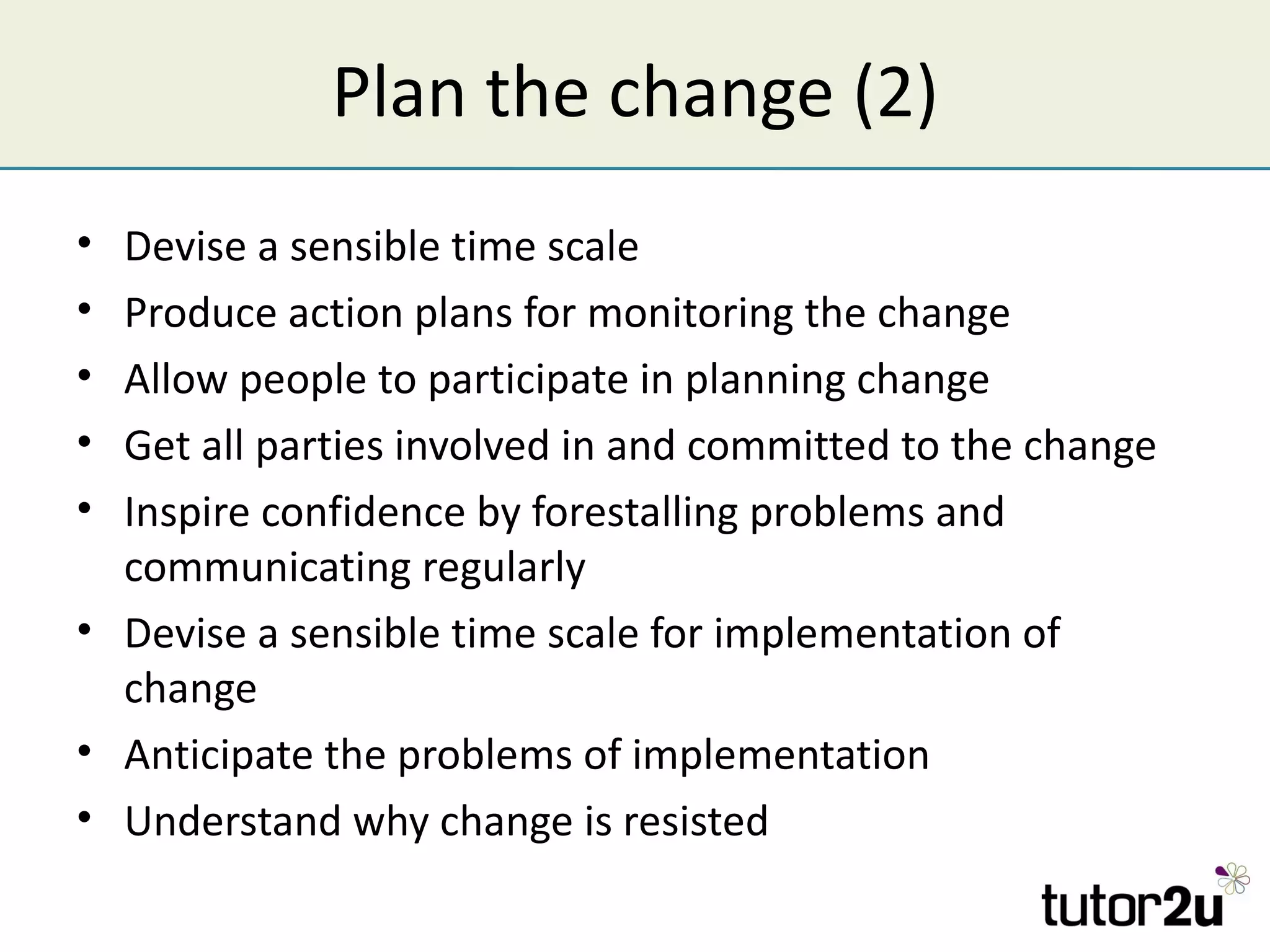
Plan the change (2)
• Devise a sensible time scale
• Produce action plans for monitoring the change
• Allow people to participate in planning change
• Get all parties involved in and committed to the change
• Inspire confidence by forestalling problems and
  communicating regularly
• Devise a sensible time scale for implementation of
  change
• Anticipate the problems of implementation
• Understand why change is resisted
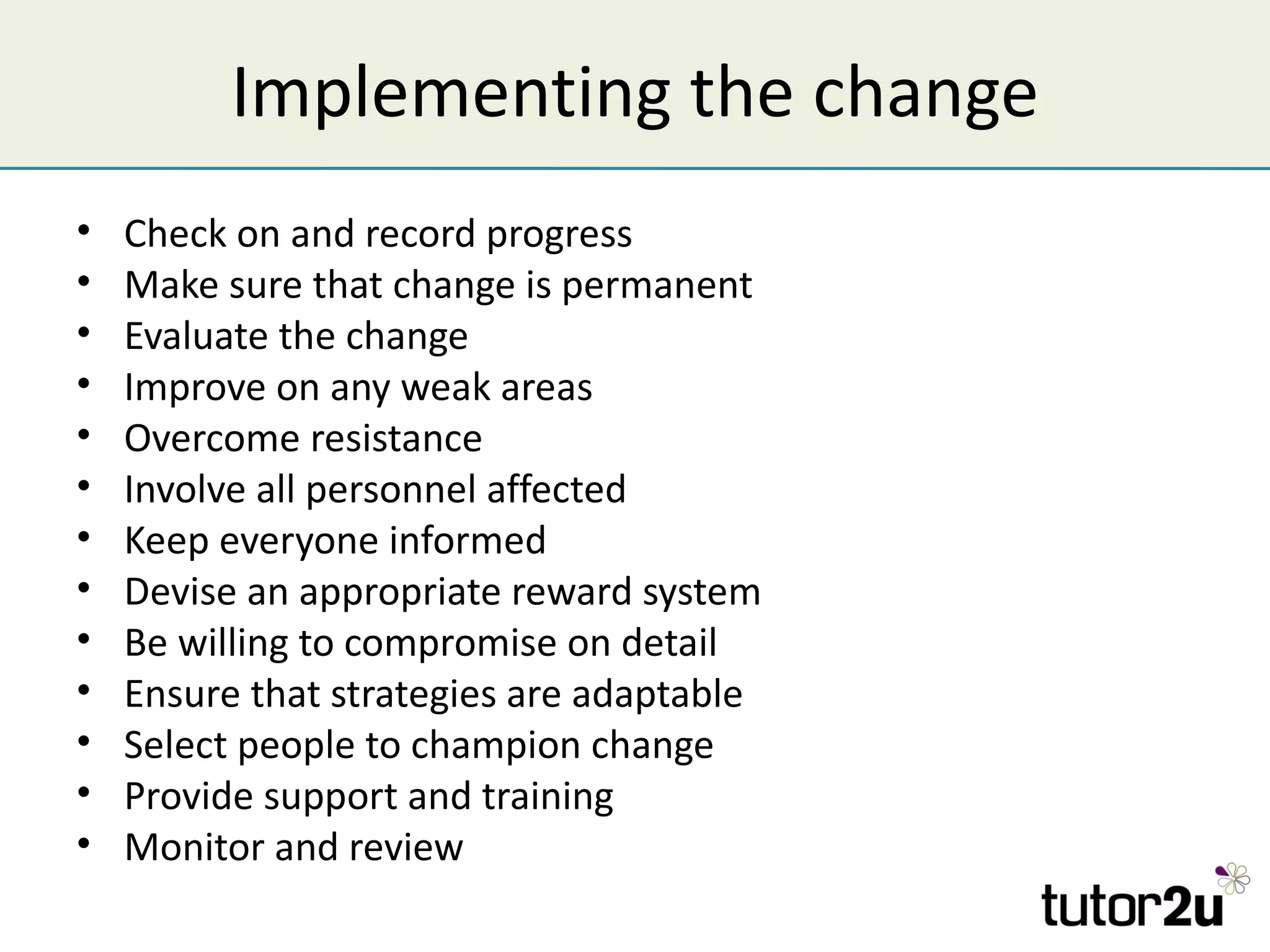
Implementing the change
•   Check on and record progress
•   Make sure that change is permanent
•   Evaluate the change
•   Improve on any weak areas
•   Overcome resistance
•   Involve all personnel affected
•   Keep everyone informed
•   Devise an appropriate reward system
•   Be willing to compromise on detail
•   Ensure that strategies are adaptable
•   Select people to champion change
•   Provide support and training
•   Monitor and review
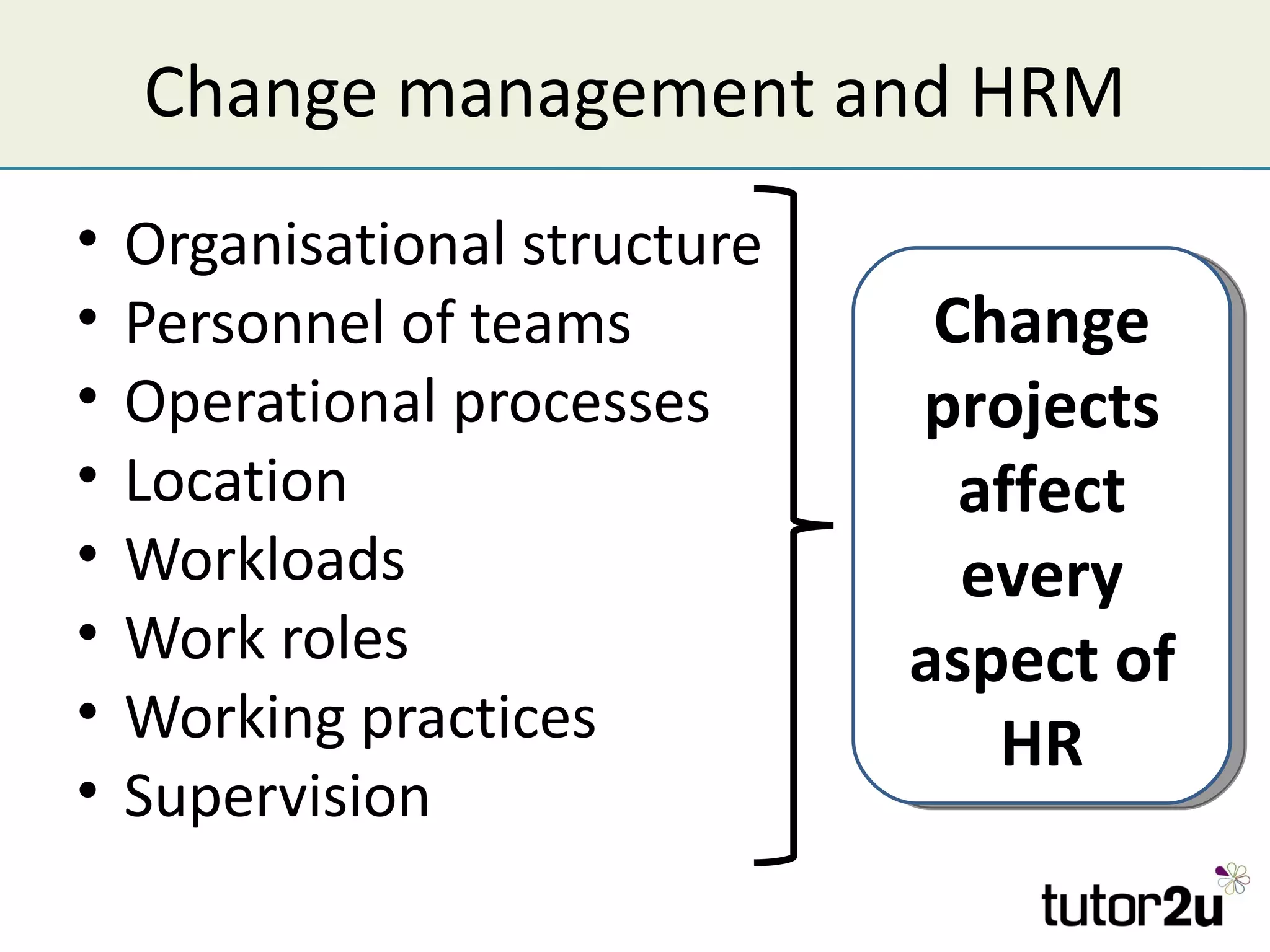
Change management and HRM
•   Organisational structure
•   Personnel of teams          Change
•   Operational processes      projects
•   Location                     affect
•   Workloads                    every
•   Work roles                 aspect of
•   Working practices             HR
•   Supervision
Agile businesses & change (1)

   The CIPD asked HRM
    professionals what
 capabilities organisations
need to be changeable…here
      are the results
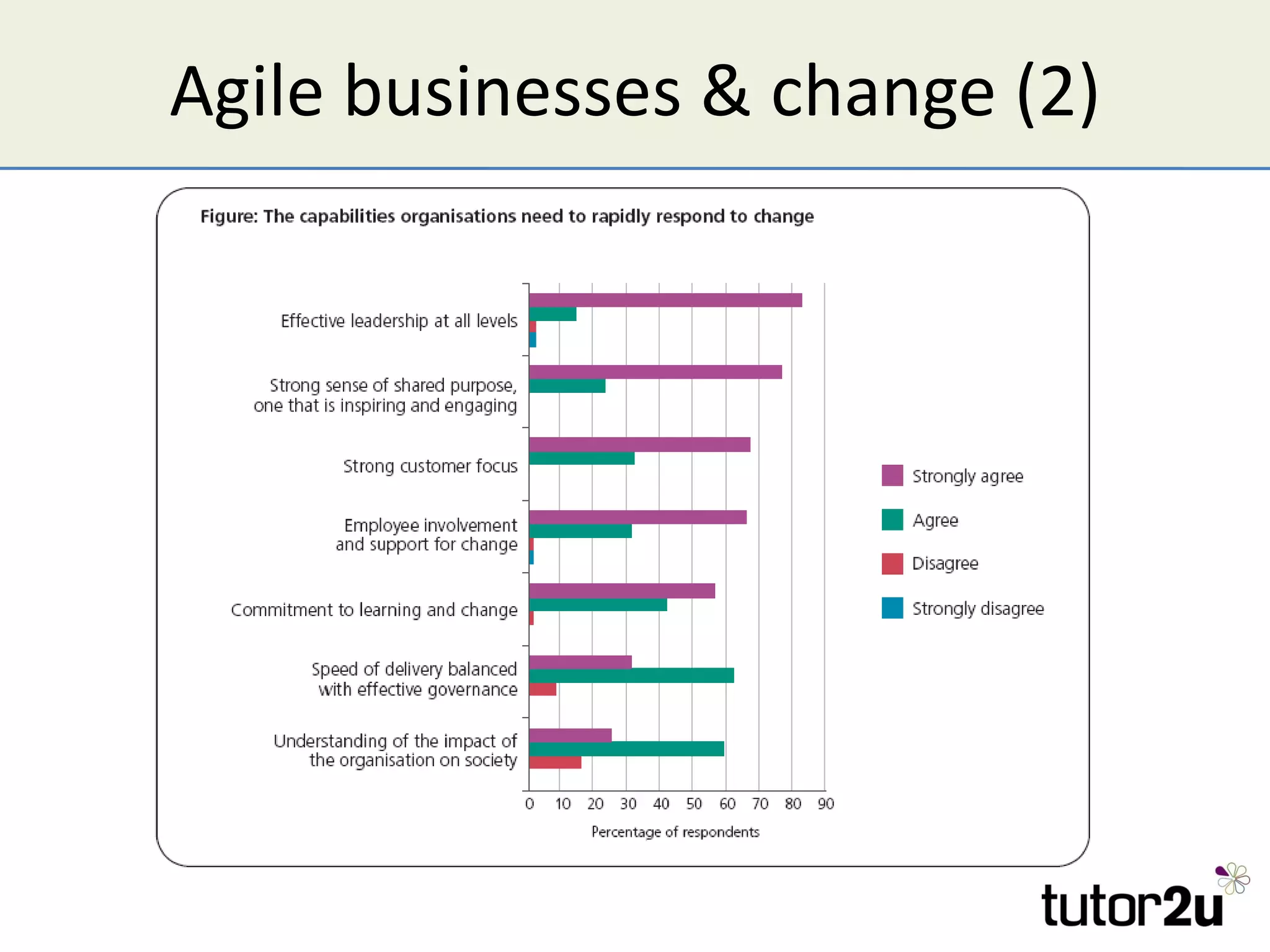
Agile businesses & change (2)
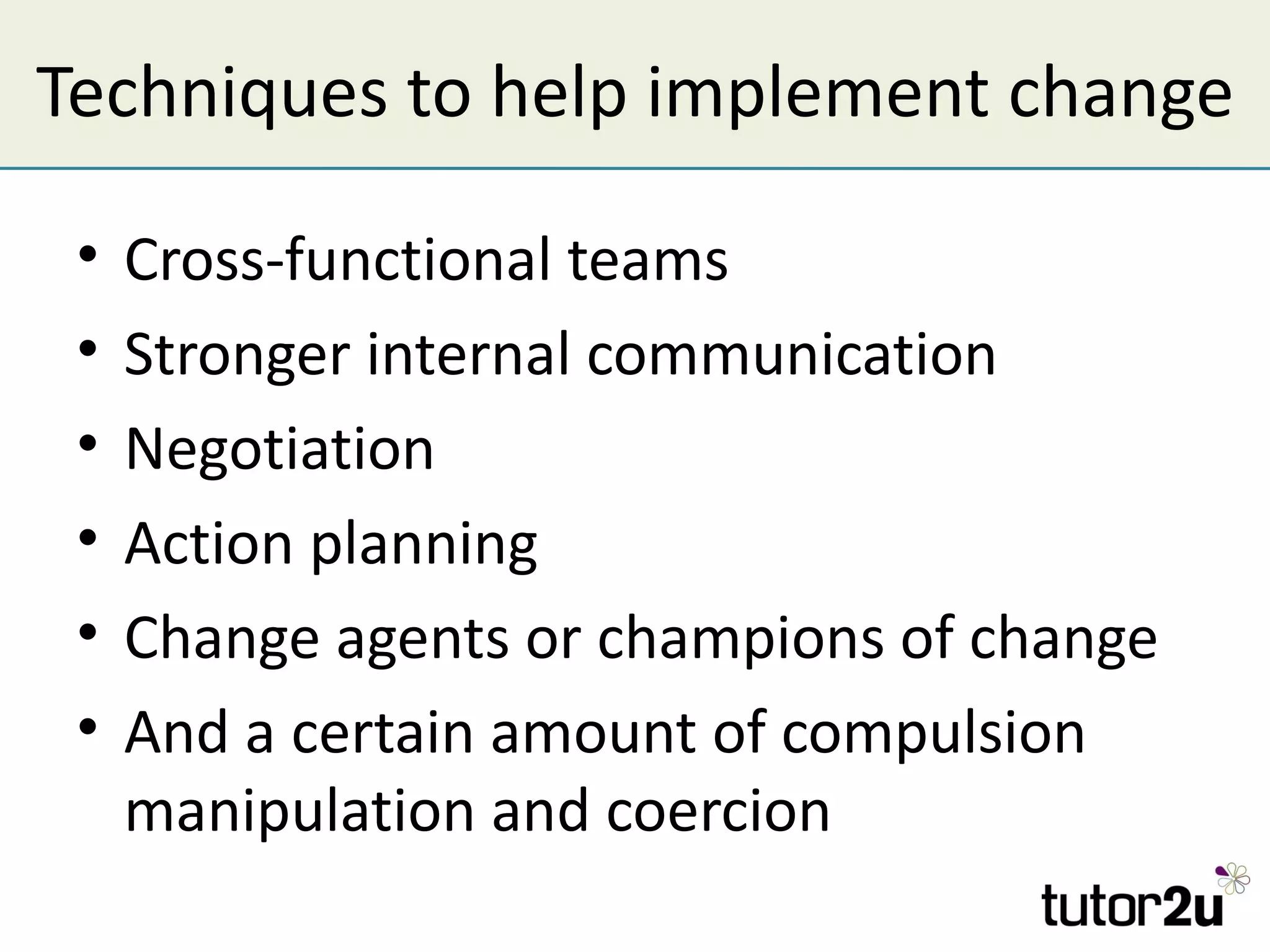
Techniques to help implement change

 •   Cross-functional teams
 •   Stronger internal communication
 •   Negotiation
 •   Action planning
 •   Change agents or champions of change
 •   And a certain amount of compulsion
     manipulation and coercion
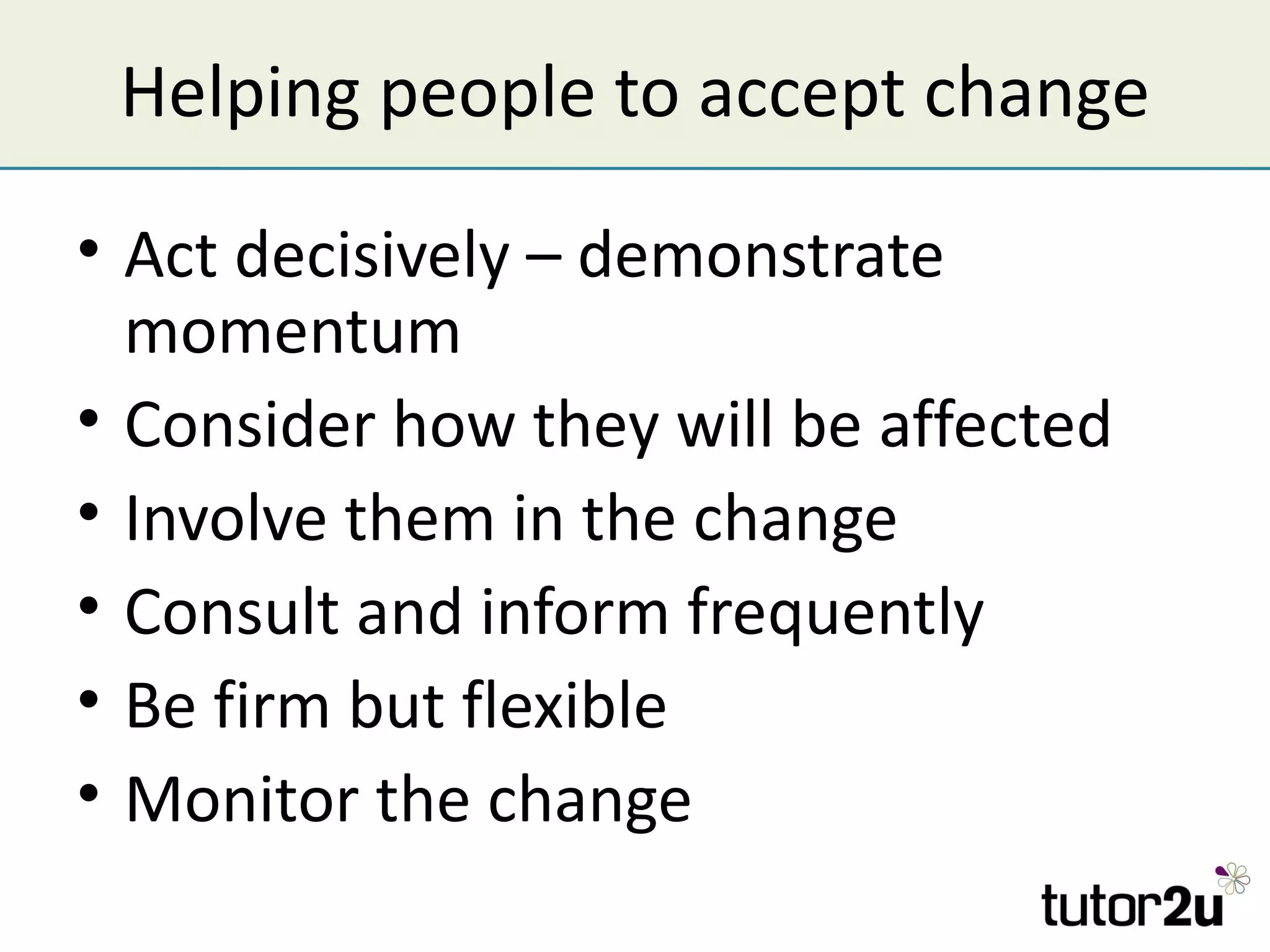
Helping people to accept change

• Act decisively – demonstrate
  momentum
• Consider how they will be affected
• Involve them in the change
• Consult and inform frequently
• Be firm but flexible
• Monitor the change
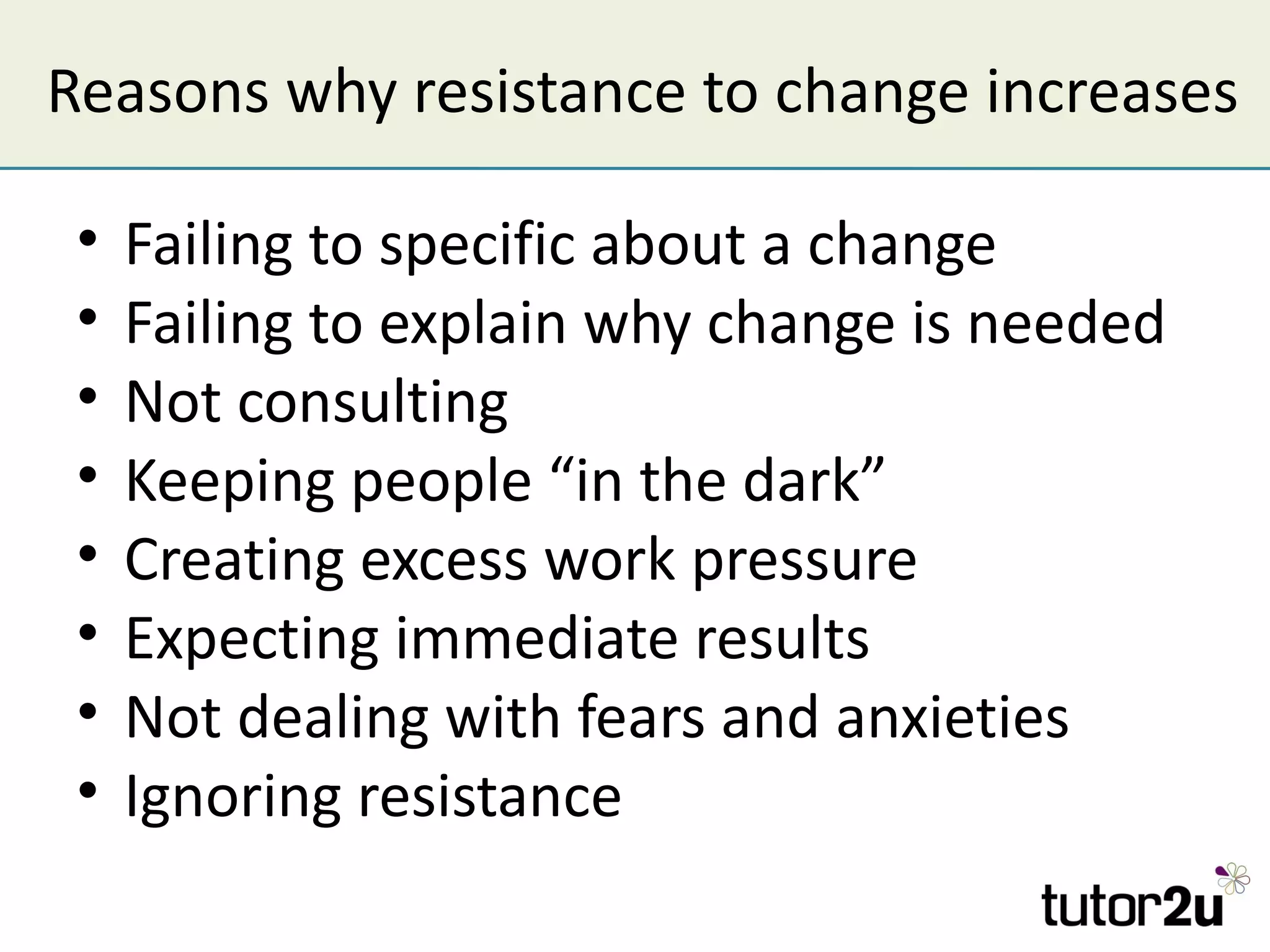
Reasons why resistance to change increases

 •   Failing to specific about a change
 •   Failing to explain why change is needed
 •   Not consulting
 •   Keeping people “in the dark”
 •   Creating excess work pressure
 •   Expecting immediate results
 •   Not dealing with fears and anxieties
 •   Ignoring resistance
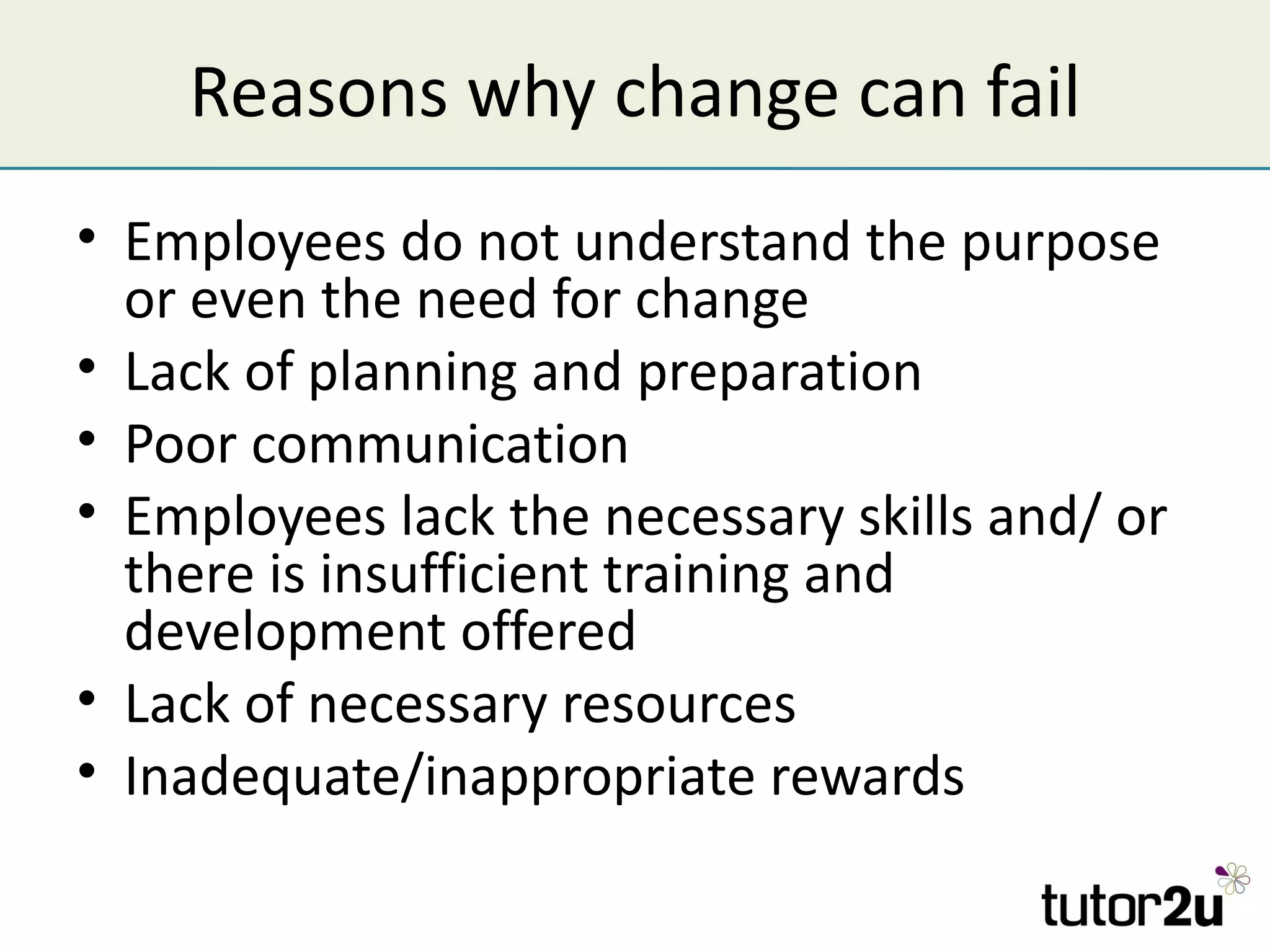
Reasons why change can fail
• Employees do not understand the purpose
  or even the need for change
• Lack of planning and preparation
• Poor communication
• Employees lack the necessary skills and/ or
  there is insufficient training and
  development offered
• Lack of necessary resources
• Inadequate/inappropriate rewards
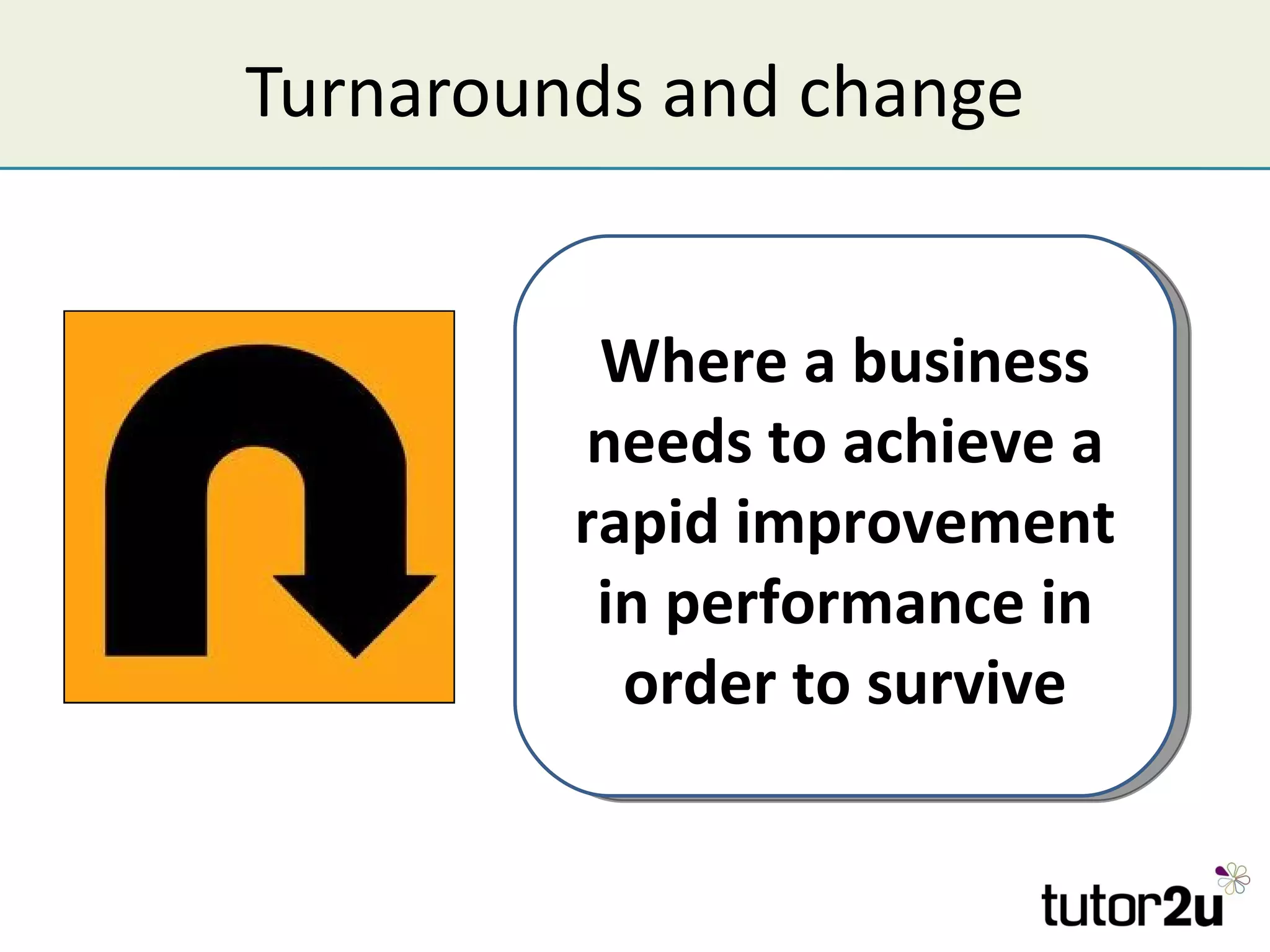
Turnarounds and change


          Where a business
         needs to achieve a
         rapid improvement
          in performance in
           order to survive
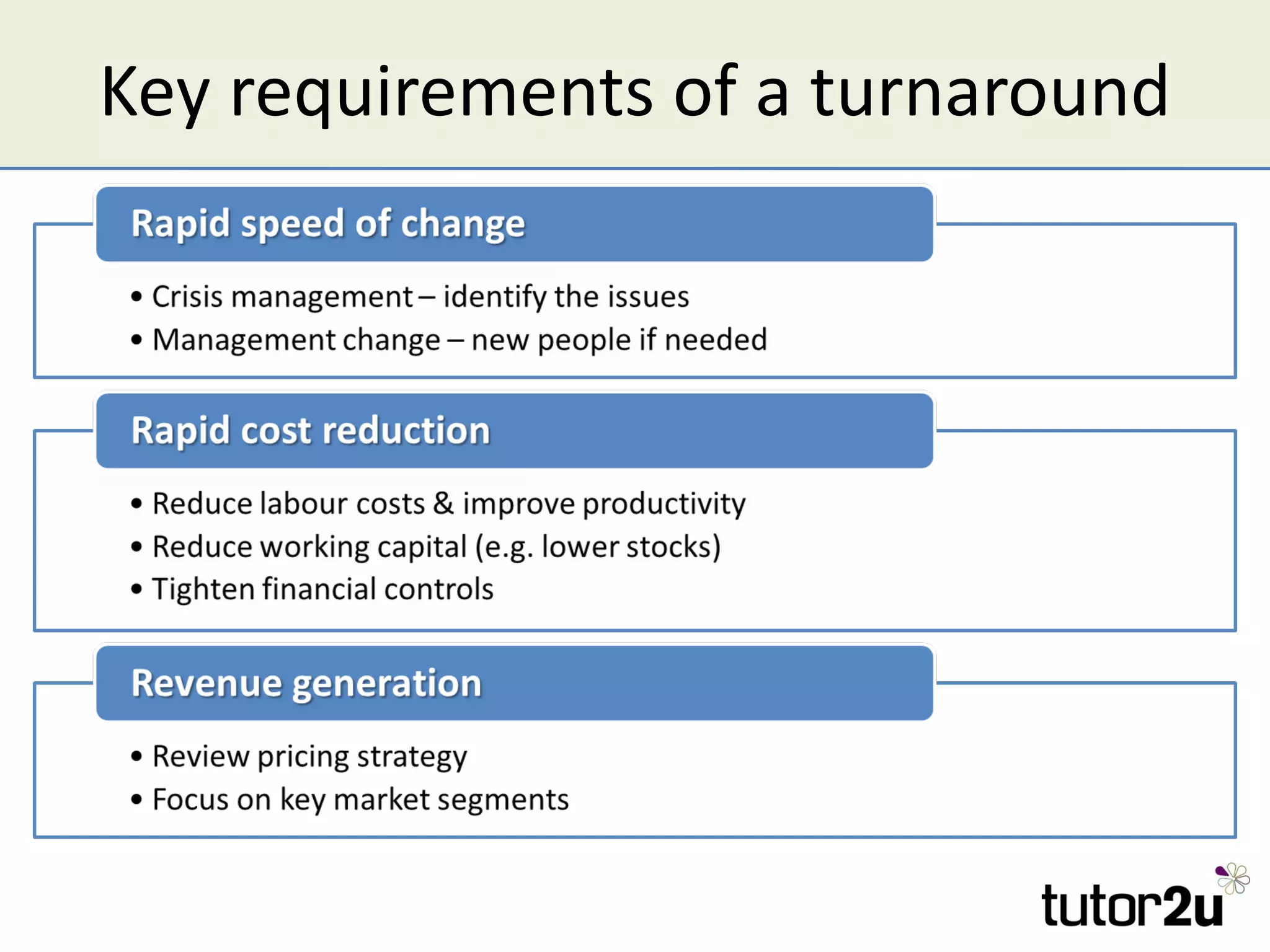
Key requirements of a turnaround
Keep up-to-date with business
stories, resources, quizzes and
 worksheets for your business
    course. Click the logo!

Change Management

  • 1.
  • 2.
    Examples of change– Royal Mail In its Victorian heyday, Royal Mail was envied for its speed and reliability Recent decades: suffered management crises, industrial disputes and lost profits Struggling to modernise fast enough to keep pace with loss of letters volume Moya Greene to electronic media Strategy now to improve efficiency and profitability to enable privatisation http://www.bbc.co.uk/news/10175621
  • 3.
    Examples of change– Nokia Nokia has seen its market share in the mobile phone market plummet as competitors like Apple, Samsung and HTC have taken market share through smartphone innovation. Elop joined Nokia in 2010 and began a strategic review. He famously likened Nokia's position as being like standing on a Stephen Elop burning platform. Feb 2011: Elop announced a new strategy for Nokia - to partner with Microsoft and abandon Nokia's Symbian operating http://www.bbc.co.uk/news/business-16953411 system.
  • 4.
    Examples of change– Starbucks When Starbucks share price fell by 40% in 2007, Starbucks turned to its founder Howard Schultz to turn the business around. Schultz was brutal about what had gone wrong and what needed to be done to fix the business. "When you succeed at this level for so long... you get a little soft," said Schultz. Howard Schultz "We have to get back to what made this company great, and that is to have the courage and curiosity, and commitment, to http://news.bbc.co.uk/1/hi/business/7219458.stm have not been done before." do things that
  • 5.
    Management is about copingwith complexity. Leadership, by contrast is about coping with change Professor John Kotter
  • 6.
    What is changemanagement? Change management involves the process that ensures a business responds to the environment in which it operates
  • 7.
  • 8.
    Two types ofchange Step change Incremental change Occurs rapidly Change occurs over a period of time in incremental stages
  • 9.
    Step v incrementalchange • Step change – Dramatic or radical change in one fell swoop – Radical alteration in the business – Gets it over with quickly – May require some coercion • Incremental change – Ongoing piecemeal change which takes place as part of an organisation’s evolution and development – Tends to more inclusive
  • 10.
    Lewin’s Force FieldAnalysis Forcefield analysis provides an overview of the change problems that need to be tackled by a business, splitting factors into forces Kurt Lewin for and against change
  • 11.
    Lewin’s Forcefield Analysis Forcesfor change Forces resisting change Driving forces Restraining forces
  • 12.
    Forcefield analysis • Thereare forces driving change and forces restraining it • Where there is an equilibrium between the two sets of forces there will be no change • In order for change to occur the driving force must exceed the restraining force • The analysis can be used to: – Investigate the balance of power involved in an issue – Identify the key stakeholders on the issue – Identify opponents and allies – Identify how to influence the target groups
  • 13.
    Forces for change Internalforces External forces • Desire to increase • Customer demand profitability • Competition • Reorganisation to • Cost of inputs increase efficiency • Legislation & taxes • Conflict between • Political departments • Ethics & social values • To change organisational • Technological change culture
  • 14.
    Resistance to change •A degree of resistance is normal since change is: – Disruptive – Stressful • A degree of scepticism can be healthy especially where there are weaknesses in the proposed changes • However resistance will also impede the achievement of organisational objectives
  • 15.
    Four reasons whychange is resisted • Parochial self interest – Individuals are concerned with the implications for themselves • Misunderstanding – Communications problems – Inadequate information • Low tolerance of change – Sense of insecurity • Different assessment of the situation – Disagreement over the need for change – Disagreement over the advantages and disadvantages Source: Kotter and Schlesinger
  • 16.
    Typical responses tochange • “My needs are already being met” • “We don’t need to do this” • “This sounds like bad news” • “The risks outweigh the benefits” • “What does this mean for me?”
  • 17.
    Organisational barriers tochange • Structural inertia • Existing power structures • Resistance from work groups • Failure of previous change initiatives
  • 18.
    Individual barriers tochange Tradition and set ways: Fear of: • Loyalty to existing • Loss of power relationships • Loss of skills • Failure to accept the need • Loss of income for change • The unknown • Insecurity • Redundancy. • Preference for the existing • Inability to perform as well arrangements in the new situation • Break up of work groups • Different person ambitions
  • 19.
    Inappropriate change management •Change is often resisted because of failures in the way it is introduced – i.e. failure to: – Explain the need for change – Provide information – Consult, negotiate and offer support and training – Involve people in the process – Build trust and sense of security – Build employee relations
  • 20.
    Why staff mightwelcome change
  • 21.
    The role ofleadership in change Strategic leadership is vital if a business is to achieve strategic change
  • 22.
    How newcomers canhelp drive change
  • 23.
    Stages in preparingfor change • Environmental analysis (PEST analysis) • SWOT analysis • Identify the changes required • Determine the major issues • Identify and assess the key stakeholders • Win the support of key individuals • Identify the obstacles • Determine the degree of risk and the cost of change • Understand why change is resisted
  • 24.
    Building the vision •Develop a clear vision • Make it people clear about what a change involves and how they are involved in it – What is involved – What is the proposed change – Why should we do it – What will the major effects be – How can we manage the change
  • 25.
    Plan the change(1) • Devise appropriate strategies to introduce change • Design the change • Identify the significant steps in the change process • Discuss the need for change and the full details of what is involved • Allow people to participate in planning change • Communicate the plan to all concerned • Produce a policy statement
  • 26.
    Plan the change(2) • Devise a sensible time scale • Produce action plans for monitoring the change • Allow people to participate in planning change • Get all parties involved in and committed to the change • Inspire confidence by forestalling problems and communicating regularly • Devise a sensible time scale for implementation of change • Anticipate the problems of implementation • Understand why change is resisted
  • 27.
    Implementing the change • Check on and record progress • Make sure that change is permanent • Evaluate the change • Improve on any weak areas • Overcome resistance • Involve all personnel affected • Keep everyone informed • Devise an appropriate reward system • Be willing to compromise on detail • Ensure that strategies are adaptable • Select people to champion change • Provide support and training • Monitor and review
  • 28.
    Change management andHRM • Organisational structure • Personnel of teams Change • Operational processes projects • Location affect • Workloads every • Work roles aspect of • Working practices HR • Supervision
  • 29.
    Agile businesses &change (1) The CIPD asked HRM professionals what capabilities organisations need to be changeable…here are the results
  • 30.
  • 31.
    Techniques to helpimplement change • Cross-functional teams • Stronger internal communication • Negotiation • Action planning • Change agents or champions of change • And a certain amount of compulsion manipulation and coercion
  • 32.
    Helping people toaccept change • Act decisively – demonstrate momentum • Consider how they will be affected • Involve them in the change • Consult and inform frequently • Be firm but flexible • Monitor the change
  • 33.
    Reasons why resistanceto change increases • Failing to specific about a change • Failing to explain why change is needed • Not consulting • Keeping people “in the dark” • Creating excess work pressure • Expecting immediate results • Not dealing with fears and anxieties • Ignoring resistance
  • 34.
    Reasons why changecan fail • Employees do not understand the purpose or even the need for change • Lack of planning and preparation • Poor communication • Employees lack the necessary skills and/ or there is insufficient training and development offered • Lack of necessary resources • Inadequate/inappropriate rewards
  • 35.
    Turnarounds and change Where a business needs to achieve a rapid improvement in performance in order to survive
  • 36.
    Key requirements ofa turnaround
  • 37.
    Keep up-to-date withbusiness stories, resources, quizzes and worksheets for your business course. Click the logo!