
Business
Objectives –
Profit Satisficing
A Level Microeconomics
Tutor2u Economics
What is profit
satisficing?
Satisficing
behaviour
Maximisers behave in a traditional way and always try to
make the best possible choice from all available alternatives
Satisficers examine only a limited set of alternatives, and
choose the best option between them
Many businesses who adopt satisficing use simple rules of
thumb rather than complex pricing policies.
Instead of trying to find the optimum profit-maximising price
and output, they rely on simpler “cost plus approaches” e.g.
they charge the unit cost of supply + 10%
Satisficers might be the managers of a business who are more
concerned with increasing sales revenue and/or their market
share instead of seeking pure profit maximisation.
Analysis diagram
for satisficing
Analysis of
price and
profit
MC
Price
and
Cost
Output
AC
MR
AR
P1
Q1
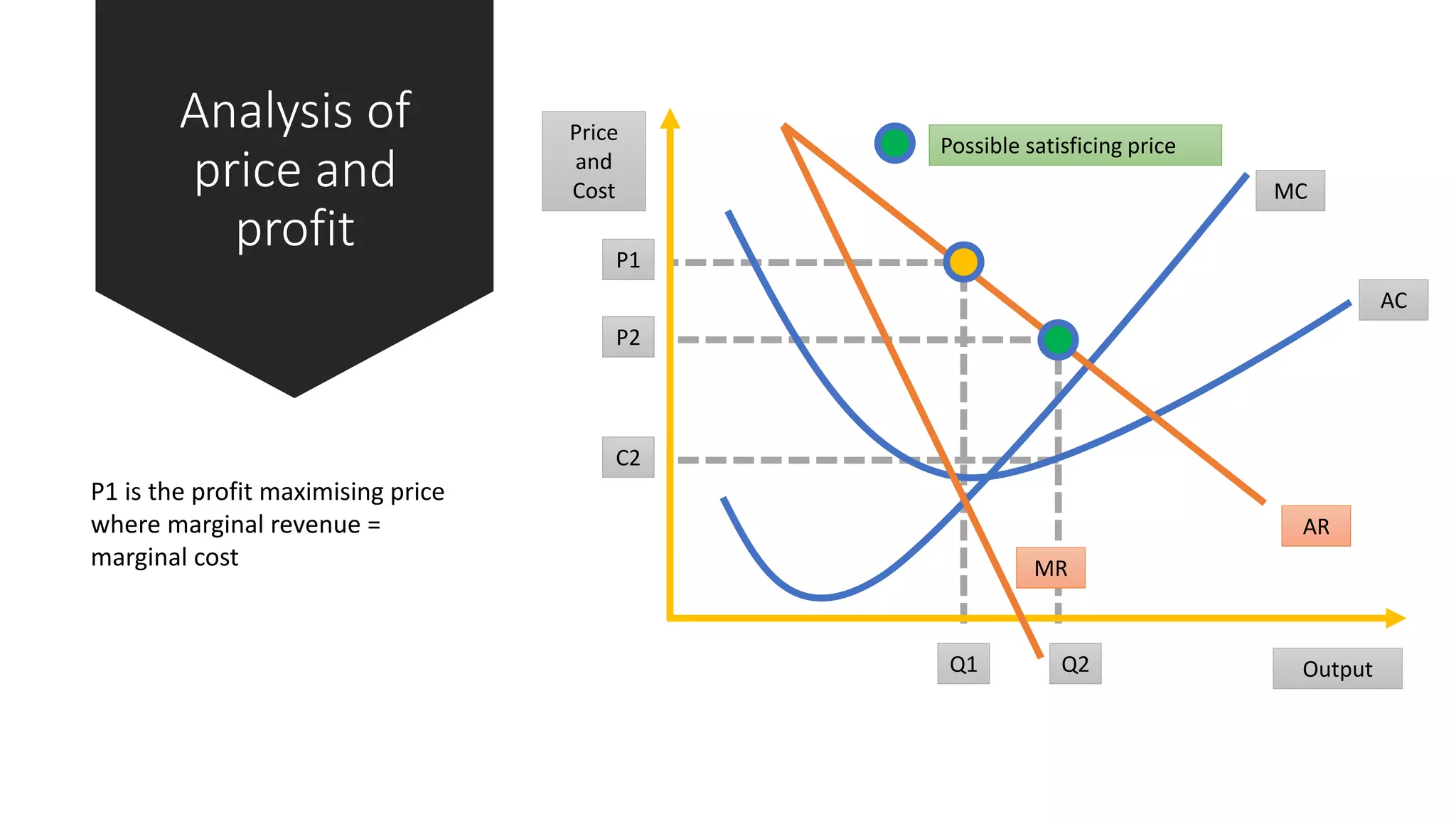
P1 is the profit maximising price
where marginal revenue =
marginal cost
Analysis of
price and
profit
MC
Price
and
Cost
Output
AC
MR
AR
Possible satisficing price
P1
Q1
P1 is the profit maximising price
where marginal revenue =
marginal cost
Analysis of
price and
profit
MC
Price
and
Cost
Output
AC
MR
AR
Possible satisficing price
P1
Q1 Q2
P1 is the profit maximising price
where marginal revenue =
marginal cost
Analysis of
price and
profit
MC
Price
and
Cost
Output
AC
MR
AR
Possible satisficing price
P1
Q1 Q2
P2
P1 is the profit maximising price
where marginal revenue =
marginal cost
Analysis of
price and
profit
MC
Price
and
Cost
Output
AC
MR
AR
Possible satisficing price
P1
Q1 Q2
P2
C2
P1 is the profit maximising price
where marginal revenue =
marginal cost
Analysis of
price and
profit
MC
Price
and
Cost
Output
AC
MR
AR
Possible satisficing price
P1
Q1 Q2
P2
C2
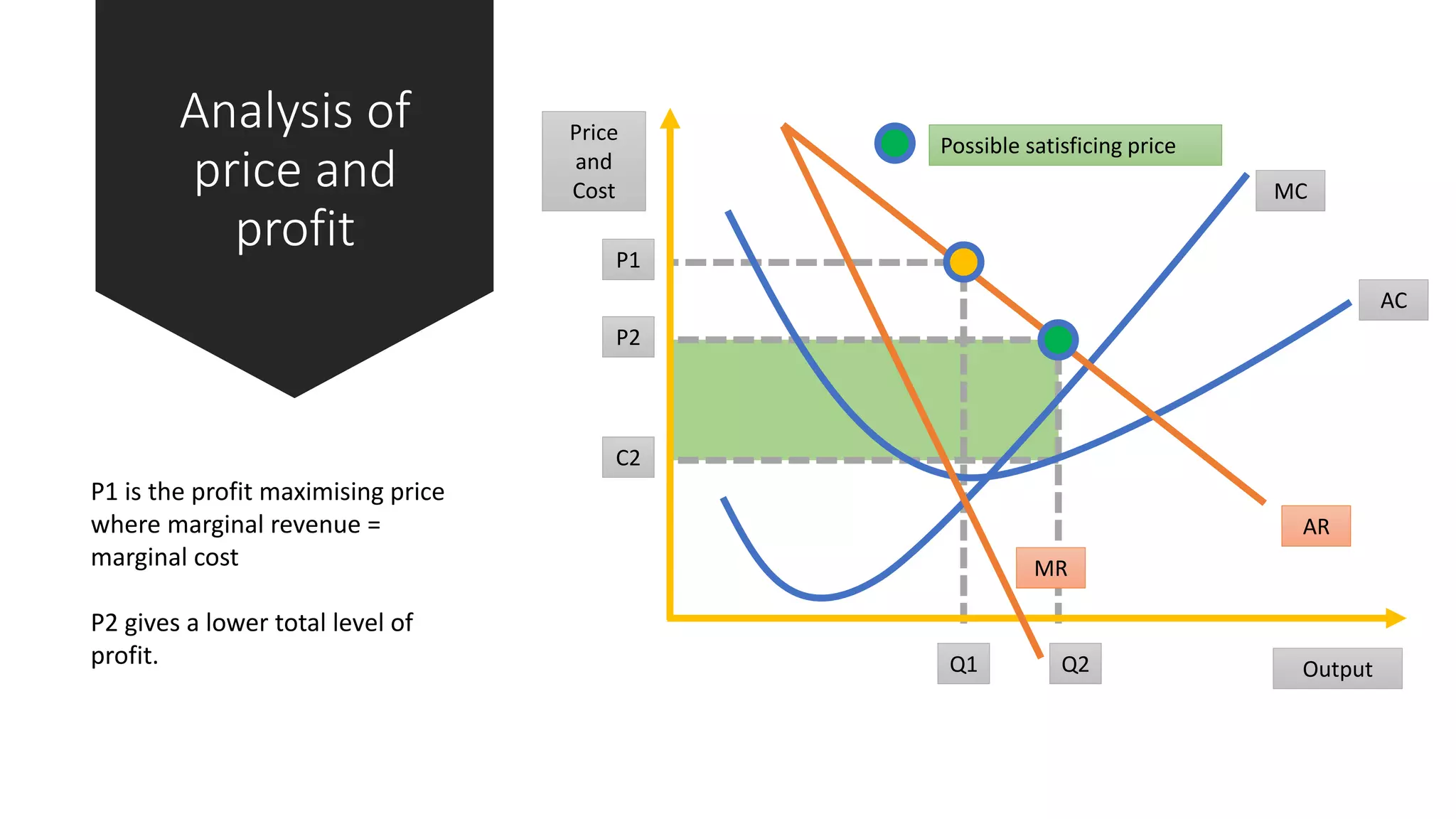
P1 is the profit maximising price
where marginal revenue =
marginal cost
P2 gives a lower total level of
profit.
Satisficing and
economic
welfare &
efficiency
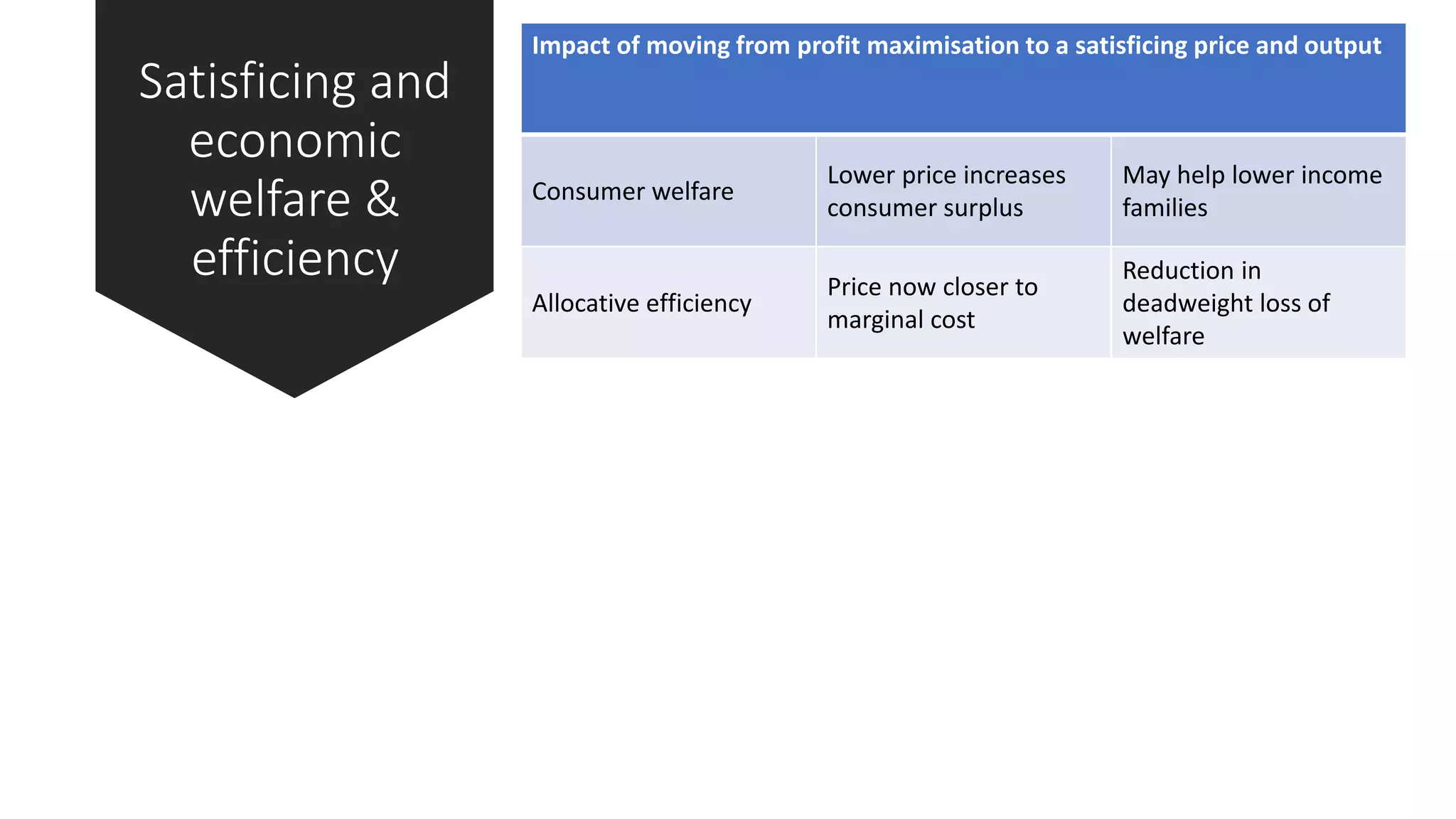
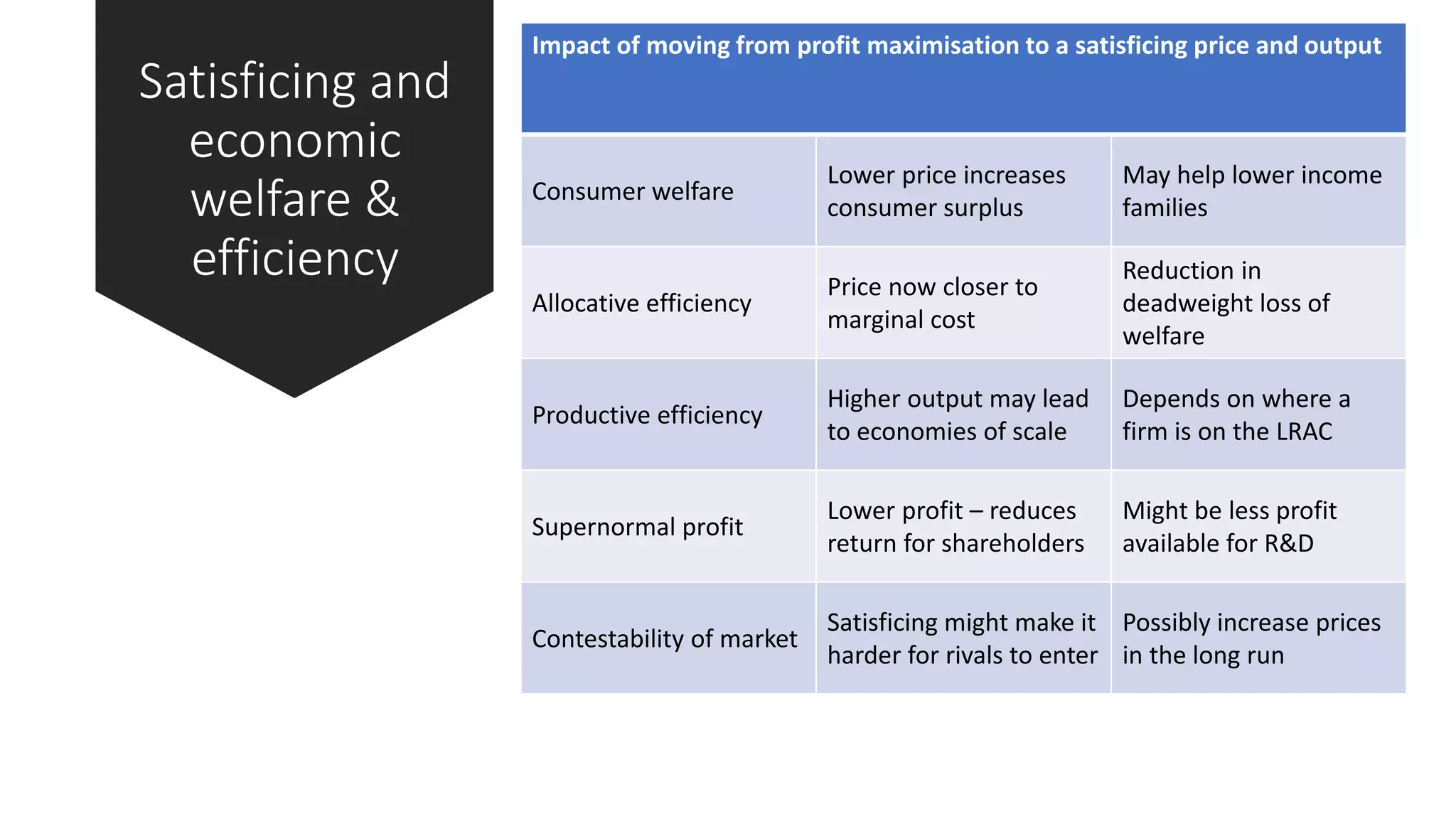
Impact of moving from profit maximisation to a satisficing price and output
Consumer welfare
Lower price increases
consumer surplus
May help lower income
families
Satisficing and
economic
welfare &
efficiency
Impact of moving from profit maximisation to a satisficing price and output
Consumer welfare
Lower price increases
consumer surplus
May help lower income
families
Allocative efficiency
Price now closer to
marginal cost
Reduction in
deadweight loss of
welfare
Satisficing and
economic
welfare &
efficiency
Impact of moving from profit maximisation to a satisficing price and output
Consumer welfare
Lower price increases
consumer surplus
May help lower income
families
Allocative efficiency
Price now closer to
marginal cost
Reduction in
deadweight loss of
welfare
Productive efficiency
Higher output may lead
to economies of scale
Depends on where a
firm is on the LRAC
Satisficing and
economic
welfare &
efficiency
Impact of moving from profit maximisation to a satisficing price and output
Consumer welfare
Lower price increases
consumer surplus
May help lower income
families
Allocative efficiency
Price now closer to
marginal cost
Reduction in
deadweight loss of
welfare
Productive efficiency
Higher output may lead
to economies of scale
Depends on where a
firm is on the LRAC
Supernormal profit
Lower profit – reduces
return for shareholders
Might be less profit
available for R&D
Satisficing and
economic
welfare &
efficiency
Impact of moving from profit maximisation to a satisficing price and output
Consumer welfare
Lower price increases
consumer surplus
May help lower income
families
Allocative efficiency
Price now closer to
marginal cost
Reduction in
deadweight loss of
welfare
Productive efficiency
Higher output may lead
to economies of scale
Depends on where a
firm is on the LRAC
Supernormal profit
Lower profit – reduces
return for shareholders
Might be less profit
available for R&D
Contestability of market
Satisficing might make it
harder for rivals to enter
Possibly increase prices
in the long run
Business
Objectives –
Profit Satisficing
A Level Microeconomics
Tutor2u Economics

Profit Satisficing

Editor's Notes

  • #3 Satisficing behaviour is an alternative business objective to maximising profits. It means a business is making enough profit to keep shareholders happy or it's sufficient for investors to maintain confidence in the management they appoint. According to Herbert Simon, people tend to make decisions by satisficing (a combination of sufficing and satisfying) rather than optimizing (Simon, 1956). Decisions are often simply good enough in light of the costs and constraints involved
  • #4 Profit satisficing is a situation where there is a separation of ownership and control. As a result, the owners are likely to have different objectives to the managers and workers. In short, owners wish to maximise profits, but workers and managers may not. So important to link satisficing with the principle-agent problem