Change management
DR YVONNE TECLA
Arrange any 3 balls to add up to 30
6 + 11+ 13 = 30
What is change management
1)Change management is the practice and process of supporting
people through change, with the goal of ensuring that the
change is successful in the long term.
2)Change management helps people to change their behaviors,
attitudes, and/or work processes to achieve a desired business
objective or outcome.
3)Change management as a discipline includes the processes,
tools, and techniques used to manage the human elements of
change which are applied at the individual, project, and
organizational level before, during, and after the change occurs.
4)Change management ensures that these projects are
successful, by helping to organize and disseminate information
and change management practices throughout the organization.
• What is changing? Everything. Even managing change in
organisations has changed.
• Change Management can be defined as a set of processes and tools
that are designed to make sure that when you try to make change;
i) Stakeholders buy into the change.
ii) The process stays under control.
iii) The process keeps on budget.
• Change Management as a discipline, is a systematic approach to
dealing with the transition or transformation of an organisation’s
goals, team or individual.
• Organizational Change largely focuses on one or all of the 4 focal
areas, being;
i)Internal processes
ii)Hierarchy/ Structure
iii) Culture
iv) Underlying Technology
• What is its purpose?
• The purpose of Change Management is to
• (i)implement strategies for implementing change,
• (ii) controlling change, and
• (iii) helping people to adapt to change.
• Organisations often undergo change in response to either or both of
external or internal factors.
• External variables-Change in Legislation, Political Stability, Economic
Meltdown, Entrance of new players in the market, Pandemics such
Corona may all be factors that demands of us to the change the way
in which we conduct business.
• Internal variables- new product development, new technology, re-
engineered processes to improve efficiency, loss of business and
financial revenue.
• Think about all the influences that are affecting your
organization today.
• How well prepared are you to adapt to that change
effectively?
• Are you doing everything you can to ensure that change is
not only implemented, but adopted and ingrained into your
business?
• Change initiatives drive projects, but are we truly prepared to
ensure the success of the change and not just the project?
• In the last 2 to 3 decades, we saw a surge in more
organisations focusing on project management, which
when put side by side with change management, it
concerns itself with the technical deliverables of a
business entity, on the other hand, at the heart of Change
Management is the PEOPLE.
• Managing PEOPLE through the change process.
• Managing how PEOPLE interact with the new business
function, and new ways of doing things demanded of
them.
• Managing how PEOPLE react to the change.
• Nurturing a positive attitude towards change.
• Ensuring they adopt the change and make it flow in the
bloodstream of the entire organisation, making sure that
the change is institutionalized and forms into the fabric
that defines organisational culture.
• When you deal with people you cannot remove the
emotions from how they will process and respond to
the change process.
• Change happens one person at a time. We can safely
say it starts with the individual, cascades down to the
team, and finally to the organisation.
• Its quite common that as management, we often focus
on the key deliverables of a business entity, which is
data, figures, bottom-line when making decisions at
behest of people’s emotions. Central to change
management is the people, and by extension their
emotions.
• Change is uncomfortable because it challenges us out of
our comfort zone into uncharted waters.
• As its to be expected, change elicits different responses from
different people,
• It is said, senior managers typically see change as an opportunity for
both the business and themselves.
• While employees typically see change as disruptive, intrusive and
likely to involve loss.
• Its all these different reactions, valid or may be not, that change
process attempts to manage, for the good of both the organisation
and the individual.
• Lets try to break down Change into small components that make IT
what it is by exploring its CORE ELEMENTS….
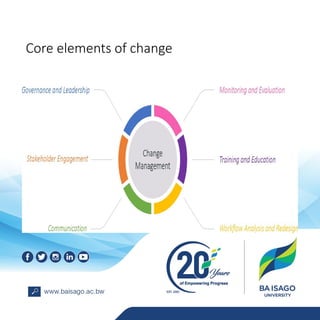
Core elements of change
• Governance refers to the mechanisms that guide the course
of an organization or project.
• Effective governance gives the individuals in an organization
an understanding of the strategic view and the reasoning
behind what is being done and why.
• This gives individuals an understanding of the project aim,
direction, and tasks involved in the execution, reducing
confusion that might otherwise lead to resistance.
• Stakeholder management: Engaging all stakeholders in a
planned and organized way ensures that all individuals that
will be affected by the change are well- prepared for and
understand the need for change.
• Communication: In order for change to be effected within an
organization, communication and messaging must be
proactive, consistent, and repeated.
• Workflow analysis increases organizational and individual
understanding of how work is currently performed. This
may provide clarity on how processes can be improved or
enhanced during the implementation of new technologies
or systems.
• Training and education are essential for staff to be able to
effectively realize a change. Education is necessary for
staff to understand both why and how they must change,
and training is required for employees to be able to carry
out the functional activities and build the new skills
required for the change.
• Evaluation and monitoring are not only important for
determining whether a project has been successful, but
also are important throughout change management
initiatives to ensure that the desired changes are being
effected.
TYPES OF CHANGE
• In this environment, the command of transformation becomes the
ultimate test of leadership.
• Leaders are confronted with a defining choice, a strategic crossroads
that can significantly influence the direction and fate of their firms:
should they embrace a radical rethinking, commonly known as a step
change, or choose the measured journey of progressive evolution,
the path of incremental change?
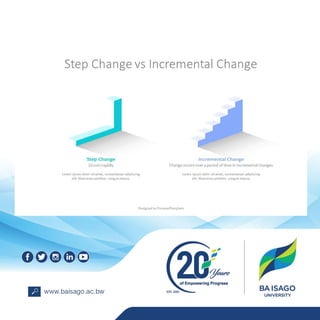
• Understanding the distinction between step change and incremental
change is crucial. It is akin to knowing when to use a sledgehammer
and when a scalpel will suffice.
• Step change is like the sledgehammer: powerful, impactful, and
capable of sweeping changes quickly. In contrast, incremental change
is the scalpel: precise, deliberate, and resulting in gradual but
consistent improvements over a more extended period.
Step change
• In step change we are confronted with three forms namely : strategic,
operational and transformational.
• 1. Strategic change
• Strategic change is concerned with broad, long-term and organization-
wide issues involving change.
• It is about moving to a future state that has been defined generally in
terms of strategic vision and scope.
• It will cover the purpose and mission of the organization, its corporate
philosophy on such matters as growth, quality, innovation and values
concerning employees and customers, competitive positioning and
strategic goals for achieving and maintaining competitive advantage
and for product-market development.
• These goals are supported by policies concerning marketing, sales,
manufacturing, product and process development, finance and human
resource management.
• Strategic change takes place within the context of the external
competitive, economic and social environment, and the organization’s
internal resources, capabilities, culture, structure systems
• Its successful implementation requires thorough analysis and
understanding of these factors in the formulation and planning
stages.
• The ultimate achievement of sustainable competitive advantage
relies on the qualities defined by Pettigrew and Whipp (1991),
namely ‘The capacity of the firm to identify and understand the
competitive forces in play and how they change over time, linked to
the competence of a business to mobilize and manage the resources
necessary for the chosen competitive response through time.’
• Strategic change, however, should not be treated simplistically as a
linear process of getting from A to B that can be planned and
executed as a logical sequence of events.
• Pettigrew and Whipp (1991) issued the following warning based on
their research into competitiveness and managing change in the
motor, financial services, insurance and publishing industries
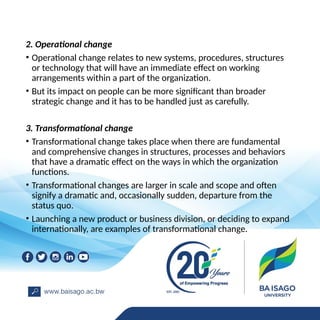
2. Operational change
• Operational change relates to new systems, procedures, structures
or technology that will have an immediate effect on working
arrangements within a part of the organization.
• But its impact on people can be more significant than broader
strategic change and it has to be handled just as carefully.
3. Transformational change
• Transformational change takes place when there are fundamental
and comprehensive changes in structures, processes and behaviors
that have a dramatic effect on the ways in which the organization
functions.
• Transformational changes are larger in scale and scope and often
signify a dramatic and, occasionally sudden, departure from the
status quo.
• Launching a new product or business division, or deciding to expand
internationally, are examples of transformational change.
Theories of Change
• There are two largely used theories of change
• These lays out a framework under which change happens
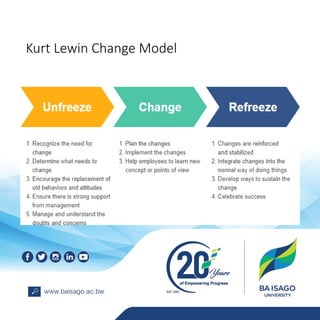
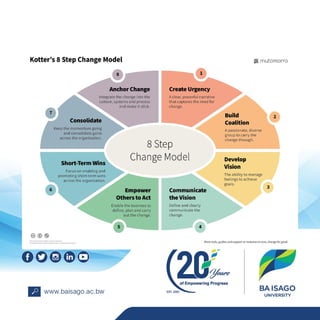
• Lets conduct an autopsy of Kurt Lewin’s Change Model, and John
Kotter’s 8 Step Model respectively.
Kurt Lewin Change Model
Making a case for change; why do we need change
• In the past, when change happened less frequently, a leader could
get by without being a proficient change agent.
• Today, it’s a completely different story. Change is occurring in
virtually every corner of business and industry, and the pace of
change is increasing rapidly.
• Being an effective change agent is no longer just a nice leadership
skill to have, it has become an essential leadership competency.
• Possibly the toughest part of leading change is generating enough
excitement and momentum to inspire others to WANT to do things
differently.
• That’s usually a tall order because there are built-in rewards for
maintaining the status quo.
• Psychologists will tell you that “all behavior is rewarded.” The
difficulty in getting people to change is convincing them to abandon
current behaviour that’s providing their current reward in favour of
new behaviour that promises a better reward.
Six Strategies to Create a Compelling Case for
Change
• 1) Contrast Current vs Future State. Paint a picture of the desired
future. What will we be able to do that we can’t do now? What will
the culture be like? How will our lives be easier, better, or more
successful? What will be the personal pay-off for each stakeholder
group for making the change? The classic example of this strategy is
Martin Luther King’s “I Have A Dream” speech. He constantly
juxtaposed ‘what is’ with ‘what could be’ to create psychological
tension and excitement that drew the listeners toward the ideal state
he was describing.
• Nancy Duarte explains in this TED talk how she discovered this
pattern in many of the greatest speeches.
• This strategy is compelling because it draws on two powerful
motivators: avoiding pain and moving towards pleasure.
• This works far better than simply creating a so-called “burning
platform” to compel people to “jump” (which is common change
management lingo).
• This is because it draws the listener toward something positive, not
just away from the negative.
• 2) Make it rational and emotional. You obviously need to engage
your audience’s brains by making your case rationally compelling, but
many presenters often fail to engage the real decision maker:
their audience’s emotions.
• The best way to engage emotions is to tell a story that highlights the
human impact of the change you are proposing, or the reality of the
current situation.
• 3) Use Metaphor. Metaphors are powerful because they enable
language to be experienced through the senses.
• Being able to see, feel or taste a concept allows people to literally
“feel” what you are saying because their emotions are being
triggered by their senses.
• For example, when Pablo Picasso wrote “Art washes away from the
soul the dust of everyday life.” we might compare art to feeling
refreshed, renewed and invigorated.
• In addition to provoking our audience’s emotions, metaphors appeal
to the rational brain because they explain the complex by comparing
them to the simple and familiar.
• 4) Make the Problem Visual. A great example of this is the “gloves
on the boardroom table” story.
• A supply chain executive was convinced that his company was
wasting a great deal of money by using too many vendors to supply
the same types of products.
• Unfortunately, none of the other executives paid much attention to
his calls for change.
• So he enlisted the help of a summer student to find out how many
different types of gloves his company was purchasing from various
vendors at various prices.
• Turns out they were purchasing 424 different gloves! So he collected
all 424 different gloves, tagged each glove with the price and
supplier, dumped them on the boardroom table and invited the
executives to see the problem for themselves.
• Needless to say, it worked!
•5) Highlight your own “Bright Spots.” Don’t simply
describe the best practices of others, highlight your
own organization’s best practices.
•People don’t appreciate it when their parents say
“Be more like your brother,” so we can expect a
similar reaction at an organizational level.
•The trick is not to tell an organization to be like
some other organization; it’s to encourage them to
be themselves at their best moments.
•This sends the message “We can actually do this
because we’ve done it before!”
• 6) Articulate your new identity. This strategy is a combination of
several strategies described above.
• It’s the answer to the questions “What will the organization be like
when the change has happened, and why is it cool?”
• If the change you want to promote is safety, you might highlight
several burly men in full Personal Protective Equipment with the
caption “We make safe look good.”
• Or you might share a story about a respected employee whose life
was saved because they followed the safety protocol.
• If the change you want to promote is a leaner, decentralized
organization that can react quickly to changes in the marketplace,
you might use the metaphor of an elephant standing next to several
cheetahs.
• The caption under the elephant would read “What we were.” The
caption under the cheetahs would read “What we are now.” The key
is to celebrate the new identity so that people will want to be
associated with it.
•For change initiatives to succeed, they must be led
by people who have the ability to generate
excitement and momentum towards the desired
end state. Change is hard. It’s like pushing a car up
hill. It can be done, but you need to begin pushing
the car on a stretch of flat road to gain momentum
long before you get to the incline. Following the
steps and strategies outlined above will help
leaders build the momentum needed to overcome
the inevitable resistance along the way.
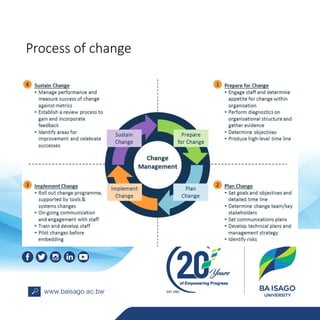
Process of change
Prepare the Organization for Change
• For an organization to successfully pursue and implement
change, it must be prepared both logistically and culturally.
• Before delving into logistics, cultural preparation must first
take place to achieve the best business outcome.
• In the preparation phase, the manager is focused on helping
employees recognize and understand the need for change.
• They raise awareness of the various challenges or problems
facing the organization that are acting as forces of change
and generating dissatisfaction with the status quo.
• Gaining this initial buy-in from employees who will help
implement the change can remove friction and resistance
later on.
Craft a Vision and Plan for Change
• Once the organization is ready to embrace change, managers must
develop a thorough, realistic, and strategic plan for bringing it about.
• The plan should detail:
• Strategic goals: What goals does this change help the organization
work toward?
• Key performance indicators: How will success be measured? What
metrics need to be moved? What’s the baseline for how things
currently stand?
• Project stakeholders and team: Who will oversee the task of
implementing change? Who needs to sign off at each critical stage?
Who will be responsible for implementation?
• Project scope: What discrete steps and actions will the project include?
What falls outside of the project scope?
• While it’s important to have a structured approach, the plan should
also account for any unknowns or roadblocks that could arise during
the implementation process and would require agility and flexibility to
overcome.
Implement the Changes
• After the plan has been created, all that remains is to follow the
steps outlined within it to implement the required change.
• Whether that involves changes to the company’s structure, strategy,
systems, processes, employee behaviors, or other aspects will
depend on the specifics of the initiative.
• During the implementation process, change managers must be
focused on empowering their employees to take the necessary steps
to achieve the goals of the initiative and celebrate any short-term
wins.
• They should also do their best to anticipate roadblocks and prevent,
remove, or mitigate them once identified.
• Repeated communication of the organization’s vision is critical
throughout the implementation process to remind team members
why change is being pursued.
Implementing change
• One of the command denominators to failed change undertaking is poor
change community strategy
• Which often leads to low morale stress and gives in the organisation.
• Relational breakdown between employer and the employee
• And sometimes loosing critical employees during this journey
• Setting up a communication strategy plan is premised on preparing the
organisation for the communication roll-out plan.
• And like a farmer, you prepare the seedbed so that the seed(message)
falls on receptive soil.
• And this is what you look at in your preparation for the roll-out;
i. Criticality of all your employees
• The value that each employee driving for the company, the niche skills
sets that they possess which are critical to e companies regular function
Once you made that understanding categorize each employee from
highly critical to not so critical
• - This analysis is going to be extremely important in the later stage of this
step.
ii. What we can refer to as, the first communication,
the change leader needs to , identify key members
from his organization, these we call the change
managers, and they will be the frontline messengers
of the change.
• But before they do that, the change leader needs
to convince them of his/ her vision for the change
and the Strategic approach of the change,
• And clearly define if this just doesn't happen, how
will it negatively impact the company and their
careers.
•Once he has done that he needs to demand
commitment and accountability from them while
they walk with him/ her on the journey
•Iii. Now that the change manager is ready with the
change management team
•He can move to the bigger platform and address
the entire team about the change initiative
•the critical elements of this conversation will be of
course, a passion for the vision that he lays out,
and the logical approach to get that goal
•But the most important will be the ethos, which is
the ethical appeal which connect him to his team
members.
•This appeal will then add to the reliability and
transparency of the approach the change leader is
taking,
• Iv. often when you are talking in a larger audience, all
information is not absorbed at all levels.
• Its only desalinated partially, the change manages team need
to go talk to the their audience in smaller groups or 1 on 1
meeting to allay their fears
• This is where your analysis of critical , to not so critical
employee comes in play.
• Because when you are talking to a very critical employee you
need to talk to them and ensure they understand their place
in the future of the organisation along with the a clear career
development path.
• However, when you are talking to not so critical employee it
is important to not make any promises to them but, at the
sane time allay their fears that the company will not take an
unjust action against them.
• All these 4 steps are going to be very important, once this first set of
communication, fear will take over. The problem with
communication change is the illusion that it has already taken place.
• Hence throughout the change Journey, it will be important for the
change leader and the change managers to connect with the team.
• Hence they should be done as a cyclical process, when there is early
success the leader should go out there and share with the team,
because It also establishes the credibility of their approach.
• The change management need to keep connected with the smaller
groups. 1 on 1 so that this entire group this community can walk
hand in towards a common goal
•73% of change- affected employees report
experiencing moderate to high stress levels
•Step 1-Establish clear Goals
•What are you trying to achieve,
•Goals →Goals>
•What are the benefits
•How can you make reliable credibility
•Surveys, asking your employees will help you
crystalize your communication strategy.
• 2. Map your Internal audiences
• Who will be affected by the change, and how they are affected by the
change:
• It’s important to communicate with all stakeholders , not just those directly
impacted by the change .
• However keep in mind, the message and amount of information should be
different for different groups
• Give preference to targeted common platforms such segmenting your
message by department, seniority, location
• Remember transparency can help you mitigate resistance and create buy in
• 3. Build Communication plan
• Ideally this should go hand in hand with a change model of choice eg. Kotter
8 step model your communication plan may look like this:
• 1 increase Urgency- communicate the reason for change and potential
consequences of not changing.
• Use data and stories to emphasis the change
• 2 build the team
• Identity stakeholders drive the change and communication with the at very
level
• 3. Get the vision correct
• Communicate the vision and strategy to all stakeholders using clear
and concise
• 4. Communicate.
• Use multi channel approach to share the vision and strategy with all
stakeholders
• Communicate the
• benefit of the change and how now it will impact them.
• 5. Get things Moving
• - Communicate the roles and responsibilities of all stakeholders in
the change initiative.
• Encourage and empower them to take ownership of change and
provide them with the necessary resources to do so
6. Focus on Short term goals.
• Celebrate all short wins
• Communicate all small wins along the way
• Use internal data to demonstrate progress and keep stakeholders
really motivated
7 Incorporate change
• Communicate the importance of continuing with the change
initiative and the need to sustain momentum
8. Don’t give up
• Keep on going, change takes time
• Don’t give up if you don’t see the results immediately
• Be persistent, give yourself and your employees time to adjust
Embed Changes Within Company Culture and Practices
• Once the change initiative has been completed, change
managers must prevent a reversion to the prior state or
status quo.
• This is particularly important for organizational change
related to business processes such as workflows,
culture, and strategy formulation. Without an adequate
plan, employees may backslide into the “old way” of
doing things, particularly during the transitory period.
• By embedding changes within the company’s culture
and practices, it becomes more difficult for backsliding
to occur.
• New organizational structures, controls, and reward
systems should all be considered as tools to help change
stick.
•Review Progress and Analyze Results
•Just because a change initiative is complete doesn’t
mean it was successful.
•Conducting analysis and review, or a “project post
mortem,” can help business leaders understand
whether a change initiative was a success, failure,
or mixed result. It can also offer valuable insights
and lessons that can be leveraged in future change
efforts.
•Ask yourself questions like: Were project goals
met? If yes, can this success be replicated
elsewhere? If not, what went wrong?
Key factors of successful change
• Parag (2018) has identified six critical factors that affecting to the
success of organizational change process.
• 1) Develop a clear vision and strategy for organizational change
process that is backed up by distinct rewards.
• Employees are more inclined to accept change if they are aware of
why it is taking place, what it includes, and how it will affect them.
• Individual change projects and programs must be coordinated and
linked with the firm's overarching strategy to produce a wide
"image" of change.
• 2) Ensure that the company have strong leadership and
sponsorship. Actions are more effective than words.
• Senior leaders and sponsors of companies must lead by example and
push for change.
• To deliver, sponsors need the right sphere of influence, time, and
personality attributes including communication and listening skills,
honesty, the ability to connect and inspire, trust, emotional
intelligence, and gravitas.
• 3) All stakeholders must be understood, engaged with, committed
to, and supported.
• Stakeholders of companies will notice and respond to change the
organizational change in a variety of ways, so it's critical to
understand, engage, acquire commitment from, and support them
throughout the change process of a company.
• Identify stakeholders early in the change process, conduct a
prospective change impact assessment, and establish a commitment-
building engagement and communication strategy.
• 4) Create a strong change team with the skills that need to
succeed. Create and cultivate a high-performing transformation team
that combines a clear focus on its mission with strong interpersonal
relationships.
• Make that the team's mission or remit is properly defined, both in
terms of itself and in relation to other teams, such as the overall
program or project team.
• To facilitate successful change, provide team members with the
essential change process and soft/people talents or skills.
• 5. Define and implement a well-structured, integrated strategy.
• Make sure you employ a holistic, integrated approach that considers all factors
and is appropriate for your endeavor and its surroundings. This is critical in
order to ensure that everyone on the change team is on the same page, to
ensure consistency in delivery, and to improve competence and maturity in
order to achieve higher success.
• 6) Assess the success of the change initiatives
• Organizational transformation is frequently a non-linear, evolutionary learning
process, and it is impossible to know everything right away.
• The external and internal organizational might alter during the process, and
evaluating a change effort in the same way as other parts of the business, such
as operations, is difficult, if not impossible.
• Measures may be a powerful tool for involving and communicating with the
rest of the organization and stakeholders about the change's success and
impact over time, as well as soliciting feedback.
• At the outset, establish a baseline and success criteria, and link metrics to the
vision, outputs, outcomes, and benefits that were originally defined.
• Use a mix of qualitative and quantitative metrics, paying special attention to
relevance, measurability, and the simplicity with which data may be collected,
analysed, and presented.
• The primary reasons why organizations are failing and losing
money are “insufficient communications” and “lack of
leadership” (PMI Report, 2014).
• The function of leadership cannot be over emphasized more
when it how critical it is to the change process.
• Largely leaders we are dealt with can make or break the
change process
• But what is leadership?
• What are some of the leadership styles that have been
curated?
• If we were to ask Al create a leader who can effectively
navigate us successfully through a change process, what
would be the likely results?
Leadership in change management: role and
attributes
• The ever increasing pressure on organizations and institutions to
undergo change to survive and maintain their relevance cannot be
overemphasized in the era of globalization.
• Consequently, leaders in the 21st century have enormous
responsibility to successfully lead change in their organizations.
• Leadership is related with change. If there is leadership then change
is inevitable. Because, challenging status quo is one of main
characteristics of leaders.
• Leadership often cited as an important element in terms of creating
conducive environment for effective change implementation.
• You’ve heard the statistics. Even though change management has
been a recognized discipline for more than half a century, studies
continue to report the high failure rates for organizational change
projects.
• Literature on organizational change management indicates that
boosting employees’ readiness for change depends on specific
attributes of the leader and how the leader promotes the change
leader .
• First, Leaders Should Understand the Meaning of “Change”
A leader should think about the meaning of “change” with
different perspectives:
• What is change? Why do we have to change? When to
change? How to change? How to trigger change?
• The answers may differ from source to source, however,
there is one thing that is constant is “change never stops”.
• Change equates with life, with our own personal, social,
mental and physical development and with our ability to
learn, to adapt, to play an active role in social and
community activities.
• So, a leader should create his/ her own style to adapt
himself/herself and his/her organization to continuously
changing environment.
• However, organizations that are highly effective at change
management, change enablers, incorporate certain practices that
they deem important to the success of strategic initiatives
• As a leader, you have to add something on management functions.
The process of change begins with organizational leaders developing
an organizational strategy, then with the creation of an initiative that
is aligned with that strategy.
• However, the change process involves emotions because nobody
likes to surrender the comfort associated with the status quo or
surrender what they value.
• Despite that, leaders will have to succeed in the mist of these
challenges, among which are the emotions of those to be affected by
the change.
• Therefore, there is an increase in focus on emotional intelligence in
leadership in managing the process of change.
• A leader has to feel himself/ herself as someone responsible from
the ones managing the change process.
Definitions
• Tokar (2020:1) states that leadership in organisation is a
management approach in which leaders helps set goals that
are strategic for the organisation while motivating individuals
within the group to successfully carry out assignments in
service to those goals.
• A comprehensive definition was created by Winston (2019:7),
which defines leadership as one or more people who selects,
equips, trains, and influences one or more follower(s) who
have diverse gifts, abilities, and skills, and focusses the
follower(s) to the organisation’s mission and objectives
causing the follower(s) to willingly and enthusiastically
expend spiritual, emotional, and physical energy in a
concerted coordinated effort to achieve the organisational
mission and objectives (Ahmed 2017:54, Terry 2017:3,
Swanwick, 2017:9).
•The leader achieves this influence by humbly
conveying a prophetic vision of the future in clear
terms that resonates with the follower(s) beliefs
and values in such a way that the follower(s) can
understand and interpret the future into present-
time action steps (Martins, Thoms. Legood & Dello
Russo, 2018:155)
•There are different styles of leadership, and most
studies mention transformational and change
leadership’s effect on employees’ readiness for
change, but there is some level of difficulty of
differentiating between them.
Change leadership vs transformational
leadership
• Some writers and researchers tend to use them interchangeably,
asserting that they share common elements .
• One criterion to differentiate between the two is time orientation.
Transformational leadership argued to emphasize on long-term
effects on followers, change leadership focuses on short-term and
specific change project.
• Most change leadership dimensions such as communicating the plan
for change, building a guiding coalition, developing a sense of
urgency or a compelling rational for the change and providing
support can be linked to one or more dimensions of
transformational leadership .
• On the other hand, transformational leadership is related to
strategic leadership, while change leadership is more attached to
tactical leadership behavior.
• Change leadership can be conceptualized as the behavior of
direct supervisors, and it is aimed at framing and shaping
organizational change along with boosting the capacity of
employees to implement the change initiative .
• It involves crating favorable attitudes among change recipients
regarding the change
• It includes ensuring the need for change, providing vision and
plan, building support and commitment to the change, and
monitoring its implementation .
• Change leadership behaviors include ensuring the need for
change, providing vision and plan, building support and
commitment, and monitoring the implementation .
• Leaders by exhibiting change leadership behaviors such as high
quality change information and employee participation,
communication about change and providing individual
employees the opportunity to contribute in the change process .
• Specific attributes of a leader and the way how he or she
promotes the change is one critical factor to increase individual
employee’s readiness to change.
• The attribute and change-promoting behavior embraces the
concept of change leadership.
• Change leaders should also show behaviors such as high-quality
change information and employee participation, communication
about the change and providing individual employee the
opportunity to contribute in the change process.
• Change leadership requires recognition of risks and dangers and
equal parts of patience, persistence and resilience in the face of
fresh challenges.
• In addition, change leadership requires a strong process
orientation.
• Approaching change as a process and knowing what actions to
take at each critical stage of that process help minimize risks and
maximize your chances for success.
Transformational leadership
• Kirkan (2011:90) asserts that transformational leadership is a
leadership pattern used by leaders to change the current situation
though inspiration, persuasion, and excitement to achieve a high
level of clear vision for the purpose of recognising common goals.
• Organisations need leaders able to cope with change, maintain daily
operations and provide a competitive advantage (Ghadi, Fernando &
Kaputi, 2013:535).
• Transformational leaders stimulate and encourage their employees
and unify them behind a collective cause, resulting in improved
outputs, performance, and job meaningfulness (Wang, Oh,
Courtright & Colbert, 2011:248).
• They also understand the strengths and weaknesses of employees,
so the leader can align employees with tasks that optimise their
performance.
• Transformational leaders affect people’s emotions by paying a big
and exciting picture of the future.
• They convey the vision; they have a clear and straight vision about the
future.
• They engage the people; change management process is anchored
around strong communication. The leader must engage and
communicate on time, right place, right audience and the how part of
the communication must also be measured and on point.
• A leader must create sustainable atmosphere for change.
• You transform people by taping into their hopes dreams and ideals.
• You lure employees by being motivated yourself,
• You enhance productivity through high transparency and
communication.
• Transformational leader there’s total ownership and involvement as a
leader.
• You lead by example, you use this to focus on building lasting personal
strengths that make your teammates more successful and confident in
you and the organisation.
• This style of leadership will definitely inspire employees and alleviate
fear and get you to the envisioned future.
Resistance to change
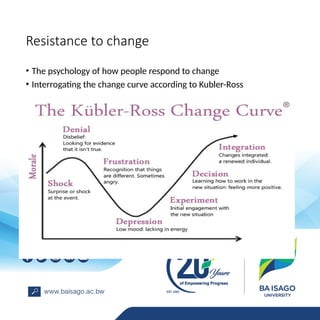
• The psychology of how people respond to change
• Interrogating the change curve according to Kubler-Ross
• Resistance to change is by far the most challenging part in the
change management process.
• What underneath change that people resist so much?
• People don’t resist change. They resist LOSS.
• Leaders would be more focused on what we stand to gain, with little
to no regard to what people are being asked to give up.
• What we stand to lose actually if the change happens.
• Psychologists say, the pain of losing is twice as powerful as the
pleasure of gaining it.
• The fear of losing something is the one that keeps us from embracing
gain in the unknown future as brightly painted as it may be.
• Perhaps lets look at the DNA of LOSS
• Loss may encompass a lot of things in our lives; people, places,
things, future plans.
• People are more open to change when they know what will
stay the same (ironic, I know)
• The vision of a brightly future, that’s only half of the
equation; We also need to know what will continue and we
can bring that forward when we highlight aspects of
ourselves that will endure so leaders must not act only as
champions of change but as anchors of stability and
stewardship of our readiness.
• The threat may not be existential and dramatic but do not
underestimate the power that the these threats of loss has
on the hearts and mind of people and on shaping their
behaviors
• When change happens and a serious threat of loss looms on
the horizon how do we lead ourselves and others through it?
• But there are several co-types of loss that are particularly painful in
social environments….
• Lets explore 5 of those today
1) Safety
• Will this change jeopardize my sense of safety, physically and
psychologically?
• We derive a sense of safety from things like a stable job, reliable
finances
• And there is something about predictability that makes us feel safe,
and when something comes along that makes us contends with
unpredictability, that very thing is equated to danger.
• So we would push back to remain on familiar grounds because they
offer a sense of safety.
• 2)Freedom
• Loss to a great degree takes away the opportunity to have a say in the
course our life is taking,
• Everything about loss is thrust upon us and throws us into a state of
helplessness, and we don’t have much to say or do to change the coarse of
life.
• 3)Status
• Social hierarchy govern our relationships as human beings, whether they
are formal or not, the higher the status the more respect, the more
significance, the more power and influence you have.
• And once you have it, its hard to let it go.
• And these are attached directly and indirectly to where we work, the job
titles we carry.
• Sometimes change may mean that we lose half of what we know, to make
space for what we should know about our jobs going forward, and sadly
we struggle with the new knowledge.
• This may take away from a sense of importance particularly when we were
used to being asked for help on a subject we were well competent on.
• 4)Belonging
• A work environment can positively offer a sense of belonging
particularly the environment radiates good energy and positivity
• People can feel sad about leaving on promotion to another
department or branch because they enjoyed quite a harmonious
environment that offered warmth and acceptance.
• We can feel joy for what we are gaining, and sadness for what we a
re losing.
• 5) Fairness
• When we encounter situations and circumstances that makes to
question fairness?
• Why me, not the other person?
• Decisions that exacerbate our pain equity, we will ask in respect to
our loss, is it fair?
• Bottom line is, expect resistance.
• There is a common thread among all these core needs,
the reason that they are so important to us, and are so
deeply painful to lose, when we are asked to lose them
we question core parts of our identity-who we think we
are?
• Who am I, without this job, title…
• It’s a tall order when you are asked to give up on things
that are tied to your identity.
• However there can be;
• Wisdom in resistance, it can teach us what’s important
to ourselves and others
• It might also teach us about where we might have
missed the mark.
• Could our plans for change cause harm.
• Change is inevitable and necessary so loss is the price
we pay for it.
• Its important that we name the losses that others are
facing, or we are facing, ignoring or dismissing all
breeds resentment and anger.
• Acknowledging these losses is an exercise in telling the
truth.
• Its an exercise in getting permission to grieve what’s
gone.
• Its an exercise that says I see you, I NOTICE YOU
• And it puts us towards the path to acceptance
•So what’s the biggest take way from resistance for
leaders
•Consider the wisdom in resistance
•Name the loss
•Shine a light on what stays the same
•Turn towards possibility- dream about what we can
become
•And remember its in the moments of resistance
that we mush show leadership, empathic
leadership.
•And this is how you write a story for the future
together
READINESS
• Change readiness is the state of an organization’s ability
to manage change and uncertainty.
• It is a measure of an organization’s preparedness to
respond to, and recover from, change events.
• Change readiness is a function of an organization’s
ability to anticipate change, change resistance, adapt to
change, and recover from change.
• Managers and change leaders use a tool which consists
of a set of questions to assess whether organization is
ready to implement change or not.
• By using the change readiness tool, organizations can
develop action plans to improve their change
management.
•What is change readiness assessment tool?
•A change readiness assessment tool is used to
gather information about an organization’s
preparation for change and how simple it will be to
build an adequate change plan – and, as a result,
change initiatives will be more successful.
•This diagnostic’s tool is to determine how well-
planned a certain organizational transformation
endeavor, project, or program has been
•The change readiness tool can help organizations
assess their change readiness and develop action
plans to improve their change readiness.
•The change readiness tool usually consists of four
key components:
•1) Anticipate change
•2) Resist change
•3) Adapt to change
•4) Recover from change.
•Each component includes a set of questions that
organizations can use to assess their change
readiness.
•The change readiness tool can help organizations
identify areas where they are strong in change
readiness and areas where they need
improvement.
•Why it is important to make assessment of change?
•Managing change is always complex and it requires
a complete preparation before starting change
initiative. Therefore, every manager and change
leader must know that whether their organizations
are ready and well prepared to take on change.
•It’s important because of two reasons:
•First, making assessment of change readiness
provides an opportunity to identify risks associated
with implementation of change.
•Second, this kind of assessement gives in-depth
analysis of all the component of change and it gives
a better picture of entire plan of change
• Using change readiness assessment tool
• You can conduct this assessment alone or with other members of
organization, such as your steering committee or project team.
• You can identify 20 or more than this questions and key areas which
reflect preparation on change management. You can ask your
colleagues to mark the scale with the corresponding number. The
number you circle should represent how well you believe the work
has been done so far on that item concerning this change.
• Throughout this assessment, keep the accepted definition of the
proposed change in mind. Since this is a general assessment tool, the
terminology might not be entirely applicable to your organization.
• If you believe that something is not pertinent to your situation,
either disregard it or consider how you may rewrite it to make it
more pertinent.
• Before sharing and discussing your results, finish this analysis on your
own if you are working on this evaluation with other members of
your program, project, or change management team. You can
discover that several team members have various points of view.
• Throughout this assessment, keep the accepted
definition of the proposed change in mind.
• Since this is a general assessment tool, the terminology
might not be entirely applicable to your organization.
• If you believe that something is not pertinent to your
situation, either disregard it or consider how you may
rewrite it to make it more pertinent.
• Before sharing and discussing your results, finish this
analysis on your own if you are working on this
evaluation with other members of your program,
project, or change management team.
• You can discover that several team members have
various points of view.
Measuring Change Readiness: Utilizing 5 Key KPI
Components
• The Change Readiness Matrix provides guidance on what to
do if these KPIs are low, emphasizing the importance of
effective communication, engagement, and support to
improve readiness. It includes five key performance indicator
(KPI) components used in a business readiness assessment:
• KPI 1: Awareness of the Change: Lack of awareness is the
primary reason for resistance to change. It’s crucial to assess
end-users’ awareness of the change to increase their
willingness to support it.
• KPI 2: Acceptance of the Change: Acceptance of the change
is vital for readiness. Initial opposition to change is common,
and it’s important to engage stakeholders to gain their
acceptance and support.
• KPI 3: Capacity for Change: Groups may be undergoing
multiple changes, affecting their capacity for more. Assess
each group’s capacity for additional change to tailor
engagement accordingly.
• KPI 4: Knowledge of What is Changing: Impacted
stakeholders may be aware of and accept a change, but they
might lack basic knowledge of what specifically is changing in
their workflow. To address this:
• Provide a high level of training and communication to
enhance their understanding.
• Ensuring people are aware of what changes are happening
and when they are happening is vital.
• Training, communication, and support are essential to
prepare an organization for a successful project go-live.
• KPI 5: Level of Training Required: Once stakeholders have
basic knowledge of the changes, formal training is needed for
them to gain the necessary proficiency. A high level of
required training indicates the need for more preparation:
• End-users must transition from their current state to the
target future state with the right knowledge and skills.
• In cases of transformational change, various components like
job roles, systems, tools, processes, policies, and procedures
may change.
• If the level of training required is high, the change
management team should plan extensive or additional
training to ensure readiness, especially during subsequent
readiness assessments.
CULTURE
• A strong organizational culture provides stability to an organization.
And for some organizations, it can also be a major barrier to change.
• A Definition of Organizational Culture Organizational culture refers to
a system of shared meaning held by members that distinguishes the
organization from other organizations.
• A company history and unwritten rules are a part of its culture
• Organizational culture is manifested in many ways including norms,
physical settings, modes of dress, special language rituals and stories.
Seven primary characteristics seem to capture the essence of an
organization’s culture:
• 1. Innovation and risk taking. The degree to which employees are
encouraged to be innovative and take risks.
• 2. Attention to detail. The degree to which employees are expected to
exhibit precision, analysis, and attention to detail.
• 3. Outcome orientation. The degree to which management focuses on
results or outcomes rather than on the techniques and processes used to
achieve them.
• 4. People orientation. The degree to which management decisions take into
consideration the effect of outcomes on people within the organization.
• 5. Team orientation. The degree to which work activities are organized
around teams rather than individuals.
• 6. Aggressiveness. The degree to which people are aggressive and
competitive rather than easygoing.
• 7. Stability. The degree to which organizational activities emphasize
maintaining the status quo in contrast to growth. Each of these
characteristics exists on a continuum from low to high. Appraising the
organization on them, then, gives a composite picture of its culture and a
basis for the shared understanding members have about the organization,
how things are done in it, and the way they are supposed to behave.
Do Organizations Have Uniform Cultures?
• Organizational culture represents a common perception the
organization’s members hold.
• We should therefore expect individuals with different backgrounds
or at different levels in the organization to describe its culture in
similar terms. That doesn’t mean, however, that there are no
subcultures.
• Most large organizations have a dominant culture and numerous
subcultures.
• A dominant culture expresses the core values a majority of members
share and that give the organization its distinct personality.
Subcultures tend to develop in large organizations to reflect common
problems or experiences members face in the same department or
location.
• If organizations were composed only of numerous subcultures,
organizational culture as an independent variable would be
significantly less powerful.
• It is the “shared meaning” aspect of culture that makes it such a
potent device for guiding and shaping behavior.
• But subcultures can influence members’ behavior too.
Strong versus Weak Cultures
• It’s possible to differentiate between strong and weak
cultures. If most employees (responding to management
surveys) have the same opinions about the organization’s
mission and values, the culture is strong; if opinions vary
widely, the culture is weak.
• In a strong culture, the organization’s core values are both
intensely held and widely shared.
• The more members who accept the core values and the
greater their commitment, the stronger the culture and the
greater its influence on member behavior, because the high
degree of sharedness and intensity creates a climate of high
behavioral control.
• A strong culture should reduce employee turnover because it
demonstrates high agreement about what the organization
represents.
• Such unanimity of purpose builds cohesiveness, loyalty, and
organizational commitment. These qualities, in turn, lessen
employees’ propensity to leave.
• One study found that the more employees agreed on
customer orientation in a service organization, the higher the
profitability of the business unit.
• Another study found that when team managers and team
members disagree about perceptions of organizational
support, there were more negative moods among team
members, and the performance of teams was lower.
• These negative effects are especially strong when managers
believe the organization provides more support than
employees think it does
Culture versus Formalization
• High formalization creates predictability, orderliness, and
consistency.
• A strong culture achieves the same end without the need for written
documentation. Therefore, we should view formalization and culture
as two different roads to a common destination. The stronger an
organization’s culture, the less management need be concerned with
developing formal rules and regulations to guide employee behavior.
Those guides will be internalized in employees when they accept the
organization’s culture.
Culture’s Functions.
• First, culture has a boundary-defining role: it creates distinctions
between one organization and others.
• Second, it conveys a sense of identity for organization members.
• Third, culture facilitates commitment to something larger than
individual self-interest.
• Fourth, it enhances the stability of the social system.
• Culture is the social glue that helps hold the organization together by
providing standards for what employees should say and do. Finally, it
is a sense-making and control mechanism that guides and shapes
employees’ attitudes and behavior. This last function is of particular
interest to us. Culture defines the rules of the game.
• Culture Creates Climate; If you’ve worked with someone whose positive
attitude inspired you to do your best, or with a lackluster team that drained
your motivation, you’ve experienced the effects of climate.
• Organizational climate refers to the shared perceptions organizational
members have about their organization and work environment.
• This aspect of culture is like team spirit at the organizational level. When
everyone has the same general feelings about what’s important or how well
things are working, the effect of these attitudes will be more than the sum of
the individual parts.
• A positive overall workplace climate has been linked to higher customer
satisfaction and financial performance as well.
Culture as a Liability
• Culture can enhance organizational commitment and increase the consistency
of employee behavior, clearly benefits to an organization. Culture is valuable
to employees too, because it spells out how things are done and what’s
important. But we shouldn’t ignore the potentially dysfunctional aspects of
culture, especially a strong one, on an organization’s effectiveness.
Institutionalization
• When an organization undergoes institutionalization and becomes
institutionalized—that is, it is valued for itself and not for the goods or services
it produces—it takes on a life of its own, apart from its founders or members.
It doesn’t go out of business even if its original goals are no longer relevant.
Acceptable modes of behavior become largely self-evident to members,
Barriers to Change
• Culture is a liability when the shared values don’t agree with those that further
the organization’s effectiveness. This is most likely when an organization’s
environment is undergoing rapid change, and its entrenched culture may no
longer be appropriate.
• Consistency of behavior, an asset in a stable environment, may then burden the
organization and make it difficult to respond to changes.
Barriers to Diversity
• Hiring new employees who differ from the majority in race, age, gender,
disability, or other characteristics creates a paradox: management wants to
demonstrate support for the differences these employees bring to the
workplace, but newcomers who wish to fit in must accept the organization’s core
cultural values. Because diverse behaviors and unique strengths are likely to
diminish as people attempt to assimilate, strong cultures can become liabilities
when they effectively eliminate these advantages.
• A strong culture that condones prejudice, supports bias, or becomes insensitive
to people who are different can even undermine formal corporate diversity
policies.
Barriers to Acquisitions and Mergers
• Historically, when management looked at acquisition or merger decisions, the
key factors were financial advantage and product synergy. In recent years,
cultural compatibility has become the primary concern. All things being equal,
whether the acquisition actually works seems to have more to do with how well
the two organizations’ cultures match up.
Attitudes
• In societies where there are distinctions between social classes on
economic, social or religious grounds certain groups adopt the
fatalistic attitude that they were created as poor people and they
are willing to live under atrocious conditions on the pretext that
poverty is God’s will for them.
• Superstitions, taboos, fetishism, fear of spirit witchcraft and sorcery,
fear of curses from offended parents and their relatives all this
hinder people from flourishing economically, socially and spiritually.
• Inter-ethnic and religious conflicts
• Inter-tribal or religious hostilities and wars in some parts of Africa
has become a common feature on our radios and newspapers in
Rwanda, Burundi, Congo, Liberia, Nigeria, Somalia, Ethiopia, Sudan
and SA (xenophobic attacks). These tensions and hostilities create an
atmosphere not conducive to security, peace and justice.
• Cultural colonization and alienation
• In European run schools in the colonies and universities of
metropoles Africans were taught that prior to the invasion by the
white man, Africa had no history to be proud of or culture worth
preserving, some accepted this teaching and in so doing was
dispossessed of their cultural background and cultural heritage (e.g.
Zimbabwe land question)
• Uneven distribution of wealth
• An important cultural factor which contributes to the widening of
the gap between the rich and poor is the unequal access to the
means of production. This results from protectionism favouritism
and distribution of resources as privileges granted to, or acquired by
individuals, groups or communities.
Organisational culture dimensions
•Harrison (1993:321) identifies 4 dimensions or levels of OC -
power, support, role and achievement and these are discussed
below together with their strengths and weaknesses.
• Power: This dimension of OC is mostly identified in smaller
businesses where the entity is run by one individual and that
one individual oversees the workers involved in that
organisation (Martin, 2005:85). Hofstede and Hofstede
(2010:9) defines power distance as the extent to which the less
powerful members of organisations and institutions (family)
accept and expect that power is distributed unequally. It
suggests that the level of inequality in society is endorsed by
the employees as much as by the
• Harrison and Stokes (1992:67) add that this dimension is based on
the fact that one individual generally has control of the resources
within the organization or institution and thus minimizing
employees’ access to those resources.
• This level of culture cannot succeed in an MNC because of the scale
of the organization, as MNC requires power distribution and resource
distribution to be effective in its operations.
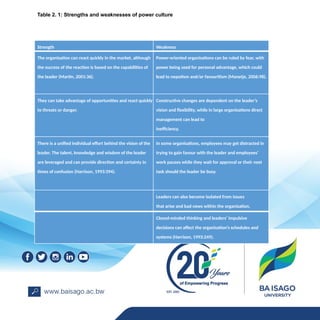
Strength Weakness
The organisation can react quickly in the market, although
the success of the reaction is based on the capabilities of
the leader (Martin, 2001:36).
Power-oriented organisations can be ruled by fear, with
power being used for personal advantage, which could
lead to nepotism and/or favouritism (Manetje, 2006:98).
They can take advantage of opportunities and react quickly
to threats or danger.
Constructive changes are dependent on the leader’s
vision and flexibility, while in large organisations direct
management can lead to
inefficiency.
There is a unified individual effort behind the vision of the
leader. The talent, knowledge and wisdom of the leader
are leveraged and can provide direction and certainty in
times of confusion (Harrison, 1993:394).
In some organisations, employees may get distracted in
trying to gain favour with the leader and employees’
work pauses while they wait for approval or their next
task should the leader be busy.
Leaders can also become isolated from issues
that arise and bad news within the organisation.
Closed-minded thinking and leaders’ impulsive
decisions can affect the organisation’s schedules and
systems (Harrison, 1993:249).
Table 2. 1: Strengths and weaknesses of power culture
• Role: According to Ho, Foo, Hui-Ming Wang, and Vitell (2012:107),
success of acculturation is contingent on the expat leader’s flexibility
and willingness to understand and adapt to the foreign culture.
• Multinational organisations are often interested in promoting
corporate culture to improve control, coordination, and integration
of their foreign subsidiaries.
• However, the biggest mistake would be to adopt a strident or
aggressive tone that focusses purely on corporate goals and ignores
local values this is known as role culture.
• Role culture is based on the formal establishment of rules, policies,
procedures, and specified job descriptions, which guide the
organisation and its employees (Martin, 2001:97).
• In this dimension the leader’s power is replaced by structures,
systems and job descriptions, which are more important than the
actual employees in those positions (Harrison & Stokes, 1992:25).
• The effort to gain power is restrained by rules, which leads to the
perception that the role dimension is organised by rules and
regulations and by rationality, order and dependence (Harrison &
Stokes, 1992:27).
• The main characteristics of this dimension are both high
formalisation and centralisation.
• According to Brown (1995:33), role dimension can be considered as a
series of pillars that represent specialist functions within the
organisation and the pediment is the small group of leaders who
coordinate and control the employees’ efforts.
• As a result, roles and responsibilities cascade downwards without
direct supervision of top management.
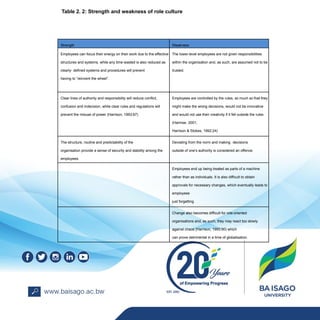
Strength Weakness
Employees can focus their energy on their work due to the effective
structures and systems, while any time wasted is also reduced as
clearly- defined systems and procedures will prevent
having to “reinvent the wheel”.
The lower-level employees are not given responsibilities
within the organisation and, as such, are assumed not to be
trusted.
Clear lines of authority and responsibility will reduce conflict,
confusion and indecision, while clear rules and regulations will
prevent the misuse of power (Harrison, 1993:87)
Employees are controlled by the rules, so much so that they
might make the wrong decisions, would not be innovative
and would not use their creativity if it fell outside the rules
(Harmse, 2001;
Harrison & Stokes, 1992:24)
The structure, routine and predictability of the
organisation provide a sense of security and stability among the
employees.
Deviating from the norm and making decisions
outside of one’s authority is considered an offence.
Employees end up being treated as parts of a machine
rather than as individuals. It is also difficult to obtain
approvals for necessary changes, which eventually leads to
employees
just forgetting
Change also becomes difficult for role-oriented
organisations and, as such, they may react too slowly
against chaos (Harrison, 1993:90) which
can prove detrimental in a time of globalisation.
Table 2. 2: Strength and weakness of role culture
• Achievement: The main characteristic of achievement is that the
organisation’s employees are united with the organisation’s common
vision or purpose (Harrison & Stokes, 1992:46).
• This dimension is characterised by high centralisation and low
formalisation.
• Employees work towards common set goals or the purpose of the
organisation and, in doing so, tries to use their personal energy in
achieving these goals.
• The systems and structures of the organisation are also put in place
to serve the organisation’s purpose.
• The main purpose is to bring appropriate workers along to realise the
organisation’s goals (Manetje & Martins, 2009:97).
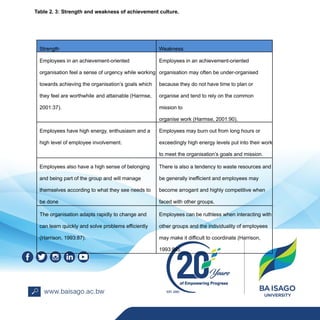
Strength Weakness
Employees in an achievement-oriented
organisation feel a sense of urgency while working
towards achieving the organisation’s goals which
they feel are worthwhile and attainable (Harmse,
2001:37).
Employees in an achievement-oriented
organisation may often be under-organised
because they do not have time to plan or
organise and tend to rely on the common
mission to
organise work (Harmse, 2001:90).
Employees have high energy, enthusiasm and a
high level of employee involvement.
Employees may burn out from long hours or
exceedingly high energy levels put into their work
to meet the organisation’s goals and mission.
Employees also have a high sense of belonging
and being part of the group and will manage
themselves according to what they see needs to
be done
There is also a tendency to waste resources and
be generally inefficient and employees may
become arrogant and highly competitive when
faced with other groups.
The organisation adapts rapidly to change and
can learn quickly and solve problems efficiently
(Harrison, 1993:87).
Employees can be ruthless when interacting with
other groups and the individuality of employees
may make it difficult to coordinate (Harrison,
1993:88).
Table 2. 3: Strength and weakness of achievement culture.
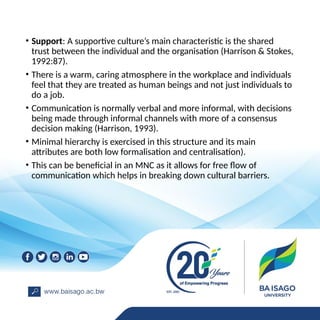
• Support: A supportive culture’s main characteristic is the shared
trust between the individual and the organisation (Harrison & Stokes,
1992:87).
• There is a warm, caring atmosphere in the workplace and individuals
feel that they are treated as human beings and not just individuals to
do a job.
• Communication is normally verbal and more informal, with decisions
being made through informal channels with more of a consensus
decision making (Harrison, 1993).
• Minimal hierarchy is exercised in this structure and its main
attributes are both low formalisation and centralisation).
• This can be beneficial in an MNC as it allows for free flow of
communication which helps in breaking down cultural barriers.
Strengths Weakness
There is good internal communication and
integration within a support-oriented organisation.
The downside of the support dimension is that they
have a habit of avoiding conflict and when actually
faced with conflict, will not deal with it well, or not
deal with it at all (Harrison & Stokes,
1992:68).
There are also high levels of trust within the
organisation, which results in a high level of
commitment to decisions that are made and
corporation to the goals of the organisation.
Employees tend to make decisions based on
compassion, which can lower employee effectiveness
and efficiency.
There is effective group work and management have
good people management skills in dealing with issues
and have a caring work environment which is good for
the health of employees
(Harrison, 1993:77).
The organisation is often slow to make decisions, as
efforts may be scattered and unfocussed on the goal
(Harrison, 1993:76).
Table 2. 4: Strength and weakness of support culture.
• Hofstede (1993:86) and UKEssays (2017:2) used data gathered from
IBM employees in more than 50 countries and classified
organisational culture into the following dimensions;
• Power distance: The degree in which employees and management
have a distant relationship, formal and informal. It refers to the
extent to which people of a society accept the unbalanced
distribution of power.
• Power distance refers to the extent in which a nation accepts the
factors that dissimilarity in its citizens’ mental and physical
capabilities increase the inequalities for their welfare.
• Individualism: The extent to which individuals are required to
support themselves and to pick their own particular affiliations, or
act as an individual from a deep-rooted gathering or association.
• It is a national culture quality that defines a flexible social framework
in which people stress on protecting themselves and their family.
• Collectivism: A national culture quality which define a close-knit
social framework in which people require from the other people of
the group to take care of them and protect them. These are societies
in which individuals from conception onwards are incorporated into
solid, binding groups, and in return are loyal to their caregivers.
• Uncertainty avoidance: The level in which people will mitigate
uncertain circumstances and tolerant of ambiguity.
• A national culture quality in this dimension is a society that feels
threatened by unknown situations and tries to avoid them; they adapt
to uncomfortable situations by minimising their vulnerability.
• Masculinity and femininity: According to Dager (2016:64), this shows
the distribution of values between the sexual orientations. Masculine
societies’ value intensity, self-assuredness, desire and the gathering of
wealth, and material belonging, where feminine societies put more
value on connections and personal satisfaction. The masculinity is a
preference for achievement, heroism, assertiveness, and material
reward for success. While femininity stands for a preference for
coordination, emotions, caring for the weak, and quality of life.
Cont..
• According to Lee and Shah-Hassoini (2019:89), masculinity is also a
traditional trait firmly rooted in most societies in Asia that can hinder
acculturation in an MNC.
• Such a trait can jeopardise the leadership of a woman expatriate
leader since she can feel disrespected or ignored.
• However, in a society where masculinity is considered important,
there is a high probability that rank within an organisation is also
respected.
• In this regard, an executive should be willing to stress the importance
of her title and educational credentials to business partners and co-
workers.
implementing CHANGE MANAGEMENT in the organisation

implementing CHANGE MANAGEMENT in the organisation

  • 1.
  • 2.
    Arrange any 3balls to add up to 30
  • 3.
    6 + 11+13 = 30
  • 4.
    What is changemanagement 1)Change management is the practice and process of supporting people through change, with the goal of ensuring that the change is successful in the long term. 2)Change management helps people to change their behaviors, attitudes, and/or work processes to achieve a desired business objective or outcome. 3)Change management as a discipline includes the processes, tools, and techniques used to manage the human elements of change which are applied at the individual, project, and organizational level before, during, and after the change occurs. 4)Change management ensures that these projects are successful, by helping to organize and disseminate information and change management practices throughout the organization. • What is changing? Everything. Even managing change in organisations has changed.
  • 5.
    • Change Managementcan be defined as a set of processes and tools that are designed to make sure that when you try to make change; i) Stakeholders buy into the change. ii) The process stays under control. iii) The process keeps on budget. • Change Management as a discipline, is a systematic approach to dealing with the transition or transformation of an organisation’s goals, team or individual. • Organizational Change largely focuses on one or all of the 4 focal areas, being; i)Internal processes ii)Hierarchy/ Structure iii) Culture iv) Underlying Technology
  • 6.
    • What isits purpose? • The purpose of Change Management is to • (i)implement strategies for implementing change, • (ii) controlling change, and • (iii) helping people to adapt to change. • Organisations often undergo change in response to either or both of external or internal factors. • External variables-Change in Legislation, Political Stability, Economic Meltdown, Entrance of new players in the market, Pandemics such Corona may all be factors that demands of us to the change the way in which we conduct business. • Internal variables- new product development, new technology, re- engineered processes to improve efficiency, loss of business and financial revenue.
  • 7.
    • Think aboutall the influences that are affecting your organization today. • How well prepared are you to adapt to that change effectively? • Are you doing everything you can to ensure that change is not only implemented, but adopted and ingrained into your business? • Change initiatives drive projects, but are we truly prepared to ensure the success of the change and not just the project?
  • 8.
    • In thelast 2 to 3 decades, we saw a surge in more organisations focusing on project management, which when put side by side with change management, it concerns itself with the technical deliverables of a business entity, on the other hand, at the heart of Change Management is the PEOPLE. • Managing PEOPLE through the change process. • Managing how PEOPLE interact with the new business function, and new ways of doing things demanded of them. • Managing how PEOPLE react to the change. • Nurturing a positive attitude towards change. • Ensuring they adopt the change and make it flow in the bloodstream of the entire organisation, making sure that the change is institutionalized and forms into the fabric that defines organisational culture.
  • 9.
    • When youdeal with people you cannot remove the emotions from how they will process and respond to the change process. • Change happens one person at a time. We can safely say it starts with the individual, cascades down to the team, and finally to the organisation. • Its quite common that as management, we often focus on the key deliverables of a business entity, which is data, figures, bottom-line when making decisions at behest of people’s emotions. Central to change management is the people, and by extension their emotions. • Change is uncomfortable because it challenges us out of our comfort zone into uncharted waters.
  • 10.
    • As itsto be expected, change elicits different responses from different people, • It is said, senior managers typically see change as an opportunity for both the business and themselves. • While employees typically see change as disruptive, intrusive and likely to involve loss. • Its all these different reactions, valid or may be not, that change process attempts to manage, for the good of both the organisation and the individual.
  • 11.
    • Lets tryto break down Change into small components that make IT what it is by exploring its CORE ELEMENTS….
  • 12.
  • 13.
    • Governance refersto the mechanisms that guide the course of an organization or project. • Effective governance gives the individuals in an organization an understanding of the strategic view and the reasoning behind what is being done and why. • This gives individuals an understanding of the project aim, direction, and tasks involved in the execution, reducing confusion that might otherwise lead to resistance. • Stakeholder management: Engaging all stakeholders in a planned and organized way ensures that all individuals that will be affected by the change are well- prepared for and understand the need for change. • Communication: In order for change to be effected within an organization, communication and messaging must be proactive, consistent, and repeated.
  • 14.
    • Workflow analysisincreases organizational and individual understanding of how work is currently performed. This may provide clarity on how processes can be improved or enhanced during the implementation of new technologies or systems. • Training and education are essential for staff to be able to effectively realize a change. Education is necessary for staff to understand both why and how they must change, and training is required for employees to be able to carry out the functional activities and build the new skills required for the change. • Evaluation and monitoring are not only important for determining whether a project has been successful, but also are important throughout change management initiatives to ensure that the desired changes are being effected.
  • 15.
    TYPES OF CHANGE •In this environment, the command of transformation becomes the ultimate test of leadership. • Leaders are confronted with a defining choice, a strategic crossroads that can significantly influence the direction and fate of their firms: should they embrace a radical rethinking, commonly known as a step change, or choose the measured journey of progressive evolution, the path of incremental change? • Understanding the distinction between step change and incremental change is crucial. It is akin to knowing when to use a sledgehammer and when a scalpel will suffice. • Step change is like the sledgehammer: powerful, impactful, and capable of sweeping changes quickly. In contrast, incremental change is the scalpel: precise, deliberate, and resulting in gradual but consistent improvements over a more extended period.
  • 17.
    Step change • Instep change we are confronted with three forms namely : strategic, operational and transformational. • 1. Strategic change • Strategic change is concerned with broad, long-term and organization- wide issues involving change. • It is about moving to a future state that has been defined generally in terms of strategic vision and scope. • It will cover the purpose and mission of the organization, its corporate philosophy on such matters as growth, quality, innovation and values concerning employees and customers, competitive positioning and strategic goals for achieving and maintaining competitive advantage and for product-market development. • These goals are supported by policies concerning marketing, sales, manufacturing, product and process development, finance and human resource management. • Strategic change takes place within the context of the external competitive, economic and social environment, and the organization’s internal resources, capabilities, culture, structure systems
  • 18.
    • Its successfulimplementation requires thorough analysis and understanding of these factors in the formulation and planning stages. • The ultimate achievement of sustainable competitive advantage relies on the qualities defined by Pettigrew and Whipp (1991), namely ‘The capacity of the firm to identify and understand the competitive forces in play and how they change over time, linked to the competence of a business to mobilize and manage the resources necessary for the chosen competitive response through time.’ • Strategic change, however, should not be treated simplistically as a linear process of getting from A to B that can be planned and executed as a logical sequence of events. • Pettigrew and Whipp (1991) issued the following warning based on their research into competitiveness and managing change in the motor, financial services, insurance and publishing industries
  • 19.
    2. Operational change •Operational change relates to new systems, procedures, structures or technology that will have an immediate effect on working arrangements within a part of the organization. • But its impact on people can be more significant than broader strategic change and it has to be handled just as carefully. 3. Transformational change • Transformational change takes place when there are fundamental and comprehensive changes in structures, processes and behaviors that have a dramatic effect on the ways in which the organization functions. • Transformational changes are larger in scale and scope and often signify a dramatic and, occasionally sudden, departure from the status quo. • Launching a new product or business division, or deciding to expand internationally, are examples of transformational change.
  • 20.
    Theories of Change •There are two largely used theories of change • These lays out a framework under which change happens • Lets conduct an autopsy of Kurt Lewin’s Change Model, and John Kotter’s 8 Step Model respectively.
  • 21.
  • 23.
    Making a casefor change; why do we need change • In the past, when change happened less frequently, a leader could get by without being a proficient change agent. • Today, it’s a completely different story. Change is occurring in virtually every corner of business and industry, and the pace of change is increasing rapidly. • Being an effective change agent is no longer just a nice leadership skill to have, it has become an essential leadership competency. • Possibly the toughest part of leading change is generating enough excitement and momentum to inspire others to WANT to do things differently. • That’s usually a tall order because there are built-in rewards for maintaining the status quo. • Psychologists will tell you that “all behavior is rewarded.” The difficulty in getting people to change is convincing them to abandon current behaviour that’s providing their current reward in favour of new behaviour that promises a better reward.
  • 24.
    Six Strategies toCreate a Compelling Case for Change • 1) Contrast Current vs Future State. Paint a picture of the desired future. What will we be able to do that we can’t do now? What will the culture be like? How will our lives be easier, better, or more successful? What will be the personal pay-off for each stakeholder group for making the change? The classic example of this strategy is Martin Luther King’s “I Have A Dream” speech. He constantly juxtaposed ‘what is’ with ‘what could be’ to create psychological tension and excitement that drew the listeners toward the ideal state he was describing. • Nancy Duarte explains in this TED talk how she discovered this pattern in many of the greatest speeches. • This strategy is compelling because it draws on two powerful motivators: avoiding pain and moving towards pleasure. • This works far better than simply creating a so-called “burning platform” to compel people to “jump” (which is common change management lingo). • This is because it draws the listener toward something positive, not just away from the negative.
  • 25.
    • 2) Makeit rational and emotional. You obviously need to engage your audience’s brains by making your case rationally compelling, but many presenters often fail to engage the real decision maker: their audience’s emotions. • The best way to engage emotions is to tell a story that highlights the human impact of the change you are proposing, or the reality of the current situation. • 3) Use Metaphor. Metaphors are powerful because they enable language to be experienced through the senses. • Being able to see, feel or taste a concept allows people to literally “feel” what you are saying because their emotions are being triggered by their senses. • For example, when Pablo Picasso wrote “Art washes away from the soul the dust of everyday life.” we might compare art to feeling refreshed, renewed and invigorated. • In addition to provoking our audience’s emotions, metaphors appeal to the rational brain because they explain the complex by comparing them to the simple and familiar.
  • 26.
    • 4) Makethe Problem Visual. A great example of this is the “gloves on the boardroom table” story. • A supply chain executive was convinced that his company was wasting a great deal of money by using too many vendors to supply the same types of products. • Unfortunately, none of the other executives paid much attention to his calls for change. • So he enlisted the help of a summer student to find out how many different types of gloves his company was purchasing from various vendors at various prices. • Turns out they were purchasing 424 different gloves! So he collected all 424 different gloves, tagged each glove with the price and supplier, dumped them on the boardroom table and invited the executives to see the problem for themselves. • Needless to say, it worked!
  • 27.
    •5) Highlight yourown “Bright Spots.” Don’t simply describe the best practices of others, highlight your own organization’s best practices. •People don’t appreciate it when their parents say “Be more like your brother,” so we can expect a similar reaction at an organizational level. •The trick is not to tell an organization to be like some other organization; it’s to encourage them to be themselves at their best moments. •This sends the message “We can actually do this because we’ve done it before!”
  • 28.
    • 6) Articulateyour new identity. This strategy is a combination of several strategies described above. • It’s the answer to the questions “What will the organization be like when the change has happened, and why is it cool?” • If the change you want to promote is safety, you might highlight several burly men in full Personal Protective Equipment with the caption “We make safe look good.” • Or you might share a story about a respected employee whose life was saved because they followed the safety protocol. • If the change you want to promote is a leaner, decentralized organization that can react quickly to changes in the marketplace, you might use the metaphor of an elephant standing next to several cheetahs. • The caption under the elephant would read “What we were.” The caption under the cheetahs would read “What we are now.” The key is to celebrate the new identity so that people will want to be associated with it.
  • 29.
    •For change initiativesto succeed, they must be led by people who have the ability to generate excitement and momentum towards the desired end state. Change is hard. It’s like pushing a car up hill. It can be done, but you need to begin pushing the car on a stretch of flat road to gain momentum long before you get to the incline. Following the steps and strategies outlined above will help leaders build the momentum needed to overcome the inevitable resistance along the way.
  • 30.
  • 31.
    Prepare the Organizationfor Change • For an organization to successfully pursue and implement change, it must be prepared both logistically and culturally. • Before delving into logistics, cultural preparation must first take place to achieve the best business outcome. • In the preparation phase, the manager is focused on helping employees recognize and understand the need for change. • They raise awareness of the various challenges or problems facing the organization that are acting as forces of change and generating dissatisfaction with the status quo. • Gaining this initial buy-in from employees who will help implement the change can remove friction and resistance later on.
  • 32.
    Craft a Visionand Plan for Change • Once the organization is ready to embrace change, managers must develop a thorough, realistic, and strategic plan for bringing it about. • The plan should detail: • Strategic goals: What goals does this change help the organization work toward? • Key performance indicators: How will success be measured? What metrics need to be moved? What’s the baseline for how things currently stand? • Project stakeholders and team: Who will oversee the task of implementing change? Who needs to sign off at each critical stage? Who will be responsible for implementation? • Project scope: What discrete steps and actions will the project include? What falls outside of the project scope? • While it’s important to have a structured approach, the plan should also account for any unknowns or roadblocks that could arise during the implementation process and would require agility and flexibility to overcome.
  • 33.
    Implement the Changes •After the plan has been created, all that remains is to follow the steps outlined within it to implement the required change. • Whether that involves changes to the company’s structure, strategy, systems, processes, employee behaviors, or other aspects will depend on the specifics of the initiative. • During the implementation process, change managers must be focused on empowering their employees to take the necessary steps to achieve the goals of the initiative and celebrate any short-term wins. • They should also do their best to anticipate roadblocks and prevent, remove, or mitigate them once identified. • Repeated communication of the organization’s vision is critical throughout the implementation process to remind team members why change is being pursued.
  • 34.
    Implementing change • Oneof the command denominators to failed change undertaking is poor change community strategy • Which often leads to low morale stress and gives in the organisation. • Relational breakdown between employer and the employee • And sometimes loosing critical employees during this journey • Setting up a communication strategy plan is premised on preparing the organisation for the communication roll-out plan. • And like a farmer, you prepare the seedbed so that the seed(message) falls on receptive soil. • And this is what you look at in your preparation for the roll-out; i. Criticality of all your employees • The value that each employee driving for the company, the niche skills sets that they possess which are critical to e companies regular function Once you made that understanding categorize each employee from highly critical to not so critical • - This analysis is going to be extremely important in the later stage of this step.
  • 35.
    ii. What wecan refer to as, the first communication, the change leader needs to , identify key members from his organization, these we call the change managers, and they will be the frontline messengers of the change. • But before they do that, the change leader needs to convince them of his/ her vision for the change and the Strategic approach of the change, • And clearly define if this just doesn't happen, how will it negatively impact the company and their careers. •Once he has done that he needs to demand commitment and accountability from them while they walk with him/ her on the journey
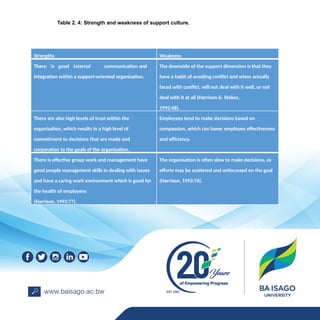
  • 36.
    •Iii. Now thatthe change manager is ready with the change management team •He can move to the bigger platform and address the entire team about the change initiative •the critical elements of this conversation will be of course, a passion for the vision that he lays out, and the logical approach to get that goal •But the most important will be the ethos, which is the ethical appeal which connect him to his team members. •This appeal will then add to the reliability and transparency of the approach the change leader is taking,
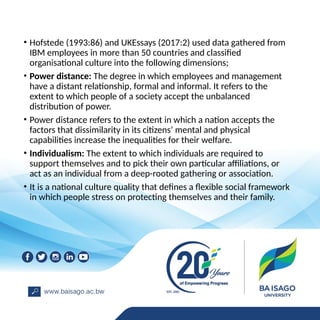
  • 37.
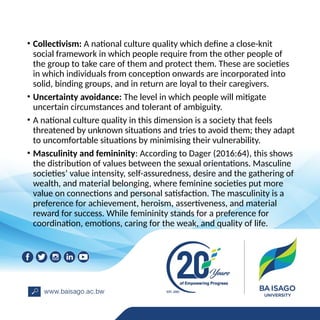
    • Iv. oftenwhen you are talking in a larger audience, all information is not absorbed at all levels. • Its only desalinated partially, the change manages team need to go talk to the their audience in smaller groups or 1 on 1 meeting to allay their fears • This is where your analysis of critical , to not so critical employee comes in play. • Because when you are talking to a very critical employee you need to talk to them and ensure they understand their place in the future of the organisation along with the a clear career development path. • However, when you are talking to not so critical employee it is important to not make any promises to them but, at the sane time allay their fears that the company will not take an unjust action against them.
  • 38.
    • All these4 steps are going to be very important, once this first set of communication, fear will take over. The problem with communication change is the illusion that it has already taken place. • Hence throughout the change Journey, it will be important for the change leader and the change managers to connect with the team. • Hence they should be done as a cyclical process, when there is early success the leader should go out there and share with the team, because It also establishes the credibility of their approach. • The change management need to keep connected with the smaller groups. 1 on 1 so that this entire group this community can walk hand in towards a common goal
  • 39.
    •73% of change-affected employees report experiencing moderate to high stress levels •Step 1-Establish clear Goals •What are you trying to achieve, •Goals →Goals> •What are the benefits •How can you make reliable credibility •Surveys, asking your employees will help you crystalize your communication strategy.
  • 40.
    • 2. Mapyour Internal audiences • Who will be affected by the change, and how they are affected by the change: • It’s important to communicate with all stakeholders , not just those directly impacted by the change . • However keep in mind, the message and amount of information should be different for different groups • Give preference to targeted common platforms such segmenting your message by department, seniority, location • Remember transparency can help you mitigate resistance and create buy in • 3. Build Communication plan • Ideally this should go hand in hand with a change model of choice eg. Kotter 8 step model your communication plan may look like this: • 1 increase Urgency- communicate the reason for change and potential consequences of not changing. • Use data and stories to emphasis the change • 2 build the team • Identity stakeholders drive the change and communication with the at very level
  • 41.
    • 3. Getthe vision correct • Communicate the vision and strategy to all stakeholders using clear and concise • 4. Communicate. • Use multi channel approach to share the vision and strategy with all stakeholders • Communicate the • benefit of the change and how now it will impact them. • 5. Get things Moving • - Communicate the roles and responsibilities of all stakeholders in the change initiative. • Encourage and empower them to take ownership of change and provide them with the necessary resources to do so
  • 42.
    6. Focus onShort term goals. • Celebrate all short wins • Communicate all small wins along the way • Use internal data to demonstrate progress and keep stakeholders really motivated 7 Incorporate change • Communicate the importance of continuing with the change initiative and the need to sustain momentum 8. Don’t give up • Keep on going, change takes time • Don’t give up if you don’t see the results immediately • Be persistent, give yourself and your employees time to adjust
  • 43.
    Embed Changes WithinCompany Culture and Practices • Once the change initiative has been completed, change managers must prevent a reversion to the prior state or status quo. • This is particularly important for organizational change related to business processes such as workflows, culture, and strategy formulation. Without an adequate plan, employees may backslide into the “old way” of doing things, particularly during the transitory period. • By embedding changes within the company’s culture and practices, it becomes more difficult for backsliding to occur. • New organizational structures, controls, and reward systems should all be considered as tools to help change stick.
  • 44.
    •Review Progress andAnalyze Results •Just because a change initiative is complete doesn’t mean it was successful. •Conducting analysis and review, or a “project post mortem,” can help business leaders understand whether a change initiative was a success, failure, or mixed result. It can also offer valuable insights and lessons that can be leveraged in future change efforts. •Ask yourself questions like: Were project goals met? If yes, can this success be replicated elsewhere? If not, what went wrong?
  • 45.
    Key factors ofsuccessful change • Parag (2018) has identified six critical factors that affecting to the success of organizational change process. • 1) Develop a clear vision and strategy for organizational change process that is backed up by distinct rewards. • Employees are more inclined to accept change if they are aware of why it is taking place, what it includes, and how it will affect them. • Individual change projects and programs must be coordinated and linked with the firm's overarching strategy to produce a wide "image" of change. • 2) Ensure that the company have strong leadership and sponsorship. Actions are more effective than words. • Senior leaders and sponsors of companies must lead by example and push for change. • To deliver, sponsors need the right sphere of influence, time, and personality attributes including communication and listening skills, honesty, the ability to connect and inspire, trust, emotional intelligence, and gravitas.
  • 46.
    • 3) Allstakeholders must be understood, engaged with, committed to, and supported. • Stakeholders of companies will notice and respond to change the organizational change in a variety of ways, so it's critical to understand, engage, acquire commitment from, and support them throughout the change process of a company. • Identify stakeholders early in the change process, conduct a prospective change impact assessment, and establish a commitment- building engagement and communication strategy. • 4) Create a strong change team with the skills that need to succeed. Create and cultivate a high-performing transformation team that combines a clear focus on its mission with strong interpersonal relationships. • Make that the team's mission or remit is properly defined, both in terms of itself and in relation to other teams, such as the overall program or project team. • To facilitate successful change, provide team members with the essential change process and soft/people talents or skills.
  • 47.
    • 5. Defineand implement a well-structured, integrated strategy. • Make sure you employ a holistic, integrated approach that considers all factors and is appropriate for your endeavor and its surroundings. This is critical in order to ensure that everyone on the change team is on the same page, to ensure consistency in delivery, and to improve competence and maturity in order to achieve higher success. • 6) Assess the success of the change initiatives • Organizational transformation is frequently a non-linear, evolutionary learning process, and it is impossible to know everything right away. • The external and internal organizational might alter during the process, and evaluating a change effort in the same way as other parts of the business, such as operations, is difficult, if not impossible. • Measures may be a powerful tool for involving and communicating with the rest of the organization and stakeholders about the change's success and impact over time, as well as soliciting feedback. • At the outset, establish a baseline and success criteria, and link metrics to the vision, outputs, outcomes, and benefits that were originally defined. • Use a mix of qualitative and quantitative metrics, paying special attention to relevance, measurability, and the simplicity with which data may be collected, analysed, and presented.
  • 48.
    • The primaryreasons why organizations are failing and losing money are “insufficient communications” and “lack of leadership” (PMI Report, 2014). • The function of leadership cannot be over emphasized more when it how critical it is to the change process. • Largely leaders we are dealt with can make or break the change process • But what is leadership? • What are some of the leadership styles that have been curated? • If we were to ask Al create a leader who can effectively navigate us successfully through a change process, what would be the likely results?
  • 49.
    Leadership in changemanagement: role and attributes • The ever increasing pressure on organizations and institutions to undergo change to survive and maintain their relevance cannot be overemphasized in the era of globalization. • Consequently, leaders in the 21st century have enormous responsibility to successfully lead change in their organizations. • Leadership is related with change. If there is leadership then change is inevitable. Because, challenging status quo is one of main characteristics of leaders. • Leadership often cited as an important element in terms of creating conducive environment for effective change implementation. • You’ve heard the statistics. Even though change management has been a recognized discipline for more than half a century, studies continue to report the high failure rates for organizational change projects. • Literature on organizational change management indicates that boosting employees’ readiness for change depends on specific attributes of the leader and how the leader promotes the change leader .
  • 50.
    • First, LeadersShould Understand the Meaning of “Change” A leader should think about the meaning of “change” with different perspectives: • What is change? Why do we have to change? When to change? How to change? How to trigger change? • The answers may differ from source to source, however, there is one thing that is constant is “change never stops”. • Change equates with life, with our own personal, social, mental and physical development and with our ability to learn, to adapt, to play an active role in social and community activities. • So, a leader should create his/ her own style to adapt himself/herself and his/her organization to continuously changing environment.
  • 51.
    • However, organizationsthat are highly effective at change management, change enablers, incorporate certain practices that they deem important to the success of strategic initiatives • As a leader, you have to add something on management functions. The process of change begins with organizational leaders developing an organizational strategy, then with the creation of an initiative that is aligned with that strategy. • However, the change process involves emotions because nobody likes to surrender the comfort associated with the status quo or surrender what they value. • Despite that, leaders will have to succeed in the mist of these challenges, among which are the emotions of those to be affected by the change. • Therefore, there is an increase in focus on emotional intelligence in leadership in managing the process of change. • A leader has to feel himself/ herself as someone responsible from the ones managing the change process.
  • 52.
    Definitions • Tokar (2020:1)states that leadership in organisation is a management approach in which leaders helps set goals that are strategic for the organisation while motivating individuals within the group to successfully carry out assignments in service to those goals. • A comprehensive definition was created by Winston (2019:7), which defines leadership as one or more people who selects, equips, trains, and influences one or more follower(s) who have diverse gifts, abilities, and skills, and focusses the follower(s) to the organisation’s mission and objectives causing the follower(s) to willingly and enthusiastically expend spiritual, emotional, and physical energy in a concerted coordinated effort to achieve the organisational mission and objectives (Ahmed 2017:54, Terry 2017:3, Swanwick, 2017:9).
  • 53.
    •The leader achievesthis influence by humbly conveying a prophetic vision of the future in clear terms that resonates with the follower(s) beliefs and values in such a way that the follower(s) can understand and interpret the future into present- time action steps (Martins, Thoms. Legood & Dello Russo, 2018:155) •There are different styles of leadership, and most studies mention transformational and change leadership’s effect on employees’ readiness for change, but there is some level of difficulty of differentiating between them.
  • 54.
    Change leadership vstransformational leadership • Some writers and researchers tend to use them interchangeably, asserting that they share common elements . • One criterion to differentiate between the two is time orientation. Transformational leadership argued to emphasize on long-term effects on followers, change leadership focuses on short-term and specific change project. • Most change leadership dimensions such as communicating the plan for change, building a guiding coalition, developing a sense of urgency or a compelling rational for the change and providing support can be linked to one or more dimensions of transformational leadership . • On the other hand, transformational leadership is related to strategic leadership, while change leadership is more attached to tactical leadership behavior.
  • 55.
    • Change leadershipcan be conceptualized as the behavior of direct supervisors, and it is aimed at framing and shaping organizational change along with boosting the capacity of employees to implement the change initiative . • It involves crating favorable attitudes among change recipients regarding the change • It includes ensuring the need for change, providing vision and plan, building support and commitment to the change, and monitoring its implementation . • Change leadership behaviors include ensuring the need for change, providing vision and plan, building support and commitment, and monitoring the implementation . • Leaders by exhibiting change leadership behaviors such as high quality change information and employee participation, communication about change and providing individual employees the opportunity to contribute in the change process .
  • 56.
    • Specific attributesof a leader and the way how he or she promotes the change is one critical factor to increase individual employee’s readiness to change. • The attribute and change-promoting behavior embraces the concept of change leadership. • Change leaders should also show behaviors such as high-quality change information and employee participation, communication about the change and providing individual employee the opportunity to contribute in the change process. • Change leadership requires recognition of risks and dangers and equal parts of patience, persistence and resilience in the face of fresh challenges. • In addition, change leadership requires a strong process orientation. • Approaching change as a process and knowing what actions to take at each critical stage of that process help minimize risks and maximize your chances for success.
  • 57.
    Transformational leadership • Kirkan(2011:90) asserts that transformational leadership is a leadership pattern used by leaders to change the current situation though inspiration, persuasion, and excitement to achieve a high level of clear vision for the purpose of recognising common goals. • Organisations need leaders able to cope with change, maintain daily operations and provide a competitive advantage (Ghadi, Fernando & Kaputi, 2013:535). • Transformational leaders stimulate and encourage their employees and unify them behind a collective cause, resulting in improved outputs, performance, and job meaningfulness (Wang, Oh, Courtright & Colbert, 2011:248). • They also understand the strengths and weaknesses of employees, so the leader can align employees with tasks that optimise their performance. • Transformational leaders affect people’s emotions by paying a big and exciting picture of the future.
  • 58.
    • They conveythe vision; they have a clear and straight vision about the future. • They engage the people; change management process is anchored around strong communication. The leader must engage and communicate on time, right place, right audience and the how part of the communication must also be measured and on point. • A leader must create sustainable atmosphere for change. • You transform people by taping into their hopes dreams and ideals. • You lure employees by being motivated yourself, • You enhance productivity through high transparency and communication. • Transformational leader there’s total ownership and involvement as a leader. • You lead by example, you use this to focus on building lasting personal strengths that make your teammates more successful and confident in you and the organisation. • This style of leadership will definitely inspire employees and alleviate fear and get you to the envisioned future.
  • 59.
    Resistance to change •The psychology of how people respond to change • Interrogating the change curve according to Kubler-Ross
  • 60.
    • Resistance tochange is by far the most challenging part in the change management process. • What underneath change that people resist so much? • People don’t resist change. They resist LOSS. • Leaders would be more focused on what we stand to gain, with little to no regard to what people are being asked to give up. • What we stand to lose actually if the change happens. • Psychologists say, the pain of losing is twice as powerful as the pleasure of gaining it. • The fear of losing something is the one that keeps us from embracing gain in the unknown future as brightly painted as it may be. • Perhaps lets look at the DNA of LOSS • Loss may encompass a lot of things in our lives; people, places, things, future plans.
  • 61.
    • People aremore open to change when they know what will stay the same (ironic, I know) • The vision of a brightly future, that’s only half of the equation; We also need to know what will continue and we can bring that forward when we highlight aspects of ourselves that will endure so leaders must not act only as champions of change but as anchors of stability and stewardship of our readiness. • The threat may not be existential and dramatic but do not underestimate the power that the these threats of loss has on the hearts and mind of people and on shaping their behaviors • When change happens and a serious threat of loss looms on the horizon how do we lead ourselves and others through it?
  • 62.
    • But thereare several co-types of loss that are particularly painful in social environments…. • Lets explore 5 of those today 1) Safety • Will this change jeopardize my sense of safety, physically and psychologically? • We derive a sense of safety from things like a stable job, reliable finances • And there is something about predictability that makes us feel safe, and when something comes along that makes us contends with unpredictability, that very thing is equated to danger. • So we would push back to remain on familiar grounds because they offer a sense of safety.
  • 63.
    • 2)Freedom • Lossto a great degree takes away the opportunity to have a say in the course our life is taking, • Everything about loss is thrust upon us and throws us into a state of helplessness, and we don’t have much to say or do to change the coarse of life. • 3)Status • Social hierarchy govern our relationships as human beings, whether they are formal or not, the higher the status the more respect, the more significance, the more power and influence you have. • And once you have it, its hard to let it go. • And these are attached directly and indirectly to where we work, the job titles we carry. • Sometimes change may mean that we lose half of what we know, to make space for what we should know about our jobs going forward, and sadly we struggle with the new knowledge. • This may take away from a sense of importance particularly when we were used to being asked for help on a subject we were well competent on.
  • 64.
    • 4)Belonging • Awork environment can positively offer a sense of belonging particularly the environment radiates good energy and positivity • People can feel sad about leaving on promotion to another department or branch because they enjoyed quite a harmonious environment that offered warmth and acceptance. • We can feel joy for what we are gaining, and sadness for what we a re losing. • 5) Fairness • When we encounter situations and circumstances that makes to question fairness? • Why me, not the other person? • Decisions that exacerbate our pain equity, we will ask in respect to our loss, is it fair? • Bottom line is, expect resistance.
  • 65.
    • There isa common thread among all these core needs, the reason that they are so important to us, and are so deeply painful to lose, when we are asked to lose them we question core parts of our identity-who we think we are? • Who am I, without this job, title… • It’s a tall order when you are asked to give up on things that are tied to your identity. • However there can be; • Wisdom in resistance, it can teach us what’s important to ourselves and others • It might also teach us about where we might have missed the mark.
  • 66.
    • Could ourplans for change cause harm. • Change is inevitable and necessary so loss is the price we pay for it. • Its important that we name the losses that others are facing, or we are facing, ignoring or dismissing all breeds resentment and anger. • Acknowledging these losses is an exercise in telling the truth. • Its an exercise in getting permission to grieve what’s gone. • Its an exercise that says I see you, I NOTICE YOU • And it puts us towards the path to acceptance
  • 67.
    •So what’s thebiggest take way from resistance for leaders •Consider the wisdom in resistance •Name the loss •Shine a light on what stays the same •Turn towards possibility- dream about what we can become •And remember its in the moments of resistance that we mush show leadership, empathic leadership. •And this is how you write a story for the future together
  • 68.
    READINESS • Change readinessis the state of an organization’s ability to manage change and uncertainty. • It is a measure of an organization’s preparedness to respond to, and recover from, change events. • Change readiness is a function of an organization’s ability to anticipate change, change resistance, adapt to change, and recover from change. • Managers and change leaders use a tool which consists of a set of questions to assess whether organization is ready to implement change or not. • By using the change readiness tool, organizations can develop action plans to improve their change management.
  • 69.
    •What is changereadiness assessment tool? •A change readiness assessment tool is used to gather information about an organization’s preparation for change and how simple it will be to build an adequate change plan – and, as a result, change initiatives will be more successful. •This diagnostic’s tool is to determine how well- planned a certain organizational transformation endeavor, project, or program has been •The change readiness tool can help organizations assess their change readiness and develop action plans to improve their change readiness.
  • 70.
    •The change readinesstool usually consists of four key components: •1) Anticipate change •2) Resist change •3) Adapt to change •4) Recover from change. •Each component includes a set of questions that organizations can use to assess their change readiness. •The change readiness tool can help organizations identify areas where they are strong in change readiness and areas where they need improvement.
  • 71.
    •Why it isimportant to make assessment of change? •Managing change is always complex and it requires a complete preparation before starting change initiative. Therefore, every manager and change leader must know that whether their organizations are ready and well prepared to take on change. •It’s important because of two reasons: •First, making assessment of change readiness provides an opportunity to identify risks associated with implementation of change. •Second, this kind of assessement gives in-depth analysis of all the component of change and it gives a better picture of entire plan of change
  • 72.
    • Using changereadiness assessment tool • You can conduct this assessment alone or with other members of organization, such as your steering committee or project team. • You can identify 20 or more than this questions and key areas which reflect preparation on change management. You can ask your colleagues to mark the scale with the corresponding number. The number you circle should represent how well you believe the work has been done so far on that item concerning this change. • Throughout this assessment, keep the accepted definition of the proposed change in mind. Since this is a general assessment tool, the terminology might not be entirely applicable to your organization. • If you believe that something is not pertinent to your situation, either disregard it or consider how you may rewrite it to make it more pertinent. • Before sharing and discussing your results, finish this analysis on your own if you are working on this evaluation with other members of your program, project, or change management team. You can discover that several team members have various points of view.
  • 73.
    • Throughout thisassessment, keep the accepted definition of the proposed change in mind. • Since this is a general assessment tool, the terminology might not be entirely applicable to your organization. • If you believe that something is not pertinent to your situation, either disregard it or consider how you may rewrite it to make it more pertinent. • Before sharing and discussing your results, finish this analysis on your own if you are working on this evaluation with other members of your program, project, or change management team. • You can discover that several team members have various points of view.
  • 74.
    Measuring Change Readiness:Utilizing 5 Key KPI Components • The Change Readiness Matrix provides guidance on what to do if these KPIs are low, emphasizing the importance of effective communication, engagement, and support to improve readiness. It includes five key performance indicator (KPI) components used in a business readiness assessment: • KPI 1: Awareness of the Change: Lack of awareness is the primary reason for resistance to change. It’s crucial to assess end-users’ awareness of the change to increase their willingness to support it. • KPI 2: Acceptance of the Change: Acceptance of the change is vital for readiness. Initial opposition to change is common, and it’s important to engage stakeholders to gain their acceptance and support.
  • 75.
    • KPI 3:Capacity for Change: Groups may be undergoing multiple changes, affecting their capacity for more. Assess each group’s capacity for additional change to tailor engagement accordingly. • KPI 4: Knowledge of What is Changing: Impacted stakeholders may be aware of and accept a change, but they might lack basic knowledge of what specifically is changing in their workflow. To address this: • Provide a high level of training and communication to enhance their understanding. • Ensuring people are aware of what changes are happening and when they are happening is vital. • Training, communication, and support are essential to prepare an organization for a successful project go-live.
  • 76.
    • KPI 5:Level of Training Required: Once stakeholders have basic knowledge of the changes, formal training is needed for them to gain the necessary proficiency. A high level of required training indicates the need for more preparation: • End-users must transition from their current state to the target future state with the right knowledge and skills. • In cases of transformational change, various components like job roles, systems, tools, processes, policies, and procedures may change. • If the level of training required is high, the change management team should plan extensive or additional training to ensure readiness, especially during subsequent readiness assessments.
  • 77.
    CULTURE • A strongorganizational culture provides stability to an organization. And for some organizations, it can also be a major barrier to change. • A Definition of Organizational Culture Organizational culture refers to a system of shared meaning held by members that distinguishes the organization from other organizations. • A company history and unwritten rules are a part of its culture • Organizational culture is manifested in many ways including norms, physical settings, modes of dress, special language rituals and stories.
  • 78.
    Seven primary characteristicsseem to capture the essence of an organization’s culture: • 1. Innovation and risk taking. The degree to which employees are encouraged to be innovative and take risks. • 2. Attention to detail. The degree to which employees are expected to exhibit precision, analysis, and attention to detail. • 3. Outcome orientation. The degree to which management focuses on results or outcomes rather than on the techniques and processes used to achieve them. • 4. People orientation. The degree to which management decisions take into consideration the effect of outcomes on people within the organization. • 5. Team orientation. The degree to which work activities are organized around teams rather than individuals. • 6. Aggressiveness. The degree to which people are aggressive and competitive rather than easygoing. • 7. Stability. The degree to which organizational activities emphasize maintaining the status quo in contrast to growth. Each of these characteristics exists on a continuum from low to high. Appraising the organization on them, then, gives a composite picture of its culture and a basis for the shared understanding members have about the organization, how things are done in it, and the way they are supposed to behave.
  • 79.
    Do Organizations HaveUniform Cultures? • Organizational culture represents a common perception the organization’s members hold. • We should therefore expect individuals with different backgrounds or at different levels in the organization to describe its culture in similar terms. That doesn’t mean, however, that there are no subcultures. • Most large organizations have a dominant culture and numerous subcultures. • A dominant culture expresses the core values a majority of members share and that give the organization its distinct personality. Subcultures tend to develop in large organizations to reflect common problems or experiences members face in the same department or location. • If organizations were composed only of numerous subcultures, organizational culture as an independent variable would be significantly less powerful. • It is the “shared meaning” aspect of culture that makes it such a potent device for guiding and shaping behavior. • But subcultures can influence members’ behavior too.
  • 80.
    Strong versus WeakCultures • It’s possible to differentiate between strong and weak cultures. If most employees (responding to management surveys) have the same opinions about the organization’s mission and values, the culture is strong; if opinions vary widely, the culture is weak. • In a strong culture, the organization’s core values are both intensely held and widely shared. • The more members who accept the core values and the greater their commitment, the stronger the culture and the greater its influence on member behavior, because the high degree of sharedness and intensity creates a climate of high behavioral control.
  • 81.
    • A strongculture should reduce employee turnover because it demonstrates high agreement about what the organization represents. • Such unanimity of purpose builds cohesiveness, loyalty, and organizational commitment. These qualities, in turn, lessen employees’ propensity to leave. • One study found that the more employees agreed on customer orientation in a service organization, the higher the profitability of the business unit. • Another study found that when team managers and team members disagree about perceptions of organizational support, there were more negative moods among team members, and the performance of teams was lower. • These negative effects are especially strong when managers believe the organization provides more support than employees think it does
  • 82.
    Culture versus Formalization •High formalization creates predictability, orderliness, and consistency. • A strong culture achieves the same end without the need for written documentation. Therefore, we should view formalization and culture as two different roads to a common destination. The stronger an organization’s culture, the less management need be concerned with developing formal rules and regulations to guide employee behavior. Those guides will be internalized in employees when they accept the organization’s culture. Culture’s Functions. • First, culture has a boundary-defining role: it creates distinctions between one organization and others. • Second, it conveys a sense of identity for organization members. • Third, culture facilitates commitment to something larger than individual self-interest. • Fourth, it enhances the stability of the social system. • Culture is the social glue that helps hold the organization together by providing standards for what employees should say and do. Finally, it is a sense-making and control mechanism that guides and shapes employees’ attitudes and behavior. This last function is of particular interest to us. Culture defines the rules of the game.
  • 83.
    • Culture CreatesClimate; If you’ve worked with someone whose positive attitude inspired you to do your best, or with a lackluster team that drained your motivation, you’ve experienced the effects of climate. • Organizational climate refers to the shared perceptions organizational members have about their organization and work environment. • This aspect of culture is like team spirit at the organizational level. When everyone has the same general feelings about what’s important or how well things are working, the effect of these attitudes will be more than the sum of the individual parts. • A positive overall workplace climate has been linked to higher customer satisfaction and financial performance as well. Culture as a Liability • Culture can enhance organizational commitment and increase the consistency of employee behavior, clearly benefits to an organization. Culture is valuable to employees too, because it spells out how things are done and what’s important. But we shouldn’t ignore the potentially dysfunctional aspects of culture, especially a strong one, on an organization’s effectiveness. Institutionalization • When an organization undergoes institutionalization and becomes institutionalized—that is, it is valued for itself and not for the goods or services it produces—it takes on a life of its own, apart from its founders or members. It doesn’t go out of business even if its original goals are no longer relevant. Acceptable modes of behavior become largely self-evident to members,
  • 84.
    Barriers to Change •Culture is a liability when the shared values don’t agree with those that further the organization’s effectiveness. This is most likely when an organization’s environment is undergoing rapid change, and its entrenched culture may no longer be appropriate. • Consistency of behavior, an asset in a stable environment, may then burden the organization and make it difficult to respond to changes. Barriers to Diversity • Hiring new employees who differ from the majority in race, age, gender, disability, or other characteristics creates a paradox: management wants to demonstrate support for the differences these employees bring to the workplace, but newcomers who wish to fit in must accept the organization’s core cultural values. Because diverse behaviors and unique strengths are likely to diminish as people attempt to assimilate, strong cultures can become liabilities when they effectively eliminate these advantages. • A strong culture that condones prejudice, supports bias, or becomes insensitive to people who are different can even undermine formal corporate diversity policies. Barriers to Acquisitions and Mergers • Historically, when management looked at acquisition or merger decisions, the key factors were financial advantage and product synergy. In recent years, cultural compatibility has become the primary concern. All things being equal, whether the acquisition actually works seems to have more to do with how well the two organizations’ cultures match up.
  • 85.
    Attitudes • In societieswhere there are distinctions between social classes on economic, social or religious grounds certain groups adopt the fatalistic attitude that they were created as poor people and they are willing to live under atrocious conditions on the pretext that poverty is God’s will for them. • Superstitions, taboos, fetishism, fear of spirit witchcraft and sorcery, fear of curses from offended parents and their relatives all this hinder people from flourishing economically, socially and spiritually. • Inter-ethnic and religious conflicts • Inter-tribal or religious hostilities and wars in some parts of Africa has become a common feature on our radios and newspapers in Rwanda, Burundi, Congo, Liberia, Nigeria, Somalia, Ethiopia, Sudan and SA (xenophobic attacks). These tensions and hostilities create an atmosphere not conducive to security, peace and justice.
  • 86.
    • Cultural colonizationand alienation • In European run schools in the colonies and universities of metropoles Africans were taught that prior to the invasion by the white man, Africa had no history to be proud of or culture worth preserving, some accepted this teaching and in so doing was dispossessed of their cultural background and cultural heritage (e.g. Zimbabwe land question) • Uneven distribution of wealth • An important cultural factor which contributes to the widening of the gap between the rich and poor is the unequal access to the means of production. This results from protectionism favouritism and distribution of resources as privileges granted to, or acquired by individuals, groups or communities.
  • 87.
    Organisational culture dimensions •Harrison(1993:321) identifies 4 dimensions or levels of OC - power, support, role and achievement and these are discussed below together with their strengths and weaknesses. • Power: This dimension of OC is mostly identified in smaller businesses where the entity is run by one individual and that one individual oversees the workers involved in that organisation (Martin, 2005:85). Hofstede and Hofstede (2010:9) defines power distance as the extent to which the less powerful members of organisations and institutions (family) accept and expect that power is distributed unequally. It suggests that the level of inequality in society is endorsed by the employees as much as by the
  • 88.
    • Harrison andStokes (1992:67) add that this dimension is based on the fact that one individual generally has control of the resources within the organization or institution and thus minimizing employees’ access to those resources. • This level of culture cannot succeed in an MNC because of the scale of the organization, as MNC requires power distribution and resource distribution to be effective in its operations.
  • 89.
    Strength Weakness The organisationcan react quickly in the market, although the success of the reaction is based on the capabilities of the leader (Martin, 2001:36). Power-oriented organisations can be ruled by fear, with power being used for personal advantage, which could lead to nepotism and/or favouritism (Manetje, 2006:98). They can take advantage of opportunities and react quickly to threats or danger. Constructive changes are dependent on the leader’s vision and flexibility, while in large organisations direct management can lead to inefficiency. There is a unified individual effort behind the vision of the leader. The talent, knowledge and wisdom of the leader are leveraged and can provide direction and certainty in times of confusion (Harrison, 1993:394). In some organisations, employees may get distracted in trying to gain favour with the leader and employees’ work pauses while they wait for approval or their next task should the leader be busy. Leaders can also become isolated from issues that arise and bad news within the organisation. Closed-minded thinking and leaders’ impulsive decisions can affect the organisation’s schedules and systems (Harrison, 1993:249). Table 2. 1: Strengths and weaknesses of power culture
  • 90.
    • Role: Accordingto Ho, Foo, Hui-Ming Wang, and Vitell (2012:107), success of acculturation is contingent on the expat leader’s flexibility and willingness to understand and adapt to the foreign culture. • Multinational organisations are often interested in promoting corporate culture to improve control, coordination, and integration of their foreign subsidiaries. • However, the biggest mistake would be to adopt a strident or aggressive tone that focusses purely on corporate goals and ignores local values this is known as role culture. • Role culture is based on the formal establishment of rules, policies, procedures, and specified job descriptions, which guide the organisation and its employees (Martin, 2001:97). • In this dimension the leader’s power is replaced by structures, systems and job descriptions, which are more important than the actual employees in those positions (Harrison & Stokes, 1992:25).
  • 91.
    • The effortto gain power is restrained by rules, which leads to the perception that the role dimension is organised by rules and regulations and by rationality, order and dependence (Harrison & Stokes, 1992:27). • The main characteristics of this dimension are both high formalisation and centralisation. • According to Brown (1995:33), role dimension can be considered as a series of pillars that represent specialist functions within the organisation and the pediment is the small group of leaders who coordinate and control the employees’ efforts. • As a result, roles and responsibilities cascade downwards without direct supervision of top management.
  • 92.
    Strength Weakness Employees canfocus their energy on their work due to the effective structures and systems, while any time wasted is also reduced as clearly- defined systems and procedures will prevent having to “reinvent the wheel”. The lower-level employees are not given responsibilities within the organisation and, as such, are assumed not to be trusted. Clear lines of authority and responsibility will reduce conflict, confusion and indecision, while clear rules and regulations will prevent the misuse of power (Harrison, 1993:87) Employees are controlled by the rules, so much so that they might make the wrong decisions, would not be innovative and would not use their creativity if it fell outside the rules (Harmse, 2001; Harrison & Stokes, 1992:24) The structure, routine and predictability of the organisation provide a sense of security and stability among the employees. Deviating from the norm and making decisions outside of one’s authority is considered an offence. Employees end up being treated as parts of a machine rather than as individuals. It is also difficult to obtain approvals for necessary changes, which eventually leads to employees just forgetting Change also becomes difficult for role-oriented organisations and, as such, they may react too slowly against chaos (Harrison, 1993:90) which can prove detrimental in a time of globalisation. Table 2. 2: Strength and weakness of role culture
  • 93.
    • Achievement: Themain characteristic of achievement is that the organisation’s employees are united with the organisation’s common vision or purpose (Harrison & Stokes, 1992:46). • This dimension is characterised by high centralisation and low formalisation. • Employees work towards common set goals or the purpose of the organisation and, in doing so, tries to use their personal energy in achieving these goals. • The systems and structures of the organisation are also put in place to serve the organisation’s purpose. • The main purpose is to bring appropriate workers along to realise the organisation’s goals (Manetje & Martins, 2009:97).
  • 94.
    Strength Weakness Employees inan achievement-oriented organisation feel a sense of urgency while working towards achieving the organisation’s goals which they feel are worthwhile and attainable (Harmse, 2001:37). Employees in an achievement-oriented organisation may often be under-organised because they do not have time to plan or organise and tend to rely on the common mission to organise work (Harmse, 2001:90). Employees have high energy, enthusiasm and a high level of employee involvement. Employees may burn out from long hours or exceedingly high energy levels put into their work to meet the organisation’s goals and mission. Employees also have a high sense of belonging and being part of the group and will manage themselves according to what they see needs to be done There is also a tendency to waste resources and be generally inefficient and employees may become arrogant and highly competitive when faced with other groups. The organisation adapts rapidly to change and can learn quickly and solve problems efficiently (Harrison, 1993:87). Employees can be ruthless when interacting with other groups and the individuality of employees may make it difficult to coordinate (Harrison, 1993:88). Table 2. 3: Strength and weakness of achievement culture.
  • 95.
    • Support: Asupportive culture’s main characteristic is the shared trust between the individual and the organisation (Harrison & Stokes, 1992:87). • There is a warm, caring atmosphere in the workplace and individuals feel that they are treated as human beings and not just individuals to do a job. • Communication is normally verbal and more informal, with decisions being made through informal channels with more of a consensus decision making (Harrison, 1993). • Minimal hierarchy is exercised in this structure and its main attributes are both low formalisation and centralisation). • This can be beneficial in an MNC as it allows for free flow of communication which helps in breaking down cultural barriers.
  • 96.
    Strengths Weakness There isgood internal communication and integration within a support-oriented organisation. The downside of the support dimension is that they have a habit of avoiding conflict and when actually faced with conflict, will not deal with it well, or not deal with it at all (Harrison & Stokes, 1992:68). There are also high levels of trust within the organisation, which results in a high level of commitment to decisions that are made and corporation to the goals of the organisation. Employees tend to make decisions based on compassion, which can lower employee effectiveness and efficiency. There is effective group work and management have good people management skills in dealing with issues and have a caring work environment which is good for the health of employees (Harrison, 1993:77). The organisation is often slow to make decisions, as efforts may be scattered and unfocussed on the goal (Harrison, 1993:76). Table 2. 4: Strength and weakness of support culture.
  • 97.
    • Hofstede (1993:86)and UKEssays (2017:2) used data gathered from IBM employees in more than 50 countries and classified organisational culture into the following dimensions; • Power distance: The degree in which employees and management have a distant relationship, formal and informal. It refers to the extent to which people of a society accept the unbalanced distribution of power. • Power distance refers to the extent in which a nation accepts the factors that dissimilarity in its citizens’ mental and physical capabilities increase the inequalities for their welfare. • Individualism: The extent to which individuals are required to support themselves and to pick their own particular affiliations, or act as an individual from a deep-rooted gathering or association. • It is a national culture quality that defines a flexible social framework in which people stress on protecting themselves and their family.
  • 98.
    • Collectivism: Anational culture quality which define a close-knit social framework in which people require from the other people of the group to take care of them and protect them. These are societies in which individuals from conception onwards are incorporated into solid, binding groups, and in return are loyal to their caregivers. • Uncertainty avoidance: The level in which people will mitigate uncertain circumstances and tolerant of ambiguity. • A national culture quality in this dimension is a society that feels threatened by unknown situations and tries to avoid them; they adapt to uncomfortable situations by minimising their vulnerability. • Masculinity and femininity: According to Dager (2016:64), this shows the distribution of values between the sexual orientations. Masculine societies’ value intensity, self-assuredness, desire and the gathering of wealth, and material belonging, where feminine societies put more value on connections and personal satisfaction. The masculinity is a preference for achievement, heroism, assertiveness, and material reward for success. While femininity stands for a preference for coordination, emotions, caring for the weak, and quality of life.
  • 99.
    Cont.. • According toLee and Shah-Hassoini (2019:89), masculinity is also a traditional trait firmly rooted in most societies in Asia that can hinder acculturation in an MNC. • Such a trait can jeopardise the leadership of a woman expatriate leader since she can feel disrespected or ignored. • However, in a society where masculinity is considered important, there is a high probability that rank within an organisation is also respected. • In this regard, an executive should be willing to stress the importance of her title and educational credentials to business partners and co- workers.