
Child Care Center
Case Study By SUMAIYA ISLAM
What is child care
center?
An institute taking care of a child during the day is a child day care
center. In a child day care center, a child is taken care of by a
person other than the child's legal guardians. Child care means
attending to the needs of infants, toddlers, preschool children, and
school children outside of school hours by persons other than their
parents. Child care centers usually cater for children aged from
birth to five years. Centre-based care is also known as a 'child care
center', as the centers are often open from early morning until
early evening.
Types of child care facilities
• Child Care Centre or Long Day Care
• Family Day Care
• Pre-school / Kindergarten / Prep
• Before / After School Care or Outside School Hours Care
• Occasional, Flexible or Casual Care Services
• In Home Care
• Nanny
• Baby sitter
Råå Day Care Center
LOCATION - HELSINGBORG, SWEDEN
Architects: Dorte Mandrup
Area: 525 m²
Year: 2013
Site
Surroundings
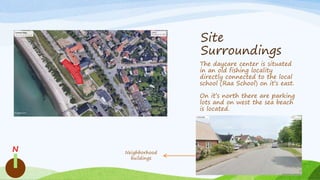
The daycare center is situated
in an old fishing locality
directly connected to the local
school (Raa School) on it’s east.
On it’s north there are parking
lots and on west the sea beach
is located.
N Neighborhood
buildings
Accessibility
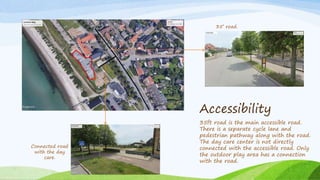
35ft road is the main accessible road.
There is a separate cycle lane and
pedestrian pathway along with the road.
The day care center is not directly
connected with the accessible road. Only
the outdoor play area has a connection
with the road.
Connected road
with the day
care.
35’ road.
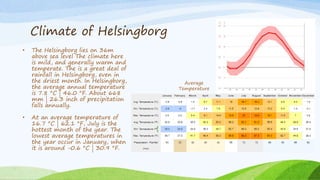
Climate of Helsingborg
• The Helsingborg lies on 36m
above sea level The climate here
is mild, and generally warm and
temperate. The is a great deal of
rainfall in Helsingborg, even in
the driest month. In Helsingborg,
the average annual temperature
is 7.8 °C | 46.0 °F. About 668
mm | 26.3 inch of precipitation
falls annually.
• At an average temperature of
16.7 °C | 62.1 °F, July is the
hottest month of the year. The
lowest average temperatures in
the year occur in January, when
it is around -0.6 °C | 30.9 °F.
Average
Temperature
Concept
• The building is based
on the surrounding
landscape, with its flat
slightly sloping dunes
and the distinctive
typology of the small
fishermen houses.
Shape of a typical fisherman house.
Form
Development.
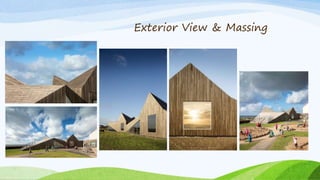
Exterior View & Massing
Zoning
Ground Floor plan.
Public
Semi-Private
Private
Ground Floor Plan
The institution comprises four
groups of children, each with its
own group room. The four group
rooms identify themselves to the
facade as gable of a fisherman
house. Located between the
gables are the common spaces.
The institution is linked to the
existing school and in the
connection a cave-like space for
wardrobes are created.
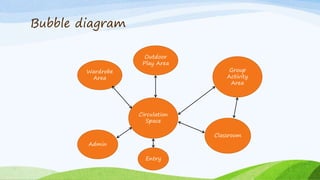
Bubble diagram
Circulation
Space
Group
Activity
Area
Classroom
Admin
Wardrobe
Area
Entry
Outdoor
Play Area
Roof View Axonometric View
Section
Interior View
The group rooms are visually
enclosed by “bookcase-walls” made
of plywood. Together with the green
floor they create a fluent spatial
experience and consistency and
transparency through the entire
institution.
Large windows in the facade
and roof create a close contact
with the sea and the
surrounding landscape, and
provides ideal daylight
conditions all year round.
Outdoor Play area
Econef Children’s Center
Architects: Asante Architecture & Design and Lönnqvist
&Vanamo Architects.
Location: Arusha, Tanzania
Gross Built Area: 650 m2
Completion Year: 2018
The project is a collaboration between Swedish architects
Asante Architecture & Design and Lönnqvist, Vanamo
Architects, Architects Without Borders Sweden,
Engineers Without Borders Sweden and Swedish-
Tanzanian NGO ECONOF.
Project Background
• ECONEF Tanzania is an independent NGO (non-governmental
organization) that runs a Children Center which lies at the foot of
Mount Kilimanjaro, Africa’s highest mountain, in northern
Tanzania. The organization is run by Caroline Nicholas and aims to
improve the standard of living for orphans in the area. Each child
has a different story, but most often, they have lost their parents
to the HIV virus.
• The first orphanage was located in Jua Kali, outside of Arusha in
northern Tanzania. This was the first phase of the ECONEF
project. The construction work for a prototype house started in
summer 2013 and was finished in March 2014. In 2018, the
inauguration of the new Children’s Center took place, marking a
new phase in ECONEF’s history.
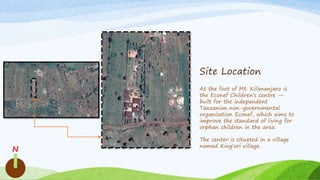
Site Location
At the foot of Mt. Kilimanjaro is
the Econef Children’s centre —
built for the independent
Tanzanian non-governmental
organisation Econef, which aims to
improve the standard of living for
orphan children in the area.
The center is situated in a village
named King’ori village.
N
Accessibility
The childen center is directly
connected with an accessible road
which is connected with the
King’ori-Leguruki road.
An ancillary road is connected with
the main accessible road. Which
ends to the Baobab house.
Also a pathway is connected to
connect these two built area
internally.
Internal
connecting road
connecting road
with King’ori-
Leguruki road.
King’ori-Leguruki
road.
N
Dam
School
Playground
Cultivation
Farm
Site plan
Baobab House planN
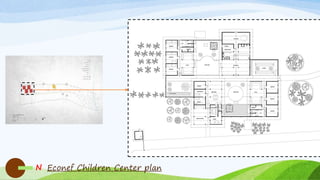
Econef Children Center planN
Public (outdoor open
area)
Private
(Bedrooms)
Private
(Admin)
Service
Zoning
A
A’
Section A-A’
Section of children center
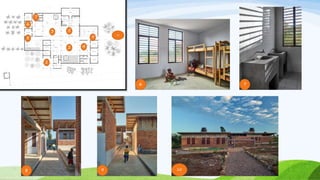
With the help of private donations, ECONEF is able to
offer security and everyday necessities for the 16children
living at the Jua Kali orphanage. The new Children’s
Center includes sleeping quarters and classrooms for 25
children.
1
2
3
4
5
6
7
8 9
10
21
3 4 5
1
2
3
4
5
6
7
8 9
10
6 7
8 9 10
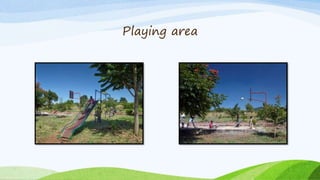
Playing area
Design Features
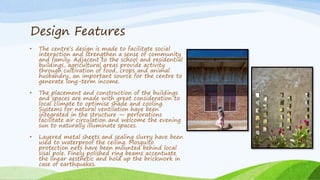
• The centre’s design is made to facilitate social
interaction and strengthen a sense of community
and family. Adjacent to the school and residential
buildings, agricultural areas provide activity
through cultivation of food, crops and animal
husbandry, an important source for the centre to
generate long-term income.
• The placement and construction of the buildings
and spaces are made with great consideration to
local climate to optimise shade and cooling.
Systems for natural ventilation have been
integrated in the structure — perforations
facilitate air circulation and welcome the evening
sun to naturally illuminate spaces.
• Layered metal sheets and sealing slurry have been
used to waterproof the ceiling. Mosquito
protection nets have been mounted behind local
sisal pole. Finely polished ring beams accentuate
the linear aesthetic and hold up the brickwork in
case of earthquakes.
Design Features
• Self sustainable children center - The aim of the
Children’s Center Project is to increase ECONEF’S
independence and reduce its reliance on private
donations. To help achieve this goal the new buildings are
planned to be ecologically and economically sustainable
and largely maintenance-free.
• The center produces its own electricity through the
installation of solar panels.
• Systems for rainwater harvesting and natural
ventilation are integrated into the architectural
design.
• The construction techniques and materials are local
and based on traditional techniques to minimize the
need for external construction expertise and excessive
transportation costs.
Design Features
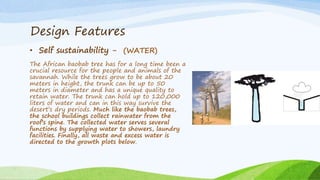
• Self sustainability - (WATER)
The African baobab tree has for a long time been a
crucial resource for the people and animals of the
savannah. While the trees grow to be about 20
meters in height, the trunk can be up to 50
meters in diameter and has a unique quality to
retain water. The trunk can hold up to 120,000
liters of water and can in this way survive the
desert’s dry periods. Much like the baobab trees,
the school buildings collect rainwater from the
roof’s spine. The collected water serves several
functions by supplying water to showers, laundry
facilities. Finally, all waste and excess water is
directed to the growth plots below.
Design Features
• Self sustainability - (Farm,
Biogas)
Adjacent areas for livestock such as chicken, cows
and vegetables are also included in the
masterplan. The residues will be converted to
cooking gas in a low-tech biogas digester.
Ultimately, the design aims to minimize the need
for external building expertise and excessive
transportation costs. To realize this goal, the use
of local materials and traditional building
techniques is prioritized.
Building materials & construction
• LOCAL BRICK
By prioritizing local and familiar materials we
avoid excessive transportation costs; and priorities
local community of builders rather than rely on
advanced masonry skills or costly external building
expertise.
• SISAL POLES MADE FROM LOCAL WOOD
The wooden roof construction elevates the upper
roof of corrugated steel to create air flow between
the roof and the inner ceiling. The space between
the two roofs is covered with sisal poles, made
from hardy and durable wood readily available in
the region, that helps prevent insects and birds
from nesting below the roof. The inner ceiling holds
a layer of thermal mass, protecting against the
heat of the sun and the lower temperatures at
night.
Roof System
Thank You

Child care center case study

  • 1.
    Child Care Center CaseStudy By SUMAIYA ISLAM
  • 2.
    What is childcare center? An institute taking care of a child during the day is a child day care center. In a child day care center, a child is taken care of by a person other than the child's legal guardians. Child care means attending to the needs of infants, toddlers, preschool children, and school children outside of school hours by persons other than their parents. Child care centers usually cater for children aged from birth to five years. Centre-based care is also known as a 'child care center', as the centers are often open from early morning until early evening.
  • 3.
    Types of childcare facilities • Child Care Centre or Long Day Care • Family Day Care • Pre-school / Kindergarten / Prep • Before / After School Care or Outside School Hours Care • Occasional, Flexible or Casual Care Services • In Home Care • Nanny • Baby sitter
  • 4.
    Råå Day CareCenter LOCATION - HELSINGBORG, SWEDEN Architects: Dorte Mandrup Area: 525 m² Year: 2013
  • 5.
    Site Surroundings The daycare centeris situated in an old fishing locality directly connected to the local school (Raa School) on it’s east. On it’s north there are parking lots and on west the sea beach is located. N Neighborhood buildings
  • 6.
    Accessibility 35ft road isthe main accessible road. There is a separate cycle lane and pedestrian pathway along with the road. The day care center is not directly connected with the accessible road. Only the outdoor play area has a connection with the road. Connected road with the day care. 35’ road.
  • 7.
    Climate of Helsingborg •The Helsingborg lies on 36m above sea level The climate here is mild, and generally warm and temperate. The is a great deal of rainfall in Helsingborg, even in the driest month. In Helsingborg, the average annual temperature is 7.8 °C | 46.0 °F. About 668 mm | 26.3 inch of precipitation falls annually. • At an average temperature of 16.7 °C | 62.1 °F, July is the hottest month of the year. The lowest average temperatures in the year occur in January, when it is around -0.6 °C | 30.9 °F. Average Temperature
  • 8.
    Concept • The buildingis based on the surrounding landscape, with its flat slightly sloping dunes and the distinctive typology of the small fishermen houses. Shape of a typical fisherman house. Form Development.
  • 9.
  • 10.
  • 11.
    Ground Floor Plan Theinstitution comprises four groups of children, each with its own group room. The four group rooms identify themselves to the facade as gable of a fisherman house. Located between the gables are the common spaces. The institution is linked to the existing school and in the connection a cave-like space for wardrobes are created.
  • 12.
  • 13.
  • 14.
  • 15.
    Interior View The grouprooms are visually enclosed by “bookcase-walls” made of plywood. Together with the green floor they create a fluent spatial experience and consistency and transparency through the entire institution. Large windows in the facade and roof create a close contact with the sea and the surrounding landscape, and provides ideal daylight conditions all year round.
  • 16.
  • 17.
    Econef Children’s Center Architects:Asante Architecture & Design and Lönnqvist &Vanamo Architects. Location: Arusha, Tanzania Gross Built Area: 650 m2 Completion Year: 2018 The project is a collaboration between Swedish architects Asante Architecture & Design and Lönnqvist, Vanamo Architects, Architects Without Borders Sweden, Engineers Without Borders Sweden and Swedish- Tanzanian NGO ECONOF.
  • 18.
    Project Background • ECONEFTanzania is an independent NGO (non-governmental organization) that runs a Children Center which lies at the foot of Mount Kilimanjaro, Africa’s highest mountain, in northern Tanzania. The organization is run by Caroline Nicholas and aims to improve the standard of living for orphans in the area. Each child has a different story, but most often, they have lost their parents to the HIV virus. • The first orphanage was located in Jua Kali, outside of Arusha in northern Tanzania. This was the first phase of the ECONEF project. The construction work for a prototype house started in summer 2013 and was finished in March 2014. In 2018, the inauguration of the new Children’s Center took place, marking a new phase in ECONEF’s history.
  • 19.
    Site Location At thefoot of Mt. Kilimanjaro is the Econef Children’s centre — built for the independent Tanzanian non-governmental organisation Econef, which aims to improve the standard of living for orphan children in the area. The center is situated in a village named King’ori village. N
  • 20.
    Accessibility The childen centeris directly connected with an accessible road which is connected with the King’ori-Leguruki road. An ancillary road is connected with the main accessible road. Which ends to the Baobab house. Also a pathway is connected to connect these two built area internally. Internal connecting road connecting road with King’ori- Leguruki road. King’ori-Leguruki road. N
  • 21.
  • 22.
  • 23.
  • 24.
  • 25.
    A A’ Section A-A’ Section ofchildren center With the help of private donations, ECONEF is able to offer security and everyday necessities for the 16children living at the Jua Kali orphanage. The new Children’s Center includes sleeping quarters and classrooms for 25 children.
  • 26.
  • 27.
  • 28.
  • 29.
    Design Features • Thecentre’s design is made to facilitate social interaction and strengthen a sense of community and family. Adjacent to the school and residential buildings, agricultural areas provide activity through cultivation of food, crops and animal husbandry, an important source for the centre to generate long-term income. • The placement and construction of the buildings and spaces are made with great consideration to local climate to optimise shade and cooling. Systems for natural ventilation have been integrated in the structure — perforations facilitate air circulation and welcome the evening sun to naturally illuminate spaces. • Layered metal sheets and sealing slurry have been used to waterproof the ceiling. Mosquito protection nets have been mounted behind local sisal pole. Finely polished ring beams accentuate the linear aesthetic and hold up the brickwork in case of earthquakes.
  • 30.
    Design Features • Selfsustainable children center - The aim of the Children’s Center Project is to increase ECONEF’S independence and reduce its reliance on private donations. To help achieve this goal the new buildings are planned to be ecologically and economically sustainable and largely maintenance-free. • The center produces its own electricity through the installation of solar panels. • Systems for rainwater harvesting and natural ventilation are integrated into the architectural design. • The construction techniques and materials are local and based on traditional techniques to minimize the need for external construction expertise and excessive transportation costs.
  • 31.
    Design Features • Selfsustainability - (WATER) The African baobab tree has for a long time been a crucial resource for the people and animals of the savannah. While the trees grow to be about 20 meters in height, the trunk can be up to 50 meters in diameter and has a unique quality to retain water. The trunk can hold up to 120,000 liters of water and can in this way survive the desert’s dry periods. Much like the baobab trees, the school buildings collect rainwater from the roof’s spine. The collected water serves several functions by supplying water to showers, laundry facilities. Finally, all waste and excess water is directed to the growth plots below.
  • 32.
    Design Features • Selfsustainability - (Farm, Biogas) Adjacent areas for livestock such as chicken, cows and vegetables are also included in the masterplan. The residues will be converted to cooking gas in a low-tech biogas digester. Ultimately, the design aims to minimize the need for external building expertise and excessive transportation costs. To realize this goal, the use of local materials and traditional building techniques is prioritized.
  • 33.
    Building materials &construction • LOCAL BRICK By prioritizing local and familiar materials we avoid excessive transportation costs; and priorities local community of builders rather than rely on advanced masonry skills or costly external building expertise. • SISAL POLES MADE FROM LOCAL WOOD The wooden roof construction elevates the upper roof of corrugated steel to create air flow between the roof and the inner ceiling. The space between the two roofs is covered with sisal poles, made from hardy and durable wood readily available in the region, that helps prevent insects and birds from nesting below the roof. The inner ceiling holds a layer of thermal mass, protecting against the heat of the sun and the lower temperatures at night.
  • 34.
  • 35.