





How to prepare students for the future
Challenges for Educators
Mirza Yawar Baig
Opening the world, one mind at a time©
WorkExperience:
 InternationalSpeaker,Trainer,Author,Coach,LeadershipConsultantwith16yearsinCorporate
GeneralManagement,30 yearsinTraining& OrganizationalDevelopment,specializinginFamily
BusinessConsulting& Entrepreneurship
Director/ ProfessionalMember:
 CenterforConflictResolution& HumanSecurity
 IndianSocietyforAppliedBehaviouralScience
Entrepreneur:
 1994:Founded
Education:
 IIM-A, P-CMM®,MBTI©,WSA©,ISABS
Books:
 TheBusinessofFamilyBusiness
 AnEntrepreneur’sDiary
 HiringWinners
 LeadershipLessonsfromtheLifeofRasoolullah
 Leadershipisa PersonalChoice
MemberConsultantPanel:
USA
 GE CorporateUniversity,Crotonville
 OracleCorporateUniversity,CA
 AMA International,NewYork
 AndersenCorporateUniversity,MN
India
 IndianInstituteof Management,Bangalore
 SVP NationalPoliceAcademy, Hyderabad
 SSB Academy,Gwaldam,UttarAkhand
 LBSAcademy of Administration, Mussoorie
ClientsInclude:
GE,Oracle,Motorola,Microsoft,IBM,Digital-Compaq,NationalSemiconductor,Unilever,BSNL,
TataIndicom,Colgate,AsianPaints,Siemens,Wartsila,MphasiS,CavinKare,EXLService,World
Bank, ICRISAT,WorldFish,TataCorporate,J & J,Accenture,ZenecaSeeds,ShantaBiotech,
Advanta,Reuters,AirIndia,YusufBinAhmedKanoo,Olam,RegalBeloit,RelianceWorld,NIS
Sparta, AMKA,EmamiGroup,Suzlon,JPMorgan,SEWInfrastructure,RahimAfroze,Expolanka,
Brandix
yawarbaig@gmail.com
www.yawarbaig.com
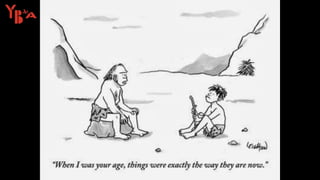
To teach the child to succeed in a future that you
know nothing about
Your challenge
Think of your role model
 For howmany of you is it a parent or a teacher?
 What wouldyour children / students say if I were to ask themthe same
question?
The challenge is to inspire those who we have the maximum facetime
with
Why do you teach?
1. History?
2. Geography?
3. Mathematics?
4. Do your exam questions reflect this?
What if you taught keeping the real purpose in mind?
Commercialization of basic education and
health care are the worst violence to society
The first casualty of schooling is imagination.
The second is independence. Confidence dies on its own
of a broken heart.
This is called Graduation.
Our schooling slaughters imagination at the altar of
practicality.
Practicality is defined by the past.
Imagination defines the future.
There's no demand until you show possibilities.
So imagination is far more important than intelligence.
IQ should mean Imagination Quotient.
Why else would so-called global leaders make the
same mistakes since the Roman Empire except that
they're trained in a flawed system?
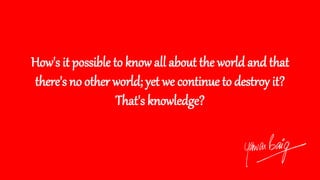
How's it possible to know all about the world and that
there's no other world; yet we continue to destroy it?
That's knowledge?
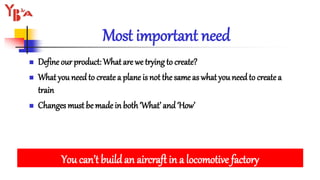
Define the Product
Method will depend on the definition
 Define our product: What are we tryingto create?
 What you needto create a plane is not the same as what you needto createa
train
 Changes must be made in both‘What’ and ‘How’
Most important need
You can’t build an aircraft in a locomotive factory
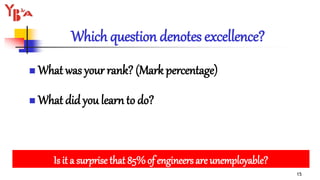
Which question denotes excellence?
 What was your rank? (Mark percentage)
 What did you learn to do?
Is it a surprise that 85%of engineers are unemployable?
15
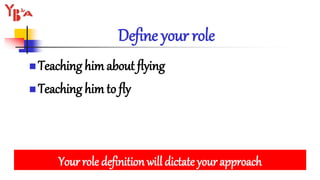
Define your role
 Teaching him about flying
 Teaching him to fly
Your role definition will dictate your approach
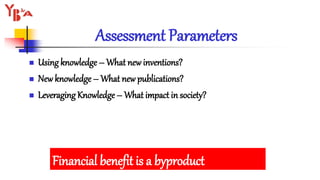
 Using knowledge – What new inventions?
 New knowledge – What new publications?
 Leveraging Knowledge – What impact in society?
Assessment Parameters
Financial benefit is a byproduct
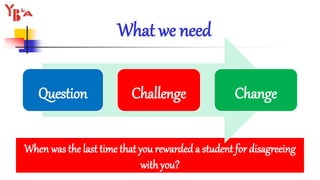
What we need
When was the last time that you rewarded a student for disagreeing
with you?
Question Challenge Change
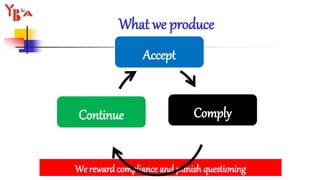
What we produce
We rewardcompliance andpunish questioning
Accept
ComplyContinue
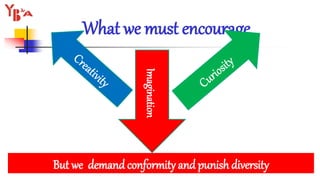
What we must encourage
But we demand conformity and punish diversity
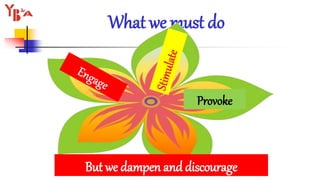
Imagination
What we must do
But we dampen and discourage
Provoke
Education is not the accumulation of random
bits of information, no matter how complex.
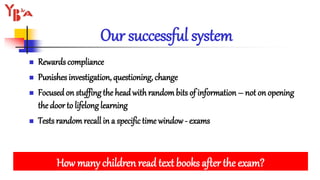
Our successful system
 Rewards compliance
 Punishes investigation, questioning, change
 Focusedon stuffing the headwith randombits of information – not on opening
the door to lifelonglearning
 Tests randomrecall in a specific time window- exams
How many children read text books after the exam?
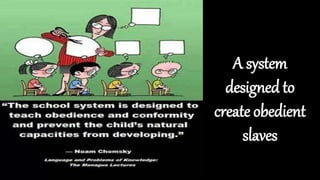
A system
designed to
create obedient
slaves
The Tragedy
Is that our system is highly successful
21st Century Leadership
To help themto thrive in a world we know nothing
about
If a system is to be judged by its results, what
should we say about our education system
looking at its result – our society?
Challenges for Educators
21st Century and Beyond
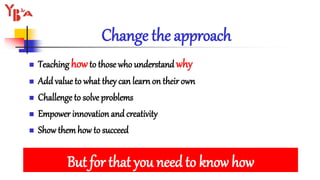
Change the approach
 Teaching howto those who understand why
 Add value to what they can learn on their own
 Challenge to solve problems
 Empower innovation and creativity
 Show them how to succeed
But for that you need to know how
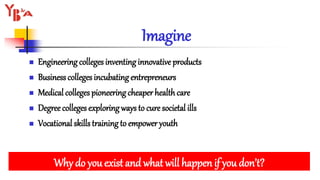
Imagine
 Engineering colleges inventing innovative products
 Business colleges incubating entrepreneurs
 Medical colleges pioneering cheaper healthcare
 Degree colleges exploring ways to cure societal ills
 Vocational skills training to empower youth
Why do you exist and what will happen if you don’t?
Primary Question to ask
What problem does my teaching solve?
What do you need to change?
 In the way you teach, your infrastructure, timetables?
 In the qualifications of your teachers?
 Do you take feedback fromyour students?
 Are your teachers increments based on them?
 Do your teachers consult outside your college?
Are your teachers inspirational?
What others are doing
 Carnegie Mellon: http://www.cmu.edu/brag/
 Inventors of Artificial Intelligence, Wi-Fi, Kevlar fibre, Java language, Smile ;-)),
CAPTCHAs, #hashtags
 Udacity: http://bit.ly/1Q6Zv2o (Money back guarantee)
Google
 1998, StanfordUniversity
 Research: Algorithmto rank hypertext documents by Sergey Brin and Larry
Page
 Product: Google SearchEngine whichranks websites
 Company: Google
 Stats: Googleis now a $480 billion company and employs 60,000 peopleas of
November 2015
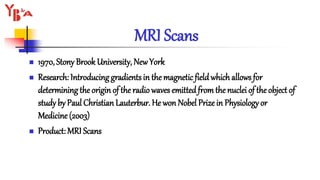
MRI Scans
 1970, Stony Brook University, NewYork
 Research: Introducing gradients in the magnetic field which allows for
determining the origin of the radio waves emittedfromthe nuclei of the object of
study by Paul Christian Lauterbur. He won Nobel Prize in Physiology or
Medicine (2003)
 Product: MRI Scans
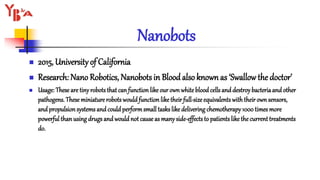
Nanobots
 2015, Universityof California
 Research: Nano Robotics, Nanobots in Bloodalsoknown as ‘Swallowthe doctor’
 Usage: These are tinyrobots that can function like our own whiteblood cells anddestroybacteriaand other
pathogens. These miniature robots would function liketheir full-sizeequivalents with their own sensors,
and propulsion systems and could performsmall taskslike delivering chemotherapy1000 times more
powerful thanusingdrugs andwould not cause as manyside-effects to patients like the current treatments
do.
Ingestible Sensors
 2015, MIT
 Research: Vital sign monitoring internally fromthe gastrointestinaltract. Ingestible Sensors
 Theseminute microchips are orally administered and have the capability to record bodily
processes, fluctuations, and vital signs in real-time, allowing for more accurateand reliable
data for physicians to work with.
 https://www.youtube.com/watch?v=8zq8cfLv84Q
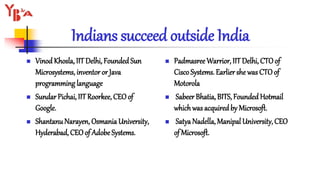
Indians succeed outside India
 Vinod Khosla, IITDelhi, FoundedSun
Microsystems, inventor or Java
programming language
 Sundar Pichai, IITRoorkee, CEOof
Google.
 ShantanuNarayen, Osmania University,
Hyderabad, CEOof Adobe Systems.
 Padmasree Warrior, IIT Delhi, CTOof
CiscoSystems. Earlier she was CTOof
Motorola
 Sabeer Bhatia, BITS, FoundedHotmail
whichwas acquiredby Microsoft.
 Satya Nadella, Manipal University, CEO
of Microsoft.
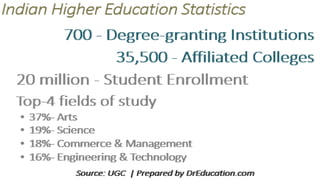
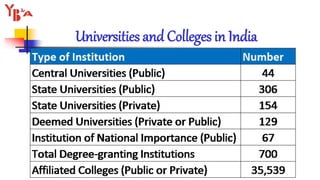
Universities and Colleges in India
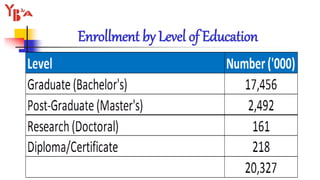
Enrollment by Level of Education
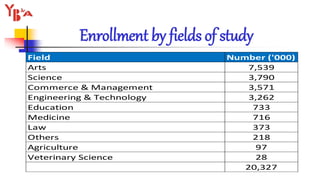
Enrollment by fields of study
Field Number ('000)
Arts 7,539
Science 3,790
Commerce & Management 3,571
Engineering & Technology 3,262
Education 733
Medicine 716
Law 373
Others 218
Agriculture 97
Veterinary Science 28
20,327
But not one single innovation
So what are we doing?
Number of words
 Urdu(including phrases & proverbs) 50,000 (Standard Twentieth Century Dictionary:
Urdu into English (Delhi, 1980)
 Arabic 250,000 http://lughat.blogspot.in/2013/12/does-arabic-have-most-words-
dont.html
 English 1,025,109.8(http://www.languagemonitor.com/number-of-words/number-of-
words-in-the-english-language-1008879/
How do you define the richness of a language?
Who loses?
 But is Englishreallymissing out by not having distinct words for male camels‫مجل‬ vs.
femalecamels ‫ناقة‬ ?
 Or is Arabicreally missing out by not having a word for scones?
 But what if I asked, ‘Is Arabicmissing out by not having words for Wi-fi, Supernova,
Diabetes, Blood Corpuscle, Nanotech, Sensor
What defines the richness of a language–
Number of words or contemporary relevance?
So what does it all MEAN for
you as a teacher??
Essence of it all
 Faster and easier access to information
 Hugely enhanced computation power, information storages and hugely fast searches
 Potential to forecast scenarios, prepare for eventualities, predict outcomes, options
 Potential to control, influence, track, help, network, leverage, surveillance, security,
share, empower andearn
But benefits only those who know how to use it
Integrated Teaching
A brief glimpse
 Connectivity: Show links between subjects
 Utility: Show howthese apply in real life
 Curiosity: Raise questions
Integrated Holistic Teaching
What do the majority of students do with text books once the
course is over?
 How do you think history impacts math?
 How do you think geography impacts history?
 How do you think physics impacts industry?
Integrated Teaching
Then why do you teach subjects in isolation?
Future Class Room
 Students of multiple ages
 Several teachers – subject wise + class teacher
 Self-learning anddiscovery
 Teachers provide support only
Text books dumb down knowledge. Teachoriginal texts
Project: Oceans
 Biology: Marine plants & animals
 Physics: Displacement floats ships
 Chemistry: Why is sea water salty?
 Geography: Navigation, Orienteering, sailing,
 Engineering: Ship building
 History: Maritime history of nations, colonial domination
 Trade: Routes, goods, cultural & population change
Living knowledge applied in context
Project: Mountains
 Geology: Isostacy of mountains: Stabilizing effect
 Geography: How mountains effect climate
 Biology: Mountain flora & fauna
 History: How mountains affectedhistory of nations
Draw lessons to connect to current events
“A successful teacher is one who enables students to leverage their
strengths and sets their feet on a path of self discovery where they
constantly strive to make the world a better place.”
It’s not about today
Teaching is about keeping the
excitement of learning alive all lifelong.
Do you really want to change?
1. What is the cost of changing?
2. What is the cost of not changing?
3. What will be easy?
4. What will be difficult?
5. What are you willing to do to make it happen?
Results are directly proportional to effort
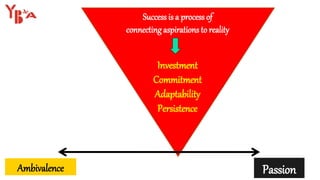
Success is a process of
connecting aspirations to reality
Investment
Commitment
Adaptability
Persistence
Ambivalence Passion
If you want to be successful you must respect
one rule:
Never lie to yourself.
~ Paulo Coelho
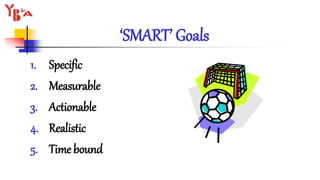
‘SMART’ Goals
1. Specific
2. Measurable
3. Actionable
4. Realistic
5. Time bound
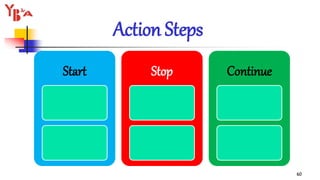
Action Steps
Start Stop Continue
60
yawarbaig@gmail.com
www.yawarbaig.com
Thought Share

Challenges for Educators

  • 1.
    How to preparestudents for the future Challenges for Educators
  • 2.
    Mirza Yawar Baig Openingthe world, one mind at a time© WorkExperience:  InternationalSpeaker,Trainer,Author,Coach,LeadershipConsultantwith16yearsinCorporate GeneralManagement,30 yearsinTraining& OrganizationalDevelopment,specializinginFamily BusinessConsulting& Entrepreneurship Director/ ProfessionalMember:  CenterforConflictResolution& HumanSecurity  IndianSocietyforAppliedBehaviouralScience Entrepreneur:  1994:Founded Education:  IIM-A, P-CMM®,MBTI©,WSA©,ISABS Books:  TheBusinessofFamilyBusiness  AnEntrepreneur’sDiary  HiringWinners  LeadershipLessonsfromtheLifeofRasoolullah  Leadershipisa PersonalChoice MemberConsultantPanel: USA  GE CorporateUniversity,Crotonville  OracleCorporateUniversity,CA  AMA International,NewYork  AndersenCorporateUniversity,MN India  IndianInstituteof Management,Bangalore  SVP NationalPoliceAcademy, Hyderabad  SSB Academy,Gwaldam,UttarAkhand  LBSAcademy of Administration, Mussoorie ClientsInclude: GE,Oracle,Motorola,Microsoft,IBM,Digital-Compaq,NationalSemiconductor,Unilever,BSNL, TataIndicom,Colgate,AsianPaints,Siemens,Wartsila,MphasiS,CavinKare,EXLService,World Bank, ICRISAT,WorldFish,TataCorporate,J & J,Accenture,ZenecaSeeds,ShantaBiotech, Advanta,Reuters,AirIndia,YusufBinAhmedKanoo,Olam,RegalBeloit,RelianceWorld,NIS Sparta, AMKA,EmamiGroup,Suzlon,JPMorgan,SEWInfrastructure,RahimAfroze,Expolanka, Brandix yawarbaig@gmail.com www.yawarbaig.com
  • 4.
    To teach thechild to succeed in a future that you know nothing about Your challenge
  • 5.
    Think of yourrole model  For howmany of you is it a parent or a teacher?  What wouldyour children / students say if I were to ask themthe same question? The challenge is to inspire those who we have the maximum facetime with
  • 6.
    Why do youteach? 1. History? 2. Geography? 3. Mathematics? 4. Do your exam questions reflect this? What if you taught keeping the real purpose in mind?
  • 7.
    Commercialization of basiceducation and health care are the worst violence to society
  • 8.
    The first casualtyof schooling is imagination. The second is independence. Confidence dies on its own of a broken heart. This is called Graduation.
  • 9.
    Our schooling slaughtersimagination at the altar of practicality. Practicality is defined by the past. Imagination defines the future.
  • 10.
    There's no demanduntil you show possibilities. So imagination is far more important than intelligence. IQ should mean Imagination Quotient.
  • 11.
    Why else wouldso-called global leaders make the same mistakes since the Roman Empire except that they're trained in a flawed system?
  • 12.
    How's it possibleto know all about the world and that there's no other world; yet we continue to destroy it? That's knowledge?
  • 13.
    Define the Product Methodwill depend on the definition
  • 14.
     Define ourproduct: What are we tryingto create?  What you needto create a plane is not the same as what you needto createa train  Changes must be made in both‘What’ and ‘How’ Most important need You can’t build an aircraft in a locomotive factory
  • 15.
    Which question denotesexcellence?  What was your rank? (Mark percentage)  What did you learn to do? Is it a surprise that 85%of engineers are unemployable? 15
  • 16.
    Define your role Teaching him about flying  Teaching him to fly Your role definition will dictate your approach
  • 17.
     Using knowledge– What new inventions?  New knowledge – What new publications?  Leveraging Knowledge – What impact in society? Assessment Parameters Financial benefit is a byproduct
  • 18.
    What we need Whenwas the last time that you rewarded a student for disagreeing with you? Question Challenge Change
  • 19.
    What we produce Werewardcompliance andpunish questioning Accept ComplyContinue
  • 20.
    What we mustencourage But we demand conformity and punish diversity Imagination
  • 21.
    What we mustdo But we dampen and discourage Provoke
  • 22.
    Education is notthe accumulation of random bits of information, no matter how complex.
  • 23.
    Our successful system Rewards compliance  Punishes investigation, questioning, change  Focusedon stuffing the headwith randombits of information – not on opening the door to lifelonglearning  Tests randomrecall in a specific time window- exams How many children read text books after the exam?
  • 24.
  • 25.
    The Tragedy Is thatour system is highly successful
  • 26.
    21st Century Leadership Tohelp themto thrive in a world we know nothing about
  • 27.
    If a systemis to be judged by its results, what should we say about our education system looking at its result – our society?
  • 28.
  • 29.
    Change the approach Teaching howto those who understand why  Add value to what they can learn on their own  Challenge to solve problems  Empower innovation and creativity  Show them how to succeed But for that you need to know how
  • 30.
    Imagine  Engineering collegesinventing innovative products  Business colleges incubating entrepreneurs  Medical colleges pioneering cheaper healthcare  Degree colleges exploring ways to cure societal ills  Vocational skills training to empower youth Why do you exist and what will happen if you don’t?
  • 31.
    Primary Question toask What problem does my teaching solve?
  • 32.
    What do youneed to change?  In the way you teach, your infrastructure, timetables?  In the qualifications of your teachers?  Do you take feedback fromyour students?  Are your teachers increments based on them?  Do your teachers consult outside your college? Are your teachers inspirational?
  • 33.
    What others aredoing  Carnegie Mellon: http://www.cmu.edu/brag/  Inventors of Artificial Intelligence, Wi-Fi, Kevlar fibre, Java language, Smile ;-)), CAPTCHAs, #hashtags  Udacity: http://bit.ly/1Q6Zv2o (Money back guarantee)
  • 34.
    Google  1998, StanfordUniversity Research: Algorithmto rank hypertext documents by Sergey Brin and Larry Page  Product: Google SearchEngine whichranks websites  Company: Google  Stats: Googleis now a $480 billion company and employs 60,000 peopleas of November 2015
  • 35.
    MRI Scans  1970,Stony Brook University, NewYork  Research: Introducing gradients in the magnetic field which allows for determining the origin of the radio waves emittedfromthe nuclei of the object of study by Paul Christian Lauterbur. He won Nobel Prize in Physiology or Medicine (2003)  Product: MRI Scans
  • 36.
    Nanobots  2015, UniversityofCalifornia  Research: Nano Robotics, Nanobots in Bloodalsoknown as ‘Swallowthe doctor’  Usage: These are tinyrobots that can function like our own whiteblood cells anddestroybacteriaand other pathogens. These miniature robots would function liketheir full-sizeequivalents with their own sensors, and propulsion systems and could performsmall taskslike delivering chemotherapy1000 times more powerful thanusingdrugs andwould not cause as manyside-effects to patients like the current treatments do.
  • 37.
    Ingestible Sensors  2015,MIT  Research: Vital sign monitoring internally fromthe gastrointestinaltract. Ingestible Sensors  Theseminute microchips are orally administered and have the capability to record bodily processes, fluctuations, and vital signs in real-time, allowing for more accurateand reliable data for physicians to work with.  https://www.youtube.com/watch?v=8zq8cfLv84Q
  • 38.
    Indians succeed outsideIndia  Vinod Khosla, IITDelhi, FoundedSun Microsystems, inventor or Java programming language  Sundar Pichai, IITRoorkee, CEOof Google.  ShantanuNarayen, Osmania University, Hyderabad, CEOof Adobe Systems.  Padmasree Warrior, IIT Delhi, CTOof CiscoSystems. Earlier she was CTOof Motorola  Sabeer Bhatia, BITS, FoundedHotmail whichwas acquiredby Microsoft.  Satya Nadella, Manipal University, CEO of Microsoft.
  • 40.
  • 41.
    Enrollment by Levelof Education
  • 42.
    Enrollment by fieldsof study Field Number ('000) Arts 7,539 Science 3,790 Commerce & Management 3,571 Engineering & Technology 3,262 Education 733 Medicine 716 Law 373 Others 218 Agriculture 97 Veterinary Science 28 20,327
  • 43.
    But not onesingle innovation So what are we doing?
  • 44.
    Number of words Urdu(including phrases & proverbs) 50,000 (Standard Twentieth Century Dictionary: Urdu into English (Delhi, 1980)  Arabic 250,000 http://lughat.blogspot.in/2013/12/does-arabic-have-most-words- dont.html  English 1,025,109.8(http://www.languagemonitor.com/number-of-words/number-of- words-in-the-english-language-1008879/ How do you define the richness of a language?
  • 45.
    Who loses?  Butis Englishreallymissing out by not having distinct words for male camels‫مجل‬ vs. femalecamels ‫ناقة‬ ?  Or is Arabicreally missing out by not having a word for scones?  But what if I asked, ‘Is Arabicmissing out by not having words for Wi-fi, Supernova, Diabetes, Blood Corpuscle, Nanotech, Sensor What defines the richness of a language– Number of words or contemporary relevance?
  • 46.
    So what doesit all MEAN for you as a teacher??
  • 47.
    Essence of itall  Faster and easier access to information  Hugely enhanced computation power, information storages and hugely fast searches  Potential to forecast scenarios, prepare for eventualities, predict outcomes, options  Potential to control, influence, track, help, network, leverage, surveillance, security, share, empower andearn But benefits only those who know how to use it
  • 48.
  • 49.
     Connectivity: Showlinks between subjects  Utility: Show howthese apply in real life  Curiosity: Raise questions Integrated Holistic Teaching What do the majority of students do with text books once the course is over?
  • 50.
     How doyou think history impacts math?  How do you think geography impacts history?  How do you think physics impacts industry? Integrated Teaching Then why do you teach subjects in isolation?
  • 51.
    Future Class Room Students of multiple ages  Several teachers – subject wise + class teacher  Self-learning anddiscovery  Teachers provide support only Text books dumb down knowledge. Teachoriginal texts
  • 52.
    Project: Oceans  Biology:Marine plants & animals  Physics: Displacement floats ships  Chemistry: Why is sea water salty?  Geography: Navigation, Orienteering, sailing,  Engineering: Ship building  History: Maritime history of nations, colonial domination  Trade: Routes, goods, cultural & population change Living knowledge applied in context
  • 53.
    Project: Mountains  Geology:Isostacy of mountains: Stabilizing effect  Geography: How mountains effect climate  Biology: Mountain flora & fauna  History: How mountains affectedhistory of nations Draw lessons to connect to current events
  • 54.
    “A successful teacheris one who enables students to leverage their strengths and sets their feet on a path of self discovery where they constantly strive to make the world a better place.”
  • 55.
    It’s not abouttoday Teaching is about keeping the excitement of learning alive all lifelong.
  • 56.
    Do you reallywant to change? 1. What is the cost of changing? 2. What is the cost of not changing? 3. What will be easy? 4. What will be difficult? 5. What are you willing to do to make it happen? Results are directly proportional to effort
  • 57.
    Success is aprocess of connecting aspirations to reality Investment Commitment Adaptability Persistence Ambivalence Passion
  • 58.
    If you wantto be successful you must respect one rule: Never lie to yourself. ~ Paulo Coelho
  • 59.
    ‘SMART’ Goals 1. Specific 2.Measurable 3. Actionable 4. Realistic 5. Time bound
  • 60.
  • 62.