@PRLA
CTO SCHOOL BERLIN
SEPTEMBER 2018
WELCOME
FROM ENGINEER
TO ENGINEERING MANAGER
Xmas 1989
First computer: ZX Sinclair
2008
Masters Computer Science
2003
First Summer Job: Perl Scripting
2008-2014
Freelance Full-Stack Developer
2015
Backend Engineer
2016
Team Lead / Engineering Manager
2017
Director of Engineering
2018
VP Engineering
An individual, who may or may not write
code, that is accountable for the success
of a number of teams and responsible for
the growth of their people.
WHY DO WE
NEED
ENGINEERING
MANAGERS?
SHOULD I
BECOME AN
ENGINEERING
MANAGER?
HOW DO I
SUCCEED AS AN
ENGINEERING
MANAGER?
QUESTION NO. 1
WHY DO WE NEED
ENGINEERING MANAGERS?
NATURE ABHORS A VACUUM.
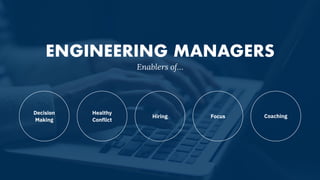
Decision
Making
Healthy
Conflict
Hiring Focus Coaching
ENGINEERING MANAGERS
Enablers of…
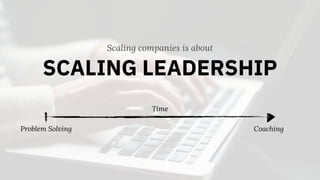
Scaling companies is about
SCALING LEADERSHIP
Problem Solving Coaching
Time
QUESTION NO. 2
SHOULD I BECOME AN
ENGINEERING MANAGER?
70%…of factors that contribute to work happiness
are directly related to managers
(no pressure)
You like being accountable
You like delivering on a predictable schedule
You like hiring
You care about others’ success
However…
IT’S NOT A PROMOTION.
It is a different job. It will feel like starting over.
IT’S NOT ABOUT THE CODE. *
It’s about the people.
* Not much.
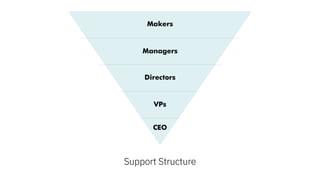
YOU WORK FOR THEM.
They don’t work for you.
Power Structure
Support Structure
DO NOT RUSH IT.
Your first management experience will shape you.
NO ONE IS EVER READY.
You can always go back.
QUESTION NO. 3
HOW DO I SUCCEED AS AN
ENGINEERING MANAGER?
“It is remarkable how much long-term
advantage people like us have gotten by
trying to be consistently not stupid, instead
of trying to be very intelligent.”
— Charlie Munger
“Listen more, talk less,
and be decisive when the time comes.“
— Satya Nadella
(CEO, Microsoft)
1
2
Try to be consistently not stupid.
Listen more. Talk less.
How do we define…
SUCCESS?
“Your job is to help the company win.”
— Fred Kofman
(Former LinkedIn VP Executive Development)
“Delivering valuable products
over
Delivering products on time, in budget and with full scope.”
— Mohammed Rizwan
medium.com/agile-bites/
Individual Team Yourself
3 DIMENSIONS
Individual
What do people
NEED?
How can you
GIVE?
What do people
NEED?
Autonomy
Mastery Purpose
Autonomy
Mastery Purpose
MOTIVATION
(the secret sauce)
“The best managers make it their highest priority to
connect the work their team is doing to the big,
ultimate goals the company is working toward.”
— Claire Hughes Johnson
(COO Stripe)
How can you
GIVE?
ONE-ON-ONE
The most important meeting you can have.
ONE-ON-ONE
One message, many formats.
ONE-ON-ONE
Mind the gap between Delivery and Perception.
ONE-ON-ONE
Constant pulse check.
ONE-ON-ONE
Set expectations both ways.
FEEDBACK!
Overused word. Underused activity.
Team
Individual Yourself
Managing at the team level
WHAT DRIVES TEAM SUCCESS?
Psychological
Safety
Decision
Making
Alignment Focus Metrics
… RETROSPECT, LEARN, ITERATE …
PSYCHOLOGICAL SAFETY
Vulnerability is not weakness.
Psychological Safety Decision Making Alignment Focus Metrics
PSYCHOLOGICAL SAFETY
Diversity is a competitive advantage.
Psychological Safety Decision Making Alignment Focus Metrics
PSYCHOLOGICAL SAFETY
Make sure everyone finds their voice.
Psychological Safety Decision Making Alignment Focus Metrics
PSYCHOLOGICAL SAFETY
Carefully watch your own mood.
Psychological Safety Decision Making Alignment Focus Metrics
PSYCHOLOGICAL SAFETY
Thoughtful disagreement.
Psychological Safety Decision Making Alignment Focus Metrics
DECISION MAKING
Values and operating principles orient, speed up
and regret-minimize decisions.
Psychological Safety Decision Making Alignment Focus Metrics
DECISION MAKING
Make the process transparent. Transparency breeds trust.
Psychological Safety Decision Making Alignment Focus Metrics
ALIGNMENT
Where are we going? And how do we get there?
Psychological Safety Decision Making Alignment Focus Metrics
ALIGNMENT
Be on the same page with other teams and functions.
Psychological Safety Decision Making Alignment Focus Metrics
ALIGNMENT
Make sure you understand priorities.
Make sure others understand tradeoffs.
Psychological Safety Decision Making Alignment Focus Metrics
FOCUS
Delivering is everything. Your credibility depends on it.
Psychological Safety Decision Making Alignment Focus Metrics
FOCUS
What do we as a team care about?
Psychological Safety Decision Making Alignment Focus Metrics
METRICS
Surface business and technical data, and keep it front and center.
Psychological Safety Decision Making Alignment Focus Metrics
METRICS
Productivity cannot be directly measured.
But you can measure what affects it.
Psychological Safety Decision Making Alignment Focus Metrics
METRICS
Leverage the tools you have.
Work for the people doing the actual work.
Psychological Safety Decision Making Alignment Focus Metrics
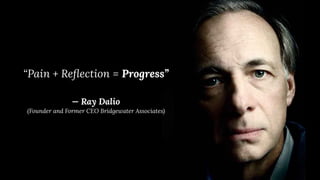
“Pain + Reflection = Progress”
— Ray Dalio
(Founder and Former CEO Bridgewater Associates)
Individual Team
Yourself
LEADERSHIP
…is all about others, but it starts with yourself.
Self-Awareness: know yourself
Self-Image: accept yourself
Self-Responsibility: commit yourself
Self-Improvement: grow yourself
Self-Honesty: don’t fool yourself
“Don’t do things that you know are morally
wrong. Not because someone is watching,
but because you are. Self-esteem is just the
reputation that you have with yourself.
You’ll always know.“
— Naval Ravikant
(Co-Founder, CEO AngelList)
What type of leader do you want to be?
XMultiplier
—Diminisher
Gives autonomy, support and trust.
Truly listens.
Makes others feel important.
Asks questions.
Shows appreciation.
Creates clarity, gives energy.
Doesn’t trust, micromanages.
Operates in “tell mode”, interrupts often.
Makes others feel irrelevant.
Assumes own knowledge.
Rarely gives credit.
Creates confusion, takes energy.
COMPASSION
…is a super power.
FIND LEVERAGE
Spend time removing friction from what runs all the time.
GUARD YOUR TIME
Delegate! Delegate! Delegate!
(And trust… but verify.)
Always ask yourself…
HOW DO I KNOW I’M RIGHT?
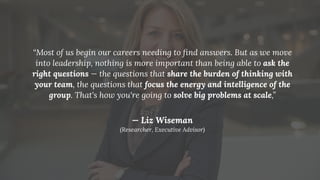
“Most of us begin our careers needing to find answers. But as we move
into leadership, nothing is more important than being able to ask the
right questions — the questions that share the burden of thinking with
your team, the questions that focus the energy and intelligence of the
group. That's how you're going to solve big problems at scale,”
— Liz Wiseman
(Researcher, Executive Advisor)
BE A STUDENT.
Always be learning.
“We don’t rise to the level of our
expectations. We fall to the level of

our training.”
— Archilocus
(Greek Poet)
Paulo André
paulo.r.l.andre@gmail.com
@prla
linkedin.com/in/paulorlandre/
prla
Thank you.

From Engineer to Engineering Manager