Update from the
Neurosciences:
What A Coach
Wants to Know
Michael	A.	Netzley,	PhD
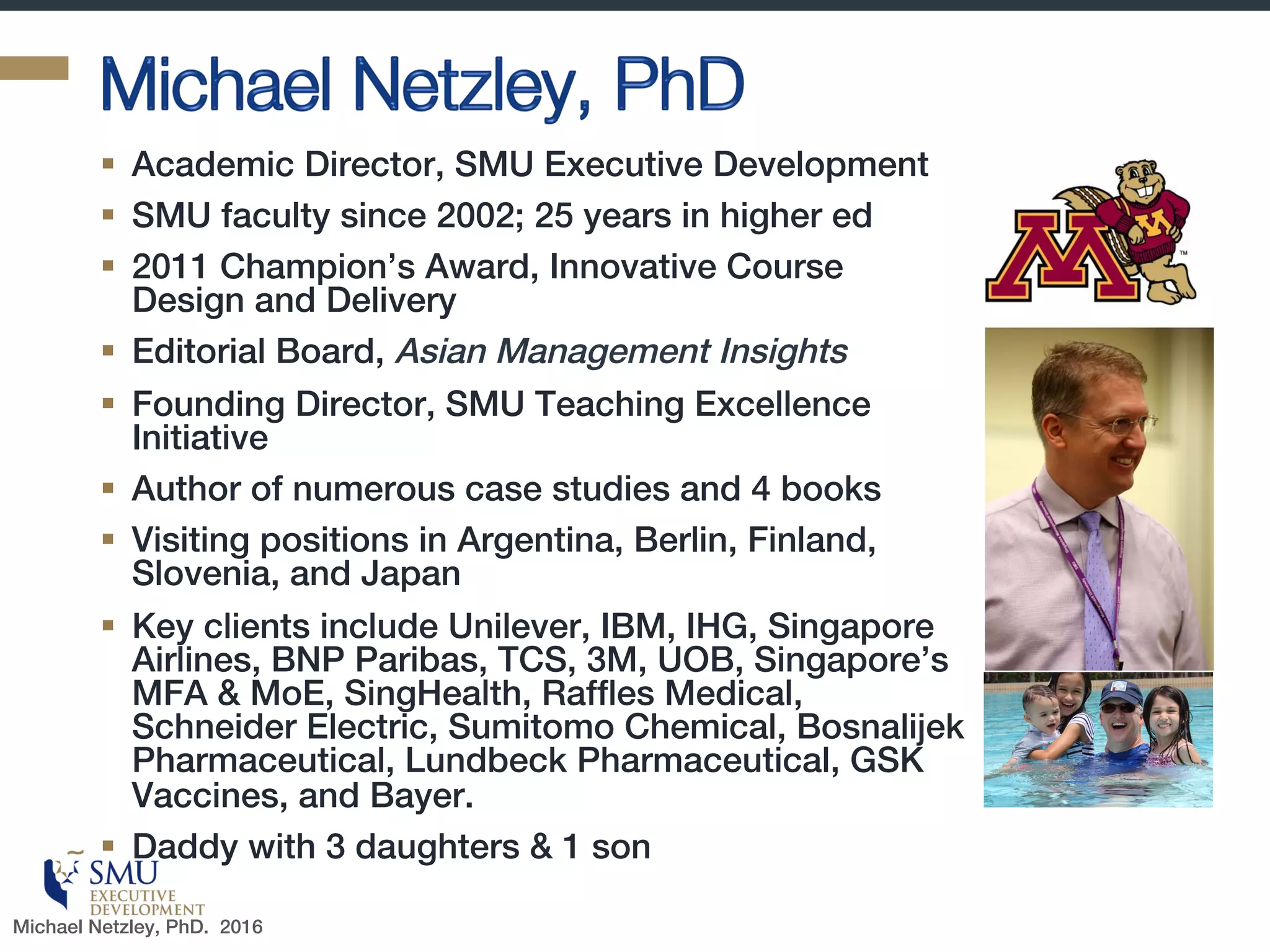
§ Academic Director, SMU Executive Development
§ SMU faculty since 2002; 25 years in higher ed
§ 2011 Champion’s Award, Innovative Course
Design and Delivery; 2015 Best Case Study Award
Winner, EFMD
§ Editorial Board, Asian Management Insights
§ Founding Director, SMU Teaching Excellence
Initiative
§ Author of numerous case studies and 4 books
§ Visiting positions in Argentina, Berlin, Finland,
Slovenia, and Japan
§ Key clients include Credit Suisse, BNP Paribas,
Singapore Airlines , Unilever, IBM, IHG, TCS, 3M,
UOB, Singapore’s MFA & MoE, SingHealth, GSK,
Bosnalijek Pharmaceutical, Lundbeck
Pharmaceutical, Bayer, Schneider Electric, and
Sumitomo Chemical.
Michael Netzley, Phd. 2016
Why Do We Care?
Connecting neurosciences to executive development
Imagine You Are Managing A Computer Lab
We know people are different from computers, but just play along…
Each Computer Has A Different OS
Much like people have different personalities, languages, and culture
Now Apply That Metaphor To People
Our brains have the same elements, but each is wired differently (we
each have a slightly different OS). This is what managers deal with
every day—neuroscience helps you succeed across the differences.
How You Can Help
Using Neurosciences
The professional benefits of applied neurosciences
Optimize Your Mental Flow
“Flow” describes our brain’s peak performance when we are
completely immersed in an activity
Build Improved Habits
By understanding neuroplasticity and how the brain can be rewired
for new tasks and strategic change
Michael Netzley, Phd. 2016
Avoid Unintentionally Stepping on Landmines
Neurosciences teaches us how our best intentions can trigger the
wrong response—and how you can evoke the desired response
Michael Netzley, Phd. 2016
Master Your Cognitive Biases
Michael Netzley, Phd. 2016
Let’s Begin With A Little Quiz
1. True or False: When we refer to our mind, we are
referring to something that is separate from our body.
2. True or False: We make better decisions when we leave
emotion out of it and rely primarily on logic.
3. True or False: People are either “left brained” or “right
brained” (left brain is better for logic and organization
while right brain is better for creativity and intuition)
4. True or False: There are neurochemicals that make us
better leaders (e.g., serotonin and Oxytocin are the
brain’s “selfless” chemicals)
5. True or False: Old dogs cannot learn new tricks.
6. True or False: Medical researchers have proven that
new habits are generally formed in 21 days.
Don’t worry…the answers will follow
Michael Netzley, PhD. 2016
Leadership
How do the neurosciences add to our understanding of
leadership?
Michael Netzley, PhD. 2016
“
Traditional leadership (and
executive, and coaching…)
development has largely
focused on what could be seen;
the brain’s activity was either
estimated or simply ignored
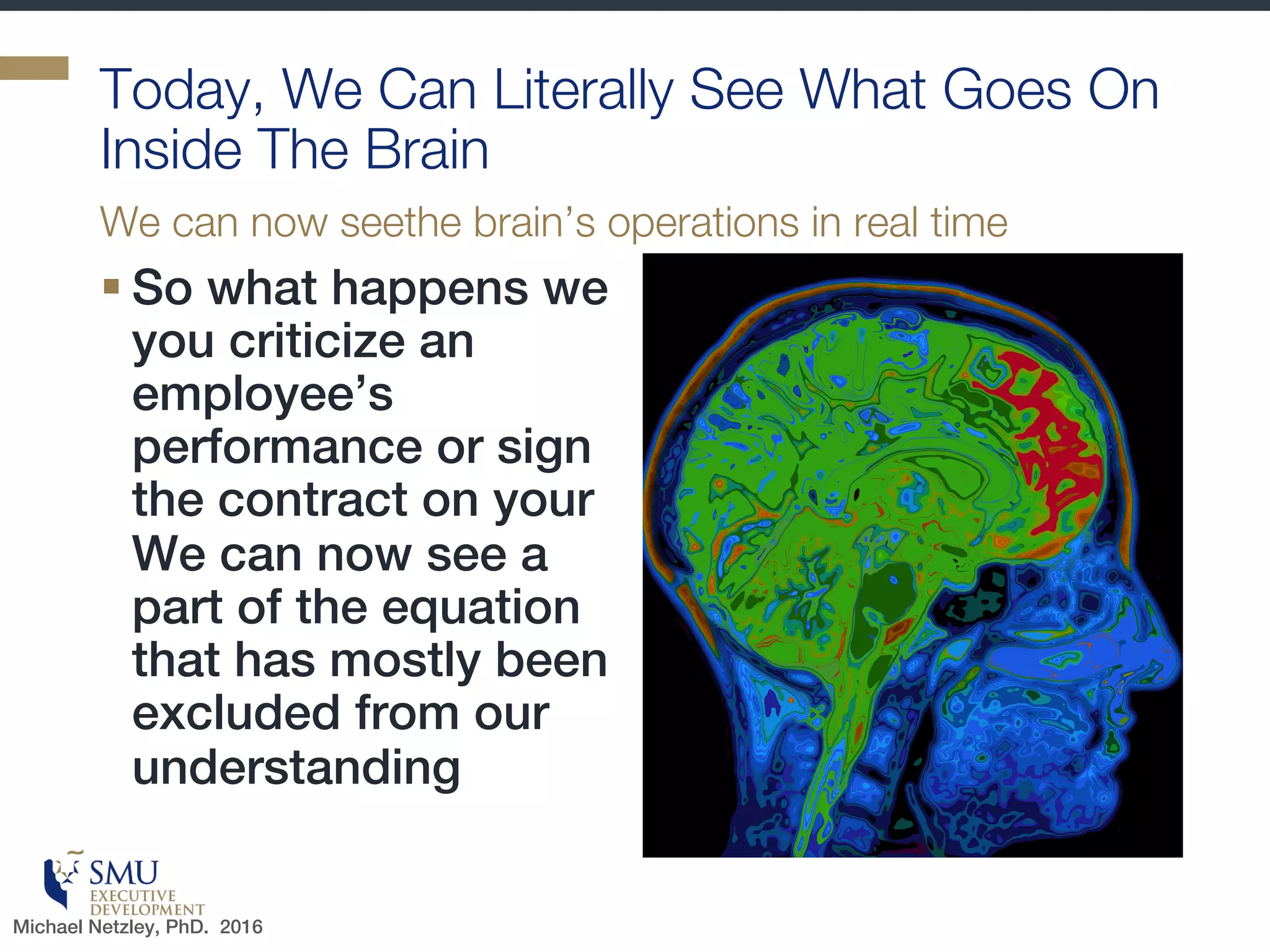
Today, We Can Literally See What Goes
On Inside The Brain
§ So what happens when
you question a
coachee’s performance
or sign the contract for
an exciting new gig?
§ We can now see a part
of the equation—the
brain activity—that has
mostly been excluded
from our understanding
We can now see the brain’s operations in real time
Michael Netzley, PhD. 2016
Motivating
An example of seeing something that was
previously not visible
Michael Netzley, PhD. 2016
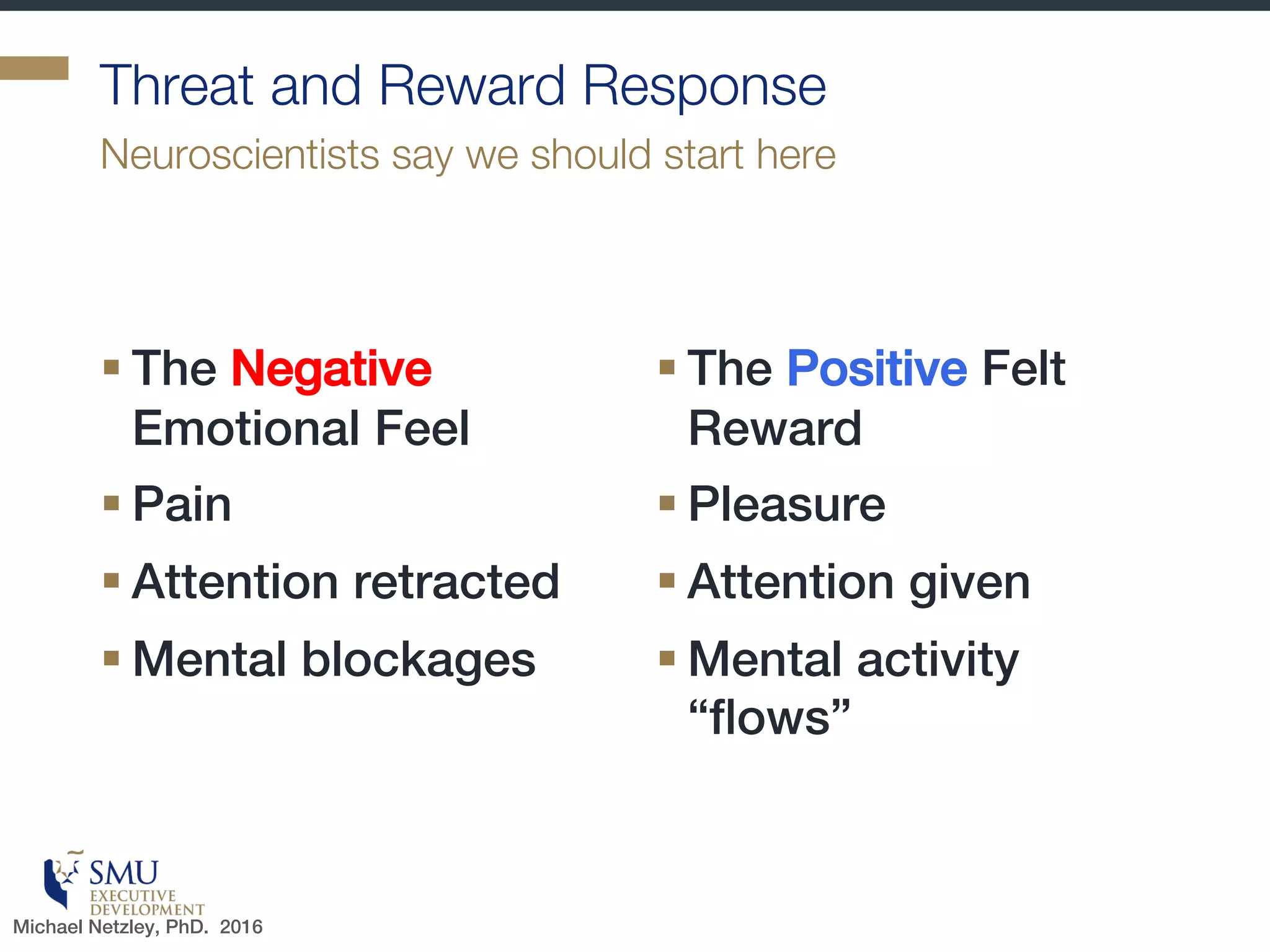
Threat and Reward Response
§ The Negative
Emotional Feel
§ Pain
§ Attention retracted
§ Mental blockages
§ The Positive Felt
Reward
§ Pleasure
§ Attention given
§ Mental activity “flows”
Neuroscientists say we should start here
Michael Netzley, PhD. 2016
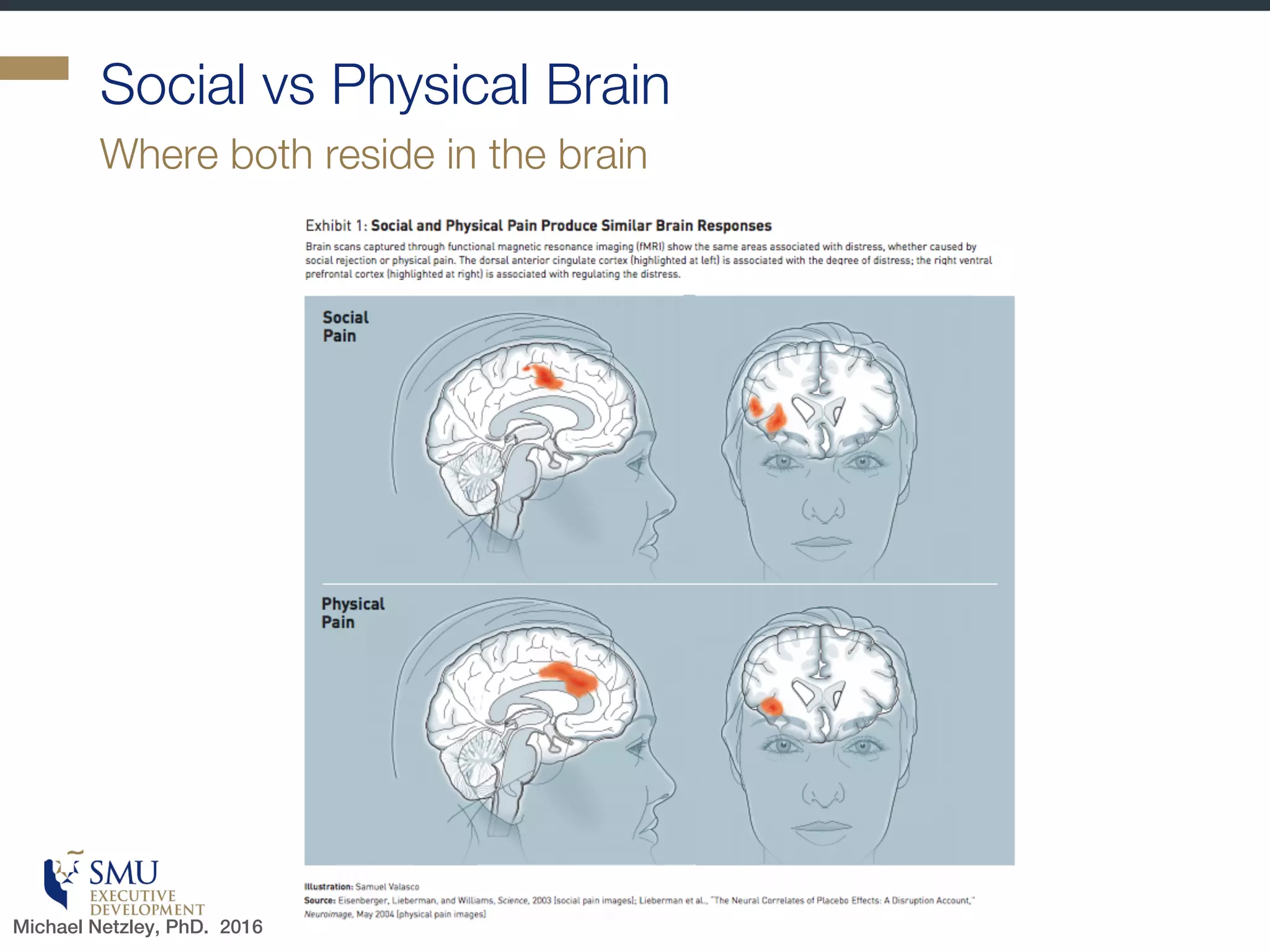
Social vs Physical Brain
Where both reside in the brain
Michael Netzley, PhD. 2016
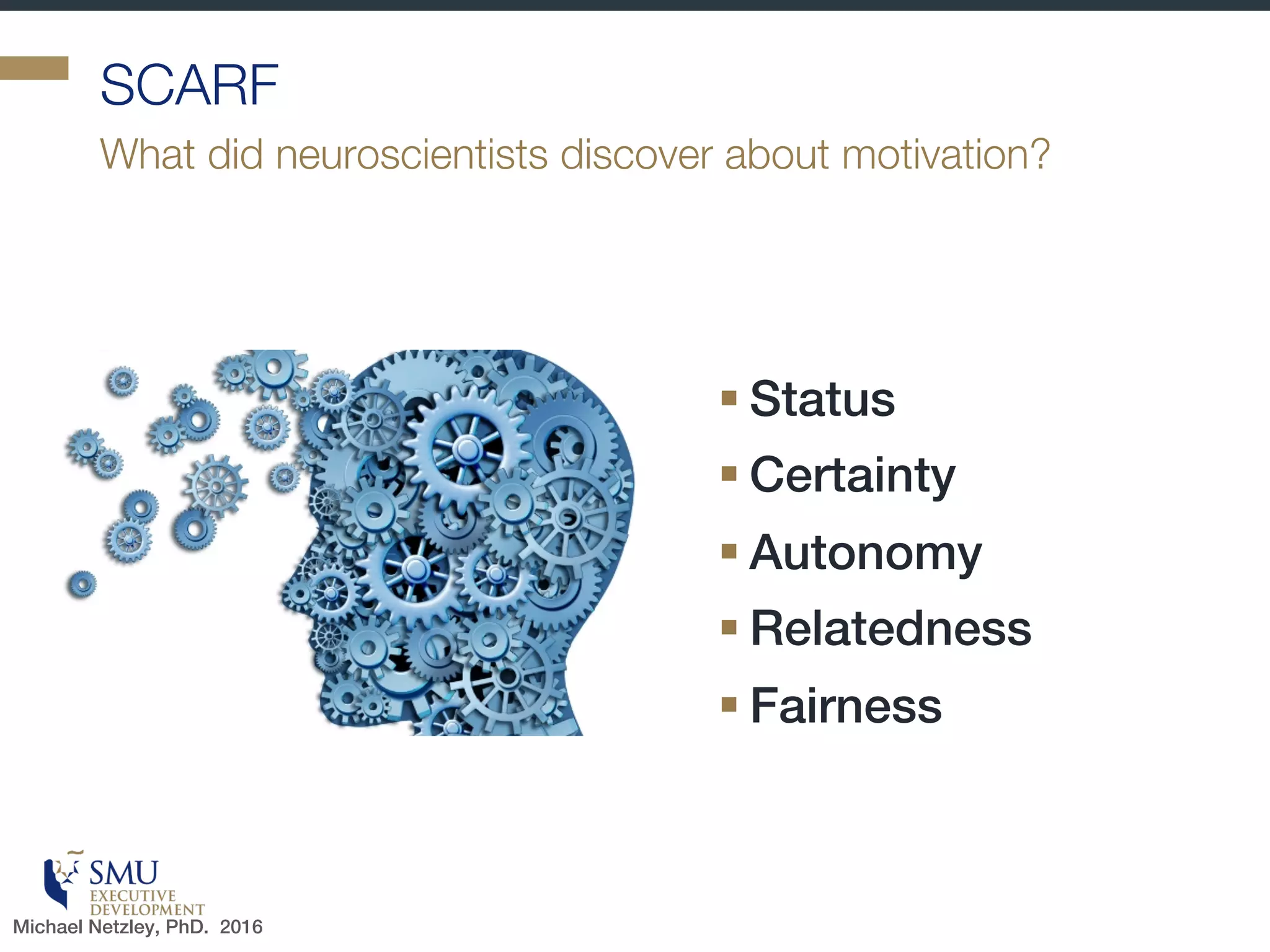
SCARF
§ Status
§ Certainty
§ Autonomy
§ Relatedness
§ Fairness
What did neuroscientists discover about motivation?
Michael Netzley, PhD. 2016
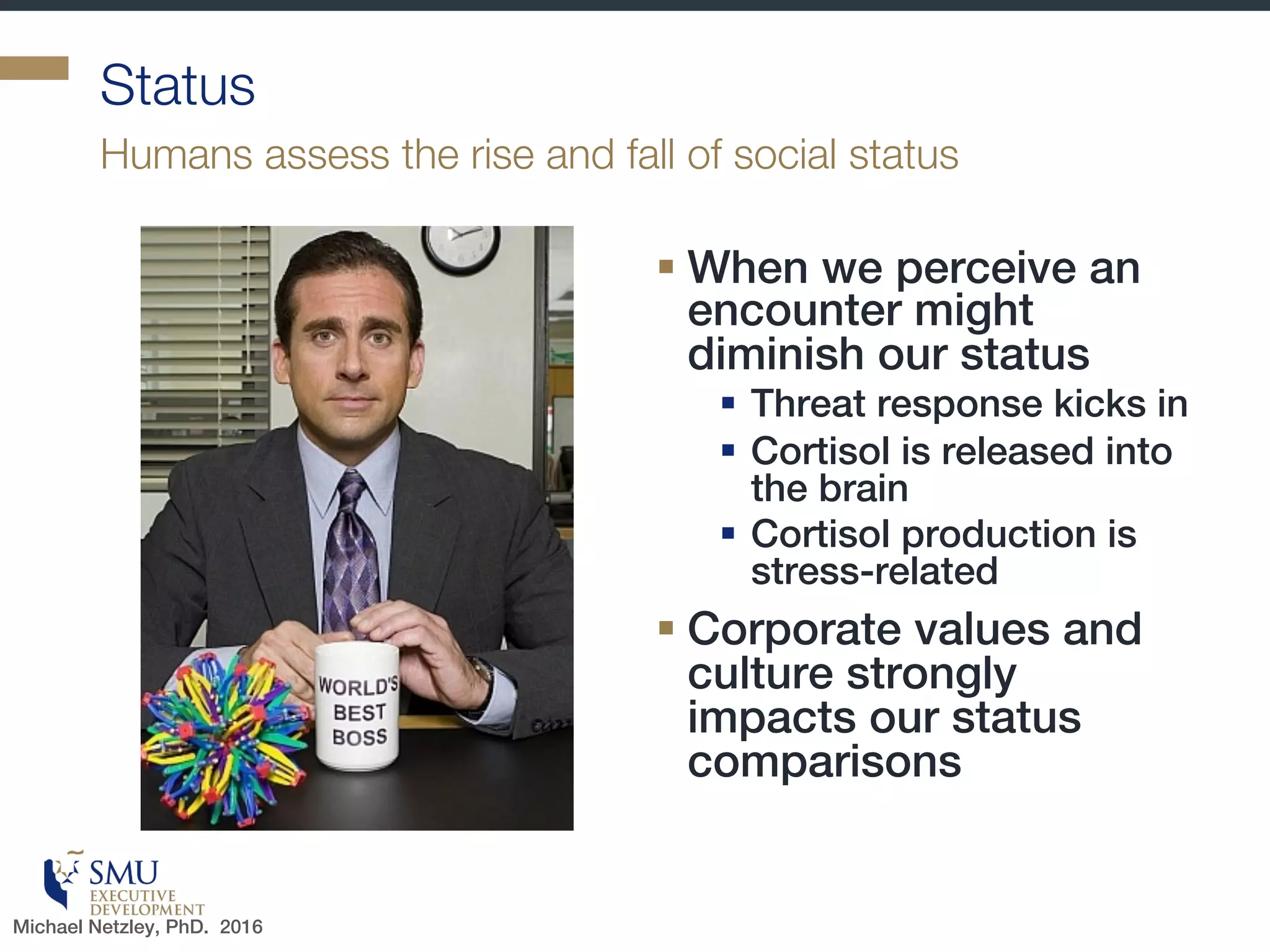
Status
§ When we perceive an
encounter might
diminish our status
§ Threat response kicks in
§ Cortisol is released into
the brain
§ Cortisol production is
stress-related
§ Corporate values and
culture strongly impacts
our status comparisons
Humans assess the rise and fall of social status
Michael Netzley, PhD. 2016
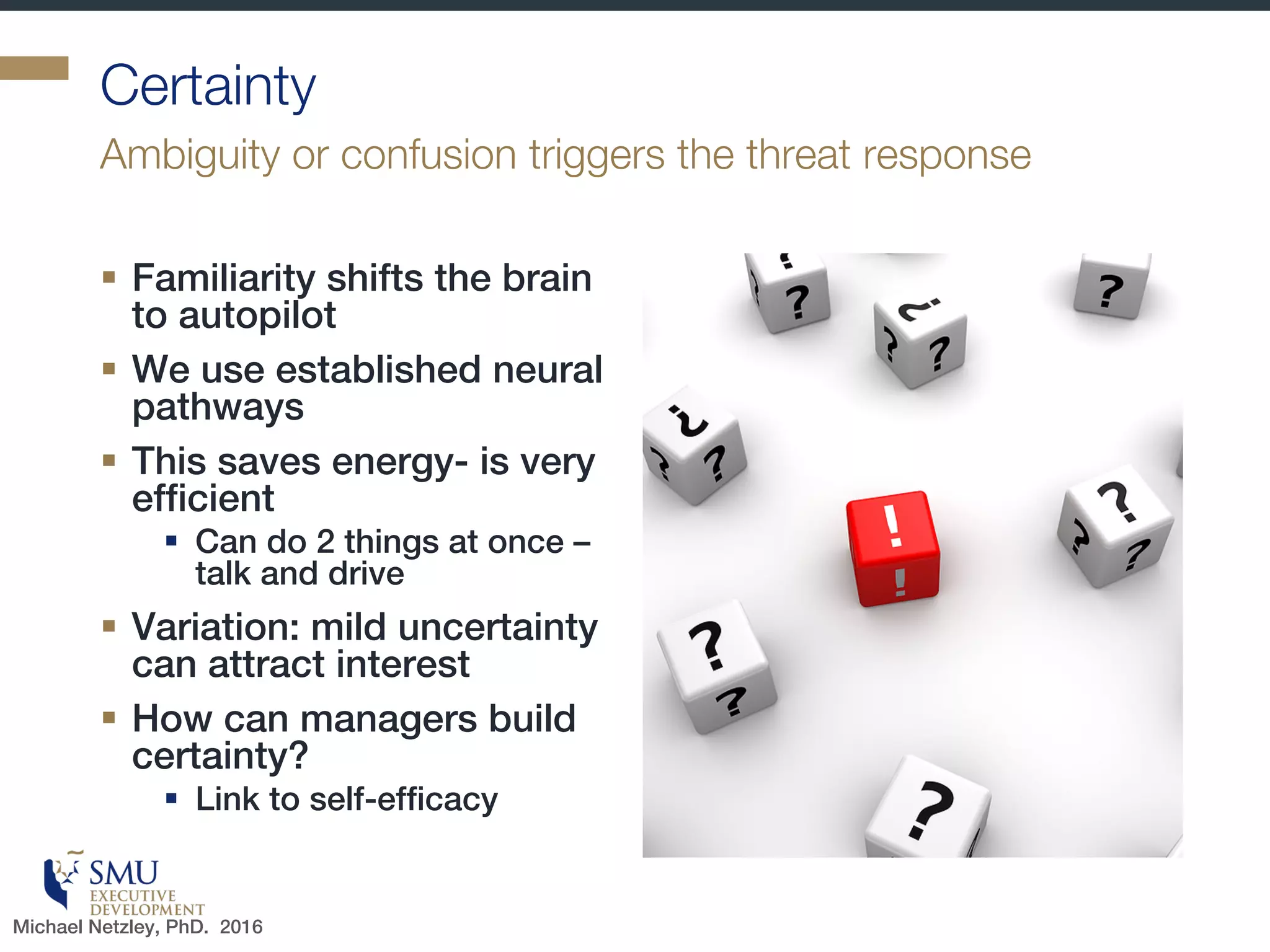
Certainty
§ Familiarity shifts the brain
to autopilot
§ We use established neural
pathways
§ This saves energy- is very
efficient
§ Can do 2 things at once –
talk and drive
§ Variation: mild uncertainty
can attract interest
§ How can managers build
certainty?
§ Link to self-efficacy
Ambiguity or confusion triggers the threat response
Michael Netzley, PhD. 2016
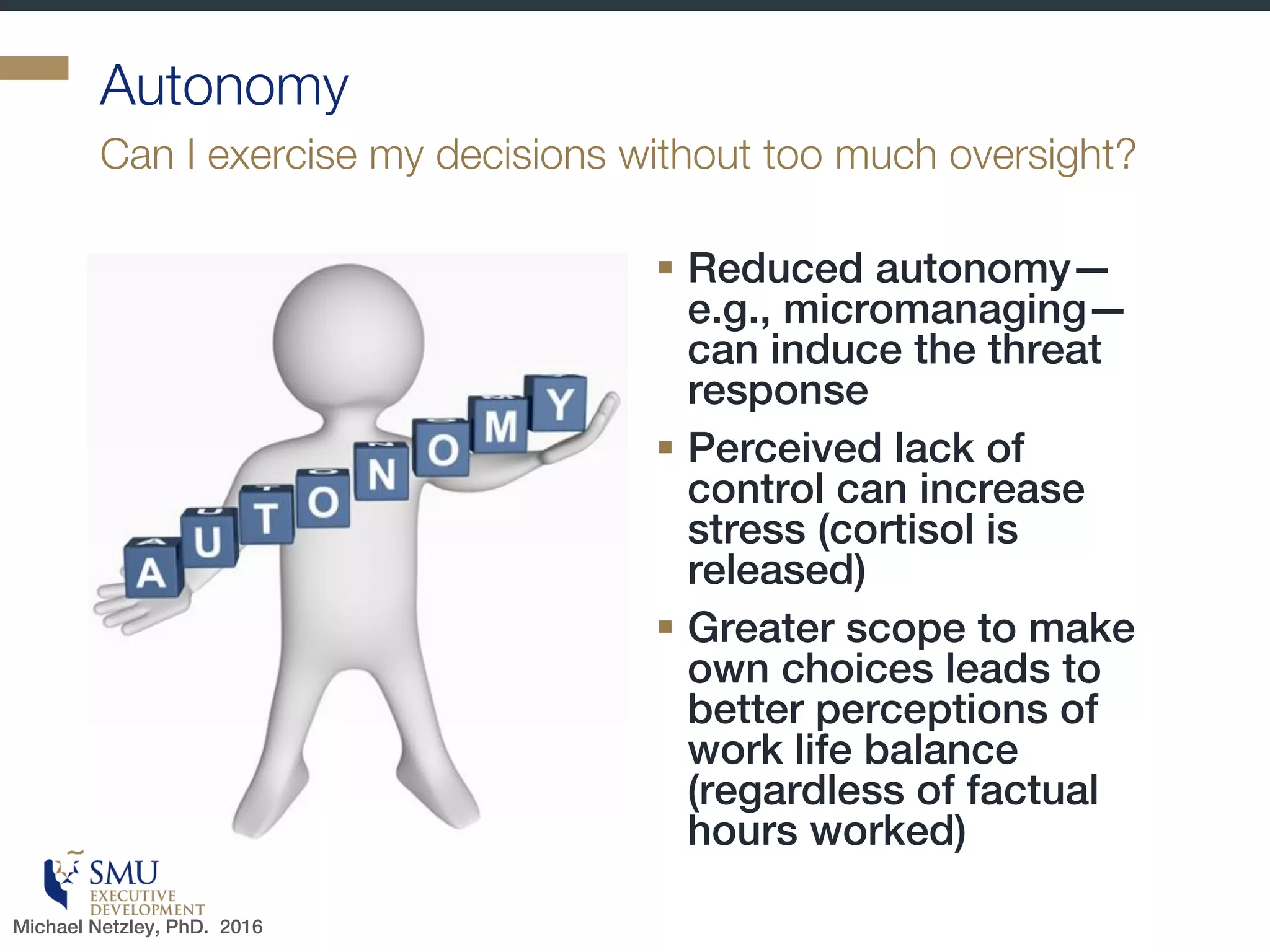
Autonomy
§ Reduced autonomy—
e.g., micromanaging—
can induce the threat
response
§ Perceived lack of control
can increase stress
(cortisol is released)
§ Greater scope to make
own choices leads to
better perceptions of
work life balance
(regardless of factual
hours worked)
Can I exercise my decisions without too much oversight?
Michael Netzley, PhD. 2016
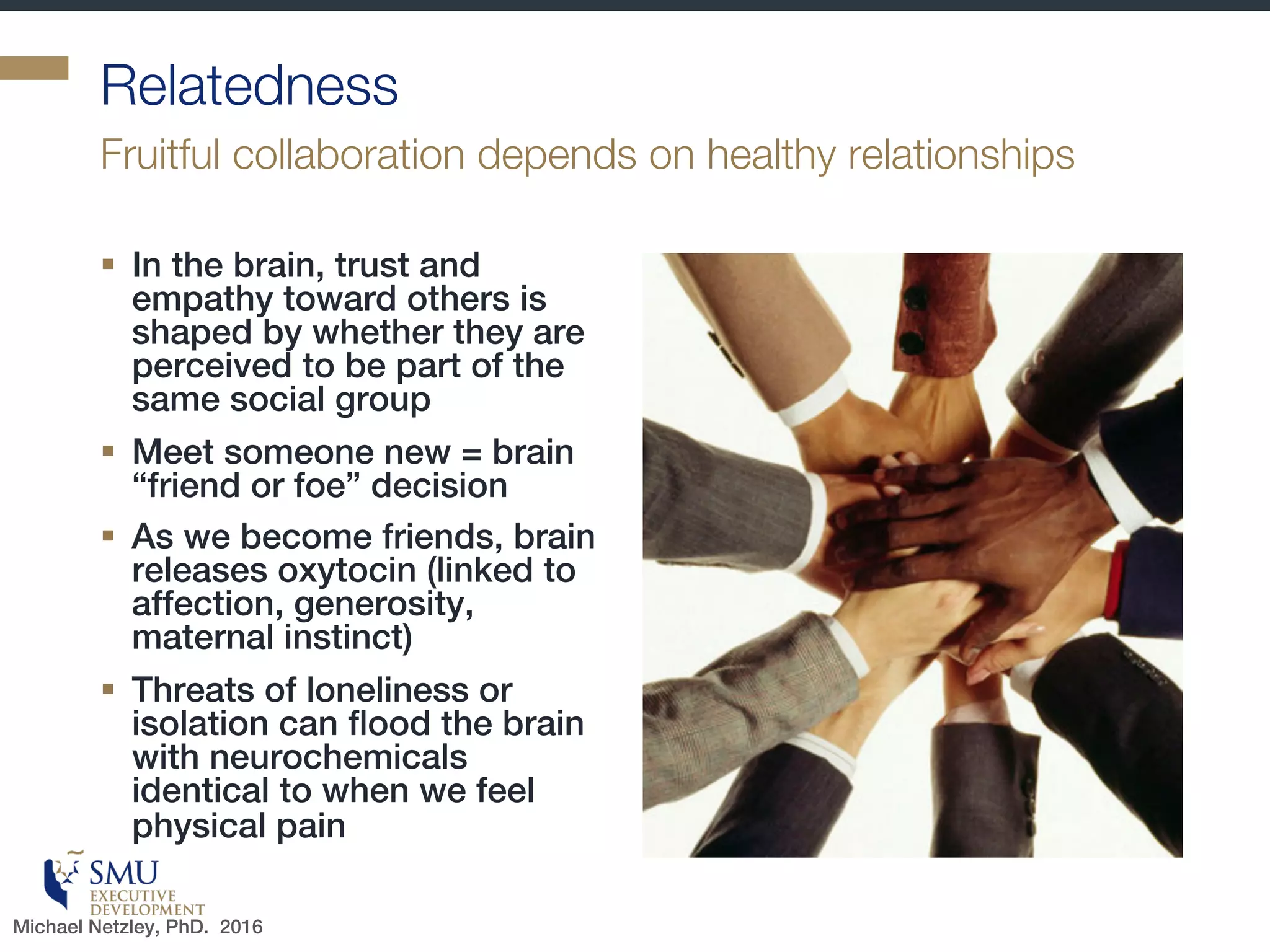
Relatedness
§ In the brain, trust and empathy
toward others is shaped by
whether they are perceived to
be part of the same social
group
§ Meet someone new = brain
“friend or foe” decision
§ As we become friends, brain
releases oxytocin (linked to
affection, generosity, maternal
instinct)
§ Threats of loneliness or
isolation can flood the brain
with neurochemicals identical
to when we feel physical pain
Fruitful collaboration depends on healthy relationships
Michael Netzley, PhD. 2016
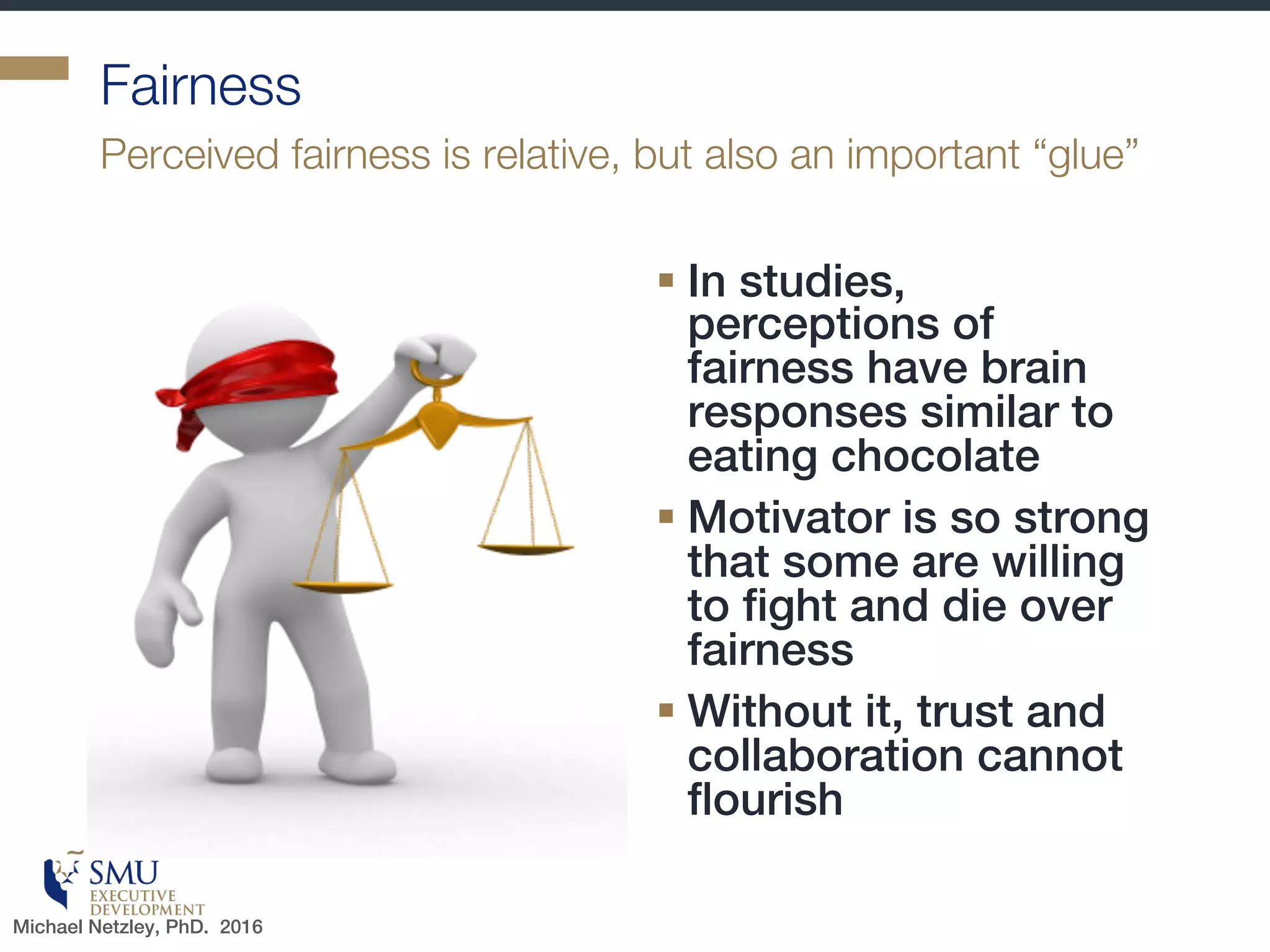
Fairness
§ In studies, perceptions
of fairness have brain
responses similar to
eating chocolate
§ Motivator is so strong
that some are willing to
fight and die over
fairness
§ Without it, trust and
collaboration cannot
flourish
Perceived fairness is relative, but also an important
“glue”
Michael Netzley, PhD. 2016
“
We now have reason to
believe that economic
incentives are only effective
when people perceive them
as supporting their social
needs…
- David Rock, 2009
Michael Netzley, PhD. 2016
“
If you are a leader, every
action you take and
decision you make either
supports or undermines
SCARF…
- David Rock, 2009
Michael Netzley, PhD. 2016
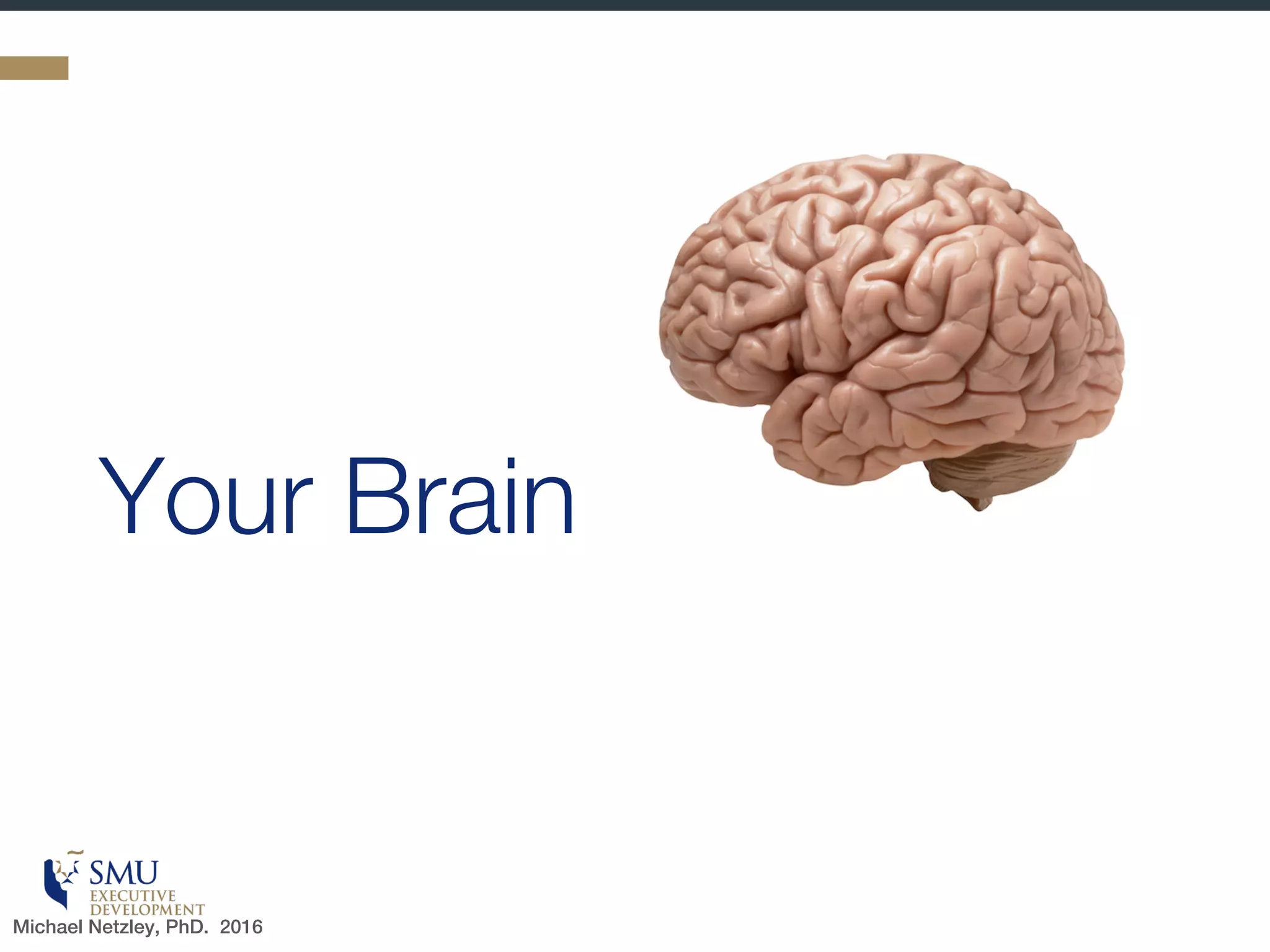
Your Brain
Michael Netzley, PhD. 2016
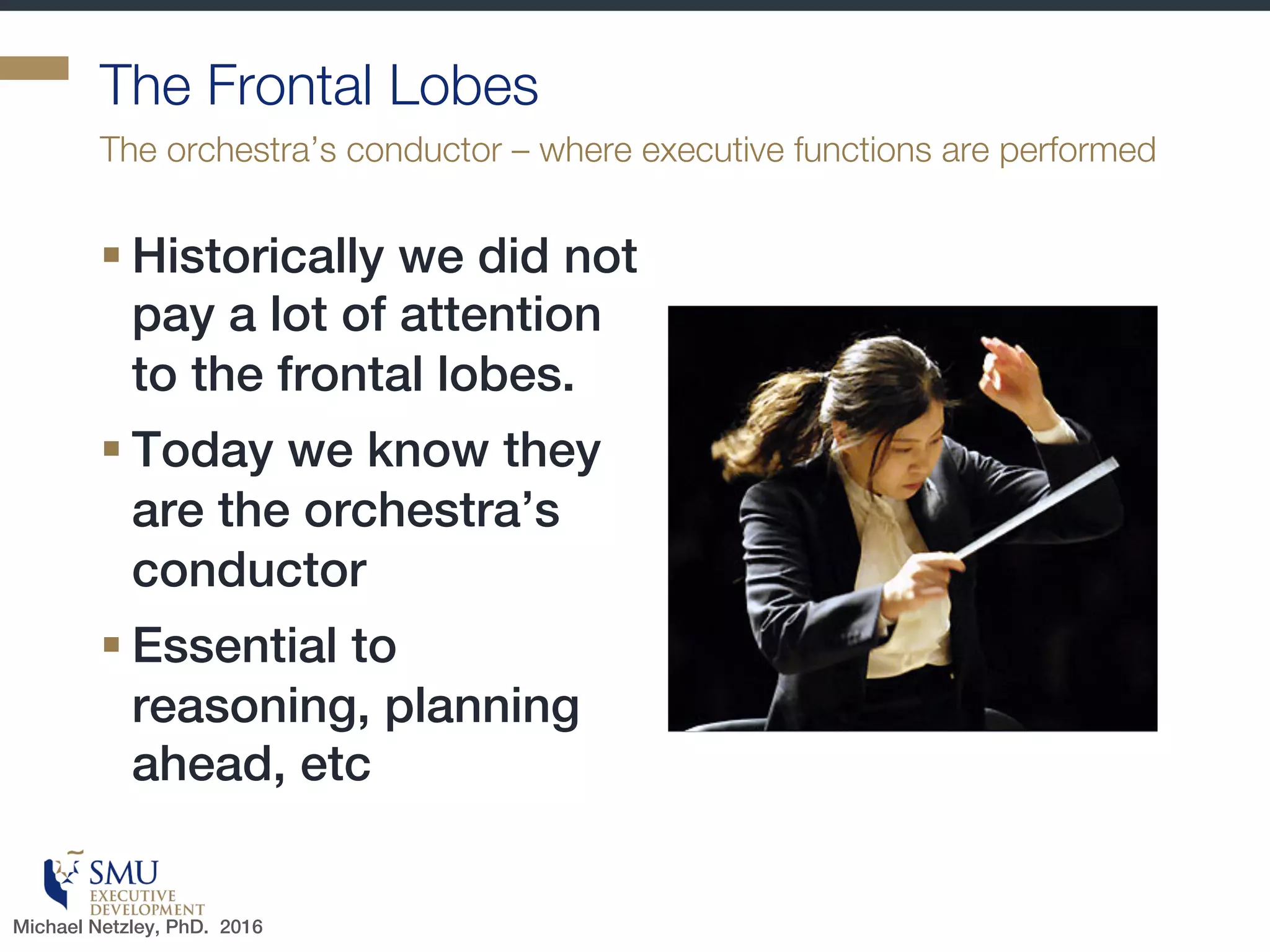
The Frontal Lobes
§ Historically we did not
pay a lot of attention to
the frontal lobes.
§ Today we know they
are the orchestra’s
conductor
§ Essential to reasoning,
planning ahead, etc
The orchestra’s conductor – where executive functions are
performed
Michael Netzley, PhD. 2016
Why Focus on the Executive’s Brain?
§ Achilles and the Myrmidon warriors
§ Historically leaders inspired courage with
front line fighting, as did Achilles
§ Today they lead from the balcony;
overseeing
§ The key assumption is that this specific type
of executive role—from the balcony—will
make the team/troops better
§ Today’s CEO typically displays such
leadership, as does the conductor of the
orchestra. The CEO does not
manufacture the goods or deliver the
actual services anymore than the
conductor makes the music.
Look at how the role of the executive has evolved
Michael Netzley, PhD. 2016
“
The function of leadership
acquires a distinct status and
becomes separate only when
the size and complexity of the
organization crosses a certain
threshold.
- Elkhonon Goldberg, The Executive Brain
Michael Netzley, PhD. 2016
Myths and Mistakes
About Your Brain
Michael Netzley, PhD. 2016
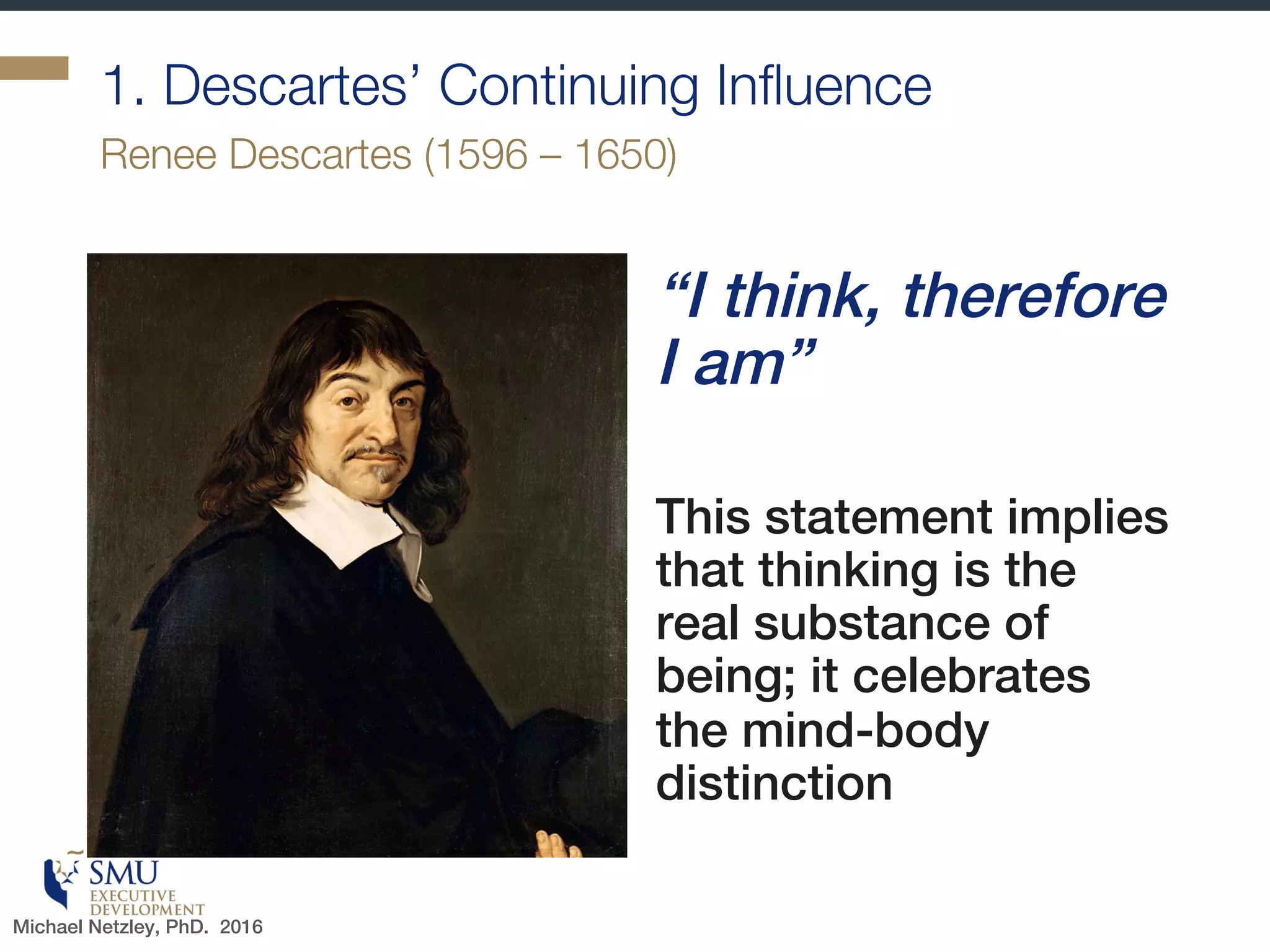
1. Descartes’ Continuing Influence
“I think,
therefore I am”
This statement
implies that thinking
is the real substance
of being; it celebrates
the mind-body
distinction
Renee Descartes (1596 – 1650)
Michael Netzley, PhD. 2016
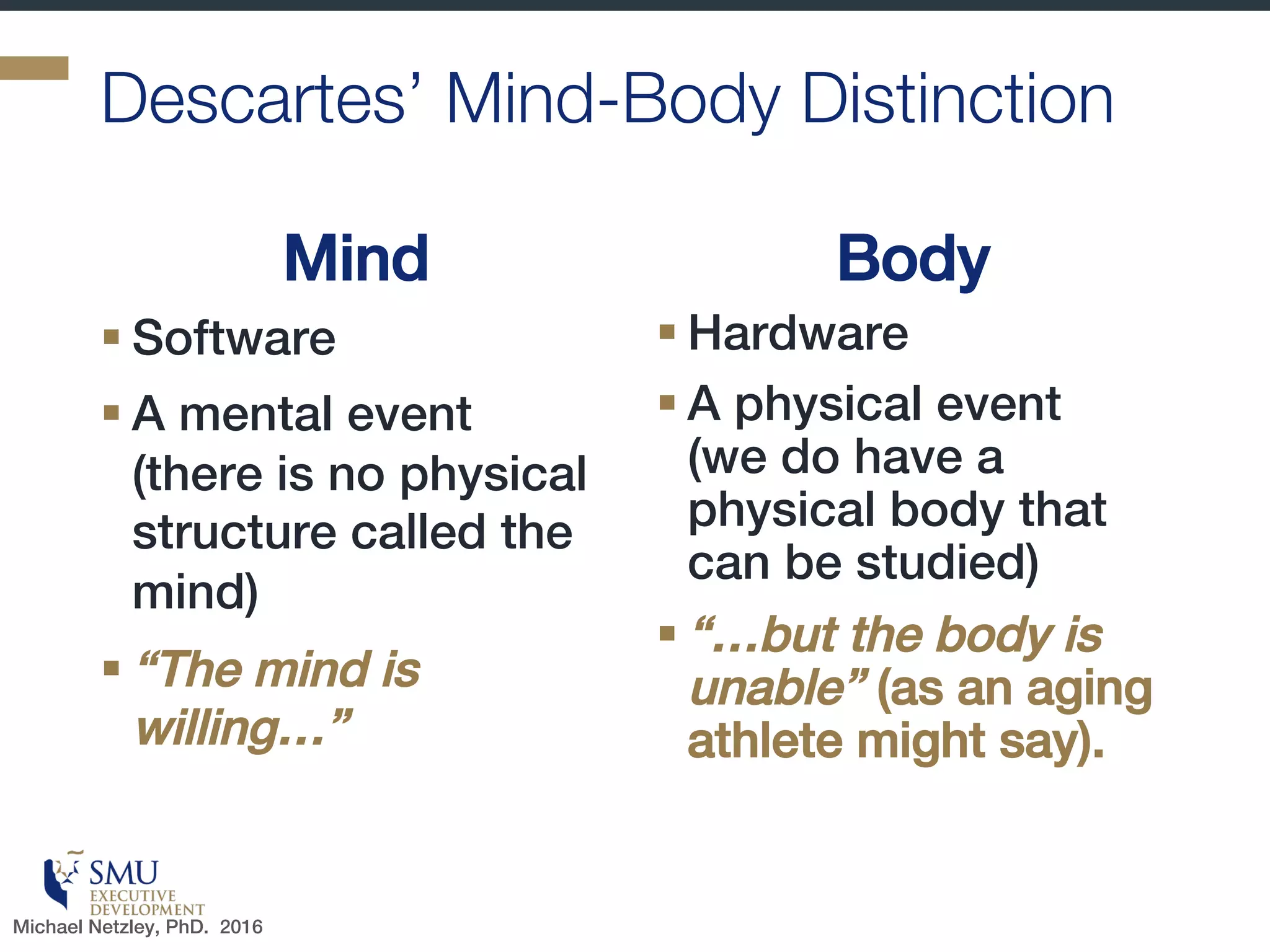
Descartes’ Mind-Body Distinction
Mind
§ Software
§ A mental event (there
is no physical
structure called the
mind)
§ “The mind is
willing…”
Body
§ Hardware
§ A physical event
(we do have a physical
body that can be
studied)
§ “…but the body is
unable” (as an aging
athlete might say).
Michael Netzley, PhD. 2016
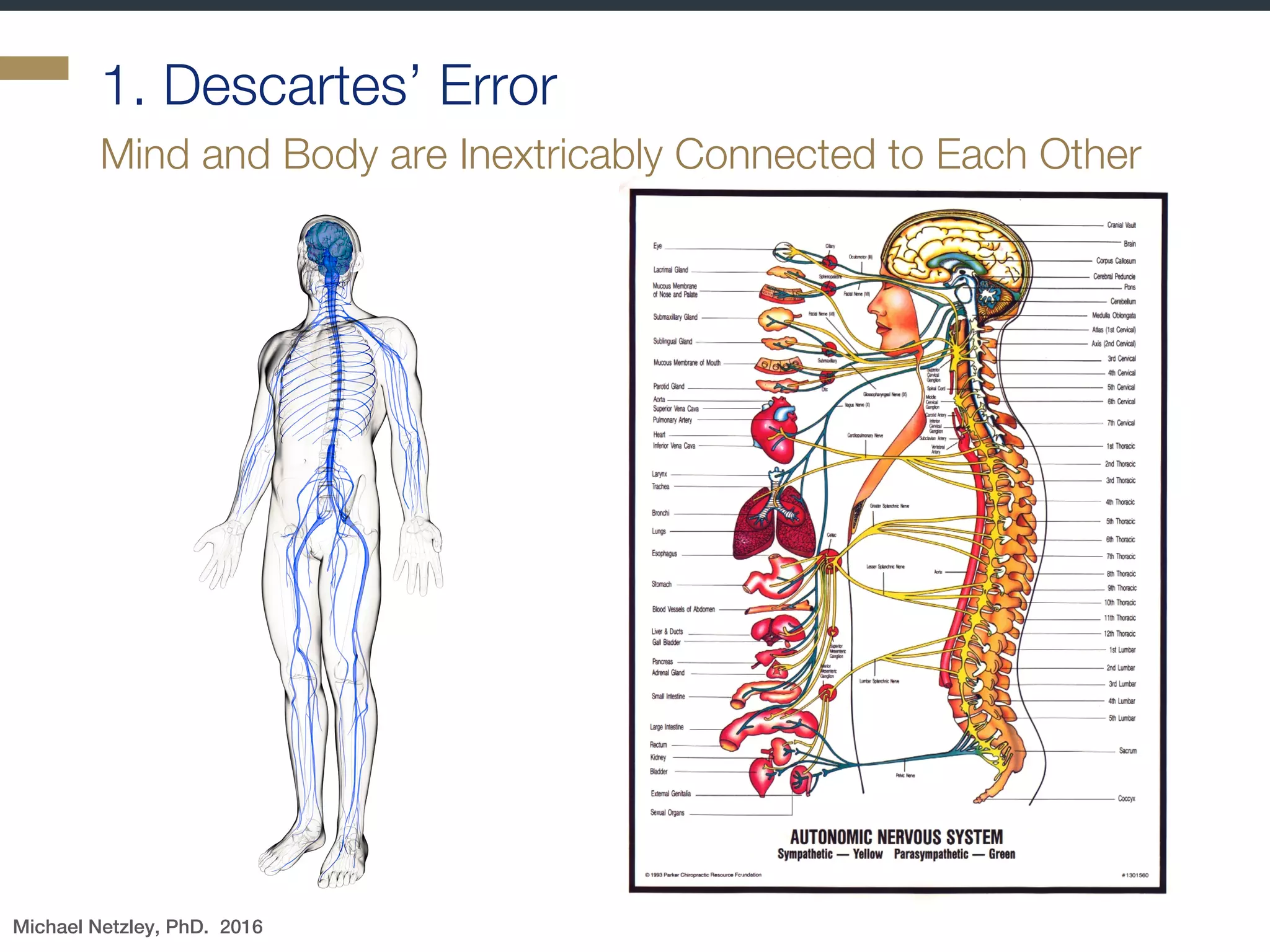
1. Descartes’ Error
Mind and Body are Inextricably Connected to Each Other
Michael Netzley, PhD. 2016
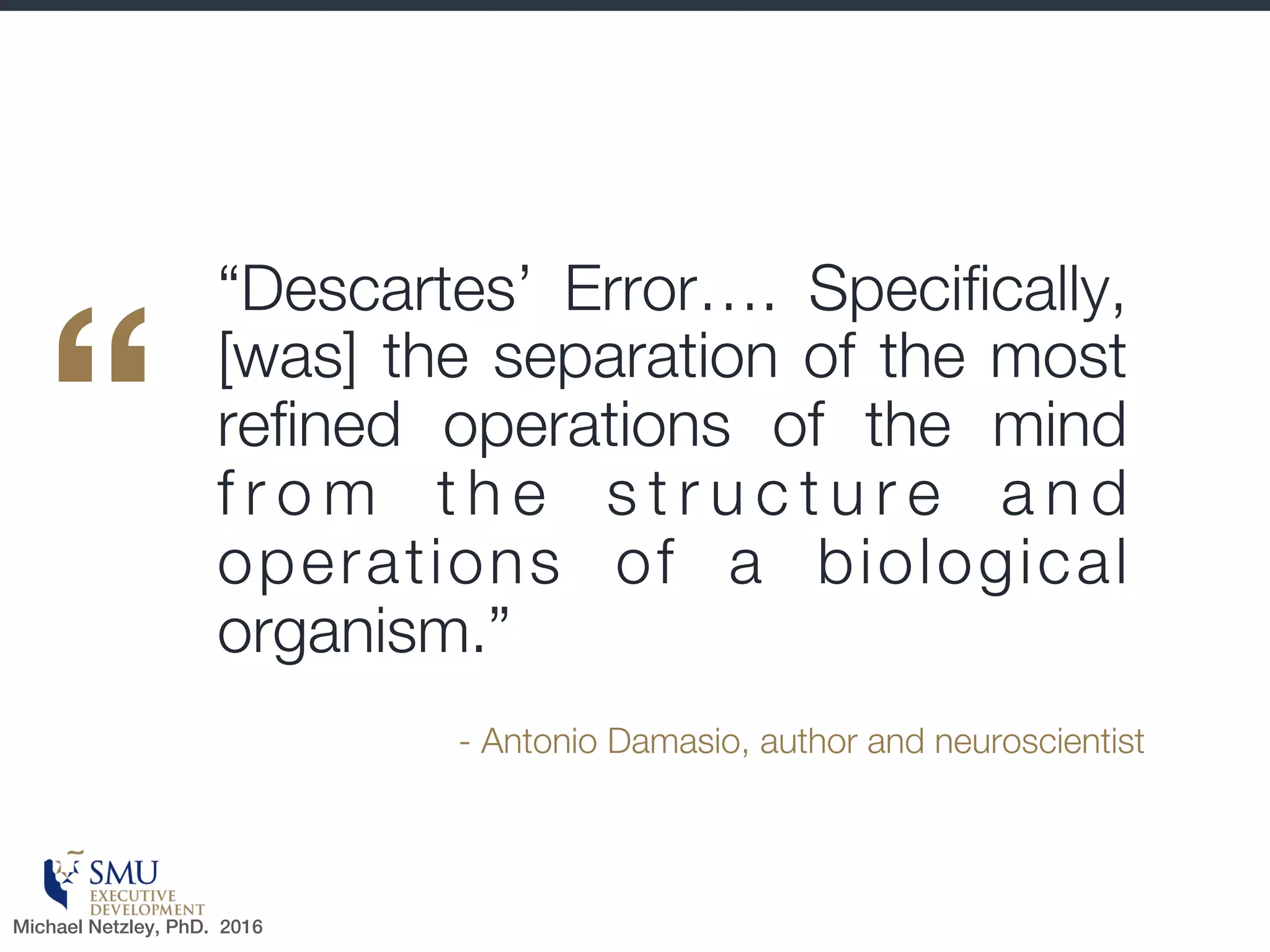
“
“Descartes’ Error…. Specifically,
[was] the separation of the most
refined operations of the mind
from the structure and
operations of a biological
organism.”
- Antonio Damasio, author and neuroscientist
Michael Netzley, PhD. 2016
Who Cares About
Descartes?
Here is Why You Should Care!
§ Researchers are already helping
us—managers, coaches, and
everyday people—maximize the
benefits that come from leveraging
on the mind-body connection.
§ “presence,” the state in which we
stop worrying about the impression
we’re making on others and instead
adjust the impression we’ve been
making on ourselves….we need to
nudge ourselves, moment by
moment, by tweaking our body
language, behavior, and mind-set
in our day-to-day lives.
The mind-body connection has potentially powerful benefits
Source: http://amycuddy.com/presence/Michael Netzley, Phd. 2016
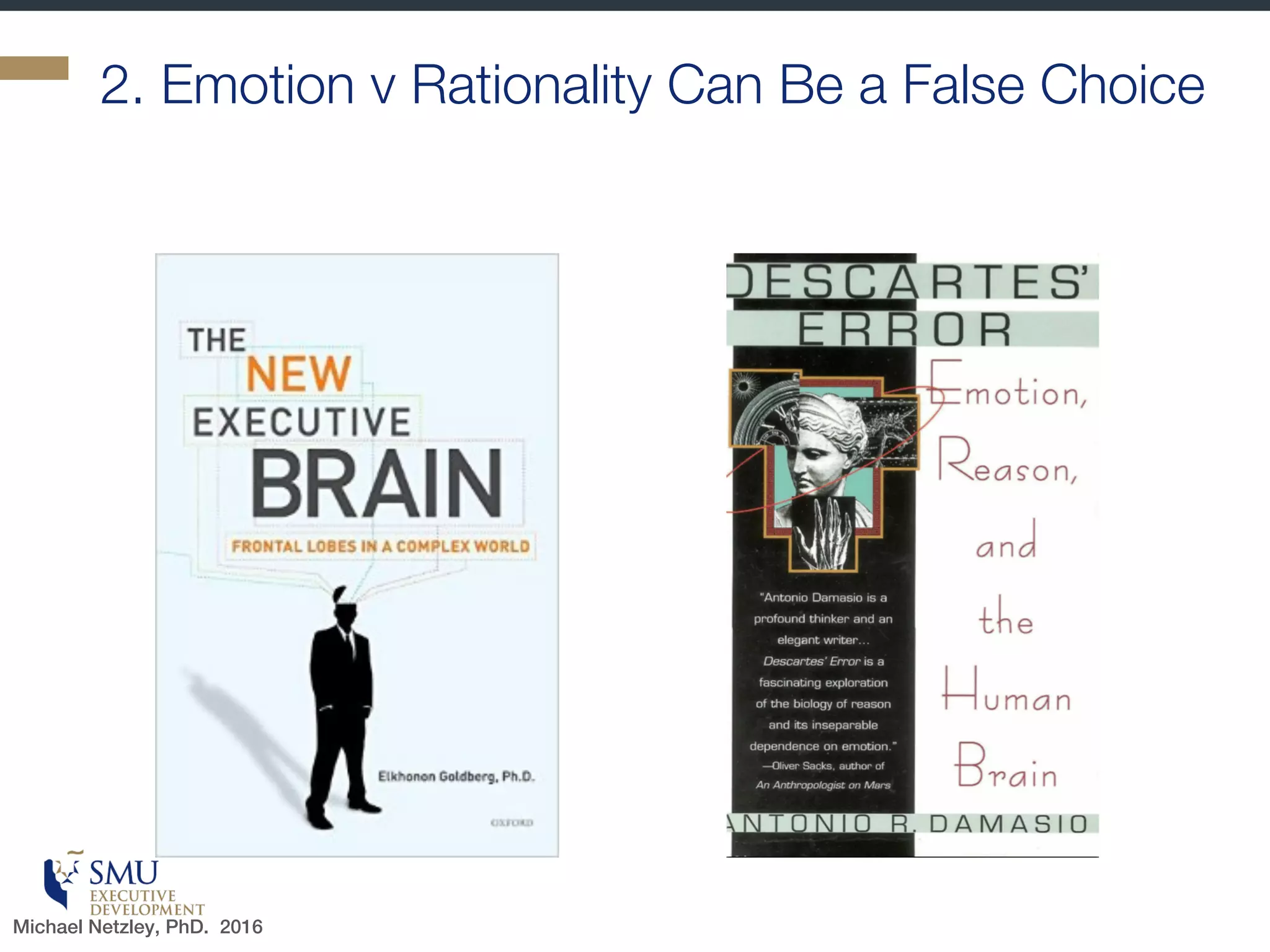
2. Emotion v Rationality Can Be a False Choice
Michael Netzley, PhD. 2016
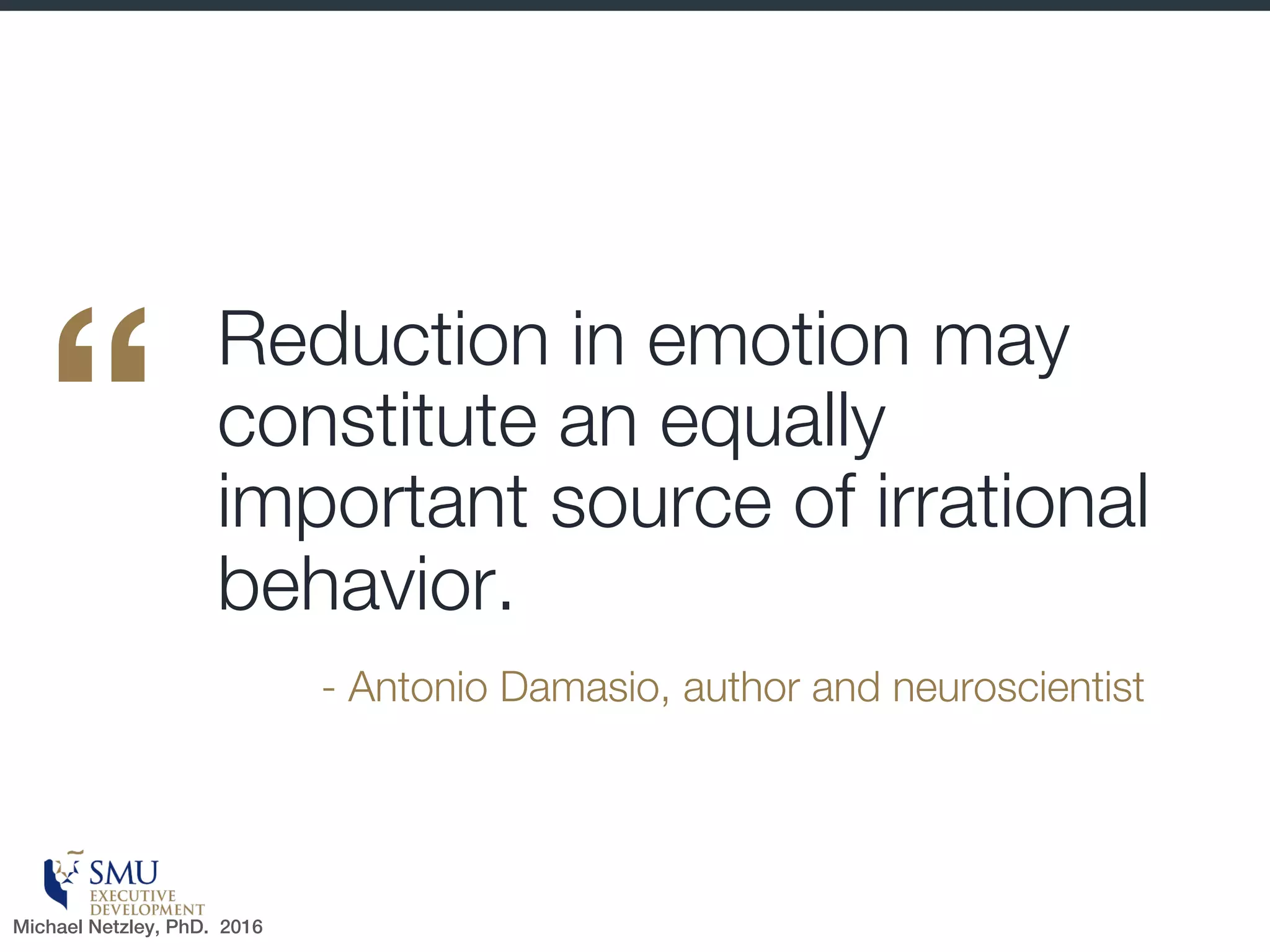
“ Reduction in emotion may
constitute an equally
important source of
irrational behavior.
- Antonio Damasio, author and neuroscientist
Michael Netzley, PhD. 2016
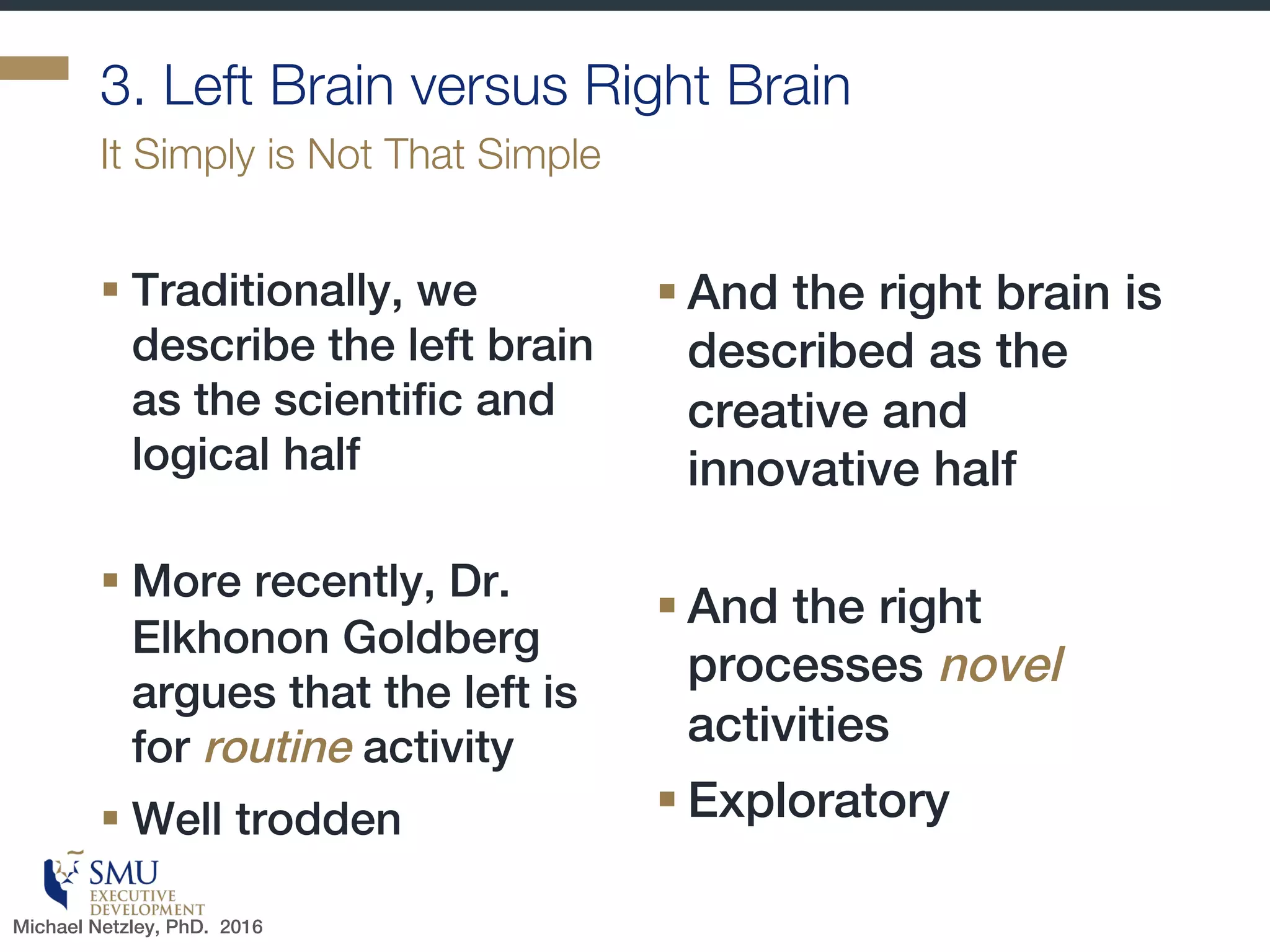
3. Left Brain versus Right Brain
§ Traditionally, we
describe the left brain
as the scientific and
logical half
§ More recently, Dr.
Elkhonon Goldberg
argues that the left is
for routine activity
§ Well trodden
§ And the right brain is
described as the
creative and
innovative half
§ Dr. Elkhonon
suggests the right
side processes novel
activities
§ Exploratory
The latest insights offer a slightly different theory…
Michael Netzley, PhD. 2016
4. Neurochemicals and Leadership
Unfortunately, a complete overstatement in the popular press
Michael Netzley, PhD. 2016
“
[Neurochemicals] are part of an
exceedingly complicated mechanism
which operates at the level of molecules,
synapses, local circuits, and and systems,
and in which sociocultural
factors…intervene powerfully. A
satisfactory explanation can arise only
from a more comprehensive view.
- Antonio Damasio, author and neuroscientist
Michael Netzley, PhD. 2016
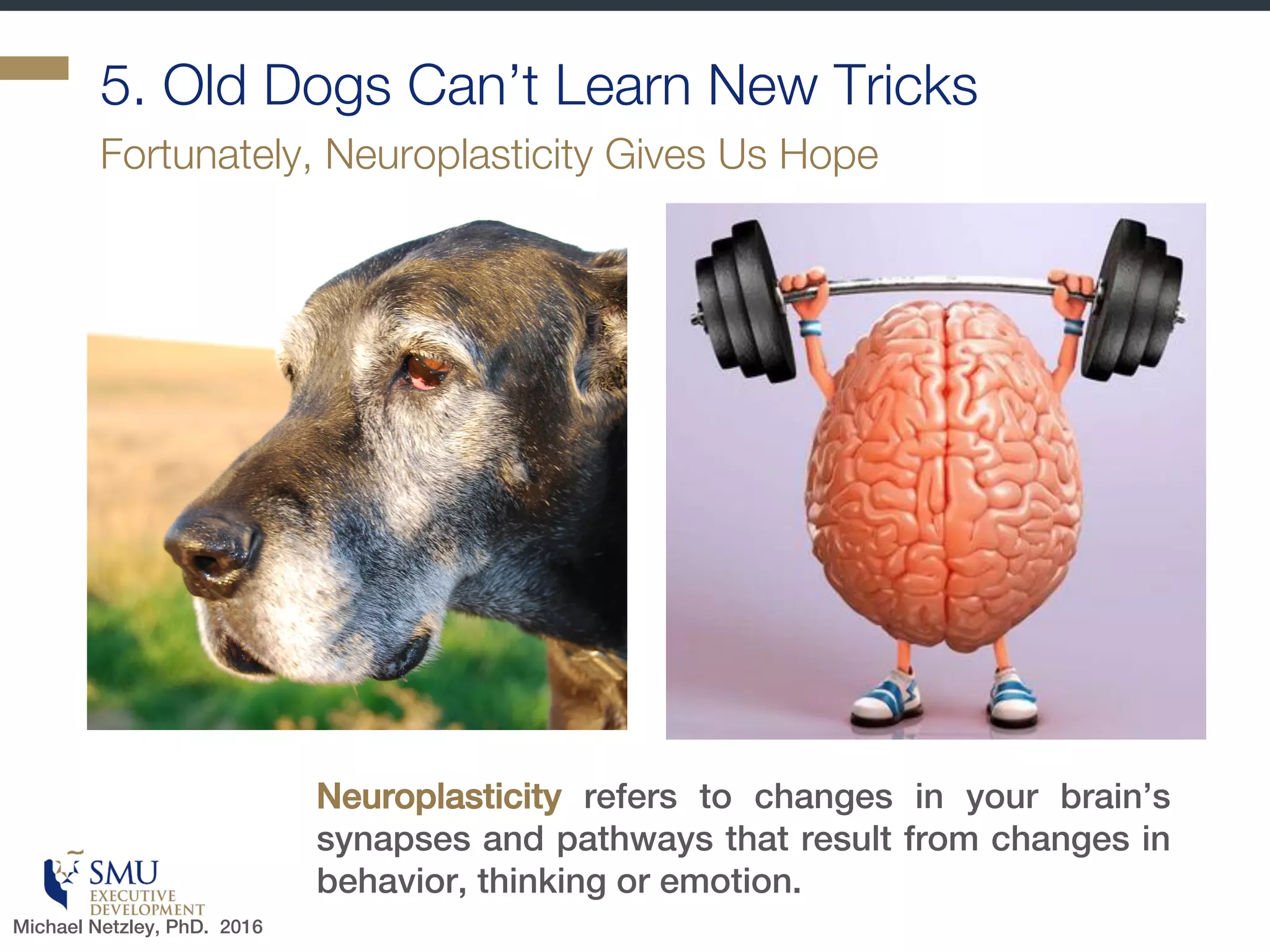
5. Old Dogs Can Learn New Tricks
Fortunately, Neuroplasticity Gives Us Hope
Neuroplasticity refers to changes in your brain’s
synapses and pathways that result from changes in
behavior, thinking or emotion.
Michael Netzley, PhD. 2016
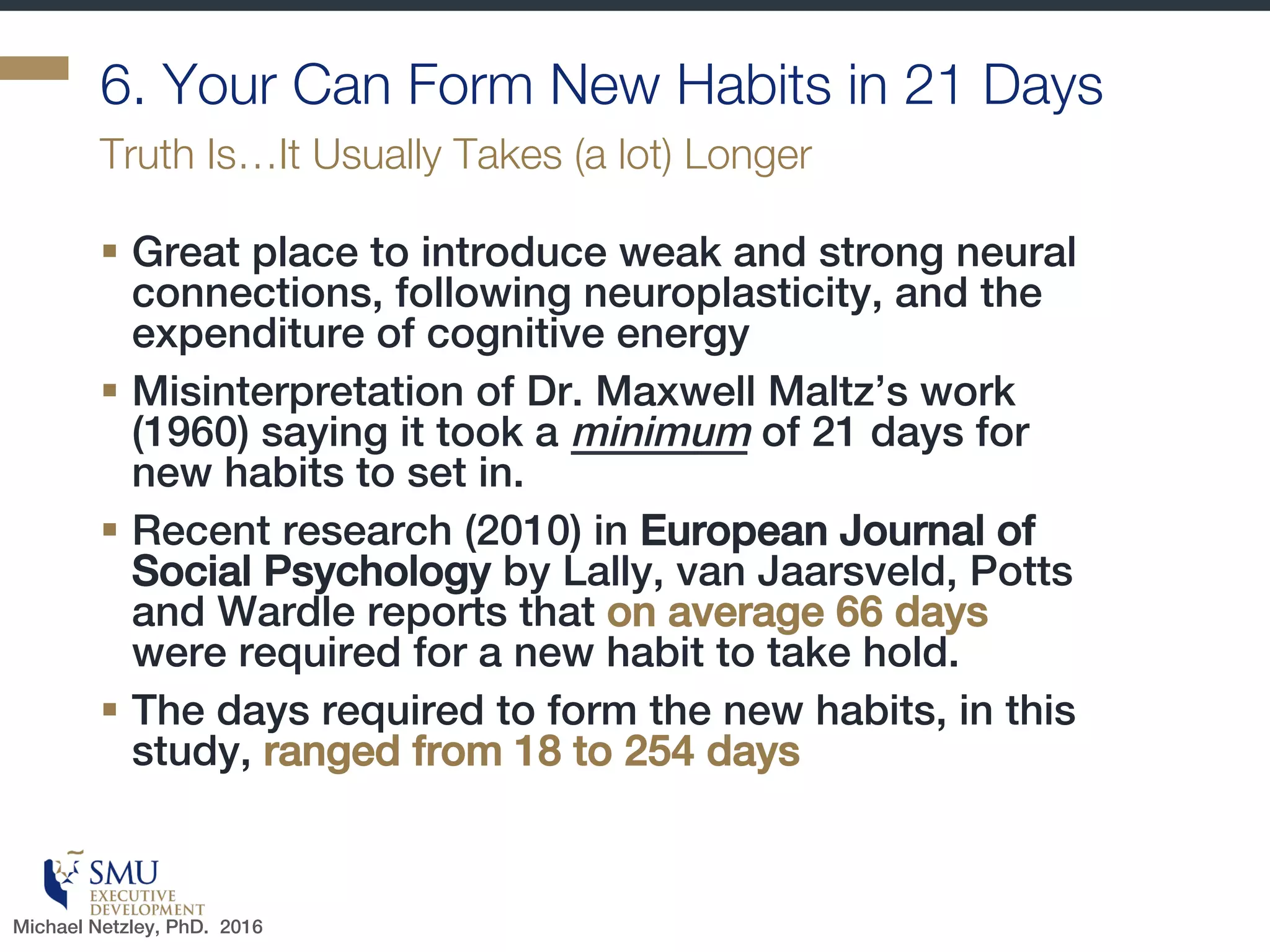
6. New Habits Tale A Bit More Than 21 Days
§ Great place to introduce weak and strong neural
connections, following neuroplasticity, and the
expenditure of cognitive energy
§ Misinterpretation of Dr. Maxwell Maltz’s work
(1960) saying it took a minimum of 21 days for
new habits to set in.
§ Recent research (2010) in European Journal of
Social Psychology by Lally, van Jaarsveld, Potts
and Wardle reports that on average 66 days were
required for a new habit to take hold.
§ The days required to form the new habits, in this
study, ranged from 18 to 254 days
The original research appears to have been misquoted
Michael Netzley, PhD. 2016
Let’s End With Our Quiz Answers
1. True or False: When we refer to our mind, we are referring to
something that is separate from our body.
2. True or False: We make better decisions when we leave
emotion out of it and rely primarily on logic.
3. True or False: People are either “left brained” or “right brained”
(left brain is better for logic and organization while right brain is
better for creativity and intuition) We use both
4. True or False: There are neurochemicals that make us better
leaders (e.g., serotonin and Oxytocin are the brain’s “selfless”
chemicals)
5. True or False: Old dogs cannot learn new tricks.
6. True or False: Medical researchers have proven that new
habits are generally formed in 21 days.
Don’t worry…the answers will follow
Michael Netzley, PhD. 2016
Leading Change
A Final Example For Your Learning Pleasure
Michael Netzley, PhD. 2016
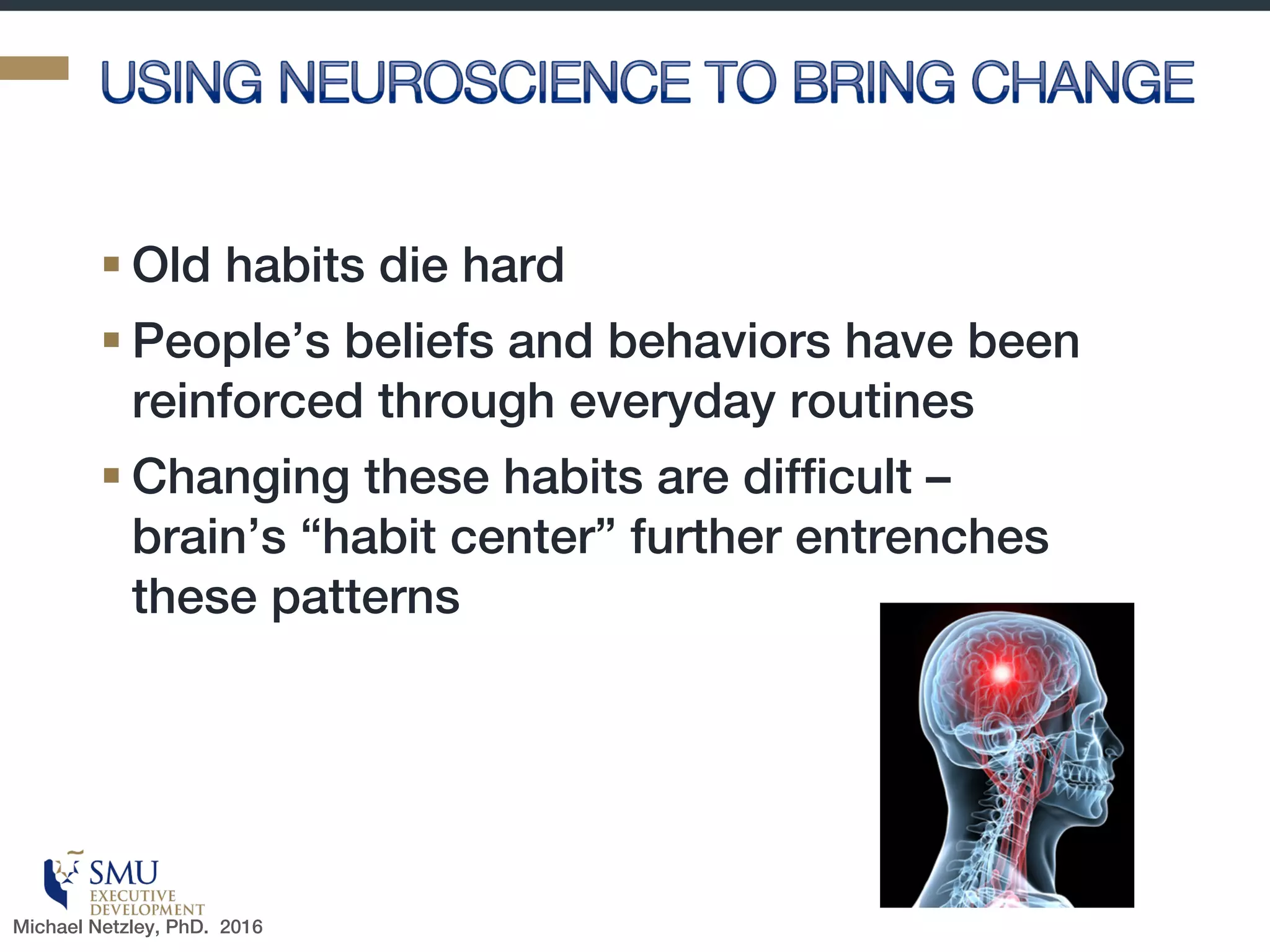
§ Old habits die hard
§ People’s beliefs and behaviors have been
reinforced through everyday routines
§ Changing these habits are difficult – brain’s
“habit center” further entrenches these
patterns
Michael Netzley, PhD. 2016
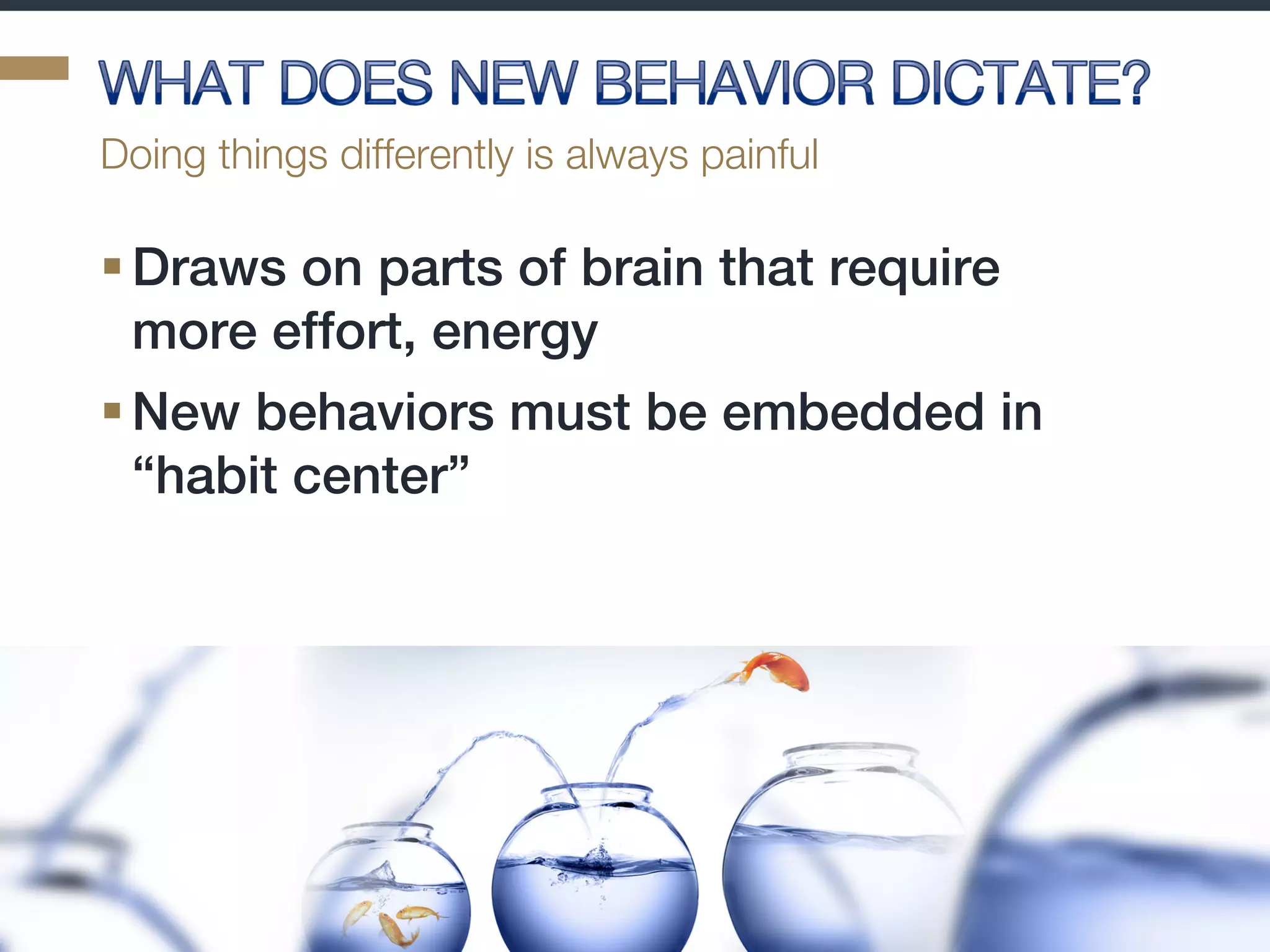
§Draws on parts of brain that require
more effort, energy
§New behaviors must be embedded in
“habit center” through time, intensity,
and repetition.
Requires a tremendous amount of cognitive energy
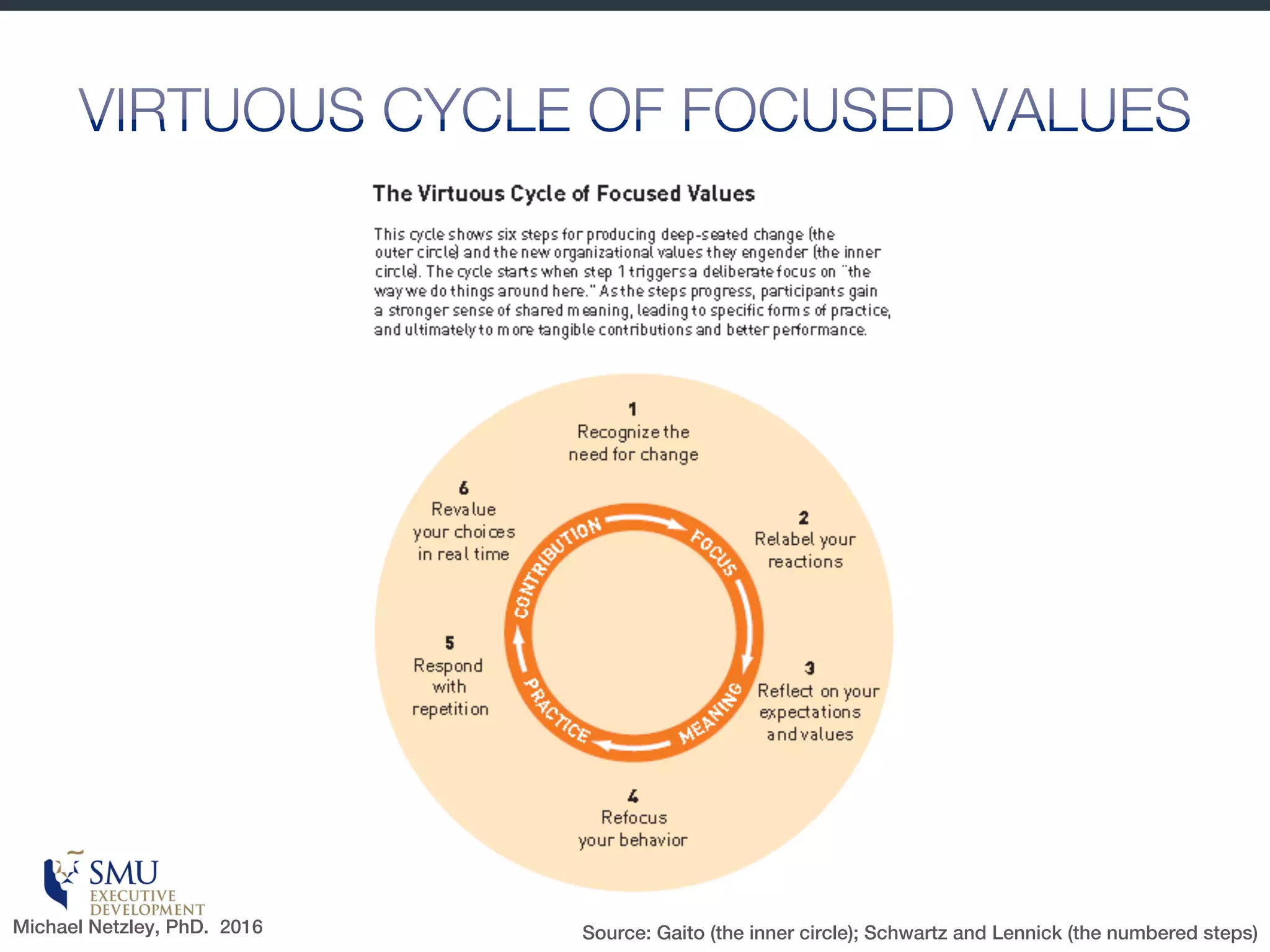
Source: Gaito (the inner circle); Schwartz and Lennick (the numbered steps)Michael Netzley, PhD. 2016
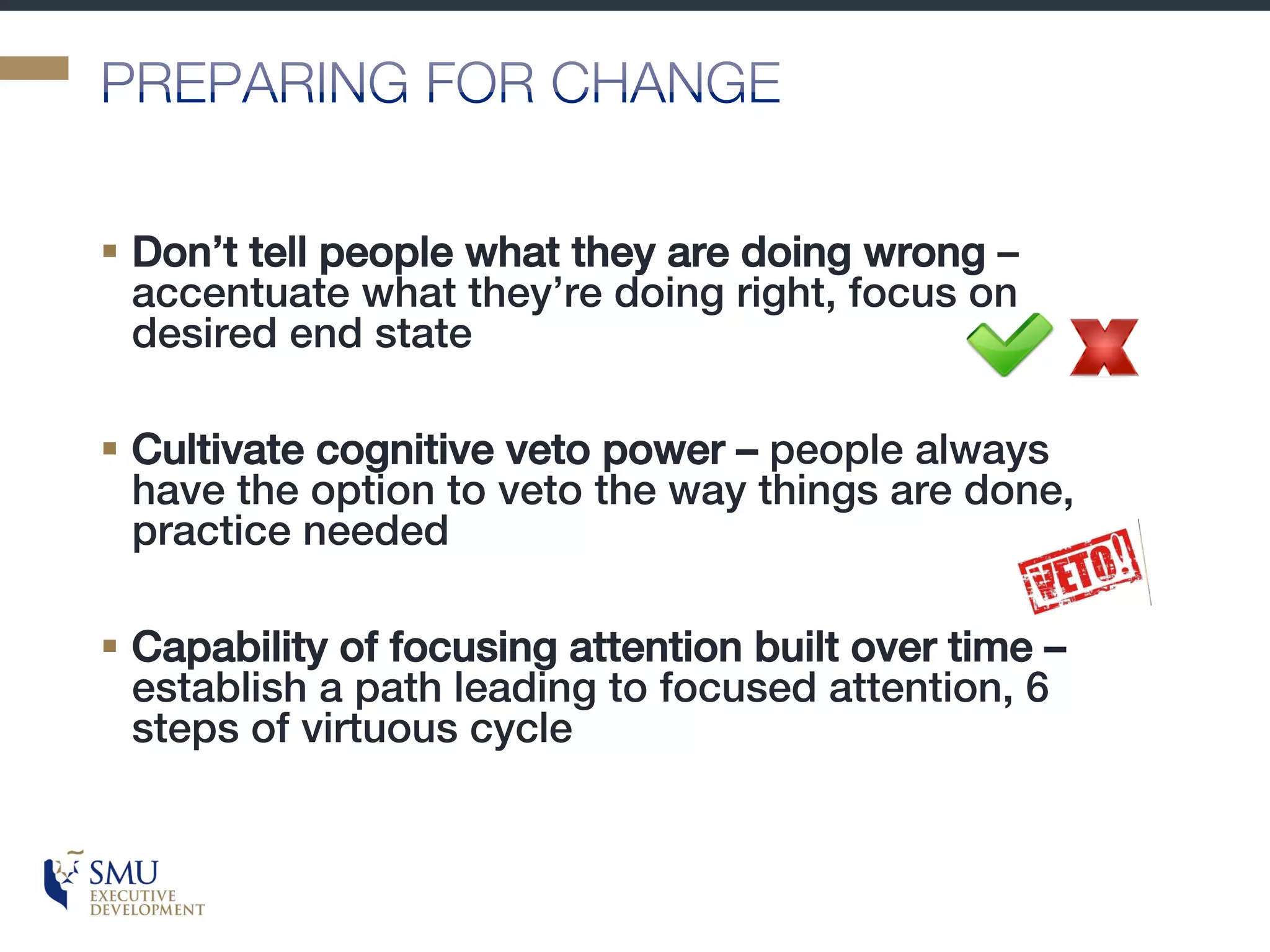
§ Don’t tell people what they are doing wrong –
accentuate what they’re doing right, focus on
desired end state
§ Cultivate cognitive veto power – people always
have the option to veto the way things are done,
practice needed
§ Capability of focusing attention built over time
– establish a path leading to focused attention, 6
steps of virtuous cycle
Michael Netzley, Phd. 2016
How We Talk About Performance Matters
§ By focusing on what is wrong,
we amplify the problem.
§ Wehen building new neural
pathways, we want to instead
amplify the desired behavior.
§ Why amplify the new
behavior? Remember,
neurons that fire together
will wire together.
§ With AI, part of our design is
staying focused on what the
coachee does right.
§ Positive care; the positive
search for what is best in
people.
Like appreciative inquiry (AI), we sometimes focus on the positives
Michael Netzley, Phd. 2016
Michael Netzley, PhD. 2016
Essential Reading
Michael Netzley, PhD. 2016
Bonus Materials
Essential Viewing
§ Charlie Rose Brain Series, multi-part
discussion of the human brain with leading
researchers and a Nobel laureate
(YouTube)
Michael Netzley, PhD. 2016

What every leader can learn from neuroscience 16 march

  • 1.
    Update from the Neurosciences: WhatA Coach Wants to Know Michael A. Netzley, PhD
  • 2.
    § Academic Director,SMU Executive Development § SMU faculty since 2002; 25 years in higher ed § 2011 Champion’s Award, Innovative Course Design and Delivery; 2015 Best Case Study Award Winner, EFMD § Editorial Board, Asian Management Insights § Founding Director, SMU Teaching Excellence Initiative § Author of numerous case studies and 4 books § Visiting positions in Argentina, Berlin, Finland, Slovenia, and Japan § Key clients include Credit Suisse, BNP Paribas, Singapore Airlines , Unilever, IBM, IHG, TCS, 3M, UOB, Singapore’s MFA & MoE, SingHealth, GSK, Bosnalijek Pharmaceutical, Lundbeck Pharmaceutical, Bayer, Schneider Electric, and Sumitomo Chemical. Michael Netzley, Phd. 2016
  • 3.
    Why Do WeCare? Connecting neurosciences to executive development
  • 4.
    Imagine You AreManaging A Computer Lab We know people are different from computers, but just play along…
  • 5.
    Each Computer HasA Different OS Much like people have different personalities, languages, and culture
  • 6.
    Now Apply ThatMetaphor To People Our brains have the same elements, but each is wired differently (we each have a slightly different OS). This is what managers deal with every day—neuroscience helps you succeed across the differences.
  • 7.
    How You CanHelp Using Neurosciences The professional benefits of applied neurosciences
  • 8.
    Optimize Your MentalFlow “Flow” describes our brain’s peak performance when we are completely immersed in an activity
  • 9.
    Build Improved Habits Byunderstanding neuroplasticity and how the brain can be rewired for new tasks and strategic change Michael Netzley, Phd. 2016
  • 10.
    Avoid Unintentionally Steppingon Landmines Neurosciences teaches us how our best intentions can trigger the wrong response—and how you can evoke the desired response Michael Netzley, Phd. 2016
  • 11.
    Master Your CognitiveBiases Michael Netzley, Phd. 2016
  • 12.
    Let’s Begin WithA Little Quiz 1. True or False: When we refer to our mind, we are referring to something that is separate from our body. 2. True or False: We make better decisions when we leave emotion out of it and rely primarily on logic. 3. True or False: People are either “left brained” or “right brained” (left brain is better for logic and organization while right brain is better for creativity and intuition) 4. True or False: There are neurochemicals that make us better leaders (e.g., serotonin and Oxytocin are the brain’s “selfless” chemicals) 5. True or False: Old dogs cannot learn new tricks. 6. True or False: Medical researchers have proven that new habits are generally formed in 21 days. Don’t worry…the answers will follow Michael Netzley, PhD. 2016
  • 13.
    Leadership How do theneurosciences add to our understanding of leadership? Michael Netzley, PhD. 2016
  • 14.
    “ Traditional leadership (and executive,and coaching…) development has largely focused on what could be seen; the brain’s activity was either estimated or simply ignored
  • 15.
    Today, We CanLiterally See What Goes On Inside The Brain § So what happens when you question a coachee’s performance or sign the contract for an exciting new gig? § We can now see a part of the equation—the brain activity—that has mostly been excluded from our understanding We can now see the brain’s operations in real time Michael Netzley, PhD. 2016
  • 16.
    Motivating An example ofseeing something that was previously not visible Michael Netzley, PhD. 2016
  • 17.
    Threat and RewardResponse § The Negative Emotional Feel § Pain § Attention retracted § Mental blockages § The Positive Felt Reward § Pleasure § Attention given § Mental activity “flows” Neuroscientists say we should start here Michael Netzley, PhD. 2016
  • 18.
    Social vs PhysicalBrain Where both reside in the brain Michael Netzley, PhD. 2016
  • 19.
    SCARF § Status § Certainty §Autonomy § Relatedness § Fairness What did neuroscientists discover about motivation? Michael Netzley, PhD. 2016
  • 20.
    Status § When weperceive an encounter might diminish our status § Threat response kicks in § Cortisol is released into the brain § Cortisol production is stress-related § Corporate values and culture strongly impacts our status comparisons Humans assess the rise and fall of social status Michael Netzley, PhD. 2016
  • 21.
    Certainty § Familiarity shiftsthe brain to autopilot § We use established neural pathways § This saves energy- is very efficient § Can do 2 things at once – talk and drive § Variation: mild uncertainty can attract interest § How can managers build certainty? § Link to self-efficacy Ambiguity or confusion triggers the threat response Michael Netzley, PhD. 2016
  • 22.
    Autonomy § Reduced autonomy— e.g.,micromanaging— can induce the threat response § Perceived lack of control can increase stress (cortisol is released) § Greater scope to make own choices leads to better perceptions of work life balance (regardless of factual hours worked) Can I exercise my decisions without too much oversight? Michael Netzley, PhD. 2016
  • 23.
    Relatedness § In thebrain, trust and empathy toward others is shaped by whether they are perceived to be part of the same social group § Meet someone new = brain “friend or foe” decision § As we become friends, brain releases oxytocin (linked to affection, generosity, maternal instinct) § Threats of loneliness or isolation can flood the brain with neurochemicals identical to when we feel physical pain Fruitful collaboration depends on healthy relationships Michael Netzley, PhD. 2016
  • 24.
    Fairness § In studies,perceptions of fairness have brain responses similar to eating chocolate § Motivator is so strong that some are willing to fight and die over fairness § Without it, trust and collaboration cannot flourish Perceived fairness is relative, but also an important “glue” Michael Netzley, PhD. 2016
  • 25.
    “ We now havereason to believe that economic incentives are only effective when people perceive them as supporting their social needs… - David Rock, 2009 Michael Netzley, PhD. 2016
  • 26.
    “ If you area leader, every action you take and decision you make either supports or undermines SCARF… - David Rock, 2009 Michael Netzley, PhD. 2016
  • 27.
  • 28.
    The Frontal Lobes §Historically we did not pay a lot of attention to the frontal lobes. § Today we know they are the orchestra’s conductor § Essential to reasoning, planning ahead, etc The orchestra’s conductor – where executive functions are performed Michael Netzley, PhD. 2016
  • 29.
    Why Focus onthe Executive’s Brain? § Achilles and the Myrmidon warriors § Historically leaders inspired courage with front line fighting, as did Achilles § Today they lead from the balcony; overseeing § The key assumption is that this specific type of executive role—from the balcony—will make the team/troops better § Today’s CEO typically displays such leadership, as does the conductor of the orchestra. The CEO does not manufacture the goods or deliver the actual services anymore than the conductor makes the music. Look at how the role of the executive has evolved Michael Netzley, PhD. 2016
  • 30.
    “ The function ofleadership acquires a distinct status and becomes separate only when the size and complexity of the organization crosses a certain threshold. - Elkhonon Goldberg, The Executive Brain Michael Netzley, PhD. 2016
  • 31.
    Myths and Mistakes AboutYour Brain Michael Netzley, PhD. 2016
  • 32.
    1. Descartes’ ContinuingInfluence “I think, therefore I am” This statement implies that thinking is the real substance of being; it celebrates the mind-body distinction Renee Descartes (1596 – 1650) Michael Netzley, PhD. 2016
  • 33.
    Descartes’ Mind-Body Distinction Mind §Software § A mental event (there is no physical structure called the mind) § “The mind is willing…” Body § Hardware § A physical event (we do have a physical body that can be studied) § “…but the body is unable” (as an aging athlete might say). Michael Netzley, PhD. 2016
  • 34.
    1. Descartes’ Error Mindand Body are Inextricably Connected to Each Other Michael Netzley, PhD. 2016
  • 35.
    “ “Descartes’ Error…. Specifically, [was]the separation of the most refined operations of the mind from the structure and operations of a biological organism.” - Antonio Damasio, author and neuroscientist Michael Netzley, PhD. 2016
  • 36.
  • 37.
    Here is WhyYou Should Care! § Researchers are already helping us—managers, coaches, and everyday people—maximize the benefits that come from leveraging on the mind-body connection. § “presence,” the state in which we stop worrying about the impression we’re making on others and instead adjust the impression we’ve been making on ourselves….we need to nudge ourselves, moment by moment, by tweaking our body language, behavior, and mind-set in our day-to-day lives. The mind-body connection has potentially powerful benefits Source: http://amycuddy.com/presence/Michael Netzley, Phd. 2016
  • 38.
    2. Emotion vRationality Can Be a False Choice Michael Netzley, PhD. 2016
  • 39.
    “ Reduction inemotion may constitute an equally important source of irrational behavior. - Antonio Damasio, author and neuroscientist Michael Netzley, PhD. 2016
  • 40.
    3. Left Brainversus Right Brain § Traditionally, we describe the left brain as the scientific and logical half § More recently, Dr. Elkhonon Goldberg argues that the left is for routine activity § Well trodden § And the right brain is described as the creative and innovative half § Dr. Elkhonon suggests the right side processes novel activities § Exploratory The latest insights offer a slightly different theory… Michael Netzley, PhD. 2016
  • 41.
    4. Neurochemicals andLeadership Unfortunately, a complete overstatement in the popular press Michael Netzley, PhD. 2016
  • 42.
    “ [Neurochemicals] are partof an exceedingly complicated mechanism which operates at the level of molecules, synapses, local circuits, and and systems, and in which sociocultural factors…intervene powerfully. A satisfactory explanation can arise only from a more comprehensive view. - Antonio Damasio, author and neuroscientist Michael Netzley, PhD. 2016
  • 43.
    5. Old DogsCan Learn New Tricks Fortunately, Neuroplasticity Gives Us Hope Neuroplasticity refers to changes in your brain’s synapses and pathways that result from changes in behavior, thinking or emotion. Michael Netzley, PhD. 2016
  • 44.
    6. New HabitsTale A Bit More Than 21 Days § Great place to introduce weak and strong neural connections, following neuroplasticity, and the expenditure of cognitive energy § Misinterpretation of Dr. Maxwell Maltz’s work (1960) saying it took a minimum of 21 days for new habits to set in. § Recent research (2010) in European Journal of Social Psychology by Lally, van Jaarsveld, Potts and Wardle reports that on average 66 days were required for a new habit to take hold. § The days required to form the new habits, in this study, ranged from 18 to 254 days The original research appears to have been misquoted Michael Netzley, PhD. 2016
  • 45.
    Let’s End WithOur Quiz Answers 1. True or False: When we refer to our mind, we are referring to something that is separate from our body. 2. True or False: We make better decisions when we leave emotion out of it and rely primarily on logic. 3. True or False: People are either “left brained” or “right brained” (left brain is better for logic and organization while right brain is better for creativity and intuition) We use both 4. True or False: There are neurochemicals that make us better leaders (e.g., serotonin and Oxytocin are the brain’s “selfless” chemicals) 5. True or False: Old dogs cannot learn new tricks. 6. True or False: Medical researchers have proven that new habits are generally formed in 21 days. Don’t worry…the answers will follow Michael Netzley, PhD. 2016
  • 46.
    Leading Change A FinalExample For Your Learning Pleasure Michael Netzley, PhD. 2016
  • 47.
    § Old habitsdie hard § People’s beliefs and behaviors have been reinforced through everyday routines § Changing these habits are difficult – brain’s “habit center” further entrenches these patterns Michael Netzley, PhD. 2016
  • 48.
    §Draws on partsof brain that require more effort, energy §New behaviors must be embedded in “habit center” through time, intensity, and repetition. Requires a tremendous amount of cognitive energy
  • 49.
    Source: Gaito (theinner circle); Schwartz and Lennick (the numbered steps)Michael Netzley, PhD. 2016
  • 50.
    § Don’t tellpeople what they are doing wrong – accentuate what they’re doing right, focus on desired end state § Cultivate cognitive veto power – people always have the option to veto the way things are done, practice needed § Capability of focusing attention built over time – establish a path leading to focused attention, 6 steps of virtuous cycle Michael Netzley, Phd. 2016
  • 51.
    How We TalkAbout Performance Matters § By focusing on what is wrong, we amplify the problem. § Wehen building new neural pathways, we want to instead amplify the desired behavior. § Why amplify the new behavior? Remember, neurons that fire together will wire together. § With AI, part of our design is staying focused on what the coachee does right. § Positive care; the positive search for what is best in people. Like appreciative inquiry (AI), we sometimes focus on the positives Michael Netzley, Phd. 2016
  • 52.
  • 53.
  • 54.
  • 55.
    Essential Viewing § CharlieRose Brain Series, multi-part discussion of the human brain with leading researchers and a Nobel laureate (YouTube) Michael Netzley, PhD. 2016