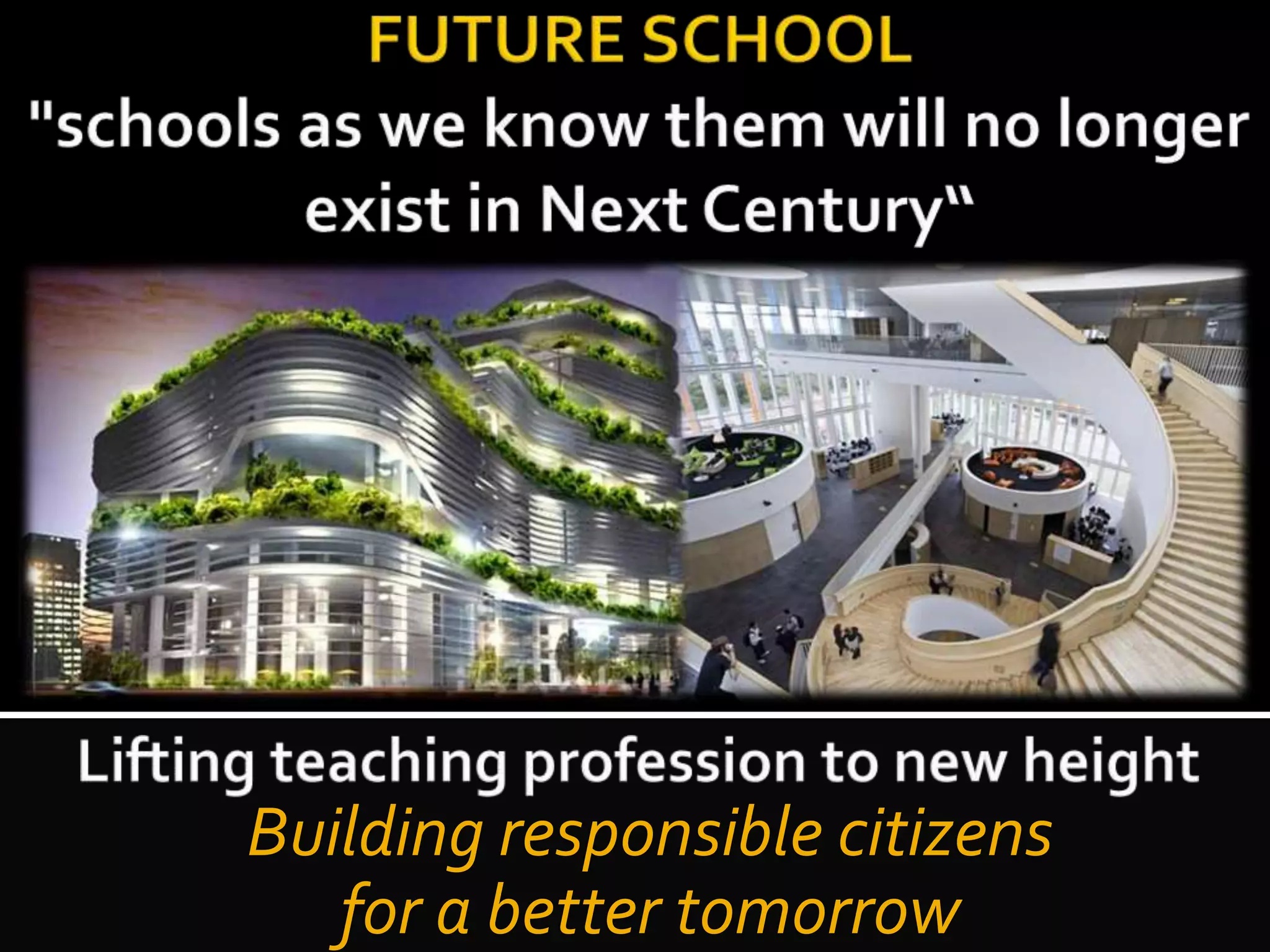
Building responsible citizens 
for a better tomorrow
Changes in Society 
What do Employers Want? 
21st Century Graduate Attributes 
What will you Do as an Educator? 
2
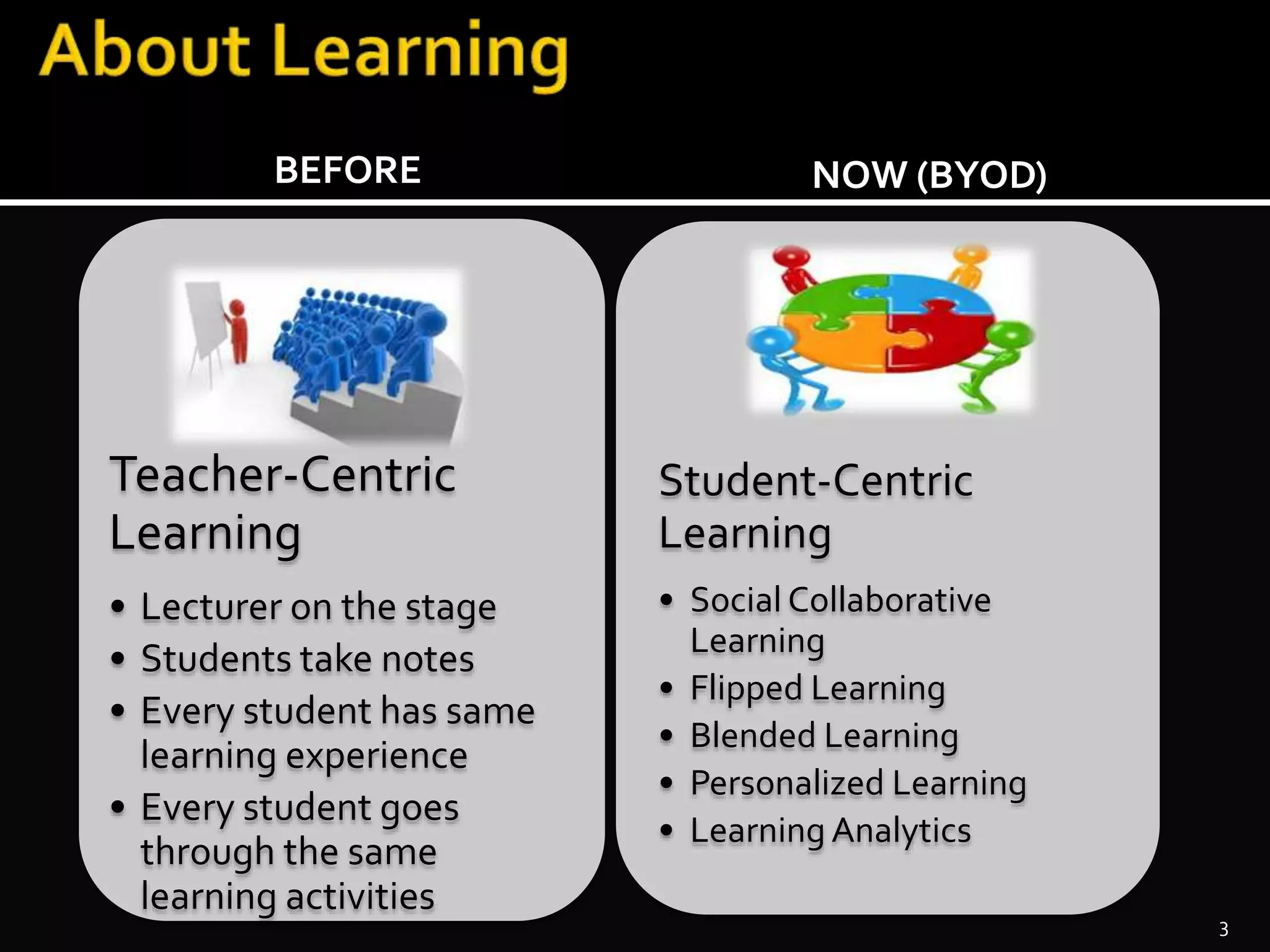
Teacher-Centric 
Learning 
• Lecturer on the stage 
• Students take notes 
• Every student has same 
learning experience 
• Every student goes 
through the same 
learning activities 
Student-Centric 
Learning 
• Social Collaborative 
Learning 
• Flipped Learning 
• Blended Learning 
• Personalized Learning 
• Learning Analytics 
3 
BEFORE NOW (BYOD)
 To predict the next 100 years, just recollect the people 
of 1900 had in predicting the world of 2000. We could 
show them rockets that can explore the moon and 
planets, MRI scanners that can peer inside the living 
body and cell phones that can put us in touch with 
anyone on the planet and can send moving images 
and messages instantly across the continents. Anyone, 
anywhere, anytime able to talk, write and send audio 
and visual to anyone else. Today, if we could somehow 
visit our ancestors and show them the gift of modern 
science and technology, we would be viewed as 
magicians.
 Predictions for the future, with a few exceptions, 
have always underestimated the pace of 
technological progress. Today, we have become 
choreographers of the dance of nature, able to 
tweak the laws of nature here and there. But by 
2100, we will make the transition to being masters 
of nature. By 2100, our destiny is to become like 
the Gods we once worshipped and feared.
1890 2010 
120 years 
apart 
9/11/2014 7
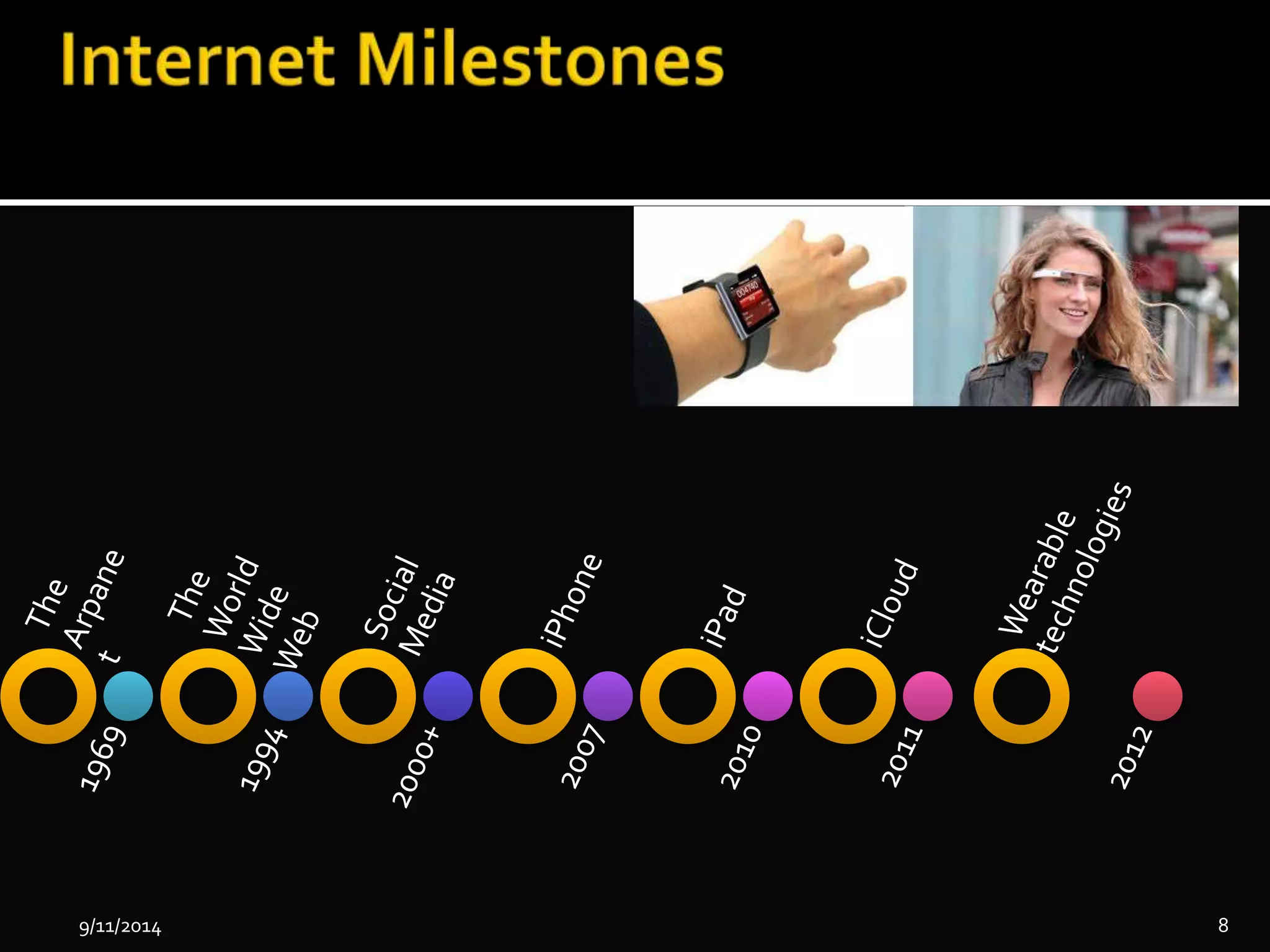
9/11/2014 8
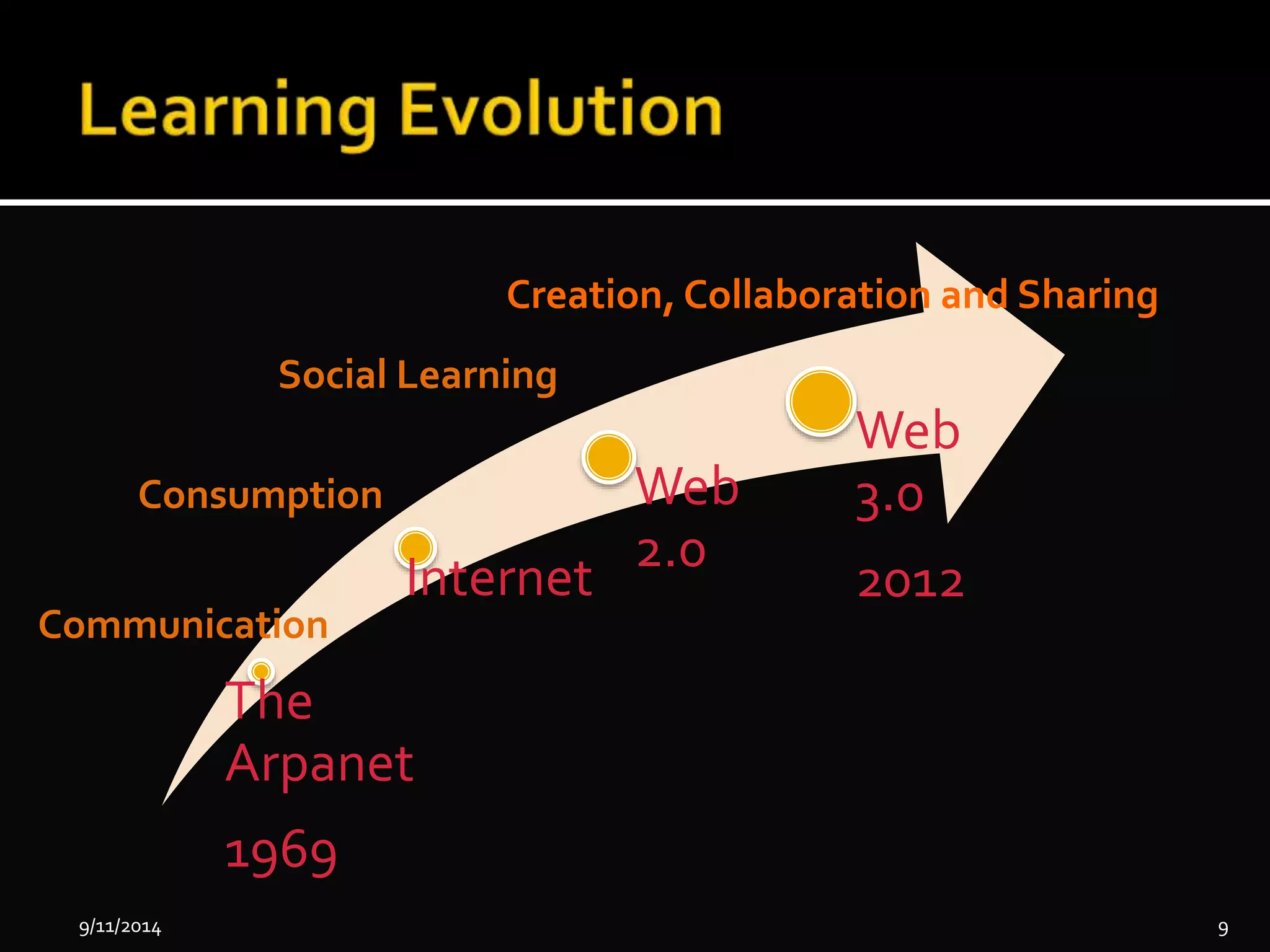
Creation, Collaboration and Sharing 
Social Learning 
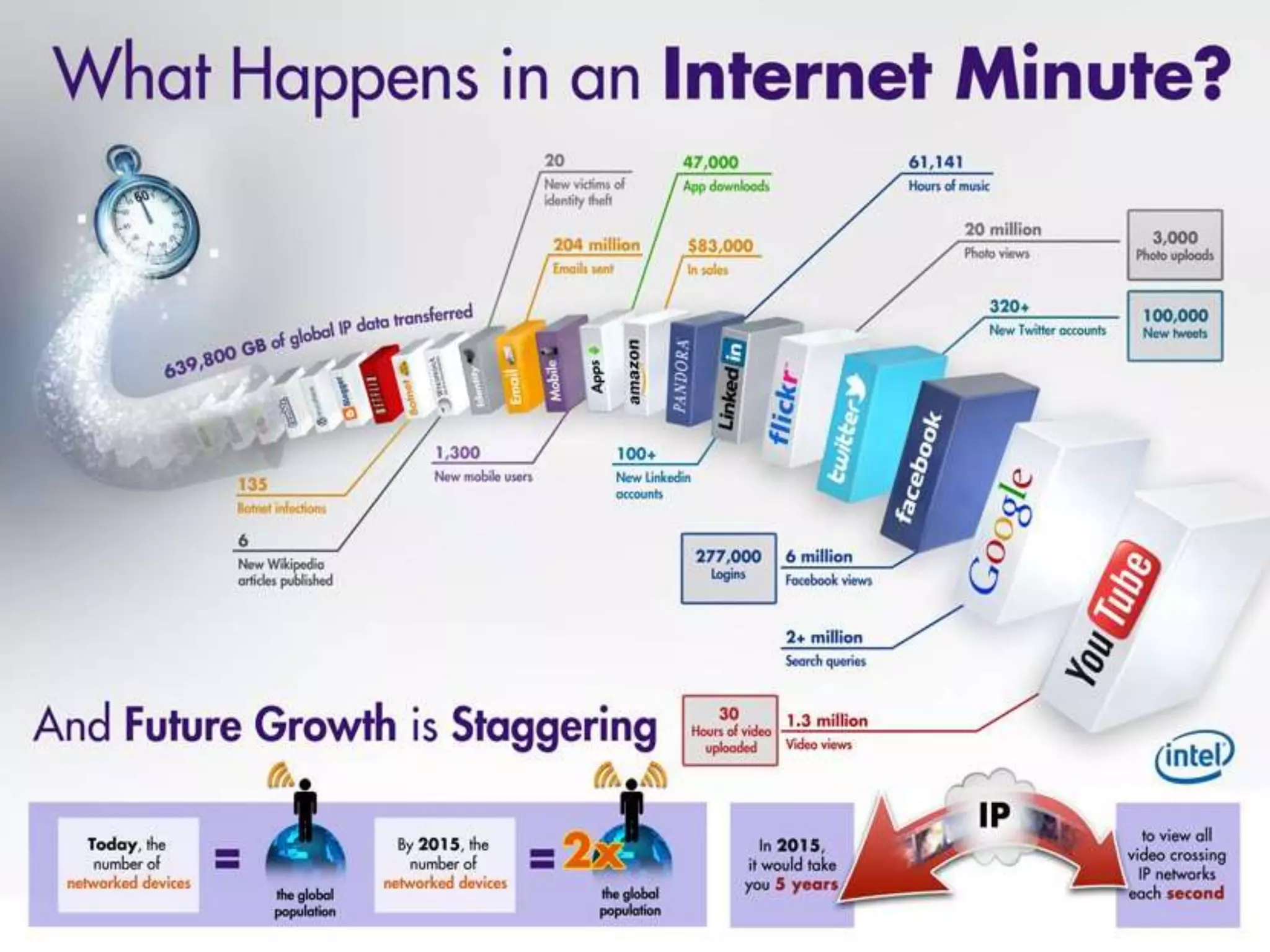
Internet 
Consumption 
Communication 
The 
Arpanet 
1969 
Web 
2.0 
Web 
3.0 
2012 
9/11/2014 9
Film 
(1940s) 
Televisio 
n (1950s) 
Programmed 
Instruction 
(1960s) 
Systematic 
Instructiona 
l Design 
(1970s) 
Computers 
(1980s) 
The 
Internet 
(1990s) 
Social 
Networks 
and Web 
2.0 
(2000s) 
Smart 
Phones 
(2003 - ) 
& Tablets 
(2010 - ) 
9/11/2014 Zoraini Wati Abas 11
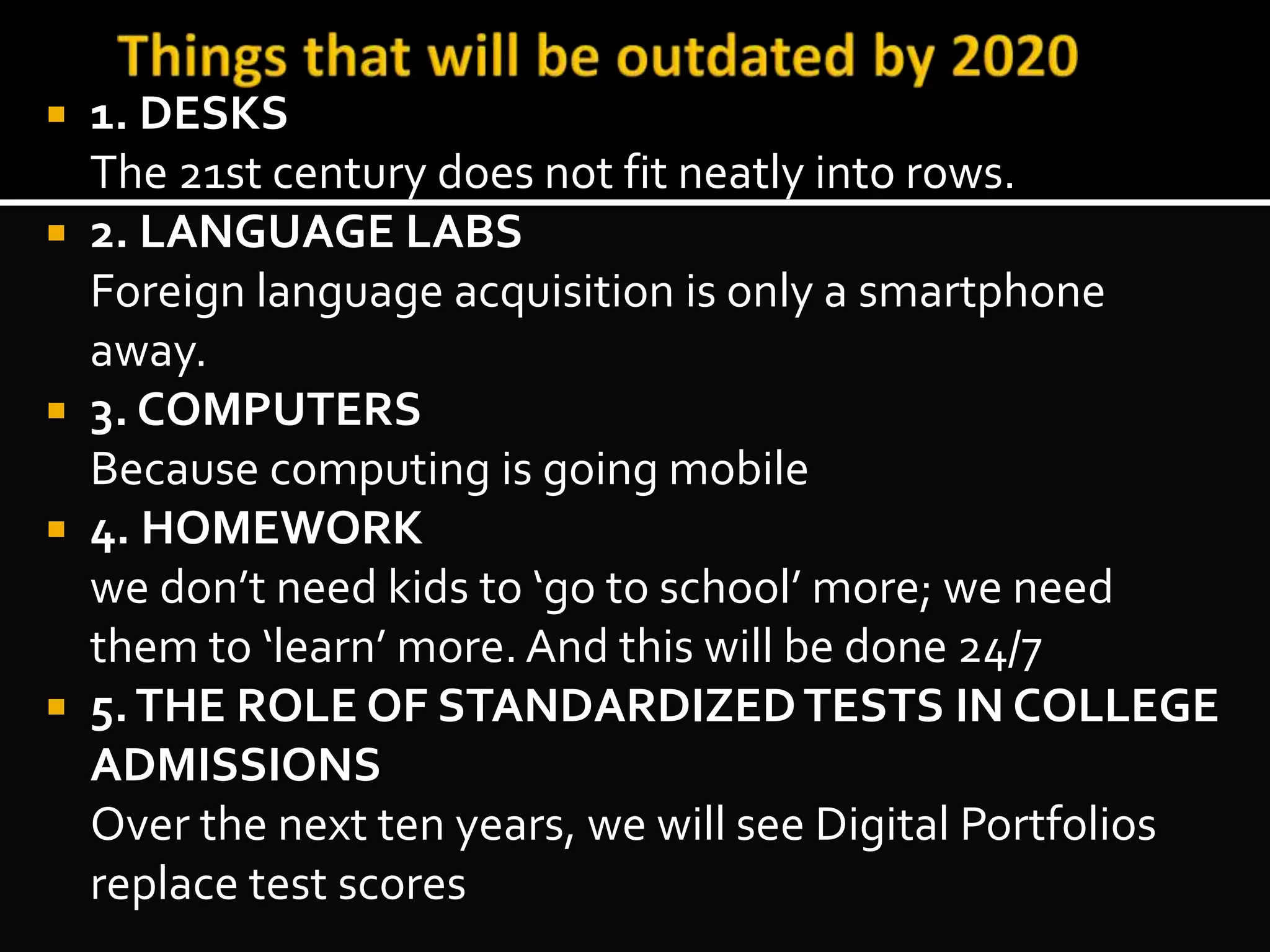
 1. DESKS 
The 21st century does not fit neatly into rows. 
 2. LANGUAGE LABS 
Foreign language acquisition is only a smartphone 
away. 
 3. COMPUTERS 
Because computing is going mobile 
 4. HOMEWORK 
we don’t need kids to ‘go to school’ more; we need 
them to ‘learn’ more. And this will be done 24/7 
 5. THE ROLE OF STANDARDIZED TESTS IN COLLEGE 
ADMISSIONS 
Over the next ten years, we will see Digital Portfolios 
replace test scores
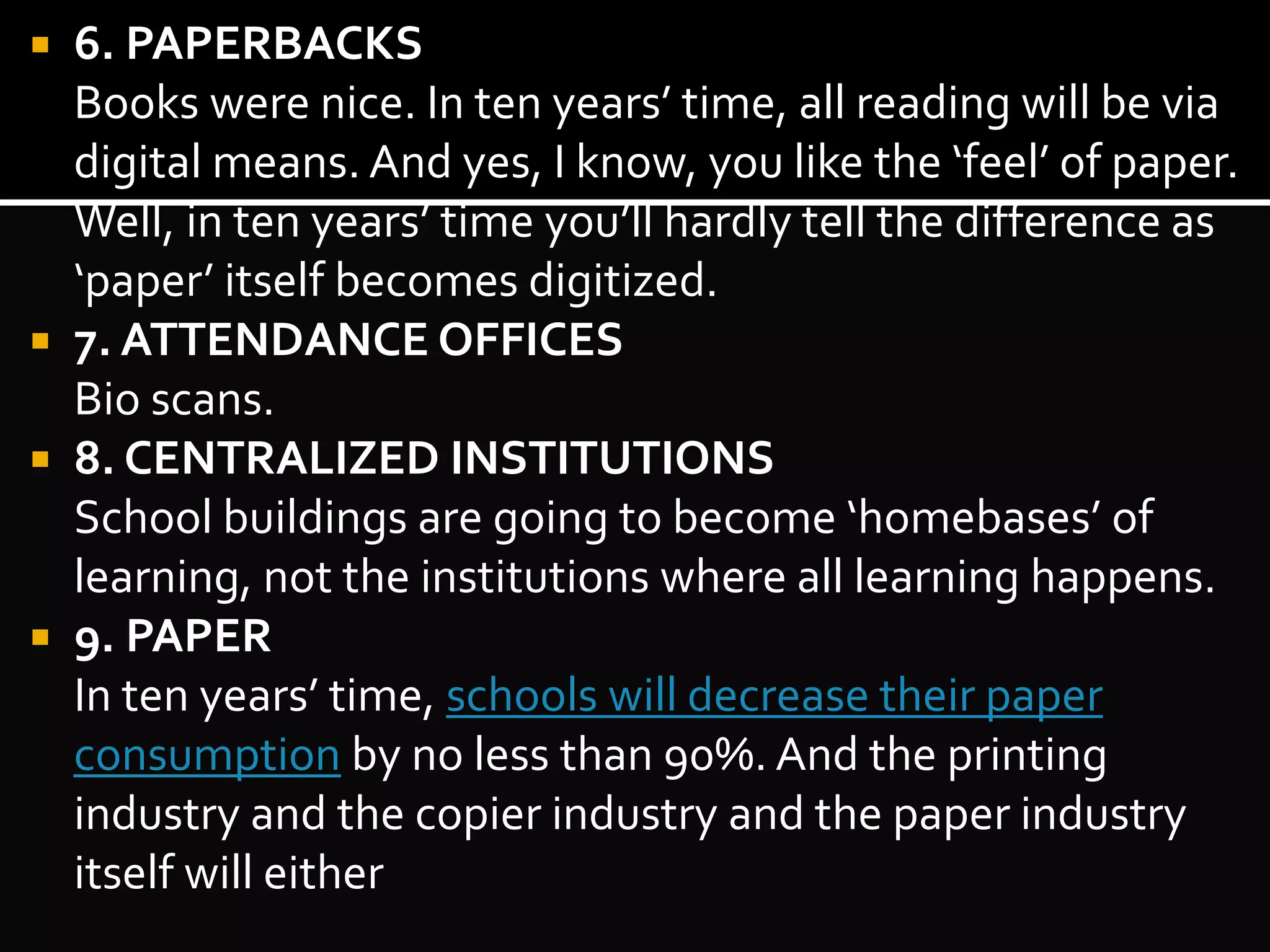
 6. PAPERBACKS 
Books were nice. In ten years’ time, all reading will be via 
digital means. And yes, I know, you like the ‘feel’ of paper. 
Well, in ten years’ time you’ll hardly tell the difference as 
‘paper’ itself becomes digitized. 
 7. ATTENDANCE OFFICES 
Bio scans. 
 8. CENTRALIZED INSTITUTIONS 
School buildings are going to become ‘homebases’ of 
learning, not the institutions where all learning happens. 
 9. PAPER 
In ten years’ time, schools will decrease their paper 
consumption by no less than 90%. And the printing 
industry and the copier industry and the paper industry 
itself will either
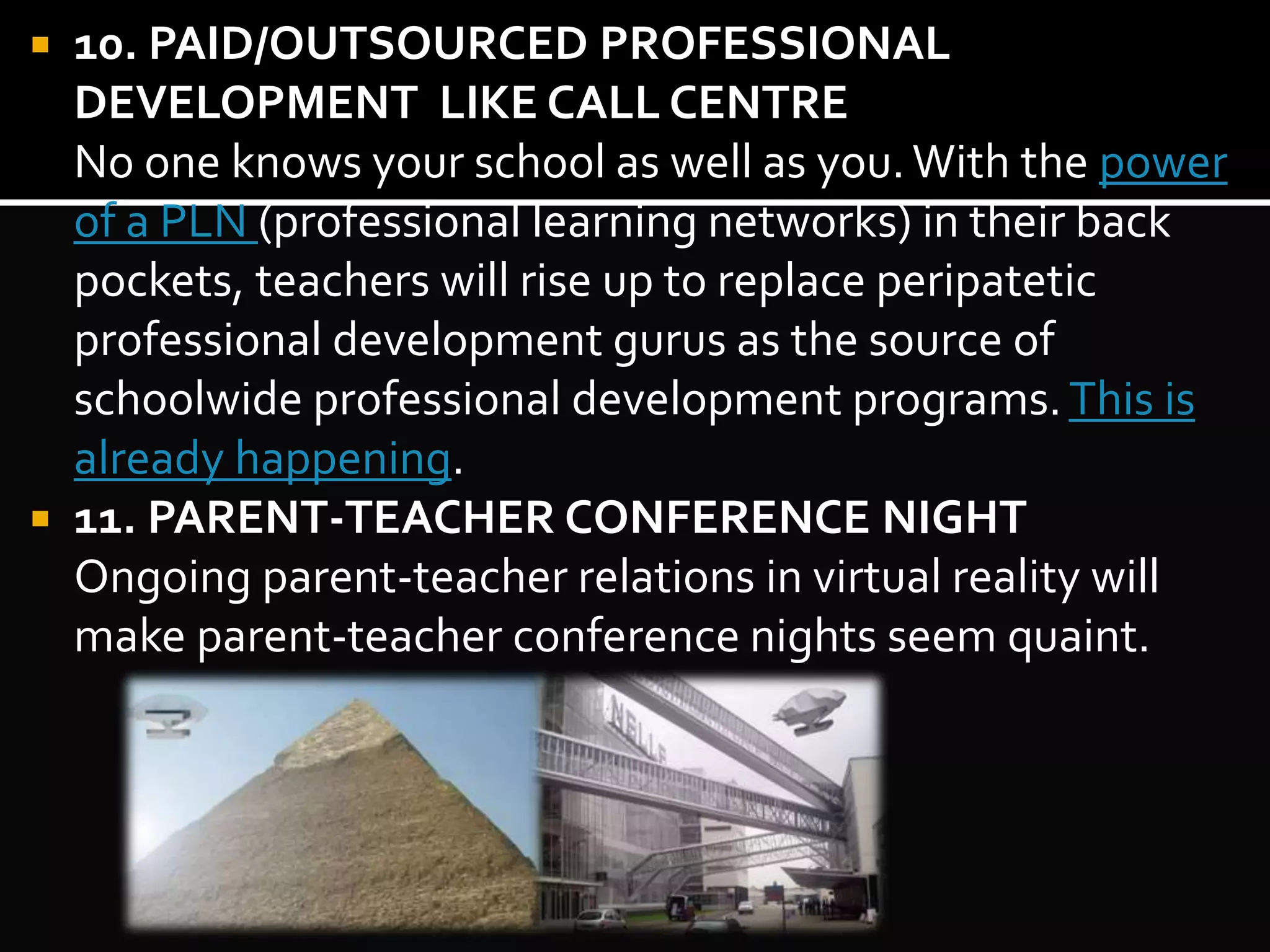
 10. PAID/OUTSOURCED PROFESSIONAL 
DEVELOPMENT LIKE CALL CENTRE 
No one knows your school as well as you. With the power 
of a PLN (professional learning networks) in their back 
pockets, teachers will rise up to replace peripatetic 
professional development gurus as the source of 
schoolwide professional development programs. This is 
already happening. 
 11. PARENT-TEACHER CONFERENCE NIGHT 
Ongoing parent-teacher relations in virtual reality will 
make parent-teacher conference nights seem quaint.
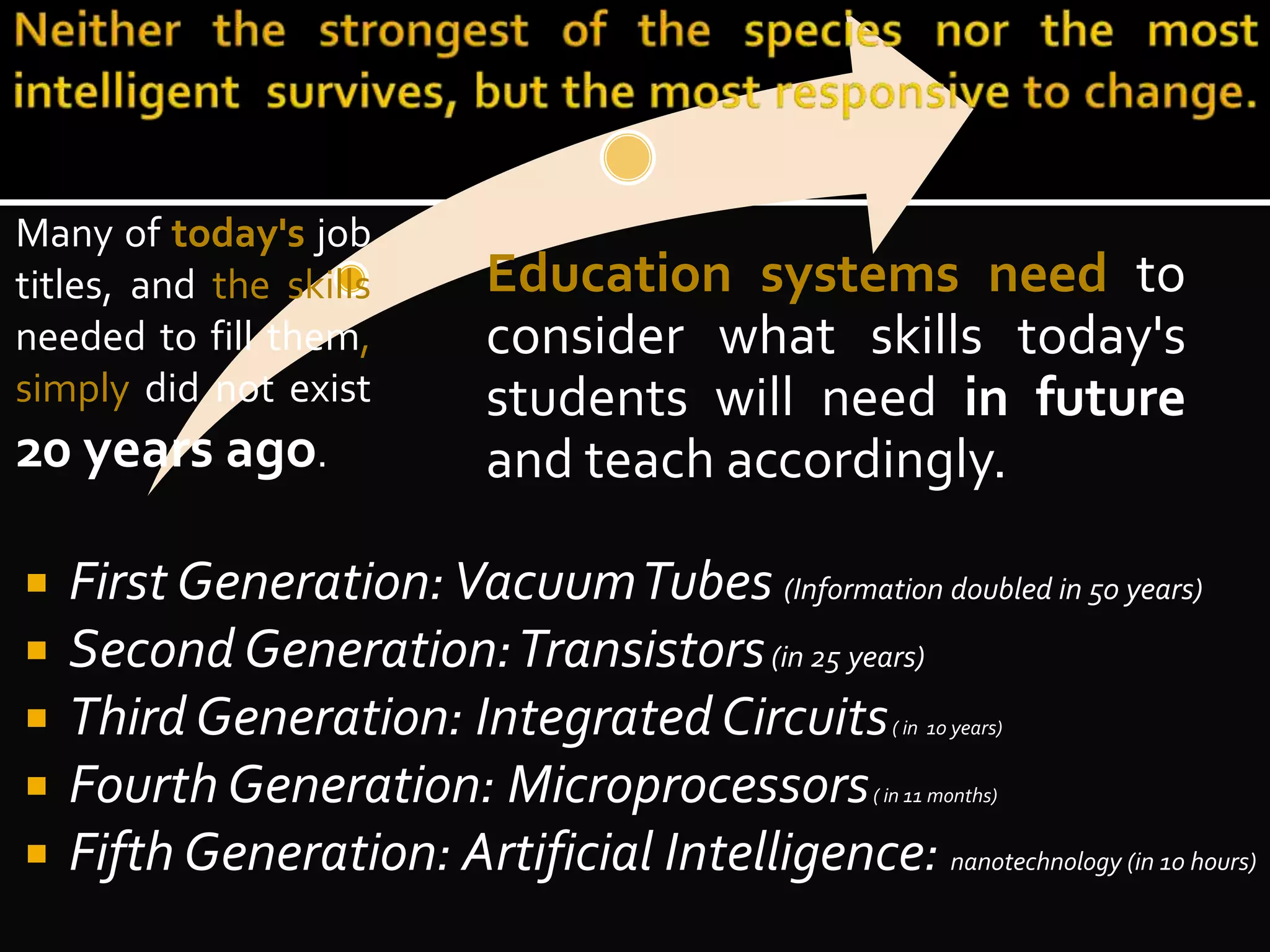
Many of today's job 
titles, and the skills 
needed to fill them, 
simply did not exist 
20 years ago. 
Education systems need to 
consider what skills today's 
students will need in future 
and teach accordingly. 
 First Generation:VacuumTubes (Information doubled in 50 years) 
 Second Generation:Transistors (in 25 years) 
 Third Generation: Integrated Circuits( in 10 years) 
 Fourth Generation: Microprocessors( in 11 months) 
 Fifth Generation: Artificial Intelligence: nanotechnology (in 10 hours)
●2015 – 3 years from now (in VI years last 3 years papers back) 
●2020 – 8 years from now (XII degree) 
●2025 - 2012/2013 Kindergarteners Graduate 
●2035 – Class of 2025 10 year reunion/ 5-6 year out of college 
●2045 – 2012/2013 Kindergarteners are in late 30’s to early 
40’s. 
●2070 – 2012/13 Kindergarteners are reaching retirement 
age at 67
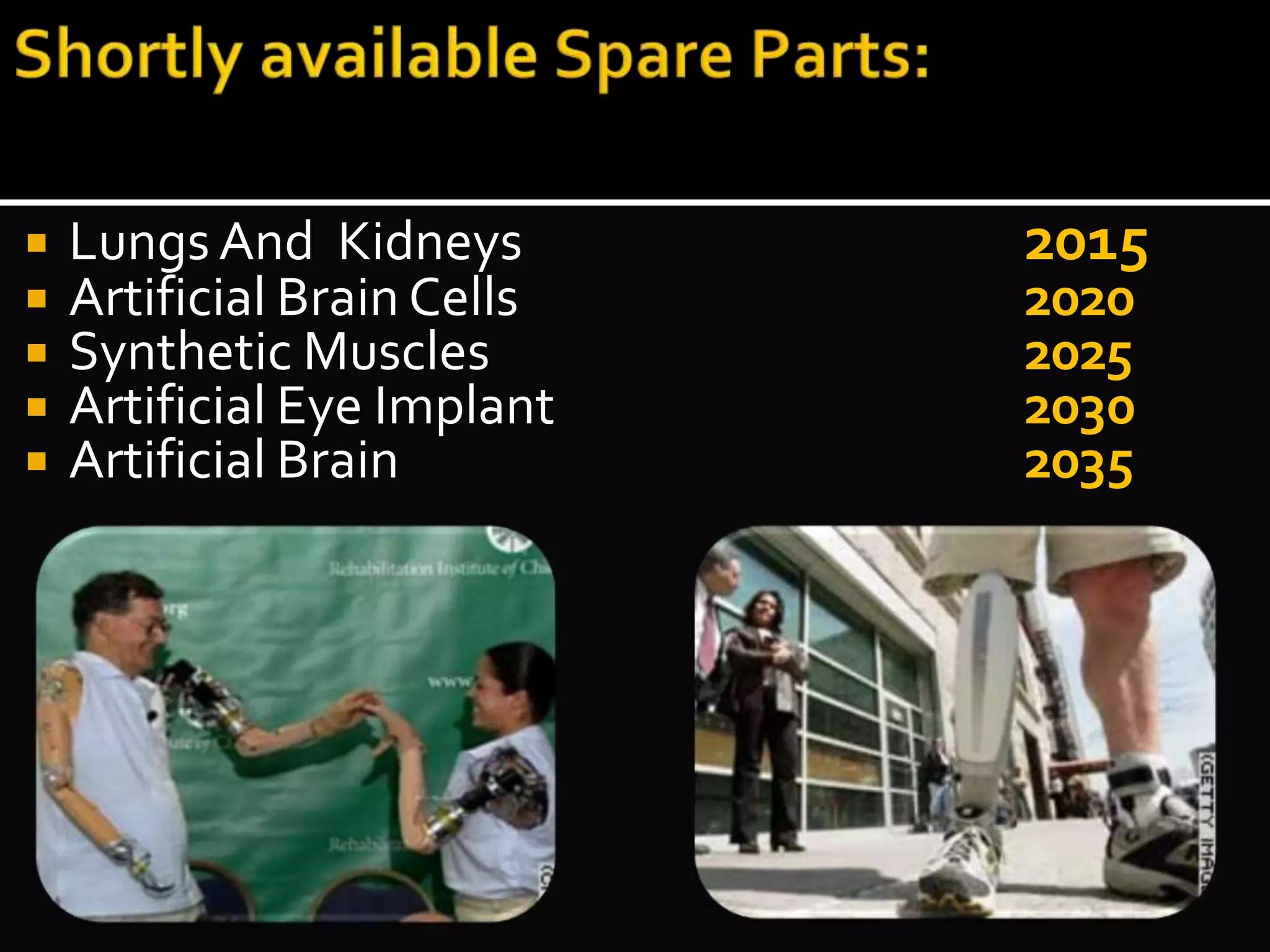
 Lungs And Kidneys 2015 
 Artificial Brain Cells 2020 
 Synthetic Muscles 2025 
 Artificial Eye Implant 2030 
 Artificial Brain 2035
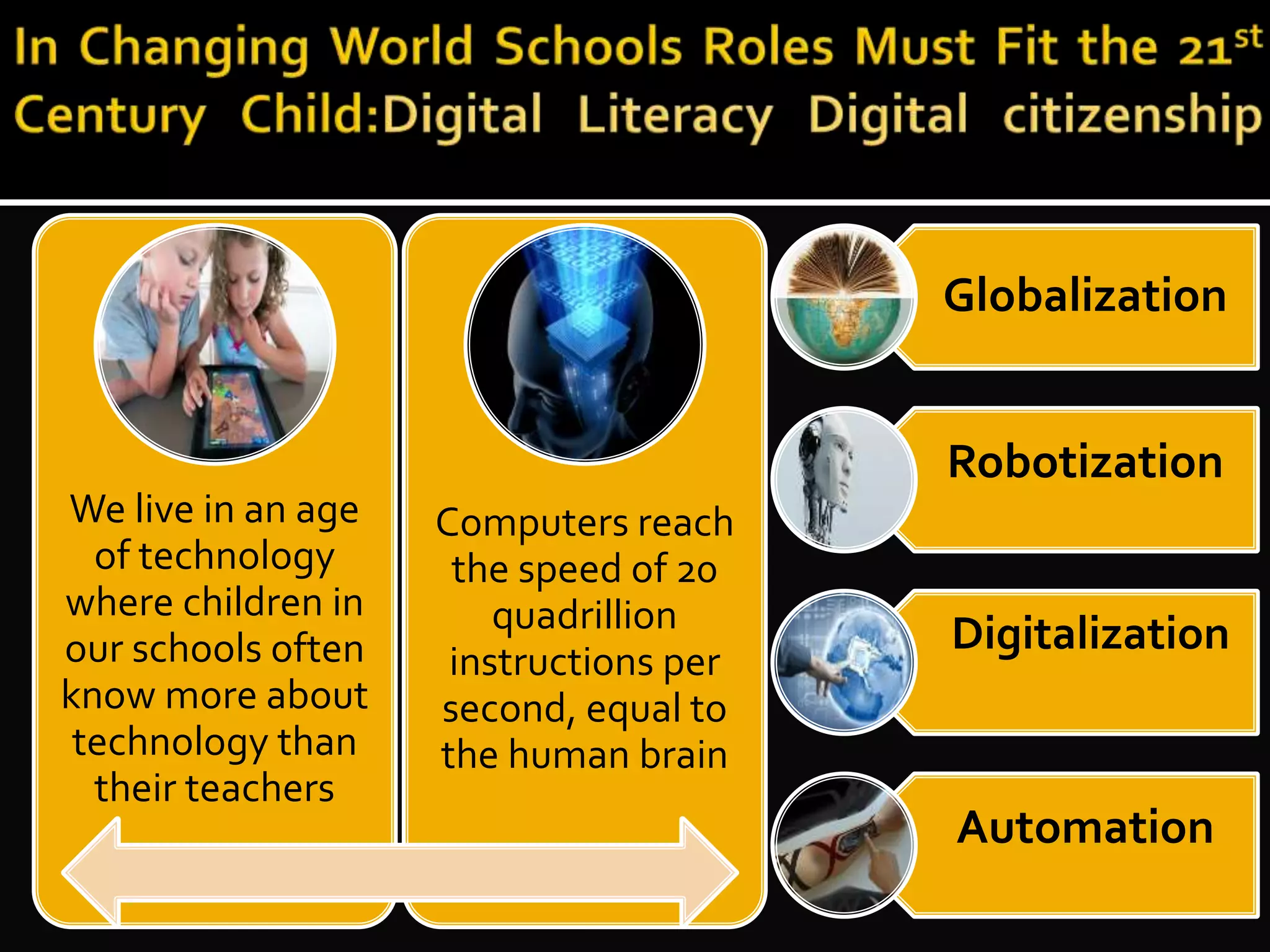
We live in an age 
of technology 
where children in 
our schools often 
know more about 
technology than 
their teachers 
Computers reach 
the speed of 20 
quadrillion 
instructions per 
second, equal to 
the human brain 
Globalization 
Robotization 
Digitalization 
Automation
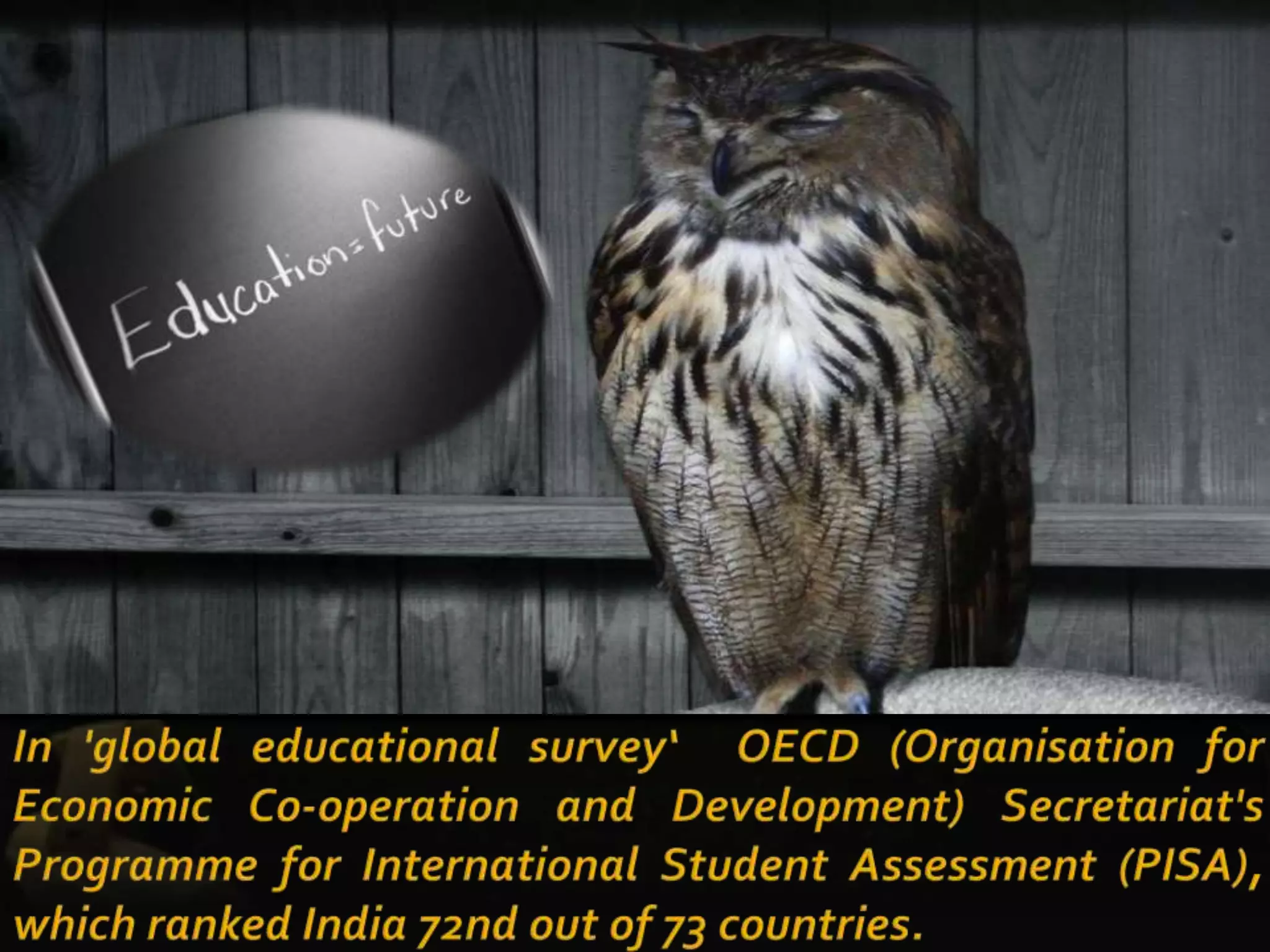
 In the second most populous nation on 
the planet, with the second biggest 
educational system in the world The 
number of years a person has spent in 
school is a dismal 4.4 years for India as 
compared to global average of 7.4 and 
4.6 for South Asia.
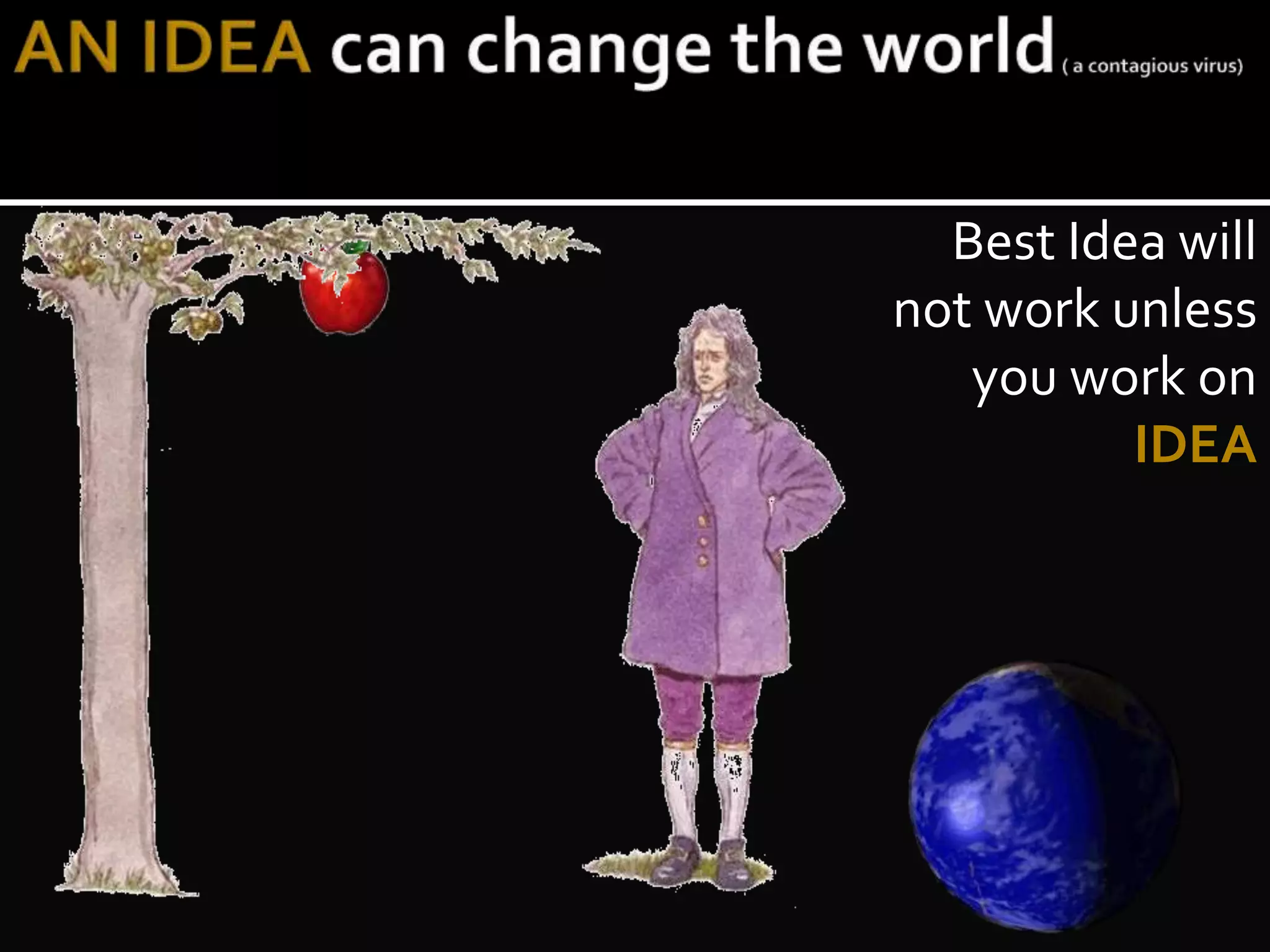
Best Idea will 
not work unless 
you work on 
IDEA
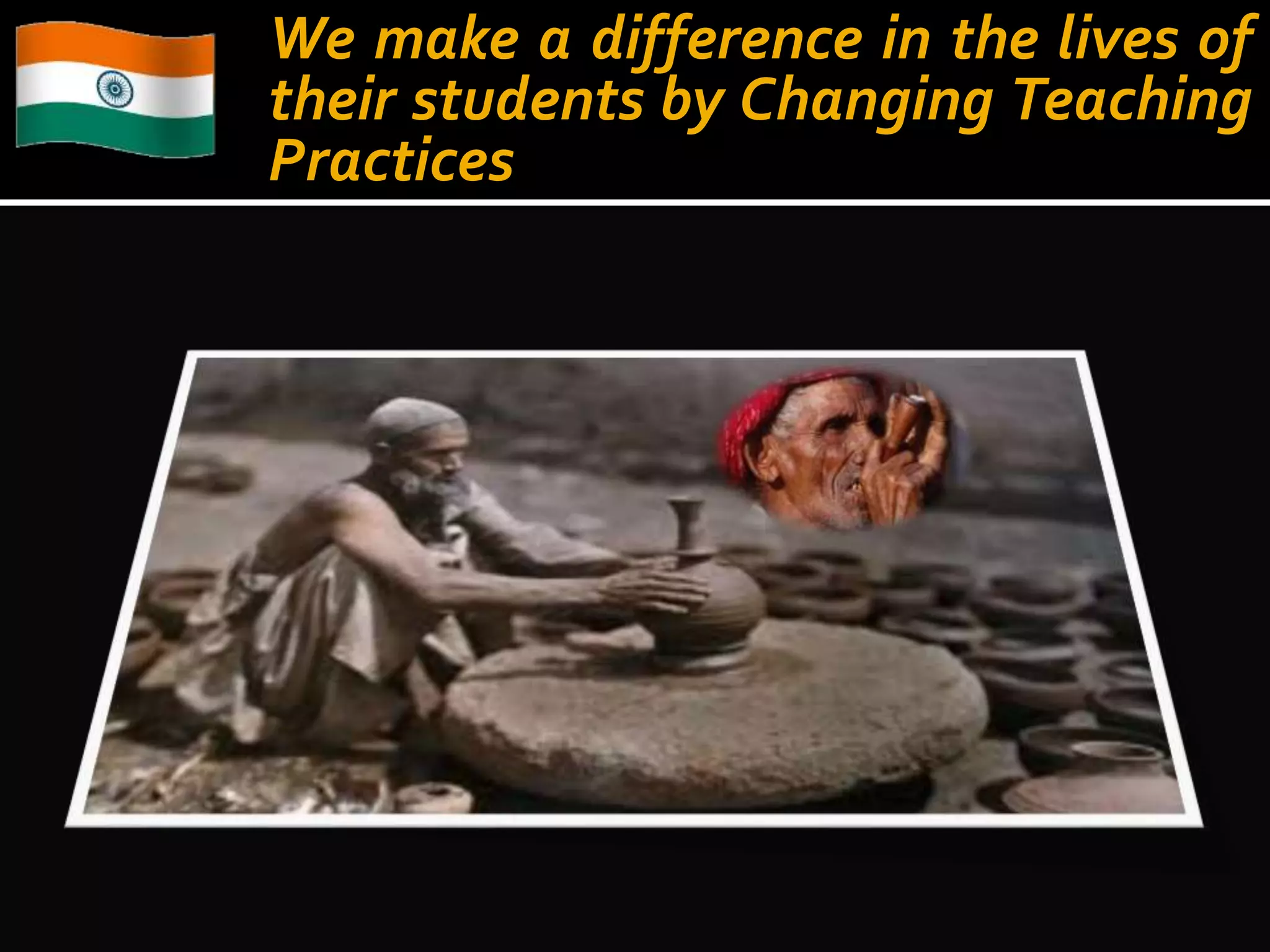
We make a difference in the lives of 
their students by Changing Teaching 
Practices
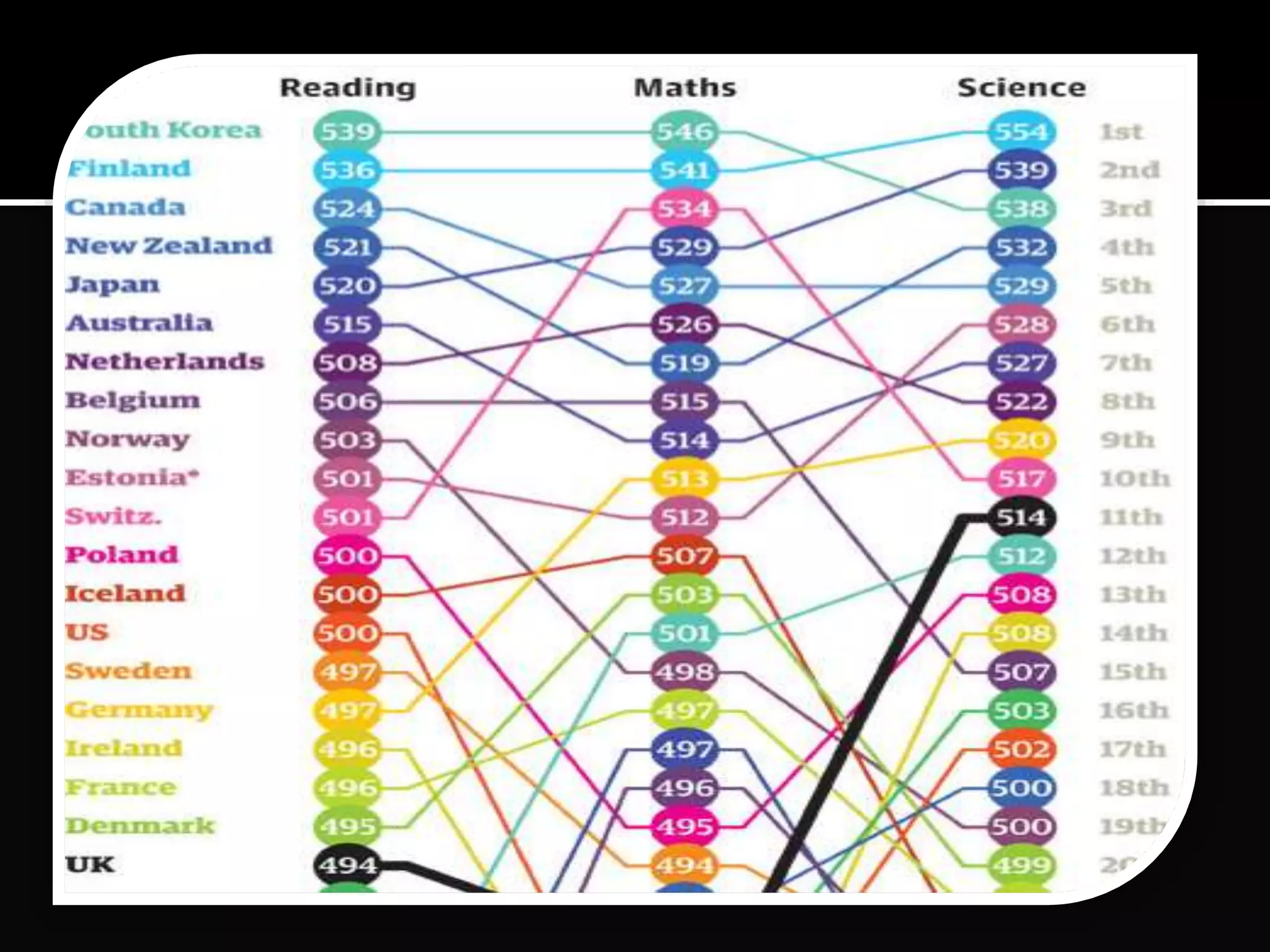
 Finnish children don't start school until they 
are 7. They rarely take exams or do homework 
till 15 then only one mandatory standardized 
test at 16. The difference between weakest and 
strongest students is the smallest in theWorld. 
 Finland has become the icon of classroom 
success, the repetitive winner of top results in 
a global ranking of national school systems
 In 1965, Singapore gained its independence 
from Britain, it was a poverty-stricken place 
with a population largely uneducated, and many 
of whom were opium addicted. Today, it is a 
global hub of trade, finance and transportation. 
 In Singapore, prospective teachers a well-paid 
profession come from a pool of the best 
graduates. 
 In China, Optimum user of technology in 
education even far ahead than USA.
 the discovery was made because 
people were able to recognize 
the significance of something 
they had never seen before! 
 Charles Good Year saw in a 
dream: Combine sulfur with the 
rubber for vulcanization, to 
process rubber for tires. 
 Discovery – 50 photographers 
(No degree but dare to click in 
front of wild lives) 
o
An Idea of Edison 
To make Bulb 
Removed the 
Darkness of 
Night 
 In his early years, teachers told 
Edison he was “too stupid to 
learn anything.” Work was no 
better, as he was fired from his 
first two jobs for not being 
productive enough. Even as an 
inventor, Edison made 1,000 
unsuccessful attempts at inventing 
the light bulb. Of course, all those 
unsuccessful attempts finally 
resulted in the design that worked.
 A great genius Einstein did not 
speak until he was 4 and did not 
read until he was 7, causing his 
teachers and parents to think he 
was mentally handicapped, slow 
and anti-social. Eventually, he 
was expelled from school and 
was refused admittance to the 
Zurich Polytechnic School. The 
Nobel Prize recipient and 
changing the face of modern 
physics:Theory of Relativity
Do what you love 
Bill Gates world’s richest man-dropout from Harvard 
University in 1975 and started Microsoft – the world 
largest software company. However, in 2007 Harvard 
University awarded him with an honorary degree. 
•Few know that the 
world’s most iconic tech 
Steve Jobs was Reed 
college, Portland 
dropout; in 1976 
started Apple. 
Rabindranath Tagore recipient 
of Nobel in literature was 
educated at home. At 17, he 
was sent to England for formal 
schooling, but he dropped out 
and did not finish his studies
 Walt Disney was fired by a 
newspaper editor because, “he 
lacked imagination and had no 
good ideas.” After that, Disney 
started a number of businesses 
that didn’t last too long and ended 
with bankruptcy and failure. Today 
Disney rakes in billions from 
merchandise, movies and theme 
parks around the world named 
Disney Land.
 In October 1959, the United State felt deeply humiliated 
by the launching of the soviet spaceship Sputnik. 
 The question was asked, How did this happen? How did 
the United state with all its technological capabilities, all 
its talent, and all its money, not achieve the goal of being 
first in space? 
 Let’s recall the events of May 25, 1961. President John F 
Kennedy gave a speech and said: “I believe this nation 
should commit itself to achieve the goal before this 
decade is out, of landing a man on the moon and 
returning himself to Earth
 Neil A Armstrong Reporting: “One small step for 
man, one giant step for mankind.” As came down 
the ladder from the lunar module Eagle, he made 
the above statement. This historic event, which 
included Edwin E Aldrin, Jr. and Michael Collins as 
the other astronauts, is burned into the memories 
of all who observed it.
A question on a physics 
exam at the University of 
Copenhagen: "Describe 
how to determine the 
height of a skyscraper 
with a barometer." 
One student replied: "You tie a long piece of string to the 
neck of the barometer, then lower from the roof of the 
skyscraper to the ground. The length of the string plus the 
length of the barometer will equal the height of the building." 
This highly original answer so incensed the examiner that he 
failed the student who immediately appealed on the grounds 
that his answer was indisputably correct.
 The university appointed an independent arbiter to decide 
the case. The arbiter ruled that the answer was indeed correct, 
but did not display any noticeable knowledge of physics. It was 
decided to call the student in and allow him six minutes in 
which to provide a verbal answer which showed at least a 
minimal familiarity with the basic principles of physics. 
 For five minutes the student sat in silence, forehead creased in 
thought. The arbiter reminded him that time was running out, 
to which the student replied that he had several extremely 
relevant answers, but couldn't make up his mind which to use. 
 On being advised to hurry up the student replied: First, you 
could take the barometer up to the roof of the skyscraper, 
drop it over the edge, and measure the time it takes to reach 
the ground. The height of the building can then be worked out 
from the motion equation. "But, Sir, I wouldn't recommend it 
as Bad luck on the barometer."
If the sun is shining you could measure the height of 
the barometer, then set it on end and measure the 
length of its shadow. Then you measure the length of 
the skyscraper's shadow, and thereafter it is a simple 
matter of proportional geometry to work out the height 
of the skyscraper. 
"But, Sir, if you wanted to be highly scientific about it, 
you could tie a short piece of string to the barometer 
and swing it like a pendulum, first at ground level and 
then on the roof of the skyscraper. The height is worked 
out by the difference in a gravitational formula. 
If the skyscraper has an outside emergency staircase, it 
would be easier to walk up it and mark off the height of the 
skyscraper in barometer lengths, then add them up."
You could use the barometer to 
measure the air pressure on the roof, 
and on the ground, and then convert 
the difference in mill bars into feet to 
give the height of the building." 
But since we are constantly being 
exhorted to exercise independence of 
mind and apply scientific methods, 
undoubtedly the best way would be 
to knock on the janitor's door and say 
to him 'If you would like a nice new 
barometer, I will give you this one if 
you tell me the height of this 
skyscraper'. 
• The student 
was Niel Bohr, 
the only Dane 
ever to win the 
Nobel Prize in 
physics.
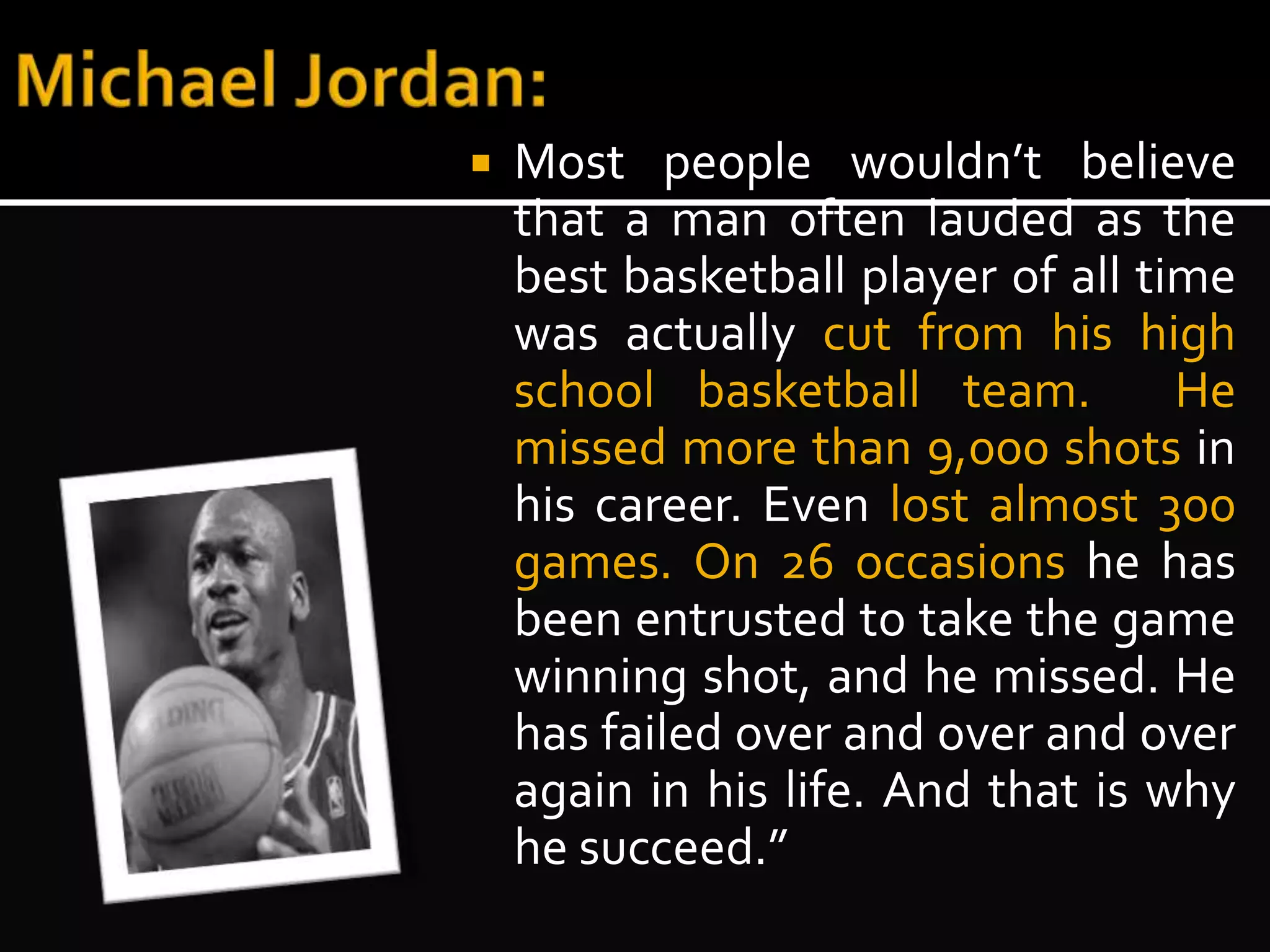
 Most people wouldn’t believe 
that a man often lauded as the 
best basketball player of all time 
was actually cut from his high 
school basketball team. He 
missed more than 9,000 shots in 
his career. Even lost almost 300 
games. On 26 occasions he has 
been entrusted to take the game 
winning shot, and he missed. He 
has failed over and over and over 
again in his life. And that is why 
he succeed.”
 I am the greatest, I said that 
even before I knew I was. 
 I hated every minute of 
training, but I said, 'Don't 
quit. Suffer now and live 
the rest of your life as a 
champion. 
 I never thought of losing, 
but now that it' s happened, 
the only thing is to do it 
right.
 prepare to deal with 
Global changes 
 bringing knowledge 
alive, 
 sparking imagination, 
 creating possibility and 
 caring environment.

Future school

  • 1.
    Building responsible citizens for a better tomorrow
  • 2.
    Changes in Society What do Employers Want? 21st Century Graduate Attributes What will you Do as an Educator? 2
  • 3.
    Teacher-Centric Learning •Lecturer on the stage • Students take notes • Every student has same learning experience • Every student goes through the same learning activities Student-Centric Learning • Social Collaborative Learning • Flipped Learning • Blended Learning • Personalized Learning • Learning Analytics 3 BEFORE NOW (BYOD)
  • 5.
     To predictthe next 100 years, just recollect the people of 1900 had in predicting the world of 2000. We could show them rockets that can explore the moon and planets, MRI scanners that can peer inside the living body and cell phones that can put us in touch with anyone on the planet and can send moving images and messages instantly across the continents. Anyone, anywhere, anytime able to talk, write and send audio and visual to anyone else. Today, if we could somehow visit our ancestors and show them the gift of modern science and technology, we would be viewed as magicians.
  • 6.
     Predictions forthe future, with a few exceptions, have always underestimated the pace of technological progress. Today, we have become choreographers of the dance of nature, able to tweak the laws of nature here and there. But by 2100, we will make the transition to being masters of nature. By 2100, our destiny is to become like the Gods we once worshipped and feared.
  • 7.
    1890 2010 120years apart 9/11/2014 7
  • 8.
  • 9.
    Creation, Collaboration andSharing Social Learning Internet Consumption Communication The Arpanet 1969 Web 2.0 Web 3.0 2012 9/11/2014 9
  • 10.
    Film (1940s) Televisio n (1950s) Programmed Instruction (1960s) Systematic Instructiona l Design (1970s) Computers (1980s) The Internet (1990s) Social Networks and Web 2.0 (2000s) Smart Phones (2003 - ) & Tablets (2010 - ) 9/11/2014 Zoraini Wati Abas 11
  • 12.
     1. DESKS The 21st century does not fit neatly into rows.  2. LANGUAGE LABS Foreign language acquisition is only a smartphone away.  3. COMPUTERS Because computing is going mobile  4. HOMEWORK we don’t need kids to ‘go to school’ more; we need them to ‘learn’ more. And this will be done 24/7  5. THE ROLE OF STANDARDIZED TESTS IN COLLEGE ADMISSIONS Over the next ten years, we will see Digital Portfolios replace test scores
  • 13.
     6. PAPERBACKS Books were nice. In ten years’ time, all reading will be via digital means. And yes, I know, you like the ‘feel’ of paper. Well, in ten years’ time you’ll hardly tell the difference as ‘paper’ itself becomes digitized.  7. ATTENDANCE OFFICES Bio scans.  8. CENTRALIZED INSTITUTIONS School buildings are going to become ‘homebases’ of learning, not the institutions where all learning happens.  9. PAPER In ten years’ time, schools will decrease their paper consumption by no less than 90%. And the printing industry and the copier industry and the paper industry itself will either
  • 14.
     10. PAID/OUTSOURCEDPROFESSIONAL DEVELOPMENT LIKE CALL CENTRE No one knows your school as well as you. With the power of a PLN (professional learning networks) in their back pockets, teachers will rise up to replace peripatetic professional development gurus as the source of schoolwide professional development programs. This is already happening.  11. PARENT-TEACHER CONFERENCE NIGHT Ongoing parent-teacher relations in virtual reality will make parent-teacher conference nights seem quaint.
  • 15.
    Many of today'sjob titles, and the skills needed to fill them, simply did not exist 20 years ago. Education systems need to consider what skills today's students will need in future and teach accordingly.  First Generation:VacuumTubes (Information doubled in 50 years)  Second Generation:Transistors (in 25 years)  Third Generation: Integrated Circuits( in 10 years)  Fourth Generation: Microprocessors( in 11 months)  Fifth Generation: Artificial Intelligence: nanotechnology (in 10 hours)
  • 16.
    ●2015 – 3years from now (in VI years last 3 years papers back) ●2020 – 8 years from now (XII degree) ●2025 - 2012/2013 Kindergarteners Graduate ●2035 – Class of 2025 10 year reunion/ 5-6 year out of college ●2045 – 2012/2013 Kindergarteners are in late 30’s to early 40’s. ●2070 – 2012/13 Kindergarteners are reaching retirement age at 67
  • 17.
     Lungs AndKidneys 2015  Artificial Brain Cells 2020  Synthetic Muscles 2025  Artificial Eye Implant 2030  Artificial Brain 2035
  • 18.
    We live inan age of technology where children in our schools often know more about technology than their teachers Computers reach the speed of 20 quadrillion instructions per second, equal to the human brain Globalization Robotization Digitalization Automation
  • 20.
     In thesecond most populous nation on the planet, with the second biggest educational system in the world The number of years a person has spent in school is a dismal 4.4 years for India as compared to global average of 7.4 and 4.6 for South Asia.
  • 21.
    Best Idea will not work unless you work on IDEA
  • 22.
    We make adifference in the lives of their students by Changing Teaching Practices
  • 24.
     Finnish childrendon't start school until they are 7. They rarely take exams or do homework till 15 then only one mandatory standardized test at 16. The difference between weakest and strongest students is the smallest in theWorld.  Finland has become the icon of classroom success, the repetitive winner of top results in a global ranking of national school systems
  • 25.
     In 1965,Singapore gained its independence from Britain, it was a poverty-stricken place with a population largely uneducated, and many of whom were opium addicted. Today, it is a global hub of trade, finance and transportation.  In Singapore, prospective teachers a well-paid profession come from a pool of the best graduates.  In China, Optimum user of technology in education even far ahead than USA.
  • 26.
     the discoverywas made because people were able to recognize the significance of something they had never seen before!  Charles Good Year saw in a dream: Combine sulfur with the rubber for vulcanization, to process rubber for tires.  Discovery – 50 photographers (No degree but dare to click in front of wild lives) o
  • 27.
    An Idea ofEdison To make Bulb Removed the Darkness of Night  In his early years, teachers told Edison he was “too stupid to learn anything.” Work was no better, as he was fired from his first two jobs for not being productive enough. Even as an inventor, Edison made 1,000 unsuccessful attempts at inventing the light bulb. Of course, all those unsuccessful attempts finally resulted in the design that worked.
  • 28.
     A greatgenius Einstein did not speak until he was 4 and did not read until he was 7, causing his teachers and parents to think he was mentally handicapped, slow and anti-social. Eventually, he was expelled from school and was refused admittance to the Zurich Polytechnic School. The Nobel Prize recipient and changing the face of modern physics:Theory of Relativity
  • 29.
    Do what youlove Bill Gates world’s richest man-dropout from Harvard University in 1975 and started Microsoft – the world largest software company. However, in 2007 Harvard University awarded him with an honorary degree. •Few know that the world’s most iconic tech Steve Jobs was Reed college, Portland dropout; in 1976 started Apple. Rabindranath Tagore recipient of Nobel in literature was educated at home. At 17, he was sent to England for formal schooling, but he dropped out and did not finish his studies
  • 30.
     Walt Disneywas fired by a newspaper editor because, “he lacked imagination and had no good ideas.” After that, Disney started a number of businesses that didn’t last too long and ended with bankruptcy and failure. Today Disney rakes in billions from merchandise, movies and theme parks around the world named Disney Land.
  • 31.
     In October1959, the United State felt deeply humiliated by the launching of the soviet spaceship Sputnik.  The question was asked, How did this happen? How did the United state with all its technological capabilities, all its talent, and all its money, not achieve the goal of being first in space?  Let’s recall the events of May 25, 1961. President John F Kennedy gave a speech and said: “I believe this nation should commit itself to achieve the goal before this decade is out, of landing a man on the moon and returning himself to Earth
  • 32.
     Neil AArmstrong Reporting: “One small step for man, one giant step for mankind.” As came down the ladder from the lunar module Eagle, he made the above statement. This historic event, which included Edwin E Aldrin, Jr. and Michael Collins as the other astronauts, is burned into the memories of all who observed it.
  • 33.
    A question ona physics exam at the University of Copenhagen: "Describe how to determine the height of a skyscraper with a barometer." One student replied: "You tie a long piece of string to the neck of the barometer, then lower from the roof of the skyscraper to the ground. The length of the string plus the length of the barometer will equal the height of the building." This highly original answer so incensed the examiner that he failed the student who immediately appealed on the grounds that his answer was indisputably correct.
  • 34.
     The universityappointed an independent arbiter to decide the case. The arbiter ruled that the answer was indeed correct, but did not display any noticeable knowledge of physics. It was decided to call the student in and allow him six minutes in which to provide a verbal answer which showed at least a minimal familiarity with the basic principles of physics.  For five minutes the student sat in silence, forehead creased in thought. The arbiter reminded him that time was running out, to which the student replied that he had several extremely relevant answers, but couldn't make up his mind which to use.  On being advised to hurry up the student replied: First, you could take the barometer up to the roof of the skyscraper, drop it over the edge, and measure the time it takes to reach the ground. The height of the building can then be worked out from the motion equation. "But, Sir, I wouldn't recommend it as Bad luck on the barometer."
  • 35.
    If the sunis shining you could measure the height of the barometer, then set it on end and measure the length of its shadow. Then you measure the length of the skyscraper's shadow, and thereafter it is a simple matter of proportional geometry to work out the height of the skyscraper. "But, Sir, if you wanted to be highly scientific about it, you could tie a short piece of string to the barometer and swing it like a pendulum, first at ground level and then on the roof of the skyscraper. The height is worked out by the difference in a gravitational formula. If the skyscraper has an outside emergency staircase, it would be easier to walk up it and mark off the height of the skyscraper in barometer lengths, then add them up."
  • 36.
    You could usethe barometer to measure the air pressure on the roof, and on the ground, and then convert the difference in mill bars into feet to give the height of the building." But since we are constantly being exhorted to exercise independence of mind and apply scientific methods, undoubtedly the best way would be to knock on the janitor's door and say to him 'If you would like a nice new barometer, I will give you this one if you tell me the height of this skyscraper'. • The student was Niel Bohr, the only Dane ever to win the Nobel Prize in physics.
  • 37.
     Most peoplewouldn’t believe that a man often lauded as the best basketball player of all time was actually cut from his high school basketball team. He missed more than 9,000 shots in his career. Even lost almost 300 games. On 26 occasions he has been entrusted to take the game winning shot, and he missed. He has failed over and over and over again in his life. And that is why he succeed.”
  • 38.
     I amthe greatest, I said that even before I knew I was.  I hated every minute of training, but I said, 'Don't quit. Suffer now and live the rest of your life as a champion.  I never thought of losing, but now that it' s happened, the only thing is to do it right.
  • 39.
     prepare todeal with Global changes  bringing knowledge alive,  sparking imagination,  creating possibility and  caring environment.