How to Make A Difference


 Using the Change Management 3.0
     model to change anything
Introduction – work in pairs
  First
• Introduce yourself
  Or
• share a little known fact about yourself
  Then
• Discuss: What change strategies or practices
  have you used in the past?

Time – 3 minutes
How to Make A Difference


 Using the Change Management 3.0
     model to change anything
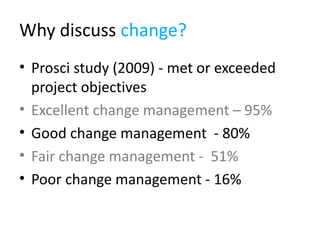
Why discuss change?
• Prosci study (2009) - met or exceeded
  project objectives
• Excellent change management – 95%
• Good change management - 80%
• Fair change management - 51%
• Poor change management - 16%
How important is the approach?
“How we go about introducing
change is usually more
important than the change
itself!”
      Geoffrey M. Bellman [2001]
Why change the world?
• “It’s no secret that the world is in need of
  change.“ - Stephen Denning

• “Stop Stealing Dreams. “ - Seth Godin


• "My friends, love is better than anger. Hope is better than
  fear. Optimism is better than despair. So let us be loving,
  hopeful and optimistic. And we'll change the world.“
                                           Jack Layton (1950-2011)
W. Edwards Deming


Bonuses are bad for business
[Deming 1986].
Peter F. Drucker

Knowledge workers cannot
be subordinates of
managers [Drucker 1974]
Dan Bobinski

Performance appraisals
don’t work [Bobinski 2010]
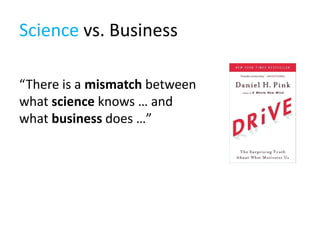
Science vs. Business

“There is a mismatch between
what science knows … and
what business does …”
It’s not all bad
Agile Manifesto (2001)


Agile adoption survey 2011
How did we get here?
Management 1.0 = Hierarchies

At the top – high salaries, big egos

At the bottom – little money + no
motivation

Old, outdated + needs an upgrade
Management 2.0 = Fads

Add-ons - Balanced Scorecard, Six Sigma, TOC,
and TQM.

Helping to better “design” the organizations

Same architecture
The Age of complexity (Stephen Hawking)
• All organizations are
  networks

• Management is about people
  and their relationships

• Organizations are living
  systems, not machines
Complexity (according to Complexity Theory)
Complexity theory is about change
    “Complexity theory is […] about the dynamics of
change in a system.”
                        – Irene Sanders The Interaction of Complexity and Management


     “[…] a new theory of business that places people
and relationships into dramatic relief.”
             – Roger Lewin, Birute Regine The Interaction of Complexity and Management


    “Complexity and Agile is a marriage made in
heaven.”
                                    – Dave Snowden http://vimeo.com/30596502
So far..
• Change is important
• Mismatch between business &
  science
• Management needs upgrade
• Complexity theory
The Management 3.0 Model
View #1: Energize People
The Management 3.0 Model
View #2: Empower Teams
The Management 3.0 Model

View #3: Align Constraints
The Management 3.0 Model
View #4: Develop Competence
The Management 3.0 Model
View #5: Grow Structure
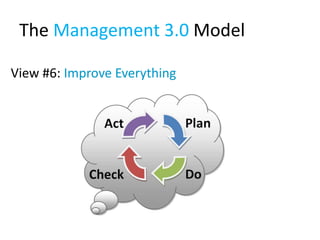
The Management 3.0 Model

View #6: Improve Everything
Exercise #1

Pick a index card and write two ideas or
interesting facts that you’ve just learned…

… and then give it to someone else!

Time: 1 minute
 
The Feedback
Door/Wall       

               
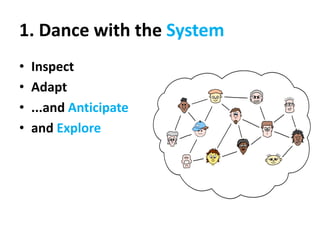
1. Dance with the System
•   Inspect
•   Adapt
•   ...and Anticipate
•   and Explore
PDCA
• Plan
  – What Is Your Goal?
  – Where is it going well?
• Do
  – What are the crucial steps?
  – When & Where do you start?
PDCA
• Check
  – How Do You Get Feedback?
  – How Do You Measure Results
• Act
  – How long is the Feedback cycle?
  – How Do You Accelerate Results?
2. Mind the People

• Remove barriers

• The ADKAR model
ADKAR model - Awareness

• How Will You
  Communicate?

• How Will You Set an
  Example?
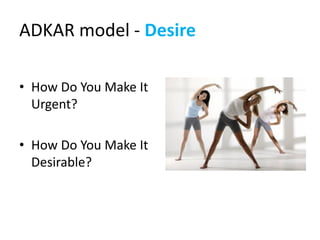
ADKAR model - Desire

• How Do You Make It
  Urgent?

• How Do You Make It
  Desirable?
ADKAR model - Knowledge
• Who Will Be Teaching?
• How Will You Teach
  Them?
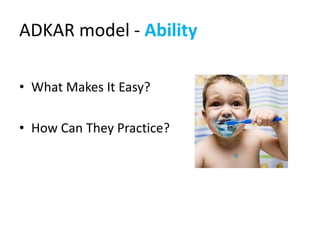
ADKAR model - Ability

• What Makes It Easy?

• How Can They Practice?
ADKAR model - Reinforcement

• What Are the Short-Term
  Wins?
• What Makes It Sustainable?
3. Stimulate the Network
The Innovation Adoption curve
• Initiators
• Innovators
• Early Adopters
The Innovation Adoption curve
• Early Majority
• Late Majority
• Laggards
Change the Environment
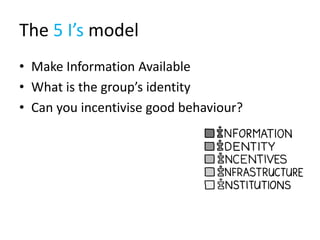
The 5 I’s model
• Make Information Available
• What is the group’s identity
• Can you incentivise good behaviour?
The 5 I’s model
• What barriers can you remove?
• How can you make it easier?
• Who makes the rules?
Summary
• Change is important
• Mismatch between business &
  science
• Management needs upgrade
• Management 3.0/Complexity theory
• Change Management 3.0 model
Exercise #2
On the index card you’ve been given write one
or two ideas or interesting facts that you’ve
learned from the last section

… and then give it to someone else!

Time: 2 minutes
Short break


• Coming up… Become a change agent
Become a Change Agent
We will be designing our own change strategy
- To make a difference in your organisation,
  community, etc.
- To introduce some kind of change
- To.. ?
Conclusion
• Partner with the person sitting next to you to
  answer one or more of these questions
  – How do I feel about what I learned?
  – What do I remember from this presentation?
  – Can I use what I learned?
  – How does my organisation benefit from what I
    learned?

How to make a difference

  • 1.
    How to MakeA Difference Using the Change Management 3.0 model to change anything
  • 2.
    Introduction – workin pairs First • Introduce yourself Or • share a little known fact about yourself Then • Discuss: What change strategies or practices have you used in the past? Time – 3 minutes
  • 3.
    How to MakeA Difference Using the Change Management 3.0 model to change anything
  • 4.
    Why discuss change? •Prosci study (2009) - met or exceeded project objectives • Excellent change management – 95% • Good change management - 80% • Fair change management - 51% • Poor change management - 16%
  • 5.
    How important isthe approach? “How we go about introducing change is usually more important than the change itself!” Geoffrey M. Bellman [2001]
  • 6.
    Why change theworld? • “It’s no secret that the world is in need of change.“ - Stephen Denning • “Stop Stealing Dreams. “ - Seth Godin • "My friends, love is better than anger. Hope is better than fear. Optimism is better than despair. So let us be loving, hopeful and optimistic. And we'll change the world.“ Jack Layton (1950-2011)
  • 7.
    W. Edwards Deming Bonusesare bad for business [Deming 1986].
  • 8.
    Peter F. Drucker Knowledgeworkers cannot be subordinates of managers [Drucker 1974]
  • 9.
  • 10.
    Science vs. Business “Thereis a mismatch between what science knows … and what business does …”
  • 11.
    It’s not allbad Agile Manifesto (2001) Agile adoption survey 2011
  • 12.
    How did weget here? Management 1.0 = Hierarchies At the top – high salaries, big egos At the bottom – little money + no motivation Old, outdated + needs an upgrade
  • 13.
    Management 2.0 =Fads Add-ons - Balanced Scorecard, Six Sigma, TOC, and TQM. Helping to better “design” the organizations Same architecture
  • 14.
    The Age ofcomplexity (Stephen Hawking) • All organizations are networks • Management is about people and their relationships • Organizations are living systems, not machines
  • 15.
    Complexity (according toComplexity Theory)
  • 16.
    Complexity theory isabout change “Complexity theory is […] about the dynamics of change in a system.” – Irene Sanders The Interaction of Complexity and Management “[…] a new theory of business that places people and relationships into dramatic relief.” – Roger Lewin, Birute Regine The Interaction of Complexity and Management “Complexity and Agile is a marriage made in heaven.” – Dave Snowden http://vimeo.com/30596502
  • 17.
    So far.. • Changeis important • Mismatch between business & science • Management needs upgrade • Complexity theory
  • 18.
    The Management 3.0Model View #1: Energize People
  • 19.
    The Management 3.0Model View #2: Empower Teams
  • 20.
    The Management 3.0Model View #3: Align Constraints
  • 21.
    The Management 3.0Model View #4: Develop Competence
  • 22.
    The Management 3.0Model View #5: Grow Structure
  • 23.
    The Management 3.0Model View #6: Improve Everything
  • 24.
    Exercise #1 Pick aindex card and write two ideas or interesting facts that you’ve just learned… … and then give it to someone else! Time: 1 minute
  • 25.
  • 27.
    1. Dance withthe System • Inspect • Adapt • ...and Anticipate • and Explore
  • 28.
    PDCA • Plan – What Is Your Goal? – Where is it going well? • Do – What are the crucial steps? – When & Where do you start?
  • 29.
    PDCA • Check – How Do You Get Feedback? – How Do You Measure Results • Act – How long is the Feedback cycle? – How Do You Accelerate Results?
  • 30.
    2. Mind thePeople • Remove barriers • The ADKAR model
  • 31.
    ADKAR model -Awareness • How Will You Communicate? • How Will You Set an Example?
  • 32.
    ADKAR model -Desire • How Do You Make It Urgent? • How Do You Make It Desirable?
  • 33.
    ADKAR model -Knowledge • Who Will Be Teaching? • How Will You Teach Them?
  • 34.
    ADKAR model -Ability • What Makes It Easy? • How Can They Practice?
  • 35.
    ADKAR model -Reinforcement • What Are the Short-Term Wins? • What Makes It Sustainable?
  • 36.
  • 37.
    The Innovation Adoptioncurve • Initiators • Innovators • Early Adopters
  • 38.
    The Innovation Adoptioncurve • Early Majority • Late Majority • Laggards
  • 39.
  • 40.
    The 5 I’smodel • Make Information Available • What is the group’s identity • Can you incentivise good behaviour?
  • 41.
    The 5 I’smodel • What barriers can you remove? • How can you make it easier? • Who makes the rules?
  • 42.
    Summary • Change isimportant • Mismatch between business & science • Management needs upgrade • Management 3.0/Complexity theory • Change Management 3.0 model
  • 43.
    Exercise #2 On theindex card you’ve been given write one or two ideas or interesting facts that you’ve learned from the last section … and then give it to someone else! Time: 2 minutes
  • 44.
    Short break • Comingup… Become a change agent
  • 45.
    Become a ChangeAgent We will be designing our own change strategy - To make a difference in your organisation, community, etc. - To introduce some kind of change - To.. ?
  • 47.
    Conclusion • Partner withthe person sitting next to you to answer one or more of these questions – How do I feel about what I learned? – What do I remember from this presentation? – Can I use what I learned? – How does my organisation benefit from what I learned?