More Than A Feeling:
Emotions and Knowledge
Management
Matt Moore
20 Oct 2020
Matt Moore
• An Industry Fellow at University of Technology Sydney.
• Over 20 years of experience working in knowledge
management with organisations such as PwC, IBM, Oracle and
ASIC.
• Also worked in Learning & Development, Marketing, IT Management,
Sales Operations, Project Management.
• NOT a psychologist.
Agenda
• Some talking
• Breakout discussion 1
• Breakout discussion 2
• Wrap up
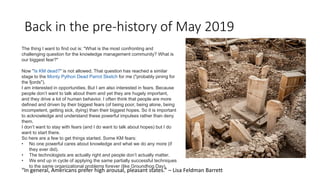
Back in the pre-history of May 2019
The thing I want to find out is: "What is the most confronting and
challenging question for the knowledge management community? What is
our biggest fear?"
Now "Is KM dead?" is not allowed. That question has reached a similar
stage to the Monty Python Dead Parrot Sketch for me ("probably pining for
the fjords").
I am interested in opportunities. But I am also interested in fears. Because
people don’t want to talk about them and yet they are hugely important,
and they drive a lot of human behavior. I often think that people are more
defined and driven by their biggest fears (of being poor, being alone, being
incompetent, getting sick, dying) than their biggest hopes. So it is important
to acknowledge and understand these powerful impulses rather than deny
them.
I don’t want to stay with fears (and I do want to talk about hopes) but I do
want to start there.
So here are a few to get things started. Some KM fears:
• No one powerful cares about knowledge and what we do any more (if
they ever did).
• The technologists are actually right and people don’t actually matter.
• We end up in cycle of applying the same partially successful techniques
to the same organizational problems forever (like Groundhog Day).
“In general, Americans prefer high arousal, pleasant states.” – Lisa Feldman Barrett
The SIKM discussion group
Many thanks to:
Robert Bogue
Aprill Allen
Denis Thomas
Nancy Dixon
Murray Jennex
John Lewis
Patrick Lambe
Rezwan Alam
Denise Senmartin (KM4Dev)
Stephen Bounds
Nirmala Palaniappan
Mahrukh Hasan
Chris Collinson
Chuck Georgo
Thomas J. Froehlich
Bill Kaplan
Tom Short
Arthur Shelley
Why are we doing this?
“I’m not clear that emotions
are what you’re after here,
Matt. To what end does
exploring that add to our
understanding as
practitioners?”
“I have to say that I somewhat
disagree with the assertion that
emotions are "rarely talked
about" in KM. Is that your
experience? In mine, most
facilitation and KM related
strategies and activities take into
account emotions, including our
own, to connect, build trust, and
from there share/manage
knowledge.”
3.25
knowledge
human or organizational asset enabling effective decisions and action
in context
Note 1 to entry: Knowledge can be individual, collective or
organizational.
Note 2 to entry: There are diverse views on the scope covered within
knowledge, based on context and purpose. The definition above is
general as to the various perspectives. Examples of knowledge include
insights and know-how.
Note 3 to entry: Knowledge is acquired through learning or
experience.
Emotions
“An emotion is an
organized system of
feelings, physiological
responses, bodily
expressions, and action
tendencies that flow
from an almost
instantaneous appraisal
of a current situation’s
relevance to the
individual” (Fisher 2019)
(Scherer 2005)
Terms
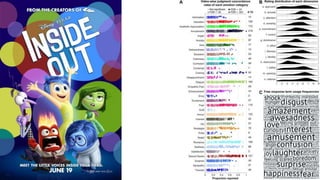
• Affect – Related to emotions – sometimes a simple state of
feeling.
• Mood – Longer term, diffuse emotional states.
• Valence – Pleasant vs Unpleasant (happy vs upset)
• Arousal – High vs Low (elated vs peaceful)
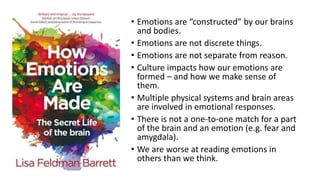
• Emotions are “constructed” by our brains
and bodies.
• Emotions are not discrete things.
• Emotions are not separate from reason.
• Culture impacts how our emotions are
formed – and how we make sense of
them.
• Multiple physical systems and brain areas
are involved in emotional responses.
• There is not a one-to-one match for a part
of the brain and an emotion (e.g. fear and
amygdala).
• We are worse at reading emotions in
others than we think.
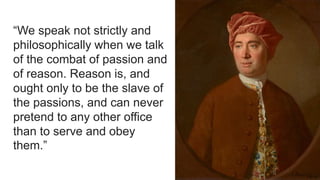
“We speak not strictly and
philosophically when we talk
of the combat of passion and
of reason. Reason is, and
ought only to be the slave of
the passions, and can never
pretend to any other office
than to serve and obey
them.”
Emotions in Organisations
“For many years emotions in the
workplace were ignored altogether
or were regarded as irrational.
Hence, they had no place in
organizations that were thought to
be bastions of rationality, or they
were considered merely a source
of annoying unreliability in the
reporting of more stable work
attitudes and perceptions.” (Fisher
2019)
Emotions in Organisations
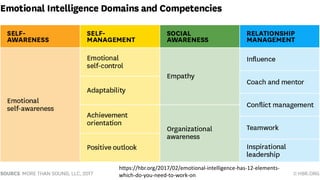
• Emotional Intelligence (EI) as “a thing”.
• Happiness / Wellness / Positive Psychology
• Awareness of mental health issues (RUOK Day)
• Employee Engagement
• Behavioural Economics / Naturalistic Decision-Making
• Social Media - changing our public performance of emotion
https://hbr.org/2017/02/emotional-intelligence-has-12-elements-
which-do-you-need-to-work-on
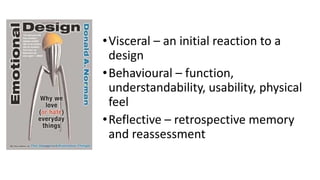
•Visceral – an initial reaction to a
design
•Behavioural – function,
understandability, usability, physical
feel
•Reflective – retrospective memory
and reassessment
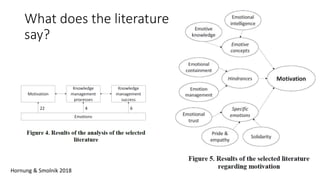
What does the literature
say?
Hornung & Smolnik 2018
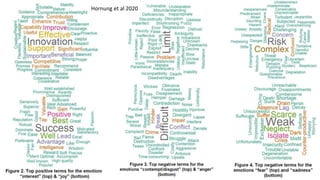
Hornung et al 2020
What has my experience been?
• Knowledge manager as emotional laboror (Hochschild).
• Reading emotions in terms of debriefing teams to collect knowledge – and
the importance of negative space.
• Managing the emotions of a community – giving people permission to feel.
• Managing anxiety during times of change.
• Knowing who will “click” with who to create and share knowledge.
• Saying what everybody is feeling.
• Not saying something in front of other people.
• Forging connections with people and alienating others.
How might we manage the emotions of
others as knowledge managers?
•Think about the time you witnessed a display of
emotion in the workplace (or surprising lack of
emotion).
•What was the context?
•How did you react?
•What did you learn from that?
How might we design our KM products and
programs to account for emotion?
•Think of a work initiative or a software tool that
has provoked an emotion in you – good or bad.
•Why did it provoke that emotion in you?
•What did you learn from that?
Extra References
• David Hume. Treatise on Human Nature.
• Alan S. Cowen, Dacher Keltner. Varieties of reported emotional experience. Proceedings of the National
Academy of Sciences Sep 2017, 114 (38) E7900-E7909; DOI: 10.1073/pnas.1702247114
• Fisher, C. D. (2019). Emotions in organizations. In R. J. Aldag (Ed.), Oxford Research Encyclopedia of Business
and Management Oxford University Press. https://doi.org/10.1093/acrefore/9780190224851.013.160
• Scherer KR. What are emotions? And how can they be measured? Social Science Information.
2005;44(4):695-729. doi:10.1177/0539018405058216
• Hornung, O., & Smolnik, S. (2018). It’s Just Emotion Taking Me Over: Investigating the Role of Emotions in
Knowledge Management Research. In Proceedings of the 51st Hawaii International Conference on System
Sciences. DOI: 10.24251/HICSS.2018.512
• Hornung, O et al (2020) Inspired by Emotions, Guided by Knowledge: Which Emotional Cues Dominate
Knowledge Management Research? In Proceedings of the 53rd Hawaii International Conference on System
Sciences. DOI: 10.24251/HICSS.2020.573

More Than a Feeling: Emotions and Knowledge Management

  • 1.
    More Than AFeeling: Emotions and Knowledge Management Matt Moore 20 Oct 2020
  • 2.
    Matt Moore • AnIndustry Fellow at University of Technology Sydney. • Over 20 years of experience working in knowledge management with organisations such as PwC, IBM, Oracle and ASIC. • Also worked in Learning & Development, Marketing, IT Management, Sales Operations, Project Management. • NOT a psychologist.
  • 3.
    Agenda • Some talking •Breakout discussion 1 • Breakout discussion 2 • Wrap up
  • 4.
    Back in thepre-history of May 2019 The thing I want to find out is: "What is the most confronting and challenging question for the knowledge management community? What is our biggest fear?" Now "Is KM dead?" is not allowed. That question has reached a similar stage to the Monty Python Dead Parrot Sketch for me ("probably pining for the fjords"). I am interested in opportunities. But I am also interested in fears. Because people don’t want to talk about them and yet they are hugely important, and they drive a lot of human behavior. I often think that people are more defined and driven by their biggest fears (of being poor, being alone, being incompetent, getting sick, dying) than their biggest hopes. So it is important to acknowledge and understand these powerful impulses rather than deny them. I don’t want to stay with fears (and I do want to talk about hopes) but I do want to start there. So here are a few to get things started. Some KM fears: • No one powerful cares about knowledge and what we do any more (if they ever did). • The technologists are actually right and people don’t actually matter. • We end up in cycle of applying the same partially successful techniques to the same organizational problems forever (like Groundhog Day). “In general, Americans prefer high arousal, pleasant states.” – Lisa Feldman Barrett
  • 5.
    The SIKM discussiongroup Many thanks to: Robert Bogue Aprill Allen Denis Thomas Nancy Dixon Murray Jennex John Lewis Patrick Lambe Rezwan Alam Denise Senmartin (KM4Dev) Stephen Bounds Nirmala Palaniappan Mahrukh Hasan Chris Collinson Chuck Georgo Thomas J. Froehlich Bill Kaplan Tom Short Arthur Shelley
  • 6.
    Why are wedoing this? “I’m not clear that emotions are what you’re after here, Matt. To what end does exploring that add to our understanding as practitioners?” “I have to say that I somewhat disagree with the assertion that emotions are "rarely talked about" in KM. Is that your experience? In mine, most facilitation and KM related strategies and activities take into account emotions, including our own, to connect, build trust, and from there share/manage knowledge.”
  • 7.
    3.25 knowledge human or organizationalasset enabling effective decisions and action in context Note 1 to entry: Knowledge can be individual, collective or organizational. Note 2 to entry: There are diverse views on the scope covered within knowledge, based on context and purpose. The definition above is general as to the various perspectives. Examples of knowledge include insights and know-how. Note 3 to entry: Knowledge is acquired through learning or experience.
  • 8.
    Emotions “An emotion isan organized system of feelings, physiological responses, bodily expressions, and action tendencies that flow from an almost instantaneous appraisal of a current situation’s relevance to the individual” (Fisher 2019) (Scherer 2005)
  • 9.
    Terms • Affect –Related to emotions – sometimes a simple state of feeling. • Mood – Longer term, diffuse emotional states. • Valence – Pleasant vs Unpleasant (happy vs upset) • Arousal – High vs Low (elated vs peaceful)
  • 11.
    • Emotions are“constructed” by our brains and bodies. • Emotions are not discrete things. • Emotions are not separate from reason. • Culture impacts how our emotions are formed – and how we make sense of them. • Multiple physical systems and brain areas are involved in emotional responses. • There is not a one-to-one match for a part of the brain and an emotion (e.g. fear and amygdala). • We are worse at reading emotions in others than we think.
  • 12.
    “We speak notstrictly and philosophically when we talk of the combat of passion and of reason. Reason is, and ought only to be the slave of the passions, and can never pretend to any other office than to serve and obey them.”
  • 13.
    Emotions in Organisations “Formany years emotions in the workplace were ignored altogether or were regarded as irrational. Hence, they had no place in organizations that were thought to be bastions of rationality, or they were considered merely a source of annoying unreliability in the reporting of more stable work attitudes and perceptions.” (Fisher 2019)
  • 14.
    Emotions in Organisations •Emotional Intelligence (EI) as “a thing”. • Happiness / Wellness / Positive Psychology • Awareness of mental health issues (RUOK Day) • Employee Engagement • Behavioural Economics / Naturalistic Decision-Making • Social Media - changing our public performance of emotion
  • 15.
  • 16.
    •Visceral – aninitial reaction to a design •Behavioural – function, understandability, usability, physical feel •Reflective – retrospective memory and reassessment
  • 17.
    What does theliterature say? Hornung & Smolnik 2018
  • 18.
  • 19.
    What has myexperience been? • Knowledge manager as emotional laboror (Hochschild). • Reading emotions in terms of debriefing teams to collect knowledge – and the importance of negative space. • Managing the emotions of a community – giving people permission to feel. • Managing anxiety during times of change. • Knowing who will “click” with who to create and share knowledge. • Saying what everybody is feeling. • Not saying something in front of other people. • Forging connections with people and alienating others.
  • 20.
    How might wemanage the emotions of others as knowledge managers? •Think about the time you witnessed a display of emotion in the workplace (or surprising lack of emotion). •What was the context? •How did you react? •What did you learn from that?
  • 21.
    How might wedesign our KM products and programs to account for emotion? •Think of a work initiative or a software tool that has provoked an emotion in you – good or bad. •Why did it provoke that emotion in you? •What did you learn from that?
  • 22.
    Extra References • DavidHume. Treatise on Human Nature. • Alan S. Cowen, Dacher Keltner. Varieties of reported emotional experience. Proceedings of the National Academy of Sciences Sep 2017, 114 (38) E7900-E7909; DOI: 10.1073/pnas.1702247114 • Fisher, C. D. (2019). Emotions in organizations. In R. J. Aldag (Ed.), Oxford Research Encyclopedia of Business and Management Oxford University Press. https://doi.org/10.1093/acrefore/9780190224851.013.160 • Scherer KR. What are emotions? And how can they be measured? Social Science Information. 2005;44(4):695-729. doi:10.1177/0539018405058216 • Hornung, O., & Smolnik, S. (2018). It’s Just Emotion Taking Me Over: Investigating the Role of Emotions in Knowledge Management Research. In Proceedings of the 51st Hawaii International Conference on System Sciences. DOI: 10.24251/HICSS.2018.512 • Hornung, O et al (2020) Inspired by Emotions, Guided by Knowledge: Which Emotional Cues Dominate Knowledge Management Research? In Proceedings of the 53rd Hawaii International Conference on System Sciences. DOI: 10.24251/HICSS.2020.573