

Present Your Way to the Top©
How to make High Impact Presentations
Mirza Yawar Baig
Opening the world, one mind at a time©
Work Experience:
International Speaker, Trainer, Author, Coach, Leadership
Consultant with 16 years in Corporate General Management,
32 years in Leadership Training & Organizational Development,
Family Business Consulting & Entrepreneurship
Entrepreneur:
 1994: Founded
Education:
 IIM-A , P-CMM®, MBTI©, WSA©, ISABS
Books include:
 It’s my Life
 The Business of Family Business
 An Entrepreneur’s Diary
 Hiring Winners
 20.10.2010-55 – Life Lessons of 55 years
 Leadership is a Personal Choice
 The World we don’t see
 A Voice in the Wilderness
Member Consultant Panel:
USA
 GE Corporate University, Crotonville, NY
 Foreign Service Institute, Washington DC
 AMA International, New York, NY
 Andersen Corporate University, MN
India
 SVP National Police Academy, Hyderabad
 SSB Academy, Bhopal & Gwaldam, Uttar Akhand
 LBS Academy of Administration, Mussoorie
Clients Include:
GE, Oracle, Motorola, Microsoft, IBM, Digital-Compaq, National
Semiconductor, Unilever, BSNL, Tata Indicom, Colgate, Asian Paints,
Siemens, Wartsila, MphasiS, CavinKare, EXL Service, World Bank,
ICRISAT, World Fish, Tata Corporate, J & J, Accenture, Zeneca Seeds,
Shanta Biotech, Advanta, Reuters, Air India, Yusuf Bin Ahmed Kanoo,
Olam, Regal Beloit, Reliance World, NIS Sparta, AMKA, Emami Group,
Suzlon, JP Morgan, SEW Infrastructure, LANCO, Expolanka, Brandix
yawarbaig@gmail.com
www.yawarbaig.com
Speaking is about
being believed
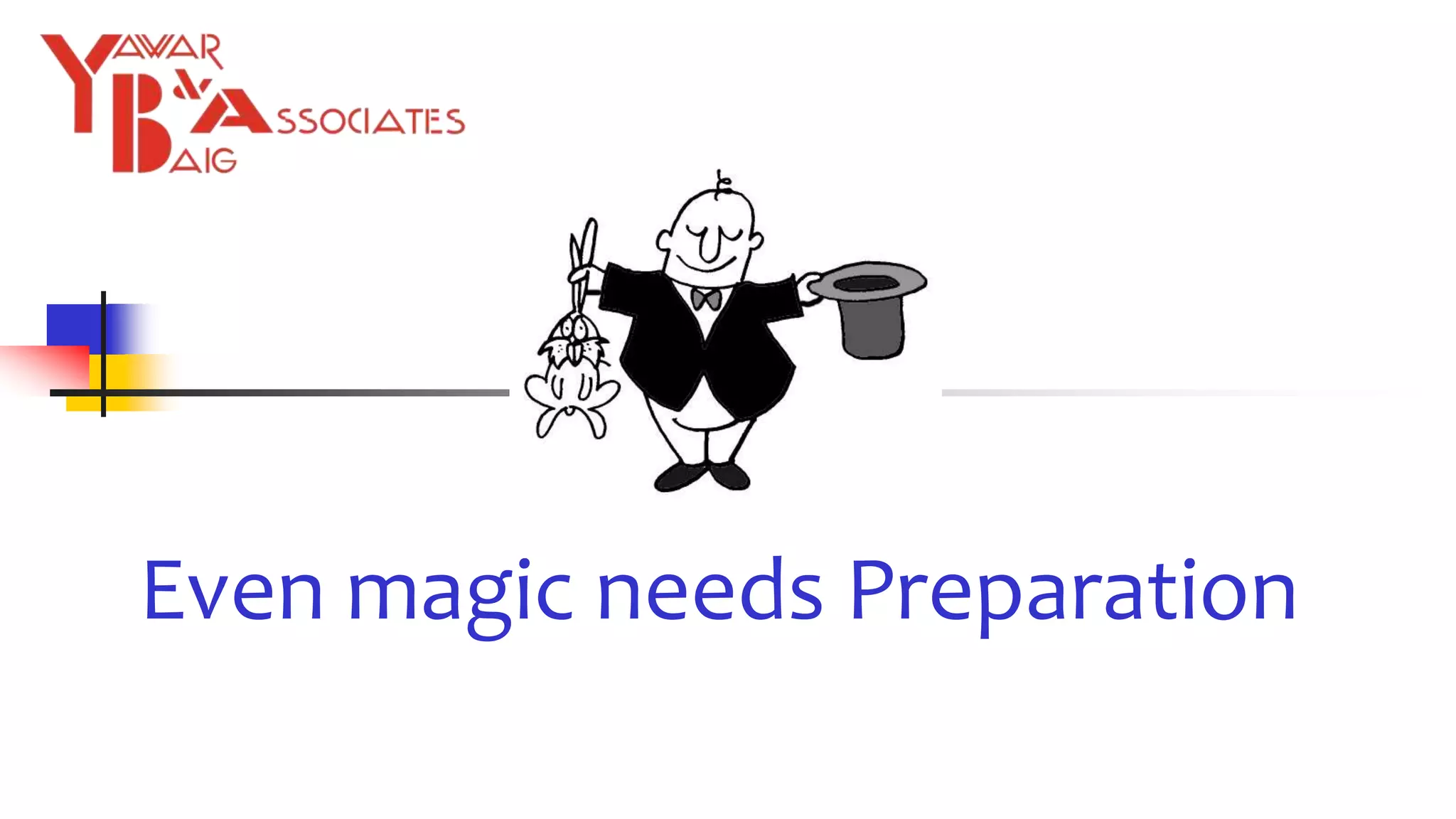
Even magic needs Preparation
Begin
1. Please speak about yourself
for ONE minute
5
The purpose of presenting is to be remembered
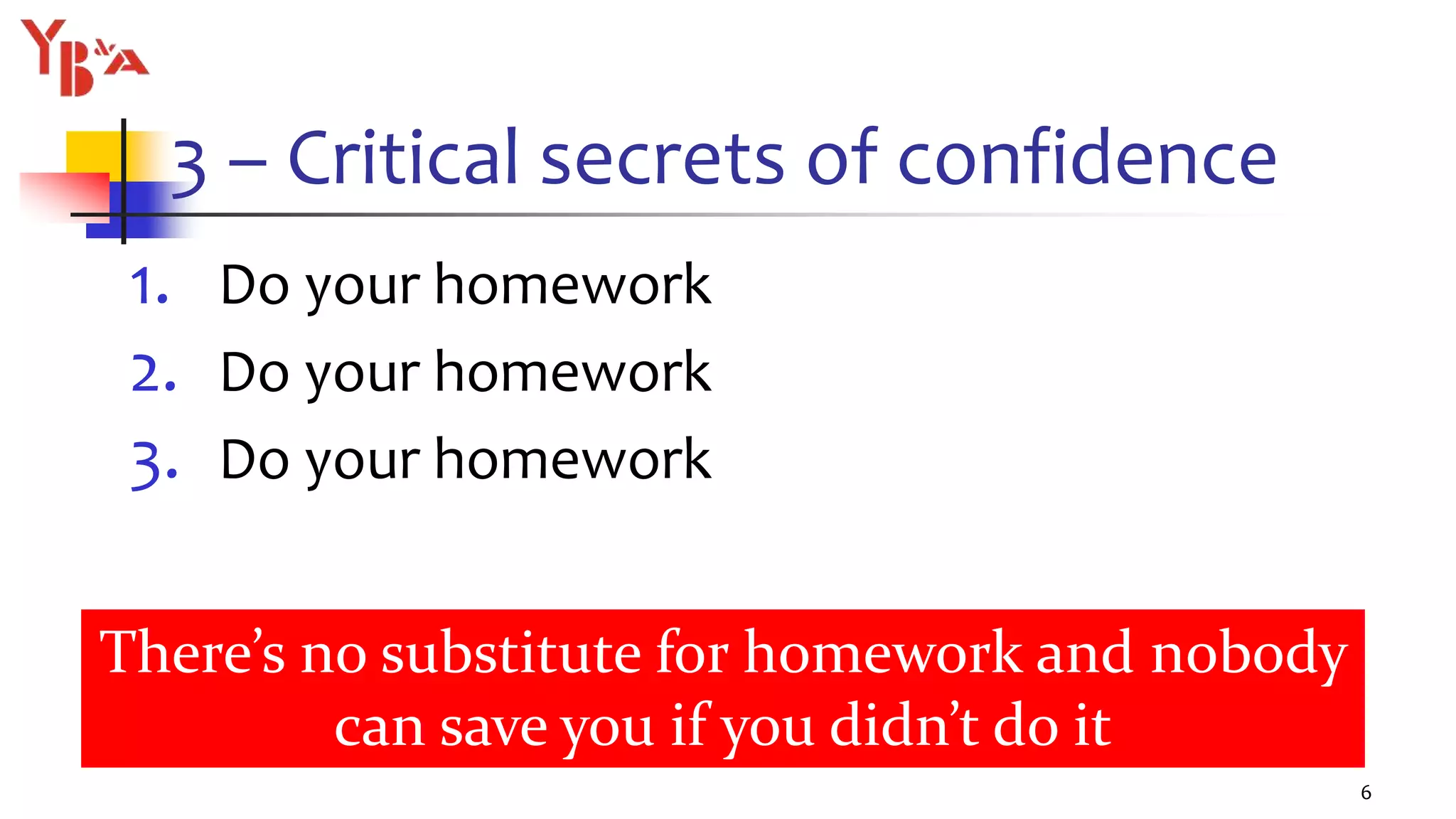
3 – Critical secrets of confidence
1. Do your homework
2. Do your homework
3. Do your homework
6
There’s no substitute for homework and nobody
can save you if you didn’t do it
7
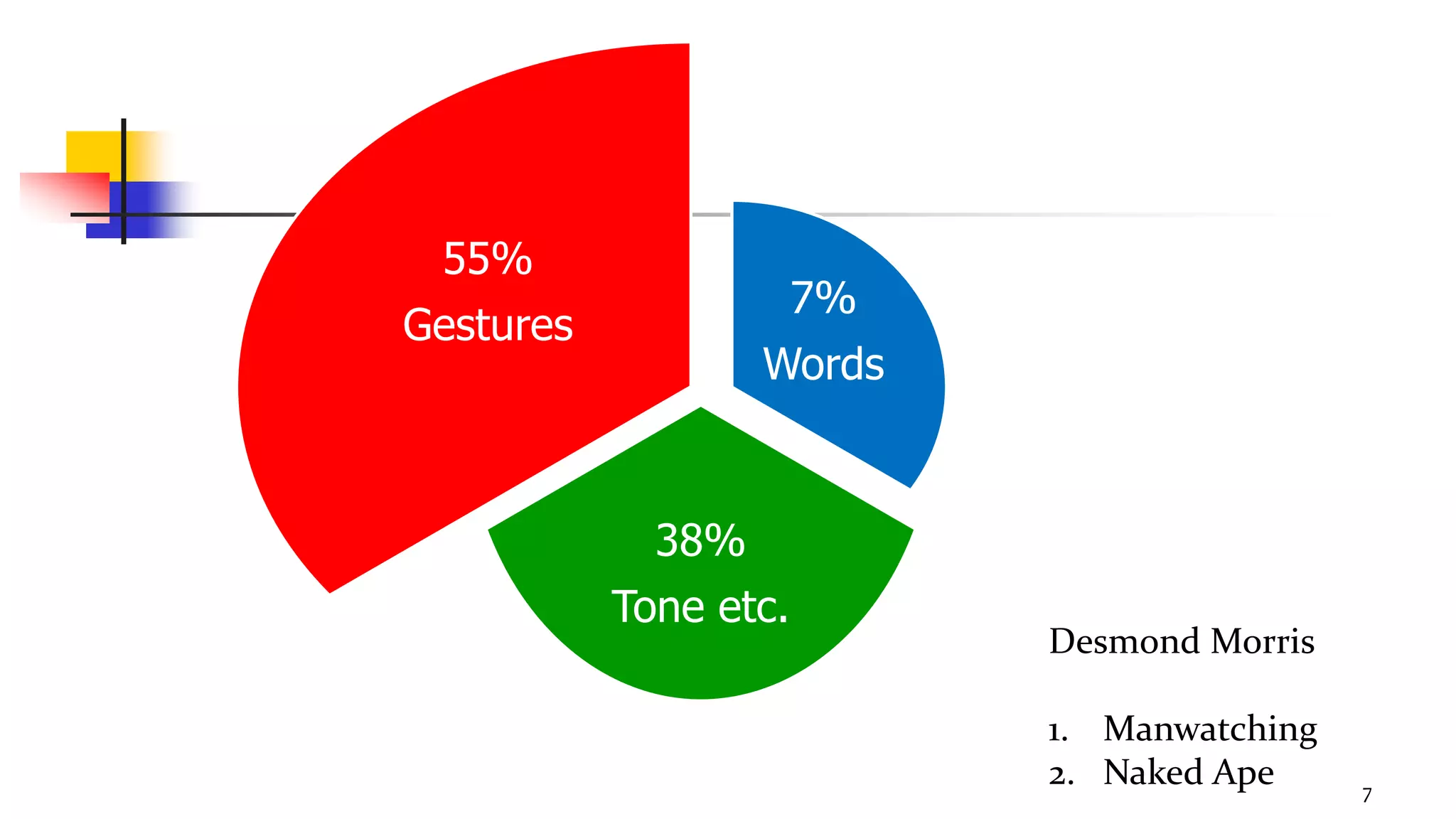
7%
Words
38%
Tone etc.
55%
Gestures
Desmond Morris
1. Manwatching
2. Naked Ape
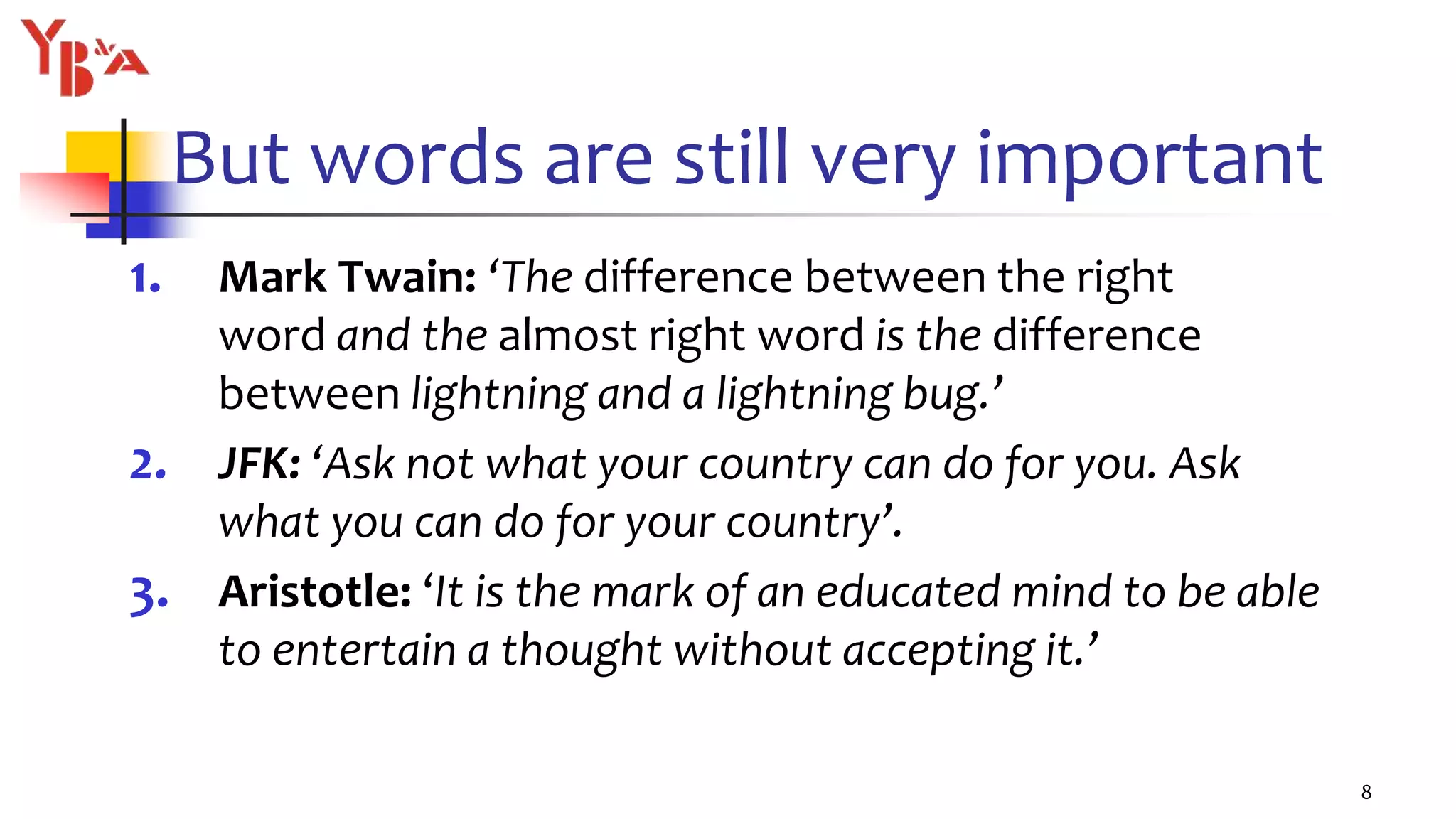
But words are still very important
1. Mark Twain: ‘The difference between the right
word and the almost right word is the difference
between lightning and a lightning bug.’
2. JFK: ‘Ask not what your country can do for you. Ask
what you can do for your country’.
3. Aristotle: ‘It is the mark of an educated mind to be able
to entertain a thought without accepting it.’
8
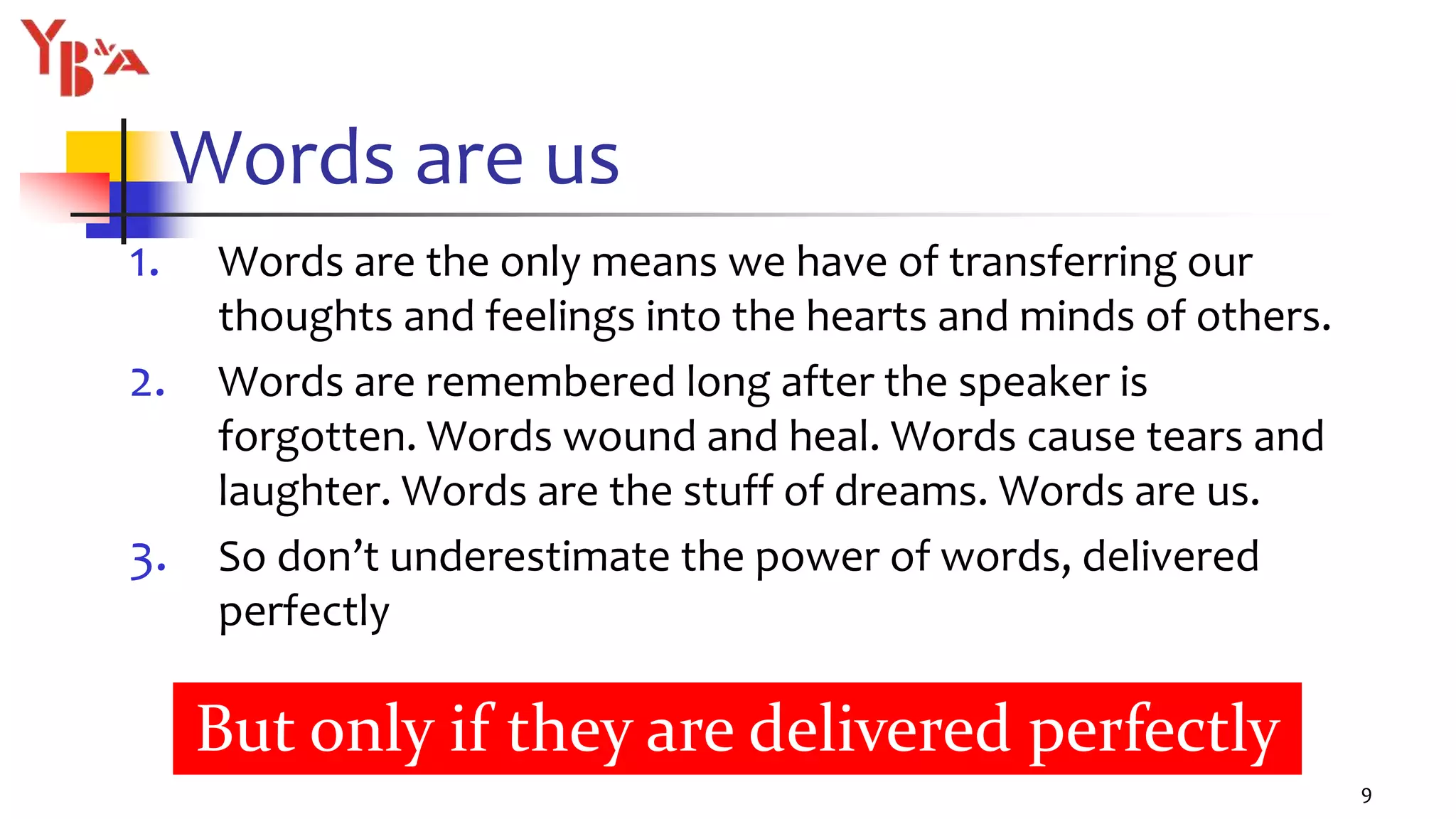
Words are us
1. Words are the only means we have of transferring our
thoughts and feelings into the hearts and minds of others.
2. Words are remembered long after the speaker is
forgotten. Words wound and heal. Words cause tears and
laughter. Words are the stuff of dreams. Words are us.
3. So don’t underestimate the power of words, delivered
perfectly
9
But only if they are delivered perfectly
The 3, Critical Questions
1. What’s your core message?
2. Why are you saying it to them?
3. What do you want them to do?
10
Remember, the audience is not reading your words.
They are listening and reacting to you.
The Preparation
1. Know your Material
1. Never make someone else’s pitch
2. Never say something you are not convinced about
2. Know your Equipment
1. What is the best medium for the topic?
2. Does it work properly?
3. Do you know what to do if it fails?
11
When, Where & What?
1. Know their Culture
1. What are appropriate similes in their culture?
2. What are the taboos?
2. Know your Audience
1. How do they like the material to be presented?
2. What kind of approach will persuade them?
3. What will put them off?
12
Knowing what NOT to do is even more important
Slides
1. The purpose of slides is two-fold
1. To hook the attention of the audience
2. To remind you of what you have to say
2. A slide is not a script of your speech
13
Never read aloud the words of the slides
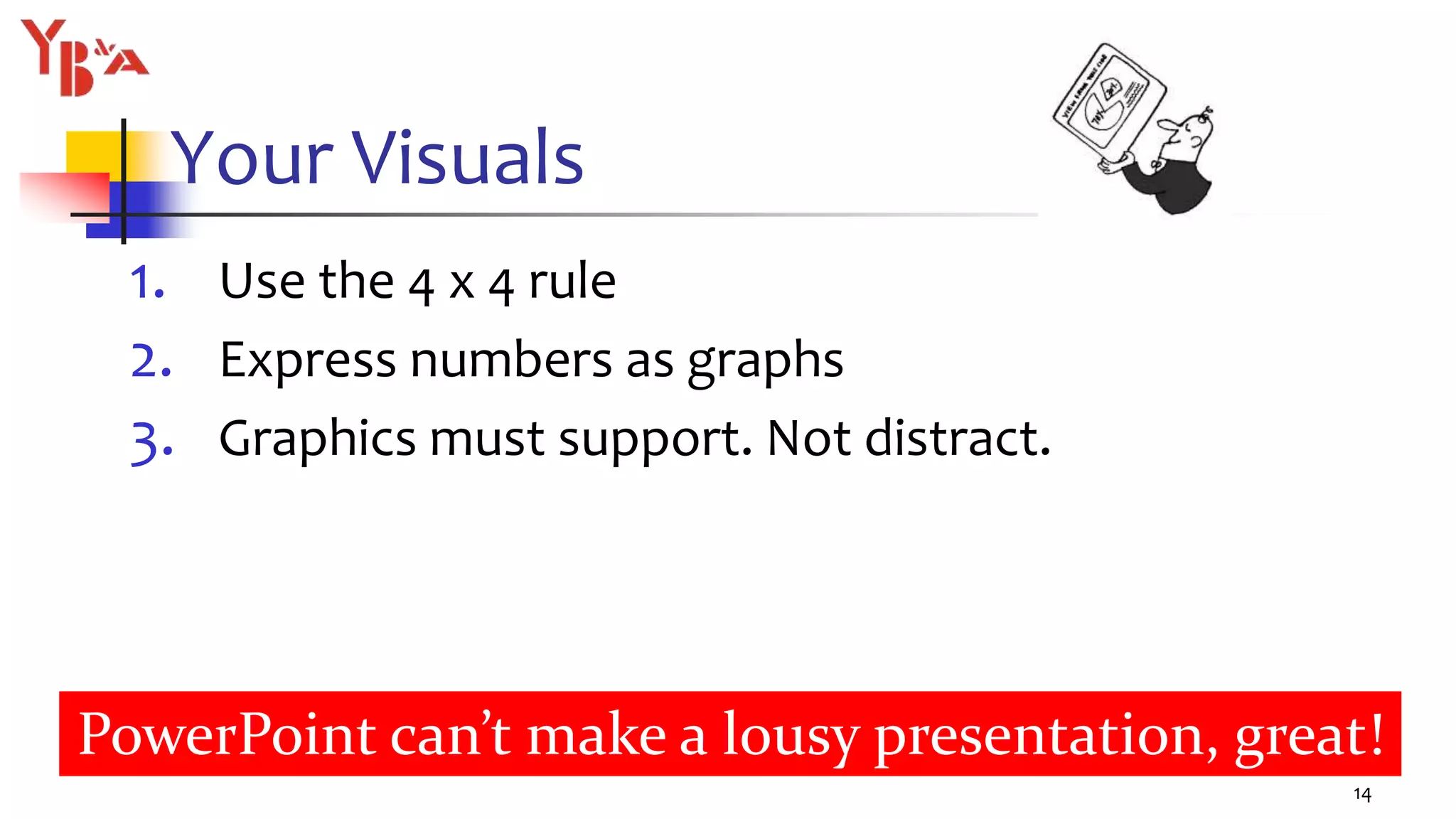
Your Visuals
1. Use the 4 x 4 rule
2. Express numbers as graphs
3. Graphics must support. Not distract.
14
PowerPoint can’t make a lousy presentation, great!
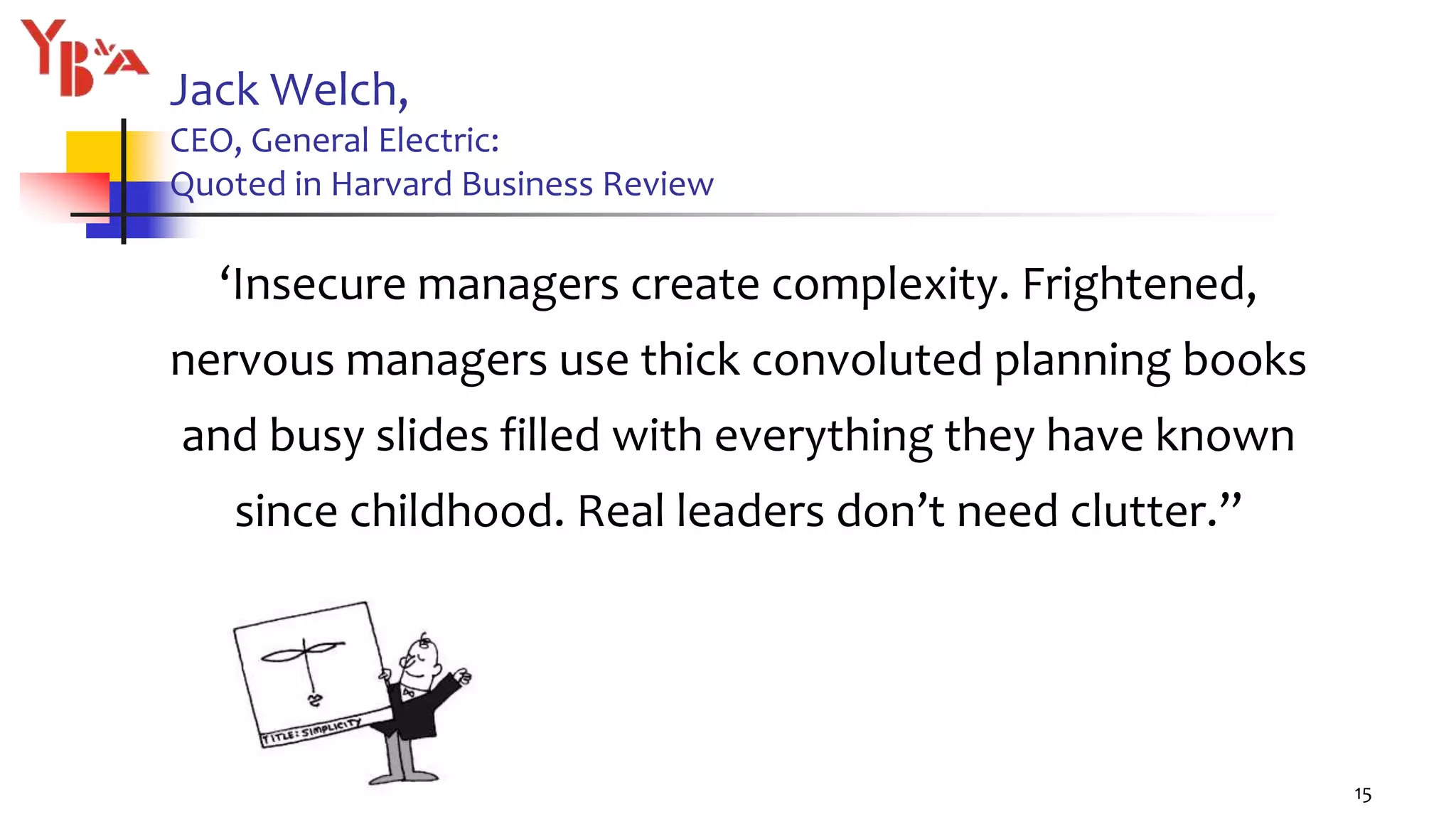
Jack Welch,
CEO, General Electric:
Quoted in Harvard Business Review
‘Insecure managers create complexity. Frightened,
nervous managers use thick convoluted planning books
and busy slides filled with everything they have known
since childhood. Real leaders don’t need clutter.”
15
PowerPoint
1. Use backgrounds to get contrast
2. Font size should be clearly readable
3. Use white space to improve readability
4. Use font colors that are clearly visible
16
NEVER use fancy animations or slide transitions
Flip Charts
1. Prepare the charts in advance
2. Don’t turn your back to the audience
3. Write neatly in large block letters or clear
running hand
4. Use blue or black colors. Not red or green
17
See if you can get a volunteer to write
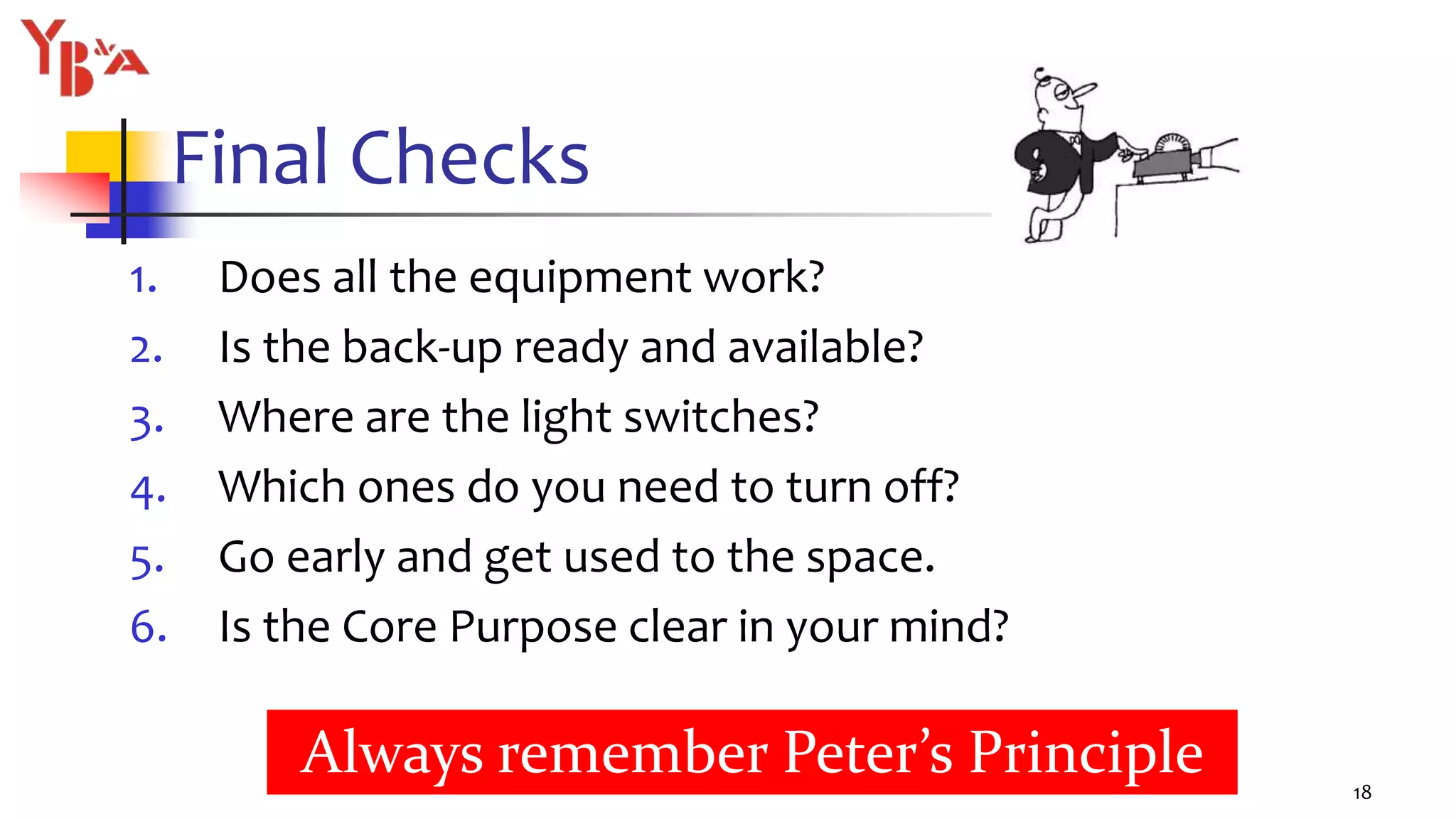
Final Checks
1. Does all the equipment work?
2. Is the back-up ready and available?
3. Where are the light switches?
4. Which ones do you need to turn off?
5. Go early and get used to the space.
6. Is the Core Purpose clear in your mind?
18
Always remember Peter’s Principle
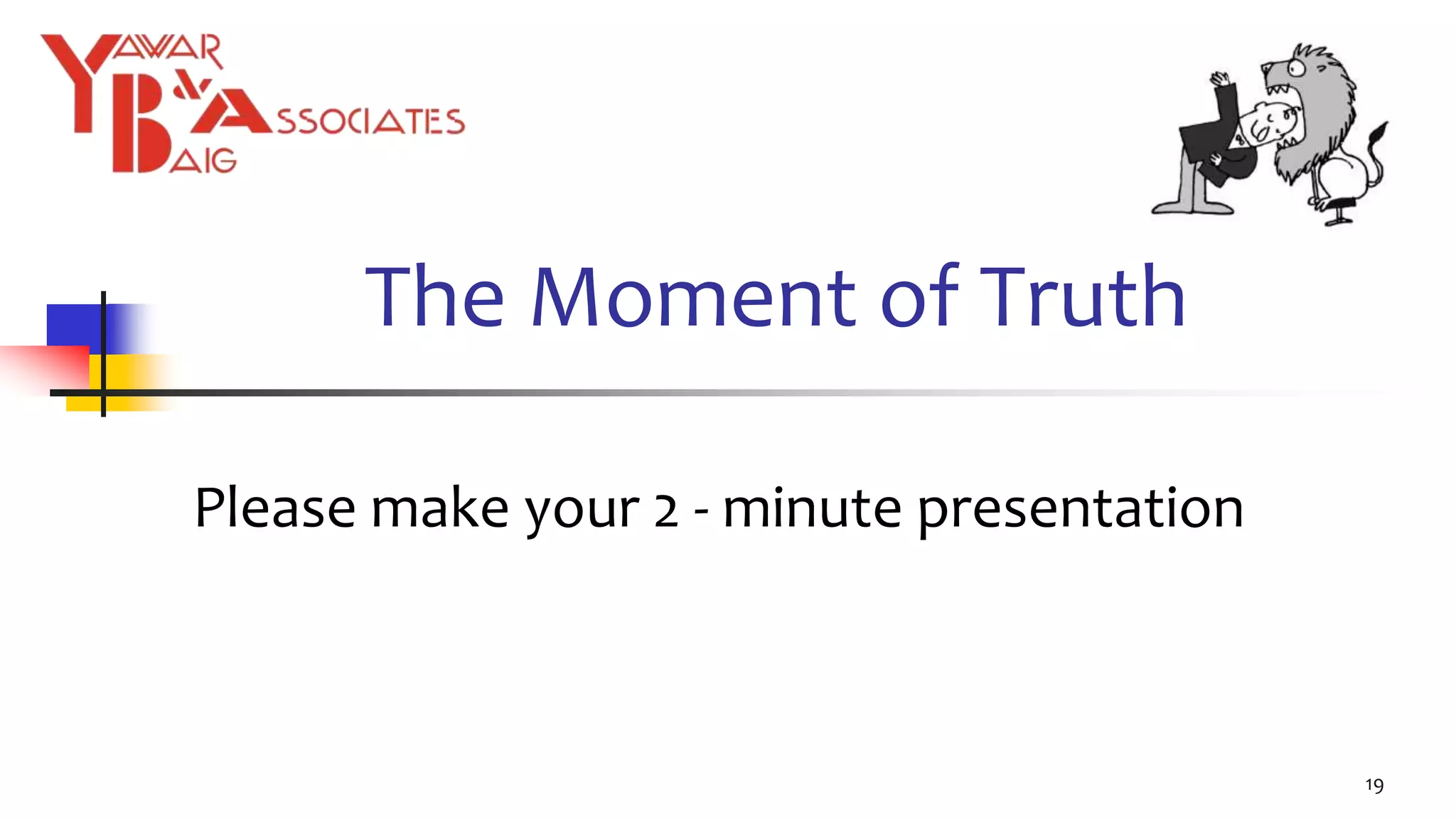
The Moment of Truth
19
Please make your 2 - minute presentation
You the Presenter
Hands!!
1. Raise your hands to the level of your waist and leave
them there. Forget about them
2. Don’t hang them by your sides or in front of your face
3. Your hands at the level of your waist will be visible,
look natural and do all the right things.
21
Not in the pocket, not behind the back and
not in each other
Clear the slide
1. Put up the slide and give 5 seconds for people to
read it – (take one deep breath)
2. The visual medium is so powerful that people
will read the matter anyway and not listen to you
22
Don’t waste your opportunity to be remembered
The PST! Method
1. P Point to a bullet
2. S Select a person
3. T Talk to that person
23
Body language’s not exact science
1. “The body does not lie" – interpreting body
language is not about mind reading.
2. Watch for gesture-clusters, facial expressions
and words. Make a hypothesis but keep it open
3. Validate your conclusion. Watch if the person
says and does something to support it.
24
Be prepared to change your opinion
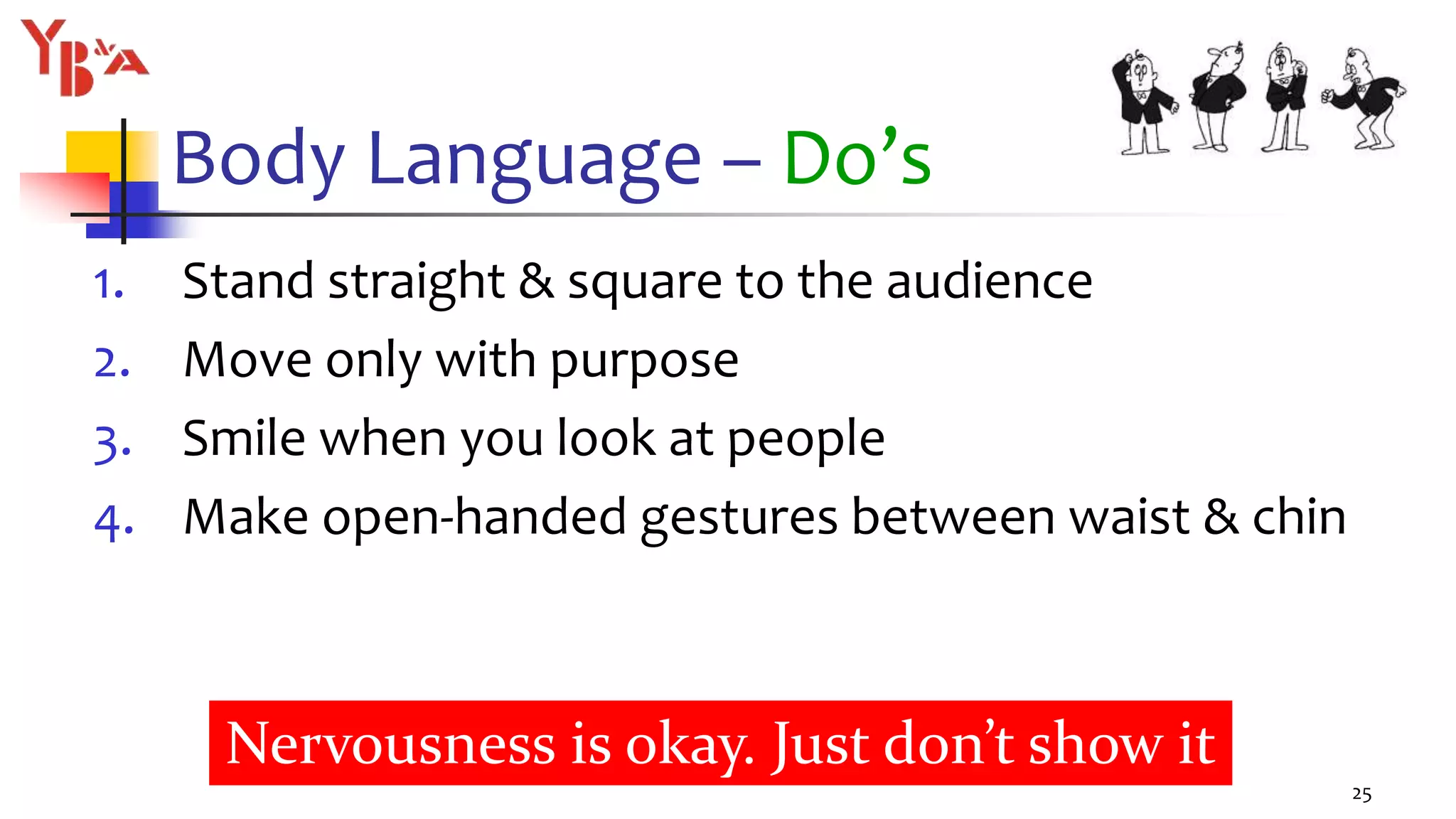
Body Language – Do’s
1. Stand straight & square to the audience
2. Move only with purpose
3. Smile when you look at people
4. Make open-handed gestures between waist & chin
25
Nervousness is okay. Just don’t show it
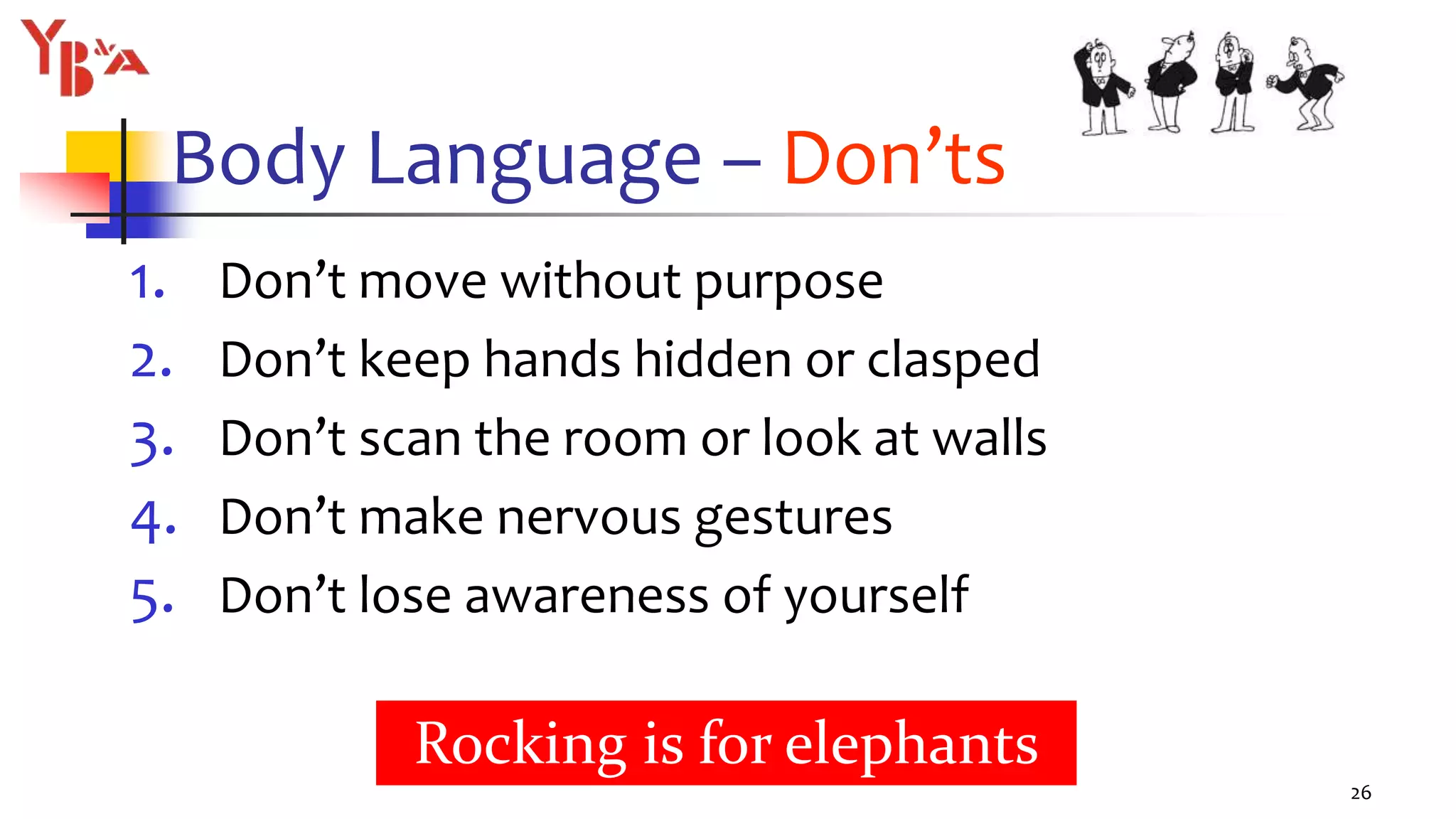
Body Language – Don’ts
1. Don’t move without purpose
2. Don’t keep hands hidden or clasped
3. Don’t scan the room or look at walls
4. Don’t make nervous gestures
5. Don’t lose awareness of yourself
26
Rocking is for elephants
Visual Input – Do’s
1. Lock your eyes with one person
2. Complete a thought with each person
3. Pause and take a breath while moving to
another person
27
Breathing is essential for survival
Visual Input – Don’ts
1. Don’t scan the room
2. Don’t look at the ceiling, floor or walls for your
thoughts
3. Don’t get hooked to one person in the audience
28
Hooked fish become dead
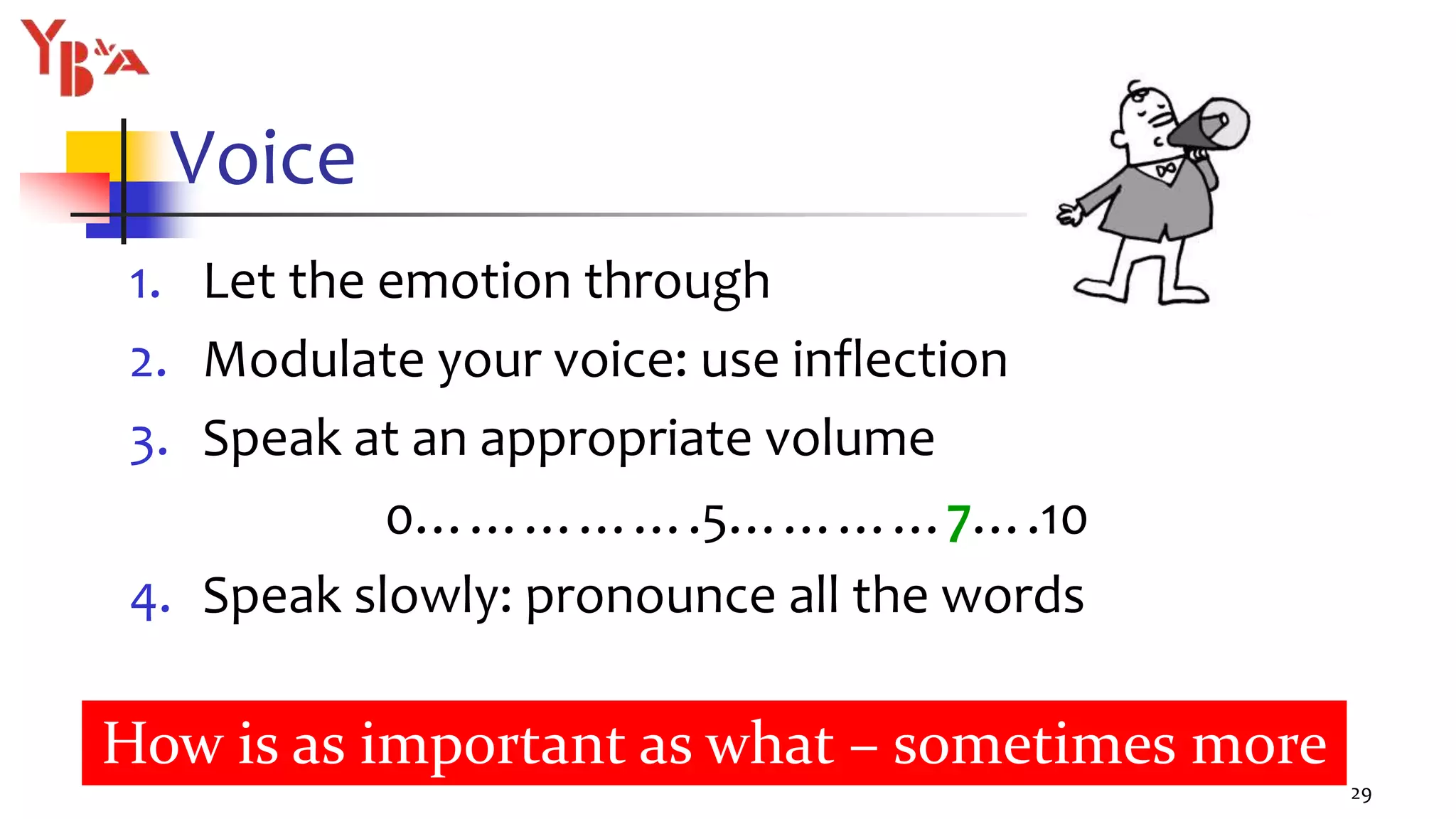
Voice
1. Let the emotion through
2. Modulate your voice: use inflection
3. Speak at an appropriate volume
0…………….5…………7….10
4. Speak slowly: pronounce all the words
29
How is as important as what – sometimes more
Raag Vistaar Sa
Sa re sa
Sa re ga re sa
Sa re ga ma ga re sa
Sa re ga ma pa ma ga re sa
Sa re ga ma pa dha pa ma ga re sa
Sa re ga ma pa dha ni dha pa ma ga re sa
Sa re ga ma pa dha ni sa ni dha pa ma ga re sa
30
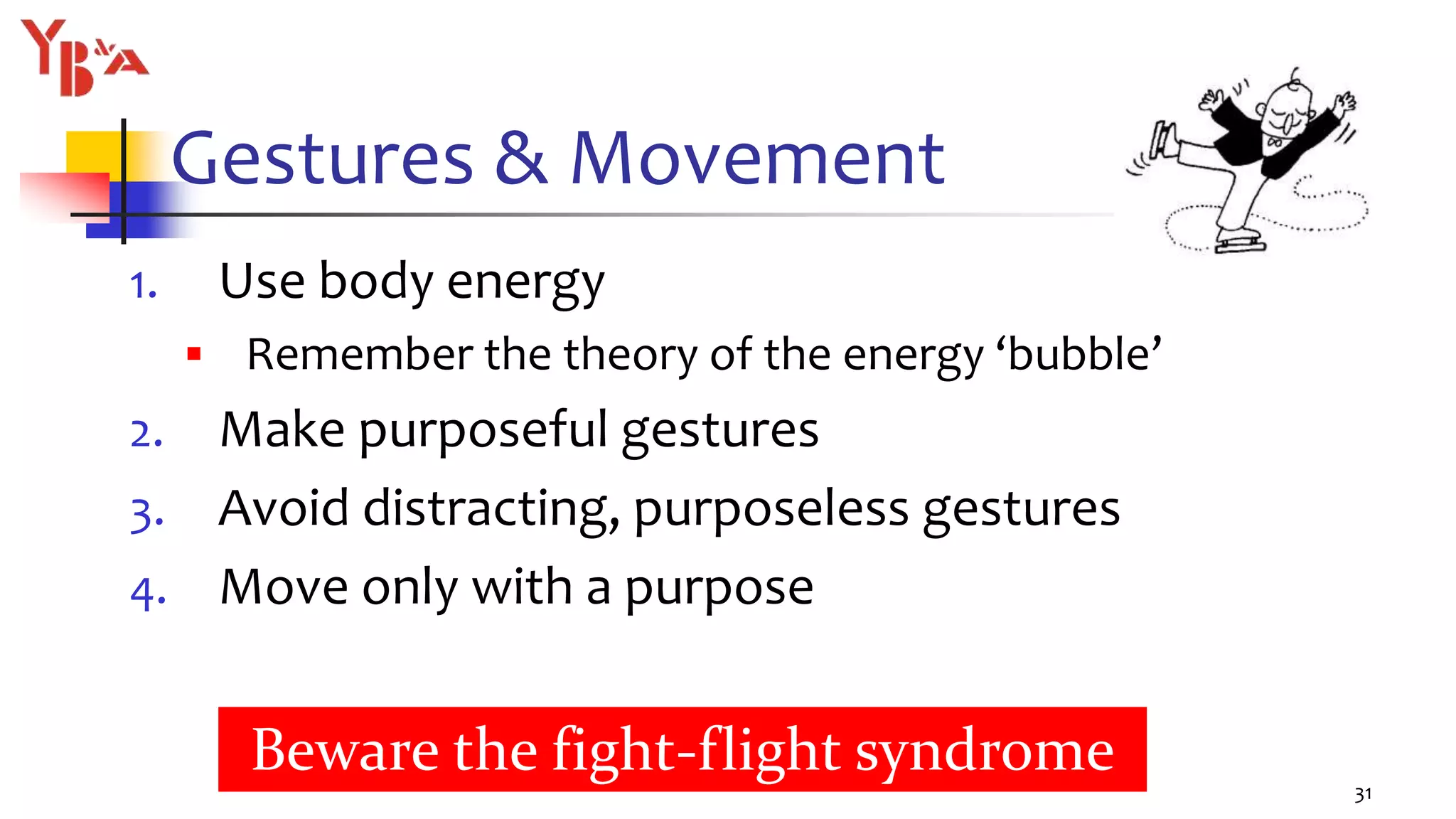
Gestures & Movement
1. Use body energy
 Remember the theory of the energy ‘bubble’
2. Make purposeful gestures
3. Avoid distracting, purposeless gestures
4. Move only with a purpose
31
Beware the fight-flight syndrome
The Moment of Truth
Please make your 2 - minute presentation
32
The Show Begins
The Critical 2 minutes
1. Maximize the effect of the first 2 minutes
2. Don’t start with a joke or an apology
3. Thank the audience for being there
4. Get to the point and keep their attention
5. Watch for audience reactions and respond
34
If you lose this moment, you’ve lost them
The 3 – step process
1. What’s the problem?
 State the basic issue in one sentence
2. What are the current negative effects or the
projected opportunity cost?
3. What is your recommendation?
 State in one sentence; “My recommendation is..
35
Answer from their perspective
1. What’s in it for me / us?
2. How do I know it will work?
 Support your solution with evidence
3. What do you want me to do?
 What’s the first step you want them to take?
 Show that this is critical, urgent and doable
36
You are on the Show
1. Never deviate from your objective
2. Let the emotion through
3. Use anecdotes and analogies to illustrate
4. Don’t be afraid of questions
37
NEVER break the time boundary
You & Them
1. Look at the audience
2. Talk to the audience
3. Silence is okay if it is not prolonged
4. Dress appropriately for the audience
38
They are giving you their attention – don’t waste it
The ‘Telling’ point
1. Tell’em what you gonna tell’em.
2. Tell’em
3. Tell’em what you told’em.
39
Give people something to walk away with
The Q&A Session
7 - Critical steps to handling it right
1. Raise your hand and ask, “Any questions?”
2. Select a questioner
3. Look directly at the person with a smile and listen for
any message behind the words
40
The Q&A Session
4. Break visually with the questioner and find another one
5. Restate or rephrase the question
6. Warn people that the session is about to end
7. Thank the audience for their interest
41
Give them a way to reach you
Continuous Learning
1. Try new things but with awareness
2. Admit mistakes when you must – don’t deny them
3. Don’t volunteer that something is wrong
4. Don’t ignore feedback
5. Don’t argue with feedback
42
Final Check
Do’s & Don’ts
8 – Do’s
1. Start with the point of your presentation
2. Speak at an appropriate level
3. Modulate your voice
4. Respect the time boundary always
44
8 – Do’s
5. Be responsive to the interest level of the audience
6. Welcome questions but stay in control
7. Be aware of yourself and others at all times
8. Thank the audience
45
8 – Don’ts
1. Be flippant or use inappropriate humor
2. Speak so softly that the audience has to strain to
hear you – they won’t
3. Beat about the bush or repeat things
4. Make apologetic preambles
46
8 – Don’ts
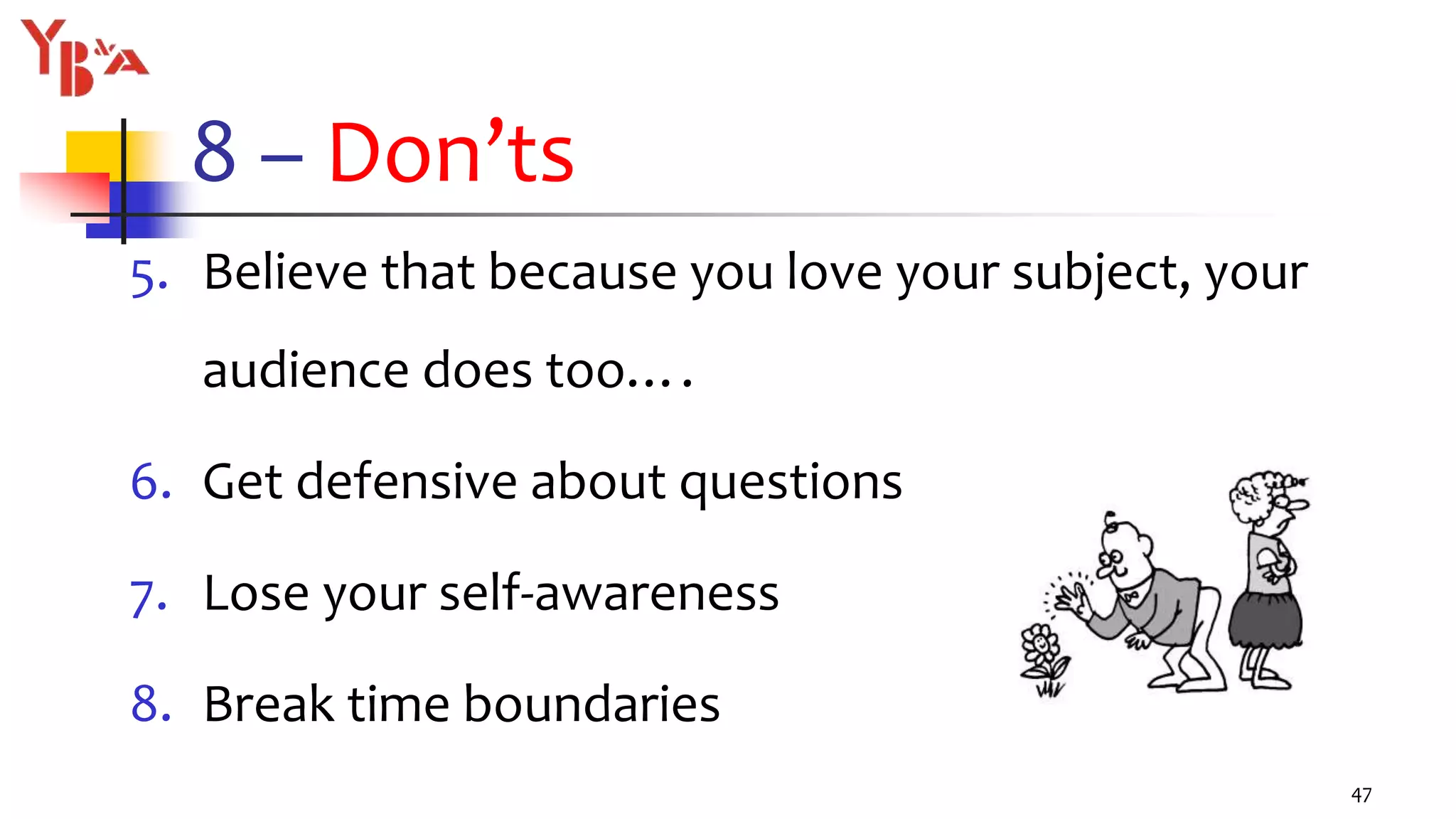
5. Believe that because you love your subject, your
audience does too….
6. Get defensive about questions
7. Lose your self-awareness
8. Break time boundaries
47
In the End
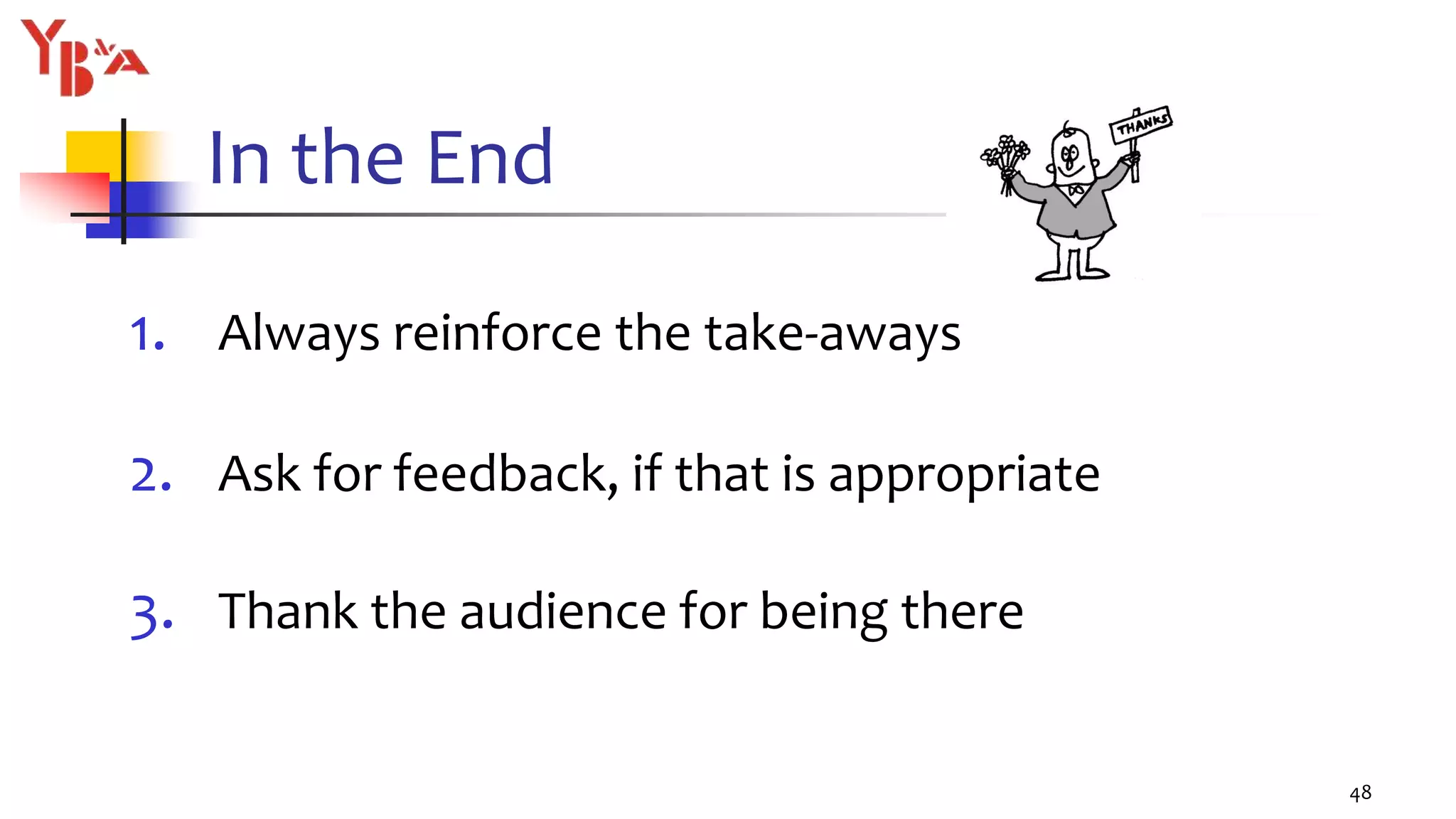
1. Always reinforce the take-aways
2. Ask for feedback, if that is appropriate
3. Thank the audience for being there
48
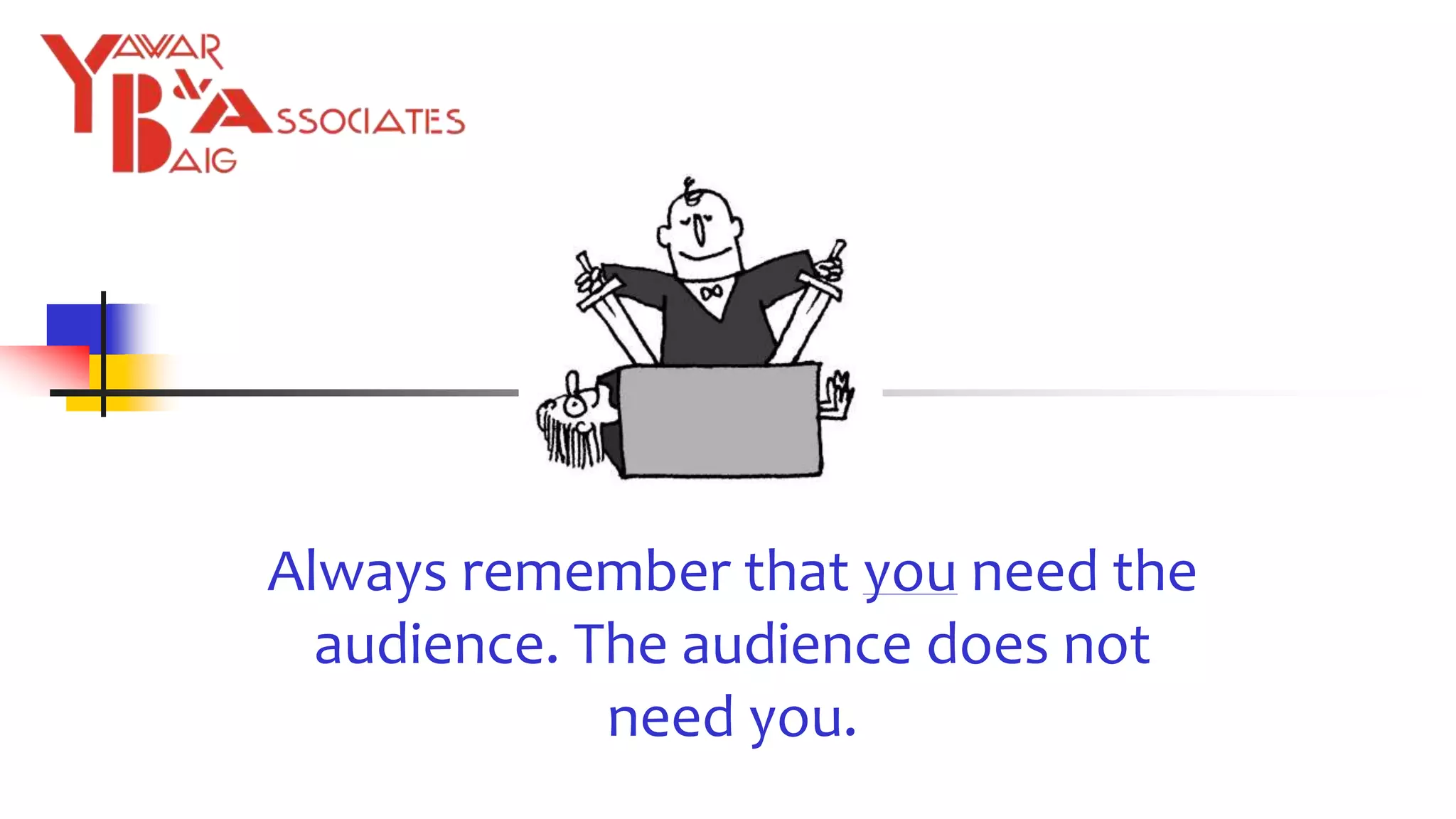
Always remember that you need the
audience. The audience does not
need you.
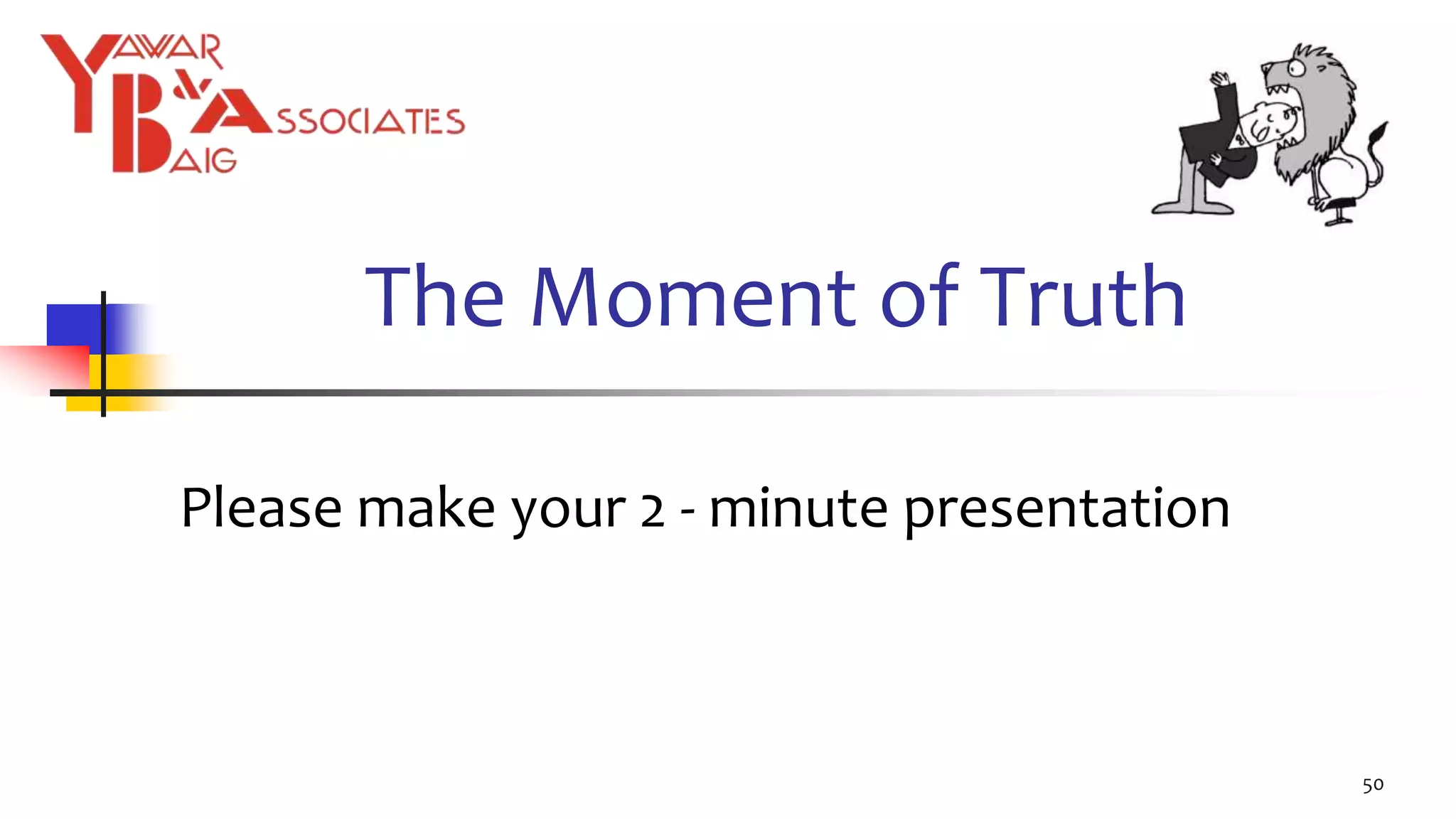
The Moment of Truth
Please make your 2 - minute presentation
50
yawarbaig@gmail.com

Present your way to the top - basic-dell

  • 1.
    Present Your Wayto the Top© How to make High Impact Presentations
  • 2.
    Mirza Yawar Baig Openingthe world, one mind at a time© Work Experience: International Speaker, Trainer, Author, Coach, Leadership Consultant with 16 years in Corporate General Management, 32 years in Leadership Training & Organizational Development, Family Business Consulting & Entrepreneurship Entrepreneur:  1994: Founded Education:  IIM-A , P-CMM®, MBTI©, WSA©, ISABS Books include:  It’s my Life  The Business of Family Business  An Entrepreneur’s Diary  Hiring Winners  20.10.2010-55 – Life Lessons of 55 years  Leadership is a Personal Choice  The World we don’t see  A Voice in the Wilderness Member Consultant Panel: USA  GE Corporate University, Crotonville, NY  Foreign Service Institute, Washington DC  AMA International, New York, NY  Andersen Corporate University, MN India  SVP National Police Academy, Hyderabad  SSB Academy, Bhopal & Gwaldam, Uttar Akhand  LBS Academy of Administration, Mussoorie Clients Include: GE, Oracle, Motorola, Microsoft, IBM, Digital-Compaq, National Semiconductor, Unilever, BSNL, Tata Indicom, Colgate, Asian Paints, Siemens, Wartsila, MphasiS, CavinKare, EXL Service, World Bank, ICRISAT, World Fish, Tata Corporate, J & J, Accenture, Zeneca Seeds, Shanta Biotech, Advanta, Reuters, Air India, Yusuf Bin Ahmed Kanoo, Olam, Regal Beloit, Reliance World, NIS Sparta, AMKA, Emami Group, Suzlon, JP Morgan, SEW Infrastructure, LANCO, Expolanka, Brandix yawarbaig@gmail.com www.yawarbaig.com
  • 3.
  • 4.
    Even magic needsPreparation
  • 5.
    Begin 1. Please speakabout yourself for ONE minute 5 The purpose of presenting is to be remembered
  • 6.
    3 – Criticalsecrets of confidence 1. Do your homework 2. Do your homework 3. Do your homework 6 There’s no substitute for homework and nobody can save you if you didn’t do it
  • 7.
  • 8.
    But words arestill very important 1. Mark Twain: ‘The difference between the right word and the almost right word is the difference between lightning and a lightning bug.’ 2. JFK: ‘Ask not what your country can do for you. Ask what you can do for your country’. 3. Aristotle: ‘It is the mark of an educated mind to be able to entertain a thought without accepting it.’ 8
  • 9.
    Words are us 1.Words are the only means we have of transferring our thoughts and feelings into the hearts and minds of others. 2. Words are remembered long after the speaker is forgotten. Words wound and heal. Words cause tears and laughter. Words are the stuff of dreams. Words are us. 3. So don’t underestimate the power of words, delivered perfectly 9 But only if they are delivered perfectly
  • 10.
    The 3, CriticalQuestions 1. What’s your core message? 2. Why are you saying it to them? 3. What do you want them to do? 10 Remember, the audience is not reading your words. They are listening and reacting to you.
  • 11.
    The Preparation 1. Knowyour Material 1. Never make someone else’s pitch 2. Never say something you are not convinced about 2. Know your Equipment 1. What is the best medium for the topic? 2. Does it work properly? 3. Do you know what to do if it fails? 11
  • 12.
    When, Where &What? 1. Know their Culture 1. What are appropriate similes in their culture? 2. What are the taboos? 2. Know your Audience 1. How do they like the material to be presented? 2. What kind of approach will persuade them? 3. What will put them off? 12 Knowing what NOT to do is even more important
  • 13.
    Slides 1. The purposeof slides is two-fold 1. To hook the attention of the audience 2. To remind you of what you have to say 2. A slide is not a script of your speech 13 Never read aloud the words of the slides
  • 14.
    Your Visuals 1. Usethe 4 x 4 rule 2. Express numbers as graphs 3. Graphics must support. Not distract. 14 PowerPoint can’t make a lousy presentation, great!
  • 15.
    Jack Welch, CEO, GeneralElectric: Quoted in Harvard Business Review ‘Insecure managers create complexity. Frightened, nervous managers use thick convoluted planning books and busy slides filled with everything they have known since childhood. Real leaders don’t need clutter.” 15
  • 16.
    PowerPoint 1. Use backgroundsto get contrast 2. Font size should be clearly readable 3. Use white space to improve readability 4. Use font colors that are clearly visible 16 NEVER use fancy animations or slide transitions
  • 17.
    Flip Charts 1. Preparethe charts in advance 2. Don’t turn your back to the audience 3. Write neatly in large block letters or clear running hand 4. Use blue or black colors. Not red or green 17 See if you can get a volunteer to write
  • 18.
    Final Checks 1. Doesall the equipment work? 2. Is the back-up ready and available? 3. Where are the light switches? 4. Which ones do you need to turn off? 5. Go early and get used to the space. 6. Is the Core Purpose clear in your mind? 18 Always remember Peter’s Principle
  • 19.
    The Moment ofTruth 19 Please make your 2 - minute presentation
  • 20.
  • 21.
    Hands!! 1. Raise yourhands to the level of your waist and leave them there. Forget about them 2. Don’t hang them by your sides or in front of your face 3. Your hands at the level of your waist will be visible, look natural and do all the right things. 21 Not in the pocket, not behind the back and not in each other
  • 22.
    Clear the slide 1.Put up the slide and give 5 seconds for people to read it – (take one deep breath) 2. The visual medium is so powerful that people will read the matter anyway and not listen to you 22 Don’t waste your opportunity to be remembered
  • 23.
    The PST! Method 1.P Point to a bullet 2. S Select a person 3. T Talk to that person 23
  • 24.
    Body language’s notexact science 1. “The body does not lie" – interpreting body language is not about mind reading. 2. Watch for gesture-clusters, facial expressions and words. Make a hypothesis but keep it open 3. Validate your conclusion. Watch if the person says and does something to support it. 24 Be prepared to change your opinion
  • 25.
    Body Language –Do’s 1. Stand straight & square to the audience 2. Move only with purpose 3. Smile when you look at people 4. Make open-handed gestures between waist & chin 25 Nervousness is okay. Just don’t show it
  • 26.
    Body Language –Don’ts 1. Don’t move without purpose 2. Don’t keep hands hidden or clasped 3. Don’t scan the room or look at walls 4. Don’t make nervous gestures 5. Don’t lose awareness of yourself 26 Rocking is for elephants
  • 27.
    Visual Input –Do’s 1. Lock your eyes with one person 2. Complete a thought with each person 3. Pause and take a breath while moving to another person 27 Breathing is essential for survival
  • 28.
    Visual Input –Don’ts 1. Don’t scan the room 2. Don’t look at the ceiling, floor or walls for your thoughts 3. Don’t get hooked to one person in the audience 28 Hooked fish become dead
  • 29.
    Voice 1. Let theemotion through 2. Modulate your voice: use inflection 3. Speak at an appropriate volume 0…………….5…………7….10 4. Speak slowly: pronounce all the words 29 How is as important as what – sometimes more
  • 30.
    Raag Vistaar Sa Sare sa Sa re ga re sa Sa re ga ma ga re sa Sa re ga ma pa ma ga re sa Sa re ga ma pa dha pa ma ga re sa Sa re ga ma pa dha ni dha pa ma ga re sa Sa re ga ma pa dha ni sa ni dha pa ma ga re sa 30
  • 31.
    Gestures & Movement 1.Use body energy  Remember the theory of the energy ‘bubble’ 2. Make purposeful gestures 3. Avoid distracting, purposeless gestures 4. Move only with a purpose 31 Beware the fight-flight syndrome
  • 32.
    The Moment ofTruth Please make your 2 - minute presentation 32
  • 33.
  • 34.
    The Critical 2minutes 1. Maximize the effect of the first 2 minutes 2. Don’t start with a joke or an apology 3. Thank the audience for being there 4. Get to the point and keep their attention 5. Watch for audience reactions and respond 34 If you lose this moment, you’ve lost them
  • 35.
    The 3 –step process 1. What’s the problem?  State the basic issue in one sentence 2. What are the current negative effects or the projected opportunity cost? 3. What is your recommendation?  State in one sentence; “My recommendation is.. 35
  • 36.
    Answer from theirperspective 1. What’s in it for me / us? 2. How do I know it will work?  Support your solution with evidence 3. What do you want me to do?  What’s the first step you want them to take?  Show that this is critical, urgent and doable 36
  • 37.
    You are onthe Show 1. Never deviate from your objective 2. Let the emotion through 3. Use anecdotes and analogies to illustrate 4. Don’t be afraid of questions 37 NEVER break the time boundary
  • 38.
    You & Them 1.Look at the audience 2. Talk to the audience 3. Silence is okay if it is not prolonged 4. Dress appropriately for the audience 38 They are giving you their attention – don’t waste it
  • 39.
    The ‘Telling’ point 1.Tell’em what you gonna tell’em. 2. Tell’em 3. Tell’em what you told’em. 39 Give people something to walk away with
  • 40.
    The Q&A Session 7- Critical steps to handling it right 1. Raise your hand and ask, “Any questions?” 2. Select a questioner 3. Look directly at the person with a smile and listen for any message behind the words 40
  • 41.
    The Q&A Session 4.Break visually with the questioner and find another one 5. Restate or rephrase the question 6. Warn people that the session is about to end 7. Thank the audience for their interest 41 Give them a way to reach you
  • 42.
    Continuous Learning 1. Trynew things but with awareness 2. Admit mistakes when you must – don’t deny them 3. Don’t volunteer that something is wrong 4. Don’t ignore feedback 5. Don’t argue with feedback 42
  • 43.
  • 44.
    8 – Do’s 1.Start with the point of your presentation 2. Speak at an appropriate level 3. Modulate your voice 4. Respect the time boundary always 44
  • 45.
    8 – Do’s 5.Be responsive to the interest level of the audience 6. Welcome questions but stay in control 7. Be aware of yourself and others at all times 8. Thank the audience 45
  • 46.
    8 – Don’ts 1.Be flippant or use inappropriate humor 2. Speak so softly that the audience has to strain to hear you – they won’t 3. Beat about the bush or repeat things 4. Make apologetic preambles 46
  • 47.
    8 – Don’ts 5.Believe that because you love your subject, your audience does too…. 6. Get defensive about questions 7. Lose your self-awareness 8. Break time boundaries 47
  • 48.
    In the End 1.Always reinforce the take-aways 2. Ask for feedback, if that is appropriate 3. Thank the audience for being there 48
  • 49.
    Always remember thatyou need the audience. The audience does not need you.
  • 50.
    The Moment ofTruth Please make your 2 - minute presentation 50
  • 51.