Workplace Learning Loses –
Unless We Engage Learners for
Action
Bert De Coutere – Center for Creative Leadership
OEB 2019 – Discovering Learning
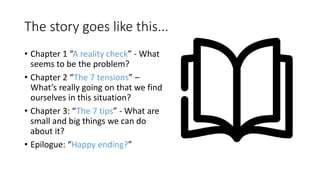
The story goes like this...
• Chapter 1 “A reality check” - What
seems to be the problem?
• Chapter 2 “The 7 tensions” –
What’s really going on that we find
ourselves in this situation?
• Chapter 3: “The 7 tips” - What are
small and big things we can do
about it?
• Epilogue: “Happy ending?”
What seems to be
the problem?
Chapter 1 – “A reality check”
1 minute introductions
How would you describe the
organization you work for in a tweet?
#shortandsweet
Reality check
Complete the sentence (1/7)
In my organization people _______ ask
for feedback on how they are doing.
(eg. never, regularly, often, only when
formally prompted, ...)
Reality check
Complete the sentence (2/7)
In my organization people _______ do
after-action reviews.
Reality check
Complete the sentence (3/7)
In my organization people _______
cancel or don’t show up for knowledge-
sharing sessions with their peers.
Reality check
Complete the sentence (4/7)
In my organization people spend
_______ time attending training than
last year.
Reality check
Complete the sentence (5/7)
In my organization when times are
tough training is among the _______ to
get cut.
Reality check
Complete the sentence (6/7)
I _______ protect my thinking time
(reflection time) by ______ .
Reality check
Complete the sentence (7/7)
In my organization, when people come
back from conferences, they _______.
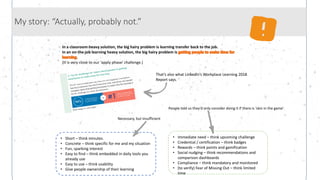
My story: “Actually, probably not.”
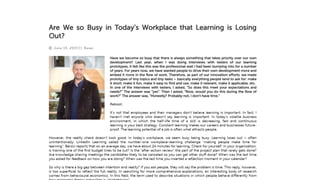
In a classroom-heavy solution, the big hairy problem is learning transfer back to the job.
In an on-the-job learning heavy solution, the big hairy problem is
.
(It is very close to our ‘apply phase’ challenge.)
That’s also what LinkedIn’s Workplace Learning 2018
Report says.
• Short – think minutes.
• Concrete – think specific for me and my situation
• Fun, sparking interest
• Easy to find – think embedded in daily tools you
already use
• Easy to use – think usability
• Give people ownership of their learning
Necessary, but insufficient
• Immediate need – think upcoming challenge
• Credential / certification – think badges
• Rewards – think points and gamification
• Social nudging – think recommendations and
comparison dashboards
• Compliance – think mandatory and monitored
• (to verify) Fear of Missing Out – think limited
time
People told us they’d only consider doing it if there is ‘skin in the game’.
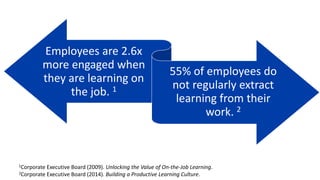
Employees are 2.6x
more engaged when
they are learning on
the job. 1
55% of employees do
not regularly extract
learning from their
work. 2
1Corporate Executive Board (2009). Unlocking the Value of On-the-Job Learning.
2Corporate Executive Board (2014). Building a Productive Learning Culture.
Phrase the problem as a question.
Complete the sentence
How can we _______?
What seems to be the puzzle to solve?
My version:
How can we help people protect – even
reclaim – their own learning in today’s busy
workplace?
But what is going
on that we find
ourselves in this
situation?
Chapter 2: The 7 tensions
1. what we say >< what we do
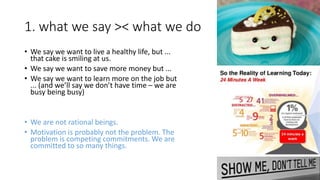
• We say we want to live a healthy life, but ...
that cake is smiling at us.
• We say we want to save more money but ...
• We say we want to learn more on the job but
... (and we’ll say we don’t have time – we are
busy being busy)
• We are not rational beings.
• Motivation is probably not the problem. The
problem is competing commitments. We are
committed to so many things.
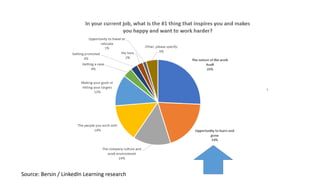
Source: Bersin / LinkedIn Learning research
2. now >< later
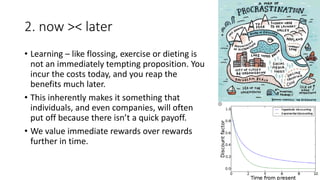
• Learning – like flossing, exercise or dieting is
not an immediately tempting proposition. You
incur the costs today, and you reap the
benefits much later.
• This inherently makes it something that
individuals, and even companies, will often
put off because there isn’t a quick payoff.
• We value immediate rewards over rewards
further in time.
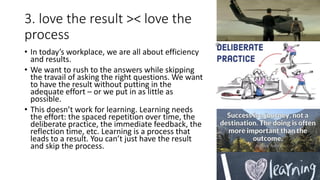
3. love the result >< love the
process
• In today’s workplace, we are all about efficiency
and results.
• We want to rush to the answers while skipping
the travail of asking the right questions. We want
to have the result without putting in the
adequate effort – or we put in as little as
possible.
• This doesn’t work for learning. Learning needs
the effort: the spaced repetition over time, the
deliberate practice, the immediate feedback, the
reflection time, etc. Learning is a process that
leads to a result. You can’t just have the result
and skip the process.
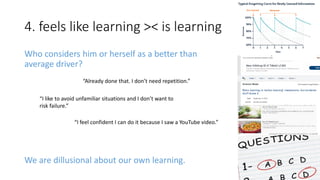
4. feels like learning >< is learning
We are dillusional about our own learning.
“Already done that. I don’t need repetition.”
“I like to avoid unfamiliar situations and I don’t want to
risk failure.”
“I feel confident I can do it because I saw a YouTube video.”
Who considers him or herself as a better than
average driver?
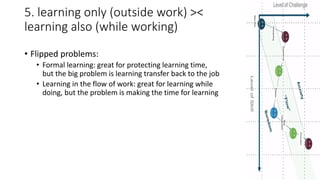
5. learning only (outside work) ><
learning also (while working)
• Flipped problems:
• Formal learning: great for protecting learning time,
but the big problem is learning transfer back to the job
• Learning in the flow of work: great for learning while
doing, but the problem is making the time for learning
6. pull >< push
• Who’s in control?
• HR ‘stuff dumped on me’
• Me in my bubble
• Self-directed learning is not the holy grail
• Who’s ultimately responsible for what?
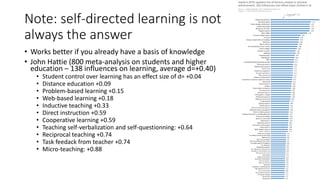
Note: self-directed learning is not
always the answer
• Works better if you already have a basis of knowledge
• John Hattie (800 meta-analysis on students and higher
education – 138 influences on learning, average d=+0.40)
• Student control over learning has an effect size of d= +0.04
• Distance education +0.09
• Problem-based learning +0.15
• Web-based learning +0.18
• Inductive teaching +0.33
• Direct instruction +0.59
• Cooperative learning +0.59
• Teaching self-verbalization and self-questionning: +0.64
• Reciprocal teaching +0.74
• Task feedack from teacher +0.74
• Micro-teaching: +0.88
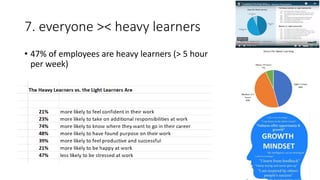
7. everyone >< heavy learners
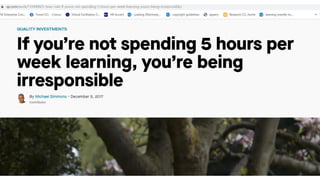
• 47% of employees are heavy learners (> 5 hour
per week)
What do you think?
Complete the sentence
In my opinion the root causes for the
problem are __________
What are big or
small things we
can do about it?
Chapter 3: The 7 tips
Start here with tip 1:
Meet your learners where they are
Engagement is
1. Cognitive  the effort the learner makes
2. Emotional  the emotional state the
learner expresses
3. Behavioral  what the learner does
What DoUsers
NOT Want
(right now)?
 To be “put in a box” (cognitive and emotional)
 To read more than a few sentences for what they need to know
(cognitive, emotional, behavioral)
 A “theme”, which is also a “box”  they DO want aVIBE4
(cognitive and emotional)
 Irrelevance and distractions from what they need/have to
do1 (cognitive, emotional, behavioral)
What DoUsers
Want (right
now)?
 As for that “box,” users instead want something
Specific to their background (emotional)
Unique in its adaptation to a changing, inclusive world1 (cognitive)
 Video that is short, quick, and to the point (video use is expected to
continue to grow)
 Instastories (cognitive and emotional)
 Users are spending a few minutes most days curating social content to
in effect create their own personal branding
It’s where they expect you to start to find out more about them.
It’s where they expect to start to find out more about you, your product,
or what you offer
 Experiences (cognitive, emotional, behavioral)
Users want to be associated with how others experience or have an
experience with them 2
• Immediacy of acquisition and application (cognitive, emotional,
behavioral)1
• Data indicates people expect a no more than 23 minute response time to
action they take online – how does that affect learning experiences?
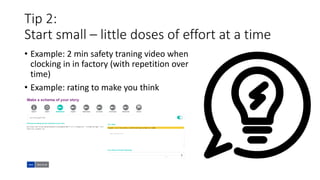
Tip 2:
Start small – little doses of effort at a time
• Example: 2 min safety traning video when
clocking in in factory (with repetition over
time)
• Example: rating to make you think
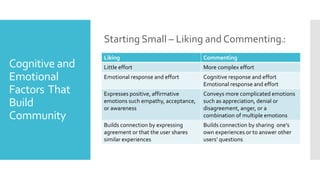
Cognitive and
Emotional
Factors That
Build
Community
Starting Small – Liking and Commenting9:
Liking Commenting
Little effort More complex effort
Emotional response and effort Cognitive response and effort
Emotional response and effort
Expresses positive, affirmative
emotions such empathy, acceptance,
or awareness
Conveys more complicated emotions
such as appreciation, denial or
disagreement, anger, or a
combination of multiple emotions
Builds connection by expressing
agreement or that the user shares
similar experiences
Builds connection by sharing one’s
own experiences or to answer other
users’ questions
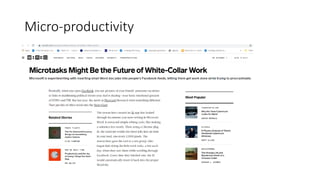
Micro-productivity
Tip 3:
Make the learning choice the default choice
Also called ‘choice architecture’ or ‘nudging’.
• Autopilot is easy. Humans pick the default choice
more often than we know.
• As the designer of leadership development
experiences, let’s make the default choice the
best one.
• Examples:
• How you formulate and anchor: “This leadership
development work will only take 5% of your direct
report’s time this year” vs “This leadership
development work will require 10 days of your direct
report’s time this year”
• Mental accounting: we think in time buckets
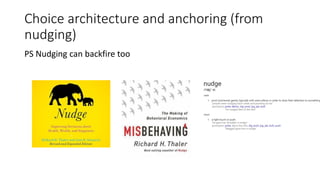
Choice architecture and anchoring (from
nudging)
PS Nudging can backfire too
Tip 4:
Help with the process
• Send reminders
• Maintain a to-learn-list
• Use solid research: Eg for a learning video
where you demonstrate something, a first
person view yields more retention than a
third person view
• Create a learning loop
• Reward effort (metaphors that tend to work:
investments or gym workouts)
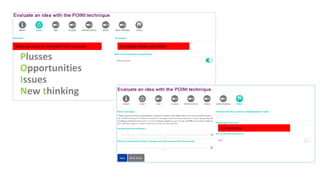
What you need to remember from last time Anticipate (makes you think)
For next time
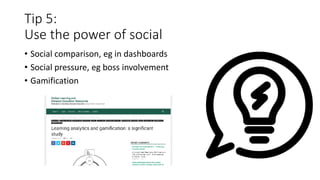
Tip 5:
Use the power of social
• Social comparison, eg in dashboards
• Social pressure, eg boss involvement
• Gamification
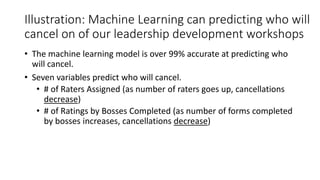
Illustration: Machine Learning can predicting who will
cancel on of our leadership development workshops
• The machine learning model is over 99% accurate at predicting who
will cancel.
• Seven variables predict who will cancel.
• # of Raters Assigned (as number of raters goes up, cancellations
decrease)
• # of Ratings by Bosses Completed (as number of forms completed
by bosses increases, cancellations decrease)
Tip 6:
Tap into the fear of missing out
• What if we DON’T record the webinar?
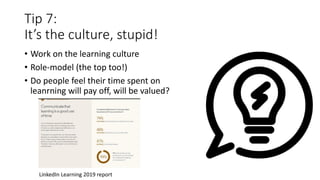
Tip 7:
It’s the culture, stupid!
• Work on the learning culture
• Role-model (the top too!)
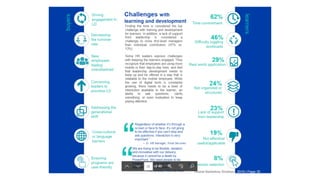
• Do people feel their time spent on
leanrning will pay off, will be valued?
LinkedIn Learning 2019 report
Share your concrete tips!
Complete the sentence
What we see us doing is ...
Is this going to
have a happy end?
Epilogue
Learning transfer depend on ...
• Research by Blume et al. (2010) on learning transfer
• Trainee features – cognitive ability (.37),
consientiousness (learner traits) (.28), voluntary
participation (.34). Moderately correlated: neuroticism
(.19), self-efficacy rating prior to training (.22),
motivation to learn (.23), learning goal orientation (some
personality trait) (.14) – interestingly also male gender
(.12)
• Work environment (.22) – supervisor support (.31), peer
support (.14), transfer climate (.27) (providing time and
practice opportunities), level of autonomy

Workplace learning loses unless we engage learners

  • 1.
    Workplace Learning Loses– Unless We Engage Learners for Action Bert De Coutere – Center for Creative Leadership OEB 2019 – Discovering Learning
  • 3.
    The story goeslike this... • Chapter 1 “A reality check” - What seems to be the problem? • Chapter 2 “The 7 tensions” – What’s really going on that we find ourselves in this situation? • Chapter 3: “The 7 tips” - What are small and big things we can do about it? • Epilogue: “Happy ending?”
  • 4.
    What seems tobe the problem? Chapter 1 – “A reality check”
  • 5.
    1 minute introductions Howwould you describe the organization you work for in a tweet? #shortandsweet
  • 6.
    Reality check Complete thesentence (1/7) In my organization people _______ ask for feedback on how they are doing. (eg. never, regularly, often, only when formally prompted, ...)
  • 7.
    Reality check Complete thesentence (2/7) In my organization people _______ do after-action reviews.
  • 8.
    Reality check Complete thesentence (3/7) In my organization people _______ cancel or don’t show up for knowledge- sharing sessions with their peers.
  • 9.
    Reality check Complete thesentence (4/7) In my organization people spend _______ time attending training than last year.
  • 10.
    Reality check Complete thesentence (5/7) In my organization when times are tough training is among the _______ to get cut.
  • 11.
    Reality check Complete thesentence (6/7) I _______ protect my thinking time (reflection time) by ______ .
  • 12.
    Reality check Complete thesentence (7/7) In my organization, when people come back from conferences, they _______.
  • 13.
    My story: “Actually,probably not.” In a classroom-heavy solution, the big hairy problem is learning transfer back to the job. In an on-the-job learning heavy solution, the big hairy problem is . (It is very close to our ‘apply phase’ challenge.) That’s also what LinkedIn’s Workplace Learning 2018 Report says. • Short – think minutes. • Concrete – think specific for me and my situation • Fun, sparking interest • Easy to find – think embedded in daily tools you already use • Easy to use – think usability • Give people ownership of their learning Necessary, but insufficient • Immediate need – think upcoming challenge • Credential / certification – think badges • Rewards – think points and gamification • Social nudging – think recommendations and comparison dashboards • Compliance – think mandatory and monitored • (to verify) Fear of Missing Out – think limited time People told us they’d only consider doing it if there is ‘skin in the game’.
  • 14.
    Employees are 2.6x moreengaged when they are learning on the job. 1 55% of employees do not regularly extract learning from their work. 2 1Corporate Executive Board (2009). Unlocking the Value of On-the-Job Learning. 2Corporate Executive Board (2014). Building a Productive Learning Culture.
  • 15.
    Phrase the problemas a question. Complete the sentence How can we _______?
  • 16.
    What seems tobe the puzzle to solve? My version: How can we help people protect – even reclaim – their own learning in today’s busy workplace?
  • 17.
    But what isgoing on that we find ourselves in this situation? Chapter 2: The 7 tensions
  • 18.
    1. what wesay >< what we do • We say we want to live a healthy life, but ... that cake is smiling at us. • We say we want to save more money but ... • We say we want to learn more on the job but ... (and we’ll say we don’t have time – we are busy being busy) • We are not rational beings. • Motivation is probably not the problem. The problem is competing commitments. We are committed to so many things.
  • 19.
    Source: Bersin /LinkedIn Learning research
  • 20.
    2. now ><later • Learning – like flossing, exercise or dieting is not an immediately tempting proposition. You incur the costs today, and you reap the benefits much later. • This inherently makes it something that individuals, and even companies, will often put off because there isn’t a quick payoff. • We value immediate rewards over rewards further in time.
  • 21.
    3. love theresult >< love the process • In today’s workplace, we are all about efficiency and results. • We want to rush to the answers while skipping the travail of asking the right questions. We want to have the result without putting in the adequate effort – or we put in as little as possible. • This doesn’t work for learning. Learning needs the effort: the spaced repetition over time, the deliberate practice, the immediate feedback, the reflection time, etc. Learning is a process that leads to a result. You can’t just have the result and skip the process.
  • 22.
    4. feels likelearning >< is learning We are dillusional about our own learning. “Already done that. I don’t need repetition.” “I like to avoid unfamiliar situations and I don’t want to risk failure.” “I feel confident I can do it because I saw a YouTube video.” Who considers him or herself as a better than average driver?
  • 23.
    5. learning only(outside work) >< learning also (while working) • Flipped problems: • Formal learning: great for protecting learning time, but the big problem is learning transfer back to the job • Learning in the flow of work: great for learning while doing, but the problem is making the time for learning
  • 24.
    6. pull ><push • Who’s in control? • HR ‘stuff dumped on me’ • Me in my bubble • Self-directed learning is not the holy grail • Who’s ultimately responsible for what?
  • 25.
    Note: self-directed learningis not always the answer • Works better if you already have a basis of knowledge • John Hattie (800 meta-analysis on students and higher education – 138 influences on learning, average d=+0.40) • Student control over learning has an effect size of d= +0.04 • Distance education +0.09 • Problem-based learning +0.15 • Web-based learning +0.18 • Inductive teaching +0.33 • Direct instruction +0.59 • Cooperative learning +0.59 • Teaching self-verbalization and self-questionning: +0.64 • Reciprocal teaching +0.74 • Task feedack from teacher +0.74 • Micro-teaching: +0.88
  • 26.
    7. everyone ><heavy learners • 47% of employees are heavy learners (> 5 hour per week)
  • 27.
    What do youthink? Complete the sentence In my opinion the root causes for the problem are __________
  • 28.
    What are bigor small things we can do about it? Chapter 3: The 7 tips
  • 29.
    Start here withtip 1: Meet your learners where they are Engagement is 1. Cognitive  the effort the learner makes 2. Emotional  the emotional state the learner expresses 3. Behavioral  what the learner does
  • 31.
    What DoUsers NOT Want (rightnow)?  To be “put in a box” (cognitive and emotional)  To read more than a few sentences for what they need to know (cognitive, emotional, behavioral)  A “theme”, which is also a “box”  they DO want aVIBE4 (cognitive and emotional)  Irrelevance and distractions from what they need/have to do1 (cognitive, emotional, behavioral)
  • 32.
    What DoUsers Want (right now)? As for that “box,” users instead want something Specific to their background (emotional) Unique in its adaptation to a changing, inclusive world1 (cognitive)  Video that is short, quick, and to the point (video use is expected to continue to grow)  Instastories (cognitive and emotional)  Users are spending a few minutes most days curating social content to in effect create their own personal branding It’s where they expect you to start to find out more about them. It’s where they expect to start to find out more about you, your product, or what you offer  Experiences (cognitive, emotional, behavioral) Users want to be associated with how others experience or have an experience with them 2 • Immediacy of acquisition and application (cognitive, emotional, behavioral)1 • Data indicates people expect a no more than 23 minute response time to action they take online – how does that affect learning experiences?
  • 33.
    Tip 2: Start small– little doses of effort at a time • Example: 2 min safety traning video when clocking in in factory (with repetition over time) • Example: rating to make you think
  • 34.
    Cognitive and Emotional Factors That Build Community StartingSmall – Liking and Commenting9: Liking Commenting Little effort More complex effort Emotional response and effort Cognitive response and effort Emotional response and effort Expresses positive, affirmative emotions such empathy, acceptance, or awareness Conveys more complicated emotions such as appreciation, denial or disagreement, anger, or a combination of multiple emotions Builds connection by expressing agreement or that the user shares similar experiences Builds connection by sharing one’s own experiences or to answer other users’ questions
  • 35.
  • 36.
    Tip 3: Make thelearning choice the default choice Also called ‘choice architecture’ or ‘nudging’. • Autopilot is easy. Humans pick the default choice more often than we know. • As the designer of leadership development experiences, let’s make the default choice the best one. • Examples: • How you formulate and anchor: “This leadership development work will only take 5% of your direct report’s time this year” vs “This leadership development work will require 10 days of your direct report’s time this year” • Mental accounting: we think in time buckets
  • 37.
    Choice architecture andanchoring (from nudging) PS Nudging can backfire too
  • 38.
    Tip 4: Help withthe process • Send reminders • Maintain a to-learn-list • Use solid research: Eg for a learning video where you demonstrate something, a first person view yields more retention than a third person view • Create a learning loop • Reward effort (metaphors that tend to work: investments or gym workouts)
  • 39.
    What you needto remember from last time Anticipate (makes you think) For next time
  • 40.
    Tip 5: Use thepower of social • Social comparison, eg in dashboards • Social pressure, eg boss involvement • Gamification
  • 41.
    Illustration: Machine Learningcan predicting who will cancel on of our leadership development workshops • The machine learning model is over 99% accurate at predicting who will cancel. • Seven variables predict who will cancel. • # of Raters Assigned (as number of raters goes up, cancellations decrease) • # of Ratings by Bosses Completed (as number of forms completed by bosses increases, cancellations decrease)
  • 42.
    Tip 6: Tap intothe fear of missing out • What if we DON’T record the webinar?
  • 43.
    Tip 7: It’s theculture, stupid! • Work on the learning culture • Role-model (the top too!) • Do people feel their time spent on leanrning will pay off, will be valued? LinkedIn Learning 2019 report
  • 45.
    Share your concretetips! Complete the sentence What we see us doing is ...
  • 46.
    Is this goingto have a happy end? Epilogue
  • 47.
    Learning transfer dependon ... • Research by Blume et al. (2010) on learning transfer • Trainee features – cognitive ability (.37), consientiousness (learner traits) (.28), voluntary participation (.34). Moderately correlated: neuroticism (.19), self-efficacy rating prior to training (.22), motivation to learn (.23), learning goal orientation (some personality trait) (.14) – interestingly also male gender (.12) • Work environment (.22) – supervisor support (.31), peer support (.14), transfer climate (.27) (providing time and practice opportunities), level of autonomy