Challenges faced by
  Indian MNCs
      Abroad

Presentation By   :   Arjun.Govind
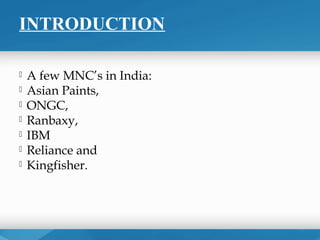
INTRODUCTION

   A few MNC’s in India:
   Asian Paints,
   ONGC,
   Ranbaxy,
   IBM
   Reliance and
   Kingfisher.
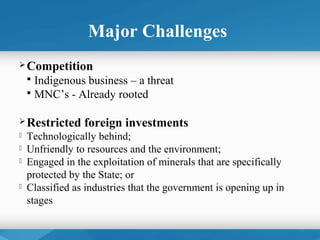
Major Challenges
 Competition
     Indigenous business – a threat
     MNC’s - Already rooted


 Restricted     foreign investments
   Technologically behind;
   Unfriendly to resources and the environment;
   Engaged in the exploitation of minerals that are specifically
    protected by the State; or
   Classified as industries that the government is opening up in
    stages
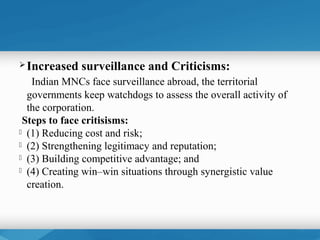
 Increased   surveillance and Criticisms:
   Indian MNCs face surveillance abroad, the territorial
  governments keep watchdogs to assess the overall activity of
  the corporation.
 Steps to face critisisms:
 (1) Reducing cost and risk;
 (2) Strengthening legitimacy and reputation;
 (3) Building competitive advantage; and
 (4) Creating win–win situations through synergistic value

  creation.
 Cross  cultural issues and values affecting Organizational
  culture
  • Motivational approaches
  • Eg. Asian Paints manager
 Ethical issues
  • Manipulation of stock markets
  • Lobbying
  • Fudging of accounts and balance sheet:
  • Product Piracy
  • Surrogate and deceptive advertising
  • Discrimination in selection, compensation and promotion
   CSR is becoming compulsion

    (1) Clear in terms of objectives and aspirations,
    (2) Transparent from both sides and
    (3) Committed with a better prospect through
    continuous feedback.
Corruption
•   Of India
•   Of the other nation

Subversion
•   Riots, political emergency situations, terrorism and
    government regulations to protect domestic business
   Norms, Policies and Political
    challenges

    a. Unfair legal proceedings
    b. Government regulations
    c. Reserved workers
    d. Taxation
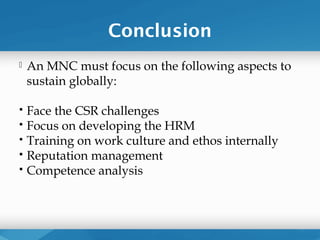
Conclusion
   An MNC must focus on the following aspects to
    sustain globally:

   Face the CSR challenges
   Focus on developing the HRM
   Training on work culture and ethos internally
   Reputation management
   Competence analysis
THANK YOU

Challenges faced by indian MNCs abroad

  • 1.
    Challenges faced by Indian MNCs Abroad Presentation By : Arjun.Govind
  • 2.
    INTRODUCTION  A few MNC’s in India:  Asian Paints,  ONGC,  Ranbaxy,  IBM  Reliance and  Kingfisher.
  • 3.
    Major Challenges  Competition  Indigenous business – a threat  MNC’s - Already rooted  Restricted foreign investments  Technologically behind;  Unfriendly to resources and the environment;  Engaged in the exploitation of minerals that are specifically protected by the State; or  Classified as industries that the government is opening up in stages
  • 4.
     Increased surveillance and Criticisms: Indian MNCs face surveillance abroad, the territorial governments keep watchdogs to assess the overall activity of the corporation. Steps to face critisisms:  (1) Reducing cost and risk;  (2) Strengthening legitimacy and reputation;  (3) Building competitive advantage; and  (4) Creating win–win situations through synergistic value creation.
  • 5.
     Cross cultural issues and values affecting Organizational culture • Motivational approaches • Eg. Asian Paints manager  Ethical issues • Manipulation of stock markets • Lobbying • Fudging of accounts and balance sheet: • Product Piracy • Surrogate and deceptive advertising • Discrimination in selection, compensation and promotion
  • 6.
    CSR is becoming compulsion (1) Clear in terms of objectives and aspirations, (2) Transparent from both sides and (3) Committed with a better prospect through continuous feedback.
  • 7.
    Corruption • Of India • Of the other nation Subversion • Riots, political emergency situations, terrorism and government regulations to protect domestic business
  • 8.
    Norms, Policies and Political challenges a. Unfair legal proceedings b. Government regulations c. Reserved workers d. Taxation
  • 9.
    Conclusion  An MNC must focus on the following aspects to sustain globally:  Face the CSR challenges  Focus on developing the HRM  Training on work culture and ethos internally  Reputation management  Competence analysis
  • 10.