LOGO
COMPANY PROFILE
 Founded in England in 1895 as J.W.
Foster and Sons, a manufacturer of track
shoes
 Renamed Reebok in 1958.
 North American distribution rights
purchased by Paul Fireman in 1979.
 Fireman and a few investors bought the
parent company in 1984.
Vision Statement
“Continue to bring inspiration to present and future
athletes, while maintaining the company's standard
of quality for its products.”
Mission Statement
“At Reebok, we see the world a little differently and
throughout our history have made our mark when
we’ve had the courage to challenge convention.
Reebok creates products and marketing programs
that reflect the brand’s unlimited creative potential. ."
REEBOK HISTORY
1890-1930
 J.W. Foster and Spikes of Fire
 in the 1890s, Joseph William Foster made some of
the first known running shoes with spikes in them.
1950-1980
 A Gazelle Named Reebok, A Company on the
Move
 In 1958, two of the founder's grandsons started a
companion company that came to be known as
Reebok, named for an African gazelle.
1980‘s
 By 1981, Reebok's sales exceeded $1.5 million.
 In 1986, Reebok made its first strategic
acquisition, The Rockport Company.
1990's
 Reebok began a transition from a company
identified principally with fitness and exercise to
one equally involved in sports.
2000-10
 Reebok and the National Football League announced
an exclusive partnership that serves as a foundation
of the NFL’s consumer products business.
 Reebok formed a long-term strategic partnership
with the National Basketball Association.
 Reebok launched Rbk Hockey, a new and innovative
line of ultra-high performance hockey equipment.
 In January 2006, adidas-Salomon AG acquired
Reebok, forever altering the worldwide sporting
goods industry landscape.
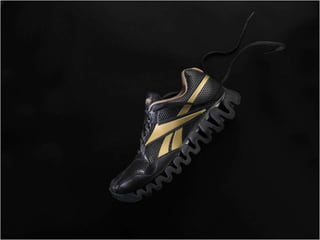
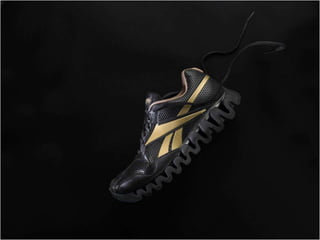
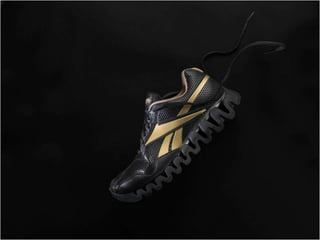
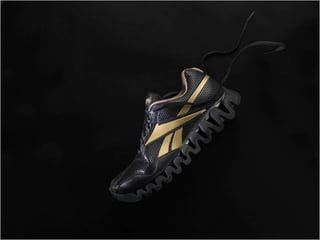
 Reebok launched ZigTech, designed to conserve and
return energy to the athlete for a soft and springy
ride.
2011-12
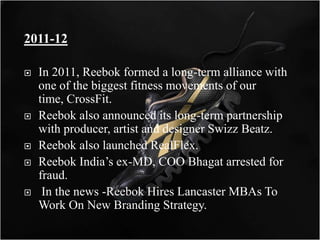
 In 2011, Reebok formed a long-term alliance with
one of the biggest fitness movements of our time,
CrossFit.
 Reebok also announced its long-term partnership
with producer, artist and designer Swizz Beatz.
 Reebok also launched RealFlex.
 Reebok India’s ex-MD, COO Bhagat arrested for
fraud.
 In the news -Reebok Hires Lancaster MBAs To
Work On New Branding Strategy.
PRODUCT LINE
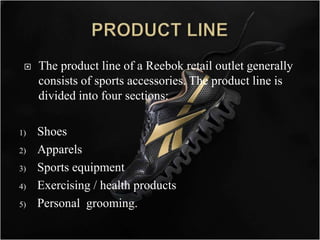
 The product line of a Reebok retail outlet
generally consists of sports accessories. The
product line is divided into four sections:
1) Shoes
2) Apparels
3) Sports equipment
4) Exercising / health products
5) Personal grooming.
1) Shoes
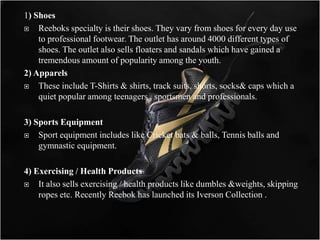
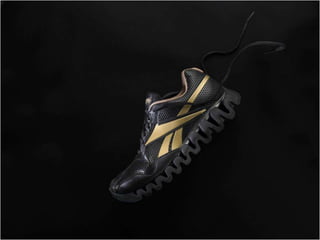
 Reeboks specialty is their shoes. They vary from shoes for every day use
to professional footwear. The outlet has around 4000 different types of
shoes. The outlet also sells floaters and sandals which have gained a
tremendous amount of popularity among the youth.
2) Apparels
 These include T-Shirts & shirts, track suits, shorts, socks& caps which a
quiet popular among teenagers , sportsmen and professionals.
3) Sports Equipment
 Sport equipment includes like Cricket bats & balls, Tennis balls and
gymnastic equipment.
4) Exercising / Health Products
 It also sells exercising / health products like dumbles &weights, skipping
ropes etc. Recently Reebok has launched its Iverson Collection .
TYPES OF RETAILERS
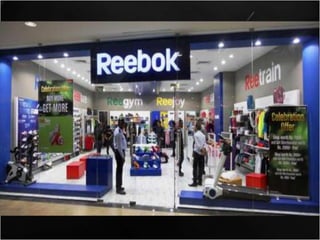
 This Reebok showroom is a specialty store and
is a franchisee organization. The products are
basically shoes , apparels, sports equipment,
health products etc. The horizon of products is
very limited, that is, there are only a few types
of product.
 According to the need of customers, specialty
stores are further divided into
1. Single-line stores,
2. Limited-line stores and
3. Super- speciality stores
Narrow product line with a deep assortment , such as apparel
stores, sporting goods stores, furniture stores , florists, and
bookstores would be super specialty store ,clothing store
would be a single line store and a men’s clothing store would
be a limited line store.
Specialty Store:
Franchise Organization:
Contractual association between a franchiser (manufacturer,
wholesalers, service organization)and franchisees
(independent business people who buy the right to own and
operate one or more units in the franchise system).
Franchising has been prominent in dozens of product and
service areas.
MARKETING MIX
 Winning companies will be those who can
meet customer needs economically and
conveniently and with effective
communication.
 The marketing mix of Reebok has a focused
market. It also has been campaigning on the
product, price, promotion and place.
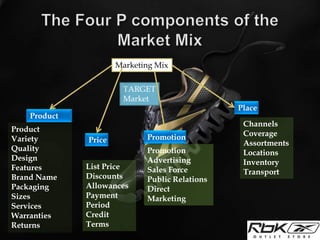
The Four P components of the
Market Mix
Marketing Mix
Product
Price Promotion
Place
TARGET
Market
Channels
Coverage
Assortment
s
Locations
Inventory
Transport
Promotion
Advertising
Sales Force
Public Relations
Direct Marketing
List Price
Discounts
Allowances
Payment
Period
Credit
Terms
Product
Variety
Quality
Design
Features
Brand Name
Packaging
Sizes
Services
Warranties
Returns
Promotion
Promotion includes all the activities the
company undertakes to communicate and
promote its products to the target market.
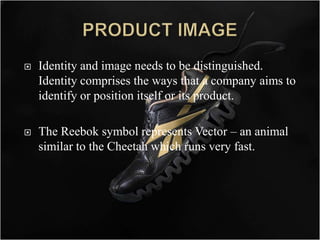
PRODUCT IMAGE
 Identity and image needs to be
distinguished. Identity comprises the ways
that a company aims to identify or position
itself or its product.
 The Reebok symbol represents Vector – an
animal similar to the Cheetah which runs
very fast.
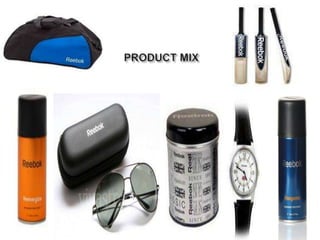
PRODUCT MIX
Buyer’s point of view
 From a buyer’s point of view, each marketing tool is
designed to deliver a customer benefit. Robert
Lauterborn suggested that the sellers’ four Ps
correspond to the customers’ four Cs.
Four Ps Four Cs
Product Customer
Price Cost
Place Convenience
Promotion Communication
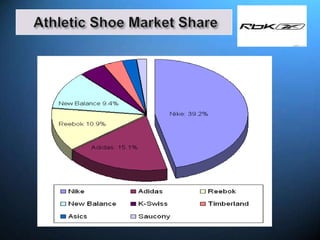
Athletic Shoe Market Share
R & D
Focus on Fitness and Training
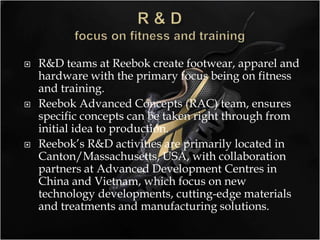
 R&D teams at Reebok create footwear, apparel and
hardware with the primary focus being on fitness and
training.
 Reebok Advanced Concepts (RAC) team, ensures
specific concepts can be taken right through from initial
idea to production.
 Reebok’s R&D activities are primarily located in
Canton/Massachusetts, USA, with collaboration partners
at Advanced Development Centres in China and
Vietnam, which focus on new technology developments,
cutting-edge materials and treatments and
manufacturing solutions.
SWOT Analysis (Reebok International LTD)
 Strength
 The firm can predict the shoe market and come up with
products that will create market.
 Diversifies its products into the competitive market.
 New technology makes the firm to be able to make better
shoes.
 The top firm in the shoe industry.
 Utilize market research and development and try to find out
consumer's preferences.
 Able to enter into different markets and to gain market share
from it.
 Weakness
 Reebok's current position in the apparel industry is not strong.
 Go for too many segments, so company can't handle all of them well, and it
may cause company to loss its market in the long run.
 Put the company operation oversea may get company potential risks.
 The company's non-Reebok brand footwear may be potential competitor for
itself.
 Opportunity
 The market is big, and the increasing demand is
expected.
 Produce oversea will help company to cut down its
cost on labour, and generate more margins on its
products.
 Newer Technology development or innovations can
help company to get more profit and market share on
its future products.
 Extend its distribution network via its own
subsidiaries or individual distributors will increase
Reebok 's future sales.
 Threats
 The industry is controlled by fads and the fads are nearly not
predictable.
 Reebok facing strong competitors in the casual market, and
competitor's products are trendy, fashionable, and fleshy.
 Rapid changes in technology and consumer preference that
can occur in the footwear and apparel markets constitute
significant risk factors in the Company's operations.
 The Company's other product lines also continue to confront
strong competition .
Related Facts
 40 Main Footwear Factories in 8 Countries
 600 Apparel Factories in 29 Countries
 450 Raw Material Suppliers
 27 Freight Forwarders
• Transportation modes include Ship, Truck,
Rail and Air
 34 Custom Brokers
 Over 5,000 purchase orders placed each
month
???
QUESTIONS
THANK
YOU!

Reebok ppt presentation

  • 2.
  • 3.
    COMPANY PROFILE  Foundedin England in 1895 as J.W. Foster and Sons, a manufacturer of track shoes  Renamed Reebok in 1958.  North American distribution rights purchased by Paul Fireman in 1979.  Fireman and a few investors bought the parent company in 1984.
  • 4.
    Vision Statement “Continue tobring inspiration to present and future athletes, while maintaining the company's standard of quality for its products.” Mission Statement “At Reebok, we see the world a little differently and throughout our history have made our mark when we’ve had the courage to challenge convention. Reebok creates products and marketing programs that reflect the brand’s unlimited creative potential. ."
  • 5.
    REEBOK HISTORY 1890-1930  J.W.Foster and Spikes of Fire  in the 1890s, Joseph William Foster made some of the first known running shoes with spikes in them. 1950-1980  A Gazelle Named Reebok, A Company on the Move  In 1958, two of the founder's grandsons started a companion company that came to be known as Reebok, named for an African gazelle.
  • 6.
    1980‘s  By 1981,Reebok's sales exceeded $1.5 million.  In 1986, Reebok made its first strategic acquisition, The Rockport Company. 1990's  Reebok began a transition from a company identified principally with fitness and exercise to one equally involved in sports.
  • 7.
    2000-10  Reebok andthe National Football League announced an exclusive partnership that serves as a foundation of the NFL’s consumer products business.  Reebok formed a long-term strategic partnership with the National Basketball Association.  Reebok launched Rbk Hockey, a new and innovative line of ultra-high performance hockey equipment.  In January 2006, adidas-Salomon AG acquired Reebok, forever altering the worldwide sporting goods industry landscape.  Reebok launched ZigTech, designed to conserve and return energy to the athlete for a soft and springy ride.
  • 8.
    2011-12  In 2011,Reebok formed a long-term alliance with one of the biggest fitness movements of our time, CrossFit.  Reebok also announced its long-term partnership with producer, artist and designer Swizz Beatz.  Reebok also launched RealFlex.  Reebok India’s ex-MD, COO Bhagat arrested for fraud.  In the news -Reebok Hires Lancaster MBAs To Work On New Branding Strategy.
  • 9.
    PRODUCT LINE  Theproduct line of a Reebok retail outlet generally consists of sports accessories. The product line is divided into four sections: 1) Shoes 2) Apparels 3) Sports equipment 4) Exercising / health products 5) Personal grooming.
  • 10.
    1) Shoes  Reeboksspecialty is their shoes. They vary from shoes for every day use to professional footwear. The outlet has around 4000 different types of shoes. The outlet also sells floaters and sandals which have gained a tremendous amount of popularity among the youth. 2) Apparels  These include T-Shirts & shirts, track suits, shorts, socks& caps which a quiet popular among teenagers , sportsmen and professionals. 3) Sports Equipment  Sport equipment includes like Cricket bats & balls, Tennis balls and gymnastic equipment. 4) Exercising / Health Products  It also sells exercising / health products like dumbles &weights, skipping ropes etc. Recently Reebok has launched its Iverson Collection .
  • 11.
    TYPES OF RETAILERS This Reebok showroom is a specialty store and is a franchisee organization. The products are basically shoes , apparels, sports equipment, health products etc. The horizon of products is very limited, that is, there are only a few types of product.  According to the need of customers, specialty stores are further divided into 1. Single-line stores, 2. Limited-line stores and 3. Super- speciality stores
  • 13.
    Narrow product linewith a deep assortment , such as apparel stores, sporting goods stores, furniture stores , florists, and bookstores would be super specialty store ,clothing store would be a single line store and a men’s clothing store would be a limited line store. Specialty Store: Franchise Organization: Contractual association between a franchiser (manufacturer, wholesalers, service organization)and franchisees (independent business people who buy the right to own and operate one or more units in the franchise system). Franchising has been prominent in dozens of product and service areas.
  • 14.
    MARKETING MIX  Winningcompanies will be those who can meet customer needs economically and conveniently and with effective communication.  The marketing mix of Reebok has a focused market. It also has been campaigning on the product, price, promotion and place.
  • 15.
    The Four Pcomponents of the Market Mix Marketing Mix Product Price Promotion Place TARGET Market Channels Coverage Assortment s Locations Inventory Transport Promotion Advertising Sales Force Public Relations Direct Marketing List Price Discounts Allowances Payment Period Credit Terms Product Variety Quality Design Features Brand Name Packaging Sizes Services Warranties Returns
  • 16.
    Promotion Promotion includes allthe activities the company undertakes to communicate and promote its products to the target market.
  • 17.
    PRODUCT IMAGE  Identityand image needs to be distinguished. Identity comprises the ways that a company aims to identify or position itself or its product.  The Reebok symbol represents Vector – an animal similar to the Cheetah which runs very fast.
  • 18.
  • 19.
    Buyer’s point ofview  From a buyer’s point of view, each marketing tool is designed to deliver a customer benefit. Robert Lauterborn suggested that the sellers’ four Ps correspond to the customers’ four Cs. Four Ps Four Cs Product Customer Price Cost Place Convenience Promotion Communication
  • 20.
  • 21.
    R & D Focuson Fitness and Training  R&D teams at Reebok create footwear, apparel and hardware with the primary focus being on fitness and training.  Reebok Advanced Concepts (RAC) team, ensures specific concepts can be taken right through from initial idea to production.  Reebok’s R&D activities are primarily located in Canton/Massachusetts, USA, with collaboration partners at Advanced Development Centres in China and Vietnam, which focus on new technology developments, cutting-edge materials and treatments and manufacturing solutions.
  • 22.
    SWOT Analysis (ReebokInternational LTD)  Strength  The firm can predict the shoe market and come up with products that will create market.  Diversifies its products into the competitive market.  New technology makes the firm to be able to make better shoes.  The top firm in the shoe industry.  Utilize market research and development and try to find out consumer's preferences.  Able to enter into different markets and to gain market share from it.
  • 23.
     Weakness  Reebok'scurrent position in the apparel industry is not strong.  Go for too many segments, so company can't handle all of them well, and it may cause company to loss its market in the long run.  Put the company operation oversea may get company potential risks.  The company's non-Reebok brand footwear may be potential competitor for itself.
  • 24.
     Opportunity  Themarket is big, and the increasing demand is expected.  Produce oversea will help company to cut down its cost on labour, and generate more margins on its products.  Newer Technology development or innovations can help company to get more profit and market share on its future products.  Extend its distribution network via its own subsidiaries or individual distributors will increase Reebok 's future sales.
  • 25.
     Threats  Theindustry is controlled by fads and the fads are nearly not predictable.  Reebok facing strong competitors in the casual market, and competitor's products are trendy, fashionable, and fleshy.  Rapid changes in technology and consumer preference that can occur in the footwear and apparel markets constitute significant risk factors in the Company's operations.  The Company's other product lines also continue to confront strong competition .
  • 26.
    Related Facts  40Main Footwear Factories in 8 Countries  600 Apparel Factories in 29 Countries  450 Raw Material Suppliers  27 Freight Forwarders • Transportation modes include Ship, Truck, Rail and Air  34 Custom Brokers  Over 5,000 purchase orders placed each month
  • 27.
  • 28.