


MASTER OF BUSINESS ADMINISTRATION
IYEAR – II SEMISTER
SUBJECT: INTERNATIONAL BUSINESS
FACULTY: MRS. JYOTHI RAO
TOPIC : EVOLUTION OF INTERNATIONAL BUSINESS
EVOLUTION OF INTERNATIONAL
BUSINESS
PRESENTED BY:
P.SHIREESHA
SECTION - A1
(1325-17-672-038)
EVOLUTION OF INTERNATIONAL BUSINESS
INTRODUCTION:
Most of you have the experience of browsing
internet and visiting different websites, knowing the
products and services offered by various companies
across the globe.
International Business focuses on global resources,
opportunities to buy / sell world wide.
EVOLUTION OF INTERNATIONAL BUSINESS
 First phase of globalization in 1870
 Ended with World war I (1919) driven by
Industrial Revolution in UK, Germany and USA
 Sharp increase in trade due to the import of raw
materials and exporting finished goods to their
overseas.
EVOLUTION OF INTERNATIONAL BUSINESS
 1913- Ratio of trade to GDP = 22.1
 1930- decreased to 9.1
 International trade between two world wars is
described as-‘A vast game of beggar-my-neighbor’
 Felt need for International Cooperation
Govt. interventions in
imposing trade barriers
to protect domestic
production.
IMF IBRD
EVOLUTION OF INTERNATIONAL BUSINESS
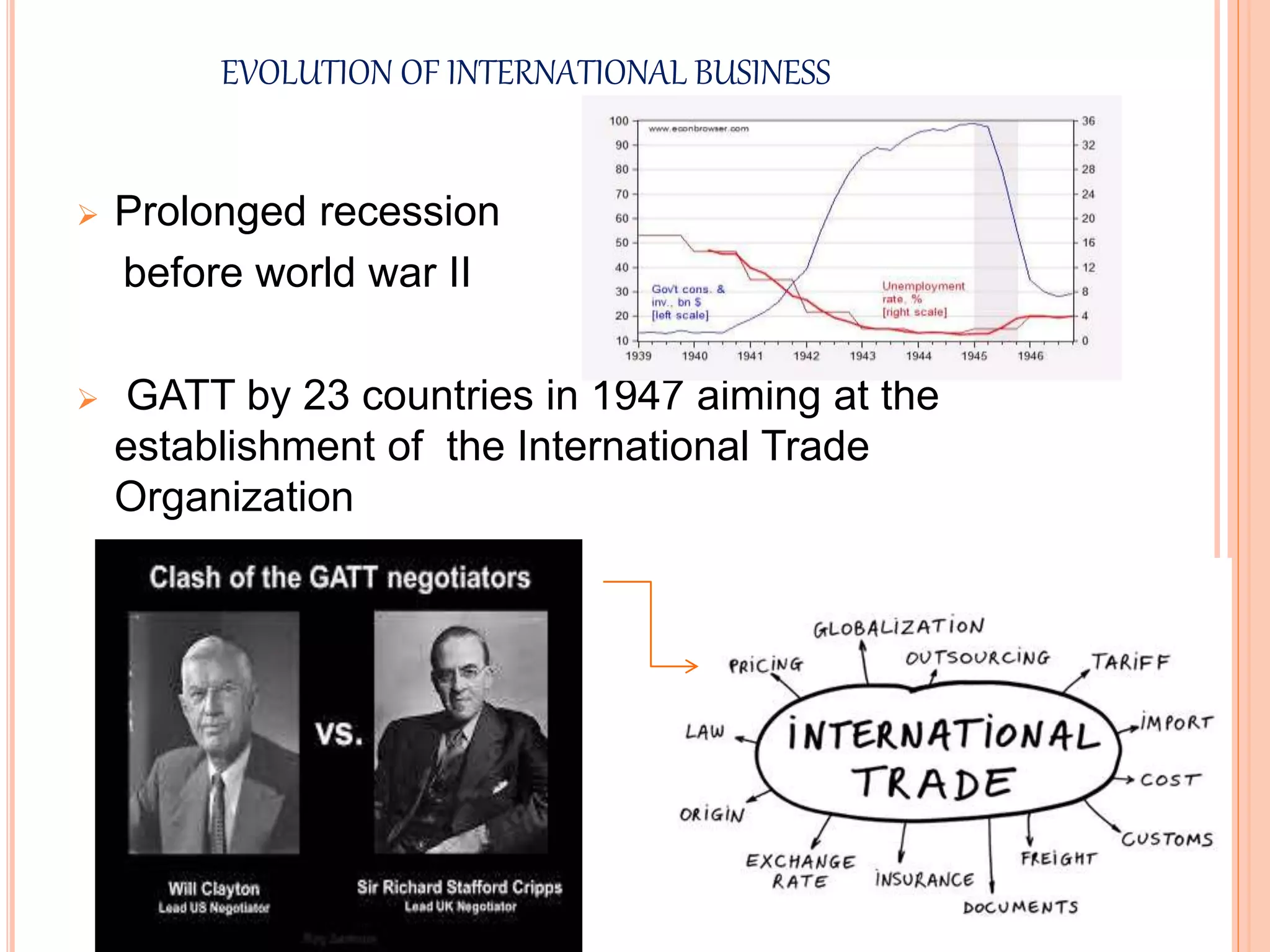
 Prolonged recession
before world war II
 GATT by 23 countries in 1947 aiming at the
establishment of the International Trade
Organization
EVOLUTION OF INTERNATIONAL BUSINESS
 GATT: General Agreement on Trade and Tariffs.
 GATT provided a frame work for a series of
“rounds” of negotiations by which tariffs were
reduced.
EVOLUTION OF INTERNATIONAL BUSINESS
 Efforts to convert GATT into WTO were intensified
during 1980.
 GATT was replaced by the WTO on
1st january,1995
EVOLUTION OF INTERNATIONAL BUSINESS
 The efforts of IMF, IBRD (World bank) and WTO led
to the “Globalization of business” particularly during
1990s
SHIFT FROM EXPORTING/IMPORTING TO
INTERNATIONAL MARKETING
 India used to export raw cotton , raw jute and iron
ore during early 1900s.
 During 1980, India could create markets for its
products like textiles, electronics, leather and steel
products, tea, coffee etc.,
 Arranged appropriate distribution channels,
attractive packaging, product development, pricing,
etc,.
SHIFT FROM INTERNATIONAL MARKETING
TO INTERNATIONAL BUSINESS
 In 1980s multinational companies produced the
products in home countries and marketed them in
various foreign countries.
 Later, MNCs started locating their plants and other
manufacturing facilities in host countries.
HINDUSTAN LEVER LIMITED(HLL)
 Established its subsidiary company in India
 Produces its products in India and markets them in
Bangladesh, Sri Lanka, Nepal etc.,
CONCLUSION:
 Thus, the scope of the international trade is
expanded into international marketing and
international marketing is expanded into
international business.
 The 1990s and the new millennium clearly indicate
rapid internationalization and globalization.
Evolution of ib

Evolution of ib

  • 1.
    MASTER OF BUSINESSADMINISTRATION IYEAR – II SEMISTER SUBJECT: INTERNATIONAL BUSINESS FACULTY: MRS. JYOTHI RAO TOPIC : EVOLUTION OF INTERNATIONAL BUSINESS
  • 2.
    EVOLUTION OF INTERNATIONAL BUSINESS PRESENTEDBY: P.SHIREESHA SECTION - A1 (1325-17-672-038)
  • 3.
    EVOLUTION OF INTERNATIONALBUSINESS INTRODUCTION: Most of you have the experience of browsing internet and visiting different websites, knowing the products and services offered by various companies across the globe. International Business focuses on global resources, opportunities to buy / sell world wide.
  • 4.
    EVOLUTION OF INTERNATIONALBUSINESS  First phase of globalization in 1870  Ended with World war I (1919) driven by Industrial Revolution in UK, Germany and USA  Sharp increase in trade due to the import of raw materials and exporting finished goods to their overseas.
  • 5.
    EVOLUTION OF INTERNATIONALBUSINESS  1913- Ratio of trade to GDP = 22.1  1930- decreased to 9.1  International trade between two world wars is described as-‘A vast game of beggar-my-neighbor’  Felt need for International Cooperation Govt. interventions in imposing trade barriers to protect domestic production. IMF IBRD
  • 6.
    EVOLUTION OF INTERNATIONALBUSINESS  Prolonged recession before world war II  GATT by 23 countries in 1947 aiming at the establishment of the International Trade Organization
  • 7.
    EVOLUTION OF INTERNATIONALBUSINESS  GATT: General Agreement on Trade and Tariffs.  GATT provided a frame work for a series of “rounds” of negotiations by which tariffs were reduced.
  • 8.
    EVOLUTION OF INTERNATIONALBUSINESS  Efforts to convert GATT into WTO were intensified during 1980.  GATT was replaced by the WTO on 1st january,1995
  • 9.
    EVOLUTION OF INTERNATIONALBUSINESS  The efforts of IMF, IBRD (World bank) and WTO led to the “Globalization of business” particularly during 1990s
  • 10.
    SHIFT FROM EXPORTING/IMPORTINGTO INTERNATIONAL MARKETING  India used to export raw cotton , raw jute and iron ore during early 1900s.
  • 11.
     During 1980,India could create markets for its products like textiles, electronics, leather and steel products, tea, coffee etc.,  Arranged appropriate distribution channels, attractive packaging, product development, pricing, etc,.
  • 12.
    SHIFT FROM INTERNATIONALMARKETING TO INTERNATIONAL BUSINESS  In 1980s multinational companies produced the products in home countries and marketed them in various foreign countries.  Later, MNCs started locating their plants and other manufacturing facilities in host countries.
  • 13.
    HINDUSTAN LEVER LIMITED(HLL) Established its subsidiary company in India  Produces its products in India and markets them in Bangladesh, Sri Lanka, Nepal etc.,
  • 14.
    CONCLUSION:  Thus, thescope of the international trade is expanded into international marketing and international marketing is expanded into international business.  The 1990s and the new millennium clearly indicate rapid internationalization and globalization.