MULTINATIONAL
COMPANIES: BLESSINGS OR
  DEVILS IN DISGUISE


       PRESENTED BY:
    GAGANJOT SINGH AULAKH
INTRODUCTION


A   multinational corporation (MNC) is trans
 national co-operation

 It can also be referred to as an international
 corporation
 The International Labor Organization (ILO) has
 defined an MNC as a corporation that has its
 management headquarters in one country, known
 as the home country, and operates in several other
 countries, known as host countries.
MARKET IMPERFECTIONS

 Market imperfections had been considered by Hymer as
 structural and caused by the deviations from perfect
 competition in the final product markets.

 The  imperfections in markets are natural as the
 neoclassical assumptions like full knowledge and
 enforcement don't exist in real markets.
INTERNATIONAL POWER
 Tax competition
 Market withdrawal
 Lobbying
 Patents
 Government power
MICRO-MULTINATIONALS
 Enabled by Internet based communication tools, a new
  breed of multinational companies is growing in numbers.

 They are small businesses.


 Internet tools like Google,Yahoo,MSN,Ebay and Amazon
  make it easier for the micro-multinationals to reach potential
  customers in other countries.
SOME POSITIVE IMPACTS OF
           MULTINATIONALS
 Provides Employment
 Help to trade in international market
 Introduces with new products
 Improves financial status
 Foreign exchange gap is reduced
 Boosts up basic economic structure
 Natural resources are utilized
 Reduce technological gap
CRITICISM OF MULTINATIONALS

 Multinationals create false needs in consumers and have
 had a long history of interference in the policies of
 sovereign nation states.

 Anti-corporate protesters suggest that corporations answer
 only to shareholders, giving human rights and other issues
 almost no consideration.
IMPACT OF MNC’S ON
         DEVELOPING COUNTRIES
 Multinational     corporations play an important role in
 globalization.


 Multinational corporations can have a powerful influence in
 international relations and local economies-

       MNCs and Indian Industries

       MNCs and agriculture

       MNCs from social and moral viewpoint
DEVIL IN DISGUISE

 This being physical exploitation one strenuous
 dimension of MNC.

 It costs the nation a fortune in terms environment.


 Used as cheap Labour


 Long Hour Working
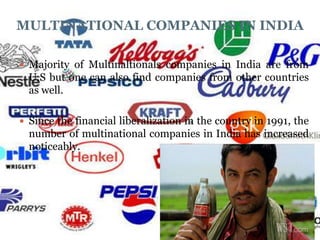
MULTINATIONAL COMPANIES IN INDIA

 Majority of Multinaltionals companies in India are from
  U.S but one can also find companies from other countries
  as well.

 Since the financial liberalization in the country in 1991, the
  number of multinational companies in India has increased
  noticeably.
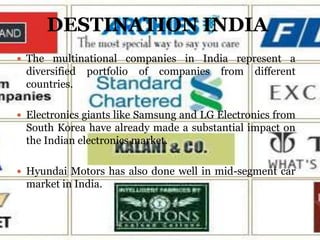
DESTINATION INDIA
 The multinational companies in India represent a
 diversified   portfolio   of   companies   from   different
 countries.

 Electronics giants like Samsung and LG Electronics from
 South Korea have already made a substantial impact on
 the Indian electronics market.

 Hyundai Motors has also done well in mid-segment car
 market in India.
REASON FOR MULTINATIONAL
    COMPANIES IN INDIA

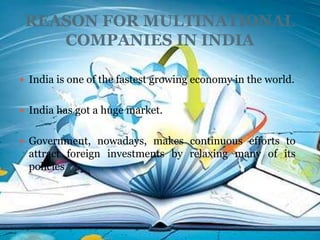
 India is one of the fastest growing economy in the world.


 India has got a huge market.


 Government, nowadays, makes continuous efforts to
  attract foreign investments by relaxing many of its
  policies
REASONS WHY MNC'S CONSIDER
INDIA AS PREFERRED DESTINATION


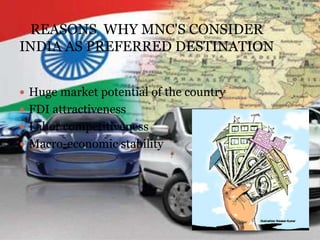
 Huge market potential of the country
 FDI attractiveness
 Labor competitiveness
 Macro-economic stability
List of Multinational Companies in
                      India
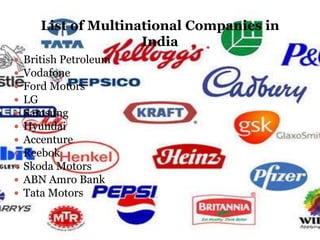
   British Petroleum
   Vodafone
   Ford Motors
   LG
   Samsung
   Hyundai
   Accenture
   Reebok
   Skoda Motors
   ABN Amro Bank
   Tata Motors
MNC CULTURE AND ITS IMPACT
   ON INDIAN CULTURAL DIVERSITY

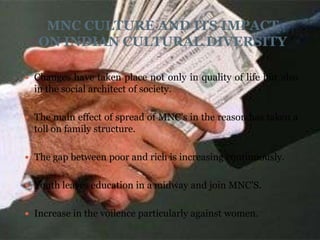
 Changes have taken place not only in quality of life but also
  in the social architect of society.

 The main effect of spread of MNC's in the reason has taken a
  toll on family structure.

 The gap between poor and rich is increasing continuously.


 Youth leaves education in a midway and join MNC'S.


 Increase in the voilence particularly against women.
MNC IMPACT ON INDIAN ECONOMY


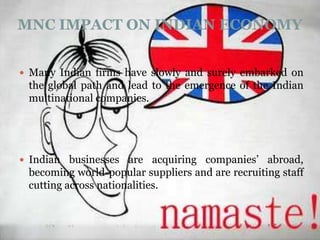
 Many Indian firms have slowly and surely embarked on
 the global path and lead to the emergence of the Indian
 multinational companies.


 Indian businesses are acquiring companies’ abroad,
 becoming world-popular suppliers and are recruiting staff
 cutting across nationalities.
 Asian Paints is painting the world red, Tata is
 rolling out Indicas from Birmingham and
 Sundram Fasteners nails home the fact that the
 Indian company is an entity to be reckoned with.
MARKETING MIXES IN
      INSURANCE SECTOR

1. Product
2. Promotion
3. Price
4. Place
5. People
6. Physical Evidence
7. Process
   1. Flow of activities
   2. Standardization
   3. Customization
MARKET SEGMENTATION IN
      INSURANCE SERVICE
 In Insurance Services, the task of formulating the overall
  marketing strategy cannot be performed satisfactorily till
  market segmentation


 Insurance market segmentation is done on the basis of region.


 The main purpose of segmentation is to know the policyholder.
CHANGING ROLE OF MNC’s
 The business activity of the MNCs coupled with
    the introduction of education and availability of
    jobs affected the social organization profoundly.
   Focus on research.
   How the new multinationals are remaking the
    old.
   First, count your blessings.
   The world is bumpy.
MNCS & INDIAN RISK EXPOSURES


 Multinational     corporations (MNC) perceive risk
  exposures to their business continuity in India more
  stringently and severely than an Indian entrepreneur
  would.
 Failure of logistics could delay information gathering, its
  processing and transmission
 The perceived risk of terrorism in India is a serious risk
  exposure.
 Continuous and long-drawn strife and tension between
  Pakistan and India
IMPACT OF MNC IN INDIA
 In the sector in which we were behind are computers,
    electronic goods which got the latest variety.
   In the fields like textiles we suffered because we have a strong
    base of that but the products are simple and not glamorous.
   Many items were reserved for small sector but we are seeing
    the entrance of foreign products in that field also.
   They are allowed to exploit our resources but our MNC's are
    not allowed to do that in other countries.
   Our people are making products at cheaper rate but they are
    not promoted at the large scale.
CONCLUSION
 Globalisation has intensified interdependence and
  competition between economies in the world
  market.
 Domestic    economic developments are not
  determined entirely by domestic policies and
  market conditions. Rather, they are influenced by
  both domestic and international policies and
  economic conditions.
 MNCs can be helpful for developing countries only
  when they are kept under control.
 MNC’s hire large amount of talented youth that
  work like dogs all through the day.
 MNCs are definitely devils in disguise.
 Although there are huge benefits for the
 country as a whole but if you look at a
 holistic perspective your opinion will differ.


 MNC’s ultimately are culture vultures and
 are penetrating into the Indian family
 system and thereby making kids more
 independent at a very young age.
THANK
 YOU

Multinationalz

  • 1.
    MULTINATIONAL COMPANIES: BLESSINGS OR DEVILS IN DISGUISE PRESENTED BY: GAGANJOT SINGH AULAKH
  • 2.
    INTRODUCTION A multinational corporation (MNC) is trans national co-operation  It can also be referred to as an international corporation
  • 3.
     The InternationalLabor Organization (ILO) has defined an MNC as a corporation that has its management headquarters in one country, known as the home country, and operates in several other countries, known as host countries.
  • 4.
    MARKET IMPERFECTIONS  Marketimperfections had been considered by Hymer as structural and caused by the deviations from perfect competition in the final product markets.  The imperfections in markets are natural as the neoclassical assumptions like full knowledge and enforcement don't exist in real markets.
  • 5.
    INTERNATIONAL POWER  Taxcompetition  Market withdrawal  Lobbying  Patents  Government power
  • 6.
    MICRO-MULTINATIONALS  Enabled byInternet based communication tools, a new breed of multinational companies is growing in numbers.  They are small businesses.  Internet tools like Google,Yahoo,MSN,Ebay and Amazon make it easier for the micro-multinationals to reach potential customers in other countries.
  • 7.
    SOME POSITIVE IMPACTSOF MULTINATIONALS  Provides Employment  Help to trade in international market  Introduces with new products  Improves financial status  Foreign exchange gap is reduced  Boosts up basic economic structure  Natural resources are utilized  Reduce technological gap
  • 8.
    CRITICISM OF MULTINATIONALS Multinationals create false needs in consumers and have had a long history of interference in the policies of sovereign nation states.  Anti-corporate protesters suggest that corporations answer only to shareholders, giving human rights and other issues almost no consideration.
  • 9.
    IMPACT OF MNC’SON DEVELOPING COUNTRIES  Multinational corporations play an important role in globalization.  Multinational corporations can have a powerful influence in international relations and local economies-  MNCs and Indian Industries  MNCs and agriculture  MNCs from social and moral viewpoint
  • 10.
    DEVIL IN DISGUISE This being physical exploitation one strenuous dimension of MNC.  It costs the nation a fortune in terms environment.  Used as cheap Labour  Long Hour Working
  • 11.
    MULTINATIONAL COMPANIES ININDIA  Majority of Multinaltionals companies in India are from U.S but one can also find companies from other countries as well.  Since the financial liberalization in the country in 1991, the number of multinational companies in India has increased noticeably.
  • 12.
    DESTINATION INDIA  Themultinational companies in India represent a diversified portfolio of companies from different countries.  Electronics giants like Samsung and LG Electronics from South Korea have already made a substantial impact on the Indian electronics market.  Hyundai Motors has also done well in mid-segment car market in India.
  • 13.
    REASON FOR MULTINATIONAL COMPANIES IN INDIA  India is one of the fastest growing economy in the world.  India has got a huge market.  Government, nowadays, makes continuous efforts to attract foreign investments by relaxing many of its policies
  • 14.
    REASONS WHY MNC'SCONSIDER INDIA AS PREFERRED DESTINATION  Huge market potential of the country  FDI attractiveness  Labor competitiveness  Macro-economic stability
  • 15.
    List of MultinationalCompanies in India  British Petroleum  Vodafone  Ford Motors  LG  Samsung  Hyundai  Accenture  Reebok  Skoda Motors  ABN Amro Bank  Tata Motors
  • 16.
    MNC CULTURE ANDITS IMPACT ON INDIAN CULTURAL DIVERSITY  Changes have taken place not only in quality of life but also in the social architect of society.  The main effect of spread of MNC's in the reason has taken a toll on family structure.  The gap between poor and rich is increasing continuously.  Youth leaves education in a midway and join MNC'S.  Increase in the voilence particularly against women.
  • 17.
    MNC IMPACT ONINDIAN ECONOMY  Many Indian firms have slowly and surely embarked on the global path and lead to the emergence of the Indian multinational companies.  Indian businesses are acquiring companies’ abroad, becoming world-popular suppliers and are recruiting staff cutting across nationalities.
  • 18.
     Asian Paintsis painting the world red, Tata is rolling out Indicas from Birmingham and Sundram Fasteners nails home the fact that the Indian company is an entity to be reckoned with.
  • 19.
    MARKETING MIXES IN INSURANCE SECTOR 1. Product 2. Promotion 3. Price 4. Place 5. People 6. Physical Evidence 7. Process 1. Flow of activities 2. Standardization 3. Customization
  • 20.
    MARKET SEGMENTATION IN INSURANCE SERVICE  In Insurance Services, the task of formulating the overall marketing strategy cannot be performed satisfactorily till market segmentation  Insurance market segmentation is done on the basis of region.  The main purpose of segmentation is to know the policyholder.
  • 21.
    CHANGING ROLE OFMNC’s  The business activity of the MNCs coupled with the introduction of education and availability of jobs affected the social organization profoundly.  Focus on research.  How the new multinationals are remaking the old.  First, count your blessings.  The world is bumpy.
  • 22.
    MNCS & INDIANRISK EXPOSURES  Multinational corporations (MNC) perceive risk exposures to their business continuity in India more stringently and severely than an Indian entrepreneur would.  Failure of logistics could delay information gathering, its processing and transmission  The perceived risk of terrorism in India is a serious risk exposure.  Continuous and long-drawn strife and tension between Pakistan and India
  • 23.
    IMPACT OF MNCIN INDIA  In the sector in which we were behind are computers, electronic goods which got the latest variety.  In the fields like textiles we suffered because we have a strong base of that but the products are simple and not glamorous.  Many items were reserved for small sector but we are seeing the entrance of foreign products in that field also.  They are allowed to exploit our resources but our MNC's are not allowed to do that in other countries.  Our people are making products at cheaper rate but they are not promoted at the large scale.
  • 24.
    CONCLUSION  Globalisation hasintensified interdependence and competition between economies in the world market.  Domestic economic developments are not determined entirely by domestic policies and market conditions. Rather, they are influenced by both domestic and international policies and economic conditions.  MNCs can be helpful for developing countries only when they are kept under control.  MNC’s hire large amount of talented youth that work like dogs all through the day.
  • 25.
     MNCs aredefinitely devils in disguise. Although there are huge benefits for the country as a whole but if you look at a holistic perspective your opinion will differ.  MNC’s ultimately are culture vultures and are penetrating into the Indian family system and thereby making kids more independent at a very young age.
  • 26.