CONTENTS
Presented By : Gaurav Singh F.D.I. in India Slide no. 01/18
1
• Introduction
2
• FDI in India
3
• Entry Strategies For Foreign Investors
4
• F.D.I. Approval Routes
5
• Current status of FDI in India
6
• Factors affecting F.D.I. in India
7
• Needs and Challenges of F.D.I. in India
8
• Advantages and Disadvantages of F.D.I. in India
9
• Recommendations for Promoting F.D.I. in India
Foreign Investment
•Direct Investment
•Portfolio Investment
Foreign Direct Investment (FDI) is a direct investment into production or business in a
country by an individual or company of another country, either,
by buying a company in the target country, or,
by expanding operations of an existing business in that country.
Why FDI?
•No debt creation on the part of the government.
•Triggers technology transfer.
•Assists capital formation.
•Contributes to international integration by promoting exports.
•Increases productivity and competitiveness.
•Improves efficiency of resources.
•Promotes innovation.
INTRODUCTION
Presented By : Gaurav Singh F.D.I. in India Slide no. 02/18
Currently FDI is permitted in India;
•Through financial collaborations.
•Through joint ventures and technical collaborations.
•Through capital markets via Euro issues.
•Through private placements or preferential allotments.
Major Sector for FDI in India are:
•Infrastructure
•Automotive
•Pharmaceuticals
•Defense
•Retails
•Railways Infrastructure
•Chemicals
•Textiles
•Airlines
FDI in India
Presented By : Gaurav Singh F.D.I. in India Slide no. 03/18
Sector for which FDI is NOT permitted in India are:
•Arms and ammunition,
•Atomic Energy,
•Railway Transport,
•Coal and lignite,
•Agriculture,
•Housing and Real Estate business.
FDI in India
Presented By : Gaurav Singh F.D.I. in India Slide no. 04/18
Major MNC’s under FDI in India are:
•Apple
•Vodafone
•Ford Motors
•LG
•Samsung
•Hyundai
•Accenture
•Reebok
•Skoda Motors
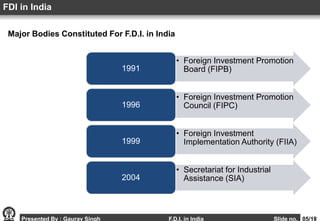
Major Bodies Constituted For F.D.I. in India
FDI in India
Presented By : Gaurav Singh F.D.I. in India Slide no. 05/18
• Foreign Investment Promotion
Board (FIPB)1991
• Foreign Investment Promotion
Council (FIPC)1996
• Foreign Investment
Implementation Authority (FIIA)1999
• Secretariat for Industrial
Assistance (SIA)2004
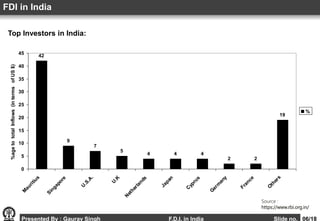
Top Investors in India:
FDI in India
Presented By : Gaurav Singh F.D.I. in India Slide no. 06/18
42
9
7
5
4 4 4
2 2
19
0
5
10
15
20
25
30
35
40
45
M
auritius
Singapore
U
.S.A
.
U
.K
N
etherlands
Japan
C
yprus
G
erm
any
France
O
thers
%agetototalInflows(intermsofUS$)
%
Source :
https://www.rbi.org.in/
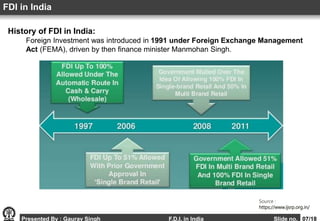
History of FDI in India:
Foreign Investment was introduced in 1991 under Foreign Exchange Management
Act (FEMA), driven by then finance minister Manmohan Singh.
FDI in India
Presented By : Gaurav Singh F.D.I. in India Slide no. 07/18
Source :
https://www.ijsrp.org.in/
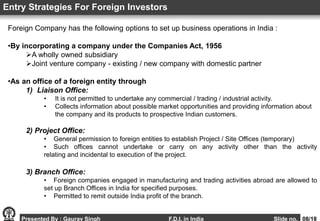
Foreign Company has the following options to set up business operations in India :
•By incorporating a company under the Companies Act, 1956
A wholly owned subsidiary
Joint venture company - existing / new company with domestic partner
•As an office of a foreign entity through
1) Liaison Office:
• It is not permitted to undertake any commercial / trading / industrial activity.
• Collects information about possible market opportunities and providing information about
the company and its products to prospective Indian customers.
2) Project Office:
• General permission to foreign entities to establish Project / Site Offices (temporary)
• Such offices cannot undertake or carry on any activity other than the activity
relating and incidental to execution of the project.
3) Branch Office:
• Foreign companies engaged in manufacturing and trading activities abroad are allowed to
set up Branch Offices in India for specified purposes.
• Permitted to remit outside India profit of the branch.
Entry Strategies For Foreign Investors
Presented By : Gaurav Singh F.D.I. in India Slide no. 08/18
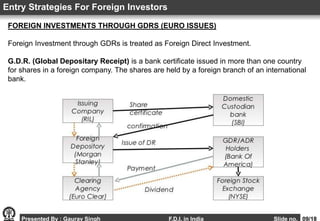
FOREIGN INVESTMENTS THROUGH GDRS (EURO ISSUES)
Foreign Investment through GDRs is treated as Foreign Direct Investment.
G.D.R. (Global Depositary Receipt) is a bank certificate issued in more than one country
for shares in a foreign company. The shares are held by a foreign branch of an international
bank.
Entry Strategies For Foreign Investors
Presented By : Gaurav Singh F.D.I. in India Slide no. 09/18
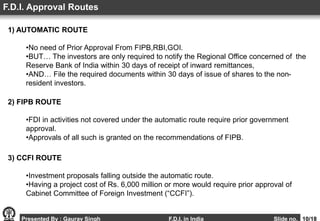
1) AUTOMATIC ROUTE
•No need of Prior Approval From FIPB,RBI,GOI.
•BUT… The investors are only required to notify the Regional Office concerned of the
Reserve Bank of India within 30 days of receipt of inward remittances,
•AND… File the required documents within 30 days of issue of shares to the non-
resident investors.
F.D.I. Approval Routes
Presented By : Gaurav Singh F.D.I. in India Slide no. 10/18
2) FIPB ROUTE
•FDI in activities not covered under the automatic route require prior government
approval.
•Approvals of all such is granted on the recommendations of FIPB.
3) CCFI ROUTE
•Investment proposals falling outside the automatic route.
•Having a project cost of Rs. 6,000 million or more would require prior approval of
Cabinet Committee of Foreign Investment (“CCFI”).
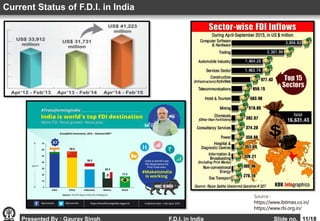
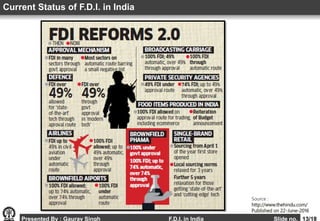
Current Status of F.D.I. in India
Presented By : Gaurav Singh F.D.I. in India Slide no. 11/18
Source :
https://www.ibtimes.co.in/
https://www.rbi.org.in/
Current Status of F.D.I. in India
Presented By : Gaurav Singh F.D.I. in India Slide no. 12/18
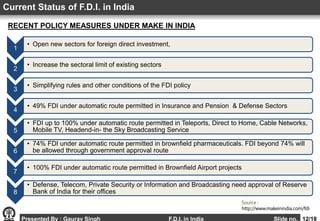
RECENT POLICY MEASURES UNDER MAKE IN INDIA
1
• Open new sectors for foreign direct investment,
2
• Increase the sectoral limit of existing sectors
3
• Simplifying rules and other conditions of the FDI policy
4
• 49% FDI under automatic route permitted in Insurance and Pension & Defense Sectors
5
• FDI up to 100% under automatic route permitted in Teleports, Direct to Home, Cable Networks,
Mobile TV, Headend-in- the Sky Broadcasting Service
6
• 74% FDI under automatic route permitted in brownfield pharmaceuticals. FDI beyond 74% will
be allowed through government approval route
7
• 100% FDI under automatic route permitted in Brownfield Airport projects
8
• Defense, Telecom, Private Security or Information and Broadcasting need approval of Reserve
Bank of India for their offices
Source :
http://www.makeinindia.com/fdi
Current Status of F.D.I. in India
Presented By : Gaurav Singh F.D.I. in India Slide no. 13/18
Source :
http://www.thehindu.com/
Published on 22-June-2016
Presented By : Gaurav Singh F.D.I. in India Slide no. 14/18
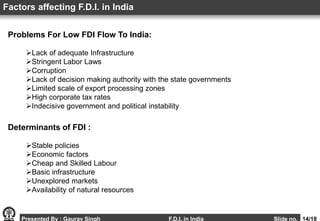
Problems For Low FDI Flow To India:
Lack of adequate Infrastructure
Stringent Labor Laws
Corruption
Lack of decision making authority with the state governments
Limited scale of export processing zones
High corporate tax rates
Indecisive government and political instability
Factors affecting F.D.I. in India
Determinants of FDI :
Stable policies
Economic factors
Cheap and Skilled Labour
Basic infrastructure
Unexplored markets
Availability of natural resources
Presented By : Gaurav Singh F.D.I. in India Slide no. 15/18
Needs:
Sustaining a high level of investment
Technological gap
Exploitation of natural resources
Understanding the initial risk
Development of basic economic infrastructure
Improvement in the balance of payments position
Foreign firm’s helps in increasing the competition
Needs and Challenges of F.D.I. in India
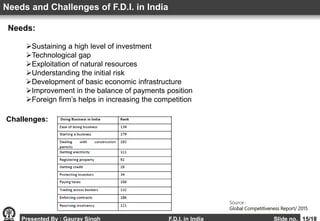
Challenges:
Source :
Global Competitiveness Report/ 2015
Presented By : Gaurav Singh F.D.I. in India Slide no. 16/18
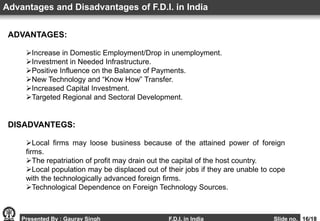
ADVANTAGES:
Increase in Domestic Employment/Drop in unemployment.
Investment in Needed Infrastructure.
Positive Influence on the Balance of Payments.
New Technology and “Know How” Transfer.
Increased Capital Investment.
Targeted Regional and Sectoral Development.
Advantages and Disadvantages of F.D.I. in India
DISADVANTEGS:
Local firms may loose business because of the attained power of foreign
firms.
The repatriation of profit may drain out the capital of the host country.
Local population may be displaced out of their jobs if they are unable to cope
with the technologically advanced foreign firms.
Technological Dependence on Foreign Technology Sources.
Presented By : Gaurav Singh F.D.I. in India Slide no. 17/18
FDI should be aggressively promoted in R&D, Manufacturing
Import duty should be imposed to protect domestic production units.
Flexible labour laws is needed
Promote Greenfield projects
Geographical disparities of FDI should be removed
Education sector should be opened to FDI
Cooperative societies should be formed for the farmers and other agricultural suppliers to
take care of their rights.
Recommendations for Promoting F.D.I. in India
Presented By : Gaurav Singh F.D.I. in India Slide no. 18/18
1. Vyas A.V. , ‘An Analytical Study of FDI in India’, SITS, International Journal of
Scientific and Research Publications, Volume 5, Issue 10, October 2015
2. http://www.sharetipsinfo.com/fdi-retail.html
3. http://en.wikipedia.org/wiki/Retailing_in_India
4. http://toostep.com/debate/what-is-impact-of-fdi-in-indian-market
5. http://www.accountingnotes.net/financial-management/
6. http://www.investopedia.com/terms/g/gdr.asp
7. https://www.rbi.org.in/scripts/
8. www.ibtimes.co.in/
9. www.rbi.org.in/
10.www.makeinindia.com/
REFERENCES

F.d.i. in India

  • 2.
    CONTENTS Presented By :Gaurav Singh F.D.I. in India Slide no. 01/18 1 • Introduction 2 • FDI in India 3 • Entry Strategies For Foreign Investors 4 • F.D.I. Approval Routes 5 • Current status of FDI in India 6 • Factors affecting F.D.I. in India 7 • Needs and Challenges of F.D.I. in India 8 • Advantages and Disadvantages of F.D.I. in India 9 • Recommendations for Promoting F.D.I. in India
  • 3.
    Foreign Investment •Direct Investment •PortfolioInvestment Foreign Direct Investment (FDI) is a direct investment into production or business in a country by an individual or company of another country, either, by buying a company in the target country, or, by expanding operations of an existing business in that country. Why FDI? •No debt creation on the part of the government. •Triggers technology transfer. •Assists capital formation. •Contributes to international integration by promoting exports. •Increases productivity and competitiveness. •Improves efficiency of resources. •Promotes innovation. INTRODUCTION Presented By : Gaurav Singh F.D.I. in India Slide no. 02/18
  • 4.
    Currently FDI ispermitted in India; •Through financial collaborations. •Through joint ventures and technical collaborations. •Through capital markets via Euro issues. •Through private placements or preferential allotments. Major Sector for FDI in India are: •Infrastructure •Automotive •Pharmaceuticals •Defense •Retails •Railways Infrastructure •Chemicals •Textiles •Airlines FDI in India Presented By : Gaurav Singh F.D.I. in India Slide no. 03/18
  • 5.
    Sector for whichFDI is NOT permitted in India are: •Arms and ammunition, •Atomic Energy, •Railway Transport, •Coal and lignite, •Agriculture, •Housing and Real Estate business. FDI in India Presented By : Gaurav Singh F.D.I. in India Slide no. 04/18 Major MNC’s under FDI in India are: •Apple •Vodafone •Ford Motors •LG •Samsung •Hyundai •Accenture •Reebok •Skoda Motors
  • 6.
    Major Bodies ConstitutedFor F.D.I. in India FDI in India Presented By : Gaurav Singh F.D.I. in India Slide no. 05/18 • Foreign Investment Promotion Board (FIPB)1991 • Foreign Investment Promotion Council (FIPC)1996 • Foreign Investment Implementation Authority (FIIA)1999 • Secretariat for Industrial Assistance (SIA)2004
  • 7.
    Top Investors inIndia: FDI in India Presented By : Gaurav Singh F.D.I. in India Slide no. 06/18 42 9 7 5 4 4 4 2 2 19 0 5 10 15 20 25 30 35 40 45 M auritius Singapore U .S.A . U .K N etherlands Japan C yprus G erm any France O thers %agetototalInflows(intermsofUS$) % Source : https://www.rbi.org.in/
  • 8.
    History of FDIin India: Foreign Investment was introduced in 1991 under Foreign Exchange Management Act (FEMA), driven by then finance minister Manmohan Singh. FDI in India Presented By : Gaurav Singh F.D.I. in India Slide no. 07/18 Source : https://www.ijsrp.org.in/
  • 9.
    Foreign Company hasthe following options to set up business operations in India : •By incorporating a company under the Companies Act, 1956 A wholly owned subsidiary Joint venture company - existing / new company with domestic partner •As an office of a foreign entity through 1) Liaison Office: • It is not permitted to undertake any commercial / trading / industrial activity. • Collects information about possible market opportunities and providing information about the company and its products to prospective Indian customers. 2) Project Office: • General permission to foreign entities to establish Project / Site Offices (temporary) • Such offices cannot undertake or carry on any activity other than the activity relating and incidental to execution of the project. 3) Branch Office: • Foreign companies engaged in manufacturing and trading activities abroad are allowed to set up Branch Offices in India for specified purposes. • Permitted to remit outside India profit of the branch. Entry Strategies For Foreign Investors Presented By : Gaurav Singh F.D.I. in India Slide no. 08/18
  • 10.
    FOREIGN INVESTMENTS THROUGHGDRS (EURO ISSUES) Foreign Investment through GDRs is treated as Foreign Direct Investment. G.D.R. (Global Depositary Receipt) is a bank certificate issued in more than one country for shares in a foreign company. The shares are held by a foreign branch of an international bank. Entry Strategies For Foreign Investors Presented By : Gaurav Singh F.D.I. in India Slide no. 09/18
  • 11.
    1) AUTOMATIC ROUTE •Noneed of Prior Approval From FIPB,RBI,GOI. •BUT… The investors are only required to notify the Regional Office concerned of the Reserve Bank of India within 30 days of receipt of inward remittances, •AND… File the required documents within 30 days of issue of shares to the non- resident investors. F.D.I. Approval Routes Presented By : Gaurav Singh F.D.I. in India Slide no. 10/18 2) FIPB ROUTE •FDI in activities not covered under the automatic route require prior government approval. •Approvals of all such is granted on the recommendations of FIPB. 3) CCFI ROUTE •Investment proposals falling outside the automatic route. •Having a project cost of Rs. 6,000 million or more would require prior approval of Cabinet Committee of Foreign Investment (“CCFI”).
  • 12.
    Current Status ofF.D.I. in India Presented By : Gaurav Singh F.D.I. in India Slide no. 11/18 Source : https://www.ibtimes.co.in/ https://www.rbi.org.in/
  • 13.
    Current Status ofF.D.I. in India Presented By : Gaurav Singh F.D.I. in India Slide no. 12/18 RECENT POLICY MEASURES UNDER MAKE IN INDIA 1 • Open new sectors for foreign direct investment, 2 • Increase the sectoral limit of existing sectors 3 • Simplifying rules and other conditions of the FDI policy 4 • 49% FDI under automatic route permitted in Insurance and Pension & Defense Sectors 5 • FDI up to 100% under automatic route permitted in Teleports, Direct to Home, Cable Networks, Mobile TV, Headend-in- the Sky Broadcasting Service 6 • 74% FDI under automatic route permitted in brownfield pharmaceuticals. FDI beyond 74% will be allowed through government approval route 7 • 100% FDI under automatic route permitted in Brownfield Airport projects 8 • Defense, Telecom, Private Security or Information and Broadcasting need approval of Reserve Bank of India for their offices Source : http://www.makeinindia.com/fdi
  • 14.
    Current Status ofF.D.I. in India Presented By : Gaurav Singh F.D.I. in India Slide no. 13/18 Source : http://www.thehindu.com/ Published on 22-June-2016
  • 15.
    Presented By :Gaurav Singh F.D.I. in India Slide no. 14/18 Problems For Low FDI Flow To India: Lack of adequate Infrastructure Stringent Labor Laws Corruption Lack of decision making authority with the state governments Limited scale of export processing zones High corporate tax rates Indecisive government and political instability Factors affecting F.D.I. in India Determinants of FDI : Stable policies Economic factors Cheap and Skilled Labour Basic infrastructure Unexplored markets Availability of natural resources
  • 16.
    Presented By :Gaurav Singh F.D.I. in India Slide no. 15/18 Needs: Sustaining a high level of investment Technological gap Exploitation of natural resources Understanding the initial risk Development of basic economic infrastructure Improvement in the balance of payments position Foreign firm’s helps in increasing the competition Needs and Challenges of F.D.I. in India Challenges: Source : Global Competitiveness Report/ 2015
  • 17.
    Presented By :Gaurav Singh F.D.I. in India Slide no. 16/18 ADVANTAGES: Increase in Domestic Employment/Drop in unemployment. Investment in Needed Infrastructure. Positive Influence on the Balance of Payments. New Technology and “Know How” Transfer. Increased Capital Investment. Targeted Regional and Sectoral Development. Advantages and Disadvantages of F.D.I. in India DISADVANTEGS: Local firms may loose business because of the attained power of foreign firms. The repatriation of profit may drain out the capital of the host country. Local population may be displaced out of their jobs if they are unable to cope with the technologically advanced foreign firms. Technological Dependence on Foreign Technology Sources.
  • 18.
    Presented By :Gaurav Singh F.D.I. in India Slide no. 17/18 FDI should be aggressively promoted in R&D, Manufacturing Import duty should be imposed to protect domestic production units. Flexible labour laws is needed Promote Greenfield projects Geographical disparities of FDI should be removed Education sector should be opened to FDI Cooperative societies should be formed for the farmers and other agricultural suppliers to take care of their rights. Recommendations for Promoting F.D.I. in India
  • 19.
    Presented By :Gaurav Singh F.D.I. in India Slide no. 18/18 1. Vyas A.V. , ‘An Analytical Study of FDI in India’, SITS, International Journal of Scientific and Research Publications, Volume 5, Issue 10, October 2015 2. http://www.sharetipsinfo.com/fdi-retail.html 3. http://en.wikipedia.org/wiki/Retailing_in_India 4. http://toostep.com/debate/what-is-impact-of-fdi-in-indian-market 5. http://www.accountingnotes.net/financial-management/ 6. http://www.investopedia.com/terms/g/gdr.asp 7. https://www.rbi.org.in/scripts/ 8. www.ibtimes.co.in/ 9. www.rbi.org.in/ 10.www.makeinindia.com/ REFERENCES