Deep Learning
Chainer
34 2017
Researcher @ Preferred Networks
1
Agenda
•
•
•
•
•
•
• Chainer
• numpy Chainer
•
•
• GAN
•
•
2
•
•
• 2010
• 2012
• 2013 - 2014 UC Berkeley (Visiting Student Researcher)
• 2015
• 2016 @ "Semantic
Segmentation for Aerial Imagery with Convolutional
Neural Network"
• 2016.9 Facebook, Inc.
• 2016.9 Preferred Networks, Inc.
3
• Preferred Networks
• PFN
• 106 8
•
• FANUC Toyota NTT
• We are hiring!
4
PFN
AutomotiveHumanoid	 Robot
Consumer Industrial
Cloud
Device
Photo
Game
Text
Speech
Infrastructure
Factory
Robot
Automotive
Healthcare
Smart	City
Industry4.0
Industrial	IoT
5
•
• Chainer Define-by-Run
• Chainer
• GAN
• ChaineCV ChainerRL
6
7
8
•
•
fully-connected layer
9
4 3 2 1 0 1 2 3 4
x
1
0
1
2
3
4
y
y = 1/(1 + exp(x))
y = tanh(x)
y = max(0, x)
•
ReLU
•
activation function
Maxout1
, LReLU2
,
PReLU3
, ELU4
, SELU5
, etc.
10
"core idea"
The core idea in deep learning is that we
assume that the data was generated by
the composition of factors or features,
potentially at multiple levels in a hierarchy.
— Ian Goodfellow, Yoshua Bengio, Aaron
Courville, "Deep Learning"
11
.
representation
12
h(1)
= a(1)
(W(1)
x + b(1)
)
h(l)
= a(l)
(W(l)
h(l 1)
+ b(l 1)
)
o = a(o)
(W(o)
h(o)
+ b(o)
)
•
•
•
hidden layer 1
1
1
Kurt Hornik, Maxwell Stinchcombe, Halbert White, "Multilayer
feedforward networks are universal approximators", Neural Networks
(1989)
13
A visual proof that neural nets can compute any function”
http://neuralnetworksanddeeplearning.com/chap4.html
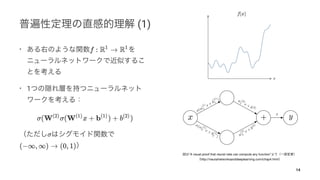
(1)
•
• 1
14
A visual proof that neural nets can compute any function”
http://neuralnetworksanddeeplearning.com/chap4.html
(2)
• 2
•
15
A visual proof that neural nets can compute any function”
http://neuralnetworksanddeeplearning.com/chap4.html
(3)
•
•
•
16
A visual proof that neural nets can compute any function”
http://neuralnetworksanddeeplearning.com/chap4.html
(4)
•
•
17
A visual proof that neural nets can compute any function”
http://neuralnetworksanddeeplearning.com/chap4.html
(5)
•
•
• 4
18
(6)
•
6
•
2
6
“A visual proof that neural nets can compute any function”
http://neuralnetworksanddeeplearning.com/chap4.html
19
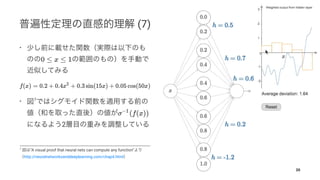
(7)
•
• 7
2
7
“A visual proof that neural nets can compute any function”
http://neuralnetworksanddeeplearning.com/chap4.html
20
so many nodes
Replacable?
• 1
•
21
•
•
… 8
• piecewise linear function
9
9
Razvan Pascanu, Guido Montufar, and Yoshua Bengio, "On the number of response regions of deep feed forward
networks with piece-wise linear activations", NIPS (2014)
8
Merrick Furst, James B. Saxe, and Michael Sipser, "Parity, Circuits, and the Polynomial-Time Hierarchy",
Mathematical systems theory (1984)
22
•
training data
•
•
23
•
•
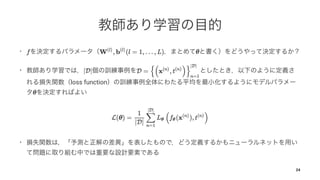
loss function
•
24
•
• softmax
• one-hot
• cross entropy
25
• gradient method
gradient descent
•
• learning rate
•
26
backpropagation
•
•
•
27
•
minibatch
•
An overview of gradient descent
optimization algorithms
28
SGD without momentum
SGD with momentum
*
Stochastic gradient descent (SGD)
Momentum SGD15
15
A. Krizhevsky, I. Sutskever, G. E. Hinton, "ImageNet Classification with
Deep Convolutional Neural Networks", NIPS (2012)
29
Nesterov accelerated gradient (NAG)16
Momentum SGD
RNN
AdaGrad17
AdaDelta18
AdaGrad
RMSProp19
, Adam20
, Eve21
…
30
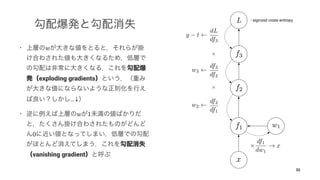
: sigmoid cross entropy
•
•
31
: sigmoid cross entropy
•
exploding gradients
…↓
•
vanishing gradient
32
33
Greedy layer-wise pre-training10
•
Yoshua Bengio ICML 2009
10
Y. Bengio, P. Lamblin, D. Popovici, H. Larochelle, "Greedy layer-wise
training of deep networks", NIPS (2006)
34
ReLU rectified linear unit 11
• Sigmoid
0
11
Xavier Glorot, Antoine Bordes, and Yoshua Bengio, "Deep Sparse
Rectifier Neural Networks", NIPS Workshop (2010)
35
Dropout12
•
[13] Figure 1 13
13
N. Srivastava, G. E. Hinton, A. Krizhevsky, I. Sutskever, and R.
Salakhutdinov, "Dropout: A Simple Way to Prevent Neural Networks from
Overfitting", Journal of Machine Learning Research (2014)
12
G. E. Hinton, N. Srivastava, A. Krizhevsky, I. Sutskever, and R.
Salakhutdinov, "Improving neural networks by preventing co-adaptation
of feature detectors", On arxiv (2012)
36
[14]
Residual learning 14
•
•
14
K. He, X. Zhang, S. Ren, and J. Sun, "Deep Residual Learning for Image
Recognition", CVPR (2016)
37
38
•
1. forward
Dropout
2. backward
3. autograd
2.
4. optimizer 3.
39
Chainer
Preferred Networks
Python
https://github.com/chainer/chainer
40
Popularity Growth of Chainer
41
Define-and-Run Define-by-Run
Define-and-Run
Define-and-Run Define-by-Run
Define-and-Run
Chainer
•
• Define-and-Run
• Define-by-Run
•
Define-and-Run
42
Define-and-Run Define-by-Run
43
Define-by-Run
•
• Python
• Caffe
prototxt
• recurrent neural
network; RNN for
BPTT backpropagation through time
44
numpy Chainer
45
Variable
Function
Function
Function
Variable Variable
VariableVariable Variable
(1)
Variable Function
• 2 Variable
Function
• Variable
Function
directed asyclic graph; DAG
• Variable Function
rank
46
rank=0
rank=1
rank=2
Variable
Function
Function
Function
Variable Variable
VariableVariable Variable
creator
creator
inputs
inputs
inputs
(2)
• backward
• Function Variable
inputs
• Function Variable
Function creator
• Function Variable rank
Function Variable Function
1 rank
47
Chainer
Chainer
48
grad_outputs
.backward(inputs, grad_outputs)
grad
Function
Function
.backward()
grad
Variable
.inputs
Variable Variable
grad_outputs
.creator.creator
grad_outputs
grad grad grad
VariableVariable Variable
.backward(inputs, grad_outputs)
grad_outputs
grad grad grad
VariableVariable Variable
Function
.inputs
creator
.inputs
=1
creator
(1)
• Define-by-Run
backward Variable
• Variable backward()
Function
backward()
•
inputs
•
grad_outputs
49
(2)
• Variable
Chainer
•
•
grad
50
(3)
• Function backward()
• Function outputs
outputs→creator→outputs
• Function
Function
x, W, b = Variable(init_x), Variable(init_W), Variable(init_b)
y = LinearFunction()(x, W, b) # forward
# ...backward, update ...
y = LinearFunction()(x, W, b) # forward
51
Link
• W, b
Function
• Link
•
params()
52
Chain
•
•
• Link
params() Link
53
Optimizer
• Optimizer setup()
Chain Link update()
• Optimizer
• Chainer state
54
• Linear
ReLUFunction
• ReLU
ReLUFunction
• ReLU (
55
• 2
mean
squared error; MSE
• MSE
ReLU
56
•
: MNIST
• 100 1
forward
• SGD Optimizer
setup()
57
• MNIST scikit-learn
from sklearn.datasets import fetch_mldata
mnist = fetch_mldata('MNIST original', data_home='./')
x, t = mnist['data'] / 255, mnist['target']
t = numpy.array([t == i for i in range(10)]).T
train_x, train_t = x[:60000], t[:60000]
val_x, val_t = x[60000:], t[60000:]
• 1
• 150
58
• 94%
•
http://bit.ly/mini_chainer_mnist
• numpy
Define-by-Run
59
Chainer
60
Trainer (1)
Optimizer
• Trainer
• Chainer Chain
• chainer.optimizer
SGD,
MomentumSGD, NesterovAG, RMSprop,
RMSpropGraves, AdaGrad, AdaDelta,
Adam, etc...
61
Trainer (2)
• Chainer
• MNIST
• Validation
len(val)
62
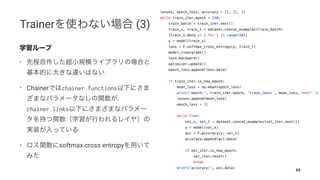
Trainer (3)
•
• Chainer chainer.functions
chainer.links
• softmax cross entropy
63
Trainer
• Trainer
Optimizer
•
• Trainer Extension
import
import
64
Trainer (1)
• Extension
• snapshot
• LogReport, PrintReport
• validation Evaluator
• PlotReport
• Graphviz dot dump_graph
• ParameterStatistics
•
• Trainer extensions (https://docs.chainer.org/en/stable/reference/extensions.html)
65
Trainer (2)
•
•
• Trainer
• GPU ParallelUpdater, MultiprocessParallelUpdater
MultiprocessIterator
66
GPU
•
• Chainer CuPy GPGPU
• CuPy NCCL NCCL2 GPU
• cuDNN NVIDIA v7 CUDA v9
• fp16
67
CuPy
• CuPy NumPy
NVIDIA CUDA GPU
• NumPy API
NumPy
GPU
•
GPU
• KMeans, Gaussian Mixture Model
Example
CuPy: https://github.com/cupy/cupy
68
69
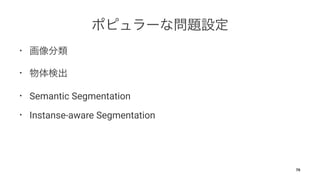
•
•
• Semantic Segmentation
• Instanse-aware Segmentation
70
horse : 94%
dog : 3%
pig : 2%
cat : 1%
.
.
.
71
R
G
B
72
•
• convolutional layer
• pooling
[A. Krizhevsky, 2016]15
**
15
A. Krizhevsky, I. Sutskever, G. E. Hinton, "ImageNet Classification with
Deep Convolutional Neural Networks", NIPS (2012)
73
• convolutional neural
network; CNN
•
• 1
74
•
•
• stride
• padding
CS231n Convolutional Neural Networks for
Visual Recognition
75
•
•
receptive field
•
CS231n Convolutional Neural
Networks for Visual Recognition
76
77
2012 Toronto Geoffry Hinton
2 10%
28.191
25.77
15.315
11.743
6.656
5.1
3.567 2.991 2.251
ILSVRC	Object	Classification	(Top-5	Error)ImageNet Large Scale Visual
Recognition Challenge
(ILSVRC)
• 1000 1
128 1000
• 2010
• 2011 localization
• 2012 Fine-grained
• 2013 bounding box
• 2015
• 2016
78
AlexNet15
• 2012 ILSVRC
• 224x244 5
3
• LRN (local response normalization) ReLU max
pooling
• AlexNet ImageNet
pre-trained model
• AlexNet pre-trained model
transfer learning
15
A. Krizhevsky, I. Sutskever, G. E. Hinton, "ImageNet Classification with
Deep Convolutional Neural Networks", NIPS (2012)
79
GoogleNet16
• 2014 ILSVRC Inception
ResNet
• Inception
22
• 1x1, 3x3, 5x5
concat
• 1x1
16
C. Szegedy, et. al., "Going Deeper with Convolutions", CVPR (2015)
80
VGG17
• 2014 GoogLeNet ILSVRC 2
• 3x3
1
receptive field 3x3 2
5x5, 3 7x7 receptive field
•
ResNet pre-trained
17
K. Simonyan, A. Zisserman "Very Deep Convolutional Networks for
Large-Scale Image Recognition" arXiv technical report, (2014)
81
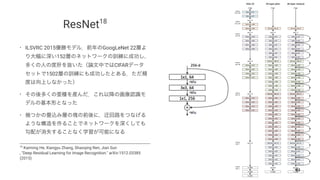
ResNet18
• ILSVRC 2015 GoogLeNet 22
152
CIFAR
1502
•
•
18
Kaiming He, Xiangyu Zhang, Shaoqing Ren, Jian Sun
, "Deep Residual Learning for Image Recognition." arXiv:1512.03385
(2015)
82
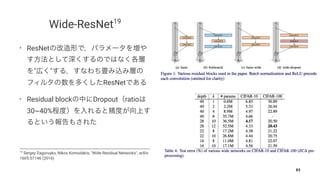
Wide-ResNet19
• ResNet
" "
ResNet
• Residual block Dropout ratio
30~40%
19
Sergey Zagoruyko, Nikos Komodakis, "Wide Residual Networks", arXiv:
1605.07146 (2016)
83
DenseNet20
• CVPR 2017 Residual
connection 2 ResBlock
•
•
20
Gao Huang, Zhuang Liu, Kilian Q. Weinberger, Laurens van der Maaten,
"Densely Connected Convolutional Networks", CVPR (2017)
84
ResNeXt21
• 2016 ILSVRC 2
•
• cardinality
•
cardinality
21
Saining Xie, Ross Girshick, Piotr Dollár, Zhuowen Tu, Kaiming He,
"Aggregated Residual Transformations for Deep Neural Networks", CVPR
(2017)
85
Squeeze-and-Excitation22
• 2017 ILSVRC
• Inception
•
•
squeeze
excitation
22
Jie Hu, Li Shen, Gang Sun, "Squeeze-and-Excitation Networks", arXiv
pre-print: 1709.01507 (2017)
86
- 2017 ILSVRC
Kaggle ImageNet Object
Localization Challenge)
-
- MSCOCO Dataset
- Places Challenge (ADE20K)
- YouTube-8M Video Understanding Challenge
- Cityscapes Dataset
- Mapillary Vistas Datset
- VisualGenome
87
88
Fast R-CNN
Faster R-CNN
Faster/Fast R-CNN/R-CNN23
• R-CNN: region proposals selective
search CNN
resize CNN
SVM
• Fast R-CNN:
RoI Pooling
bounding box bbox regression
• Faster R-CNN: Region proposal network (RPN)
CNN RPN
/ bbox
23
Ren, Shaoqing, et al. "Faster R-CNN: Towards real-time object
detection with region proposal networks." NIPS (2015)
89
You Only Look Once (YOLO)25
•
bounding box
• bounding box
1
end-to-end
• FCN
YOLO9000 CVPR2017
25
Redmon, Joseph, et al. "You only look once: Unified, real-time object
detection." arXiv preprint arXiv:1506.02640 (2015)
90
Single Shot Multibox
Detector (SSD)24
• YOLO Faster R-CNN
•
•
• End-to-end
24
Liu, Wei, et al. "SSD: Single Shot MultiBox Detector." ECCV (2016)
91
Semantic Segmentation
92
Semantic Segmentation
•
•
" "
• Instance-aware
93
(1)
Dilated convolution51
•
•
51
"Multi-Scale Context Aggregation by Dilated Convolutions", ICLR 2016
94
(2)
Multi-scale feature ensemble
•
•
52
52
"Hypercolumns for Object Segmentation and Fine-grained
Localization", CVPR 2015
95
(3)
Conditional random field (CRF)
• CNN refine
(DeepLab53
)
• DeepLab
refine End-to-End
(DPN54
, CRF as RNN55
, Detections and
Superpixels56
)
56
"Higher order conditional random fields in deep neural networks",
ECCV 2016
55
"Conditional random fields as recurrent neural networks", ICCV 2015
54
"Semantic image segmentation via deep parsing network", ICCV 2015
53
"Semantic image segmentation with deep convolutional nets and fully
connected crfs", ICLR 2015
96
(4)
Global average pooling (GAP)
•
• ParseNet57
Global average pooling
FCN
57
"Parsenet: Looking wider to see better", ICLR 2016
97
(1)
Mismatched relationship
•
•
•
• FCN
98
(2)
Confusing Classes
•
• ADE20K
17.6%
58
• FCN
•
58
"Semantic understanding of scenes through the ADE20K dataset",
CVPR 2017
99
(3)
Inconspicuous Classes
•
•
FCN
•
sub-
region
100
•
•
•
101
Fully Convolutional Network26
• Classification
pre-training
1x1
• Deconvolution
• semantic low
level skip connection
26
Jonathan Long and Evan Shelhamer et al., "Fully Convolutional
Networks for Semantic Segmentation", appeared in arxiv on Nov. 14,
2014
102
Deconvolution
• Deconvolution transposed
convolution backward convolution
• Convolution
1. stride
2. -1
3. padding
4. Convolution
• stride
Convolution arithmetic https://github.com/vdumoulin/
conv_arithmetic
103
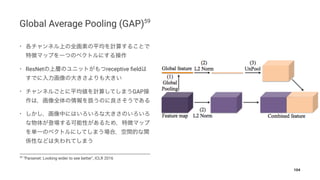
Global Average Pooling (GAP)59
•
• ResNet receptive field
• GAP
•
59
"Parsenet: Looking wider to see better", ICLR 2016
104
SegNet27
•
• Max pooling
•
0
27
Vijay Badrinarayanan, Alex Kendall and Roberto Cipolla "SegNet: A
Deep Convolutional Encoder-Decoder Architecture for Image
Segmentation." PAMI, (2017)
105
U-Net28
•
• Max pooling
Deconvolution
•
concat
• "U" U-
Net
28
“U-Net: Convolutional Networks for Biomedical Image Segmentation”,
Olaf Ronneberger, Philipp Fischer, Thomas Brox, 18 May 2015
106
PSPNet60
Pyramid Pooling Module
60
Hengshuang Zhao, Jianping Shi, Xiaojuan Qi, Xiaogang Wang, Jiaya Jia, "Pyramid Scene Parsing Network", CVPR
(2017)
107
Pose Estimation
108
Pose Affinity Field33
•
CNN Convolutional Pose Machine
Part Affinity Field
CNN
• OpenPose
https://github.com/CMU-Perceptual-Computing-
Lab/openpose
• Geforce GTX 1080 9fps
33
Zhe Cao and Tomas Simon and Shih-En Wei and Yaser Sheikh,
"Realtime Multi-Person Pose Estimation using Part Affinity Fields", CVPR
(2017)
109
•
→ Faster
R-CNN
•
→
110
repeatability
reproducibility
repeatability reproducibility
repeatability
reproducibility
ACM Repeatability (same team, same experimental setup), Replicability
(different team, same experimental setup), Reproducibility (different
team, different experiental setup)
http://www.acm.org/publications/policies/artifact-review-badging
111
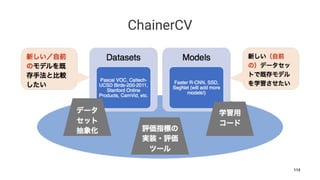
ChainerCV
https://github.com/chainer/chainercv
ChainerCV
•
•
•
• pre-trained
112
ChainerCV
113
- Faster R-CNN (VGG16-based, )
- SSD300, SSD512
:
- SegNet
- PSPNet (coming soon)
- PASCAL VOC (bounding box, segmentation)
- Stanford Online Products (classification)
- CamVid (segmentation)
- Caltech-UCSD Birds-200 (classification, key-points)
- Cityscapes (segmentation)
114
: pretrained-model
ChainerCV pretarined_model
model = FasterRCNNVGG16() #
# PASCAL VOC2007
model = FasterRCNNVGG16(pretrained_model='voc07')
model = SSD300(pretrained_model='voc0712')
model = SegNet(pretrained_model='camvid')
115
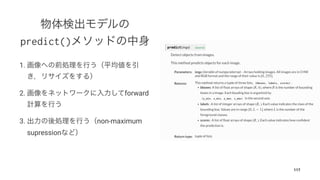
predict()
ChainerCV predict()
#
bboxes, labels, scores = model.predict(imgs)
#
labels = model.predict(imgs)
116
predict()
1.
2. forward
3. non-maximum
supression
117
[37] D. Xu, Y. Zhu, C. B. Choy, L. Fei-Fei, “Scene Graph
Generation by Iterative Message Passing”, CVPR (2017)
•
Faster R-CNN Region
Proposal network (RPN)
• RPN
…
•
118
ChainerCV
• Chainer
• public
•
from chainercv.datasets import VOCDetectionDataset
dataset = VOCDetectionDatset(split='trainval', year='2007')
# "trainval" 34
img, bbox, label = dataset[34]
119
ChainerCV transforms
•
data augmentation
• ChainerCV
data augmentation
•
• center_crop, pca_lighting, random_crop,
random_expand, random_flip, random_rotate,
ten_crop, etc...
120
ChainerCV transforms
TransformDataset Chainer
from chainercv import transforms
def transform(in_data):
img, bbox, label = in_data
img, param = transforms.random_flip(img, x_flip=True, return_param=True)
bbox = transforms.flip_bbox(bbox, x_flip=param['x_flip'])
return img, bbox, label
dataset = TransformDataset(dataset, transform)
bounding box
121
bounding box
ChainerCV
•
•
• bounding box
• matplotlib
122
ChainerCV
mean Intersection over Union (mIoU) mean
Average Precision (mAP)
Chainer Trainer Extension
# mAP Trainer Extension
evaluator = chainercv.extension.DetectionVOCEvaluator(iterator, model)
#
# e.g., result['main/map']
result = evaluator()
123
• https://github.com/chainer/chainercv
Faster R-CNN
SegNet
124
GAN
125
•
•
• RBM restricted boltzmann machine 34
Variational Auto-Encoder (VAE)35
Generative Adversarial Nets (GAN)
35
Diederik P Kingma and Max Welling, "Auto-Encoding Variational Bayes", ICLR (2014)
34
Smolensky, Paul, "Chapter 6: Information Processing in Dynamical Systems: Foundations of Harmony Theory",
Parallel Distributed Processing: Explorations in the Microstructure of Cognition (1986)
126
Generator
Discriminator
Dataset
OR from dataset?
Generative Adversarial Nets36
•
unsupervised learning
• G D
• D G
• G D
36
I. J. Goodfellowm, et. al., "Generative Adversarial Nets", NIPS (2014)
127
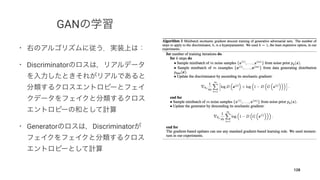
GAN
•
• Discriminator
• Generator Discriminator
128
GAN
•
Generator
• Generator
129
DCGAN37
• GAN
• Generator 1
Deconvolution
• Discriminator Generator
•
•
37
Alec Radford, Luke Metz, Soumith Chintala, "Unsupervised
Representation Learning with Deep Convolutional Generative Adversarial
Networks", ICLR (2016)
130
DCGAN37
• GAN DCGAN
• D
stride=2
• D Global Average Pooling
• D Leaky ReLU
• G D Batch Normalization G
D
37
Alec Radford, Luke Metz, Soumith Chintala, "Unsupervised
Representation Learning with Deep Convolutional Generative Adversarial
Networks", ICLR (2016)
131
Improved Techniques for Training GANs38
• GAN
• Feature matching: D fake real
• Minibatch discrimination: G D
1 mode cllapse
D
concat
•
38
T. Salimans, I. Goodfellow, et. al., "Improved Techniques for Training
GANs", NIPS (2016)
132
Improved Techniques for Training GANs38
• Generator
Semi-supervised
learning
• ImageNet DCGAN
• Inception score GAN
pre-trained model
38
T. Salimans, I. Goodfellow, et. al., "Improved Techniques for Training
GANs", NIPS (2016)
133
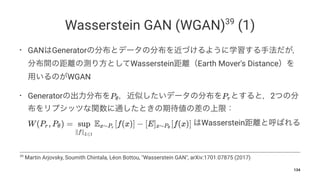
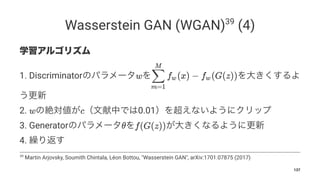
Wasserstein GAN (WGAN)39
(1)
• GAN Generator
Wasserstein Earth Mover's Distance
WGAN
• Generator 2
Wasserstein
39
Martin Arjovsky, Soumith Chintala, Léon Bottou, "Wasserstein GAN", arXiv:1701.07875 (2017)
134
Wasserstein GAN (WGAN)39
(2)
• WGAN Discriminator Wasserstein
• Discriminator(D)
D Wasserstein
•
39
Martin Arjovsky, Soumith Chintala, Léon Bottou, "Wasserstein GAN", arXiv:1701.07875 (2017)
135
Wasserstein GAN (WGAN)39
(3)
• WGAN Discriminator Wasserstein
Wasserstein
• Generator Wasserstein
39
Martin Arjovsky, Soumith Chintala, Léon Bottou, "Wasserstein GAN", arXiv:1701.07875 (2017)
136
Wasserstein GAN (WGAN)39
(4)
1. Discriminator
2. 0.01
3. Generator
4.
39
Martin Arjovsky, Soumith Chintala, Léon Bottou, "Wasserstein GAN", arXiv:1701.07875 (2017)
137
WGAN with Gradient Penalty (WGAN-GP) 40
• WGAN Discriminator
Gradient Penalty
• Chainer v3
40
Gulrajani, Ishaan, et al. "Improved training of wasserstein gans." arXiv preprint arXiv:1704.00028 (2017).
138
Temporal Generative
Adversarial Nets (TGAN)41
• WGAN
•
Video Generator
Image Generator
41
Masaki Saito, Eiichi Matsumoto, Shunta Saito, "Temporal Generative
Adversarial Nets with Singular Value Clipping", ICCV (2017)
139
Temporal Generative
Adversarial Nets (TGAN)41
•
GAN WGAN
1
singular
value clipping
• Inception score
41
Masaki Saito, Eiichi Matsumoto, Shunta Saito, "Temporal Generative
Adversarial Nets with Singular Value Clipping", ICCV (2017)
140
SimGAN42
•
CG Refiner
• Refiner Discriminator
adversarial loss
self-regularization
• Apple, inc. CVPR 2017
"Improving the Realism of Synthetic Images"
42
A. Shrivastava, et. al. "Learning from Simulated and Unsupervised
Images through Adversarial Training", CVPR (2017)
141
Chainer-GAN-lib
GAN Chainer
Chainer Trainer GAN
https://github.com/pfnet-research/chainer-gan-lib
142
Adversarial examples70
• " "
•
NIPS 2017: Non-targeted Adversarial Attack
Google Brain "Non-
targeted"
70
Ian J. Goodfellow, Jonathon Shlens, Christian Szegedy, "Explaining and
Harnessing Adversarial Examples." ICLR (2015)
143
144
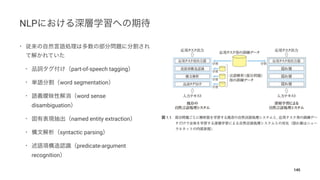
NLP
•
• part-of-speech tagging
• word segmentation
• word sense
disambiguation
• named entity extraction
• syntactic parsing
• predicate-argument
recognition
145
NLP
•
•
•
146
147
RNN
• RNN (recurrent neural networks)
•
RNN
148
http://qiita.com/t_Signull/items/21b82be280b46f467d1b
LSTM
•
• 1 3
•
:
• 1
•
•
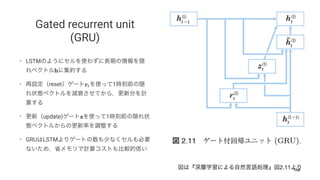
149
2.11
Gated recurrent unit
(GRU)
• LSTM
• reset 1
• update) 1
• GRU LSTM
150
RNN
one-hot
RNN
RNN
151
s.t.
perplexity; PPL 2
PPL PPL
152
1. Penn Treebank ptb
90 1
Chainer example ptb example
https://github.com/chainer/chainer/
tree/master/examples/ptb
2. One Biliion Word
8 80
3. Hutter
90MB/5MB/5MB
train/val/test
153
sequence-to-sequence
•
•
RNN
•
•
•
154
155
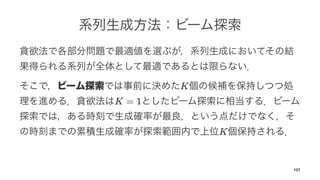
greedy algorithm
156
157
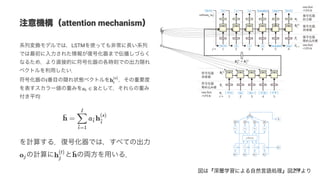
attention mechanism
LSTM
158
Attention is all you need65
RNN/CNN Attention Transformer
SOTA
Transformer: A Novel Neural Network
Architecture for Language Understanding
65
Ashish Vaswani, Noam Shazeer, Niki Parmar, Jakob Uszkoreit, Llion
Jones, Aidan N. Gomez, Lukasz Kaiser, Illia Polosukhin, "Attention Is All
You Need", (2017)
159
160
policy
1.
2.
3.
4.
161
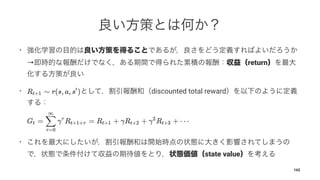
•
→ return
• discounted total reward
•
state value
162
state value function
optimal policy
163
action value function
164
greedy
ε-greedy
greedy
ε-greedy ε
greedy
165
Q Q-learning
Q
Q
166
Q (1)
Q Q
167
Q (2)
Q
Q
→MSE SGD
168
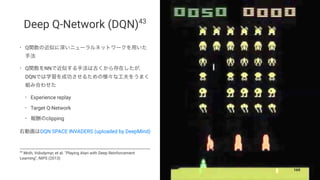
Deep Q-Network (DQN)43
• Q
• Q NN
DQN
• Experience replay
• Target Q-Network
• clipping
DQN SPACE INVADERS (uploaded by DeepMind)
43
Mnih, Volodymyr, et al. "Playing Atari with Deep Reinforcement
Learning", NIPS (2013)
169
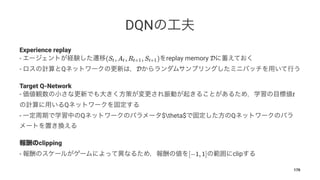
DQN
Experience replay
- replay memory
- Q
Target Q-Network
-
Q
- Q $theta$ Q
clipping
- clip
170
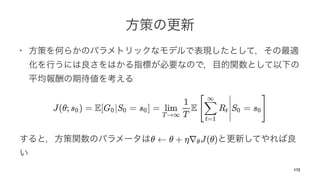
• Q
•
•
171
•
172
• 45
•
45
Pierre Andry, et. al., "Learning invariant sensorimotor behaviors: A developmental approach to imitation
mechanisms." Adaptive behavior (2004)
173
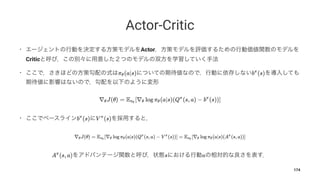
Actor-Critic
• Actor
Critic
•
•
174
Asynchronous Advantage
Actor-Critic (A3C)44
•
•
Actor-Critic
• Experience replay
RNN
•
44
V. Mnih, et. al., "Asynchronous Methods for Deep Reinforcement
Learning", ICML (2016)
175
DDPG46
• Deep Deterministic Policy Gradient
(DDPG) Actor-Critic
• Deep Q-Network
End-to-End
•
Deep Reinforcement Learning
(DDPG) demonstration
46
Lillicrap, Timothy P., et al. "Continuous control with deep reinforcement
learning." arXiv preprint arXiv:1509.02971 (2015)
176
ChainerRL
•
Chainer
https://github.com/chainer/chainerrl
177
ChainerRL :
• ChainerRL OpenAI Gym Gym
• reset step
env = YourEnv()
# reset
obs = env.reset()
action = 0
# step
# 4
obs, r, done, info = env.step(action)
178
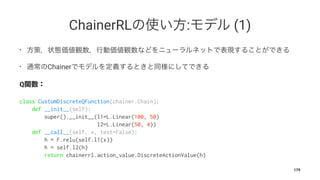
ChainerRL : (1)
•
• Chainer
Q
class CustomDiscreteQFunction(chainer.Chain):
def __init__(self):
super().__init__(l1=L.Linear(100, 50)
l2=L.Linear(50, 4))
def __call__(self, x, test=False):
h = F.relu(self.l1(x))
h = self.l2(h)
return chainerrl.action_value.DiscreteActionValue(h)
179
ChainerRL : (2)
class CustomGaussianPolicy(chainer.Chain):
def __init__(self):
super().__init__(l1=L.Linear(100, 50)
mean=L.Linear(50, 4),
var=L.Linear(50, 4))
def __call__(self, x, test=False):
h = F.relu(self.l1(x))
mean = self.mean(h)
var = self.var(h)
return chainerrl.distribution.GaussianDistribution(mean, var)
180
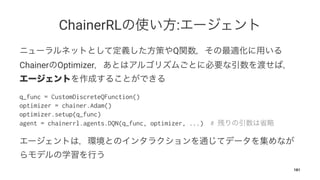
ChainerRL :
Q
Chainer Optimizer
q_func = CustomDiscreteQFunction()
optimizer = chainer.Adam()
optimizer.setup(q_func)
agent = chainerrl.agents.DQN(q_func, optimizer, ...) #
181
ChainerRL : (1)
ChainerRL
• ChainerRL
chainerrl.experiments.train_agent_with_evaluation(
agent, env, steps=100000, eval_frequency=10000, eval_n_runs=10, outdir='results')
182
ChainerRL : (1)
obs = env.reset()
r = 0
done = False
for _ in range(10000):
while not done:
action = agent.act_and_train(obs, r)
obs, r, done, info = env.step(action)
agent.stop_episode_and_train(obs, r, done)
obs = env.reset()
r, done = 0, False
agent.save('final_agent')
183
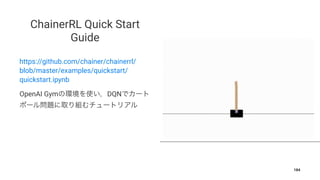
ChainerRL Quick Start
Guide
https://github.com/chainer/chainerrl/
blob/master/examples/quickstart/
quickstart.ipynb
OpenAI Gym DQN
184
Chainer
185

Deep LearningフレームワークChainerと最近の技術動向