
WELCOMEWELCOME
Credit Seminar
On
Role of nanobodies in diagnosis
of bacterial diseases
Outline
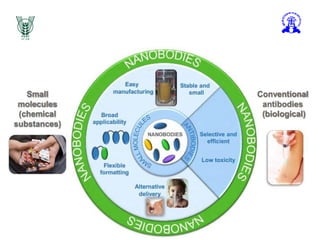
Nanobodies
Properties
Selection and production
Potential applications
Conventional antibody and their
engineering
CH2
CH3
Camel
Paratope
VHH
Hinge
DOMAIN ANTIBODY
(NANOBODY)
(Ag binding site)
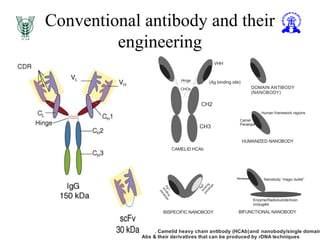
Fig. 3 Camelid heavy chain antibody (HCAb) nanobody/single domain
Abs & their derivatives that can be produced by rDNA techniques
. and
CHOs
CAMELID HCAb
Human framework regions
HUMANIZED NANOBODY
BISPECIFIC NANOBODY BIFUNCTIONAL NANOBODY
Ag1
binding
paratope
Ag2binding
paratope
Nanobody “magic bullet”
Enzyme/Radionuclide/toxin
conjugate
Paratope
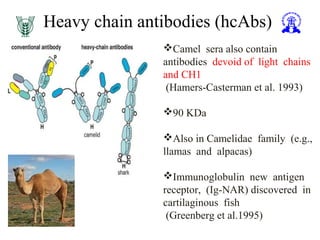
Heavy chain antibodies (hcAbs)
Camel sera also contain
antibodies devoid of light chains
and CH1
(Hamers-Casterman et al. 1993)
90 KDa
Also in Camelidae family (e.g.,
llamas and alpacas)
Immunoglobulin new antigen
receptor, (Ig-NAR) discovered in
cartilaginous fish
(Greenberg et al.1995)
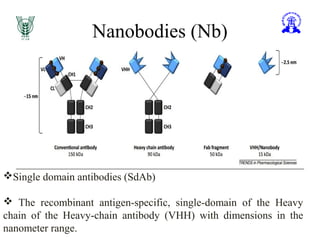
Nanobodies (Nb)
Single domain antibodies (SdAb)
 The recombinant antigen-specific, single-domain of the Heavy
chain of the Heavy-chain antibody (VHH) with dimensions in the
nanometer range.
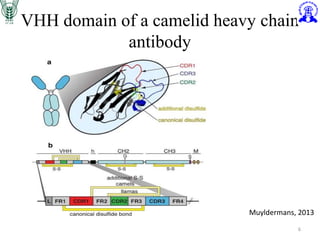
VHH domain of a camelid heavy chain
antibody
6
Muyldermans, 2013
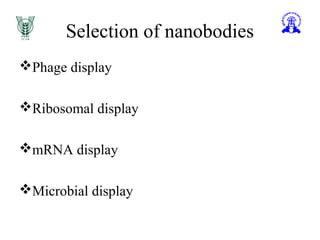
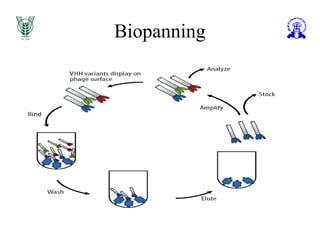
Selection of nanobodies
Phage display
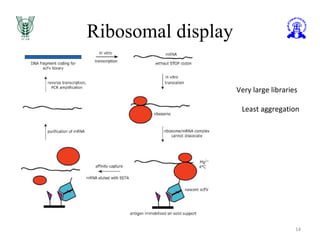
Ribosomal display
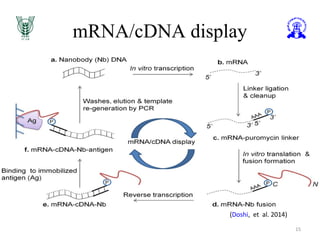
mRNA display
Microbial display
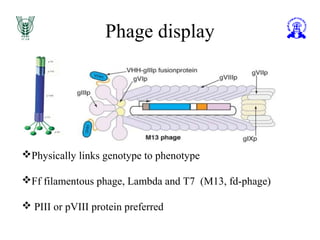
Phage display
Physically links genotype to phenotype
Ff filamentous phage, Lambda and T7 (M13, fd-phage)
 PIII or pVIII protein preferred
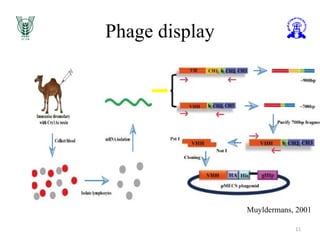
Phage display
11
Muyldermans, 2001
Biopanning
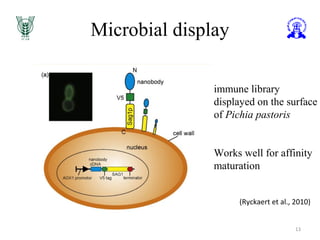
Microbial display
13
immune library
displayed on the surface
of Pichia pastoris
Works well for affinity
maturation
(Ryckaert et al., 2010)
Ribosomal display
14
Very large libraries
Least aggregation
mRNA/cDNA display
15
(Doshi, et al. 2014)
Affinity maturation
• Process to improve antibody affinity for an
antigen.
• In vivo, by somatic hypermutation and clonal
selection.
• In vitro, in the laboratory affinity maturation
can be obtained by mutation and selection.
Expression
17
Bacteria- Periplasmic Nb production 1 to 10 mg/l
Fungi - from <1 to >100 mg/l
Mammalian cell lines - when eukaryotic protein folding
machinery is required
Plants - free of possible contamination with human
and animal pathogens
Nb-Fc antibodies in soyabean as feed for oral
passive immunisation De Meyer et al.., 2014
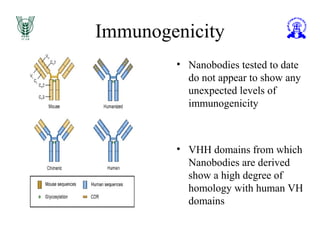
Immunogenicity
• Nanobodies tested to date
do not appear to show any
unexpected levels of
immunogenicity
• VHH domains from which
Nanobodies are derived
show a high degree of
homology with human VH
domains
Potential applications
19
Nanobodies as Diagnostic Tools
Nanobodies as Research Tools
Nanobodies as Therapeutics
Nanobodies as Diagnostic Tools
20
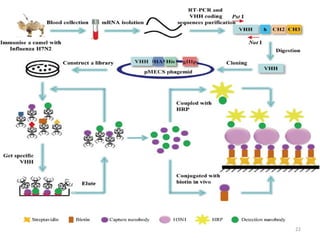
Pathogen detection
In vivo molecular imaging
Pathogen and toxin detection
• Distinguish between Brucella and Yersinia infections in livestock,
mAbs have failed. (Abbady, et al. 2012)
• Anti-caffeine Nbs for the quantification of caffeine in hot
beverages. (Ladenson et al. 2006)
• Nanobodies against three toxins, staphylococcal enterotoxin B and
botulinum toxin A complex toxoid, have been isolated by panning a
semi-synthetic shark dAb display library. (Liu et al., 2007).
• Sandwich assays using these dAbs as the reporter antibody were
developed to demonstrate their utility for future sensor applications
(Liu et al., 2007).
22
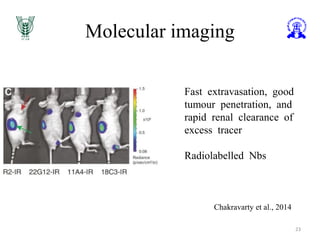
Molecular imaging
23
Chakravarty et al., 2014
Fast extravasation, good
tumour penetration, and
rapid renal clearance of
excess tracer
Radiolabelled Nbs
Nanobodies as Therapeutics
24
 Pathogen targeting
 Bacteria/Phages
Viruses
Fungi/ Parasites
Crossing blood brain barrier
Inhibition of enzymes, cell surface and other soluble
proteins
Cancer therapeutics
 Auto immune diseases
 Others
Targeting bacteria and phages
25
Transformed lactobacilli with VHH against Streptococcus
mutans, in dental caries.
Reducing the bacterial resistance to antibiotics by VHHs with
beta-lactamase inhibitory effect.
Preventing the infection of Lactococcus lactis cultures by the p2
bacteriophage by Nbs against a phage tail protein Engineering
(an interesting approach for vaccinating microorganisms of
biotechno-logical interest)
(Wesolowski et al. 2009)
Targeting fungi, protozoans, toxins
26
Against a cell wall protein of Malassezia furfur, a fungus
implicated in dandruff –used in shampoo formulation
Trypanosomes (oligomannose cryptic epitope)
Scorpion, snake venom
(Baral et al. 2006)
Crossing Blood Brain Barrier
27
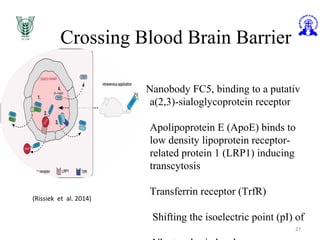
Nanobody FC5, binding to a putativ
a(2,3)-sialoglycoprotein receptor
Apolipoprotein E (ApoE) binds to
low density lipoprotein receptor-
related protein 1 (LRP1) inducing
transcytosis
Transferrin receptor (TrfR)
Shifting the isoelectric point (pI) of
(Rissiek et al. 2014)
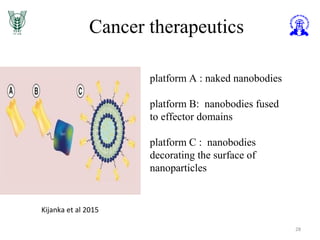
Cancer therapeutics
28
platform A : naked nanobodies
platform B: nanobodies fused
to effector domains
platform C : nanobodies
decorating the surface of
nanoparticles
Kijanka et al 2015
Nanobodies as Research Tools
29
Protein purification and immunoprecipitation
crystallization and structural determination of
challenging targets
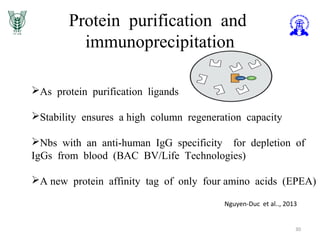
Protein purification and
immunoprecipitation
30
As protein purification ligands
Stability ensures a high column regeneration capacity
Nbs with an anti-human IgG specificity for depletion of
IgGs from blood (BAC BV/Life Technologies)
A new protein affinity tag of only four amino acids (EPEA)
Nguyen-Duc et al.., 2013
Crystallization chaperones
• Determining protein structures by X-ray crystallography is
difficult for ‘high hanging fruits’ such as membrane
proteins and large protein complexes.
• Nanobodies facilitated crystallization of many proteins
SUMMARY
32
Single domain antibodies from heavy chain antibodies
An accessible and streamlined protocol available
Recombinant Nbs are well expressed, highly robust, and easy to
engineer
Prefer to interact with cavities on the surface of their antigen
Applications in research, diagnostic and therapeutics
Nanobodies

Nanobodies

  • 1.
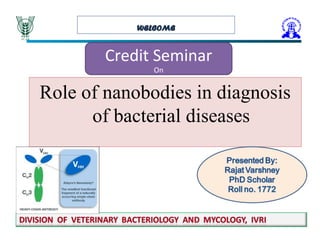
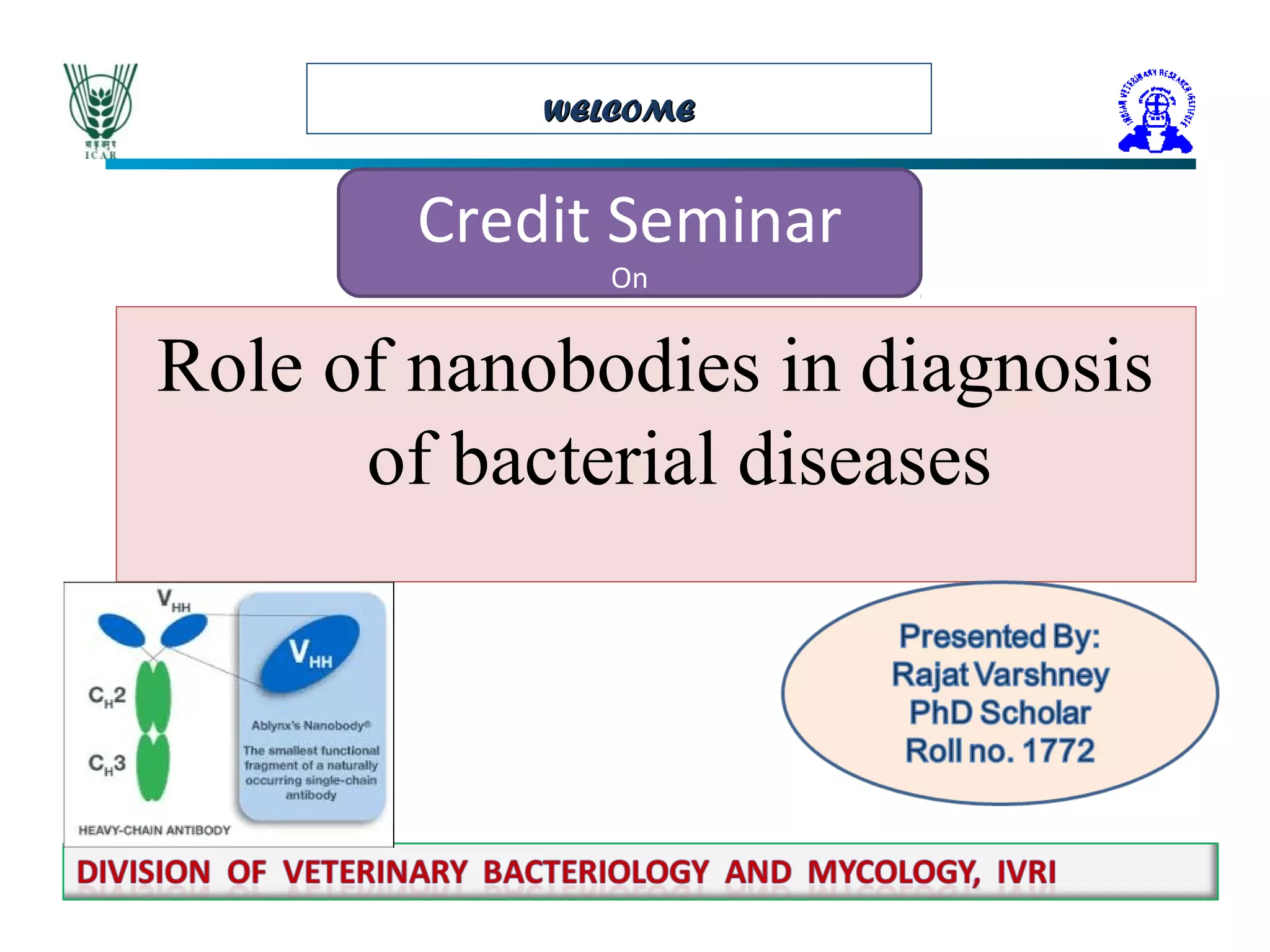
    WELCOMEWELCOME Credit Seminar On Role ofnanobodies in diagnosis of bacterial diseases
  • 2.
  • 3.
    Conventional antibody andtheir engineering CH2 CH3 Camel Paratope VHH Hinge DOMAIN ANTIBODY (NANOBODY) (Ag binding site) Fig. 3 Camelid heavy chain antibody (HCAb) nanobody/single domain Abs & their derivatives that can be produced by rDNA techniques . and CHOs CAMELID HCAb Human framework regions HUMANIZED NANOBODY BISPECIFIC NANOBODY BIFUNCTIONAL NANOBODY Ag1 binding paratope Ag2binding paratope Nanobody “magic bullet” Enzyme/Radionuclide/toxin conjugate Paratope
  • 4.
    Heavy chain antibodies(hcAbs) Camel sera also contain antibodies devoid of light chains and CH1 (Hamers-Casterman et al. 1993) 90 KDa Also in Camelidae family (e.g., llamas and alpacas) Immunoglobulin new antigen receptor, (Ig-NAR) discovered in cartilaginous fish (Greenberg et al.1995)
  • 5.
    Nanobodies (Nb) Single domainantibodies (SdAb)  The recombinant antigen-specific, single-domain of the Heavy chain of the Heavy-chain antibody (VHH) with dimensions in the nanometer range.
  • 6.
    VHH domain ofa camelid heavy chain antibody 6 Muyldermans, 2013
  • 9.
    Selection of nanobodies Phagedisplay Ribosomal display mRNA display Microbial display
  • 10.
    Phage display Physically linksgenotype to phenotype Ff filamentous phage, Lambda and T7 (M13, fd-phage)  PIII or pVIII protein preferred
  • 11.
  • 12.
  • 13.
    Microbial display 13 immune library displayedon the surface of Pichia pastoris Works well for affinity maturation (Ryckaert et al., 2010)
  • 14.
    Ribosomal display 14 Very largelibraries Least aggregation
  • 15.
  • 16.
    Affinity maturation • Processto improve antibody affinity for an antigen. • In vivo, by somatic hypermutation and clonal selection. • In vitro, in the laboratory affinity maturation can be obtained by mutation and selection.
  • 17.
    Expression 17 Bacteria- Periplasmic Nbproduction 1 to 10 mg/l Fungi - from <1 to >100 mg/l Mammalian cell lines - when eukaryotic protein folding machinery is required Plants - free of possible contamination with human and animal pathogens Nb-Fc antibodies in soyabean as feed for oral passive immunisation De Meyer et al.., 2014
  • 18.
    Immunogenicity • Nanobodies testedto date do not appear to show any unexpected levels of immunogenicity • VHH domains from which Nanobodies are derived show a high degree of homology with human VH domains
  • 19.
    Potential applications 19 Nanobodies asDiagnostic Tools Nanobodies as Research Tools Nanobodies as Therapeutics
  • 20.
    Nanobodies as DiagnosticTools 20 Pathogen detection In vivo molecular imaging
  • 21.
    Pathogen and toxindetection • Distinguish between Brucella and Yersinia infections in livestock, mAbs have failed. (Abbady, et al. 2012) • Anti-caffeine Nbs for the quantification of caffeine in hot beverages. (Ladenson et al. 2006) • Nanobodies against three toxins, staphylococcal enterotoxin B and botulinum toxin A complex toxoid, have been isolated by panning a semi-synthetic shark dAb display library. (Liu et al., 2007). • Sandwich assays using these dAbs as the reporter antibody were developed to demonstrate their utility for future sensor applications (Liu et al., 2007).
  • 22.
  • 23.
    Molecular imaging 23 Chakravarty etal., 2014 Fast extravasation, good tumour penetration, and rapid renal clearance of excess tracer Radiolabelled Nbs
  • 24.
    Nanobodies as Therapeutics 24 Pathogen targeting  Bacteria/Phages Viruses Fungi/ Parasites Crossing blood brain barrier Inhibition of enzymes, cell surface and other soluble proteins Cancer therapeutics  Auto immune diseases  Others
  • 25.
    Targeting bacteria andphages 25 Transformed lactobacilli with VHH against Streptococcus mutans, in dental caries. Reducing the bacterial resistance to antibiotics by VHHs with beta-lactamase inhibitory effect. Preventing the infection of Lactococcus lactis cultures by the p2 bacteriophage by Nbs against a phage tail protein Engineering (an interesting approach for vaccinating microorganisms of biotechno-logical interest) (Wesolowski et al. 2009)
  • 26.
    Targeting fungi, protozoans,toxins 26 Against a cell wall protein of Malassezia furfur, a fungus implicated in dandruff –used in shampoo formulation Trypanosomes (oligomannose cryptic epitope) Scorpion, snake venom (Baral et al. 2006)
  • 27.
    Crossing Blood BrainBarrier 27 Nanobody FC5, binding to a putativ a(2,3)-sialoglycoprotein receptor Apolipoprotein E (ApoE) binds to low density lipoprotein receptor- related protein 1 (LRP1) inducing transcytosis Transferrin receptor (TrfR) Shifting the isoelectric point (pI) of (Rissiek et al. 2014)
  • 28.
    Cancer therapeutics 28 platform A: naked nanobodies platform B: nanobodies fused to effector domains platform C : nanobodies decorating the surface of nanoparticles Kijanka et al 2015
  • 29.
    Nanobodies as ResearchTools 29 Protein purification and immunoprecipitation crystallization and structural determination of challenging targets
  • 30.
    Protein purification and immunoprecipitation 30 Asprotein purification ligands Stability ensures a high column regeneration capacity Nbs with an anti-human IgG specificity for depletion of IgGs from blood (BAC BV/Life Technologies) A new protein affinity tag of only four amino acids (EPEA) Nguyen-Duc et al.., 2013
  • 31.
    Crystallization chaperones • Determiningprotein structures by X-ray crystallography is difficult for ‘high hanging fruits’ such as membrane proteins and large protein complexes. • Nanobodies facilitated crystallization of many proteins
  • 32.
    SUMMARY 32 Single domain antibodiesfrom heavy chain antibodies An accessible and streamlined protocol available Recombinant Nbs are well expressed, highly robust, and easy to engineer Prefer to interact with cavities on the surface of their antigen Applications in research, diagnostic and therapeutics