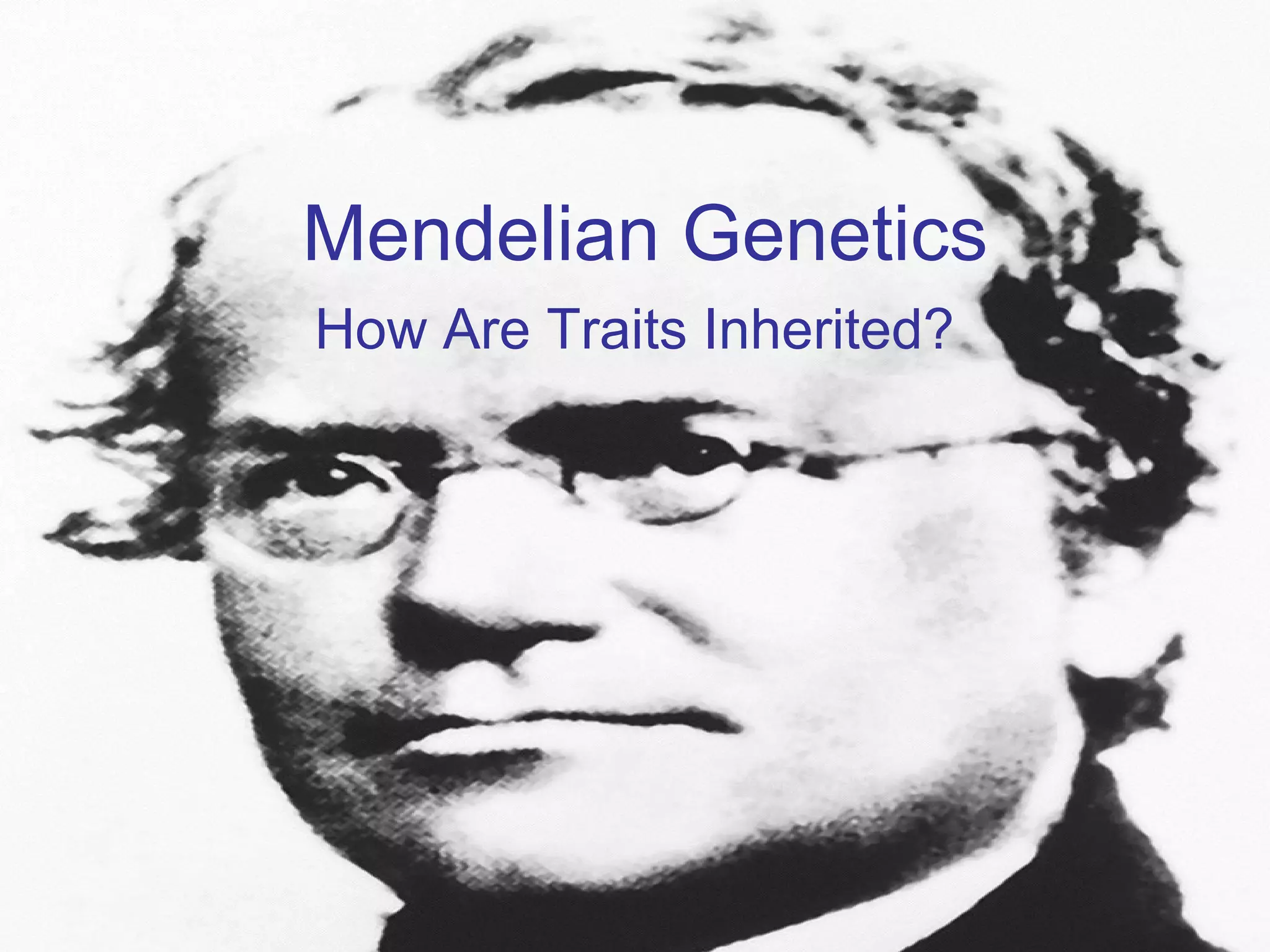
Mendelian Genetics
How Are Traits Inherited?
Gregor Mendel
• Raised on farm and understood the value of
plant breeding.
• At 21, entered priesthood and studied plant
breeding in a monastery in the Czech Republic.
• Loved to read especially about natural sciences
and was aware of Darwin’s findings.
• Studied the inheritance of traits in pea plants.
Gregor Mendel
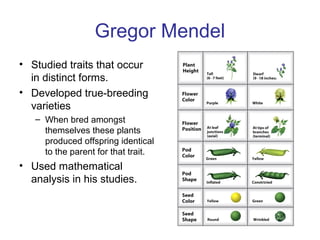
• Studied traits that occur
in distinct forms.
• Developed true-breeding
varieties
– When bred amongst
themselves these plants
produced offspring identical
to the parent for that trait.
• Used mathematical
analysis in his studies.
Definitions
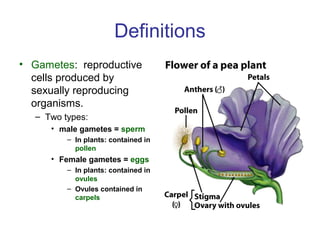
• Gametes: reproductive
cells produced by
sexually reproducing
organisms.
– Two types:
• male gametes = sperm
– In plants: contained in
pollen
• Female gametes = eggs
– In plants: contained in
ovules
– Ovules contained in
carpels
Fertilization
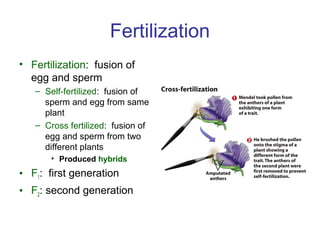
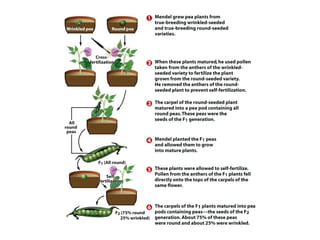
• Fertilization: fusion of
egg and sperm
– Self-fertilized: fusion of
sperm and egg from same
plant
– Cross fertilized: fusion of
egg and sperm from two
different plants
• Produced hybrids
• F1: first generation
• F2: second generation
Mendel’s Interpretations
• Modified to incorporate today’s vocabulary
– Genes: the hereditary information that determines a
single trait
– Alleles: alternate forms of a gene
• When an organism inherits two identical alleles
for a trait, organism is said to be homozygous
for the trait.
• When an organism inherits to different alleles for
one trait, the organism is called heterozygous for
the trait.
Why were all the seeds in the F1
generation round?
• Dominant vs. Recessive Allele
– Dominant: an allele that is expressed
whenever it is present
– Recessive: an allele that is masked
whenever the dominant allele is present.
• Dominant and recessive alleles influence
an organism’s phenotype
Genotype and Phenotype
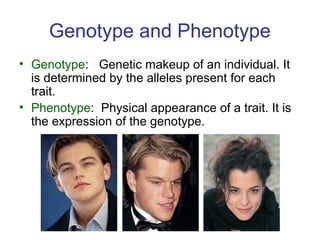
• Genotype: Genetic makeup of an individual. It
is determined by the alleles present for each
trait.
• Phenotype: Physical appearance of a trait. It is
the expression of the genotype.
Can you look at someone and
determine their genotype?
• Testcross is used to determine the
genotype of an individual
– Testcross: crossing an organism with
unknown genotype with one that is
homozygous recessive for the trait.
– Example:
• Plant that has round (R) seeds crossed with one
that is homozygous recessive (rr) for wrinkled
seeds
R? x rr
Using Punnett Squares to Predict
the Inheritance of Sickle Cell
Anemia
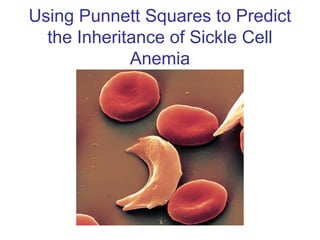
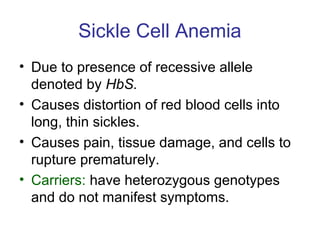
Sickle Cell Anemia
• Due to presence of recessive allele
denoted by HbS.
• Causes distortion of red blood cells into
long, thin sickles.
• Causes pain, tissue damage, and cells to
rupture prematurely.
• Carriers: have heterozygous genotypes
and do not manifest symptoms.
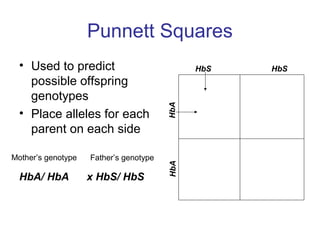
Punnett Squares
• Used to predict
possible offspring
genotypes
• Place alleles for each
parent on each side
HbA/ HbA x HbS/ HbS HbAHbA
HbS HbS
Mother’s genotype Father’s genotype
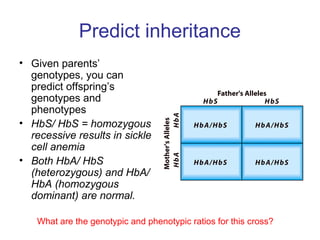
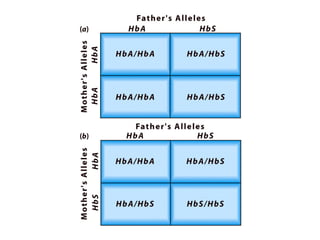
Predict inheritance
• Given parents’
genotypes, you can
predict offspring’s
genotypes and
phenotypes
• HbS/ HbS = homozygous
recessive results in sickle
cell anemia
• Both HbA/ HbS
(heterozygous) and HbA/
HbA (homozygous
dominant) are normal.
What are the genotypic and phenotypic ratios for this cross?
Mendel’s Laws
• Based on Mendel’s data, he formulated
two laws:
– Law of Segregation: A parent contributes only
one of its alleles for a trait to each offspring.
– If parent is heterozygous for a trait, the
particular allele donated to the offspring is
random.
Mendel’s Laws
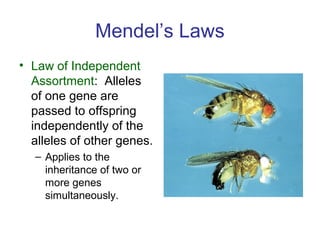
• Law of Independent
Assortment: Alleles
of one gene are
passed to offspring
independently of the
alleles of other genes.
– Applies to the
inheritance of two or
more genes
simultaneously.
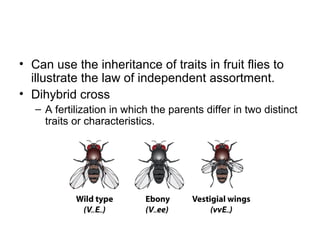
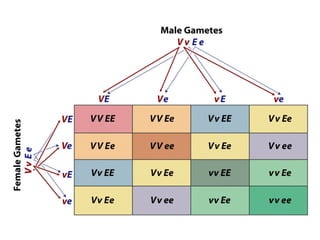
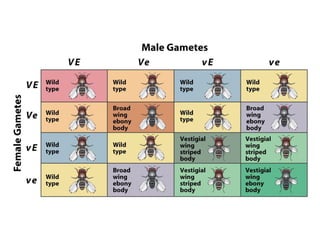
• Can use the inheritance of traits in fruit flies to
illustrate the law of independent assortment.
• Dihybrid cross
– A fertilization in which the parents differ in two distinct
traits or characteristics.
Probability
• Can be used to better
understand
segregation and
independent
assortment.
• Look at coins first…
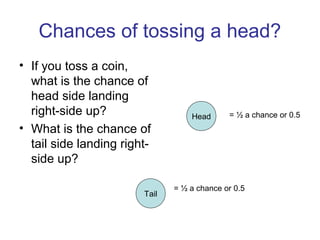
Chances of tossing a head?
• If you toss a coin,
what is the chance of
head side landing
right-side up?
• What is the chance of
tail side landing right-
side up?
Tail
Head = ½ a chance or 0.5
= ½ a chance or 0.5
Probability Rule
• Sum rule: the combined probability of two
or more mutually exclusive events
occurring is equal to the sum of their
individual probabilities
• Example: Parent has Gg genotype. What
is the probability that the offspring will
receive the g or G allele from the parent?
Probability of g or G = 0.5 + 0.5
Probability of g or G = 1
Probability Rule
• Product rule: The joint probability that
both of two independent events occur is
the product of the individual probabilities
of each event.
• Example: Mother has Gg genotype and
father has Gg genotype. What is the
probability that the offspring will have gg
genotype?
Probability of g from Mom and g from Dad G = 0.5 x 0.5
Probability of gg genotype in offspring = 0.25
Why Aren’t Members of the Same
Species Identical?
• Sources of Genetic Variation
– Law of Independent Assortment
– Mutation
Law of Independent Assortment
• Allows for new gene combinations or
genetic recombination
• Can mathematically predict the possible
combinations
– Number of possible genotypes = 2n
where n = the number of genes or traits
considered
– Example: considering 100 traits:
• 2100
= 1.26765 x 1030
Mutations
• Definition = change in DNA sequence
resulting the appearance of a new allele
• Can occur at any time, but not always
beneficial
• Some can be harmful and result in death
• Some can result in the organism having
traits that make them better suited to the
environment
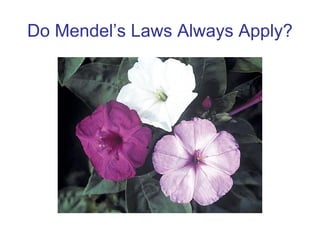
Do Mendel’s Laws Always Apply?
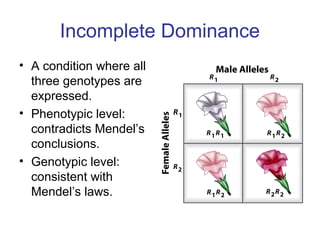
Incomplete Dominance
• A condition where all
three genotypes are
expressed.
• Phenotypic level:
contradicts Mendel’s
conclusions.
• Genotypic level:
consistent with
Mendel’s laws.
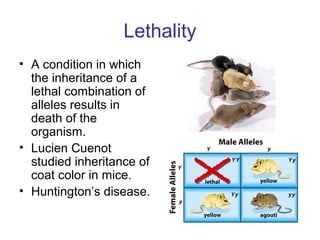
Lethality
• A condition in which
the inheritance of a
lethal combination of
alleles results in
death of the
organism.
• Lucien Cuenot
studied inheritance of
coat color in mice.
• Huntington’s disease.
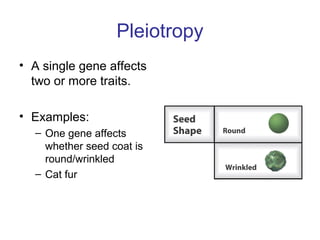
Pleiotropy
• A single gene affects
two or more traits.
• Examples:
– One gene affects
whether seed coat is
round/wrinkled
– Cat fur
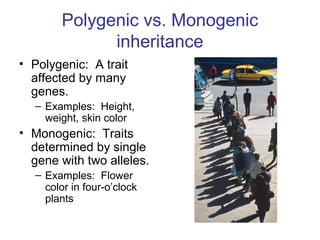
Polygenic vs. Monogenic
inheritance
• Polygenic: A trait
affected by many
genes.
– Examples: Height,
weight, skin color
• Monogenic: Traits
determined by single
gene with two alleles.
– Examples: Flower
color in four-o’clock
plants

Chapter 3 (1)

  • 1.
    Mendelian Genetics How AreTraits Inherited?
  • 2.
    Gregor Mendel • Raisedon farm and understood the value of plant breeding. • At 21, entered priesthood and studied plant breeding in a monastery in the Czech Republic. • Loved to read especially about natural sciences and was aware of Darwin’s findings. • Studied the inheritance of traits in pea plants.
  • 3.
    Gregor Mendel • Studiedtraits that occur in distinct forms. • Developed true-breeding varieties – When bred amongst themselves these plants produced offspring identical to the parent for that trait. • Used mathematical analysis in his studies.
  • 4.
    Definitions • Gametes: reproductive cellsproduced by sexually reproducing organisms. – Two types: • male gametes = sperm – In plants: contained in pollen • Female gametes = eggs – In plants: contained in ovules – Ovules contained in carpels
  • 5.
    Fertilization • Fertilization: fusionof egg and sperm – Self-fertilized: fusion of sperm and egg from same plant – Cross fertilized: fusion of egg and sperm from two different plants • Produced hybrids • F1: first generation • F2: second generation
  • 7.
    Mendel’s Interpretations • Modifiedto incorporate today’s vocabulary – Genes: the hereditary information that determines a single trait – Alleles: alternate forms of a gene • When an organism inherits two identical alleles for a trait, organism is said to be homozygous for the trait. • When an organism inherits to different alleles for one trait, the organism is called heterozygous for the trait.
  • 8.
    Why were allthe seeds in the F1 generation round? • Dominant vs. Recessive Allele – Dominant: an allele that is expressed whenever it is present – Recessive: an allele that is masked whenever the dominant allele is present. • Dominant and recessive alleles influence an organism’s phenotype
  • 9.
    Genotype and Phenotype •Genotype: Genetic makeup of an individual. It is determined by the alleles present for each trait. • Phenotype: Physical appearance of a trait. It is the expression of the genotype.
  • 10.
    Can you lookat someone and determine their genotype? • Testcross is used to determine the genotype of an individual – Testcross: crossing an organism with unknown genotype with one that is homozygous recessive for the trait. – Example: • Plant that has round (R) seeds crossed with one that is homozygous recessive (rr) for wrinkled seeds R? x rr
  • 11.
    Using Punnett Squaresto Predict the Inheritance of Sickle Cell Anemia
  • 12.
    Sickle Cell Anemia •Due to presence of recessive allele denoted by HbS. • Causes distortion of red blood cells into long, thin sickles. • Causes pain, tissue damage, and cells to rupture prematurely. • Carriers: have heterozygous genotypes and do not manifest symptoms.
  • 13.
    Punnett Squares • Usedto predict possible offspring genotypes • Place alleles for each parent on each side HbA/ HbA x HbS/ HbS HbAHbA HbS HbS Mother’s genotype Father’s genotype
  • 14.
    Predict inheritance • Givenparents’ genotypes, you can predict offspring’s genotypes and phenotypes • HbS/ HbS = homozygous recessive results in sickle cell anemia • Both HbA/ HbS (heterozygous) and HbA/ HbA (homozygous dominant) are normal. What are the genotypic and phenotypic ratios for this cross?
  • 16.
    Mendel’s Laws • Basedon Mendel’s data, he formulated two laws: – Law of Segregation: A parent contributes only one of its alleles for a trait to each offspring. – If parent is heterozygous for a trait, the particular allele donated to the offspring is random.
  • 17.
    Mendel’s Laws • Lawof Independent Assortment: Alleles of one gene are passed to offspring independently of the alleles of other genes. – Applies to the inheritance of two or more genes simultaneously.
  • 18.
    • Can usethe inheritance of traits in fruit flies to illustrate the law of independent assortment. • Dihybrid cross – A fertilization in which the parents differ in two distinct traits or characteristics.
  • 21.
    Probability • Can beused to better understand segregation and independent assortment. • Look at coins first…
  • 22.
    Chances of tossinga head? • If you toss a coin, what is the chance of head side landing right-side up? • What is the chance of tail side landing right- side up? Tail Head = ½ a chance or 0.5 = ½ a chance or 0.5
  • 23.
    Probability Rule • Sumrule: the combined probability of two or more mutually exclusive events occurring is equal to the sum of their individual probabilities • Example: Parent has Gg genotype. What is the probability that the offspring will receive the g or G allele from the parent? Probability of g or G = 0.5 + 0.5 Probability of g or G = 1
  • 24.
    Probability Rule • Productrule: The joint probability that both of two independent events occur is the product of the individual probabilities of each event. • Example: Mother has Gg genotype and father has Gg genotype. What is the probability that the offspring will have gg genotype? Probability of g from Mom and g from Dad G = 0.5 x 0.5 Probability of gg genotype in offspring = 0.25
  • 25.
    Why Aren’t Membersof the Same Species Identical? • Sources of Genetic Variation – Law of Independent Assortment – Mutation
  • 26.
    Law of IndependentAssortment • Allows for new gene combinations or genetic recombination • Can mathematically predict the possible combinations – Number of possible genotypes = 2n where n = the number of genes or traits considered – Example: considering 100 traits: • 2100 = 1.26765 x 1030
  • 27.
    Mutations • Definition =change in DNA sequence resulting the appearance of a new allele • Can occur at any time, but not always beneficial • Some can be harmful and result in death • Some can result in the organism having traits that make them better suited to the environment
  • 28.
    Do Mendel’s LawsAlways Apply?
  • 29.
    Incomplete Dominance • Acondition where all three genotypes are expressed. • Phenotypic level: contradicts Mendel’s conclusions. • Genotypic level: consistent with Mendel’s laws.
  • 30.
    Lethality • A conditionin which the inheritance of a lethal combination of alleles results in death of the organism. • Lucien Cuenot studied inheritance of coat color in mice. • Huntington’s disease.
  • 31.
    Pleiotropy • A singlegene affects two or more traits. • Examples: – One gene affects whether seed coat is round/wrinkled – Cat fur
  • 32.
    Polygenic vs. Monogenic inheritance •Polygenic: A trait affected by many genes. – Examples: Height, weight, skin color • Monogenic: Traits determined by single gene with two alleles. – Examples: Flower color in four-o’clock plants