Chemical Bonding
Chapter 1
Interactions of Matter
REVIEW
 Identify the 4 atoms whose models are on the
bulletin board.
 How did you identify these elements?
Electron Arrangements
Energy Level Maximum
Number of
Electrons
1 2
2 8
3 8 (then 10 more
later)
Remember
electrons
arrange in
energy levels
outside the
nucleus.
Electron Dot Diagrams
 Show ONLY outer level electrons
 Also called Lewis diagrams
1. Begin with the element’s symbol
2. Use the PT to determine the number of
outer level electrons
3. Place up to 2 dots per side for a total of up
to 8 electrons
 Put the first 2 dots together on one
side, then put single dots on the remaining
sides until you have to pair them
Electron Dot Diagrams
 Ex: 1 electron
X
Electron Dot Diagrams
 Ex: 2 electrons
X
Electron Dot Diagrams
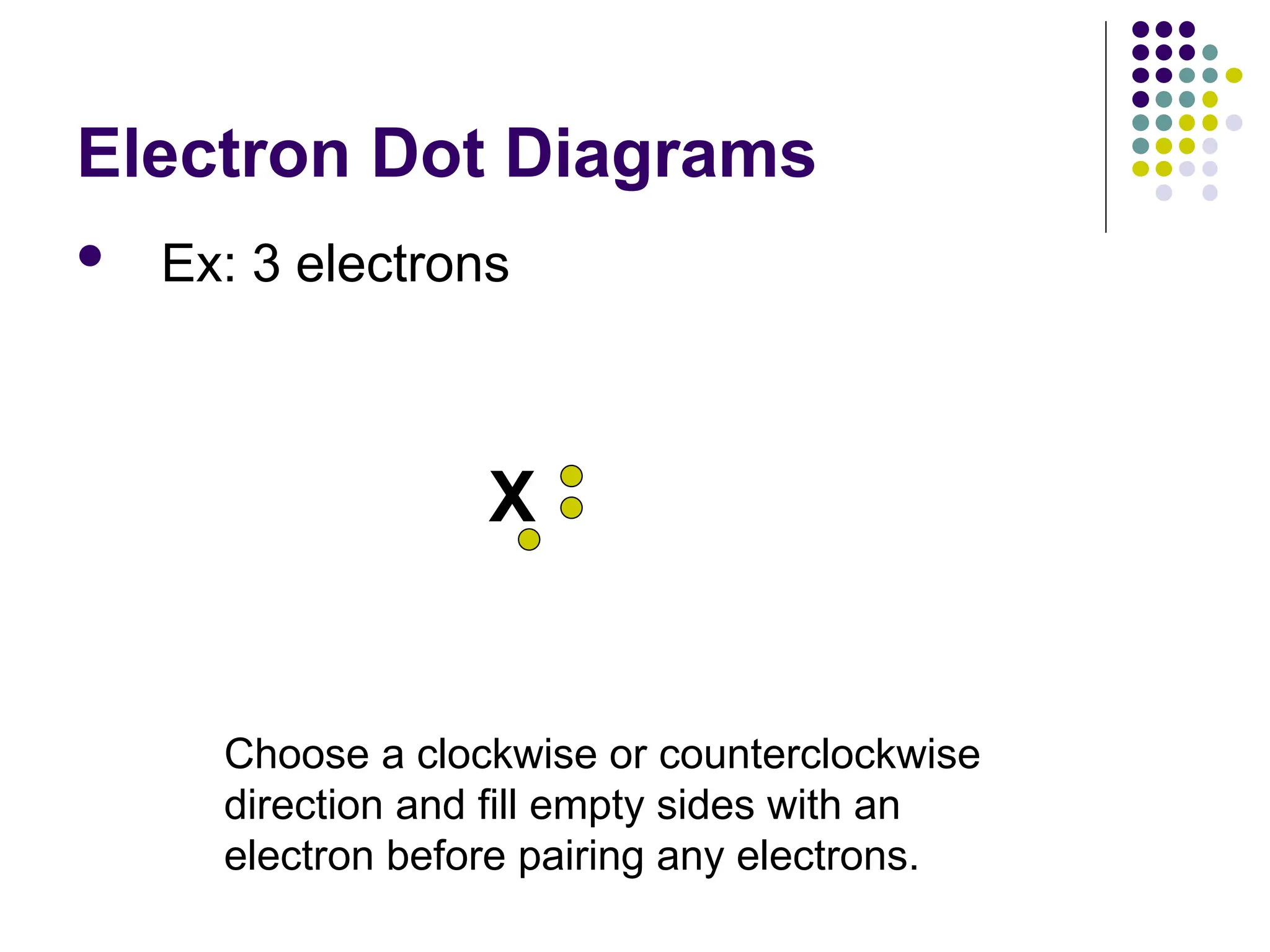
 Ex: 3 electrons
X
Choose a clockwise or counterclockwise
direction and fill empty sides with an
electron before pairing any electrons.
Electron Dot Diagrams
 Ex: 4 electrons
X
Choose a clockwise or counterclockwise
direction and fill empty sides with an
electron before pairing any electrons.
Electron Dot Diagrams
 Ex: 5 electrons
X
Choose a clockwise or counterclockwise
direction and fill empty sides with an
electron before pairing any electrons.
Electron Dot Diagrams
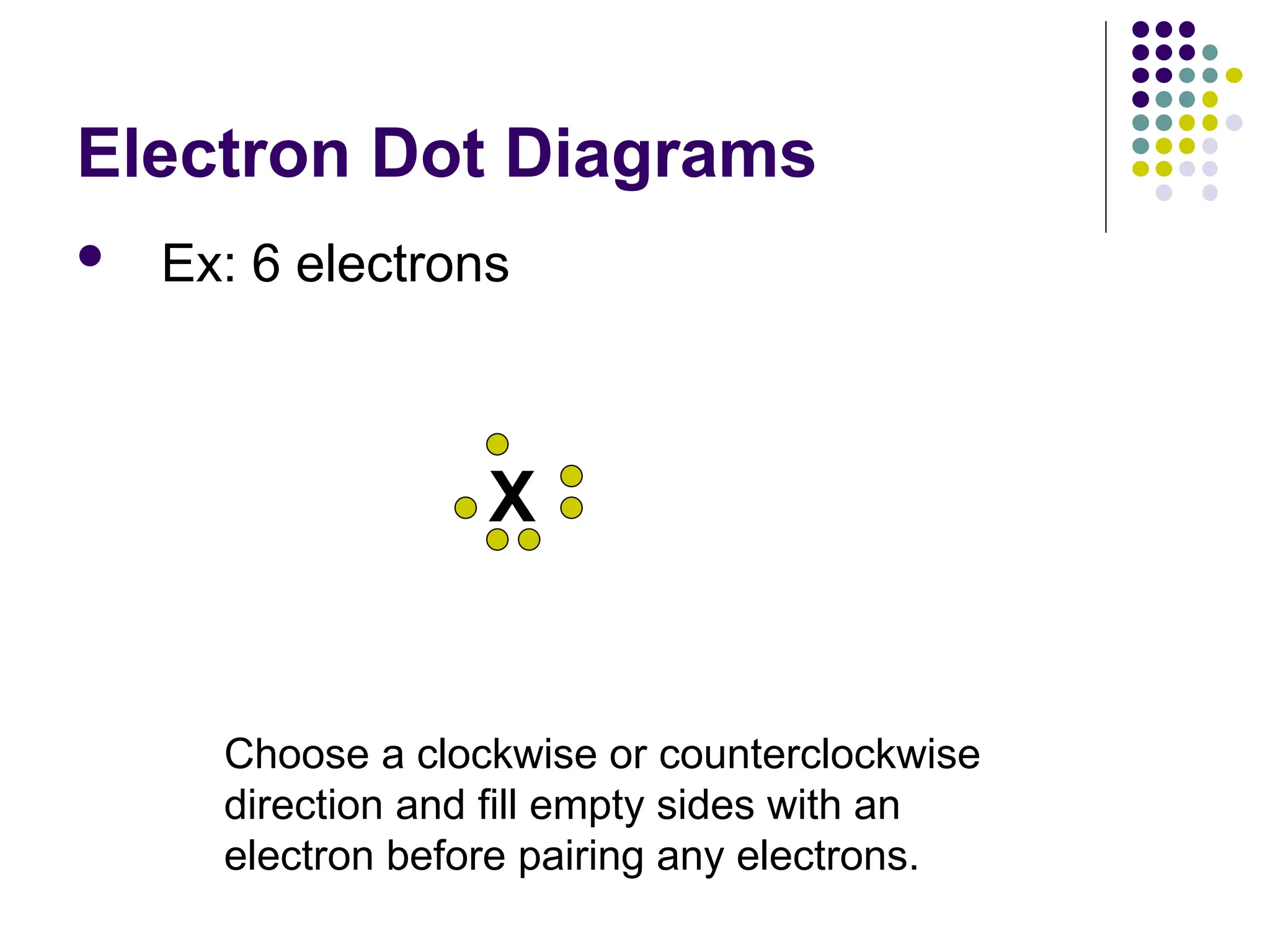
 Ex: 6 electrons
X
Choose a clockwise or counterclockwise
direction and fill empty sides with an
electron before pairing any electrons.
Electron Dot Diagrams
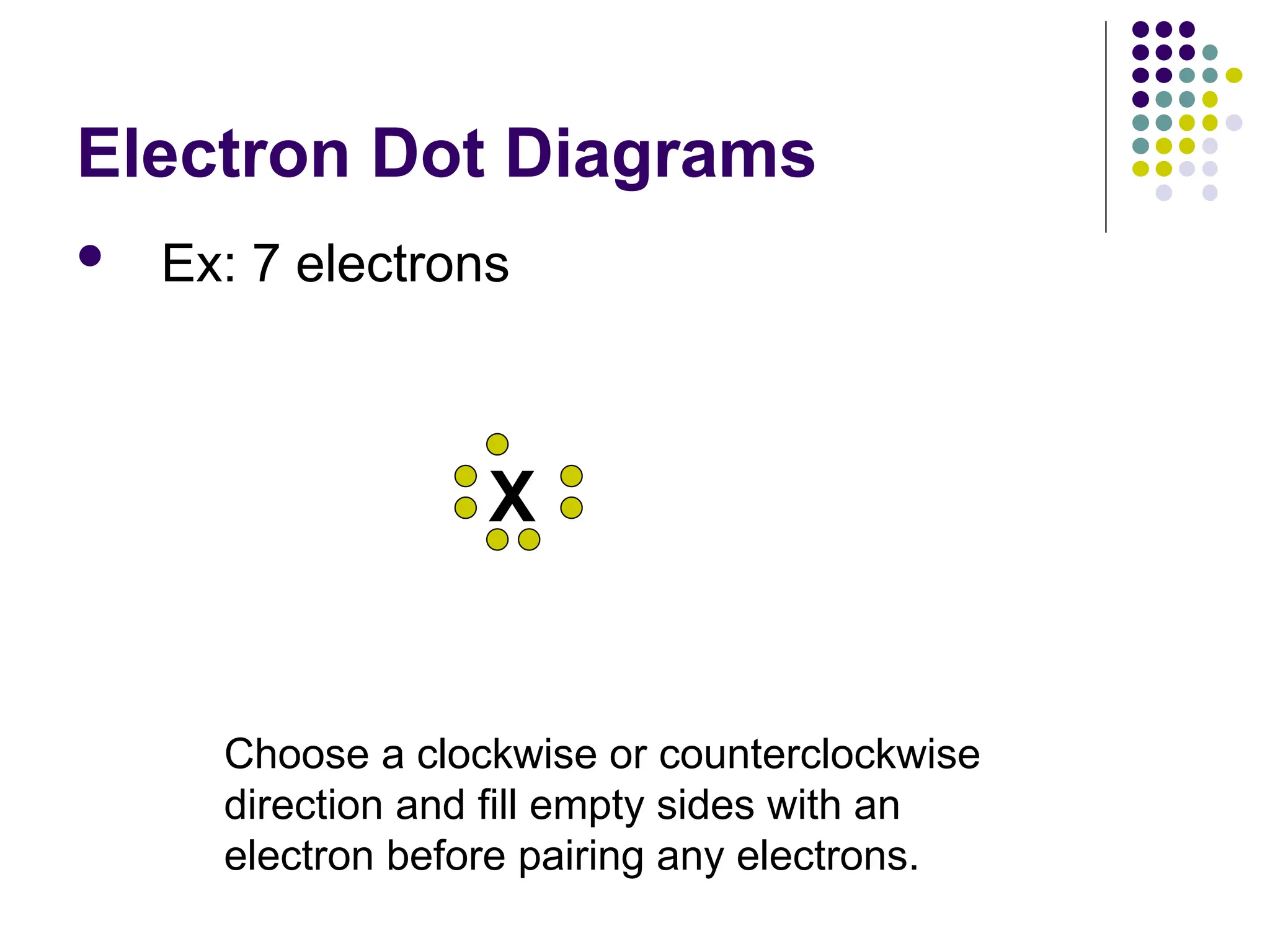
 Ex: 7 electrons
X
Choose a clockwise or counterclockwise
direction and fill empty sides with an
electron before pairing any electrons.
Electron Dot Diagrams
 Ex: 8 electrons
X
THIS IS THE MOST ELECTRONS THAT EVER ARE
INCLUDED IN ELECTRON DOT DIAGRAMS.
Electron Dot Diagrams
 Time to practice what you’ve learned
 For the following elements, create electron dot diagrams
using M&M’s as electrons. Be sure to write large size
symbols on your paper.
 YUM, but no eating allowed until all your work is
checked and is correct!
aluminum potassium argon oxygen
phosphorus silicon barium iodine
BRING IN YOUR ATOMIC MODEL TOMORROW!
CHEMICAL BONDING
 The number of electrons in the ____________ energy
level determines whether an atom will form bonds.
 These electrons are also called ___________ electrons.
 Atoms bond to get a ________ outer level.
 For all E levels beyond the first, the outermost E level is
considered to be full if it contains ______ (#) electrons.
 The first E level is full with ____ (#) electrons.
 Why are noble gases nonreactive?
CHEMICAL BONDING
 Atoms bond by __________, ____________, or
___________ electrons to have a filled outermost
energy level containing 8 valence electrons.
 ___(#) types of bonds hold atoms together.
1. IONIC BOND- force of electrostatic attraction between 2
oppositely charged ______.
 Ions form when electrons are _________________.
2. COVALENT BOND- force of attraction between nuclei of atoms
and the electrons _______________ by the atoms.
 Neutral atoms held by covalent bonds are called
__________________.
3. METALLIC BOND- force of attraction between a ____________
charged metal ion and the electrons in a metal.
IONIC BONDS
 Chem 4 Kids example
METALS
•have a low/high number of valence electrons.
•metals lose/gain electrons when bonding.
•form positive/negative ions.
NONMETALS
•have a low/high number of valence electrons.
•lose/gain electrons when bonding.
•form positive/negative ions.
•ions end in –ide
IONIC BONDS
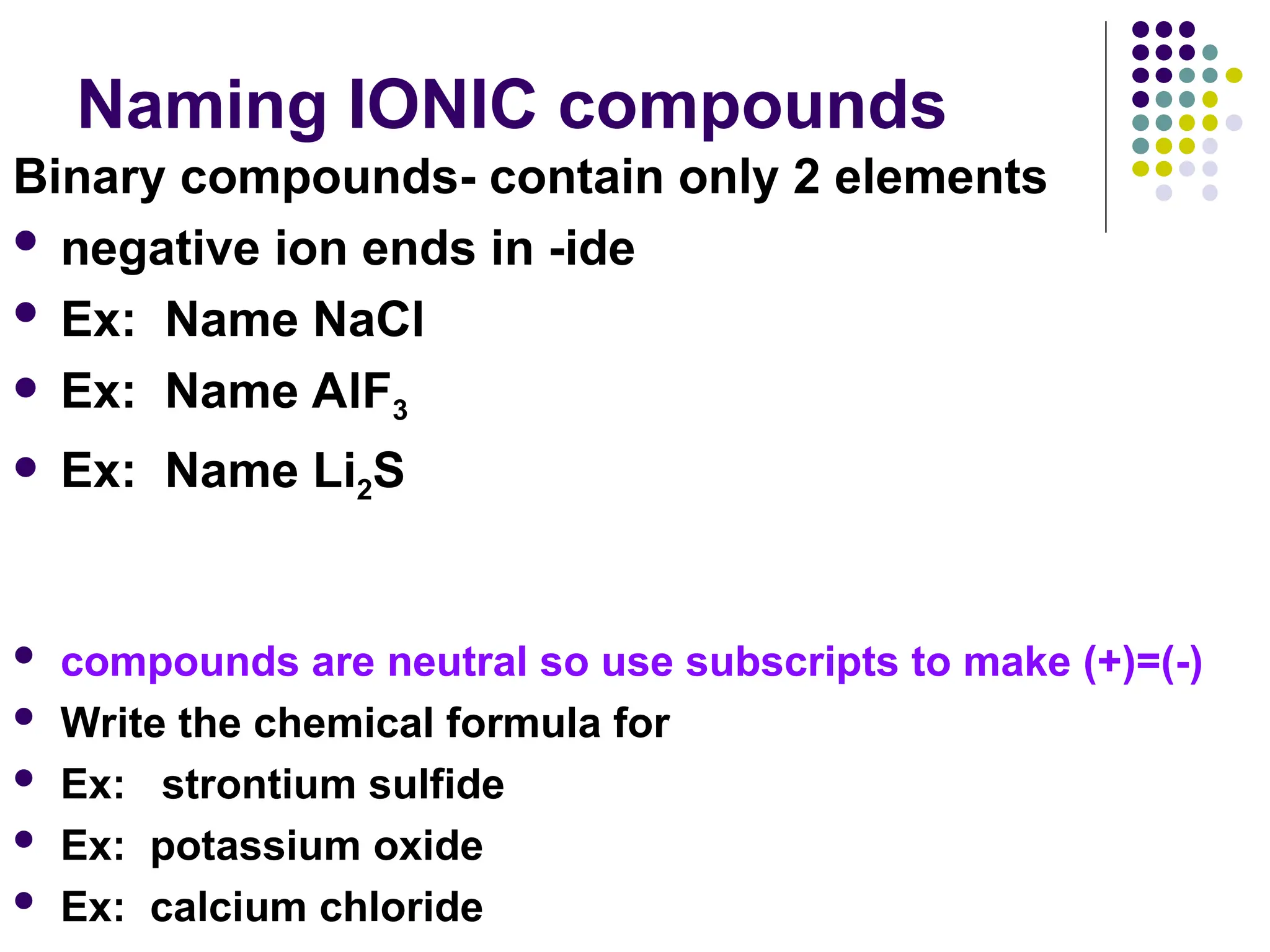
Naming IONIC compounds
Binary compounds- contain only 2 elements
 negative ion ends in -ide
 Ex: Name NaCl
 Ex: Name AlF3
 Ex: Name Li2S
 compounds are neutral so use subscripts to make (+)=(-)
 Write the chemical formula for
 Ex: strontium sulfide
 Ex: potassium oxide
 Ex: calcium chloride
Naming IONIC compounds
Binary compounds- containing transition elements
 Transition metals- the charge is in parenthesis
following the name of the metal except for Ag, Cd,
and Zn (see PT)
 ex: chromium (II) chloride
ex: iron (III) oxide

Ex: NiF2 vs. NiF

Ex: CrI4 vs. CrI2
Naming IONIC compounds
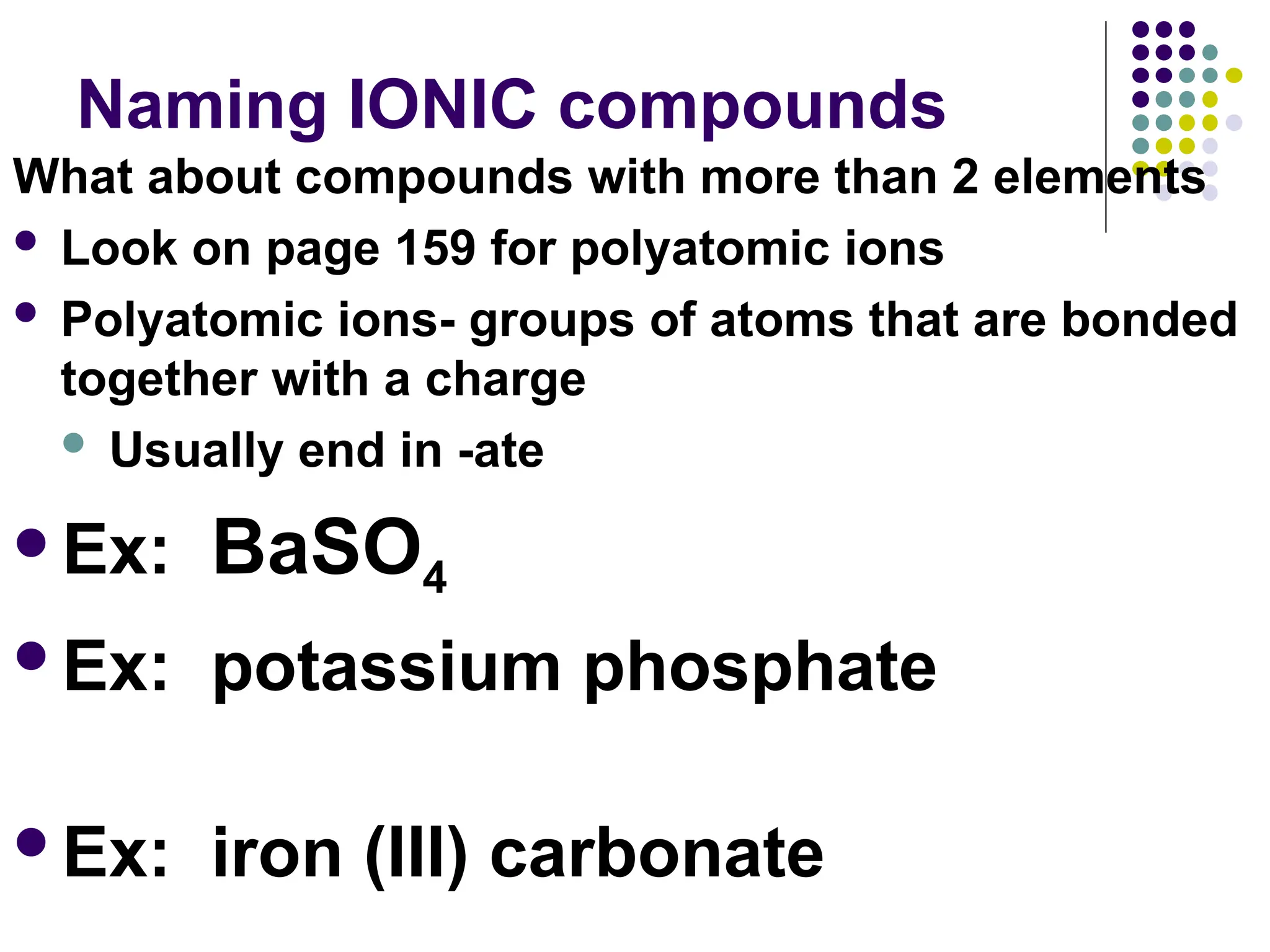
What about compounds with more than 2 elements
 Look on page 159 for polyatomic ions
 Polyatomic ions- groups of atoms that are bonded
together with a charge
 Usually end in -ate
Ex: BaSO4
Ex: potassium phosphate
Ex: iron (III) carbonate
IONIC BONDS- metal ion + nonmetal ion
CHARACTERISTICS OF IONIC COMPOUNDS
•Hard, brittle solids at room temp
•High melting and boiling points
•Ions are held in a crystal lattice
•Conduct electricity when dissolved in H2O
Quick Review
1.Barium sulfide
2.Aluminum carbonate
3.NaClO3
4.SiO2
5.Dinitrogen pentoxide
COVALENT BONDS
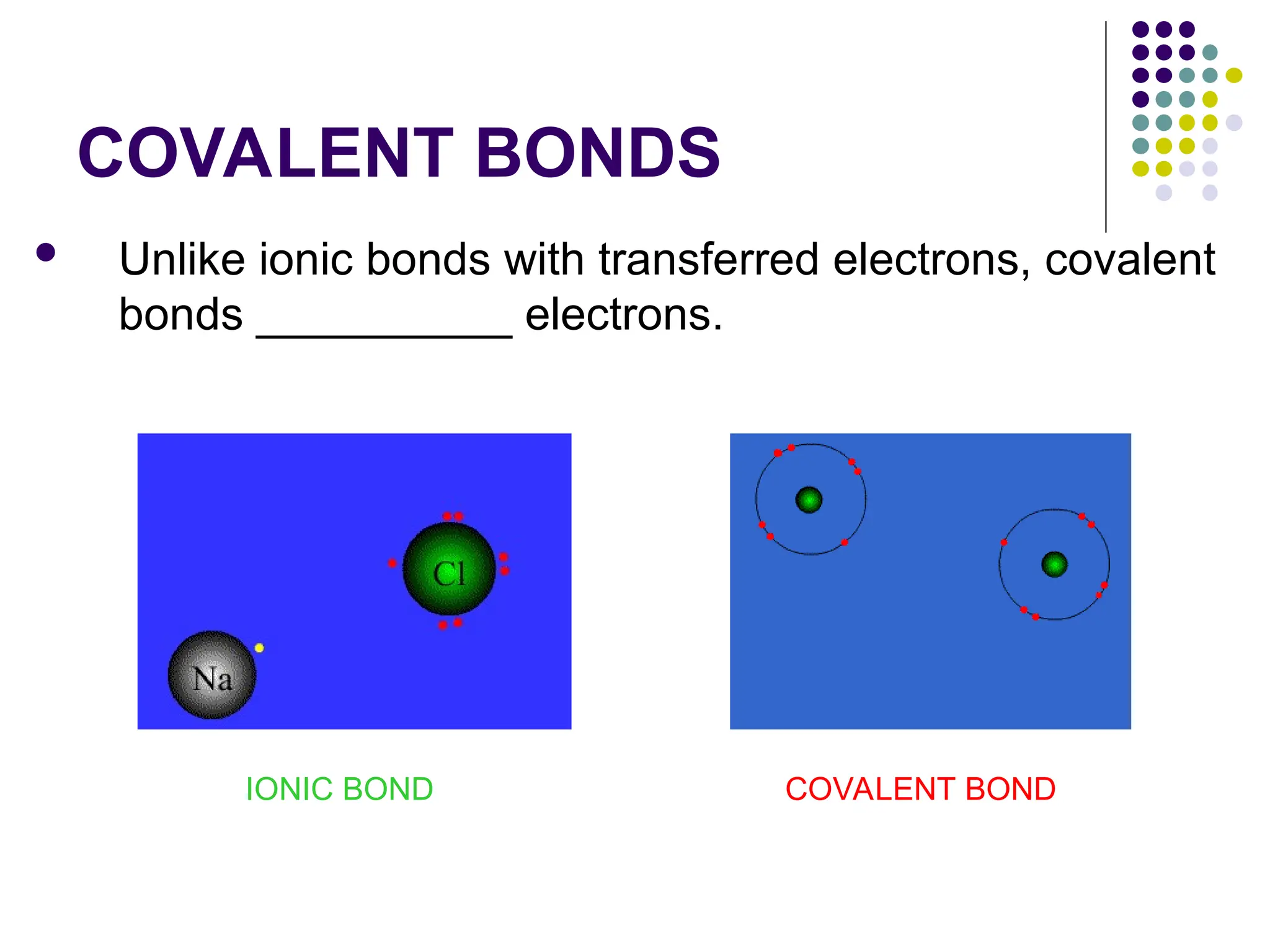
 Unlike ionic bonds with transferred electrons, covalent
bonds __________ electrons.
IONIC BOND COVALENT BOND
COVALENT BONDS
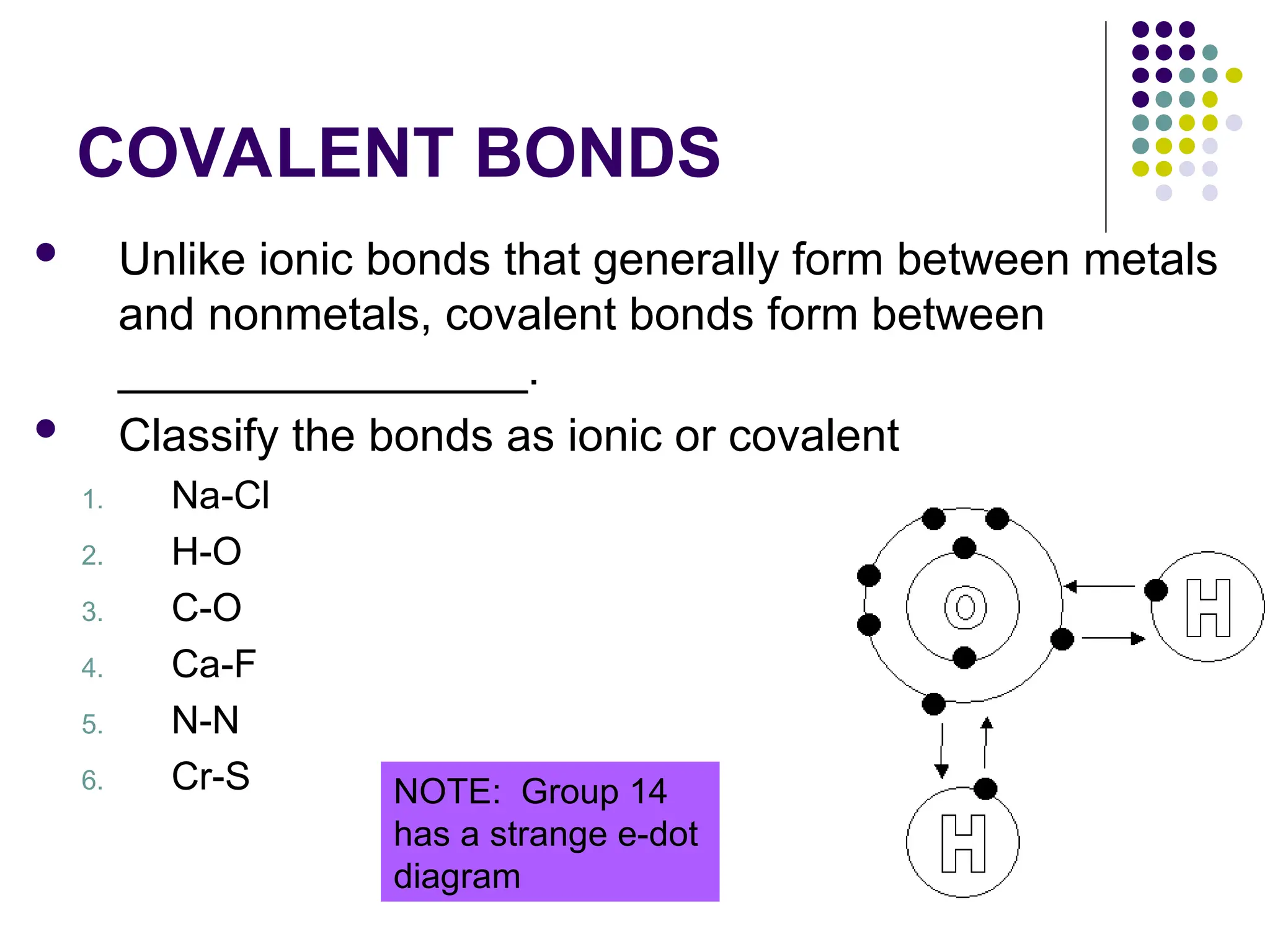
 Unlike ionic bonds that generally form between metals
and nonmetals, covalent bonds form between
________________.
 Classify the bonds as ionic or covalent
1. Na-Cl
2. H-O
3. C-O
4. Ca-F
5. N-N
6. Cr-S NOTE: Group 14
has a strange e-dot
diagram
COVALENT BONDS
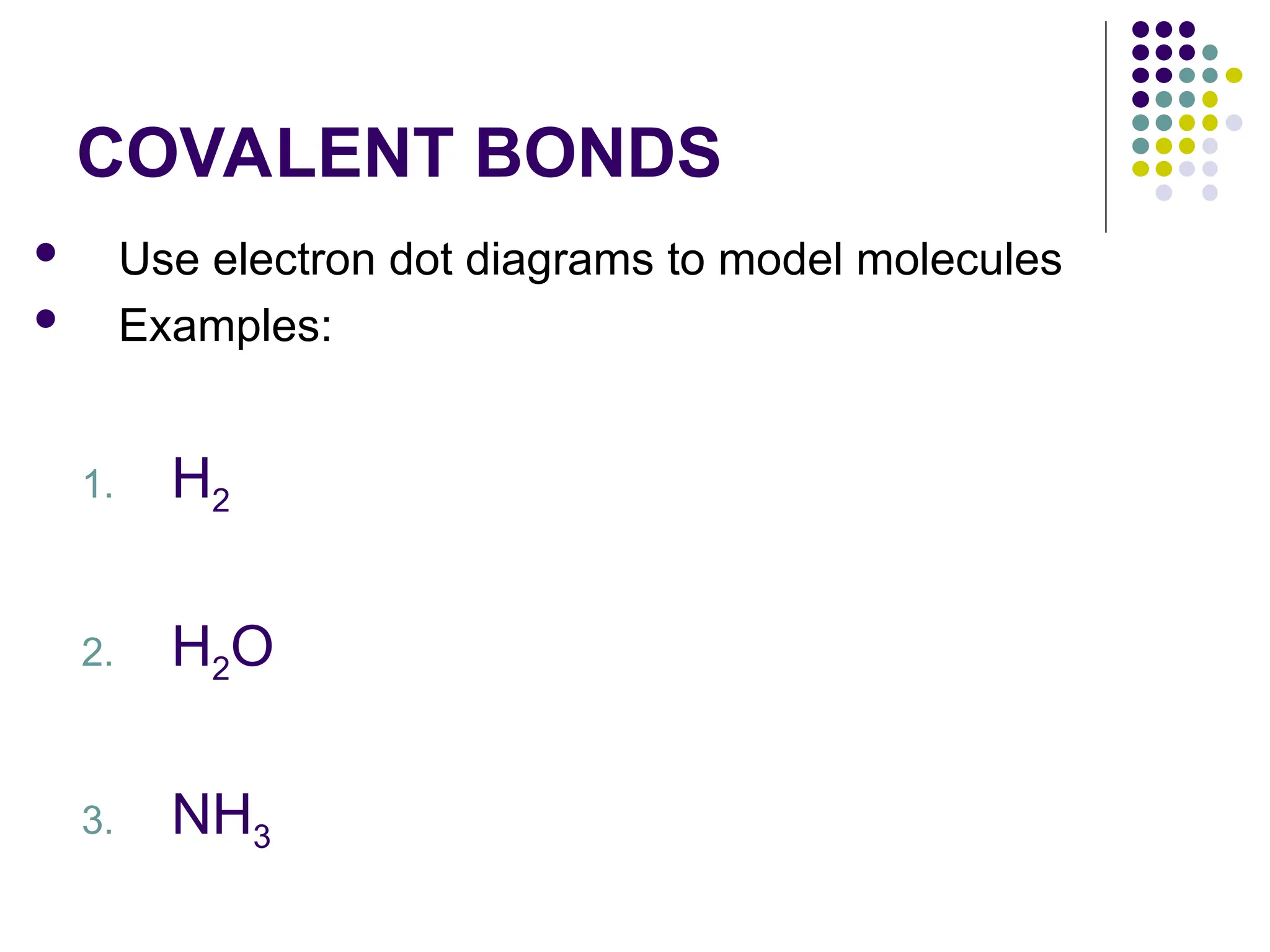
 Use electron dot diagrams to model molecules
 Examples:
1. H2
2. H2O
3. NH3
COVALENT BONDS
 Some molecules are simple with only one element
 7 elements are not found in nature as atoms

They always are found in pairs- called diatomic
N2 O2 F2
Cl2
Br2
I2
And H2 (always the exception)
COVALENT BONDS
 EXAMPLES OF COVALENT COMPOUNDS
 water
 plastic
 sugar
 Gasoline oils & fats
 CHARACTERISTICS OF COVALENT COMPOUNDS
1. Do NOT conduct an electrical current
2. Low melting and boiling points
3. Lightweight molecules: generally gases and liquids at
room temp
4. Heavier molecules: generally solids at room temp
COVALENT COMPOUNDS
 Naming covalent compounds involves using prefixes to
indicate the number of atoms in the formula.

Website w/prefixes and rules
COVALENT COMPOUNDS
• When atoms share electrons, they don’t
always share them equally.
• Nonpolar covalent compounds:
share e- equally
• Will not conduct an electrical
current at all
• All diatomic molecules are
nonpolar
• Polar covalent compounds: share e-
unequally
• Can conduct an electrical current
COVALENT COMPOUNDS
• Polarity affects how chemicals mix.
• “Like dissolves like.”
• Nonpolar compounds mix with other
nonpolar compounds.
• Ex:
• Polar compounds mix with other polar
compounds.
• Ex:
• Nonpolar compounds will not mix with
polar compounds.
• Ex:
• How does this affect how soap is made?
METALLIC BONDS
 EXAMPLES CONTAINING METALLIC BONDS
 Cu, Fe
 Alloys- mixtures of metals
 EX: brass, bronze, steel
 CHARACTERISTICS OF METALS
1. Malleable & ductile
2. Good conductors
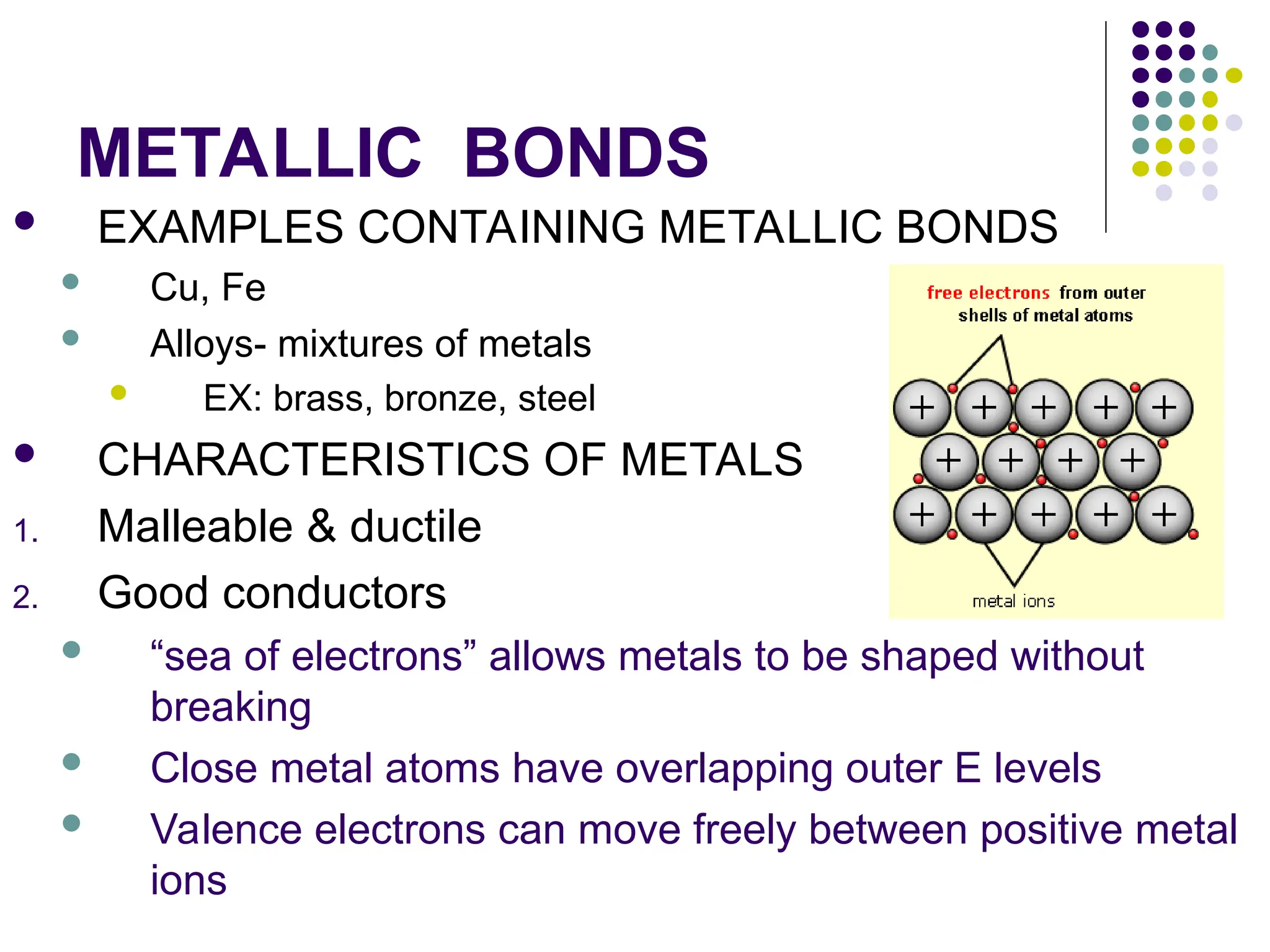
 “sea of electrons” allows metals to be shaped without
breaking
 Close metal atoms have overlapping outer E levels
 Valence electrons can move freely between positive metal
ions

Chemical Bonding: Types and Definition.ppt

  • 1.
  • 2.
    REVIEW  Identify the4 atoms whose models are on the bulletin board.  How did you identify these elements?
  • 3.
    Electron Arrangements Energy LevelMaximum Number of Electrons 1 2 2 8 3 8 (then 10 more later) Remember electrons arrange in energy levels outside the nucleus.
  • 4.
    Electron Dot Diagrams Show ONLY outer level electrons  Also called Lewis diagrams 1. Begin with the element’s symbol 2. Use the PT to determine the number of outer level electrons 3. Place up to 2 dots per side for a total of up to 8 electrons  Put the first 2 dots together on one side, then put single dots on the remaining sides until you have to pair them
  • 5.
    Electron Dot Diagrams Ex: 1 electron X
  • 6.
    Electron Dot Diagrams Ex: 2 electrons X
  • 7.
    Electron Dot Diagrams Ex: 3 electrons X Choose a clockwise or counterclockwise direction and fill empty sides with an electron before pairing any electrons.
  • 8.
    Electron Dot Diagrams Ex: 4 electrons X Choose a clockwise or counterclockwise direction and fill empty sides with an electron before pairing any electrons.
  • 9.
    Electron Dot Diagrams Ex: 5 electrons X Choose a clockwise or counterclockwise direction and fill empty sides with an electron before pairing any electrons.
  • 10.
    Electron Dot Diagrams Ex: 6 electrons X Choose a clockwise or counterclockwise direction and fill empty sides with an electron before pairing any electrons.
  • 11.
    Electron Dot Diagrams Ex: 7 electrons X Choose a clockwise or counterclockwise direction and fill empty sides with an electron before pairing any electrons.
  • 12.
    Electron Dot Diagrams Ex: 8 electrons X THIS IS THE MOST ELECTRONS THAT EVER ARE INCLUDED IN ELECTRON DOT DIAGRAMS.
  • 13.
    Electron Dot Diagrams Time to practice what you’ve learned  For the following elements, create electron dot diagrams using M&M’s as electrons. Be sure to write large size symbols on your paper.  YUM, but no eating allowed until all your work is checked and is correct! aluminum potassium argon oxygen phosphorus silicon barium iodine BRING IN YOUR ATOMIC MODEL TOMORROW!
  • 14.
    CHEMICAL BONDING  Thenumber of electrons in the ____________ energy level determines whether an atom will form bonds.  These electrons are also called ___________ electrons.  Atoms bond to get a ________ outer level.  For all E levels beyond the first, the outermost E level is considered to be full if it contains ______ (#) electrons.  The first E level is full with ____ (#) electrons.  Why are noble gases nonreactive?
  • 15.
    CHEMICAL BONDING  Atomsbond by __________, ____________, or ___________ electrons to have a filled outermost energy level containing 8 valence electrons.  ___(#) types of bonds hold atoms together. 1. IONIC BOND- force of electrostatic attraction between 2 oppositely charged ______.  Ions form when electrons are _________________. 2. COVALENT BOND- force of attraction between nuclei of atoms and the electrons _______________ by the atoms.  Neutral atoms held by covalent bonds are called __________________. 3. METALLIC BOND- force of attraction between a ____________ charged metal ion and the electrons in a metal.
  • 16.
    IONIC BONDS  Chem4 Kids example METALS •have a low/high number of valence electrons. •metals lose/gain electrons when bonding. •form positive/negative ions. NONMETALS •have a low/high number of valence electrons. •lose/gain electrons when bonding. •form positive/negative ions. •ions end in –ide
  • 17.
  • 18.
    Naming IONIC compounds Binarycompounds- contain only 2 elements  negative ion ends in -ide  Ex: Name NaCl  Ex: Name AlF3  Ex: Name Li2S  compounds are neutral so use subscripts to make (+)=(-)  Write the chemical formula for  Ex: strontium sulfide  Ex: potassium oxide  Ex: calcium chloride
  • 19.
    Naming IONIC compounds Binarycompounds- containing transition elements  Transition metals- the charge is in parenthesis following the name of the metal except for Ag, Cd, and Zn (see PT)  ex: chromium (II) chloride ex: iron (III) oxide  Ex: NiF2 vs. NiF  Ex: CrI4 vs. CrI2
  • 20.
    Naming IONIC compounds Whatabout compounds with more than 2 elements  Look on page 159 for polyatomic ions  Polyatomic ions- groups of atoms that are bonded together with a charge  Usually end in -ate Ex: BaSO4 Ex: potassium phosphate Ex: iron (III) carbonate
  • 21.
    IONIC BONDS- metalion + nonmetal ion CHARACTERISTICS OF IONIC COMPOUNDS •Hard, brittle solids at room temp •High melting and boiling points •Ions are held in a crystal lattice •Conduct electricity when dissolved in H2O
  • 22.
    Quick Review 1.Barium sulfide 2.Aluminumcarbonate 3.NaClO3 4.SiO2 5.Dinitrogen pentoxide
  • 23.
    COVALENT BONDS  Unlikeionic bonds with transferred electrons, covalent bonds __________ electrons. IONIC BOND COVALENT BOND
  • 24.
    COVALENT BONDS  Unlikeionic bonds that generally form between metals and nonmetals, covalent bonds form between ________________.  Classify the bonds as ionic or covalent 1. Na-Cl 2. H-O 3. C-O 4. Ca-F 5. N-N 6. Cr-S NOTE: Group 14 has a strange e-dot diagram
  • 25.
    COVALENT BONDS  Useelectron dot diagrams to model molecules  Examples: 1. H2 2. H2O 3. NH3
  • 26.
    COVALENT BONDS  Somemolecules are simple with only one element  7 elements are not found in nature as atoms  They always are found in pairs- called diatomic N2 O2 F2 Cl2 Br2 I2 And H2 (always the exception)
  • 27.
    COVALENT BONDS  EXAMPLESOF COVALENT COMPOUNDS  water  plastic  sugar  Gasoline oils & fats  CHARACTERISTICS OF COVALENT COMPOUNDS 1. Do NOT conduct an electrical current 2. Low melting and boiling points 3. Lightweight molecules: generally gases and liquids at room temp 4. Heavier molecules: generally solids at room temp
  • 28.
    COVALENT COMPOUNDS  Namingcovalent compounds involves using prefixes to indicate the number of atoms in the formula.  Website w/prefixes and rules
  • 29.
    COVALENT COMPOUNDS • Whenatoms share electrons, they don’t always share them equally. • Nonpolar covalent compounds: share e- equally • Will not conduct an electrical current at all • All diatomic molecules are nonpolar • Polar covalent compounds: share e- unequally • Can conduct an electrical current
  • 30.
    COVALENT COMPOUNDS • Polarityaffects how chemicals mix. • “Like dissolves like.” • Nonpolar compounds mix with other nonpolar compounds. • Ex: • Polar compounds mix with other polar compounds. • Ex: • Nonpolar compounds will not mix with polar compounds. • Ex: • How does this affect how soap is made?
  • 31.
    METALLIC BONDS  EXAMPLESCONTAINING METALLIC BONDS  Cu, Fe  Alloys- mixtures of metals  EX: brass, bronze, steel  CHARACTERISTICS OF METALS 1. Malleable & ductile 2. Good conductors  “sea of electrons” allows metals to be shaped without breaking  Close metal atoms have overlapping outer E levels  Valence electrons can move freely between positive metal ions