PowerPoint Lectures
to accompany
Physical Science, 10e
Copyright © The McGraw-Hill Companies, Inc. Permission required for reproduction or display.
Chapter 9
Chemical Bonds
An Introduction to Chemistry
Core Concept
Electron structure will explain how and
why atoms join together in certain
numbers.
Compounds and Chemical
Change
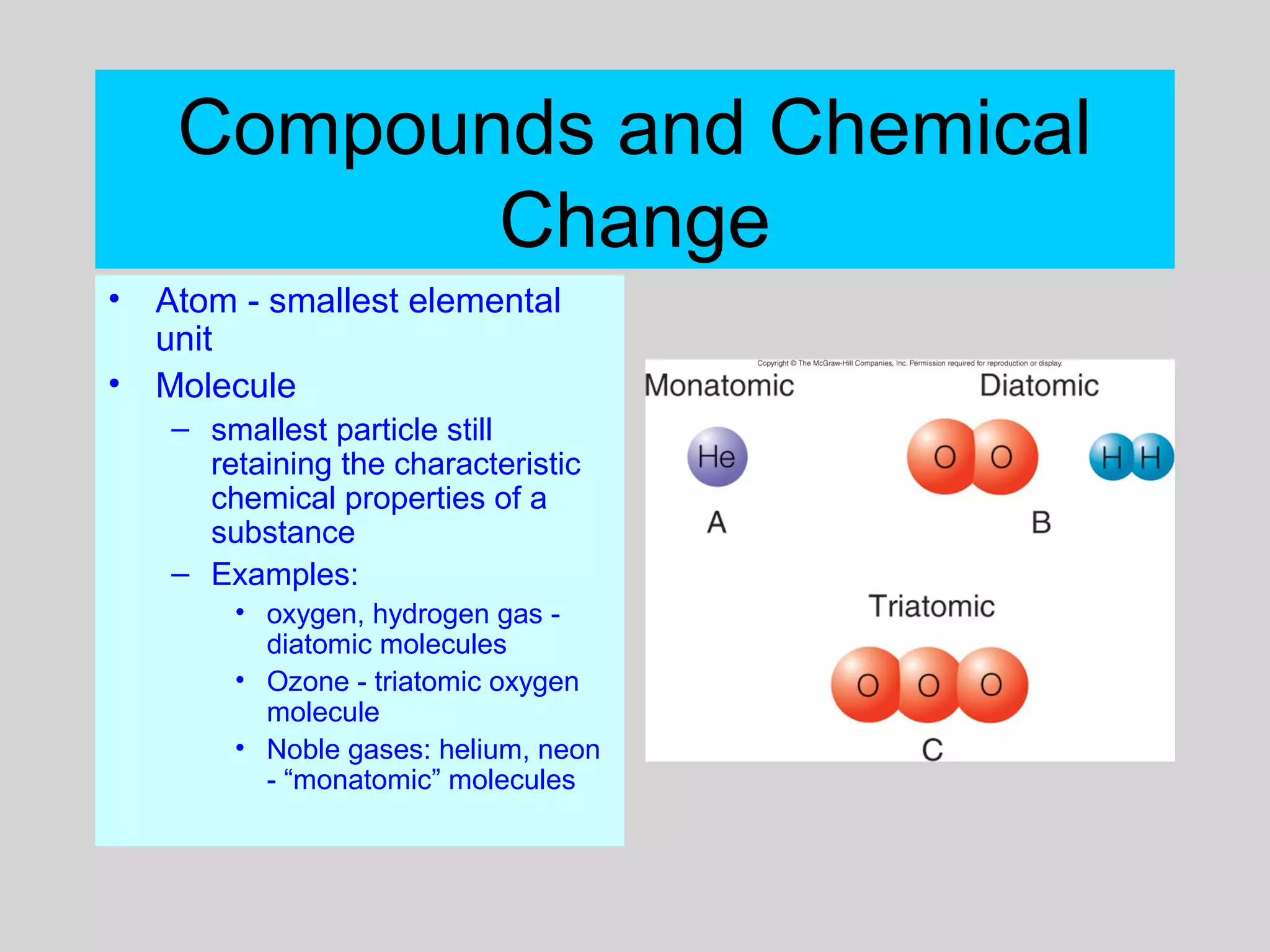
• Atom - smallest elemental
unit
• Molecule
– smallest particle still
retaining the characteristic
chemical properties of a
substance
– Examples:
• oxygen, hydrogen gas -
diatomic molecules
• Ozone - triatomic oxygen
molecule
• Noble gases: helium, neon
- “monatomic” molecules
Chemical Reactions
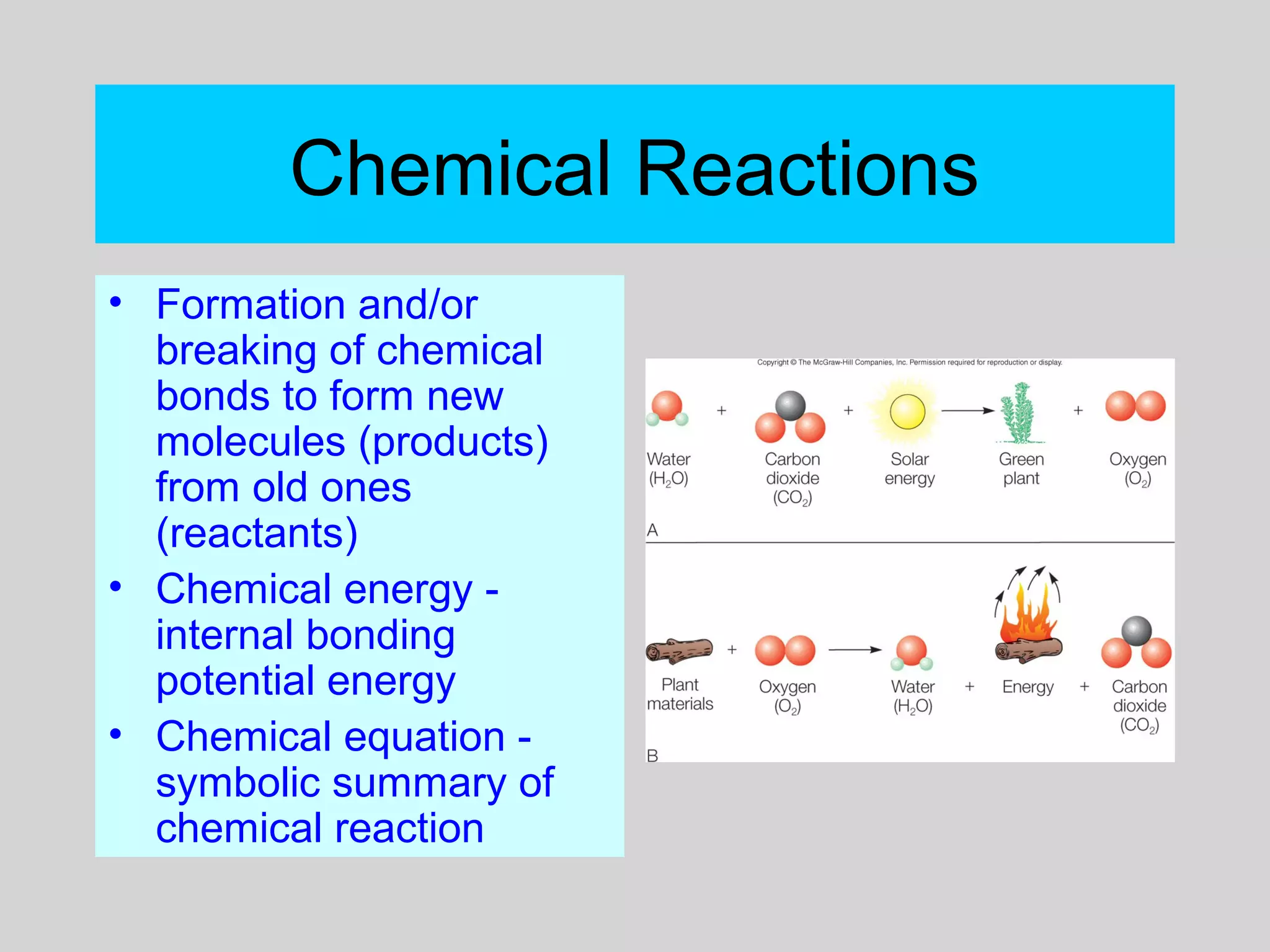
• Formation and/or
breaking of chemical
bonds to form new
molecules (products)
from old ones
(reactants)
• Chemical energy -
internal bonding
potential energy
• Chemical equation -
symbolic summary of
chemical reaction
Valence Electrons and Ions
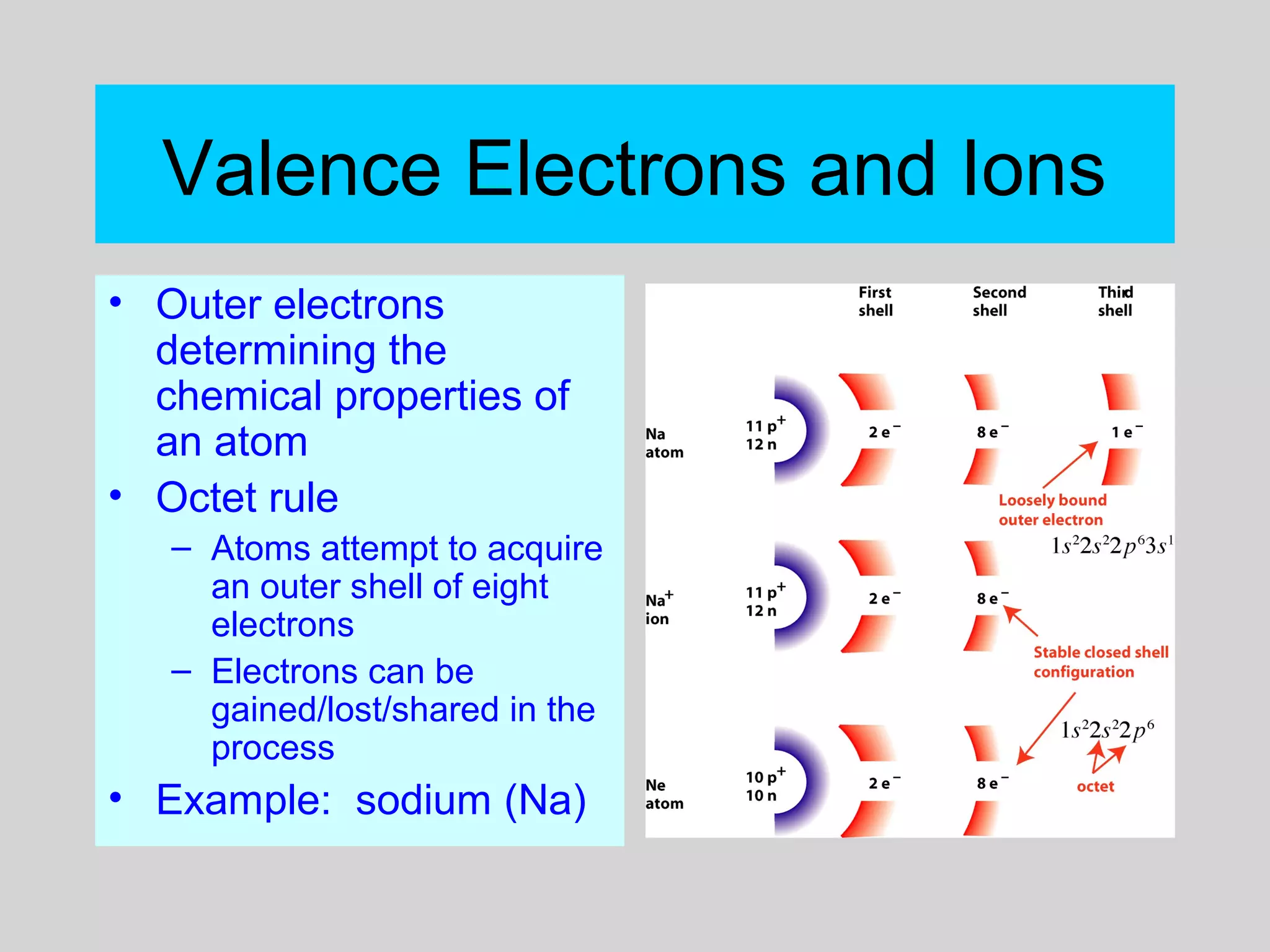
• Outer electrons
determining the
chemical properties of
an atom
• Octet rule
– Atoms attempt to acquire
an outer shell of eight
electrons
– Electrons can be
gained/lost/shared in the
process
• Example: sodium (Na)
Chemical Bonds
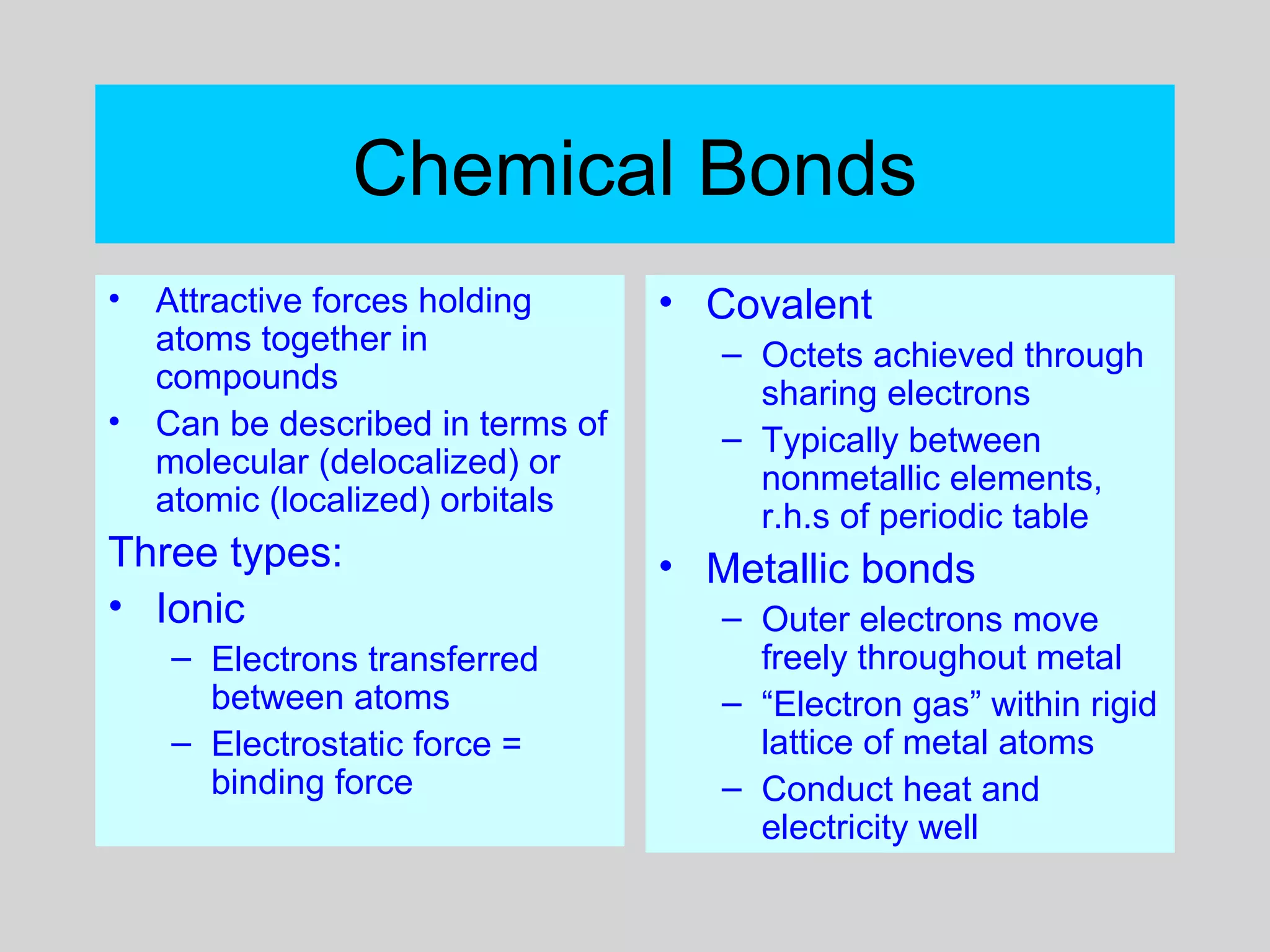
• Attractive forces holding
atoms together in
compounds
• Can be described in terms of
molecular (delocalized) or
atomic (localized) orbitals
Three types:
• Ionic
– Electrons transferred
between atoms
– Electrostatic force =
binding force
• Covalent
– Octets achieved through
sharing electrons
– Typically between
nonmetallic elements,
r.h.s of periodic table
• Metallic bonds
– Outer electrons move
freely throughout metal
– “Electron gas” within rigid
lattice of metal atoms
– Conduct heat and
electricity well
Ionic Bonds
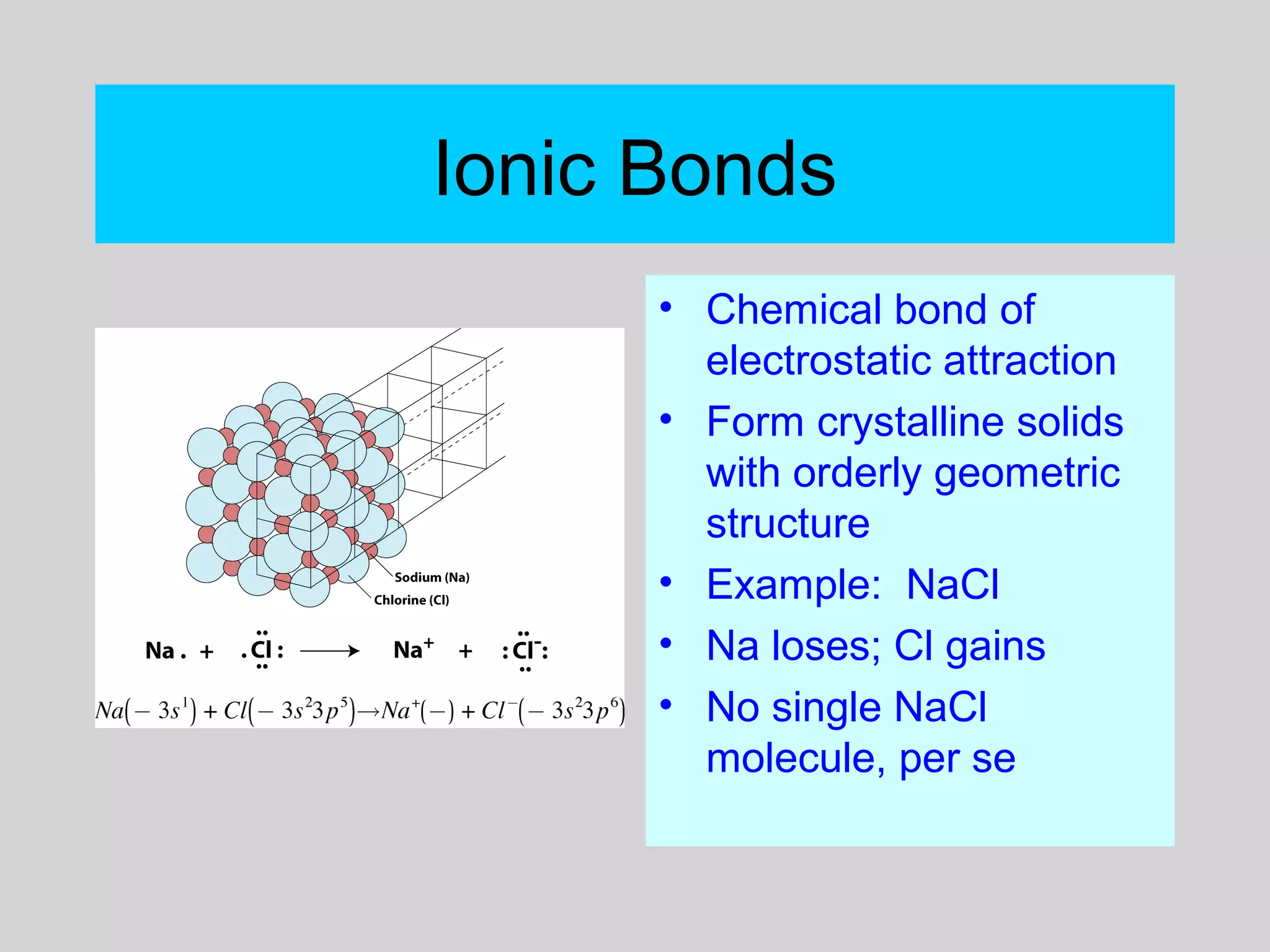
• Chemical bond of
electrostatic attraction
• Form crystalline solids
with orderly geometric
structure
• Example: NaCl
• Na loses; Cl gains
• No single NaCl
molecule, per se
Energy and Electrons in
Ionic Bonding
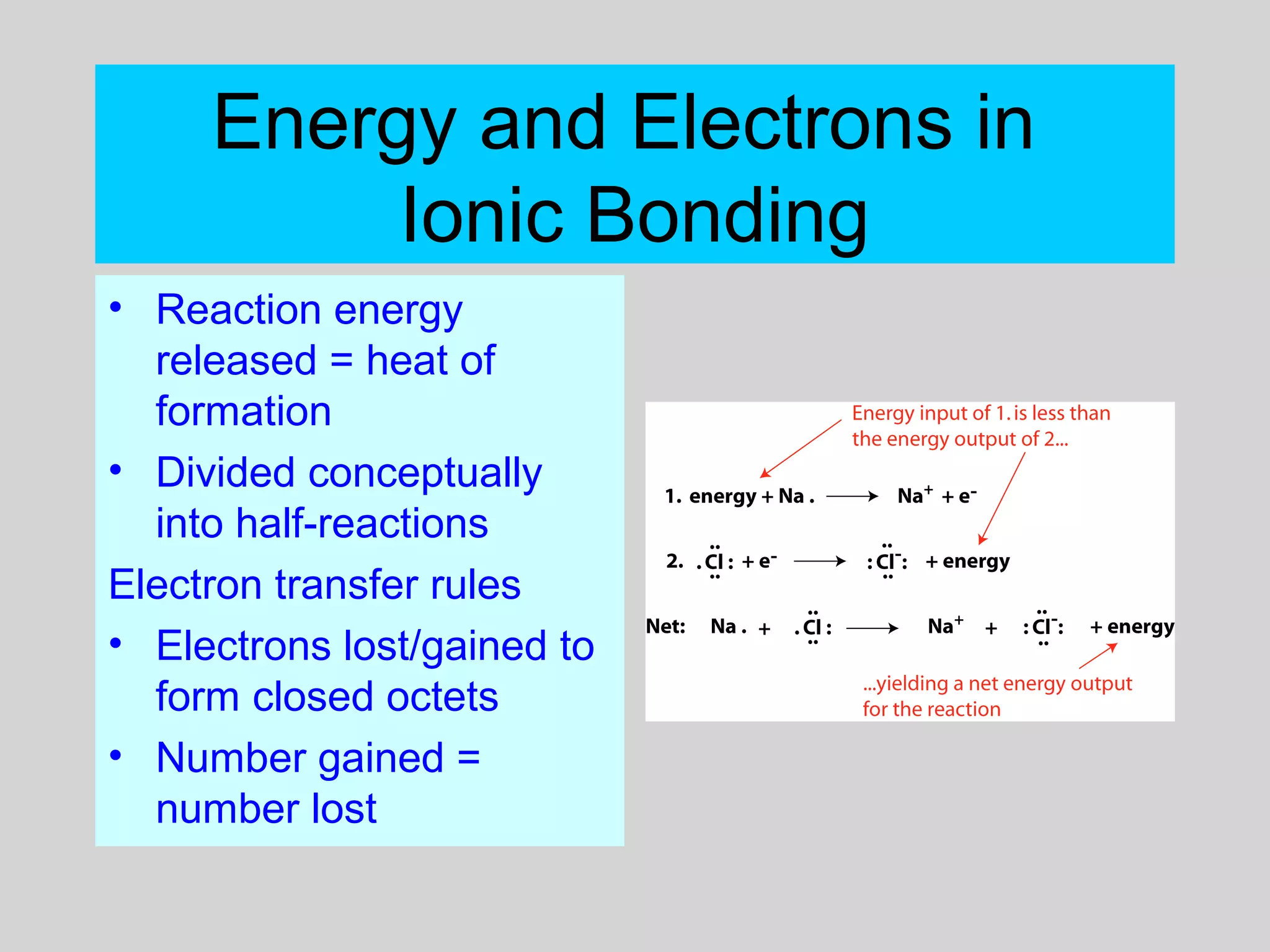
• Reaction energy
released = heat of
formation
• Divided conceptually
into half-reactions
Electron transfer rules
• Electrons lost/gained to
form closed octets
• Number gained =
number lost
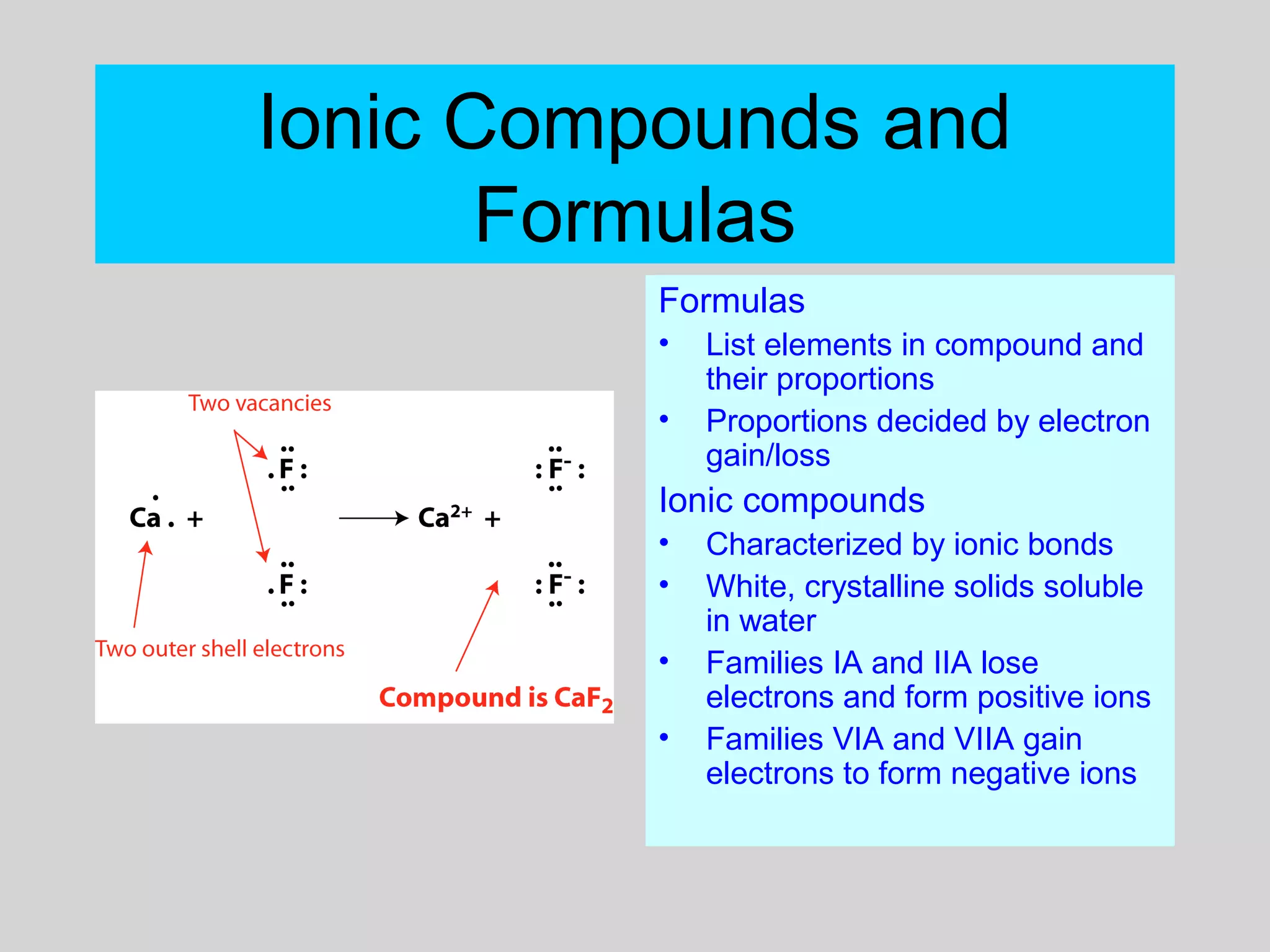
Ionic Compounds and
Formulas
Formulas
• List elements in compound and
their proportions
• Proportions decided by electron
gain/loss
Ionic compounds
• Characterized by ionic bonds
• White, crystalline solids soluble
in water
• Families IA and IIA lose
electrons and form positive ions
• Families VIA and VIIA gain
electrons to form negative ions
Covalent Bonds
• Chemical bonds formed by sharing
pairs of electrons
• Electrons shared to form octets, ideally
• Overlap of shared electron clouds
between nuclei yields net attraction
• Atoms within covalent compounds are
electrically neutral, or nearly so
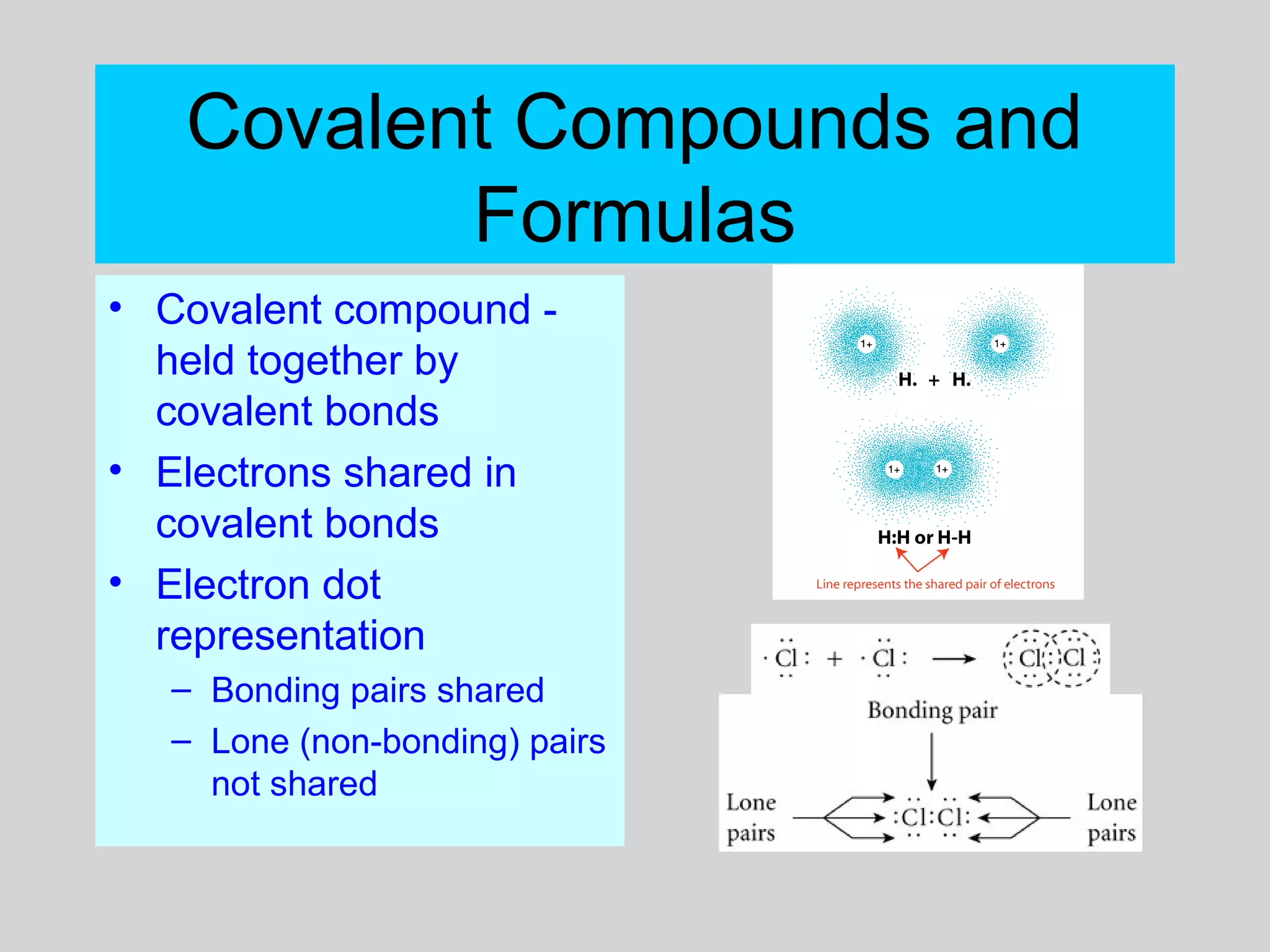
Covalent Compounds and
Formulas
• Covalent compound -
held together by
covalent bonds
• Electrons shared in
covalent bonds
• Electron dot
representation
– Bonding pairs shared
– Lone (non-bonding) pairs
not shared
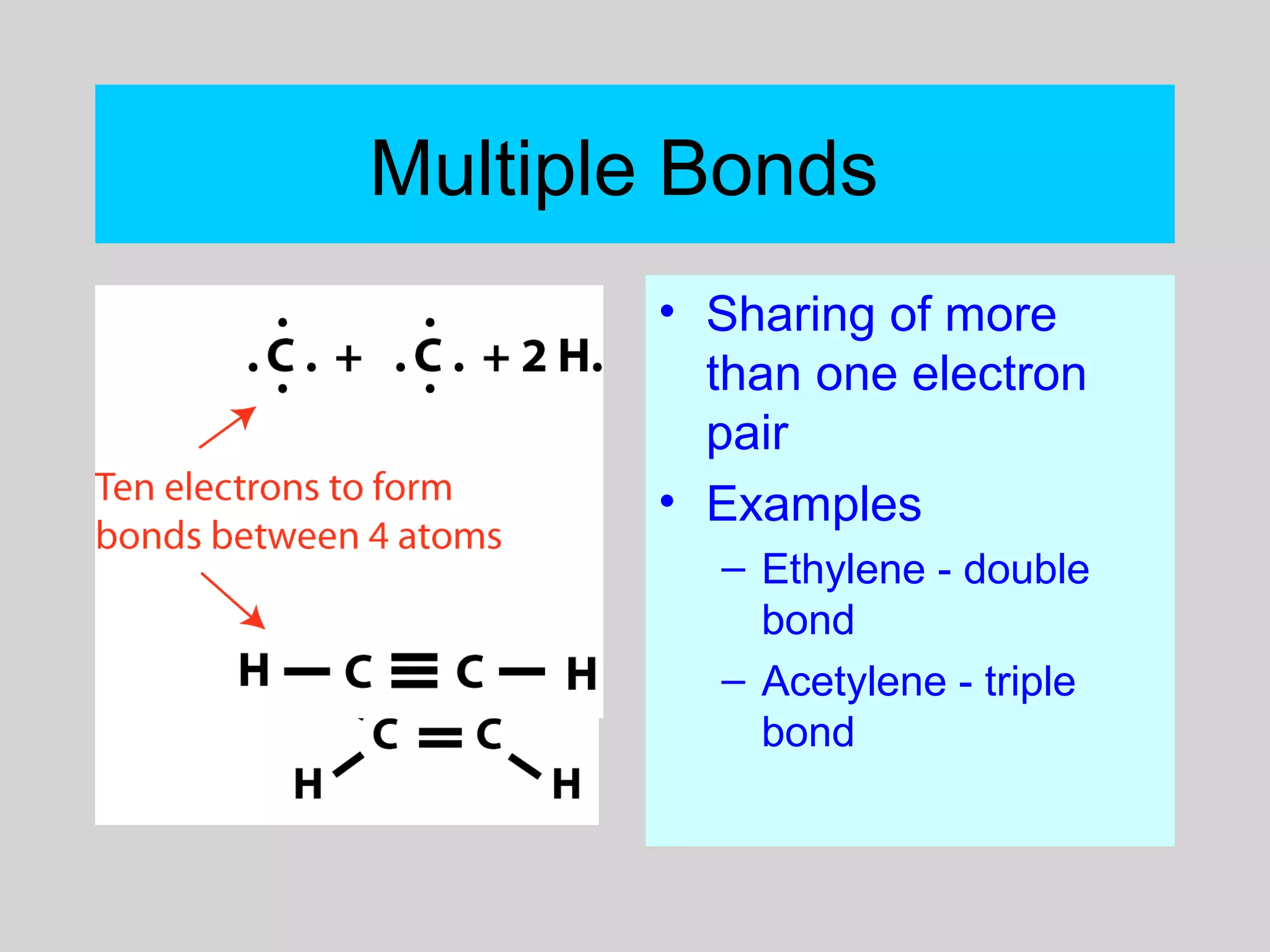
Multiple Bonds
• Sharing of more
than one electron
pair
• Examples
– Ethylene - double
bond
– Acetylene - triple
bond
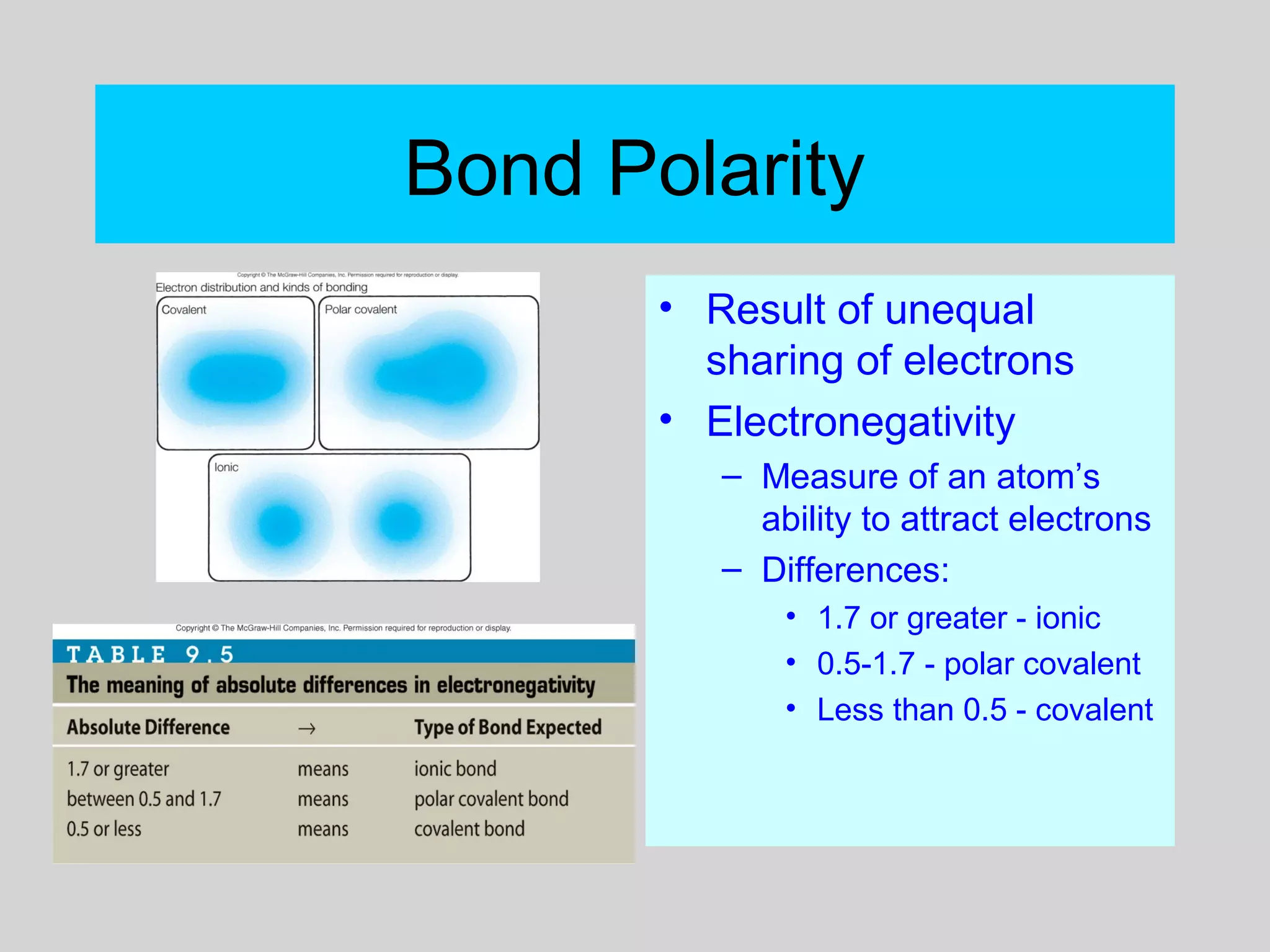
Bond Polarity
• Result of unequal
sharing of electrons
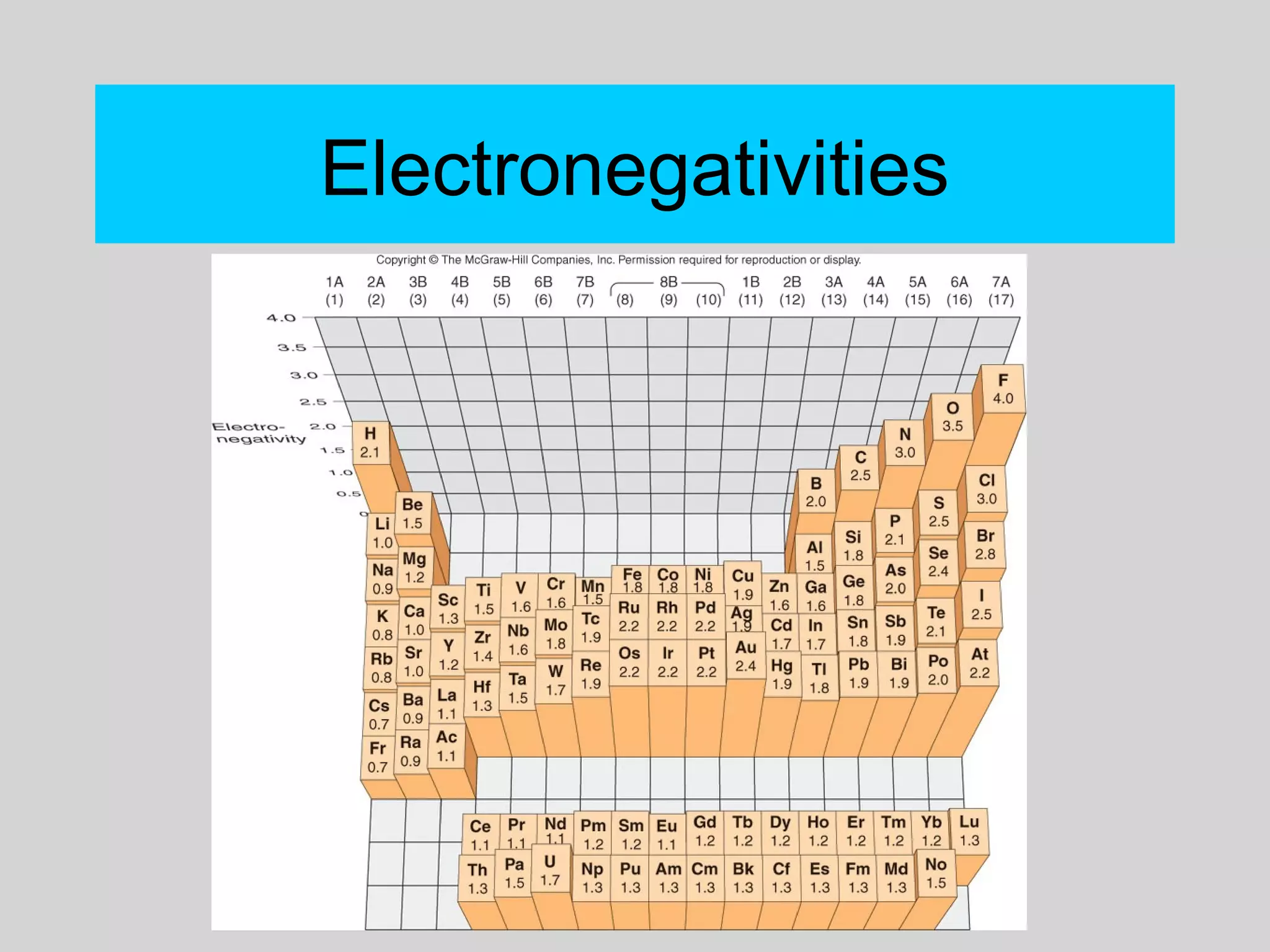
• Electronegativity
– Measure of an atom’s
ability to attract electrons
– Differences:
• 1.7 or greater - ionic
• 0.5-1.7 - polar covalent
• Less than 0.5 - covalent
Electronegativities
Composition of Compounds
• Millions of different combinations of over 90
elements
• Common names
– Often related to historical usage (baking soda,
washing soda,…)
– Difficult to relate to actual molecular composition
• Modern approach - systematic sets of rules
– Different for ionic and covalent compounds
– One common rule - “-ide” means compound
contains only two different elements
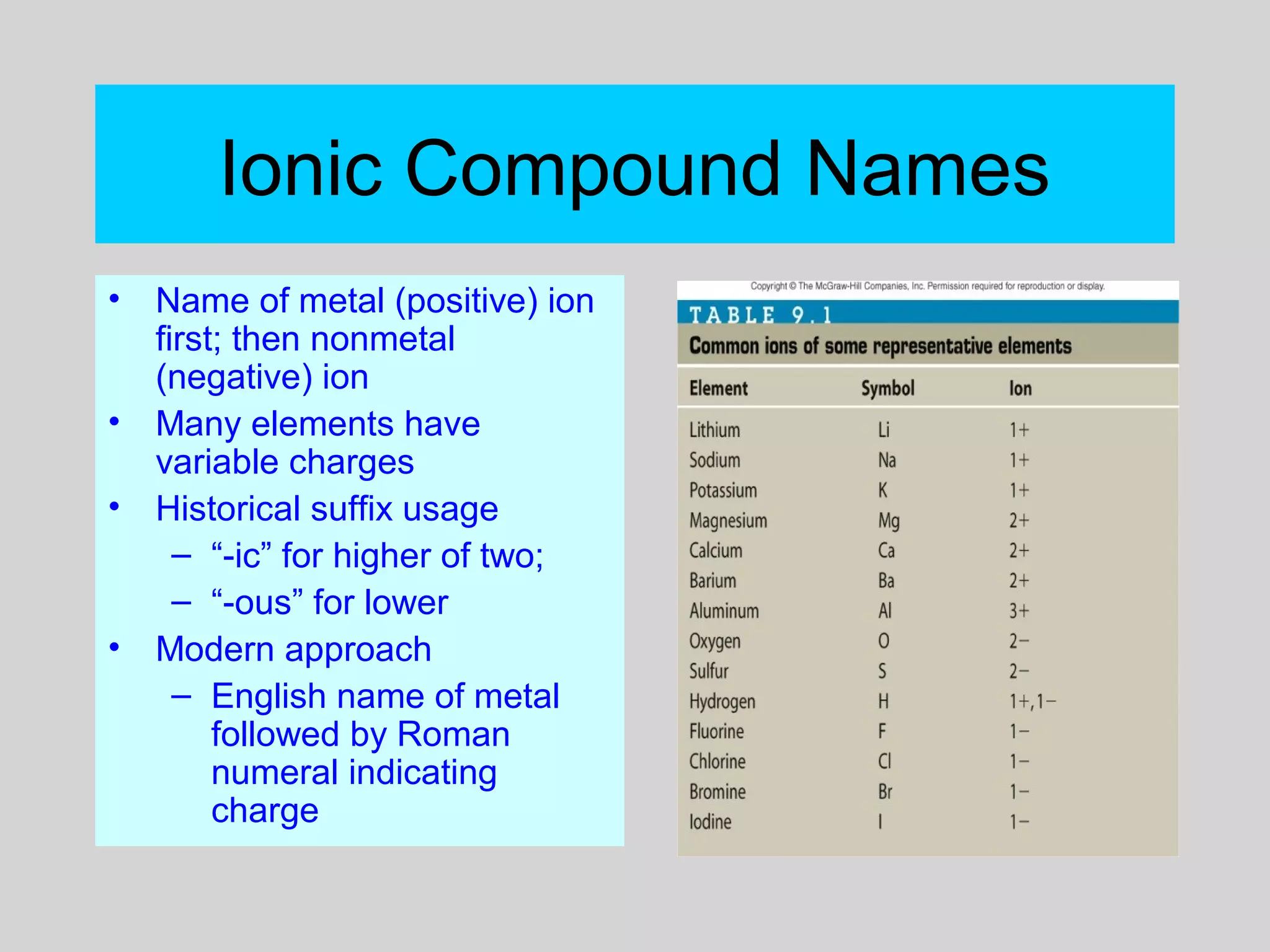
Ionic Compound Names
• Name of metal (positive) ion
first; then nonmetal
(negative) ion
• Many elements have
variable charges
• Historical suffix usage
– “-ic” for higher of two;
– “-ous” for lower
• Modern approach
– English name of metal
followed by Roman
numeral indicating
charge
Ionic Compound Formulas
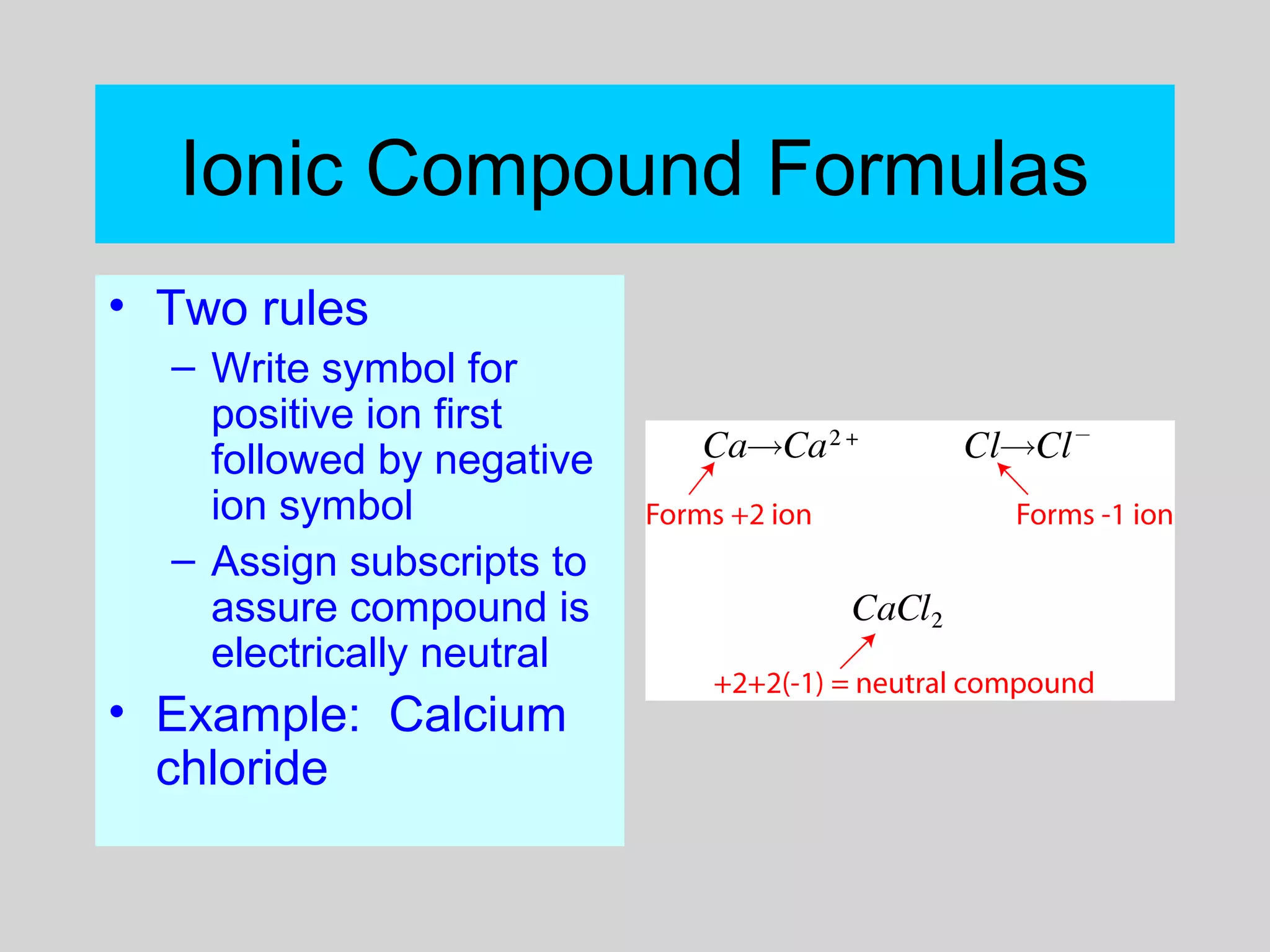
• Two rules
– Write symbol for
positive ion first
followed by negative
ion symbol
– Assign subscripts to
assure compound is
electrically neutral
• Example: Calcium
chloride
Covalent Compound Names
• Molecular -
composed of two or
more nonmetals
• Same elements can
combine to form a
number of different
compounds
Two rules
• First element in formula
named first with number
indicated by Greek
prefix
• Stem name of second
element next; Greek
prefix for number;
ending in “-ide” (for two
elements)
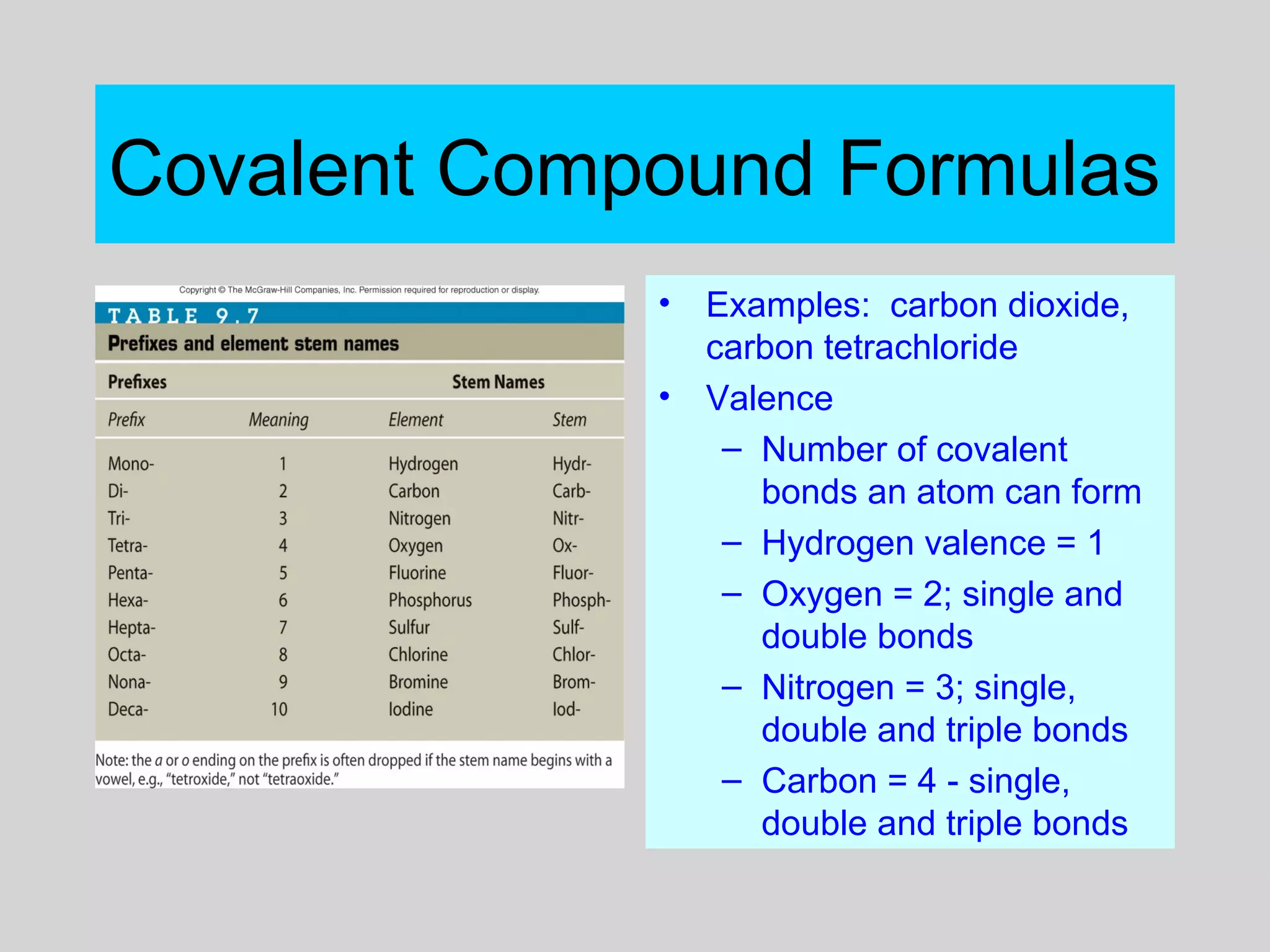
Covalent Compound Formulas
• Examples: carbon dioxide,
carbon tetrachloride
• Valence
– Number of covalent
bonds an atom can form
– Hydrogen valence = 1
– Oxygen = 2; single and
double bonds
– Nitrogen = 3; single,
double and triple bonds
– Carbon = 4 - single,
double and triple bonds

Ch09 lecture

  • 1.
    PowerPoint Lectures to accompany PhysicalScience, 10e Copyright © The McGraw-Hill Companies, Inc. Permission required for reproduction or display. Chapter 9 Chemical Bonds An Introduction to Chemistry
  • 2.
    Core Concept Electron structurewill explain how and why atoms join together in certain numbers.
  • 3.
    Compounds and Chemical Change •Atom - smallest elemental unit • Molecule – smallest particle still retaining the characteristic chemical properties of a substance – Examples: • oxygen, hydrogen gas - diatomic molecules • Ozone - triatomic oxygen molecule • Noble gases: helium, neon - “monatomic” molecules
  • 4.
    Chemical Reactions • Formationand/or breaking of chemical bonds to form new molecules (products) from old ones (reactants) • Chemical energy - internal bonding potential energy • Chemical equation - symbolic summary of chemical reaction
  • 5.
    Valence Electrons andIons • Outer electrons determining the chemical properties of an atom • Octet rule – Atoms attempt to acquire an outer shell of eight electrons – Electrons can be gained/lost/shared in the process • Example: sodium (Na)
  • 6.
    Chemical Bonds • Attractiveforces holding atoms together in compounds • Can be described in terms of molecular (delocalized) or atomic (localized) orbitals Three types: • Ionic – Electrons transferred between atoms – Electrostatic force = binding force • Covalent – Octets achieved through sharing electrons – Typically between nonmetallic elements, r.h.s of periodic table • Metallic bonds – Outer electrons move freely throughout metal – “Electron gas” within rigid lattice of metal atoms – Conduct heat and electricity well
  • 7.
    Ionic Bonds • Chemicalbond of electrostatic attraction • Form crystalline solids with orderly geometric structure • Example: NaCl • Na loses; Cl gains • No single NaCl molecule, per se
  • 8.
    Energy and Electronsin Ionic Bonding • Reaction energy released = heat of formation • Divided conceptually into half-reactions Electron transfer rules • Electrons lost/gained to form closed octets • Number gained = number lost
  • 9.
    Ionic Compounds and Formulas Formulas •List elements in compound and their proportions • Proportions decided by electron gain/loss Ionic compounds • Characterized by ionic bonds • White, crystalline solids soluble in water • Families IA and IIA lose electrons and form positive ions • Families VIA and VIIA gain electrons to form negative ions
  • 10.
    Covalent Bonds • Chemicalbonds formed by sharing pairs of electrons • Electrons shared to form octets, ideally • Overlap of shared electron clouds between nuclei yields net attraction • Atoms within covalent compounds are electrically neutral, or nearly so
  • 11.
    Covalent Compounds and Formulas •Covalent compound - held together by covalent bonds • Electrons shared in covalent bonds • Electron dot representation – Bonding pairs shared – Lone (non-bonding) pairs not shared
  • 12.
    Multiple Bonds • Sharingof more than one electron pair • Examples – Ethylene - double bond – Acetylene - triple bond
  • 13.
    Bond Polarity • Resultof unequal sharing of electrons • Electronegativity – Measure of an atom’s ability to attract electrons – Differences: • 1.7 or greater - ionic • 0.5-1.7 - polar covalent • Less than 0.5 - covalent
  • 14.
  • 15.
    Composition of Compounds •Millions of different combinations of over 90 elements • Common names – Often related to historical usage (baking soda, washing soda,…) – Difficult to relate to actual molecular composition • Modern approach - systematic sets of rules – Different for ionic and covalent compounds – One common rule - “-ide” means compound contains only two different elements
  • 16.
    Ionic Compound Names •Name of metal (positive) ion first; then nonmetal (negative) ion • Many elements have variable charges • Historical suffix usage – “-ic” for higher of two; – “-ous” for lower • Modern approach – English name of metal followed by Roman numeral indicating charge
  • 17.
    Ionic Compound Formulas •Two rules – Write symbol for positive ion first followed by negative ion symbol – Assign subscripts to assure compound is electrically neutral • Example: Calcium chloride
  • 18.
    Covalent Compound Names •Molecular - composed of two or more nonmetals • Same elements can combine to form a number of different compounds Two rules • First element in formula named first with number indicated by Greek prefix • Stem name of second element next; Greek prefix for number; ending in “-ide” (for two elements)
  • 19.
    Covalent Compound Formulas •Examples: carbon dioxide, carbon tetrachloride • Valence – Number of covalent bonds an atom can form – Hydrogen valence = 1 – Oxygen = 2; single and double bonds – Nitrogen = 3; single, double and triple bonds – Carbon = 4 - single, double and triple bonds