ATOMS, IONS
AND
MOLECULES
ATOMS
• There are more than 100 types of elements existing
  naturally in this world.
• An element is a substance consisting of one type of atom
  only. It cannot be broken down chemically into simpler
  substances.
• Atom of different elements are different in size.
• An atom is the smallest particle of a substance.
• It has a nucleus which contains protons and neutrons.
• Electrons move around the nucleus in the electron shell or
  orbit.
ATOMS
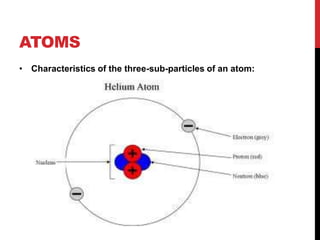
• Characteristics of the three-sub-particles of an atom:
ATOMS


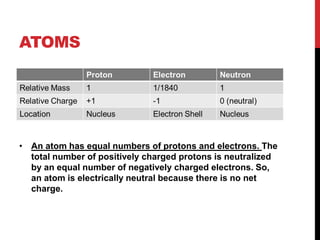
• An atom has equal numbers of protons and electrons. The
  total number of positively charged protons is neutralized
  by an equal number of negatively charged electrons. So,
  an atom is electrically neutral because there is no net
  charge.
PROTON AND MASS
NUMBER
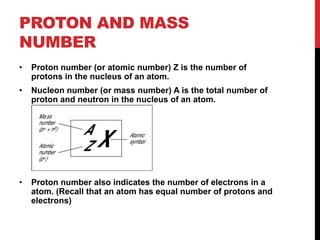
•   Proton number (or atomic number) Z is the number of
    protons in the nucleus of an atom.
•   Nucleon number (or mass number) A is the total number of
    proton and neutron in the nucleus of an atom.


•   Proton number also indicates the number of electrons in a
    atom. (Recall that an atom has equal number of protons and
    electrons)
ISOTOPES
• Isotopes are atoms that have the same number of protons
  but different number of neutrons.
• Due to the difference in the number of neutrons, isotopes
  have different mass number.
IONS
• All atoms are electrically neutral. They have equal number
  of protons and electrons.
• When an atom loses or gains electrons, the number of
  protons is not equal to the number of electrons anymore.
  Therefore, the atom will not be electrically neutral.
• When an atom is not electrically neutral, it is called an ion.
• There are two types of ions:
-   If an atom loses electron(s), it becomes a positive ion.
-   If an atom gains electron(s), it becomes a negative ion.
• In the formation of ions, the process only involves the
  gaining or losing electrons. Therefore, electrons are
  responsible for chemical properties of an atom
IONS
• The number of protons and neutrons remains the same.
  Therefore, proton number and mass number are not
  affected.
• In the formation of ions:
-   Metals lose electrons to form positive ions
-   Non-metals gain electrons to form negative ions
FORMATION OF
POSITIVE IONS
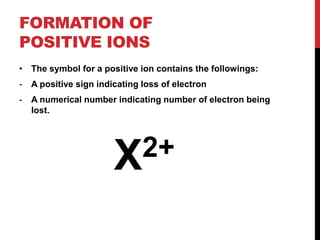
• The symbol for a positive ion contains the followings:
-   A positive sign indicating loss of electron
-   A numerical number indicating number of electron being
    lost.


                        X 2+
FORMATION OF
NEGATIVE IONS
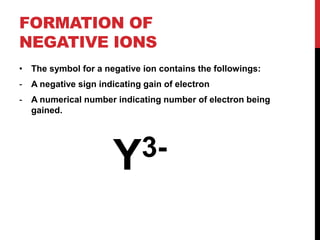
• The symbol for a negative ion contains the followings:
-   A negative sign indicating gain of electron
-   A numerical number indicating number of electron being
    gained.


                       Y 3-
MOLECULES
• Molecules are two or more atoms chemically joined
  together.
• A molecule can be made up of atoms of the same element
  or of different element.
• A molecule which contains two atoms of the same or
  different type chemically joined together is called a
  diatomic molecule.
MOLECULE OF AN
ELEMENT
• A molecule of an element is a substance containing two or
  more of the same type of atom chemically joined together.
MOLECULE OF A
COMPOUND
• A molecule of a compound is a substance containing two
  or more of different type of atoms chemically joined
  together.
CHEMICAL FORMULA
• A chemical formula of a substance indicates two
  important information about the substance:
-   Type of element
-   Total number of each type of atom

Atoms, Ions and Molecules

  • 1.
  • 2.
    ATOMS • There aremore than 100 types of elements existing naturally in this world. • An element is a substance consisting of one type of atom only. It cannot be broken down chemically into simpler substances. • Atom of different elements are different in size. • An atom is the smallest particle of a substance. • It has a nucleus which contains protons and neutrons. • Electrons move around the nucleus in the electron shell or orbit.
  • 3.
    ATOMS • Characteristics ofthe three-sub-particles of an atom:
  • 4.
    ATOMS • An atomhas equal numbers of protons and electrons. The total number of positively charged protons is neutralized by an equal number of negatively charged electrons. So, an atom is electrically neutral because there is no net charge.
  • 5.
    PROTON AND MASS NUMBER • Proton number (or atomic number) Z is the number of protons in the nucleus of an atom. • Nucleon number (or mass number) A is the total number of proton and neutron in the nucleus of an atom. • Proton number also indicates the number of electrons in a atom. (Recall that an atom has equal number of protons and electrons)
  • 6.
    ISOTOPES • Isotopes areatoms that have the same number of protons but different number of neutrons. • Due to the difference in the number of neutrons, isotopes have different mass number.
  • 7.
    IONS • All atomsare electrically neutral. They have equal number of protons and electrons. • When an atom loses or gains electrons, the number of protons is not equal to the number of electrons anymore. Therefore, the atom will not be electrically neutral. • When an atom is not electrically neutral, it is called an ion. • There are two types of ions: - If an atom loses electron(s), it becomes a positive ion. - If an atom gains electron(s), it becomes a negative ion. • In the formation of ions, the process only involves the gaining or losing electrons. Therefore, electrons are responsible for chemical properties of an atom
  • 8.
    IONS • The numberof protons and neutrons remains the same. Therefore, proton number and mass number are not affected. • In the formation of ions: - Metals lose electrons to form positive ions - Non-metals gain electrons to form negative ions
  • 9.
    FORMATION OF POSITIVE IONS •The symbol for a positive ion contains the followings: - A positive sign indicating loss of electron - A numerical number indicating number of electron being lost. X 2+
  • 10.
    FORMATION OF NEGATIVE IONS •The symbol for a negative ion contains the followings: - A negative sign indicating gain of electron - A numerical number indicating number of electron being gained. Y 3-
  • 11.
    MOLECULES • Molecules aretwo or more atoms chemically joined together. • A molecule can be made up of atoms of the same element or of different element. • A molecule which contains two atoms of the same or different type chemically joined together is called a diatomic molecule.
  • 12.
    MOLECULE OF AN ELEMENT •A molecule of an element is a substance containing two or more of the same type of atom chemically joined together.
  • 13.
    MOLECULE OF A COMPOUND •A molecule of a compound is a substance containing two or more of different type of atoms chemically joined together.
  • 14.
    CHEMICAL FORMULA • Achemical formula of a substance indicates two important information about the substance: - Type of element - Total number of each type of atom