PowerPoint Lectures
to accompany
Physical Science, 10e
Copyright © The McGraw-Hill Companies, Inc. Permission required for reproduction or display.
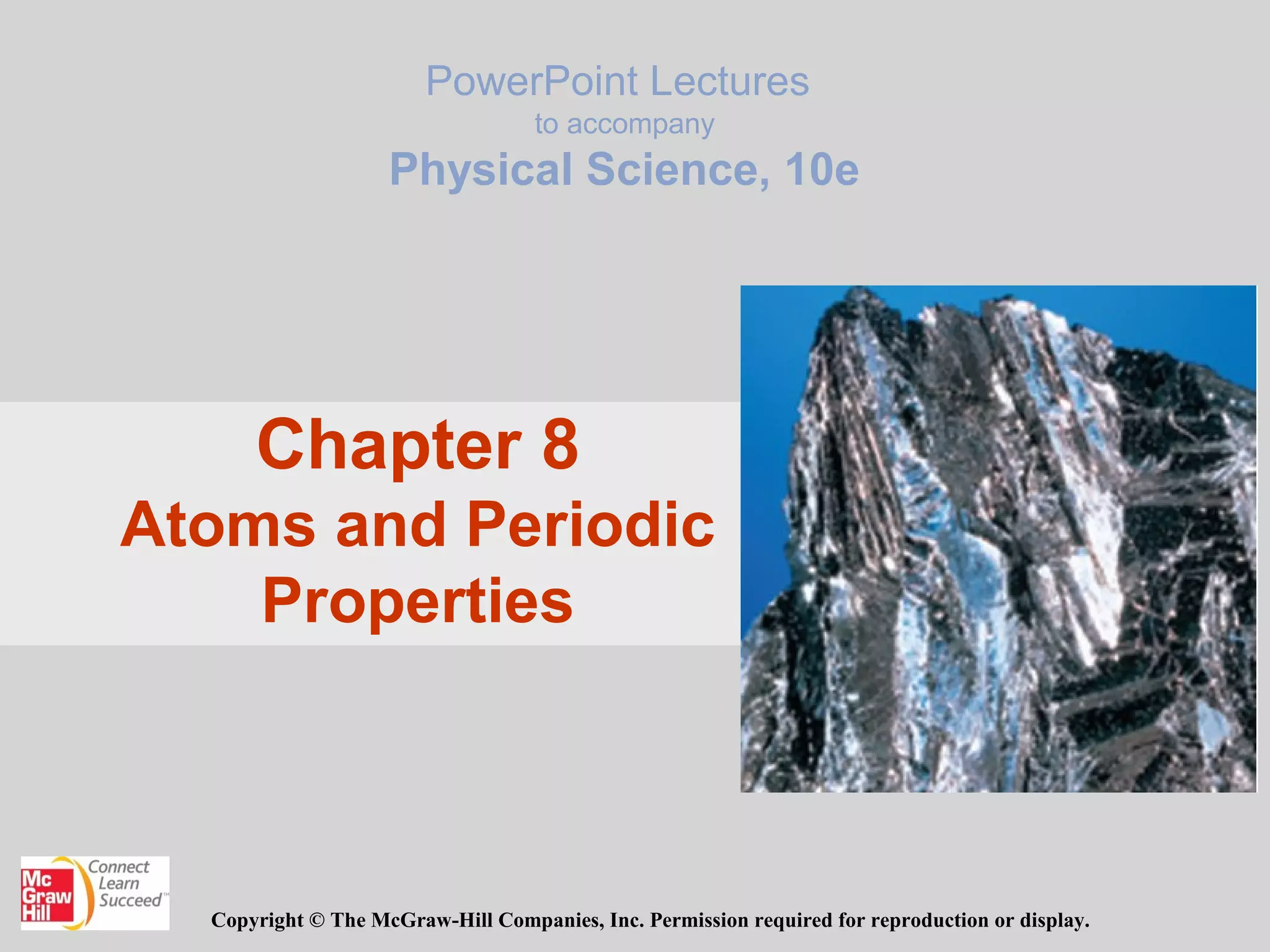
Chapter 8
Atoms and Periodic
Properties
Different fields of study
contributed to the development of
a model of the atom.
Core Concept
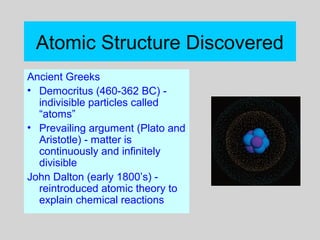
Atomic Structure Discovered
Ancient Greeks
• Democritus (460-362 BC) -
indivisible particles called
“atoms”
• Prevailing argument (Plato and
Aristotle) - matter is
continuously and infinitely
divisible
John Dalton (early 1800’s) -
reintroduced atomic theory to
explain chemical reactions
Dalton’s Atomic Theory
1. All matter = indivisible atoms
2. An element is made up of identical atoms.
3. Different elements have atoms with different
masses.
4. Chemical compounds are made of atoms in
specific integer ratios.
5. Atoms are neither created nor destroyed in
chemical reactions.
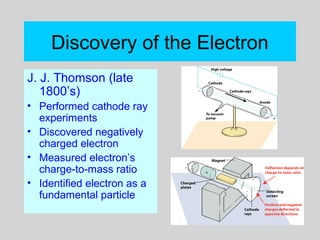
Discovery of the Electron
J. J. Thomson (late
1800’s)
• Performed cathode ray
experiments
• Discovered negatively
charged electron
• Measured electron’s
charge-to-mass ratio
• Identified electron as a
fundamental particle
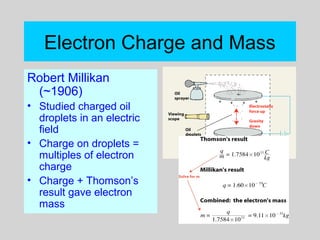
Electron Charge and Mass
Robert Millikan
(~1906)
• Studied charged oil
droplets in an electric
field
• Charge on droplets =
multiples of electron
charge
• Charge + Thomson’s
result gave electron
mass
Early Models of the Atom
• Dalton - atoms indivisible
• Thomson and Millikan experiments
– Electron mass very small, no measurable volume
– What is the nature of an atom’s positive charge?
• Thomson’s “Plum pudding” model
– Electrons embedded in blob of positively charged
matter like “raisins in plum pudding”
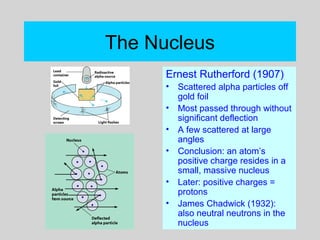
The Nucleus
Ernest Rutherford (1907)
• Scattered alpha particles off
gold foil
• Most passed through without
significant deflection
• A few scattered at large
angles
• Conclusion: an atom’s
positive charge resides in a
small, massive nucleus
• Later: positive charges =
protons
• James Chadwick (1932):
also neutral neutrons in the
nucleus
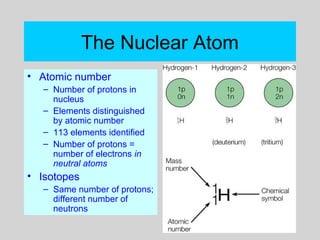
The Nuclear Atom
• Atomic number
– Number of protons in
nucleus
– Elements distinguished
by atomic number
– 113 elements identified
– Number of protons =
number of electrons in
neutral atoms
• Isotopes
– Same number of protons;
different number of
neutrons
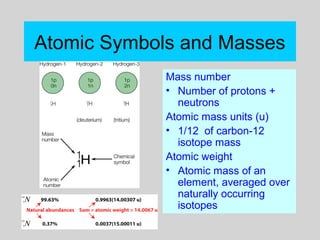
Atomic Symbols and Masses
Mass number
• Number of protons +
neutrons
Atomic mass units (u)
• 1/12 of carbon-12
isotope mass
Atomic weight
• Atomic mass of an
element, averaged over
naturally occurring
isotopes
Classical “Atoms”
Predictions of classical theory
• Electrons orbit the nucleus
• Curved path = acceleration
• Accelerated charges radiate
• Electrons lose energy and spiral into nucleus
• Atoms cannot exist!
Experiment - atoms do exist
⇒ New theory needed
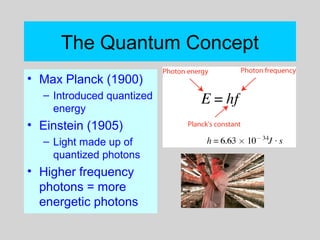
The Quantum Concept
• Max Planck (1900)
– Introduced quantized
energy
• Einstein (1905)
– Light made up of
quantized photons
• Higher frequency
photons = more
energetic photons
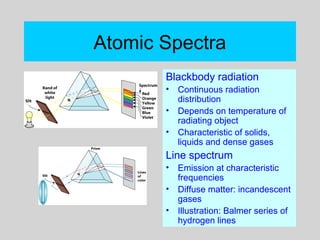
Atomic Spectra
Blackbody radiation
• Continuous radiation
distribution
• Depends on temperature of
radiating object
• Characteristic of solids,
liquids and dense gases
Line spectrum
• Emission at characteristic
frequencies
• Diffuse matter: incandescent
gases
• Illustration: Balmer series of
hydrogen lines
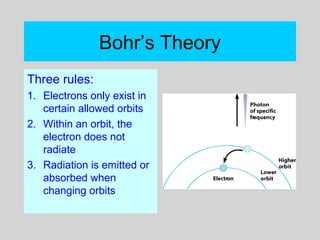
Bohr’s Theory
Three rules:
1. Electrons only exist in
certain allowed orbits
2. Within an orbit, the
electron does not
radiate
3. Radiation is emitted or
absorbed when
changing orbits
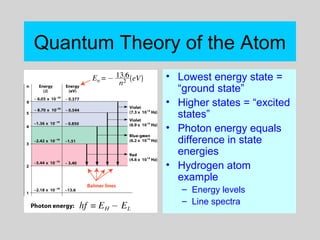
Quantum Theory of the Atom
• Lowest energy state =
“ground state”
• Higher states = “excited
states”
• Photon energy equals
difference in state
energies
• Hydrogen atom
example
– Energy levels
– Line spectra
Quantum Mechanics
• Bohr theory only modeled the line spectrum
of H
• Further experiments established wave-
particle duality of light and matter
– Young’s two slit experiment produced interference
patterns for both photons and electrons.
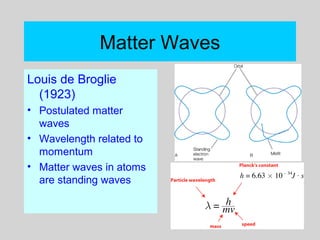
Matter Waves
Louis de Broglie
(1923)
• Postulated matter
waves
• Wavelength related to
momentum
• Matter waves in atoms
are standing waves
Wave Mechanics
• Developed by Erwin Schrodinger
• Treats atoms as three-dimensional systems
of waves
• Contains successful ideas of Bohr model and
much more
• Describes hydrogen atom and many electron
atoms
• Forms our fundamental understanding of
chemistry
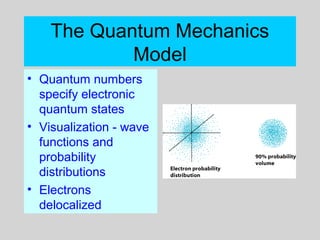
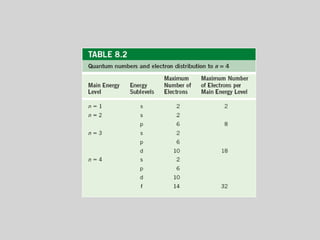
The Quantum Mechanics
Model
• Quantum numbers
specify electronic
quantum states
• Visualization - wave
functions and
probability
distributions
• Electrons
delocalized
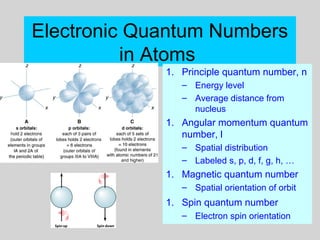
Electronic Quantum Numbers
in Atoms
1. Principle quantum number, n
– Energy level
– Average distance from
nucleus
1. Angular momentum quantum
number, l
– Spatial distribution
– Labeled s, p, d, f, g, h, …
1. Magnetic quantum number
– Spatial orientation of orbit
1. Spin quantum number
– Electron spin orientation
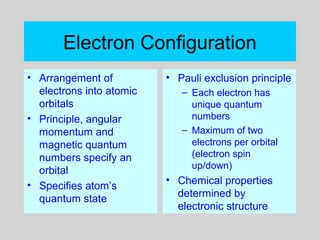
Electron Configuration
• Arrangement of
electrons into atomic
orbitals
• Principle, angular
momentum and
magnetic quantum
numbers specify an
orbital
• Specifies atom’s
quantum state
• Pauli exclusion principle
– Each electron has
unique quantum
numbers
– Maximum of two
electrons per orbital
(electron spin
up/down)
• Chemical properties
determined by
electronic structure
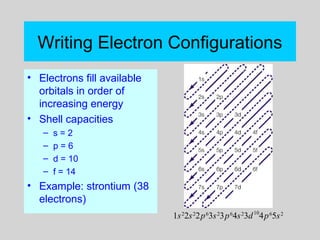
Writing Electron Configurations
• Electrons fill available
orbitals in order of
increasing energy
• Shell capacities
– s = 2
– p = 6
– d = 10
– f = 14
• Example: strontium (38
electrons)
1s2
2s2
2p6
3s2
3p6
4s2
3d10
4p6
5s2
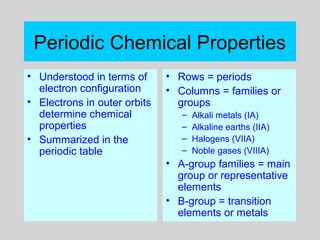
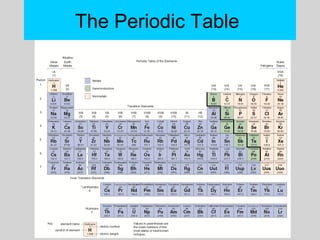
Periodic Chemical Properties
• Understood in terms of
electron configuration
• Electrons in outer orbits
determine chemical
properties
• Summarized in the
periodic table
• Rows = periods
• Columns = families or
groups
– Alkali metals (IA)
– Alkaline earths (IIA)
– Halogens (VIIA)
– Noble gases (VIIIA)
• A-group families = main
group or representative
elements
• B-group = transition
elements or metals
The Periodic Table
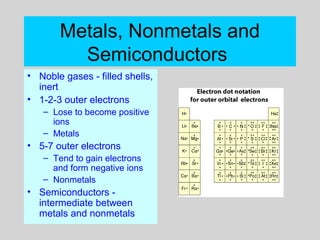
Metals, Nonmetals and
Semiconductors
• Noble gases - filled shells,
inert
• 1-2-3 outer electrons
– Lose to become positive
ions
– Metals
• 5-7 outer electrons
– Tend to gain electrons
and form negative ions
– Nonmetals
• Semiconductors -
intermediate between
metals and nonmetals

Ch08 lecture

  • 1.
    PowerPoint Lectures to accompany PhysicalScience, 10e Copyright © The McGraw-Hill Companies, Inc. Permission required for reproduction or display. Chapter 8 Atoms and Periodic Properties
  • 2.
    Different fields ofstudy contributed to the development of a model of the atom. Core Concept
  • 3.
    Atomic Structure Discovered AncientGreeks • Democritus (460-362 BC) - indivisible particles called “atoms” • Prevailing argument (Plato and Aristotle) - matter is continuously and infinitely divisible John Dalton (early 1800’s) - reintroduced atomic theory to explain chemical reactions
  • 4.
    Dalton’s Atomic Theory 1.All matter = indivisible atoms 2. An element is made up of identical atoms. 3. Different elements have atoms with different masses. 4. Chemical compounds are made of atoms in specific integer ratios. 5. Atoms are neither created nor destroyed in chemical reactions.
  • 5.
    Discovery of theElectron J. J. Thomson (late 1800’s) • Performed cathode ray experiments • Discovered negatively charged electron • Measured electron’s charge-to-mass ratio • Identified electron as a fundamental particle
  • 6.
    Electron Charge andMass Robert Millikan (~1906) • Studied charged oil droplets in an electric field • Charge on droplets = multiples of electron charge • Charge + Thomson’s result gave electron mass
  • 7.
    Early Models ofthe Atom • Dalton - atoms indivisible • Thomson and Millikan experiments – Electron mass very small, no measurable volume – What is the nature of an atom’s positive charge? • Thomson’s “Plum pudding” model – Electrons embedded in blob of positively charged matter like “raisins in plum pudding”
  • 8.
    The Nucleus Ernest Rutherford(1907) • Scattered alpha particles off gold foil • Most passed through without significant deflection • A few scattered at large angles • Conclusion: an atom’s positive charge resides in a small, massive nucleus • Later: positive charges = protons • James Chadwick (1932): also neutral neutrons in the nucleus
  • 9.
    The Nuclear Atom •Atomic number – Number of protons in nucleus – Elements distinguished by atomic number – 113 elements identified – Number of protons = number of electrons in neutral atoms • Isotopes – Same number of protons; different number of neutrons
  • 10.
    Atomic Symbols andMasses Mass number • Number of protons + neutrons Atomic mass units (u) • 1/12 of carbon-12 isotope mass Atomic weight • Atomic mass of an element, averaged over naturally occurring isotopes
  • 11.
    Classical “Atoms” Predictions ofclassical theory • Electrons orbit the nucleus • Curved path = acceleration • Accelerated charges radiate • Electrons lose energy and spiral into nucleus • Atoms cannot exist! Experiment - atoms do exist ⇒ New theory needed
  • 12.
    The Quantum Concept •Max Planck (1900) – Introduced quantized energy • Einstein (1905) – Light made up of quantized photons • Higher frequency photons = more energetic photons
  • 13.
    Atomic Spectra Blackbody radiation •Continuous radiation distribution • Depends on temperature of radiating object • Characteristic of solids, liquids and dense gases Line spectrum • Emission at characteristic frequencies • Diffuse matter: incandescent gases • Illustration: Balmer series of hydrogen lines
  • 14.
    Bohr’s Theory Three rules: 1.Electrons only exist in certain allowed orbits 2. Within an orbit, the electron does not radiate 3. Radiation is emitted or absorbed when changing orbits
  • 15.
    Quantum Theory ofthe Atom • Lowest energy state = “ground state” • Higher states = “excited states” • Photon energy equals difference in state energies • Hydrogen atom example – Energy levels – Line spectra
  • 16.
    Quantum Mechanics • Bohrtheory only modeled the line spectrum of H • Further experiments established wave- particle duality of light and matter – Young’s two slit experiment produced interference patterns for both photons and electrons.
  • 17.
    Matter Waves Louis deBroglie (1923) • Postulated matter waves • Wavelength related to momentum • Matter waves in atoms are standing waves
  • 18.
    Wave Mechanics • Developedby Erwin Schrodinger • Treats atoms as three-dimensional systems of waves • Contains successful ideas of Bohr model and much more • Describes hydrogen atom and many electron atoms • Forms our fundamental understanding of chemistry
  • 19.
    The Quantum Mechanics Model •Quantum numbers specify electronic quantum states • Visualization - wave functions and probability distributions • Electrons delocalized
  • 20.
    Electronic Quantum Numbers inAtoms 1. Principle quantum number, n – Energy level – Average distance from nucleus 1. Angular momentum quantum number, l – Spatial distribution – Labeled s, p, d, f, g, h, … 1. Magnetic quantum number – Spatial orientation of orbit 1. Spin quantum number – Electron spin orientation
  • 22.
    Electron Configuration • Arrangementof electrons into atomic orbitals • Principle, angular momentum and magnetic quantum numbers specify an orbital • Specifies atom’s quantum state • Pauli exclusion principle – Each electron has unique quantum numbers – Maximum of two electrons per orbital (electron spin up/down) • Chemical properties determined by electronic structure
  • 23.
    Writing Electron Configurations •Electrons fill available orbitals in order of increasing energy • Shell capacities – s = 2 – p = 6 – d = 10 – f = 14 • Example: strontium (38 electrons) 1s2 2s2 2p6 3s2 3p6 4s2 3d10 4p6 5s2
  • 24.
    Periodic Chemical Properties •Understood in terms of electron configuration • Electrons in outer orbits determine chemical properties • Summarized in the periodic table • Rows = periods • Columns = families or groups – Alkali metals (IA) – Alkaline earths (IIA) – Halogens (VIIA) – Noble gases (VIIIA) • A-group families = main group or representative elements • B-group = transition elements or metals
  • 25.
  • 26.
    Metals, Nonmetals and Semiconductors •Noble gases - filled shells, inert • 1-2-3 outer electrons – Lose to become positive ions – Metals • 5-7 outer electrons – Tend to gain electrons and form negative ions – Nonmetals • Semiconductors - intermediate between metals and nonmetals