Mr/ Ehab Mohamed Mobile:- 0146178107
Unit : One
Atomic Structure
Lesson One
Structure of the atom
There were many attempts, which tried to explain  what is the matter and what is its structure?
They gave us the idea of the atom as a small invisible particle that  could not be divided into smaller particles from more than 2000 years  ago ( 1)Greek philosophers
They gave us the idea of the atom as a small invisible particle that could not be divided into smaller particles from more than 2000 years ago ( 1)Greek philosophers
He refused the idea of atom and he suggested that, all matters (subjects) are different in nature but the matter is consists of four main components which are:  Water, Air, Soil, and Fire (2) Aristotle attempt
Scientists believed  that cheap metal as iron or copper can be changed into precious ones as gold by change the ratio of its four components.
He refused the concept of Aristotle and he gave the first definition to the element . (3) Boyle attempt in 1661
(3) Boyle attempt in 1661 He refused the concept of Aristotle and he gave the first definition to the element.
Is the purest simplest matter (substance) that cannot be divided or decomposed to a simpler form by chemical methods. The element
The element Is the purest simplest matter (substance) that cannot be divided or decomposed to a simpler form by chemical methods.
(4) Dalton attempt in 1802
(4) Dalton attempt in 1802 His atomic theory includes the following statements:-
 
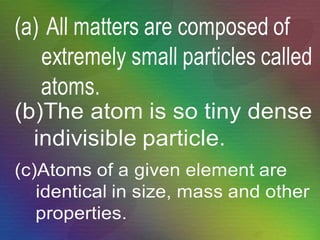
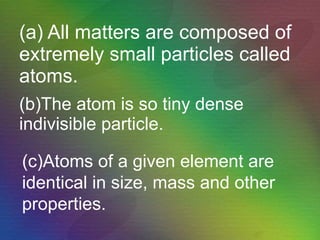
(a) All matters are composed of extremely small particles called atoms. (b)The atom is so tiny dense indivisible particle.   (c)Atoms of a given element are identical in size, mass and other properties.
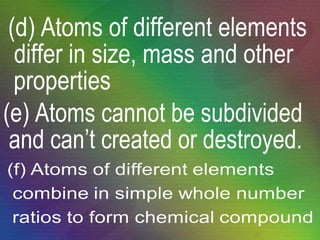
(d) Atoms of different elements differ in size, mass and other properties (e) Atoms cannot be subdivided and can’t created or destroyed.
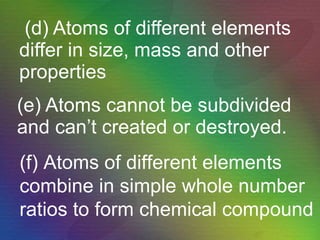
(d) Atoms of different elements differ in size, mass and other properties  (e) Atoms cannot be subdivided and can’t created or destroyed. (f) Atoms of different elements combine in simple whole number ratios to form chemical compound
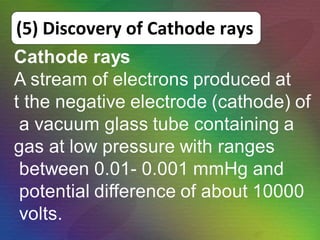
(5) Discovery of Cathode rays
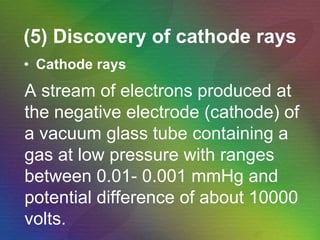
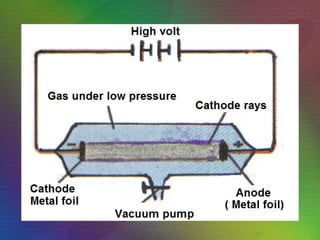
(5) Discovery of cathode rays Cathode rays A stream of electrons produced at the negative electrode (cathode) of a vacuum glass tube containing a gas at low pressure with ranges between 0.01- 0.001 mmHg and potential difference of about 10000 volts.
 
(1) when electric current was passed through various gases under normal condition of atmospheric pressure don't conduct electricity because all gases are isolated at these conditions.
(2) But when these experiments were carried out in vacuum glass tubes as the following:- A- At low pressures less than  0.01 mmHg, through various gases, the gas conduct  electricity well
B- At low pressures less than 0.01 mmHg and potential  difference of about 10000 volts  through the space between electrodes,  a fluorescent glow was appeared on the  tube   wall by a stream of particles, which they called cathode rays.
* The important properties of cathode rays (1) Cathode rays are considered   as subatomic particles. (2) Cathode rays have thermal   effect. (3) Cathode rays move in straight line (from the cathode to the anode)  
(4) Cathode rays are negatively charged. (5) Cathode rays were deflected by magnetic and electric fields.  (6) Cathode rays do not differ in their nature and behavior by the difference of cathode substance or type of gas; so, it is proved that it entrees in the structure of all  matter.
 
Thomson atom
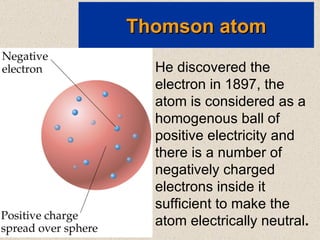
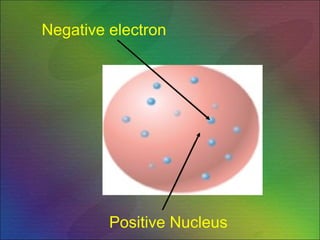
Thomson atom He discovered the electron in 1897, the atom is considered as a homogenous ball of positive electricity and there is a number of negatively charged electrons inside it sufficient to make the atom electrically neutral .
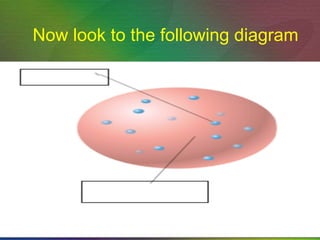
Now look to the following diagram
Negative electron  Positive Nucleus
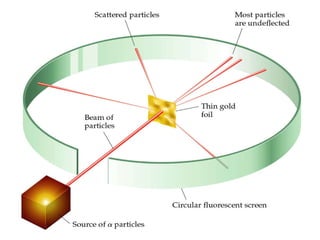
Rutherford experiment  Now we will study the
 
Rutherford experiment
 
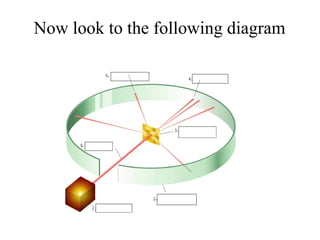
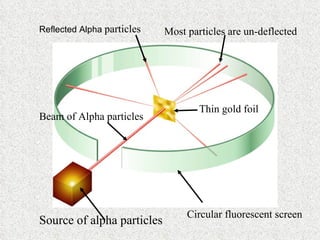
Now look to the following diagram
Thin gold foil Source of alpha particles Circular fluorescent screen  Most particles are un-deflected Beam of Alpha particles Reflected Alpha  particles
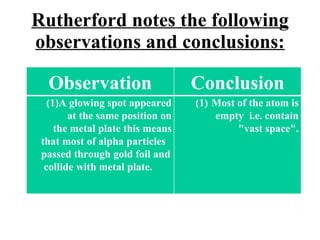
Rutherford notes the following observations and conclusions: Conclusion Observation Most of the atom is empty  i.e. contain "vast space".     (1)A glowing spot appeared at the same position on the metal plate this means that most of alpha particles passed through gold foil and collide with metal plate.
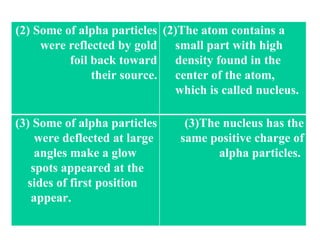
(2)The atom contains a small part with high density found in the center of the atom, which is called nucleus. (2) Some of alpha particles were reflected by gold foil back toward their source. (3)The nucleus has the same positive charge of alpha particles.    (3) Some of alpha particles were deflected at large angles make a glow spots appeared at the sides of first position appear.
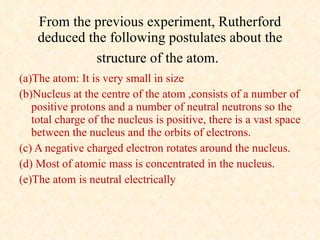
From the previous experiment, Rutherford deduced the following postulates about the structure of the atom.   (a)The atom: It is very small in size (b)Nucleus at the centre of the atom ,consists of a number of positive protons and a number of neutral neutrons so the total charge of the nucleus is positive, there is a vast space between the nucleus and the orbits of electrons.  (c) A negative charged electron rotates around the nucleus.  (d) Most of atomic mass is concentrated in the nucleus.  (e)The atom is neutral electrically
Maxwell's theory
 
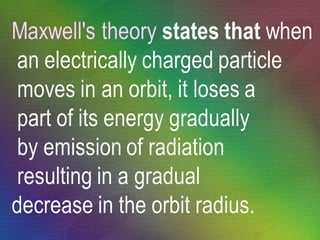
Maxwell's theory  states that  when an electrically charged particle moves in an orbit, it loses a part of its energy gradually by emission of radiation resulting in a gradual decrease in the orbit radius.
 
 
By applying this theory to the electron movement in Rutherford's atom we would expect that electrons are in the state of continuous emission to energy therefore the electron revolves in spiral orbit until it hit inside the nucleus, this doesn’t happen in nature.
Bohr's atomic theory
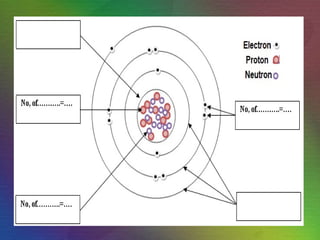
Bohr's atomic theory Bohr  adapted some of Rutherford's postulates about the atomic structure and then he added the following hypotheses.
 
 
At normal condition   the electrons are movement rapidly around the nucleus of the atom  without emission or absorption of any amount of energy so,  we can determine both the speed and the location of electrons at the same time.
 
2. Each electron is considered as a material practical only  movement around the nucleus only in definite allowed energy levels so they cannot be found at intermediate distances.
 
3. Each electron in the atom has a definite amount of energy depending on the distance between its energy level and the nucleus. The energy of any level increases as the radius increases (as we go far away of the nucleus).
 
4. Each energy level is expressed by a whole number called the principle quantum number. * The nearest (first) energy level to the nucleus has a principle quantum number which equals (1) and designated by letter (k) while the second energy level has a principle quantum number (2) and is designated by the letter (L) .
 
The third energy level has a principle quantum NO, (3) and is designated by the letter (M) and so on until the seventh energy level (Q).
5. The electron remains in the lowest  allowed energy level in its ground  state however if  it acquires an amount of energy (termed quantum) by heating or by electric discharge the electron becomes excited and jumps (temporarily) to some higher energy level depending on the absorbed quantum.
5. The electron remains in the lowest allowed energy level in its ground state however if  it acquires an amount of energy (termed  quantum) by heating or by electric discharge the electron becomes excited and jumps (temporarily) to some higher energy level depending on the absorbed quantum.
 
The exited atom   is an atom which has gained an amount  of energy sufficient to transfer  electrons from their original energy level to higher ones.
 
The excited electron in the higher energy level is unstable and soon returns to its original level losing the same quantum of energy, which is absorbed during its excitation in the form of radiant light called line spectra.
A limited number of colour lines appeared on heating gases or vapours of substances under reduced pressure to high temperature or by electric spark during examining the light produced by spectroscope.  Line spectra
A limited number of colour lines appeared on heating gases or vapours of substances under reduced pressure to high temperature or by electric spark during examining the light  produced by spectroscope.  Line spectra
 
Spectrum line is a characteristic for any elements because every element has a definite atomic number with special electronic configuration that differs from element to another  element and when the exciting electron returns to its original level, it emits the difference of energy between levels in the form of radiant light with special spectra line.
 
Spectral line of hydrogen atom is composed of a group of spectral lines  because the single spectra line is a number of fine spectral lines representing  electron transition between very nearly energy sublevels.
Is the amount of energy absorbed or emitted when the electron jumps from one energy level to another. The quantum
The quantum of energy required to transfer one electron from one energy level to another is not equal because the difference in energy between them is not equal i.e. the energy gap decreases further from the nucleus
Quantum is a limited amount of energy that can't be divided or multiplied.
The electron doesn't move from its energy level to another unless the energy absorbed or emitted is equal to the energy difference between the two levels.
Bohr's atomic model succeeded to a great extent in the following 1. Explain the hydrogen atom spectrum. 2. He introduced the idea of quantized energy states for the electron or for the level in the atom. 3. He proved that the moving of the electron around the nucleus in the ground state did not radiate energy so they would not fall back to the nucleus. i.e. Bohr's atomic model  reconciliated  ( وفق )  between Rutherford and Maxwell's theories.
Inadequacy of Bohr's atomic model 1- It had succeeded in explaining the hydrogen spectral lines only however it failed to explain the spectrum of any other element even helium atom which contains only two electrons. 2- Bohr's model considered the electron as a particle only and did not consider that it had also has a wave properties. 3- Bohr's theory postulated that it was possible to determine both the speed and the location of electrons  at the same time but this practically impossible because the apparatus will change either the speed or the location of the electron. 4- It considered the electron moving in circular planar orbit, which means that the hydrogen atom is planar.  

Chapter 1 - Lesson (1)

  • 1.
    Mr/ Ehab MohamedMobile:- 0146178107
  • 2.
  • 3.
  • 4.
  • 5.
  • 6.
    There were manyattempts, which tried to explain what is the matter and what is its structure?
  • 7.
    They gave usthe idea of the atom as a small invisible particle that could not be divided into smaller particles from more than 2000 years ago ( 1)Greek philosophers
  • 8.
    They gave usthe idea of the atom as a small invisible particle that could not be divided into smaller particles from more than 2000 years ago ( 1)Greek philosophers
  • 9.
    He refused theidea of atom and he suggested that, all matters (subjects) are different in nature but the matter is consists of four main components which are: Water, Air, Soil, and Fire (2) Aristotle attempt
  • 10.
    He refused theidea of atom and he suggested that, all matters (subjects) are different in nature but the matter is consists of four main components which are: Water, Air, Soil, and Fire (2) Aristotle attempt
  • 11.
    Scientists believed that cheap metal as iron or copper can be changed into precious ones as gold by change the ratio of its four components.
  • 12.
    He refused theconcept of Aristotle and he gave the first definition to the element . (3) Boyle attempt in 1661
  • 13.
    (3) Boyle attemptin 1661 He refused the concept of Aristotle and he gave the first definition to the element.
  • 14.
    Is the purestsimplest matter (substance) that cannot be divided or decomposed to a simpler form by chemical methods. The element
  • 15.
    The element Isthe purest simplest matter (substance) that cannot be divided or decomposed to a simpler form by chemical methods.
  • 16.
  • 17.
    (4) Dalton attemptin 1802 His atomic theory includes the following statements:-
  • 18.
  • 19.
    (a) All mattersare composed of extremely small particles called atoms. (b)The atom is so tiny dense indivisible particle. (c)Atoms of a given element are identical in size, mass and other properties.
  • 20.
    (d) Atoms ofdifferent elements differ in size, mass and other properties (e) Atoms cannot be subdivided and can’t created or destroyed.
  • 21.
    (d) Atoms ofdifferent elements differ in size, mass and other properties (e) Atoms cannot be subdivided and can’t created or destroyed. (f) Atoms of different elements combine in simple whole number ratios to form chemical compound
  • 22.
    (5) Discovery ofCathode rays
  • 23.
    (5) Discovery ofcathode rays Cathode rays A stream of electrons produced at the negative electrode (cathode) of a vacuum glass tube containing a gas at low pressure with ranges between 0.01- 0.001 mmHg and potential difference of about 10000 volts.
  • 24.
  • 25.
    (1) when electriccurrent was passed through various gases under normal condition of atmospheric pressure don't conduct electricity because all gases are isolated at these conditions.
  • 26.
    (2) But whenthese experiments were carried out in vacuum glass tubes as the following:- A- At low pressures less than 0.01 mmHg, through various gases, the gas conduct electricity well
  • 27.
    B- At lowpressures less than 0.01 mmHg and potential difference of about 10000 volts through the space between electrodes, a fluorescent glow was appeared on the tube wall by a stream of particles, which they called cathode rays.
  • 28.
    * The importantproperties of cathode rays (1) Cathode rays are considered as subatomic particles. (2) Cathode rays have thermal effect. (3) Cathode rays move in straight line (from the cathode to the anode)  
  • 29.
    (4) Cathode raysare negatively charged. (5) Cathode rays were deflected by magnetic and electric fields. (6) Cathode rays do not differ in their nature and behavior by the difference of cathode substance or type of gas; so, it is proved that it entrees in the structure of all matter.
  • 30.
  • 31.
  • 32.
    Thomson atom Hediscovered the electron in 1897, the atom is considered as a homogenous ball of positive electricity and there is a number of negatively charged electrons inside it sufficient to make the atom electrically neutral .
  • 33.
    Now look tothe following diagram
  • 34.
    Negative electron Positive Nucleus
  • 35.
    Rutherford experiment Now we will study the
  • 36.
  • 37.
  • 38.
  • 39.
    Now look tothe following diagram
  • 40.
    Thin gold foilSource of alpha particles Circular fluorescent screen Most particles are un-deflected Beam of Alpha particles Reflected Alpha particles
  • 41.
    Rutherford notes thefollowing observations and conclusions: Conclusion Observation Most of the atom is empty i.e. contain "vast space".     (1)A glowing spot appeared at the same position on the metal plate this means that most of alpha particles passed through gold foil and collide with metal plate.
  • 42.
    (2)The atom containsa small part with high density found in the center of the atom, which is called nucleus. (2) Some of alpha particles were reflected by gold foil back toward their source. (3)The nucleus has the same positive charge of alpha particles.   (3) Some of alpha particles were deflected at large angles make a glow spots appeared at the sides of first position appear.
  • 43.
    From the previousexperiment, Rutherford deduced the following postulates about the structure of the atom. (a)The atom: It is very small in size (b)Nucleus at the centre of the atom ,consists of a number of positive protons and a number of neutral neutrons so the total charge of the nucleus is positive, there is a vast space between the nucleus and the orbits of electrons. (c) A negative charged electron rotates around the nucleus. (d) Most of atomic mass is concentrated in the nucleus. (e)The atom is neutral electrically
  • 44.
  • 45.
  • 46.
    Maxwell's theory states that when an electrically charged particle moves in an orbit, it loses a part of its energy gradually by emission of radiation resulting in a gradual decrease in the orbit radius.
  • 47.
  • 48.
  • 49.
    By applying thistheory to the electron movement in Rutherford's atom we would expect that electrons are in the state of continuous emission to energy therefore the electron revolves in spiral orbit until it hit inside the nucleus, this doesn’t happen in nature.
  • 50.
  • 51.
    Bohr's atomic theoryBohr adapted some of Rutherford's postulates about the atomic structure and then he added the following hypotheses.
  • 52.
  • 53.
  • 54.
    At normal condition the electrons are movement rapidly around the nucleus of the atom without emission or absorption of any amount of energy so, we can determine both the speed and the location of electrons at the same time.
  • 55.
  • 56.
    2. Each electronis considered as a material practical only movement around the nucleus only in definite allowed energy levels so they cannot be found at intermediate distances.
  • 57.
  • 58.
    3. Each electronin the atom has a definite amount of energy depending on the distance between its energy level and the nucleus. The energy of any level increases as the radius increases (as we go far away of the nucleus).
  • 59.
  • 60.
    4. Each energylevel is expressed by a whole number called the principle quantum number. * The nearest (first) energy level to the nucleus has a principle quantum number which equals (1) and designated by letter (k) while the second energy level has a principle quantum number (2) and is designated by the letter (L) .
  • 61.
  • 62.
    The third energylevel has a principle quantum NO, (3) and is designated by the letter (M) and so on until the seventh energy level (Q).
  • 63.
    5. The electronremains in the lowest allowed energy level in its ground state however if it acquires an amount of energy (termed quantum) by heating or by electric discharge the electron becomes excited and jumps (temporarily) to some higher energy level depending on the absorbed quantum.
  • 64.
    5. The electronremains in the lowest allowed energy level in its ground state however if it acquires an amount of energy (termed quantum) by heating or by electric discharge the electron becomes excited and jumps (temporarily) to some higher energy level depending on the absorbed quantum.
  • 65.
  • 66.
    The exited atom is an atom which has gained an amount of energy sufficient to transfer electrons from their original energy level to higher ones.
  • 67.
  • 68.
    The excited electronin the higher energy level is unstable and soon returns to its original level losing the same quantum of energy, which is absorbed during its excitation in the form of radiant light called line spectra.
  • 69.
    A limited numberof colour lines appeared on heating gases or vapours of substances under reduced pressure to high temperature or by electric spark during examining the light produced by spectroscope. Line spectra
  • 70.
    A limited numberof colour lines appeared on heating gases or vapours of substances under reduced pressure to high temperature or by electric spark during examining the light produced by spectroscope. Line spectra
  • 71.
  • 72.
    Spectrum line isa characteristic for any elements because every element has a definite atomic number with special electronic configuration that differs from element to another element and when the exciting electron returns to its original level, it emits the difference of energy between levels in the form of radiant light with special spectra line.
  • 73.
  • 74.
    Spectral line ofhydrogen atom is composed of a group of spectral lines because the single spectra line is a number of fine spectral lines representing electron transition between very nearly energy sublevels.
  • 75.
    Is the amountof energy absorbed or emitted when the electron jumps from one energy level to another. The quantum
  • 76.
    Is the amountof energy absorbed or emitted when the electron jumps from one energy level to another. The quantum
  • 77.
    The quantum ofenergy required to transfer one electron from one energy level to another is not equal because the difference in energy between them is not equal i.e. the energy gap decreases further from the nucleus
  • 78.
    The quantum ofenergy required to transfer one electron from one energy level to another is not equal because the difference in energy between them is not equal i.e. the energy gap decreases further from the nucleus
  • 79.
    Quantum is alimited amount of energy that can't be divided or multiplied.
  • 80.
    Quantum is alimited amount of energy that can't be divided or multiplied.
  • 81.
    The electron doesn'tmove from its energy level to another unless the energy absorbed or emitted is equal to the energy difference between the two levels.
  • 82.
    The electron doesn'tmove from its energy level to another unless the energy absorbed or emitted is equal to the energy difference between the two levels.
  • 83.
    Bohr's atomic modelsucceeded to a great extent in the following 1. Explain the hydrogen atom spectrum. 2. He introduced the idea of quantized energy states for the electron or for the level in the atom. 3. He proved that the moving of the electron around the nucleus in the ground state did not radiate energy so they would not fall back to the nucleus. i.e. Bohr's atomic model reconciliated ( وفق ) between Rutherford and Maxwell's theories.
  • 84.
    Inadequacy of Bohr'satomic model 1- It had succeeded in explaining the hydrogen spectral lines only however it failed to explain the spectrum of any other element even helium atom which contains only two electrons. 2- Bohr's model considered the electron as a particle only and did not consider that it had also has a wave properties. 3- Bohr's theory postulated that it was possible to determine both the speed and the location of electrons at the same time but this practically impossible because the apparatus will change either the speed or the location of the electron. 4- It considered the electron moving in circular planar orbit, which means that the hydrogen atom is planar.