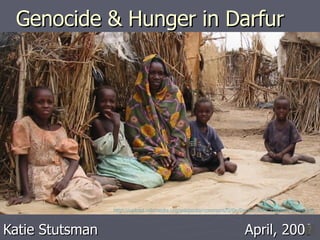
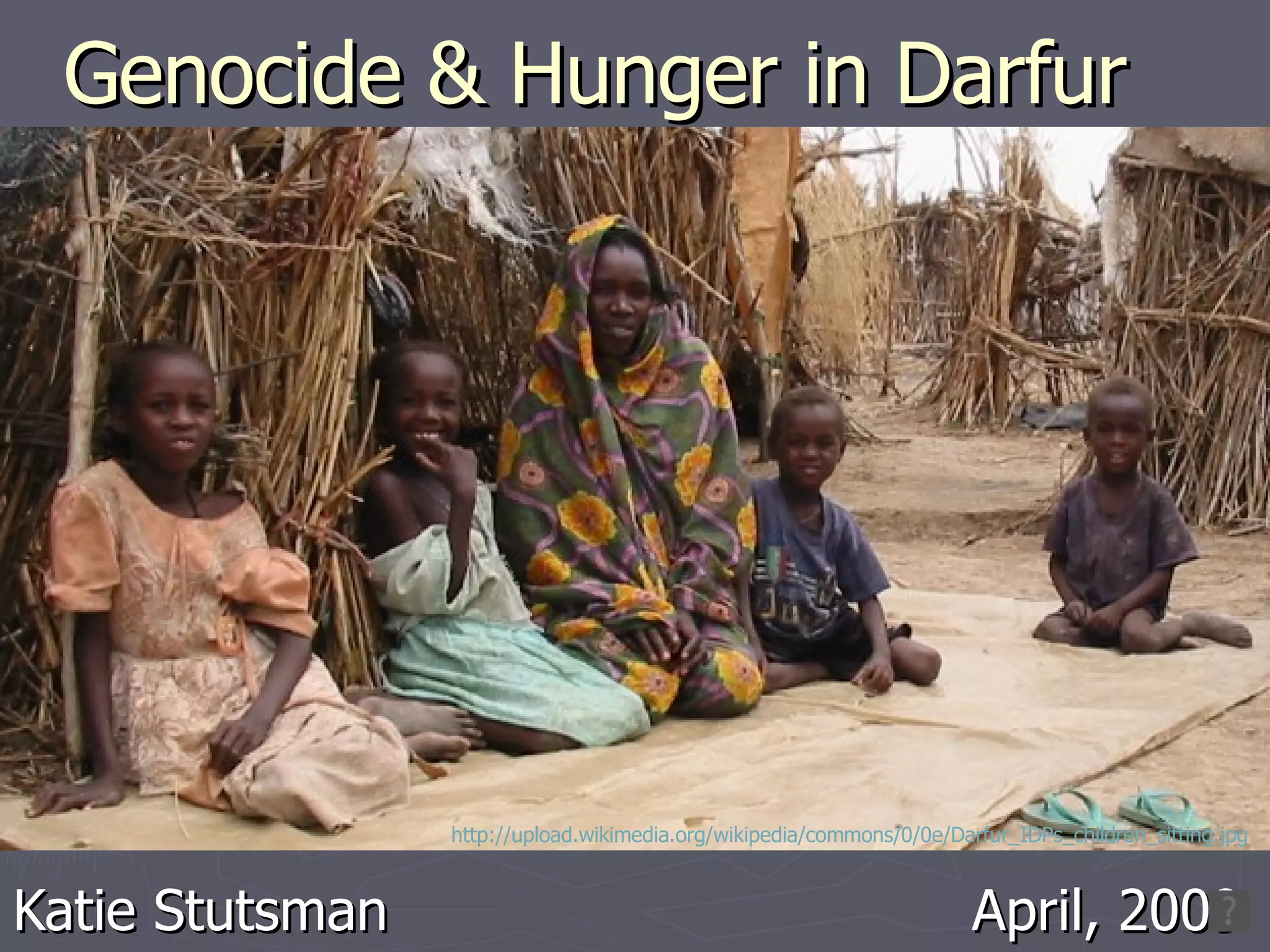
Genocide & Hunger in Darfur Katie Stutsman     April, 2009 http://upload.wikimedia.org/wikipedia/commons/0/0e/Darfur_IDPs_children_sitting.jpg
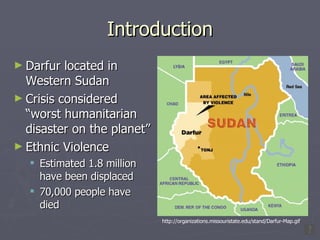
Introduction Darfur located in Western Sudan Crisis considered “worst humanitarian disaster on the planet” Ethnic Violence Estimated 1.8 million have been displaced 70,000 people have died http://organizations.missouristate.edu/stand/Darfur-Map.gif
Historical Perspective Conflict nothing new to region Have been many civil wars in the region Have been conflict all but 11 years in Sudan since gaining independence from U.K. in 1956 Government has a nearly 30 year history of arming the rebels Janjaweed comprised of the “Arab” fighters responsible for attacks in region
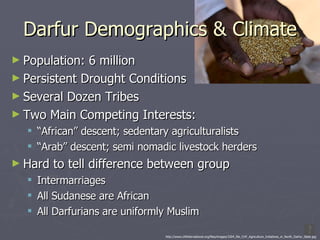
Darfur Demographics & Climate Population: 6 million Persistent Drought Conditions Several Dozen Tribes Two Main Competing Interests: “ African” descent; sedentary agriculturalists “ Arab” descent; semi nomadic livestock herders Hard to tell difference between group Intermarriages All Sudanese are African All Darfurians are uniformly Muslim http://www.chfinternational.org/files/images/3304_file_CHF_Agriculture_Initiatives_in_North_Darfur_State.jpg
International Response Slow to accept crisis as a genocide Some argue that it is not an extermination, just a forced removal EU, Canadian, and British officials have not described conflict as a “genocide”  UN has asked for more information Celebrities have sparked a media frenzy fueling more attention towards Darfur Evangelists Media outlets Civil Rights Groups
Impact on Society Men most common victim of death Attacks also on women, children and elderly Women victims of rape 574 villages destroyed 1.8 million displaced People must gather in camps Food crisis result Conflict surrounding food distribution Reliance on international aid for food in camps Increased disease as well
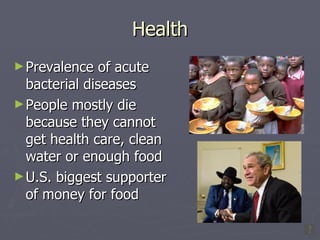
Health Prevalence of acute bacterial diseases People mostly die because they cannot get health care, clean water or enough food U.S. biggest supporter of money for food
An Ethical Perspective Many people have lost their homes Many are left hungry, susceptible to disease, death, homes Not a huge international response Problem persisted before there was attention Too much debate over definition of genocide Time could have been spent more wisely
Economic Implications Displaced individuals have lost main source of income and food: land Unsteady markets and poor climate conditions Not many solid jobs available in the camps Economic measurement of civilian death is limitless Very expensive to provide aid to region U.S. has pledged $100 million to region
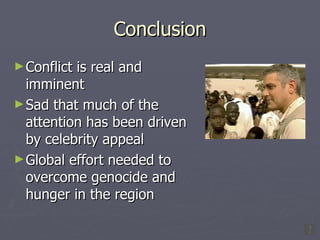
Conclusion Conflict is real and imminent Sad that much of the attention has been driven by celebrity appeal Global effort needed to overcome genocide and hunger in the region
Sources Scott, Straus. "Darfur and the Genocide Debate."  Foreign Affairs  84 (2005): 123-33.  Weissman, Fabrice. “Humanitarian Dilemmas in Darfur.” July 2008. http://en.wikipedia.org/wiki/Darfur_conflict

Genocide & Hunger In Darfur[1]

  • 1.
    Genocide & Hungerin Darfur Katie Stutsman April, 2009 http://upload.wikimedia.org/wikipedia/commons/0/0e/Darfur_IDPs_children_sitting.jpg
  • 2.
    Introduction Darfur locatedin Western Sudan Crisis considered “worst humanitarian disaster on the planet” Ethnic Violence Estimated 1.8 million have been displaced 70,000 people have died http://organizations.missouristate.edu/stand/Darfur-Map.gif
  • 3.
    Historical Perspective Conflictnothing new to region Have been many civil wars in the region Have been conflict all but 11 years in Sudan since gaining independence from U.K. in 1956 Government has a nearly 30 year history of arming the rebels Janjaweed comprised of the “Arab” fighters responsible for attacks in region
  • 4.
    Darfur Demographics &Climate Population: 6 million Persistent Drought Conditions Several Dozen Tribes Two Main Competing Interests: “ African” descent; sedentary agriculturalists “ Arab” descent; semi nomadic livestock herders Hard to tell difference between group Intermarriages All Sudanese are African All Darfurians are uniformly Muslim http://www.chfinternational.org/files/images/3304_file_CHF_Agriculture_Initiatives_in_North_Darfur_State.jpg
  • 5.
    International Response Slowto accept crisis as a genocide Some argue that it is not an extermination, just a forced removal EU, Canadian, and British officials have not described conflict as a “genocide” UN has asked for more information Celebrities have sparked a media frenzy fueling more attention towards Darfur Evangelists Media outlets Civil Rights Groups
  • 6.
    Impact on SocietyMen most common victim of death Attacks also on women, children and elderly Women victims of rape 574 villages destroyed 1.8 million displaced People must gather in camps Food crisis result Conflict surrounding food distribution Reliance on international aid for food in camps Increased disease as well
  • 7.
    Health Prevalence ofacute bacterial diseases People mostly die because they cannot get health care, clean water or enough food U.S. biggest supporter of money for food
  • 8.
    An Ethical PerspectiveMany people have lost their homes Many are left hungry, susceptible to disease, death, homes Not a huge international response Problem persisted before there was attention Too much debate over definition of genocide Time could have been spent more wisely
  • 9.
    Economic Implications Displacedindividuals have lost main source of income and food: land Unsteady markets and poor climate conditions Not many solid jobs available in the camps Economic measurement of civilian death is limitless Very expensive to provide aid to region U.S. has pledged $100 million to region
  • 10.
    Conclusion Conflict isreal and imminent Sad that much of the attention has been driven by celebrity appeal Global effort needed to overcome genocide and hunger in the region
  • 11.
    Sources Scott, Straus."Darfur and the Genocide Debate." Foreign Affairs 84 (2005): 123-33. Weissman, Fabrice. “Humanitarian Dilemmas in Darfur.” July 2008. http://en.wikipedia.org/wiki/Darfur_conflict