Unit 10: different types of population
movement
Throughout history, people have moved across land
and sea all over the world

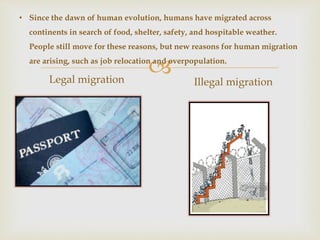
• Since the dawn of human evolution, humans have migrated across
continents in search of food, shelter, safety, and hospitable weather.
People still move for these reasons, but new reasons for human migration
are arising, such as job relocation and overpopulation.
Legal migration Illegal migration
What is migration?
• Movement of people to an area or country in order to find work or a better living conditions.
• The movement of people so as to change their place of residence .
• The periodic movement of animals from one location to another.

Two migration types
Voluntary migration
 People move them selves.
 They move to find better
employment opportunities.
 To be with their friends and
family.
 For better social facilities.
 For better climate.
Forced migration
 People are forced to move.
 This may be due to war
conflicts.
 Unsafe conditions (crime)
 Shortage of food.
 Natural disasters such as
earthquakes, floods, hurricanes,
and volcanic eruptions etc.

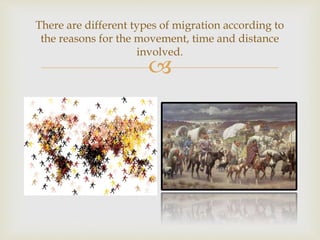
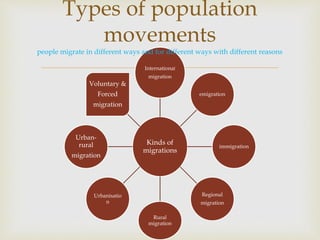
There are different types of migration according to
the reasons for the movement, time and distance
involved.

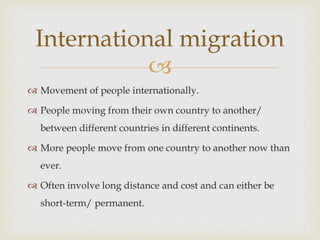
Kinds of
migrations
International
migration
emigration
immigration
Regional
migration
Rural
migration
Urbanisatio
n
Urban-
rural
migration
Voluntary &
Forced
migration
Types of population
movements
people migrate in different ways and for different ways with different reasons

 Movement of people internationally.
 People moving from their own country to another/
between different countries in different continents.
 More people move from one country to another now than
ever.
 Often involve long distance and cost and can either be
short-term/ permanent.
International migration

 The act of coming to live permanently in a foreign
country
 That person we call an immigration
 E.g. when one comes to live permanently in S.A from
Mozambique we call him an…? That’s because he
immigrated.
Immigration

 Living ones home country to permanently live in
another country (moving abroad).
 This person is called an emigrant
 E.g. when you move from S.A to London we from
S.A will say you emigrated to London therefore
making you an emigrant.
Emigration

 Movement within a region
 It is usually a type of international migration
 The government has specified certain areas for
regional migration and requirements are lower for
immigrants prepared to work in those areas.
Regional migration

 Movement of people from the rural to the urban
areas, often in the same country.
 45% of S.A citizens live in the rural areas.
 Most people move from rural areas to the urban
areas with the hope of a better life, and standard of
living which is not always true.
Rural-urban migration

 The increase in the proportion of people living in
towns and cities, with a matching increase in city
size and infrastructure.
 This is caused by rural urban migration
 The rate of urbanisation in developing countries has
been very high
 This has resulted in ‘megacities’ which are cities with
more than 10 people
Urbanisation
Megacities
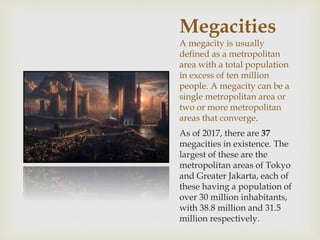
A megacity is usually
defined as a metropolitan
area with a total population
in excess of ten million
people. A megacity can be a
single metropolitan area or
two or more metropolitan
areas that converge.
As of 2017, there are 37
megacities in existence. The
largest of these are the
metropolitan areas of Tokyo
and Greater Jakarta, each of
these having a population of
over 30 million inhabitants,
with 38.8 million and 31.5
million respectively.

 Movement from towns and cities to rural areas
 This is counter migration as it goes against the
normal movement of people from rural to urban
Urban rural migration

Chapter 4: population movement

  • 1.
    Unit 10: differenttypes of population movement Throughout history, people have moved across land and sea all over the world
  • 2.
     • Since thedawn of human evolution, humans have migrated across continents in search of food, shelter, safety, and hospitable weather. People still move for these reasons, but new reasons for human migration are arising, such as job relocation and overpopulation. Legal migration Illegal migration
  • 3.
    What is migration? •Movement of people to an area or country in order to find work or a better living conditions. • The movement of people so as to change their place of residence . • The periodic movement of animals from one location to another.
  • 4.
     Two migration types Voluntarymigration  People move them selves.  They move to find better employment opportunities.  To be with their friends and family.  For better social facilities.  For better climate. Forced migration  People are forced to move.  This may be due to war conflicts.  Unsafe conditions (crime)  Shortage of food.  Natural disasters such as earthquakes, floods, hurricanes, and volcanic eruptions etc.
  • 5.
     There are differenttypes of migration according to the reasons for the movement, time and distance involved.
  • 6.
  • 7.
      Movement ofpeople internationally.  People moving from their own country to another/ between different countries in different continents.  More people move from one country to another now than ever.  Often involve long distance and cost and can either be short-term/ permanent. International migration
  • 8.
      The actof coming to live permanently in a foreign country  That person we call an immigration  E.g. when one comes to live permanently in S.A from Mozambique we call him an…? That’s because he immigrated. Immigration
  • 9.
      Living oneshome country to permanently live in another country (moving abroad).  This person is called an emigrant  E.g. when you move from S.A to London we from S.A will say you emigrated to London therefore making you an emigrant. Emigration
  • 10.
      Movement withina region  It is usually a type of international migration  The government has specified certain areas for regional migration and requirements are lower for immigrants prepared to work in those areas. Regional migration
  • 11.
      Movement ofpeople from the rural to the urban areas, often in the same country.  45% of S.A citizens live in the rural areas.  Most people move from rural areas to the urban areas with the hope of a better life, and standard of living which is not always true. Rural-urban migration
  • 12.
      The increasein the proportion of people living in towns and cities, with a matching increase in city size and infrastructure.  This is caused by rural urban migration  The rate of urbanisation in developing countries has been very high  This has resulted in ‘megacities’ which are cities with more than 10 people Urbanisation
  • 13.
    Megacities A megacity isusually defined as a metropolitan area with a total population in excess of ten million people. A megacity can be a single metropolitan area or two or more metropolitan areas that converge. As of 2017, there are 37 megacities in existence. The largest of these are the metropolitan areas of Tokyo and Greater Jakarta, each of these having a population of over 30 million inhabitants, with 38.8 million and 31.5 million respectively.
  • 14.
      Movement fromtowns and cities to rural areas  This is counter migration as it goes against the normal movement of people from rural to urban Urban rural migration

Editor's Notes