Chapter 3: Migration
Field Note:
Risking Lives for Remittances

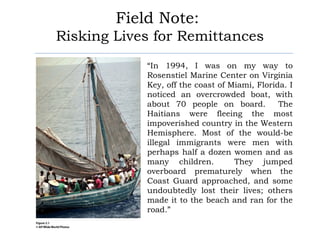
         “   “In 1994, I was on my way to
             Rosenstiel Marine Center on Virginia
             Key, off the coast of Miami, Florida. I
             noticed an overcrowded boat, with
             about 70 people on board.          The
             Haitians were fleeing the most
             impoverished country in the Western
             Hemisphere. Most of the would-be
             illegal immigrants were men with
             perhaps half a dozen women and as
             many children.         They jumped
             overboard prematurely when the
             Coast Guard approached, and some
             undoubtedly lost their lives; others
             made it to the beach and ran for the
             road.”
Key Question


• What is migration?
What Is Migration?

• Movement is inherently geographical.
• All movement involves leaving home.
• Three types of movement:
  1. Cyclic
  2. Periodic
  3. Migration
What Is Migration?
Cyclic Movement
• Involves journeys that begin at our home
  base and bring us back to it
• Regular sequences of short moves within a
  local area = activity spaces
• Commuting
• Seasonal movement
• Nomadism
What Is Migration?
Periodic Movement
• Involves a longer period of time away from
  the home base than cyclic movement
• Migrant labor
• Transhumance, a system of pastoral
  farming where ranchers move livestock
  according to the seasonal availability of
  pastures
• College attendance
• Military service
What Is Migration?
Migration
• Permanent relocation across significant
  distances
• International migration/Transnational
  migration
   Emigrant = migrates out of country
   Immigrant = migrates into country
• Internal migration varies according to the
  mobility of the population.
Choose one type of cyclic or periodic
movement and then think of a specific
example of the kind of movement you chose.
Now, determine how this movement changes
both the home and the destination as a result
of this cyclic or period movement.
Key Question


Why do people migrate?
What Is Migration?
Forced Migration
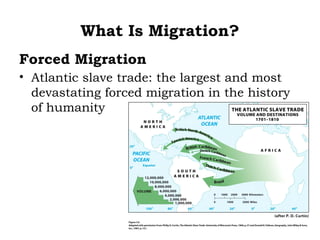
• Atlantic slave trade: the largest and most
  devastating forced migration in the history
  of humanity
What Is Migration?

Forced Migration
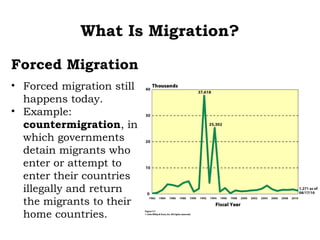
• Forced migration still
  happens today.
• Example:
  countermigration, in
  which governments
  detain migrants who
  enter or attempt to
  enter their countries
  illegally and return
  the migrants to their
  home countries.
What Is Migration?
Push and Pull Factors in Voluntary
Migration
• Ernst Ravenstein proposed laws of migration:
  1. Every migration flow generates a return or
     countermigration.
  2. The majority of migrants move a short distance.
  3. Migrants who move longer distances tend to
     choose big-city destinations.
  4. Urban residents are less migratory than
     inhabitants of rural areas.
  5. Families are less likely to make international
     moves than young adults.
What Is Migration?
Push and Pull Factors in Voluntary
Migration
Gravity model:
• Predicts interaction between places on the
  basis of their population size and distance
  between them
• Assumes that spatial interaction (such as
  migration) is directly related to the
  populations and inversely related to the
  distance between them
What Is Migration?
Push and Pull Factors in Voluntary
Migration
• Push factors are the conditions and
  perceptions that help the migrant decide to
  leave a place.
• They include individual considerations
  such as work or retirement conditions, cost
  of living, personal safety and security, and,
  for many, environmental catastrophes or
  even issues like weather and climate.
What Is Migration?
  Push and Pull Factors in Voluntary
  Migration
• Pull factors are the circumstances that
  effectively attract the migrant to certain
  locales from other places, the decision of
  where to go.
• They tend to be vaguer and may depend
  solely on perceptions construed from things
  heard and read rather than on experiences
  in the destination place.
What Is Migration?
Push and Pull Factors in Voluntary
Migration
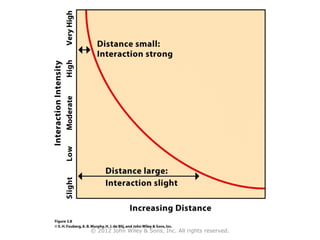
• Distance decay: Prospective migrants are
  likely to have more complete perceptions of
  nearer places than of farther ones.
• Since interaction with faraway places
  generally decreases as distance increases,
  prospective migrants are likely to feel much
  less certain about distant destinations than
  about nearer ones.
             © 2012 John Wiley & Sons, Inc. All rights reserved.
© 2012 John Wiley & Sons, Inc. All rights reserved.
What Is Migration?
Push and Pull Factors in Voluntary
Migration
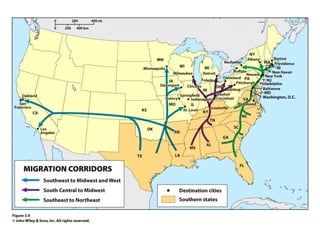
• Step migration: Migration streams
  consist of a series of stages.
• Intervening opportunity: Many
  migrants encounter an opportunity
  along their migration stream that keeps
  them from getting to the metropolis that
  impelled them to move in the first place.
   Example: during the Great Migration
What Is Migration?

Types of Push and Pull Factors
• Legal status: Migrants can arrive in a
  country with or without consent of the host
  country.
• Economic conditions: Poverty has driven
  countless millions from their homelands.
• Power relationships: Power relationships
  already embedded in society enable the flow
  of migrants around the world.

             © 2012 John Wiley & Sons, Inc. All rights reserved.
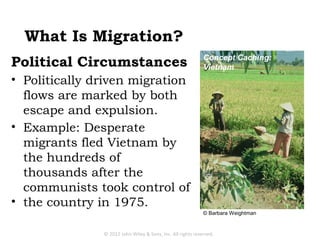
What Is Migration?
                                                             Concept Caching:
Political Circumstances                                      Vietnam
• Politically driven migration
  flows are marked by both
  escape and expulsion.
• Example: Desperate
  migrants fled Vietnam by
  the hundreds of
  thousands after the
  communists took control of
• the country in 1975.
                                                             © Barbara Weightman


               © 2012 John Wiley & Sons, Inc. All rights reserved.
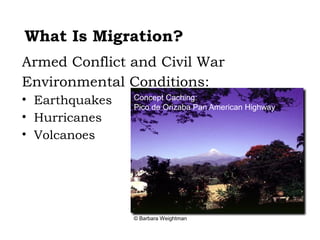
What Is Migration?
Armed Conflict and Civil War
Environmental Conditions:
• Earthquakes   Concept Caching:
                 Concept Caching:
                Pico de Orizaba Pan American Highway
                 Mount Vesuvius
• Hurricanes
• Volcanoes


                © Barbara Weightman
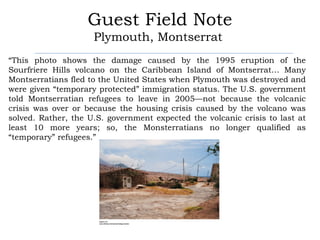
Guest Field Note
                     Plymouth, Montserrat
“This photo shows the damage caused by the 1995 eruption of the
Sourfriere Hills volcano on the Caribbean Island of Montserrat… Many
Montserratians fled to the United States when Plymouth was destroyed and
were given “temporary protected” immigration status. The U.S. government
told Montserratian refugees to leave in 2005—not because the volcanic
crisis was over or because the housing crisis caused by the volcano was
solved. Rather, the U.S. government expected the volcanic crisis to last at
least 10 more years; so, the Monsterratians no longer qualified as
“temporary” refugees.”
What Is Migration?
Culture and Traditions
• People who fear that their culture and
  traditions will not survive a major political
  transition, and who are able to migrate to
  places they perceive as safer, will often do so.
Technological Advances
• Television, radio, cell phones, and telephone
  stimulate millions of people to migrate by
  relaying information about relatives,
  opportunities, and already established
  communities in destination lands.
              © 2012 John Wiley & Sons, Inc. All rights reserved.
What Is Migration?
Technological Advances
• Kinship links: Communication strengthens
  their role of push/pull factors.
• Chain migration: flows along and through
  kinship links.
• Chains of migration built upon each other
  create immigration waves or swells in
  migration from one origin to the same
  destination.


            © 2012 John Wiley & Sons, Inc. All rights reserved.
Key Question

Where do people migrate?
Where Do People Migrate?

Global Migration Flows

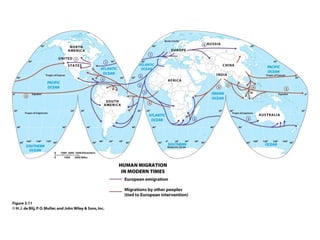
• Global-scale migration
• Explorers
• Colonization
Where Do People Migrate?
Regional Migration Flows
• Economic opportunities
  • Islands of development
  • Role of globalization and colonialism
• Reconnection of cultural groups
• Conflict and war
Field Note
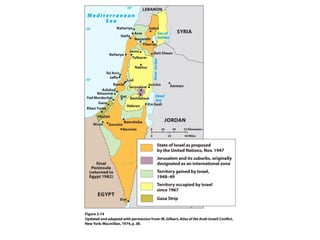
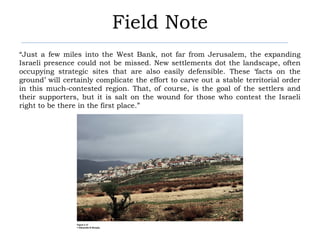
“Just a few miles into the West Bank, not far from Jerusalem, the expanding
Israeli presence could not be missed. New settlements dot the landscape, often
occupying strategic sites that are also easily defensible. These ‘facts on the
ground’ will certainly complicate the effort to carve out a stable territorial order
in this much-contested region. That, of course, is the goal of the settlers and
their supporters, but it is salt on the wound for those who contest the Israeli
right to be there in the first place.”
Where Do People Migrate?
National Migration Flows
• Historically, two of the major migration
  flows before 1950 occurred internally in the
  United States and in Russia.
• Russification sought to assimilate all the
  people in the Soviet territory into the
  Russian culture, during the communist
  period, by encouraging people to move out
  of Moscow and St. Petersburg and fill in the
  country.
Where Do People Migrate?
Guest Workers
• Millions of guest workers live outside of their
  home country and send remittances from their
  jobs home.
• Their home states are fully aware that their
  citizens have visas and are working abroad.
• Despite the legal status of guest workers, many
  employers abuse them because guest workers
  are often unaware of their rights.
• Guest workers are legal, documented migrants
  who have work visas, usually short term.
Where Do People Migrate?
Refugees
• The United Nations High Commissioner on
  Refugees (UNHCR) estimates that 83
  percent of refugees flee to a country in the
  same region as their home country.
• The 1951 Refugee Convention defines a
  refugee as “a person who has a
  wellfounded fear of being persecuted for
  reasons of race, religion, nationality,
  membership of a particular social group, or
  political opinion.”
Where Do People Migrate?
Refugees
• Internally displaced persons are people
  who have been displaced within their own
  countries, but they do not cross
  international borders as they flee.
• Asylum: the right to protection in the first
  country in which the refugee arrives.
• Repatriation: a process by which the
  UNHCR helps return refugees to their
  homelands once violence and persecution
  subside.
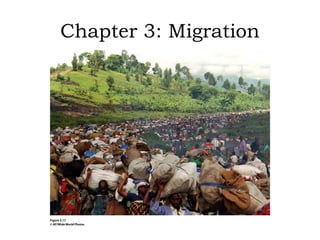
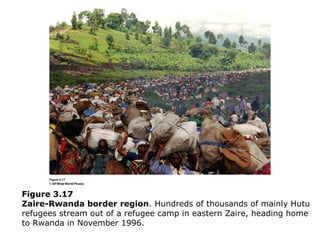
Figure 3.17
Zaire-Rwanda border region. Hundreds of thousands of mainly Hutu
refugees stream out of a refugee camp in eastern Zaire, heading home
to Rwanda in November 1996.
Where Do People Migrate?
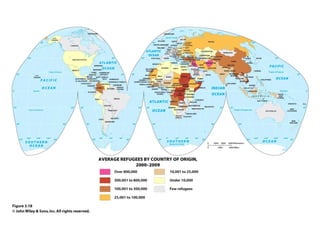
Regions of Dislocation
• North Africa and Southwest Asia: This
  geographic region, extending from Morocco
  in the west to Afghanistan in the east,
  contains some of the world’s longest-lasting
  and most deeply entrenched conflicts that
  generate refugees.
• Africa: 2 million refugees are accounted for
  by international relief agencies, but also
  millions more are internally displaced
  persons.
Where Do People Migrate?
Regions of Dislocation
• South Asia: is the third-ranking geographic
  realm, mainly because of Pakistan’s role in
  accommodating Afghanistan’s refugees.
• Southeast Asia: a reminder that refugee
  problems can change quickly. Example:
  Indochina’s refugee crisis
Where Do People Migrate?
Regions of Dislocation
Europe: even after the cessation of armed
conflict and the implementation of a peace
agreement known as the Dayton Accords, the
UNHCR still reports over 100,000 IDPs in the
area.
Other Regions: The number of refugees and
internally displaced persons in other
geographic realms is much smaller.
Key Question


How do governments affect
       migration?
How Do Governments Affect
Migration?
Legal Restrictions
• Oriental Exclusion Acts (1882–1907): U.S.
  Congress designed immigration laws to
  prevent the immigration of Chinese people
  to California.
• In 1901, the Australian government
  approved the Immigration Restriction Act,
  which ended all nonwhite immigration into
  the newly united country.
• White Australia Policy
How Do Governments Affect
Migration?
Waves of Immigration in the
United States
• The United States experienced two major
  waves of immigration before 1930 and is in
  the midst of another great wave of
  immigration today.
• Immigration quotas
• National Origins Law in 1929
• Immigration and Nationality Act: 1952
• Selective immigration
How Do Governments Affect
Migration?
Post–September 11
• New government policies affect asylum-
  seekers, illegal immigrants, and legal
  immigrants.
• 9/11 Commission Report was released in
  2004.
One goal of international organizations involved in aiding refugees is repatriation—return
of the refugees to their home countries once the threat against them has passed. Take
the example of refugees from the Darfur region of Sudan. Think about how their land
and their lives have changed since they became refugees. You are assigned the daunting
task of repatriating refugees from Darfur to Sudan once a peace solution is reached.
What steps would you have to take to rediscover a home for these refugees?


• A functional region is defined by a particular set of activities or
  interactions that occur within it. Ex: the City of Chicago
Additional Resources

• Immigration to the United States
  www.uscis.gov
• Refugees
  www.unhcr.org
• Geographic Mobility and Movement in the
  United States
  www.census.gov/population/www/socdemo/migr

Ch03 AP Human

  • 1.
  • 2.
    Field Note: Risking Livesfor Remittances “ “In 1994, I was on my way to Rosenstiel Marine Center on Virginia Key, off the coast of Miami, Florida. I noticed an overcrowded boat, with about 70 people on board. The Haitians were fleeing the most impoverished country in the Western Hemisphere. Most of the would-be illegal immigrants were men with perhaps half a dozen women and as many children. They jumped overboard prematurely when the Coast Guard approached, and some undoubtedly lost their lives; others made it to the beach and ran for the road.”
  • 3.
    Key Question • Whatis migration?
  • 4.
    What Is Migration? •Movement is inherently geographical. • All movement involves leaving home. • Three types of movement: 1. Cyclic 2. Periodic 3. Migration
  • 5.
    What Is Migration? CyclicMovement • Involves journeys that begin at our home base and bring us back to it • Regular sequences of short moves within a local area = activity spaces • Commuting • Seasonal movement • Nomadism
  • 6.
    What Is Migration? PeriodicMovement • Involves a longer period of time away from the home base than cyclic movement • Migrant labor • Transhumance, a system of pastoral farming where ranchers move livestock according to the seasonal availability of pastures • College attendance • Military service
  • 7.
    What Is Migration? Migration •Permanent relocation across significant distances • International migration/Transnational migration Emigrant = migrates out of country Immigrant = migrates into country • Internal migration varies according to the mobility of the population.
  • 10.
    Choose one typeof cyclic or periodic movement and then think of a specific example of the kind of movement you chose. Now, determine how this movement changes both the home and the destination as a result of this cyclic or period movement.
  • 11.
    Key Question Why dopeople migrate?
  • 12.
    What Is Migration? ForcedMigration • Atlantic slave trade: the largest and most devastating forced migration in the history of humanity
  • 13.
    What Is Migration? ForcedMigration • Forced migration still happens today. • Example: countermigration, in which governments detain migrants who enter or attempt to enter their countries illegally and return the migrants to their home countries.
  • 14.
    What Is Migration? Pushand Pull Factors in Voluntary Migration • Ernst Ravenstein proposed laws of migration: 1. Every migration flow generates a return or countermigration. 2. The majority of migrants move a short distance. 3. Migrants who move longer distances tend to choose big-city destinations. 4. Urban residents are less migratory than inhabitants of rural areas. 5. Families are less likely to make international moves than young adults.
  • 15.
    What Is Migration? Pushand Pull Factors in Voluntary Migration Gravity model: • Predicts interaction between places on the basis of their population size and distance between them • Assumes that spatial interaction (such as migration) is directly related to the populations and inversely related to the distance between them
  • 16.
    What Is Migration? Pushand Pull Factors in Voluntary Migration • Push factors are the conditions and perceptions that help the migrant decide to leave a place. • They include individual considerations such as work or retirement conditions, cost of living, personal safety and security, and, for many, environmental catastrophes or even issues like weather and climate.
  • 17.
    What Is Migration? Push and Pull Factors in Voluntary Migration • Pull factors are the circumstances that effectively attract the migrant to certain locales from other places, the decision of where to go. • They tend to be vaguer and may depend solely on perceptions construed from things heard and read rather than on experiences in the destination place.
  • 18.
    What Is Migration? Pushand Pull Factors in Voluntary Migration • Distance decay: Prospective migrants are likely to have more complete perceptions of nearer places than of farther ones. • Since interaction with faraway places generally decreases as distance increases, prospective migrants are likely to feel much less certain about distant destinations than about nearer ones. © 2012 John Wiley & Sons, Inc. All rights reserved.
  • 19.
    © 2012 JohnWiley & Sons, Inc. All rights reserved.
  • 20.
    What Is Migration? Pushand Pull Factors in Voluntary Migration • Step migration: Migration streams consist of a series of stages. • Intervening opportunity: Many migrants encounter an opportunity along their migration stream that keeps them from getting to the metropolis that impelled them to move in the first place. Example: during the Great Migration
  • 21.
    What Is Migration? Typesof Push and Pull Factors • Legal status: Migrants can arrive in a country with or without consent of the host country. • Economic conditions: Poverty has driven countless millions from their homelands. • Power relationships: Power relationships already embedded in society enable the flow of migrants around the world. © 2012 John Wiley & Sons, Inc. All rights reserved.
  • 22.
    What Is Migration? Concept Caching: Political Circumstances Vietnam • Politically driven migration flows are marked by both escape and expulsion. • Example: Desperate migrants fled Vietnam by the hundreds of thousands after the communists took control of • the country in 1975. © Barbara Weightman © 2012 John Wiley & Sons, Inc. All rights reserved.
  • 23.
    What Is Migration? ArmedConflict and Civil War Environmental Conditions: • Earthquakes Concept Caching: Concept Caching: Pico de Orizaba Pan American Highway Mount Vesuvius • Hurricanes • Volcanoes © Barbara Weightman
  • 24.
    Guest Field Note Plymouth, Montserrat “This photo shows the damage caused by the 1995 eruption of the Sourfriere Hills volcano on the Caribbean Island of Montserrat… Many Montserratians fled to the United States when Plymouth was destroyed and were given “temporary protected” immigration status. The U.S. government told Montserratian refugees to leave in 2005—not because the volcanic crisis was over or because the housing crisis caused by the volcano was solved. Rather, the U.S. government expected the volcanic crisis to last at least 10 more years; so, the Monsterratians no longer qualified as “temporary” refugees.”
  • 25.
    What Is Migration? Cultureand Traditions • People who fear that their culture and traditions will not survive a major political transition, and who are able to migrate to places they perceive as safer, will often do so. Technological Advances • Television, radio, cell phones, and telephone stimulate millions of people to migrate by relaying information about relatives, opportunities, and already established communities in destination lands. © 2012 John Wiley & Sons, Inc. All rights reserved.
  • 26.
    What Is Migration? TechnologicalAdvances • Kinship links: Communication strengthens their role of push/pull factors. • Chain migration: flows along and through kinship links. • Chains of migration built upon each other create immigration waves or swells in migration from one origin to the same destination. © 2012 John Wiley & Sons, Inc. All rights reserved.
  • 27.
    Key Question Where dopeople migrate?
  • 28.
    Where Do PeopleMigrate? Global Migration Flows • Global-scale migration • Explorers • Colonization
  • 30.
    Where Do PeopleMigrate? Regional Migration Flows • Economic opportunities • Islands of development • Role of globalization and colonialism • Reconnection of cultural groups • Conflict and war
  • 32.
    Field Note “Just afew miles into the West Bank, not far from Jerusalem, the expanding Israeli presence could not be missed. New settlements dot the landscape, often occupying strategic sites that are also easily defensible. These ‘facts on the ground’ will certainly complicate the effort to carve out a stable territorial order in this much-contested region. That, of course, is the goal of the settlers and their supporters, but it is salt on the wound for those who contest the Israeli right to be there in the first place.”
  • 33.
    Where Do PeopleMigrate? National Migration Flows • Historically, two of the major migration flows before 1950 occurred internally in the United States and in Russia. • Russification sought to assimilate all the people in the Soviet territory into the Russian culture, during the communist period, by encouraging people to move out of Moscow and St. Petersburg and fill in the country.
  • 34.
    Where Do PeopleMigrate? Guest Workers • Millions of guest workers live outside of their home country and send remittances from their jobs home. • Their home states are fully aware that their citizens have visas and are working abroad. • Despite the legal status of guest workers, many employers abuse them because guest workers are often unaware of their rights. • Guest workers are legal, documented migrants who have work visas, usually short term.
  • 35.
    Where Do PeopleMigrate? Refugees • The United Nations High Commissioner on Refugees (UNHCR) estimates that 83 percent of refugees flee to a country in the same region as their home country. • The 1951 Refugee Convention defines a refugee as “a person who has a wellfounded fear of being persecuted for reasons of race, religion, nationality, membership of a particular social group, or political opinion.”
  • 36.
    Where Do PeopleMigrate? Refugees • Internally displaced persons are people who have been displaced within their own countries, but they do not cross international borders as they flee. • Asylum: the right to protection in the first country in which the refugee arrives. • Repatriation: a process by which the UNHCR helps return refugees to their homelands once violence and persecution subside.
  • 37.
    Figure 3.17 Zaire-Rwanda borderregion. Hundreds of thousands of mainly Hutu refugees stream out of a refugee camp in eastern Zaire, heading home to Rwanda in November 1996.
  • 38.
    Where Do PeopleMigrate? Regions of Dislocation • North Africa and Southwest Asia: This geographic region, extending from Morocco in the west to Afghanistan in the east, contains some of the world’s longest-lasting and most deeply entrenched conflicts that generate refugees. • Africa: 2 million refugees are accounted for by international relief agencies, but also millions more are internally displaced persons.
  • 39.
    Where Do PeopleMigrate? Regions of Dislocation • South Asia: is the third-ranking geographic realm, mainly because of Pakistan’s role in accommodating Afghanistan’s refugees. • Southeast Asia: a reminder that refugee problems can change quickly. Example: Indochina’s refugee crisis
  • 40.
    Where Do PeopleMigrate? Regions of Dislocation Europe: even after the cessation of armed conflict and the implementation of a peace agreement known as the Dayton Accords, the UNHCR still reports over 100,000 IDPs in the area. Other Regions: The number of refugees and internally displaced persons in other geographic realms is much smaller.
  • 42.
    Key Question How dogovernments affect migration?
  • 43.
    How Do GovernmentsAffect Migration? Legal Restrictions • Oriental Exclusion Acts (1882–1907): U.S. Congress designed immigration laws to prevent the immigration of Chinese people to California. • In 1901, the Australian government approved the Immigration Restriction Act, which ended all nonwhite immigration into the newly united country. • White Australia Policy
  • 44.
    How Do GovernmentsAffect Migration? Waves of Immigration in the United States • The United States experienced two major waves of immigration before 1930 and is in the midst of another great wave of immigration today. • Immigration quotas • National Origins Law in 1929 • Immigration and Nationality Act: 1952 • Selective immigration
  • 45.
    How Do GovernmentsAffect Migration? Post–September 11 • New government policies affect asylum- seekers, illegal immigrants, and legal immigrants. • 9/11 Commission Report was released in 2004.
  • 46.
    One goal ofinternational organizations involved in aiding refugees is repatriation—return of the refugees to their home countries once the threat against them has passed. Take the example of refugees from the Darfur region of Sudan. Think about how their land and their lives have changed since they became refugees. You are assigned the daunting task of repatriating refugees from Darfur to Sudan once a peace solution is reached. What steps would you have to take to rediscover a home for these refugees? • A functional region is defined by a particular set of activities or interactions that occur within it. Ex: the City of Chicago
  • 47.
    Additional Resources • Immigrationto the United States www.uscis.gov • Refugees www.unhcr.org • Geographic Mobility and Movement in the United States www.census.gov/population/www/socdemo/migr

Editor's Notes

  • #2 Figure 3.17 Zaire-Rwanda border region . Hundreds of thousands of mainly Hutu refugees stream out of a refugee camp in eastern Zaire, heading home to Rwanda in November 1996. © AP/Wide World Photos.
  • #25 *Credit: Jason Dittmer, University College London