OPERATING SYSTEM
Chapter 4: Threads
Chapter 4: Threads
•
•
•
•
•
•
•

Overview
Multicore Programming
Multithreading Models
Thread Libraries
Implicit Threading
Threading Issues
Operating System Examples
Objectives
• To introduce the notion of a thread—a fundamental unit of CPU utilization
that forms the basis of multithreaded computer systems
• To discuss the APIs for the Pthreads, Windows, and Java thread libraries
• To explore several strategies that provide implicit threading
• To examine issues related to multithreaded programming
• To cover operating system support for threads in Windows and Linux
Motivation
•
•
•

Most modern applications are multithreaded
Threads run within application
Multiple tasks with the application can be implemented by separate threads
–
–
–
–

•
•
•

Update display
Fetch data
Spell checking
Answer a network request

Process creation is heavy-weight while thread creation is light-weight
Can simplify code, increase efficiency
Kernels are generally multithreaded
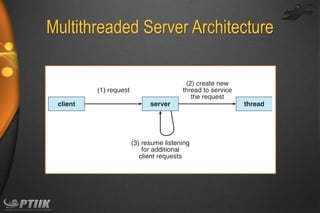
Multithreaded Server Architecture
Benefits
• Responsiveness – may allow continued execution if part of process is
blocked, especially important for user interfaces

• Resource Sharing – threads share resources of process, easier than
shared memory or message passing
• Economy – cheaper than process creation, thread switching lower
overhead than context switching
• Scalability – process can take advantage of multiprocessor architectures
Multicore Programming
•

Multicore or multiprocessor systems putting pressure on programmers, challenges
include:
–
–
–
–
–

•
•
•

Dividing activities
Balance
Data splitting
Data dependency
Testing and debugging

Parallelism implies a system can perform more than one task simultaneously
Concurrency supports more than one task making progress
Single processor / core, scheduler providing concurrency
Multicore Programming (Cont.)
Types of parallelism
•

•

•
•
•

Data parallelism – distributes subsets of the same data across multiple cores, same
operation on each
Task parallelism – distributing threads across cores, each thread performing unique
operation
As # of threads grows, so does architectural support for threading
CPUs have cores as well as hardware threads
Consider Oracle SPARC T4 with 8 cores, and 8 hardware threads per core
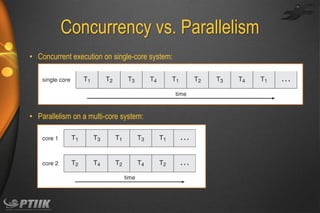
Concurrency vs. Parallelism
• Concurrent execution on single-core system:

• Parallelism on a multi-core system:
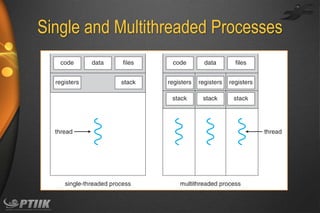
Single and Multithreaded Processes
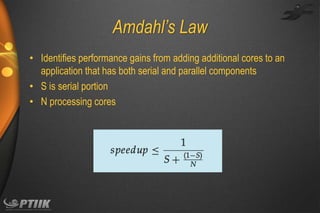
Amdahl’s Law
• Identifies performance gains from adding additional cores to an
application that has both serial and parallel components
• S is serial portion
• N processing cores
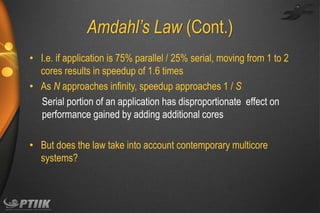
Amdahl’s Law (Cont.)
• I.e. if application is 75% parallel / 25% serial, moving from 1 to 2
cores results in speedup of 1.6 times
• As N approaches infinity, speedup approaches 1 / S
Serial portion of an application has disproportionate effect on
performance gained by adding additional cores
• But does the law take into account contemporary multicore
systems?
User Threads and Kernel Threads
• User threads - management done by user-level threads
library
• Three primary thread libraries:
– POSIX Pthreads
– Win32 threads
– Java threads
User Threads and Kernel Threads
• Kernel threads - Supported by the Kernel
• Examples – virtually all general purpose operating systems,
including:
–
–
–
–
–

Windows
Solaris
Linux
Tru64 UNIX
Mac OS X
Multithreading Models
• Many-to-One

• One-to-One
• Many-to-Many
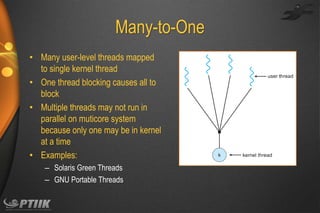
Many-to-One
• Many user-level threads mapped
to single kernel thread
• One thread blocking causes all to
block
• Multiple threads may not run in
parallel on muticore system
because only one may be in kernel
at a time
• Examples:
– Solaris Green Threads
– GNU Portable Threads
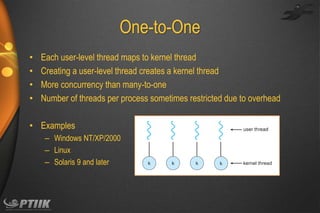
One-to-One
•
•
•
•

Each user-level thread maps to kernel thread
Creating a user-level thread creates a kernel thread
More concurrency than many-to-one
Number of threads per process sometimes restricted due to overhead

• Examples
– Windows NT/XP/2000
– Linux
– Solaris 9 and later
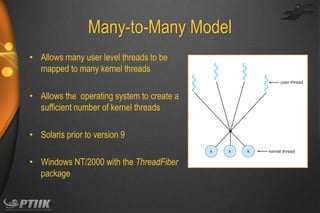
Many-to-Many Model
• Allows many user level threads to be
mapped to many kernel threads
• Allows the operating system to create a
sufficient number of kernel threads

• Solaris prior to version 9
• Windows NT/2000 with the ThreadFiber
package
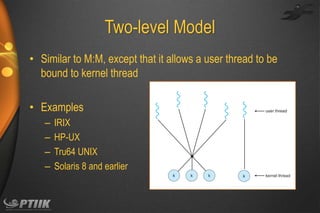
Two-level Model
• Similar to M:M, except that it allows a user thread to be
bound to kernel thread
• Examples
–
–
–
–

IRIX
HP-UX
Tru64 UNIX
Solaris 8 and earlier
Thread Libraries
• Thread library provides programmer with API for creating
and managing threads
• Two primary ways of implementing
– Library entirely in user space
– Kernel-level library supported by the OS
Pthreads
• May be provided either as user-level or kernel-level
• A POSIX standard (IEEE 1003.1c) API for thread creation and
synchronization
• Specification, not implementation
• API specifies behavior of the thread library, implementation is up to
development of the library
• Common in UNIX operating systems (Solaris, Linux, Mac OS X)
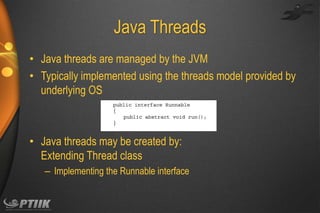
Java Threads
• Java threads are managed by the JVM
• Typically implemented using the threads model provided by
underlying OS

• Java threads may be created by:
Extending Thread class
– Implementing the Runnable interface
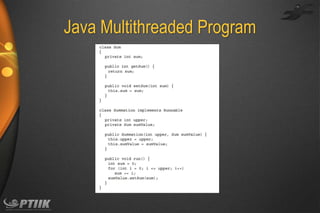
Java Multithreaded Program
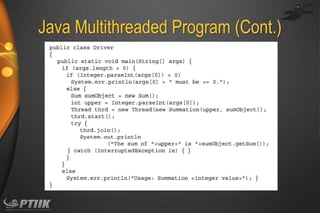
Java Multithreaded Program (Cont.)
Implicit Threading
• Growing in popularity as numbers of threads increase, program
correctness more difficult with explicit threads
• Creation and management of threads done by compilers and run-time
libraries rather than programmers
• Three methods explored
– Thread Pools
– OpenMP
– Grand Central Dispatch

• Other methods include Microsoft Threading Building Blocks (TBB),
java.util.concurrent package.
Threading Issues
• Semantics of fork() and exec() system calls
• Signal handling
– Synchronous and asynchronous

• Thread cancellation of target thread
– Asynchronous or deferred

• Thread-local storage
• Scheduler Activations
Semantics of fork() and exec()
• Does fork()duplicate only the calling thread or all
threads?
– Some UNIXes have two versions of fork

• Exec() usually works as normal – replace the running
process including all threads
Signal Handling
• Signals are used in UNIX systems to notify a process that a
particular event has occurred.
• A signal handler is used to process signals
1. Signal is generated by particular event
2. Signal is delivered to a process
3. Signal is handled by one of two signal handlers:
• default
• user-defined
Signal Handling (Cont.)
• Every signal has default handler that kernel runs when handling
signal
– User-defined signal handler can override default
– For single-threaded, signal delivered to process

• Where should a signal be delivered for multi-threaded?
–
–
–
–

Deliver the signal to the thread to which the signal applies
Deliver the signal to every thread in the process
Deliver the signal to certain threads in the process
Assign a specific thread to receive all signals for the process
Thread Cancellation
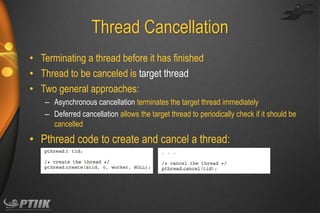
• Terminating a thread before it has finished
• Thread to be canceled is target thread
• Two general approaches:
– Asynchronous cancellation terminates the target thread immediately
– Deferred cancellation allows the target thread to periodically check if it should be
cancelled

• Pthread code to create and cancel a thread:
Thread Cancellation (Cont.)
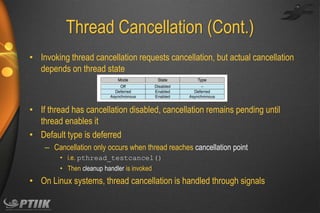
• Invoking thread cancellation requests cancellation, but actual cancellation
depends on thread state

• If thread has cancellation disabled, cancellation remains pending until
thread enables it
• Default type is deferred
– Cancellation only occurs when thread reaches cancellation point
• i.e. pthread_testcancel()

• Then cleanup handler is invoked

• On Linux systems, thread cancellation is handled through signals
Thread-Local Storage
• Thread-local storage (TLS) allows each thread to have its own copy of data
• Useful when you do not have control over the thread creation process (i.e.,
when using a thread pool)
• Different from local variables
– Local variables visible only during single function invocation
– TLS visible across function invocations

• Similar to static data
– TLS is unique to each thread
Scheduler Activations
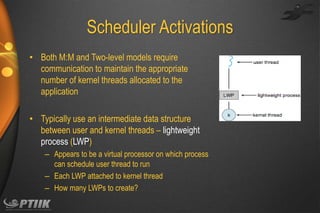
• Both M:M and Two-level models require
communication to maintain the appropriate
number of kernel threads allocated to the
application
• Typically use an intermediate data structure
between user and kernel threads – lightweight
process (LWP)
– Appears to be a virtual processor on which process
can schedule user thread to run
– Each LWP attached to kernel thread
– How many LWPs to create?
Scheduler Activations (Cont.)
• Scheduler activations provide upcalls, a communication mechanism from
the kernel to the upcall handler in the thread library
• This communication allows an application to maintain the correct number
kernel threads
Operating System Examples
• Windows XP Threads

• Linux Thread
Windows Threads
• Windows implements the Windows API – primary API for Win 98, Win NT,
Win 2000, Win XP, and Win 7
• Implements the one-to-one mapping, kernel-level
• Each thread contains
– A thread id
– Register set representing state of processor
– Separate user and kernel stacks for when thread runs in user mode or kernel
mode
– Private data storage area used by run-time libraries and dynamic link libraries
(DLLs)
Windows Threads (Cont.)
• The register set, stacks, and private storage area are known as the context
of the thread
• The primary data structures of a thread include:
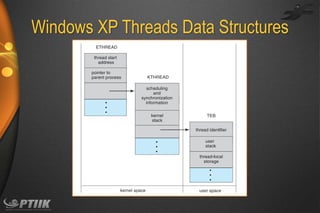
– ETHREAD (executive thread block) – includes pointer to process to which thread
belongs and to KTHREAD, in kernel space
– KTHREAD (kernel thread block) – scheduling and synchronization info, kernelmode stack, pointer to TEB, in kernel space
– TEB (thread environment block) – thread id, user-mode stack, thread-local
storage, in user space
Windows XP Threads Data Structures
Linux Threads
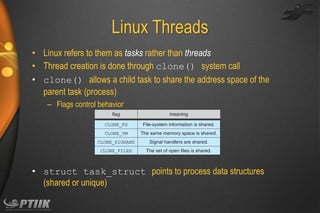
• Linux refers to them as tasks rather than threads
• Thread creation is done through clone() system call
• clone() allows a child task to share the address space of the
parent task (process)
– Flags control behavior

• struct task_struct points to process data structures
(shared or unique)
End of Chapter 4

Ch4 threads

  • 1.
  • 2.
    Chapter 4: Threads • • • • • • • Overview MulticoreProgramming Multithreading Models Thread Libraries Implicit Threading Threading Issues Operating System Examples
  • 3.
    Objectives • To introducethe notion of a thread—a fundamental unit of CPU utilization that forms the basis of multithreaded computer systems • To discuss the APIs for the Pthreads, Windows, and Java thread libraries • To explore several strategies that provide implicit threading • To examine issues related to multithreaded programming • To cover operating system support for threads in Windows and Linux
  • 4.
    Motivation • • • Most modern applicationsare multithreaded Threads run within application Multiple tasks with the application can be implemented by separate threads – – – – • • • Update display Fetch data Spell checking Answer a network request Process creation is heavy-weight while thread creation is light-weight Can simplify code, increase efficiency Kernels are generally multithreaded
  • 5.
  • 6.
    Benefits • Responsiveness –may allow continued execution if part of process is blocked, especially important for user interfaces • Resource Sharing – threads share resources of process, easier than shared memory or message passing • Economy – cheaper than process creation, thread switching lower overhead than context switching • Scalability – process can take advantage of multiprocessor architectures
  • 7.
    Multicore Programming • Multicore ormultiprocessor systems putting pressure on programmers, challenges include: – – – – – • • • Dividing activities Balance Data splitting Data dependency Testing and debugging Parallelism implies a system can perform more than one task simultaneously Concurrency supports more than one task making progress Single processor / core, scheduler providing concurrency
  • 8.
    Multicore Programming (Cont.) Typesof parallelism • • • • • Data parallelism – distributes subsets of the same data across multiple cores, same operation on each Task parallelism – distributing threads across cores, each thread performing unique operation As # of threads grows, so does architectural support for threading CPUs have cores as well as hardware threads Consider Oracle SPARC T4 with 8 cores, and 8 hardware threads per core
  • 9.
    Concurrency vs. Parallelism •Concurrent execution on single-core system: • Parallelism on a multi-core system:
  • 10.
  • 11.
    Amdahl’s Law • Identifiesperformance gains from adding additional cores to an application that has both serial and parallel components • S is serial portion • N processing cores
  • 12.
    Amdahl’s Law (Cont.) •I.e. if application is 75% parallel / 25% serial, moving from 1 to 2 cores results in speedup of 1.6 times • As N approaches infinity, speedup approaches 1 / S Serial portion of an application has disproportionate effect on performance gained by adding additional cores • But does the law take into account contemporary multicore systems?
  • 13.
    User Threads andKernel Threads • User threads - management done by user-level threads library • Three primary thread libraries: – POSIX Pthreads – Win32 threads – Java threads
  • 14.
    User Threads andKernel Threads • Kernel threads - Supported by the Kernel • Examples – virtually all general purpose operating systems, including: – – – – – Windows Solaris Linux Tru64 UNIX Mac OS X
  • 15.
    Multithreading Models • Many-to-One •One-to-One • Many-to-Many
  • 16.
    Many-to-One • Many user-levelthreads mapped to single kernel thread • One thread blocking causes all to block • Multiple threads may not run in parallel on muticore system because only one may be in kernel at a time • Examples: – Solaris Green Threads – GNU Portable Threads
  • 17.
    One-to-One • • • • Each user-level threadmaps to kernel thread Creating a user-level thread creates a kernel thread More concurrency than many-to-one Number of threads per process sometimes restricted due to overhead • Examples – Windows NT/XP/2000 – Linux – Solaris 9 and later
  • 18.
    Many-to-Many Model • Allowsmany user level threads to be mapped to many kernel threads • Allows the operating system to create a sufficient number of kernel threads • Solaris prior to version 9 • Windows NT/2000 with the ThreadFiber package
  • 19.
    Two-level Model • Similarto M:M, except that it allows a user thread to be bound to kernel thread • Examples – – – – IRIX HP-UX Tru64 UNIX Solaris 8 and earlier
  • 20.
    Thread Libraries • Threadlibrary provides programmer with API for creating and managing threads • Two primary ways of implementing – Library entirely in user space – Kernel-level library supported by the OS
  • 21.
    Pthreads • May beprovided either as user-level or kernel-level • A POSIX standard (IEEE 1003.1c) API for thread creation and synchronization • Specification, not implementation • API specifies behavior of the thread library, implementation is up to development of the library • Common in UNIX operating systems (Solaris, Linux, Mac OS X)
  • 22.
    Java Threads • Javathreads are managed by the JVM • Typically implemented using the threads model provided by underlying OS • Java threads may be created by: Extending Thread class – Implementing the Runnable interface
  • 23.
  • 24.
  • 25.
    Implicit Threading • Growingin popularity as numbers of threads increase, program correctness more difficult with explicit threads • Creation and management of threads done by compilers and run-time libraries rather than programmers • Three methods explored – Thread Pools – OpenMP – Grand Central Dispatch • Other methods include Microsoft Threading Building Blocks (TBB), java.util.concurrent package.
  • 26.
    Threading Issues • Semanticsof fork() and exec() system calls • Signal handling – Synchronous and asynchronous • Thread cancellation of target thread – Asynchronous or deferred • Thread-local storage • Scheduler Activations
  • 27.
    Semantics of fork()and exec() • Does fork()duplicate only the calling thread or all threads? – Some UNIXes have two versions of fork • Exec() usually works as normal – replace the running process including all threads
  • 28.
    Signal Handling • Signalsare used in UNIX systems to notify a process that a particular event has occurred. • A signal handler is used to process signals 1. Signal is generated by particular event 2. Signal is delivered to a process 3. Signal is handled by one of two signal handlers: • default • user-defined
  • 29.
    Signal Handling (Cont.) •Every signal has default handler that kernel runs when handling signal – User-defined signal handler can override default – For single-threaded, signal delivered to process • Where should a signal be delivered for multi-threaded? – – – – Deliver the signal to the thread to which the signal applies Deliver the signal to every thread in the process Deliver the signal to certain threads in the process Assign a specific thread to receive all signals for the process
  • 30.
    Thread Cancellation • Terminatinga thread before it has finished • Thread to be canceled is target thread • Two general approaches: – Asynchronous cancellation terminates the target thread immediately – Deferred cancellation allows the target thread to periodically check if it should be cancelled • Pthread code to create and cancel a thread:
  • 31.
    Thread Cancellation (Cont.) •Invoking thread cancellation requests cancellation, but actual cancellation depends on thread state • If thread has cancellation disabled, cancellation remains pending until thread enables it • Default type is deferred – Cancellation only occurs when thread reaches cancellation point • i.e. pthread_testcancel() • Then cleanup handler is invoked • On Linux systems, thread cancellation is handled through signals
  • 32.
    Thread-Local Storage • Thread-localstorage (TLS) allows each thread to have its own copy of data • Useful when you do not have control over the thread creation process (i.e., when using a thread pool) • Different from local variables – Local variables visible only during single function invocation – TLS visible across function invocations • Similar to static data – TLS is unique to each thread
  • 33.
    Scheduler Activations • BothM:M and Two-level models require communication to maintain the appropriate number of kernel threads allocated to the application • Typically use an intermediate data structure between user and kernel threads – lightweight process (LWP) – Appears to be a virtual processor on which process can schedule user thread to run – Each LWP attached to kernel thread – How many LWPs to create?
  • 34.
    Scheduler Activations (Cont.) •Scheduler activations provide upcalls, a communication mechanism from the kernel to the upcall handler in the thread library • This communication allows an application to maintain the correct number kernel threads
  • 35.
    Operating System Examples •Windows XP Threads • Linux Thread
  • 36.
    Windows Threads • Windowsimplements the Windows API – primary API for Win 98, Win NT, Win 2000, Win XP, and Win 7 • Implements the one-to-one mapping, kernel-level • Each thread contains – A thread id – Register set representing state of processor – Separate user and kernel stacks for when thread runs in user mode or kernel mode – Private data storage area used by run-time libraries and dynamic link libraries (DLLs)
  • 37.
    Windows Threads (Cont.) •The register set, stacks, and private storage area are known as the context of the thread • The primary data structures of a thread include: – ETHREAD (executive thread block) – includes pointer to process to which thread belongs and to KTHREAD, in kernel space – KTHREAD (kernel thread block) – scheduling and synchronization info, kernelmode stack, pointer to TEB, in kernel space – TEB (thread environment block) – thread id, user-mode stack, thread-local storage, in user space
  • 38.
    Windows XP ThreadsData Structures
  • 39.
    Linux Threads • Linuxrefers to them as tasks rather than threads • Thread creation is done through clone() system call • clone() allows a child task to share the address space of the parent task (process) – Flags control behavior • struct task_struct points to process data structures (shared or unique)
  • 40.