Operating System 22
Threading Issues
Prof Neeraj Bhargava
Vaibhav Khanna
Department of Computer Science
School of Engineering and Systems Sciences
Maharshi Dayanand Saraswati University Ajmer
Threading Issues
• Semantics of fork() and exec() system
calls
• Signal handling
– Synchronous and asynchronous
• Thread cancellation of target thread
– Asynchronous or deferred
• Thread-local storage
• Scheduler Activations
Semantics of fork() and exec()
• Does fork()duplicate only the
calling thread or all threads?
– Some UNIXes have two versions of fork
• exec() usually works as normal –
replace the running process
including all threads
Signal Handling
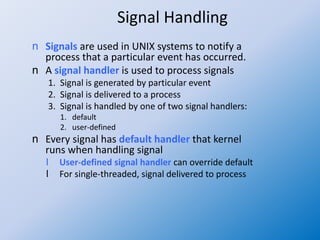
n Signals are used in UNIX systems to notify a
process that a particular event has occurred.
n A signal handler is used to process signals
1. Signal is generated by particular event
2. Signal is delivered to a process
3. Signal is handled by one of two signal handlers:
1. default
2. user-defined
n Every signal has default handler that kernel
runs when handling signal
l User-defined signal handler can override default
l For single-threaded, signal delivered to process
Signal Handling (Cont.)
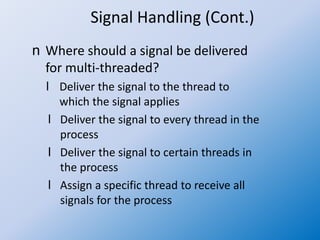
n Where should a signal be delivered
for multi-threaded?
l Deliver the signal to the thread to
which the signal applies
l Deliver the signal to every thread in the
process
l Deliver the signal to certain threads in
the process
l Assign a specific thread to receive all
signals for the process
Thread Cancellation
• Terminating a thread before it has finished
• Thread to be canceled is target thread
• Two general approaches:
– Asynchronous cancellation terminates the
target thread immediately
– Deferred cancellation allows the target thread
to periodically check if it should be cancelled
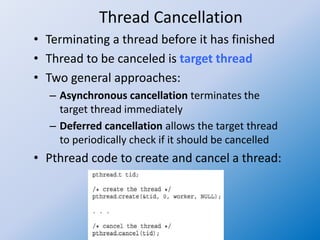
• Pthread code to create and cancel a thread:
Thread Cancellation (Cont.)
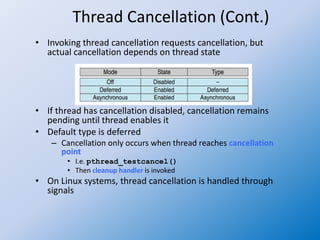
• Invoking thread cancellation requests cancellation, but
actual cancellation depends on thread state
• If thread has cancellation disabled, cancellation remains
pending until thread enables it
• Default type is deferred
– Cancellation only occurs when thread reaches cancellation
point
• I.e. pthread_testcancel()
• Then cleanup handler is invoked
• On Linux systems, thread cancellation is handled through
signals
Thread-Local Storage
• Thread-local storage (TLS) allows each
thread to have its own copy of data
• Useful when you do not have control
over the thread creation process (i.e.,
when using a thread pool)
• Different from local variables
– Local variables visible only during single
function invocation
– TLS visible across function invocations
• Similar to static data
– TLS is unique to each thread
Scheduler Activations
• Both M:M and Two-level models require
communication to maintain the appropriate
number of kernel threads allocated to the
application
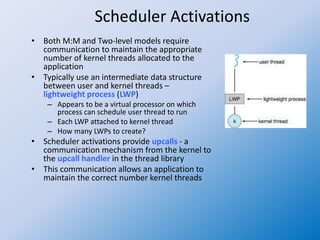
• Typically use an intermediate data structure
between user and kernel threads –
lightweight process (LWP)
– Appears to be a virtual processor on which
process can schedule user thread to run
– Each LWP attached to kernel thread
– How many LWPs to create?
• Scheduler activations provide upcalls - a
communication mechanism from the kernel to
the upcall handler in the thread library
• This communication allows an application to
maintain the correct number kernel threads
Operating System Examples
• Windows Threads
• Linux Threads
Windows Threads
• Windows implements the Windows API –
primary API for Win 98, Win NT, Win 2000,
Win XP, and Win 7
• Implements the one-to-one mapping, kernel-
level
• Each thread contains
– A thread id
– Register set representing state of processor
– Separate user and kernel stacks for when thread
runs in user mode or kernel mode
– Private data storage area used by run-time
libraries and dynamic link libraries (DLLs)
• The register set, stacks, and private storage
area are known as the context of the thread
Windows Threads (Cont.)
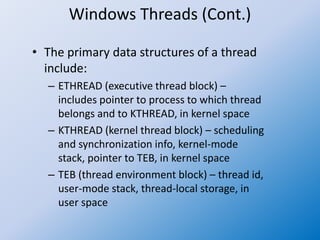
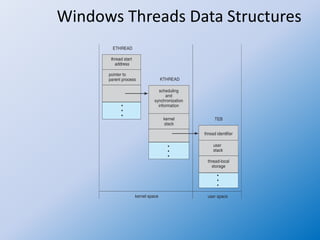
• The primary data structures of a thread
include:
– ETHREAD (executive thread block) –
includes pointer to process to which thread
belongs and to KTHREAD, in kernel space
– KTHREAD (kernel thread block) – scheduling
and synchronization info, kernel-mode
stack, pointer to TEB, in kernel space
– TEB (thread environment block) – thread id,
user-mode stack, thread-local storage, in
user space
Windows Threads Data Structures
Linux Threads
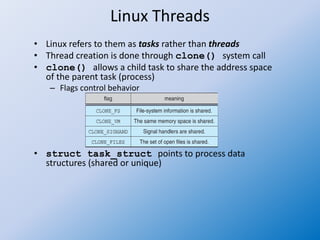
• Linux refers to them as tasks rather than threads
• Thread creation is done through clone() system call
• clone() allows a child task to share the address space
of the parent task (process)
– Flags control behavior
• struct task_struct points to process data
structures (shared or unique)
Assignment
• Explain any two issues related to thread
management.

Operating system 22 threading issues

  • 1.
    Operating System 22 ThreadingIssues Prof Neeraj Bhargava Vaibhav Khanna Department of Computer Science School of Engineering and Systems Sciences Maharshi Dayanand Saraswati University Ajmer
  • 2.
    Threading Issues • Semanticsof fork() and exec() system calls • Signal handling – Synchronous and asynchronous • Thread cancellation of target thread – Asynchronous or deferred • Thread-local storage • Scheduler Activations
  • 3.
    Semantics of fork()and exec() • Does fork()duplicate only the calling thread or all threads? – Some UNIXes have two versions of fork • exec() usually works as normal – replace the running process including all threads
  • 4.
    Signal Handling n Signalsare used in UNIX systems to notify a process that a particular event has occurred. n A signal handler is used to process signals 1. Signal is generated by particular event 2. Signal is delivered to a process 3. Signal is handled by one of two signal handlers: 1. default 2. user-defined n Every signal has default handler that kernel runs when handling signal l User-defined signal handler can override default l For single-threaded, signal delivered to process
  • 5.
    Signal Handling (Cont.) nWhere should a signal be delivered for multi-threaded? l Deliver the signal to the thread to which the signal applies l Deliver the signal to every thread in the process l Deliver the signal to certain threads in the process l Assign a specific thread to receive all signals for the process
  • 6.
    Thread Cancellation • Terminatinga thread before it has finished • Thread to be canceled is target thread • Two general approaches: – Asynchronous cancellation terminates the target thread immediately – Deferred cancellation allows the target thread to periodically check if it should be cancelled • Pthread code to create and cancel a thread:
  • 7.
    Thread Cancellation (Cont.) •Invoking thread cancellation requests cancellation, but actual cancellation depends on thread state • If thread has cancellation disabled, cancellation remains pending until thread enables it • Default type is deferred – Cancellation only occurs when thread reaches cancellation point • I.e. pthread_testcancel() • Then cleanup handler is invoked • On Linux systems, thread cancellation is handled through signals
  • 8.
    Thread-Local Storage • Thread-localstorage (TLS) allows each thread to have its own copy of data • Useful when you do not have control over the thread creation process (i.e., when using a thread pool) • Different from local variables – Local variables visible only during single function invocation – TLS visible across function invocations • Similar to static data – TLS is unique to each thread
  • 9.
    Scheduler Activations • BothM:M and Two-level models require communication to maintain the appropriate number of kernel threads allocated to the application • Typically use an intermediate data structure between user and kernel threads – lightweight process (LWP) – Appears to be a virtual processor on which process can schedule user thread to run – Each LWP attached to kernel thread – How many LWPs to create? • Scheduler activations provide upcalls - a communication mechanism from the kernel to the upcall handler in the thread library • This communication allows an application to maintain the correct number kernel threads
  • 10.
    Operating System Examples •Windows Threads • Linux Threads
  • 11.
    Windows Threads • Windowsimplements the Windows API – primary API for Win 98, Win NT, Win 2000, Win XP, and Win 7 • Implements the one-to-one mapping, kernel- level • Each thread contains – A thread id – Register set representing state of processor – Separate user and kernel stacks for when thread runs in user mode or kernel mode – Private data storage area used by run-time libraries and dynamic link libraries (DLLs) • The register set, stacks, and private storage area are known as the context of the thread
  • 12.
    Windows Threads (Cont.) •The primary data structures of a thread include: – ETHREAD (executive thread block) – includes pointer to process to which thread belongs and to KTHREAD, in kernel space – KTHREAD (kernel thread block) – scheduling and synchronization info, kernel-mode stack, pointer to TEB, in kernel space – TEB (thread environment block) – thread id, user-mode stack, thread-local storage, in user space
  • 13.
  • 14.
    Linux Threads • Linuxrefers to them as tasks rather than threads • Thread creation is done through clone() system call • clone() allows a child task to share the address space of the parent task (process) – Flags control behavior • struct task_struct points to process data structures (shared or unique)
  • 15.
    Assignment • Explain anytwo issues related to thread management.