Chapter 8: Object-Oriented
Databases
Need for Complex Data Types
The Object-Oriented Data Model
Object-Oriented Languages
Persistent Programming Languages
Persistent C++ Systems

Database System Concepts

8.1

©Silberschatz, Korth and Sudarshan
Need for Complex Data Types
Traditional database applications in data processing had
conceptually simple data types
 Relatively few data types, first normal form holds

Complex data types have grown more important in recent years
 E.g. Addresses can be viewed as a
 Single string, or
 Separate attributes for each part, or
 Composite attributes (which are not in first normal form)
 E.g. it is often convenient to store multivalued attributes as-is,
without creating a separate relation to store the values in first
normal form

Applications
 computer-aided design, computer-aided software engineering
 multimedia and image databases, and document/hypertext
databases.

Database System Concepts

8.2

©Silberschatz, Korth and Sudarshan
Object-Oriented Data Model
Loosely speaking, an object corresponds to an entity in the
E-R model.
The object-oriented paradigm is based on encapsulating code
and data related to an object into single unit.
The object-oriented data model is a logical data model (like
the E-R model).
Adaptation of the object-oriented programming paradigm (e.g.,
Smalltalk, C++) to database systems.

Database System Concepts

8.3

©Silberschatz, Korth and Sudarshan
Object Structure
An object has associated with it:
 A set of variables that contain the data for the object. The value of
each variable is itself an object.
 A set of messages to which the object responds; each message
may have zero, one, or more parameters.
 A set of methods, each of which is a body of code to implement a
message; a method returns a value as the response to the message

The physical representation of data is visible only to the
implementor of the object
Messages and responses provide the only external interface to an
object.
The term message does not necessarily imply physical message
passing. Messages can be implemented as procedure
invocations.

Database System Concepts

8.4

©Silberschatz, Korth and Sudarshan
Messages and Methods
Methods are programs written in general-purpose language
with the following features
 only variables in the object itself may be referenced directly
 data in other objects are referenced only by sending messages.

Methods can be read-only or update methods
 Read-only methods do not change the value of the object

Strictly speaking, every attribute of an entity must be
represented by a variable and two methods, one to read and
the other to update the attribute
 e.g., the attribute address is represented by a variable address
and two messages get-address and set-address.
 For convenience, many object-oriented data models permit direct
access to variables of other objects.

Database System Concepts

8.5

©Silberschatz, Korth and Sudarshan
Object Classes
Similar objects are grouped into a class; each such object is
called an instance of its class
All objects in a class have the same
 Variables, with the same types
 message interface
 methods
The may differ in the values assigned to variables

Example: Group objects for people into a person class
Classes are analogous to entity sets in the E-R model

Database System Concepts

8.6

©Silberschatz, Korth and Sudarshan
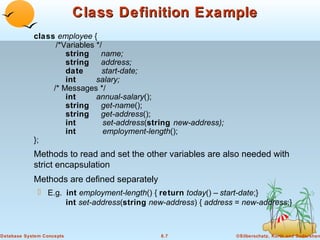
Class Definition Example
class employee {
/*Variables */
string name;
string address;
date
start-date;
int
salary;
/* Messages */
int
annual-salary();
string get-name();
string get-address();
int
set-address(string new-address);
int
employment-length();
};

Methods to read and set the other variables are also needed with
strict encapsulation
Methods are defined separately
 E.g. int employment-length() { return today() – start-date;}
int set-address(string new-address) { address = new-address;}

Database System Concepts

8.7

©Silberschatz, Korth and Sudarshan
Inheritance
E.g., class of bank customers is similar to class of bank
employees, although there are differences
 both share some variables and messages, e.g., name and address.
 But there are variables and messages specific to each class e.g.,
salary for employees and credit-rating for customers.

Every employee is a person; thus employee is a specialization of
person
Similarly, customer is a specialization of person.
Create classes person, employee and customer
 variables/messages applicable to all persons associated with class
person.
 variables/messages specific to employees associated with class
employee; similarly for customer

Database System Concepts

8.8

©Silberschatz, Korth and Sudarshan
Inheritance (Cont.)
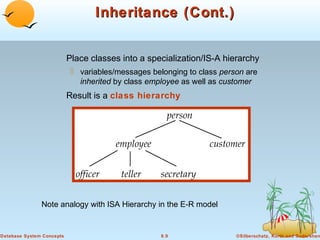
Place classes into a specialization/IS-A hierarchy
 variables/messages belonging to class person are
inherited by class employee as well as customer

Result is a class hierarchy

Note analogy with ISA Hierarchy in the E-R model

Database System Concepts

8.9

©Silberschatz, Korth and Sudarshan
Class Hierarchy Definition
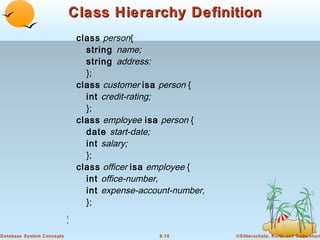
class person{
string name;
string address:
};
class customer isa person {
int credit-rating;
};
class employee isa person {
date start-date;
int salary;
};
class officer isa employee {
int office-number,
int expense-account-number,
};
.
.
.
Database System Concepts

8.10

©Silberschatz, Korth and Sudarshan
Class Hierarchy Example (Cont.)
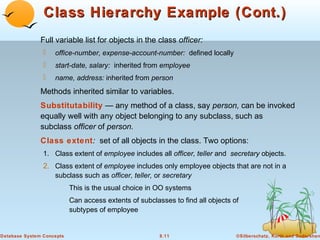
Full variable list for objects in the class officer:


office-number, expense-account-number: defined locally



start-date, salary: inherited from employee



name, address: inherited from person

Methods inherited similar to variables.
Substitutability — any method of a class, say person, can be invoked
equally well with any object belonging to any subclass, such as
subclass officer of person.
Class extent: set of all objects in the class. Two options:
1. Class extent of employee includes all officer, teller and secretary objects.

2. Class extent of employee includes only employee objects that are not in a
subclass such as officer, teller, or secretary
This is the usual choice in OO systems
Can access extents of subclasses to find all objects of
subtypes of employee

Database System Concepts

8.11

©Silberschatz, Korth and Sudarshan
Example of Multiple Inheritance

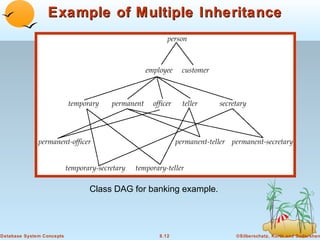
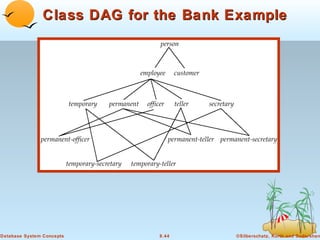
Class DAG for banking example.

Database System Concepts

8.12

©Silberschatz, Korth and Sudarshan
Multiple Inheritance
With multiple inheritance a class may have more than one superclass.
 The class/subclass relationship is represented by a directed acyclic
graph (DAG)
 Particularly useful when objects can be classified in more than one way,
which are independent of each other
 E.g. temporary/permanent is independent of Officer/secretary/teller
 Create a subclass for each combination of subclasses
– Need not create subclasses for combinations that are not possible in
the database being modeled

A class inherits variables and methods from all its superclasses
There is potential for ambiguity when a variable/message N with the
same name is inherited from two superclasses A and B
 No problem if the variable/message is defined in a shared superclass
 Otherwise, do one of the following
 flag as an error,
 rename variables (A.N and B.N)
 choose one.

Database System Concepts

8.13

©Silberschatz, Korth and Sudarshan
More Examples of Multiple
Inheritance
Conceptually, an object can belong to each of several
subclasses
 A person can play the roles of student, a teacher or footballPlayer,
or any combination of the three
 E.g., student teaching assistant who also play football

Can use multiple inheritance to model “roles” of an object
 That is, allow an object to take on any one or more of a set of types

But many systems insist an object should have a mostspecific class
 That is, there must be one class that an object belongs to which is
a subclass of all other classes that the object belongs to
 Create subclasses such as student-teacher and
student-teacher-footballPlayer for each combination
 When many combinations are possible, creating
subclasses for each combination can become cumbersome
Database System Concepts

8.14

©Silberschatz, Korth and Sudarshan
Object Identity
An object retains its identity even if some or all of the values
of variables or definitions of methods change over time.
Object identity is a stronger notion of identity than in
programming languages or data models not based on object
orientation.
 Value – data value; e.g. primary key value used in relational
systems.
 Name – supplied by user; used for variables in procedures.
 Built-in – identity built into data model or programming
language.
 no user-supplied identifier is required.
 Is the form of identity used in object-oriented systems.

Database System Concepts

8.15

©Silberschatz, Korth and Sudarshan
Object Identifiers
Object identifiers used to uniquely identify objects
 Object identifiers are unique:
 no two objects have the same identifier
 each object has only one object identifier

 E.g., the spouse field of a person object may be an identifier of
another person object.
 can be stored as a field of an object, to refer to another object.
 Can be
 system generated (created by database) or
 external (such as social-security number)

 System generated identifiers:
 Are easier to use, but cannot be used across database systems
 May be redundant if unique identifier already exists

Database System Concepts

8.16

©Silberschatz, Korth and Sudarshan
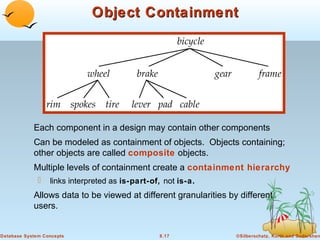
Object Containment

Each component in a design may contain other components
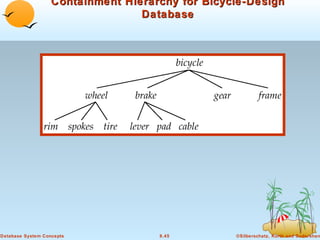
Can be modeled as containment of objects. Objects containing;
other objects are called composite objects.
Multiple levels of containment create a containment hierarchy


links interpreted as is-part-of, not is-a.

Allows data to be viewed at different granularities by different
users.

Database System Concepts

8.17

©Silberschatz, Korth and Sudarshan
Object-Oriented Languages
Object-oriented concepts can be used in different ways


Object-orientation can be used as a design tool, and be
encoded into, for example, a relational database
analogous to modeling data with E-R diagram and then
converting to a set of relations)



The concepts of object orientation can be incorporated into a
programming language that is used to manipulate the
database.
 Object-relational systems – add complex types and

object-orientation to relational language.
 Persistent programming languages – extend object-

oriented programming language to deal with databases
by adding concepts such as persistence and collections.

Database System Concepts

8.18

©Silberschatz, Korth and Sudarshan
Persistent Programming Languages
Persistent Programming languages allow objects to be created
and stored in a database, and used directly from a programming
language
 allow data to be manipulated directly from the programming language
 No need to go through SQL.
 No need for explicit format (type) changes
 format changes are carried out transparently by system
 Without a persistent programming language, format changes
becomes a burden on the programmer
– More code to be written
– More chance of bugs
 allow objects to be manipulated in-memory
 no need to explicitly load from or store to the database
– Saved code, and saved overhead of loading/storing large
amounts of data

Database System Concepts

8.19

©Silberschatz, Korth and Sudarshan
Persistent Prog. Languages (Cont.)
Drawbacks of persistent programming languages
 Due to power of most programming languages, it is easy to make
programming errors that damage the database.
 Complexity of languages makes automatic high-level optimization
more difficult.
 Do not support declarative querying as well as relational databases

Database System Concepts

8.20

©Silberschatz, Korth and Sudarshan
Persistence of Objects
Approaches to make transient objects persistent include
establishing
 Persistence by Class – declare all objects of a class to be
persistent; simple but inflexible.
 Persistence by Creation – extend the syntax for creating objects to
specify that that an object is persistent.
 Persistence by Marking – an object that is to persist beyond
program execution is marked as persistent before program
termination.
 Persistence by Reachability - declare (root) persistent objects;
objects are persistent if they are referred to (directly or indirectly)
from a root object.
 Easier for programmer, but more overhead for database system
 Similar to garbage collection used e.g. in Java, which

also performs reachability tests

Database System Concepts

8.21

©Silberschatz, Korth and Sudarshan
Object Identity and Pointers
A persistent object is assigned a persistent object identifier.
Degrees of permanence of identity:
 Intraprocedure – identity persists only during the executions of a
single procedure
 Intraprogram – identity persists only during execution of a single
program or query.
 Interprogram – identity persists from one program execution to
another, but may change if the storage organization is changed
 Persistent – identity persists throughout program executions and
structural reorganizations of data; required for object-oriented
systems.

Database System Concepts

8.22

©Silberschatz, Korth and Sudarshan
Object Identity and Pointers (Cont.)
In O-O languages such as C++, an object identifier is
actually an in-memory pointer.
Persistent pointer – persists beyond program execution
 can be thought of as a pointer into the database
 E.g. specify file identifier and offset into the file

 Problems due to database reorganization have to be dealt
with by keeping forwarding pointers

Database System Concepts

8.23

©Silberschatz, Korth and Sudarshan
Storage and Access of Persistent
Objects
How to find objects in the database:
Name objects (as you would name files)
 Cannot scale to large number of objects.
 Typically given only to class extents and other collections of
objects, but not objects.

Expose object identifiers or persistent pointers to the objects
 Can be stored externally.
 All objects have object identifiers.

Store collections of objects, and allow programs to iterate
over the collections to find required objects
 Model collections of objects as collection types
 Class extent - the collection of all objects belonging to the
class; usually maintained for all classes that can have persistent
objects.

Database System Concepts

8.24

©Silberschatz, Korth and Sudarshan
Persistent C++ Systems
C++ language allows support for persistence to be added without
changing the language
 Declare a class called Persistent_Object with attributes and methods
to support persistence
 Overloading – ability to redefine standard function names and
operators (i.e., +, –, the pointer deference operator –>) when applied
to new types
 Template classes help to build a type-safe type system supporting
collections and persistent types.

Providing persistence without extending the C++ language is
 relatively easy to implement
 but more difficult to use

Persistent C++ systems that add features to the C++ language
have been built, as also systems that avoid changing the
language

Database System Concepts

8.25

©Silberschatz, Korth and Sudarshan
ODMG C++ Object Definition
Language
The Object Database Management Group is an industry
consortium aimed at standardizing object-oriented databases


in particular persistent programming languages

 Includes standards for C++, Smalltalk and Java
 ODMG-93
 ODMG-2.0 and 3.0 (which is 2.0 plus extensions to Java)
 Our description based on ODMG-2.0

ODMG C++ standard avoids changes to the C++ language


provides functionality via template classes and class libraries

Database System Concepts

8.26

©Silberschatz, Korth and Sudarshan
ODMG Types
Template class d_Ref<class> used to specify references
(persistent pointers)
Template class d_Set<class> used to define sets of objects.
 Methods include insert_element(e) and delete_element(e)

Other collection classes such as d_Bag (set with duplicates
allowed), d_List and d_Varray (variable length array) also
provided.
d_ version of many standard types provided, e.g. d_Long and
d_string
 Interpretation of these types is platform independent
 Dynamically allocated data (e.g. for d_string) allocated in the
database, not in main memory

Database System Concepts

8.27

©Silberschatz, Korth and Sudarshan
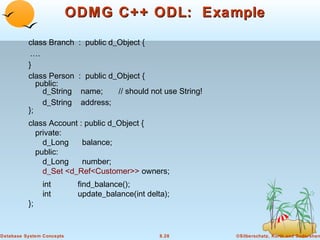
ODMG C++ ODL: Example
class Branch
….
}
class Person
public:
d_String
d_String
};

: public d_Object {

: public d_Object {
name;
// should not use String!
address;

class Account : public d_Object {
private:
d_Long
balance;
public:
d_Long
number;
d_Set <d_Ref<Customer>> owners;

};

int
int

Database System Concepts

find_balance();
update_balance(int delta);

8.28

©Silberschatz, Korth and Sudarshan
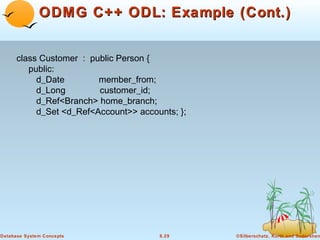
ODMG C++ ODL: Example (Cont.)
class Customer : public Person {
public:
d_Date
member_from;
d_Long
customer_id;
d_Ref<Branch> home_branch;
d_Set <d_Ref<Account>> accounts; };

Database System Concepts

8.29

©Silberschatz, Korth and Sudarshan
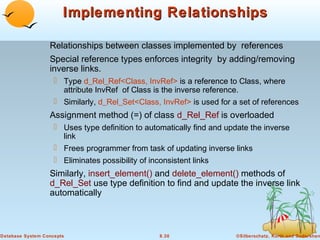
Implementing Relationships
Relationships between classes implemented by references
Special reference types enforces integrity by adding/removing
inverse links.
 Type d_Rel_Ref<Class, InvRef> is a reference to Class, where
attribute InvRef of Class is the inverse reference.
 Similarly, d_Rel_Set<Class, InvRef> is used for a set of references

Assignment method (=) of class d_Rel_Ref is overloaded
 Uses type definition to automatically find and update the inverse
link
 Frees programmer from task of updating inverse links
 Eliminates possibility of inconsistent links

Similarly, insert_element() and delete_element() methods of
d_Rel_Set use type definition to find and update the inverse link
automatically

Database System Concepts

8.30

©Silberschatz, Korth and Sudarshan
Implementing Relationships
E.g.
extern const char _owners[ ], _accounts[ ];
class Account : public d.Object {
….
d_Rel_Set <Customer, _accounts> owners;
}
// .. Since strings can’t be used in templates …
const char _owners= “owners”;
const char _accounts= “accounts”;

Database System Concepts

8.31

©Silberschatz, Korth and Sudarshan
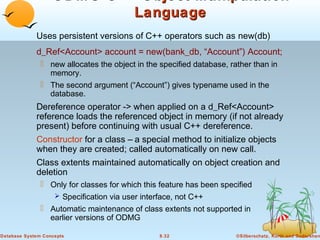
ODMG C++ Object Manipulation
Language
Uses persistent versions of C++ operators such as new(db)
d_Ref<Account> account = new(bank_db, “Account”) Account;
 new allocates the object in the specified database, rather than in
memory.
 The second argument (“Account”) gives typename used in the
database.

Dereference operator -> when applied on a d_Ref<Account>
reference loads the referenced object in memory (if not already
present) before continuing with usual C++ dereference.
Constructor for a class – a special method to initialize objects
when they are created; called automatically on new call.
Class extents maintained automatically on object creation and
deletion
 Only for classes for which this feature has been specified
 Specification via user interface, not C++
 Automatic maintenance of class extents not supported in
earlier versions of ODMG
Database System Concepts

8.32

©Silberschatz, Korth and Sudarshan
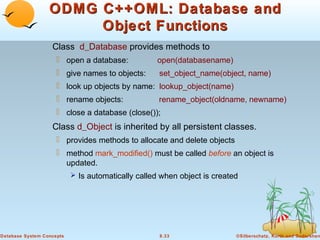
ODMG C++OML: Database and
Object Functions
Class d_Database provides methods to
 open a database:
 give names to objects:

open(databasename)
set_object_name(object, name)

 look up objects by name: lookup_object(name)
 rename objects:
rename_object(oldname, newname)
 close a database (close());

Class d_Object is inherited by all persistent classes.
 provides methods to allocate and delete objects
 method mark_modified() must be called before an object is
updated.
 Is automatically called when object is created

Database System Concepts

8.33

©Silberschatz, Korth and Sudarshan
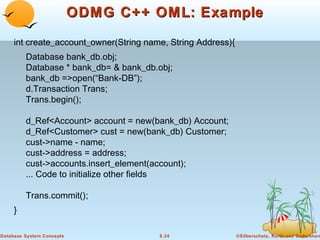
ODMG C++ OML: Example
int create_account_owner(String name, String Address){
Database bank_db.obj;
Database * bank_db= & bank_db.obj;
bank_db =>open(“Bank-DB”);
d.Transaction Trans;
Trans.begin();
d_Ref<Account> account = new(bank_db) Account;
d_Ref<Customer> cust = new(bank_db) Customer;
cust->name - name;
cust->address = address;
cust->accounts.insert_element(account);
... Code to initialize other fields
Trans.commit();
}
Database System Concepts

8.34

©Silberschatz, Korth and Sudarshan
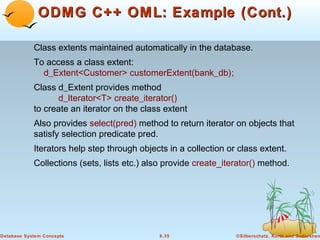
ODMG C++ OML: Example (Cont.)
Class extents maintained automatically in the database.
To access a class extent:
d_Extent<Customer> customerExtent(bank_db);
Class d_Extent provides method
d_Iterator<T> create_iterator()
to create an iterator on the class extent
Also provides select(pred) method to return iterator on objects that
satisfy selection predicate pred.
Iterators help step through objects in a collection or class extent.
Collections (sets, lists etc.) also provide create_iterator() method.

Database System Concepts

8.35

©Silberschatz, Korth and Sudarshan
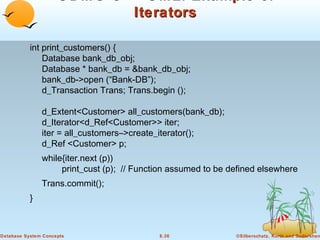
ODMG C++ OML: Example of
Iterators
int print_customers() {
Database bank_db_obj;
Database * bank_db = &bank_db_obj;
bank_db->open (“Bank-DB”);
d_Transaction Trans; Trans.begin ();
d_Extent<Customer> all_customers(bank_db);
d_Iterator<d_Ref<Customer>> iter;
iter = all_customers–>create_iterator();
d_Ref <Customer> p;
while{iter.next (p))
print_cust (p); // Function assumed to be defined elsewhere
Trans.commit();
}

Database System Concepts

8.36

©Silberschatz, Korth and Sudarshan
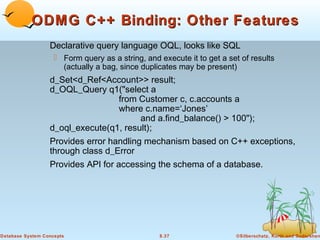
ODMG C++ Binding: Other Features
Declarative query language OQL, looks like SQL
 Form query as a string, and execute it to get a set of results
(actually a bag, since duplicates may be present)

d_Set<d_Ref<Account>> result;
d_OQL_Query q1("select a
from Customer c, c.accounts a
where c.name=‘Jones’
and a.find_balance() > 100");
d_oql_execute(q1, result);
Provides error handling mechanism based on C++ exceptions,
through class d_Error
Provides API for accessing the schema of a database.

Database System Concepts

8.37

©Silberschatz, Korth and Sudarshan
Making Pointer Persistence
Transparent
Drawback of the ODMG C++ approach:
 Two types of pointers
 Programmer has to ensure mark_modified() is called, else database
can become corrupted

ObjectStore approach
 Uses exactly the same pointer type for in-memory and database
objects
 Persistence is transparent applications
 Except when creating objects
 Same functions can be used on in-memory and persistent objects
since pointer types are the same
 Implemented by a technique called pointer-swizzling which is
described in Chapter 11.
 No need to call mark_modified(), modification detected
automatically.

Database System Concepts

8.38

©Silberschatz, Korth and Sudarshan
Persistent Java Systems
ODMG-3.0 defines extensions to Java for persistence
 Java does not support templates, so language extensions are
required

Model for persistence: persistence by reachability
 Matches Java’s garbage collection model
 Garbage collection needed on the database also
 Only one pointer type for transient and persistent pointers

Class is made persistence capable by running a postprocessor on object code generated by the Java compiler
 Contrast with pre-processor used in C++
 Post-processor adds mark_modified() automatically

Defines collection types DSet, DBag, DList, etc.
Uses Java iterators, no need for new iterator class

Database System Concepts

8.39

©Silberschatz, Korth and Sudarshan
ODMG Java
Transaction must start accessing database from one of the root
object (looked up by name)
 finds other objects by following pointers from the root objects

Objects referred to from a fetched object are allocated space in
memory, but not necessarily fetched
 Fetching can be done lazily
 An object with space allocated but not yet fetched is called a hollow
object
 When a hollow object is accessed, its data is fetched from disk.

Database System Concepts

8.40

©Silberschatz, Korth and Sudarshan
End of Chapter
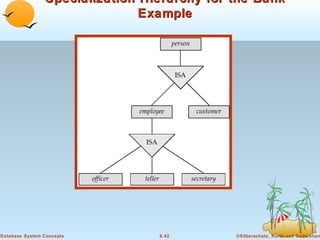
Specialization Hierarchy for the Bank
Example

Database System Concepts

8.42

©Silberschatz, Korth and Sudarshan
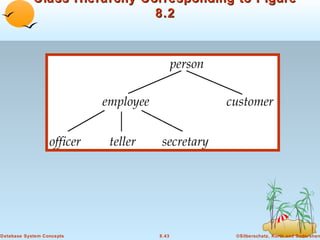
Class Hierarchy Corresponding to Figure
8.2

Database System Concepts

8.43

©Silberschatz, Korth and Sudarshan
Class DAG for the Bank Example

Database System Concepts

8.44

©Silberschatz, Korth and Sudarshan
Containment Hierarchy for Bicycle-Design
Database

Database System Concepts

8.45

©Silberschatz, Korth and Sudarshan

Ch8

  • 1.
    Chapter 8: Object-Oriented Databases Needfor Complex Data Types The Object-Oriented Data Model Object-Oriented Languages Persistent Programming Languages Persistent C++ Systems Database System Concepts 8.1 ©Silberschatz, Korth and Sudarshan
  • 2.
    Need for ComplexData Types Traditional database applications in data processing had conceptually simple data types  Relatively few data types, first normal form holds Complex data types have grown more important in recent years  E.g. Addresses can be viewed as a  Single string, or  Separate attributes for each part, or  Composite attributes (which are not in first normal form)  E.g. it is often convenient to store multivalued attributes as-is, without creating a separate relation to store the values in first normal form Applications  computer-aided design, computer-aided software engineering  multimedia and image databases, and document/hypertext databases. Database System Concepts 8.2 ©Silberschatz, Korth and Sudarshan
  • 3.
    Object-Oriented Data Model Looselyspeaking, an object corresponds to an entity in the E-R model. The object-oriented paradigm is based on encapsulating code and data related to an object into single unit. The object-oriented data model is a logical data model (like the E-R model). Adaptation of the object-oriented programming paradigm (e.g., Smalltalk, C++) to database systems. Database System Concepts 8.3 ©Silberschatz, Korth and Sudarshan
  • 4.
    Object Structure An objecthas associated with it:  A set of variables that contain the data for the object. The value of each variable is itself an object.  A set of messages to which the object responds; each message may have zero, one, or more parameters.  A set of methods, each of which is a body of code to implement a message; a method returns a value as the response to the message The physical representation of data is visible only to the implementor of the object Messages and responses provide the only external interface to an object. The term message does not necessarily imply physical message passing. Messages can be implemented as procedure invocations. Database System Concepts 8.4 ©Silberschatz, Korth and Sudarshan
  • 5.
    Messages and Methods Methodsare programs written in general-purpose language with the following features  only variables in the object itself may be referenced directly  data in other objects are referenced only by sending messages. Methods can be read-only or update methods  Read-only methods do not change the value of the object Strictly speaking, every attribute of an entity must be represented by a variable and two methods, one to read and the other to update the attribute  e.g., the attribute address is represented by a variable address and two messages get-address and set-address.  For convenience, many object-oriented data models permit direct access to variables of other objects. Database System Concepts 8.5 ©Silberschatz, Korth and Sudarshan
  • 6.
    Object Classes Similar objectsare grouped into a class; each such object is called an instance of its class All objects in a class have the same  Variables, with the same types  message interface  methods The may differ in the values assigned to variables Example: Group objects for people into a person class Classes are analogous to entity sets in the E-R model Database System Concepts 8.6 ©Silberschatz, Korth and Sudarshan
  • 7.
    Class Definition Example classemployee { /*Variables */ string name; string address; date start-date; int salary; /* Messages */ int annual-salary(); string get-name(); string get-address(); int set-address(string new-address); int employment-length(); }; Methods to read and set the other variables are also needed with strict encapsulation Methods are defined separately  E.g. int employment-length() { return today() – start-date;} int set-address(string new-address) { address = new-address;} Database System Concepts 8.7 ©Silberschatz, Korth and Sudarshan
  • 8.
    Inheritance E.g., class ofbank customers is similar to class of bank employees, although there are differences  both share some variables and messages, e.g., name and address.  But there are variables and messages specific to each class e.g., salary for employees and credit-rating for customers. Every employee is a person; thus employee is a specialization of person Similarly, customer is a specialization of person. Create classes person, employee and customer  variables/messages applicable to all persons associated with class person.  variables/messages specific to employees associated with class employee; similarly for customer Database System Concepts 8.8 ©Silberschatz, Korth and Sudarshan
  • 9.
    Inheritance (Cont.) Place classesinto a specialization/IS-A hierarchy  variables/messages belonging to class person are inherited by class employee as well as customer Result is a class hierarchy Note analogy with ISA Hierarchy in the E-R model Database System Concepts 8.9 ©Silberschatz, Korth and Sudarshan
  • 10.
    Class Hierarchy Definition classperson{ string name; string address: }; class customer isa person { int credit-rating; }; class employee isa person { date start-date; int salary; }; class officer isa employee { int office-number, int expense-account-number, }; . . . Database System Concepts 8.10 ©Silberschatz, Korth and Sudarshan
  • 11.
    Class Hierarchy Example(Cont.) Full variable list for objects in the class officer:  office-number, expense-account-number: defined locally  start-date, salary: inherited from employee  name, address: inherited from person Methods inherited similar to variables. Substitutability — any method of a class, say person, can be invoked equally well with any object belonging to any subclass, such as subclass officer of person. Class extent: set of all objects in the class. Two options: 1. Class extent of employee includes all officer, teller and secretary objects. 2. Class extent of employee includes only employee objects that are not in a subclass such as officer, teller, or secretary This is the usual choice in OO systems Can access extents of subclasses to find all objects of subtypes of employee Database System Concepts 8.11 ©Silberschatz, Korth and Sudarshan
  • 12.
    Example of MultipleInheritance Class DAG for banking example. Database System Concepts 8.12 ©Silberschatz, Korth and Sudarshan
  • 13.
    Multiple Inheritance With multipleinheritance a class may have more than one superclass.  The class/subclass relationship is represented by a directed acyclic graph (DAG)  Particularly useful when objects can be classified in more than one way, which are independent of each other  E.g. temporary/permanent is independent of Officer/secretary/teller  Create a subclass for each combination of subclasses – Need not create subclasses for combinations that are not possible in the database being modeled A class inherits variables and methods from all its superclasses There is potential for ambiguity when a variable/message N with the same name is inherited from two superclasses A and B  No problem if the variable/message is defined in a shared superclass  Otherwise, do one of the following  flag as an error,  rename variables (A.N and B.N)  choose one. Database System Concepts 8.13 ©Silberschatz, Korth and Sudarshan
  • 14.
    More Examples ofMultiple Inheritance Conceptually, an object can belong to each of several subclasses  A person can play the roles of student, a teacher or footballPlayer, or any combination of the three  E.g., student teaching assistant who also play football Can use multiple inheritance to model “roles” of an object  That is, allow an object to take on any one or more of a set of types But many systems insist an object should have a mostspecific class  That is, there must be one class that an object belongs to which is a subclass of all other classes that the object belongs to  Create subclasses such as student-teacher and student-teacher-footballPlayer for each combination  When many combinations are possible, creating subclasses for each combination can become cumbersome Database System Concepts 8.14 ©Silberschatz, Korth and Sudarshan
  • 15.
    Object Identity An objectretains its identity even if some or all of the values of variables or definitions of methods change over time. Object identity is a stronger notion of identity than in programming languages or data models not based on object orientation.  Value – data value; e.g. primary key value used in relational systems.  Name – supplied by user; used for variables in procedures.  Built-in – identity built into data model or programming language.  no user-supplied identifier is required.  Is the form of identity used in object-oriented systems. Database System Concepts 8.15 ©Silberschatz, Korth and Sudarshan
  • 16.
    Object Identifiers Object identifiersused to uniquely identify objects  Object identifiers are unique:  no two objects have the same identifier  each object has only one object identifier  E.g., the spouse field of a person object may be an identifier of another person object.  can be stored as a field of an object, to refer to another object.  Can be  system generated (created by database) or  external (such as social-security number)  System generated identifiers:  Are easier to use, but cannot be used across database systems  May be redundant if unique identifier already exists Database System Concepts 8.16 ©Silberschatz, Korth and Sudarshan
  • 17.
    Object Containment Each componentin a design may contain other components Can be modeled as containment of objects. Objects containing; other objects are called composite objects. Multiple levels of containment create a containment hierarchy  links interpreted as is-part-of, not is-a. Allows data to be viewed at different granularities by different users. Database System Concepts 8.17 ©Silberschatz, Korth and Sudarshan
  • 18.
    Object-Oriented Languages Object-oriented conceptscan be used in different ways  Object-orientation can be used as a design tool, and be encoded into, for example, a relational database analogous to modeling data with E-R diagram and then converting to a set of relations)  The concepts of object orientation can be incorporated into a programming language that is used to manipulate the database.  Object-relational systems – add complex types and object-orientation to relational language.  Persistent programming languages – extend object- oriented programming language to deal with databases by adding concepts such as persistence and collections. Database System Concepts 8.18 ©Silberschatz, Korth and Sudarshan
  • 19.
    Persistent Programming Languages PersistentProgramming languages allow objects to be created and stored in a database, and used directly from a programming language  allow data to be manipulated directly from the programming language  No need to go through SQL.  No need for explicit format (type) changes  format changes are carried out transparently by system  Without a persistent programming language, format changes becomes a burden on the programmer – More code to be written – More chance of bugs  allow objects to be manipulated in-memory  no need to explicitly load from or store to the database – Saved code, and saved overhead of loading/storing large amounts of data Database System Concepts 8.19 ©Silberschatz, Korth and Sudarshan
  • 20.
    Persistent Prog. Languages(Cont.) Drawbacks of persistent programming languages  Due to power of most programming languages, it is easy to make programming errors that damage the database.  Complexity of languages makes automatic high-level optimization more difficult.  Do not support declarative querying as well as relational databases Database System Concepts 8.20 ©Silberschatz, Korth and Sudarshan
  • 21.
    Persistence of Objects Approachesto make transient objects persistent include establishing  Persistence by Class – declare all objects of a class to be persistent; simple but inflexible.  Persistence by Creation – extend the syntax for creating objects to specify that that an object is persistent.  Persistence by Marking – an object that is to persist beyond program execution is marked as persistent before program termination.  Persistence by Reachability - declare (root) persistent objects; objects are persistent if they are referred to (directly or indirectly) from a root object.  Easier for programmer, but more overhead for database system  Similar to garbage collection used e.g. in Java, which also performs reachability tests Database System Concepts 8.21 ©Silberschatz, Korth and Sudarshan
  • 22.
    Object Identity andPointers A persistent object is assigned a persistent object identifier. Degrees of permanence of identity:  Intraprocedure – identity persists only during the executions of a single procedure  Intraprogram – identity persists only during execution of a single program or query.  Interprogram – identity persists from one program execution to another, but may change if the storage organization is changed  Persistent – identity persists throughout program executions and structural reorganizations of data; required for object-oriented systems. Database System Concepts 8.22 ©Silberschatz, Korth and Sudarshan
  • 23.
    Object Identity andPointers (Cont.) In O-O languages such as C++, an object identifier is actually an in-memory pointer. Persistent pointer – persists beyond program execution  can be thought of as a pointer into the database  E.g. specify file identifier and offset into the file  Problems due to database reorganization have to be dealt with by keeping forwarding pointers Database System Concepts 8.23 ©Silberschatz, Korth and Sudarshan
  • 24.
    Storage and Accessof Persistent Objects How to find objects in the database: Name objects (as you would name files)  Cannot scale to large number of objects.  Typically given only to class extents and other collections of objects, but not objects. Expose object identifiers or persistent pointers to the objects  Can be stored externally.  All objects have object identifiers. Store collections of objects, and allow programs to iterate over the collections to find required objects  Model collections of objects as collection types  Class extent - the collection of all objects belonging to the class; usually maintained for all classes that can have persistent objects. Database System Concepts 8.24 ©Silberschatz, Korth and Sudarshan
  • 25.
    Persistent C++ Systems C++language allows support for persistence to be added without changing the language  Declare a class called Persistent_Object with attributes and methods to support persistence  Overloading – ability to redefine standard function names and operators (i.e., +, –, the pointer deference operator –>) when applied to new types  Template classes help to build a type-safe type system supporting collections and persistent types. Providing persistence without extending the C++ language is  relatively easy to implement  but more difficult to use Persistent C++ systems that add features to the C++ language have been built, as also systems that avoid changing the language Database System Concepts 8.25 ©Silberschatz, Korth and Sudarshan
  • 26.
    ODMG C++ ObjectDefinition Language The Object Database Management Group is an industry consortium aimed at standardizing object-oriented databases  in particular persistent programming languages  Includes standards for C++, Smalltalk and Java  ODMG-93  ODMG-2.0 and 3.0 (which is 2.0 plus extensions to Java)  Our description based on ODMG-2.0 ODMG C++ standard avoids changes to the C++ language  provides functionality via template classes and class libraries Database System Concepts 8.26 ©Silberschatz, Korth and Sudarshan
  • 27.
    ODMG Types Template classd_Ref<class> used to specify references (persistent pointers) Template class d_Set<class> used to define sets of objects.  Methods include insert_element(e) and delete_element(e) Other collection classes such as d_Bag (set with duplicates allowed), d_List and d_Varray (variable length array) also provided. d_ version of many standard types provided, e.g. d_Long and d_string  Interpretation of these types is platform independent  Dynamically allocated data (e.g. for d_string) allocated in the database, not in main memory Database System Concepts 8.27 ©Silberschatz, Korth and Sudarshan
  • 28.
    ODMG C++ ODL:Example class Branch …. } class Person public: d_String d_String }; : public d_Object { : public d_Object { name; // should not use String! address; class Account : public d_Object { private: d_Long balance; public: d_Long number; d_Set <d_Ref<Customer>> owners; }; int int Database System Concepts find_balance(); update_balance(int delta); 8.28 ©Silberschatz, Korth and Sudarshan
  • 29.
    ODMG C++ ODL:Example (Cont.) class Customer : public Person { public: d_Date member_from; d_Long customer_id; d_Ref<Branch> home_branch; d_Set <d_Ref<Account>> accounts; }; Database System Concepts 8.29 ©Silberschatz, Korth and Sudarshan
  • 30.
    Implementing Relationships Relationships betweenclasses implemented by references Special reference types enforces integrity by adding/removing inverse links.  Type d_Rel_Ref<Class, InvRef> is a reference to Class, where attribute InvRef of Class is the inverse reference.  Similarly, d_Rel_Set<Class, InvRef> is used for a set of references Assignment method (=) of class d_Rel_Ref is overloaded  Uses type definition to automatically find and update the inverse link  Frees programmer from task of updating inverse links  Eliminates possibility of inconsistent links Similarly, insert_element() and delete_element() methods of d_Rel_Set use type definition to find and update the inverse link automatically Database System Concepts 8.30 ©Silberschatz, Korth and Sudarshan
  • 31.
    Implementing Relationships E.g. extern constchar _owners[ ], _accounts[ ]; class Account : public d.Object { …. d_Rel_Set <Customer, _accounts> owners; } // .. Since strings can’t be used in templates … const char _owners= “owners”; const char _accounts= “accounts”; Database System Concepts 8.31 ©Silberschatz, Korth and Sudarshan
  • 32.
    ODMG C++ ObjectManipulation Language Uses persistent versions of C++ operators such as new(db) d_Ref<Account> account = new(bank_db, “Account”) Account;  new allocates the object in the specified database, rather than in memory.  The second argument (“Account”) gives typename used in the database. Dereference operator -> when applied on a d_Ref<Account> reference loads the referenced object in memory (if not already present) before continuing with usual C++ dereference. Constructor for a class – a special method to initialize objects when they are created; called automatically on new call. Class extents maintained automatically on object creation and deletion  Only for classes for which this feature has been specified  Specification via user interface, not C++  Automatic maintenance of class extents not supported in earlier versions of ODMG Database System Concepts 8.32 ©Silberschatz, Korth and Sudarshan
  • 33.
    ODMG C++OML: Databaseand Object Functions Class d_Database provides methods to  open a database:  give names to objects: open(databasename) set_object_name(object, name)  look up objects by name: lookup_object(name)  rename objects: rename_object(oldname, newname)  close a database (close()); Class d_Object is inherited by all persistent classes.  provides methods to allocate and delete objects  method mark_modified() must be called before an object is updated.  Is automatically called when object is created Database System Concepts 8.33 ©Silberschatz, Korth and Sudarshan
  • 34.
    ODMG C++ OML:Example int create_account_owner(String name, String Address){ Database bank_db.obj; Database * bank_db= & bank_db.obj; bank_db =>open(“Bank-DB”); d.Transaction Trans; Trans.begin(); d_Ref<Account> account = new(bank_db) Account; d_Ref<Customer> cust = new(bank_db) Customer; cust->name - name; cust->address = address; cust->accounts.insert_element(account); ... Code to initialize other fields Trans.commit(); } Database System Concepts 8.34 ©Silberschatz, Korth and Sudarshan
  • 35.
    ODMG C++ OML:Example (Cont.) Class extents maintained automatically in the database. To access a class extent: d_Extent<Customer> customerExtent(bank_db); Class d_Extent provides method d_Iterator<T> create_iterator() to create an iterator on the class extent Also provides select(pred) method to return iterator on objects that satisfy selection predicate pred. Iterators help step through objects in a collection or class extent. Collections (sets, lists etc.) also provide create_iterator() method. Database System Concepts 8.35 ©Silberschatz, Korth and Sudarshan
  • 36.
    ODMG C++ OML:Example of Iterators int print_customers() { Database bank_db_obj; Database * bank_db = &bank_db_obj; bank_db->open (“Bank-DB”); d_Transaction Trans; Trans.begin (); d_Extent<Customer> all_customers(bank_db); d_Iterator<d_Ref<Customer>> iter; iter = all_customers–>create_iterator(); d_Ref <Customer> p; while{iter.next (p)) print_cust (p); // Function assumed to be defined elsewhere Trans.commit(); } Database System Concepts 8.36 ©Silberschatz, Korth and Sudarshan
  • 37.
    ODMG C++ Binding:Other Features Declarative query language OQL, looks like SQL  Form query as a string, and execute it to get a set of results (actually a bag, since duplicates may be present) d_Set<d_Ref<Account>> result; d_OQL_Query q1("select a from Customer c, c.accounts a where c.name=‘Jones’ and a.find_balance() > 100"); d_oql_execute(q1, result); Provides error handling mechanism based on C++ exceptions, through class d_Error Provides API for accessing the schema of a database. Database System Concepts 8.37 ©Silberschatz, Korth and Sudarshan
  • 38.
    Making Pointer Persistence Transparent Drawbackof the ODMG C++ approach:  Two types of pointers  Programmer has to ensure mark_modified() is called, else database can become corrupted ObjectStore approach  Uses exactly the same pointer type for in-memory and database objects  Persistence is transparent applications  Except when creating objects  Same functions can be used on in-memory and persistent objects since pointer types are the same  Implemented by a technique called pointer-swizzling which is described in Chapter 11.  No need to call mark_modified(), modification detected automatically. Database System Concepts 8.38 ©Silberschatz, Korth and Sudarshan
  • 39.
    Persistent Java Systems ODMG-3.0defines extensions to Java for persistence  Java does not support templates, so language extensions are required Model for persistence: persistence by reachability  Matches Java’s garbage collection model  Garbage collection needed on the database also  Only one pointer type for transient and persistent pointers Class is made persistence capable by running a postprocessor on object code generated by the Java compiler  Contrast with pre-processor used in C++  Post-processor adds mark_modified() automatically Defines collection types DSet, DBag, DList, etc. Uses Java iterators, no need for new iterator class Database System Concepts 8.39 ©Silberschatz, Korth and Sudarshan
  • 40.
    ODMG Java Transaction muststart accessing database from one of the root object (looked up by name)  finds other objects by following pointers from the root objects Objects referred to from a fetched object are allocated space in memory, but not necessarily fetched  Fetching can be done lazily  An object with space allocated but not yet fetched is called a hollow object  When a hollow object is accessed, its data is fetched from disk. Database System Concepts 8.40 ©Silberschatz, Korth and Sudarshan
  • 41.
  • 42.
    Specialization Hierarchy forthe Bank Example Database System Concepts 8.42 ©Silberschatz, Korth and Sudarshan
  • 43.
    Class Hierarchy Correspondingto Figure 8.2 Database System Concepts 8.43 ©Silberschatz, Korth and Sudarshan
  • 44.
    Class DAG forthe Bank Example Database System Concepts 8.44 ©Silberschatz, Korth and Sudarshan
  • 45.
    Containment Hierarchy forBicycle-Design Database Database System Concepts 8.45 ©Silberschatz, Korth and Sudarshan