Operating System 21
Multi Threading Models
Prof Neeraj Bhargava
Vaibhav Khanna
Department of Computer Science
School of Engineering and Systems Sciences
Maharshi Dayanand Saraswati University Ajmer
Multithreading Models
• Many-to-One
• One-to-One
• Many-to-Many
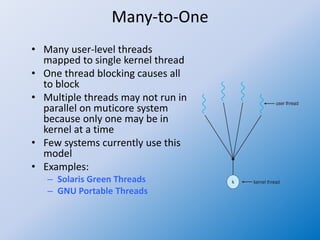
Many-to-One
• Many user-level threads
mapped to single kernel thread
• One thread blocking causes all
to block
• Multiple threads may not run in
parallel on muticore system
because only one may be in
kernel at a time
• Few systems currently use this
model
• Examples:
– Solaris Green Threads
– GNU Portable Threads
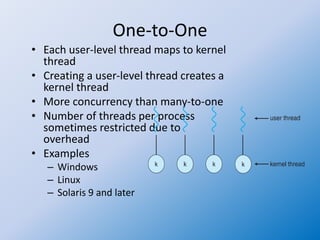
One-to-One
• Each user-level thread maps to kernel
thread
• Creating a user-level thread creates a
kernel thread
• More concurrency than many-to-one
• Number of threads per process
sometimes restricted due to
overhead
• Examples
– Windows
– Linux
– Solaris 9 and later
Many-to-Many Model
• Allows many user level
threads to be mapped to
many kernel threads
• Allows the operating
system to create a
sufficient number of
kernel threads
• Solaris prior to version 9
• Windows with the
ThreadFiber package
Two-level Model
• Similar to M:M, except that it
allows a user thread to be bound to
kernel thread
• Examples
– IRIX
– HP-UX
– Tru64 UNIX
– Solaris 8 and earlier
Thread Libraries
• Thread library provides
programmer with API for creating
and managing threads
• Two primary ways of implementing
– Library entirely in user space
– Kernel-level library supported by the
OS
Pthreads
• May be provided either as user-level or
kernel-level
• A POSIX standard (IEEE 1003.1c) API for
thread creation and synchronization
• Specification, not implementation
• API specifies behavior of the thread
library, implementation is up to
development of the library
• Common in UNIX operating systems
(Solaris, Linux, Mac OS X)
Implicit Threading
• Growing in popularity as numbers of threads
increase, program correctness more difficult with
explicit threads
• Creation and management of threads done by
compilers and run-time libraries rather than
programmers
• Three methods explored
– Thread Pools
– OpenMP
– Grand Central Dispatch
• Other methods include Microsoft Threading
Building Blocks (TBB),
java.util.concurrent package
Thread Pools
• Create a number of threads in a pool where they
await work
• Advantages:
– Usually slightly faster to service a request with an
existing thread than create a new thread
– Allows the number of threads in the application(s) to
be bound to the size of the pool
– Separating task to be performed from mechanics of
creating task allows different strategies for running
task
• i.e.Tasks could be scheduled to run periodically
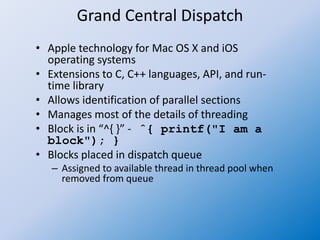
Grand Central Dispatch
• Apple technology for Mac OS X and iOS
operating systems
• Extensions to C, C++ languages, API, and run-
time library
• Allows identification of parallel sections
• Manages most of the details of threading
• Block is in “^{ }” - ˆ{ printf("I am a
block"); }
• Blocks placed in dispatch queue
– Assigned to available thread in thread pool when
removed from queue
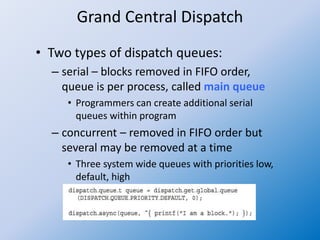
Grand Central Dispatch
• Two types of dispatch queues:
– serial – blocks removed in FIFO order,
queue is per process, called main queue
• Programmers can create additional serial
queues within program
– concurrent – removed in FIFO order but
several may be removed at a time
• Three system wide queues with priorities low,
default, high
Assignment
• Explain Multithreading Models and thread
Libraries.

Operating system 21 multithreading models

  • 1.
    Operating System 21 MultiThreading Models Prof Neeraj Bhargava Vaibhav Khanna Department of Computer Science School of Engineering and Systems Sciences Maharshi Dayanand Saraswati University Ajmer
  • 2.
    Multithreading Models • Many-to-One •One-to-One • Many-to-Many
  • 3.
    Many-to-One • Many user-levelthreads mapped to single kernel thread • One thread blocking causes all to block • Multiple threads may not run in parallel on muticore system because only one may be in kernel at a time • Few systems currently use this model • Examples: – Solaris Green Threads – GNU Portable Threads
  • 4.
    One-to-One • Each user-levelthread maps to kernel thread • Creating a user-level thread creates a kernel thread • More concurrency than many-to-one • Number of threads per process sometimes restricted due to overhead • Examples – Windows – Linux – Solaris 9 and later
  • 5.
    Many-to-Many Model • Allowsmany user level threads to be mapped to many kernel threads • Allows the operating system to create a sufficient number of kernel threads • Solaris prior to version 9 • Windows with the ThreadFiber package
  • 6.
    Two-level Model • Similarto M:M, except that it allows a user thread to be bound to kernel thread • Examples – IRIX – HP-UX – Tru64 UNIX – Solaris 8 and earlier
  • 7.
    Thread Libraries • Threadlibrary provides programmer with API for creating and managing threads • Two primary ways of implementing – Library entirely in user space – Kernel-level library supported by the OS
  • 8.
    Pthreads • May beprovided either as user-level or kernel-level • A POSIX standard (IEEE 1003.1c) API for thread creation and synchronization • Specification, not implementation • API specifies behavior of the thread library, implementation is up to development of the library • Common in UNIX operating systems (Solaris, Linux, Mac OS X)
  • 9.
    Implicit Threading • Growingin popularity as numbers of threads increase, program correctness more difficult with explicit threads • Creation and management of threads done by compilers and run-time libraries rather than programmers • Three methods explored – Thread Pools – OpenMP – Grand Central Dispatch • Other methods include Microsoft Threading Building Blocks (TBB), java.util.concurrent package
  • 10.
    Thread Pools • Createa number of threads in a pool where they await work • Advantages: – Usually slightly faster to service a request with an existing thread than create a new thread – Allows the number of threads in the application(s) to be bound to the size of the pool – Separating task to be performed from mechanics of creating task allows different strategies for running task • i.e.Tasks could be scheduled to run periodically
  • 11.
    Grand Central Dispatch •Apple technology for Mac OS X and iOS operating systems • Extensions to C, C++ languages, API, and run- time library • Allows identification of parallel sections • Manages most of the details of threading • Block is in “^{ }” - ˆ{ printf("I am a block"); } • Blocks placed in dispatch queue – Assigned to available thread in thread pool when removed from queue
  • 12.
    Grand Central Dispatch •Two types of dispatch queues: – serial – blocks removed in FIFO order, queue is per process, called main queue • Programmers can create additional serial queues within program – concurrent – removed in FIFO order but several may be removed at a time • Three system wide queues with priorities low, default, high
  • 13.
    Assignment • Explain MultithreadingModels and thread Libraries.