McGraw-Hill ©The McGraw-Hill Companies, Inc., 2000
Thread Scheduler
And
Scheduler Activation
A Operating System
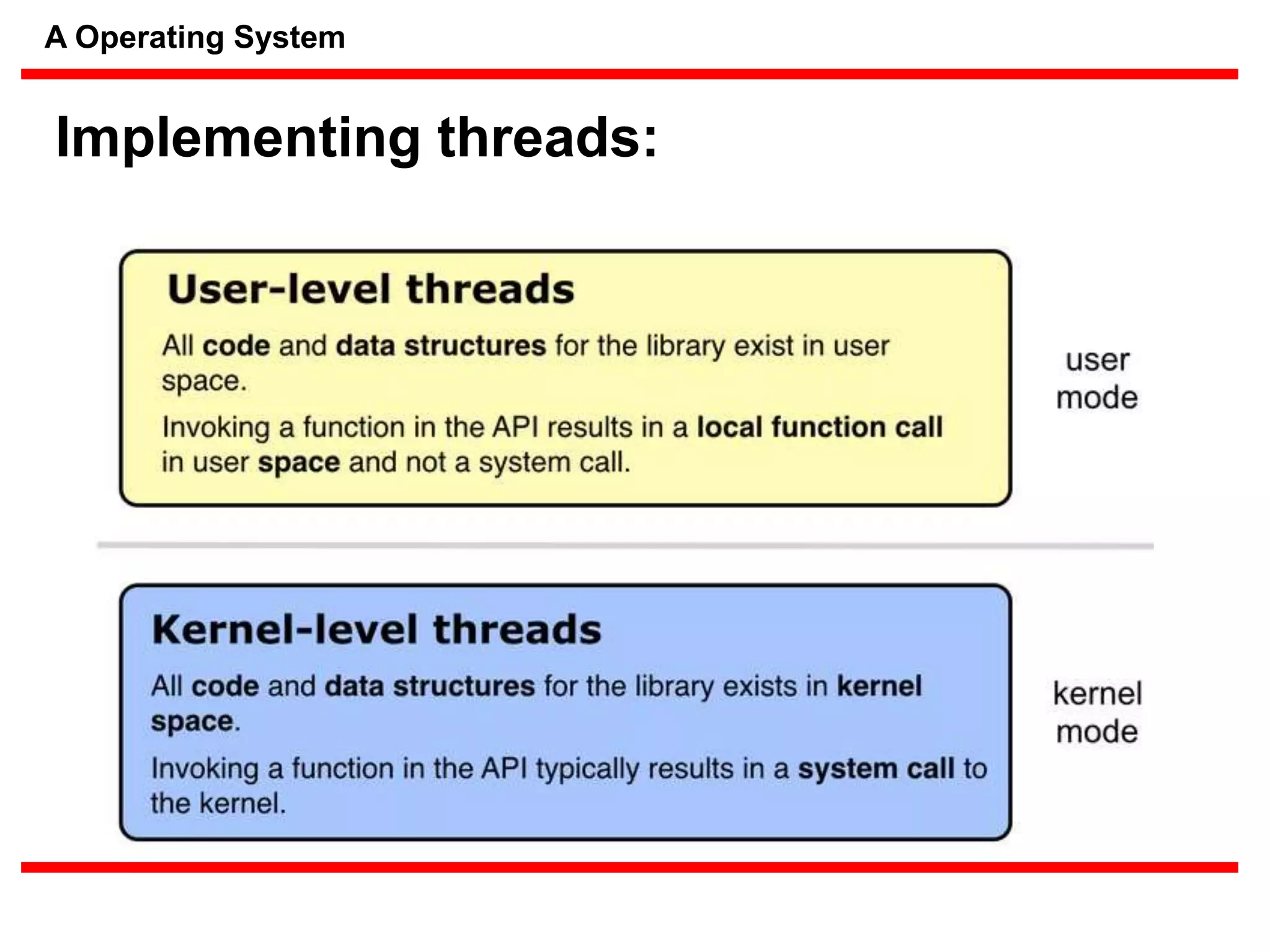
Implementing threads:
Kernel level threads:
Kernel level threads are supported and managed directly by the
operating system.
• The kernel knows about and manages all threads.
• One process control block (PCB) per process.
• Provide system calls to create and manage threads from user space.
A Operating System
User level threads:
User level threads are supported above the kernel in user space and are
managed with or sometimes out kernel support.
• Threads managed entirely by the run-time system (user-level
library).
• Ideally, thread operations should be as fast as a function call.
• The kernel knows little about user-level threads and manage them
as if they where single-threaded processes.
User-level thread models:
In general, user-level threads can be implemented using one of four
models: Many-to-one, One-to-one
A Operating System
User-level thread models:
In general, user-level threads can be implemented using one of four
models: Many-to-many, Two-level
A Operating System
• In Many-to-Many model and Two-level model there must be some way
for the kernel to communicate with the user level thread manager to
maintain an appropriate number of kernel threads execution.
• This mechanism is called scheduler activations just like Context
Switching activation
• The kernel provides the application with a set of kernel threads (virtual
processors) with resources; memory, cache memory, files etc
• The application and the OS have complete control over which threads to
run on each of the kernel threads
• What I/O operations are being performed under that application
Scheduler activations:
A Operating System
• The number of kernel threads (virtual processors) in the set is
controlled by the kernel, in response to the competing demands of
different processes in the system
• The kernel notify the user-level thread manager of important kernel
events using upcalls from the kernel to the user-level thread manager.
• Examples of such events includes a thread making a blocking system
call and the kernel allocating a new kernel thread to the process
Scheduler activations:
Operating System
Scheduler activations:
Operating System
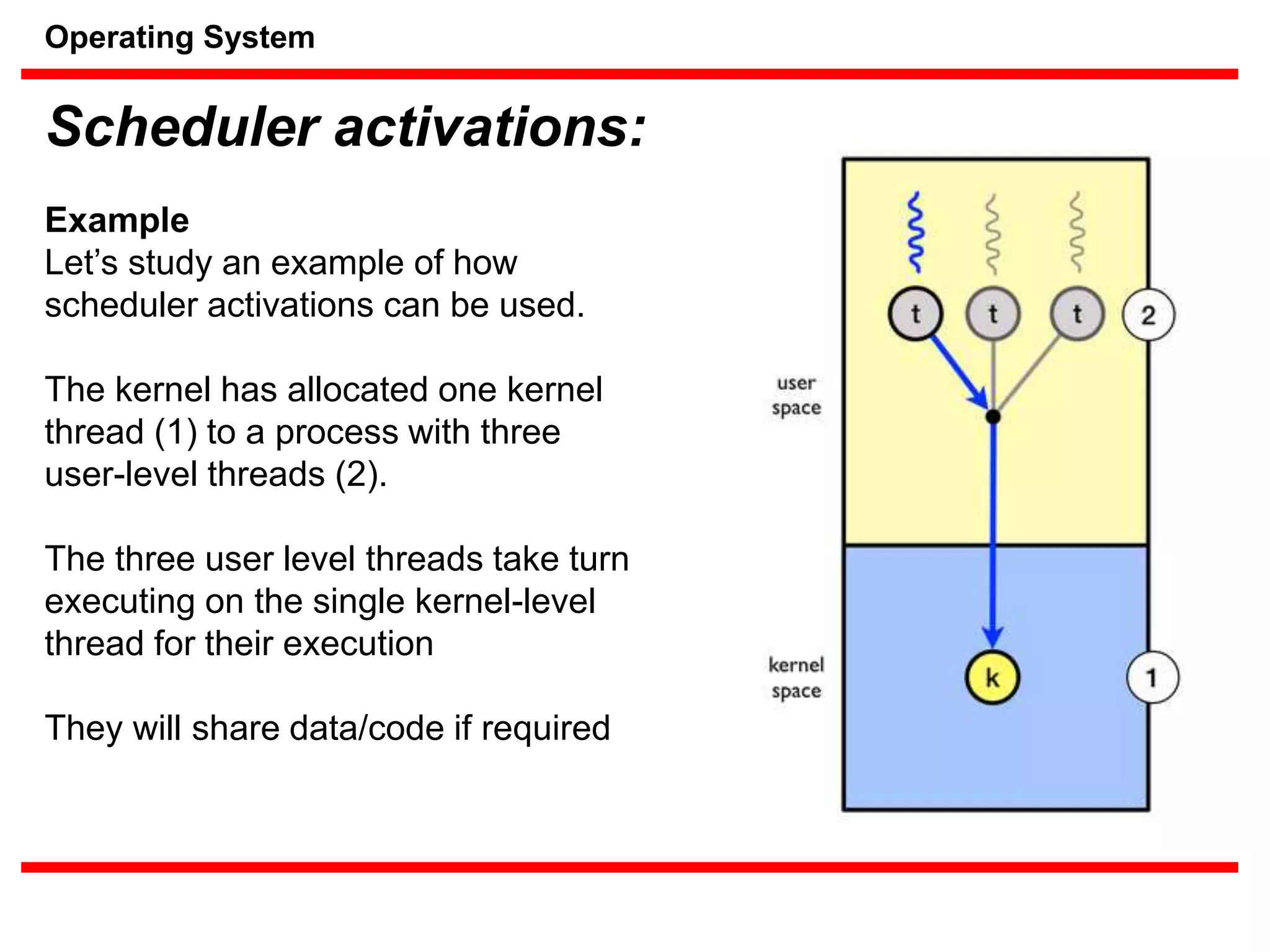
Example
Let’s study an example of how
scheduler activations can be used.
The kernel has allocated one kernel
thread (1) to a process with three
user-level threads (2).
The three user level threads take turn
executing on the single kernel-level
thread for their execution
They will share data/code if required
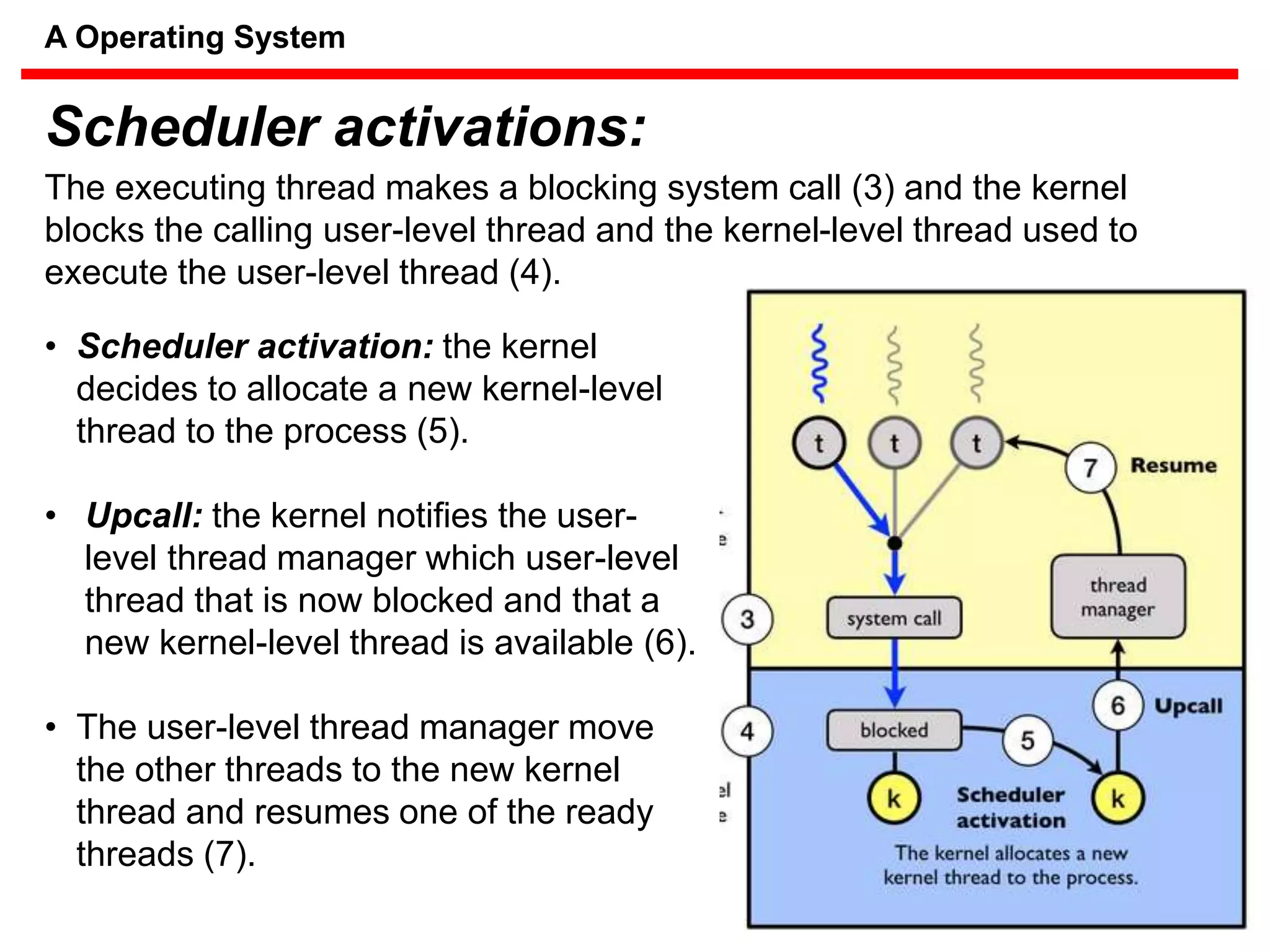
The executing thread makes a blocking system call (3) and the kernel
blocks the calling user-level thread and the kernel-level thread used to
execute the user-level thread (4).
• Scheduler activation: the kernel
decides to allocate a new kernel-level
thread to the process (5).
• Upcall: the kernel notifies the user-
level thread manager which user-level
thread that is now blocked and that a
new kernel-level thread is available (6).
• The user-level thread manager move
the other threads to the new kernel
thread and resumes one of the ready
threads (7).
Scheduler activations:
A Operating System
While one user-level thread is blocked (8) the other threads can take turn
executing on the new kernel thread (9).
Scheduler activations:
A Operating System
• When a part of the process (the thread) which got blocked due to
i/o) gets blocked for i/o operation, the os suspends the entire
process, since the os deals only with the processes
• As in the many to one model, there is only a single kernel, the
process whose thread was blocked cant be executed until the
blocked thread resumes,
• whereas in a many to many or one to one model, each kernel runs
its piece of code and is unaware of the threads blocked in the other
kernels.
Scheduler activations:
A Operating System
Cooperative scheduling of user-level threads
The cooperative model is similar to multiprogramming where a process
executes on the CPU until making a I/O request.
Cooperative user-level threads execute on the assigned kernel-level
thread until they voluntarily give back the kernel thread to the thread
manager.
Scheduler activations:
A Operating System
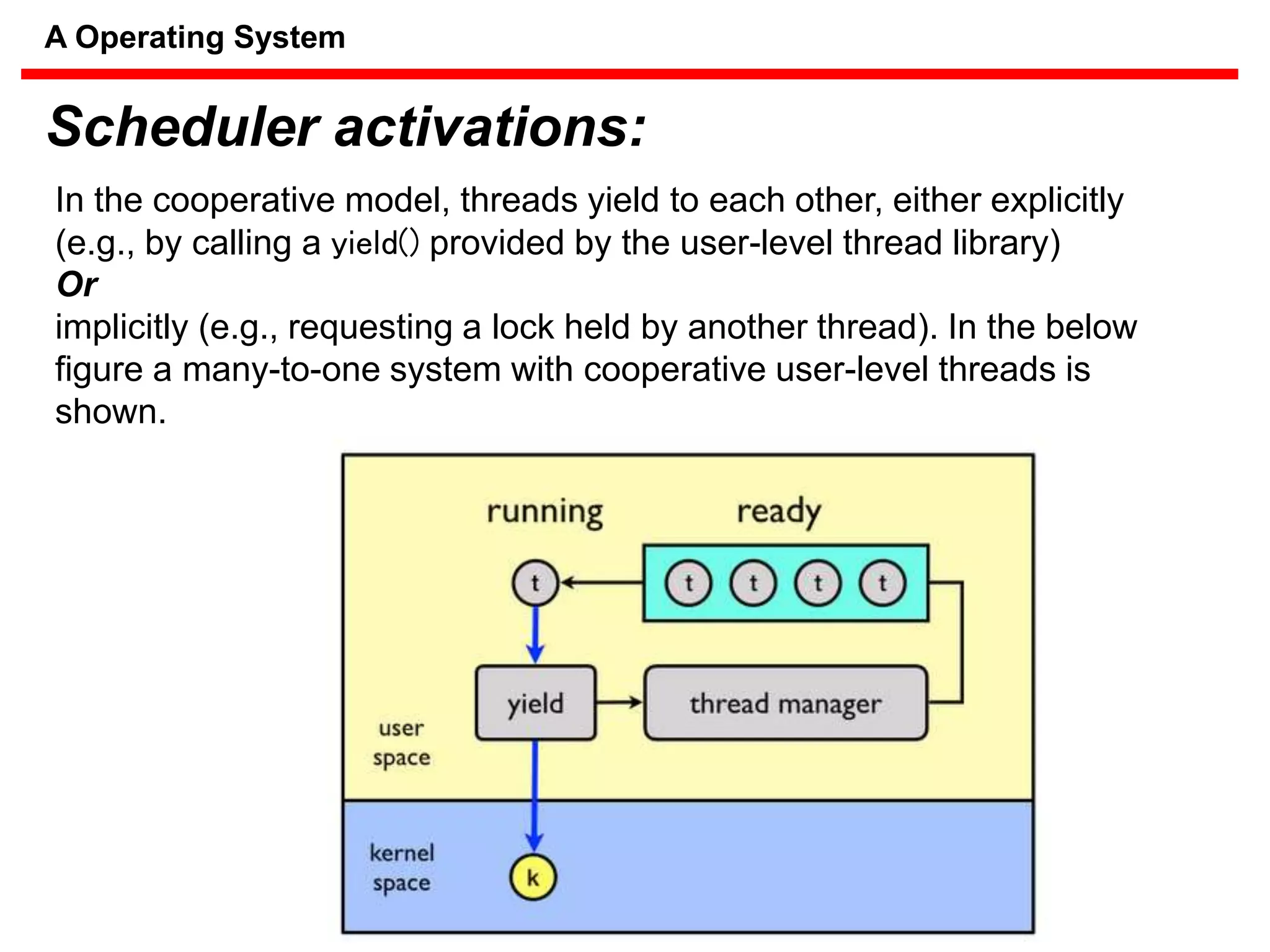
In the cooperative model, threads yield to each other, either explicitly
(e.g., by calling a yield() provided by the user-level thread library)
Or
implicitly (e.g., requesting a lock held by another thread). In the below
figure a many-to-one system with cooperative user-level threads is
shown.
Scheduler activations:
A Operating System
Preemptive scheduling of user-level threads
The preemptive model is similar to multitasking (like time sharing).
Multitasking is a logical extension of multiprogramming where a timer is
set to cause an interrupt at a regular time interval
The running process is replaced if the job requests I/O or if the job is
interrupted by the timer.
Scheduler activations:
A Operating System
In the preemptive model, a timer is used to cause execution flow to jump
to a central dispatcher thread, which chooses the next thread to run.
In the below figure a many-to-one system with preemptive user-level
threads is shown.
Scheduler activations:
A Operating System
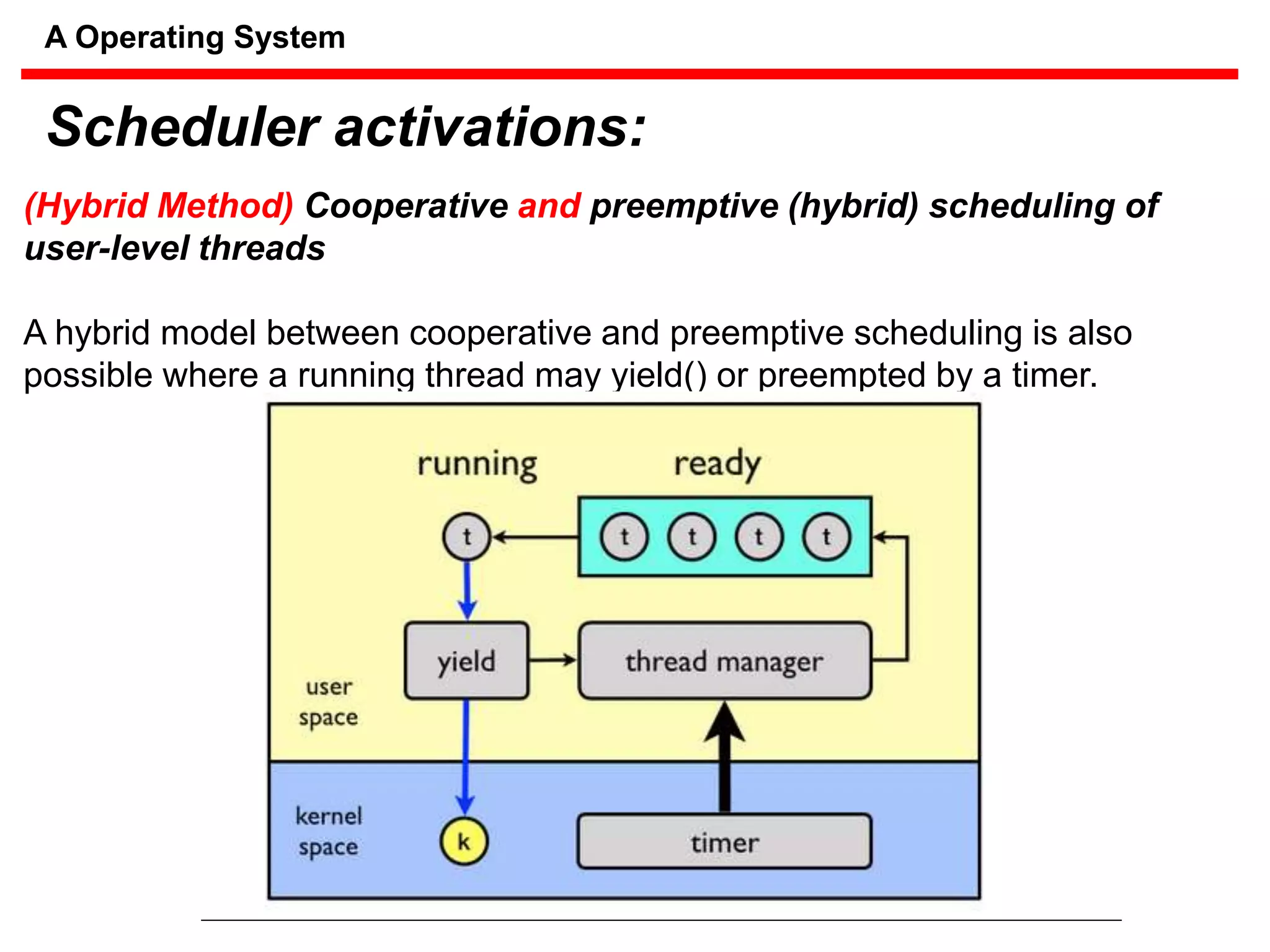
(Hybrid Method) Cooperative and preemptive (hybrid) scheduling of
user-level threads
A hybrid model between cooperative and preemptive scheduling is also
possible where a running thread may yield() or preempted by a timer.
Scheduler activations:
A Operating System

OS Thr schd.ppt

  • 1.
    McGraw-Hill ©The McGraw-HillCompanies, Inc., 2000 Thread Scheduler And Scheduler Activation
  • 2.
  • 3.
    Kernel level threads: Kernellevel threads are supported and managed directly by the operating system. • The kernel knows about and manages all threads. • One process control block (PCB) per process. • Provide system calls to create and manage threads from user space. A Operating System User level threads: User level threads are supported above the kernel in user space and are managed with or sometimes out kernel support. • Threads managed entirely by the run-time system (user-level library). • Ideally, thread operations should be as fast as a function call. • The kernel knows little about user-level threads and manage them as if they where single-threaded processes.
  • 4.
    User-level thread models: Ingeneral, user-level threads can be implemented using one of four models: Many-to-one, One-to-one A Operating System
  • 5.
    User-level thread models: Ingeneral, user-level threads can be implemented using one of four models: Many-to-many, Two-level A Operating System
  • 6.
    • In Many-to-Manymodel and Two-level model there must be some way for the kernel to communicate with the user level thread manager to maintain an appropriate number of kernel threads execution. • This mechanism is called scheduler activations just like Context Switching activation • The kernel provides the application with a set of kernel threads (virtual processors) with resources; memory, cache memory, files etc • The application and the OS have complete control over which threads to run on each of the kernel threads • What I/O operations are being performed under that application Scheduler activations: A Operating System
  • 7.
    • The numberof kernel threads (virtual processors) in the set is controlled by the kernel, in response to the competing demands of different processes in the system • The kernel notify the user-level thread manager of important kernel events using upcalls from the kernel to the user-level thread manager. • Examples of such events includes a thread making a blocking system call and the kernel allocating a new kernel thread to the process Scheduler activations: Operating System
  • 8.
    Scheduler activations: Operating System Example Let’sstudy an example of how scheduler activations can be used. The kernel has allocated one kernel thread (1) to a process with three user-level threads (2). The three user level threads take turn executing on the single kernel-level thread for their execution They will share data/code if required
  • 9.
    The executing threadmakes a blocking system call (3) and the kernel blocks the calling user-level thread and the kernel-level thread used to execute the user-level thread (4). • Scheduler activation: the kernel decides to allocate a new kernel-level thread to the process (5). • Upcall: the kernel notifies the user- level thread manager which user-level thread that is now blocked and that a new kernel-level thread is available (6). • The user-level thread manager move the other threads to the new kernel thread and resumes one of the ready threads (7). Scheduler activations: A Operating System
  • 10.
    While one user-levelthread is blocked (8) the other threads can take turn executing on the new kernel thread (9). Scheduler activations: A Operating System
  • 11.
    • When apart of the process (the thread) which got blocked due to i/o) gets blocked for i/o operation, the os suspends the entire process, since the os deals only with the processes • As in the many to one model, there is only a single kernel, the process whose thread was blocked cant be executed until the blocked thread resumes, • whereas in a many to many or one to one model, each kernel runs its piece of code and is unaware of the threads blocked in the other kernels. Scheduler activations: A Operating System
  • 12.
    Cooperative scheduling ofuser-level threads The cooperative model is similar to multiprogramming where a process executes on the CPU until making a I/O request. Cooperative user-level threads execute on the assigned kernel-level thread until they voluntarily give back the kernel thread to the thread manager. Scheduler activations: A Operating System
  • 13.
    In the cooperativemodel, threads yield to each other, either explicitly (e.g., by calling a yield() provided by the user-level thread library) Or implicitly (e.g., requesting a lock held by another thread). In the below figure a many-to-one system with cooperative user-level threads is shown. Scheduler activations: A Operating System
  • 14.
    Preemptive scheduling ofuser-level threads The preemptive model is similar to multitasking (like time sharing). Multitasking is a logical extension of multiprogramming where a timer is set to cause an interrupt at a regular time interval The running process is replaced if the job requests I/O or if the job is interrupted by the timer. Scheduler activations: A Operating System
  • 15.
    In the preemptivemodel, a timer is used to cause execution flow to jump to a central dispatcher thread, which chooses the next thread to run. In the below figure a many-to-one system with preemptive user-level threads is shown. Scheduler activations: A Operating System
  • 16.
    (Hybrid Method) Cooperativeand preemptive (hybrid) scheduling of user-level threads A hybrid model between cooperative and preemptive scheduling is also possible where a running thread may yield() or preempted by a timer. Scheduler activations: A Operating System