Projectile
Motion
P R E S E N T E D B Y S U J H S P H Y S I C S T E A C H E R S G R A D E 9 P H Y S I C S
Learning Targets
I can describe the horizontal and
vertical motions of a projectile.
I can investigate the relationship
between the angle of release and the
height and range of the projectile.
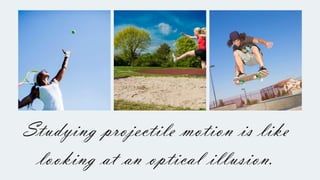
Studying projectile motion is like
looking at an optical illusion.
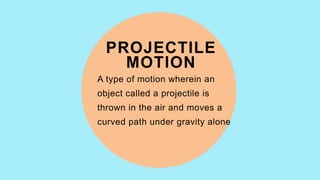
PROJECTILE
MOTION
A type of motion wherein an
object called a projectile is
thrown in the air and moves a
curved path under gravity alone
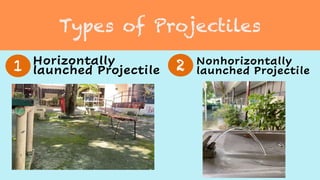
Types of Projectiles
Horizontally
launched Projectile
Nonhorizontally
launched Projectile
1 2
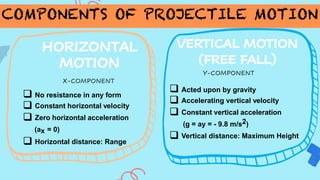
 No resistance in any form
 Constant horizontal velocity
 Zero horizontal acceleration
(ax = 0)
 Horizontal distance: Range
HORIZONTAL
MOTION
X-COMPONENT
VERTICAL MOTION
(FREE FALL)
Y-COMPONENT
COMPONENTS OF PROJECTILE MOTION
 Acted upon by gravity
 Accelerating vertical velocity
 Constant vertical acceleration
(g = ay = - 9.8 m/s2)
 Vertical distance: Maximum Height
y
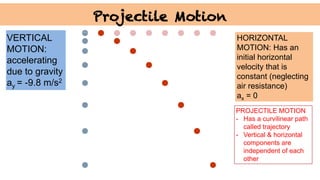
HORIZONTAL
MOTION: Has an
initial horizontal
velocity that is
constant (neglecting
air resistance)
ax = 0
VERTICAL
MOTION:
accelerating
due to gravity
ay = -9.8 m/s2
PROJECTILE MOTION
- Has a curvilinear path
called trajectory
- Vertical & horizontal
components are
independent of each
other
Projectile Motion
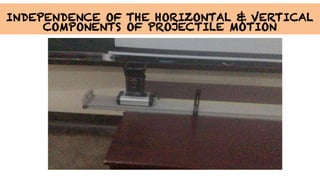
INDEPENDENCE OF THE HORIZONTAL & VERTICAL
COMPONENTS OF PROJECTILE MOTION
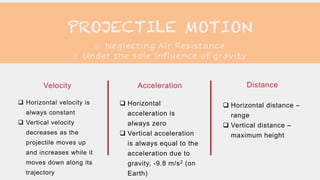
PROJECTILE MOTION
o Neglecting Air Resistance
o Under the sole influence of gravity
 Horizontal velocity is
always constant
 Vertical velocity
decreases as the
projectile moves up
and increases while it
moves down along its
trajectory
Velocity
 Horizontal
acceleration is
always zero
 Vertical acceleration
is always equal to the
acceleration due to
gravity, -9.8 m/s2 (on
Earth)
Acceleration
 Horizontal distance –
range
 Vertical distance –
maximum height
Distance
HUMILITY IS NOT THINKING
LESS OF YOURSELF BUT
THINKING OF YOURSELF LESS.
C.S LEWIS
PRESENTED BY SUJHS PHYSICS TEACHERS
REFERENCES
C.S. Lewis on Humility | Humility, Inspirational quotes, Quotable quotes. (n.d.). Pinterest.
https://www.pinterest.ph/pin/388646642816576065/
Department of Education (2016). K to 12 Curriculum Guide for Science: Kindergarten to Grade 10.
Retrieved from http://deped.gov.ph/sites/default/files/page/2016/Science%20CG.pdf
Garcia, R.J.G., Laurente, J.A.T., Montebon, D. R. T., & Auditor, E. (2015). Science for the 21st century
learner 9. [e-textbook]
Moros, E.M., Avilla, R.A., Greogorio, J.B., & Pineda, M.G.F. (2018). Practical science 9. Makati City:
University Press First Asia
Papa, E. C. R., Moros, E.M., Pineda, M. G. P., & Gregorio, J.B. (2018). Practical Science 7. Makati City:
University Press of First Asia

Projectile Motion || Grade 9 Physics || K to 12 Science

  • 1.
    Projectile Motion P R ES E N T E D B Y S U J H S P H Y S I C S T E A C H E R S G R A D E 9 P H Y S I C S
  • 2.
    Learning Targets I candescribe the horizontal and vertical motions of a projectile. I can investigate the relationship between the angle of release and the height and range of the projectile.
  • 3.
    Studying projectile motionis like looking at an optical illusion.
  • 4.
    PROJECTILE MOTION A type ofmotion wherein an object called a projectile is thrown in the air and moves a curved path under gravity alone
  • 5.
    Types of Projectiles Horizontally launchedProjectile Nonhorizontally launched Projectile 1 2
  • 6.
     No resistancein any form  Constant horizontal velocity  Zero horizontal acceleration (ax = 0)  Horizontal distance: Range HORIZONTAL MOTION X-COMPONENT VERTICAL MOTION (FREE FALL) Y-COMPONENT COMPONENTS OF PROJECTILE MOTION  Acted upon by gravity  Accelerating vertical velocity  Constant vertical acceleration (g = ay = - 9.8 m/s2)  Vertical distance: Maximum Height
  • 7.
    y HORIZONTAL MOTION: Has an initialhorizontal velocity that is constant (neglecting air resistance) ax = 0 VERTICAL MOTION: accelerating due to gravity ay = -9.8 m/s2 PROJECTILE MOTION - Has a curvilinear path called trajectory - Vertical & horizontal components are independent of each other Projectile Motion
  • 8.
    INDEPENDENCE OF THEHORIZONTAL & VERTICAL COMPONENTS OF PROJECTILE MOTION
  • 9.
    PROJECTILE MOTION o NeglectingAir Resistance o Under the sole influence of gravity  Horizontal velocity is always constant  Vertical velocity decreases as the projectile moves up and increases while it moves down along its trajectory Velocity  Horizontal acceleration is always zero  Vertical acceleration is always equal to the acceleration due to gravity, -9.8 m/s2 (on Earth) Acceleration  Horizontal distance – range  Vertical distance – maximum height Distance
  • 10.
    HUMILITY IS NOTTHINKING LESS OF YOURSELF BUT THINKING OF YOURSELF LESS. C.S LEWIS PRESENTED BY SUJHS PHYSICS TEACHERS
  • 11.
    REFERENCES C.S. Lewis onHumility | Humility, Inspirational quotes, Quotable quotes. (n.d.). Pinterest. https://www.pinterest.ph/pin/388646642816576065/ Department of Education (2016). K to 12 Curriculum Guide for Science: Kindergarten to Grade 10. Retrieved from http://deped.gov.ph/sites/default/files/page/2016/Science%20CG.pdf Garcia, R.J.G., Laurente, J.A.T., Montebon, D. R. T., & Auditor, E. (2015). Science for the 21st century learner 9. [e-textbook] Moros, E.M., Avilla, R.A., Greogorio, J.B., & Pineda, M.G.F. (2018). Practical science 9. Makati City: University Press First Asia Papa, E. C. R., Moros, E.M., Pineda, M. G. P., & Gregorio, J.B. (2018). Practical Science 7. Makati City: University Press of First Asia