Downloaded 92 times




![Data Representation 13 Fixed Point Representations
ARITHMETIC ADDITION: SIGNED MAGNITUDE
[1] Compare their signs
[2] If two signs are the same ,
ADD the two magnitudes - Look out for an overflow
[3] If not the same , compare the relative magnitudes of the numbers and
then SUBTRACT the smaller from the larger --> need a subtractor to add
[4] Determine the sign of the result
6+9 -6 + 9
6 0110 9 1001
+) 9 1001 -)6 0110
15 1111 -> 01111 3 0011 -> 00011
6 + (- 9) -6 + (-9)
9 1001 6 0110
-) 6 0110 +) 9 1001
- 3 0011 -> 10011 -15 1111 -> 11111
Overflow 9 + 9 or (-9) + (-9)
9 1001
+) 9 1001
overflow (1)0010
Rashid Farid Chishti Computer Architecture](https://image.slidesharecdn.com/ch3-120309091014-phpapp02/85/Ch3-13-320.jpg)




![Data Representation 26 Other Binary codes
CHARACTER REPRESENTATION ASCII
ASCII (American Standard Code for Information Interchange) Code
MSB (3 bits)
0 1 2 3 4 5 6 7
LSB 0 NUL DLE SP 0 @ P ‘ P
(4 bits) 1 SOH DC1 ! 1 A Q a q
2 STX DC2 “ 2 B R b r
3 ETX DC3 # 3 C S c s
4 EOT DC4 $ 4 D T d t
5 ENQ NAK % 5 E U e u
6 ACK SYN & 6 F V f v
7 BEL ETB ‘ 7 G W g w
8 BS CAN ( 8 H X h x
9 HT EM ) 9 I Y I y
A LF SUB * : J Z j z
B VT ESC + ; K [ k {
C FF FS , < L l |
D CR GS - = M ] m }
E SO RS . > N m n ~
F SI US / ? O n o DEL
Rashid Farid Chishti Computer Architecture](https://image.slidesharecdn.com/ch3-120309091014-phpapp02/85/Ch3-26-320.jpg)


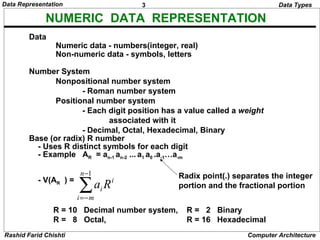
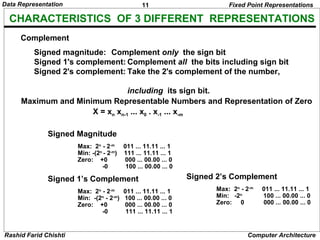
The document discusses different methods of representing numeric and non-numeric data in digital computers. It covers numeric data types like integer and real numbers. It explains why positional number systems like binary are used over non-positional systems for efficiency. Different number bases like binary, octal, hexadecimal and their representations are described. Methods to convert between bases like binary to decimal are provided, along with examples. Fixed point and floating point numeric representations are introduced. Signed number representations using signed magnitude, 1's complement and 2's complement are also summarized.


