Data Structures

Queues
Problem to be Solved
It is so often necessary to wait one’s turn before having
access to something.
We may want to simulate a real life situation of a waiting
line, like

– A line of people waiting to purchase tickets, where the first
  person in line is the first person served.
With in a computer system there may be lines of tasks

– Waiting for the printer

– Waiting for access to disk storage
Queue
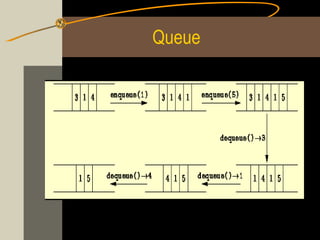
We define a queue to be a list in which

– All additions to the list are made at one end, and

– All deletions from the list are made at the other end
Queues are also called first-in, first-out lists, or FIFO
for short.
The entry in a queue ready to be served, will be
– the first entry that will be removed from the queue,

– We call this the front of the queue.
Queue

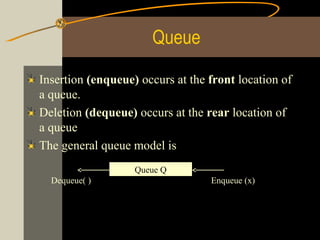
Insertion (enqueue) occurs at the front location of
a queue.
Deletion (dequeue) occurs at the rear location of
a queue
The general queue model is
                   Queue Q
  Dequeue( )                      Enqueue (x)
Queue
Queue Operations
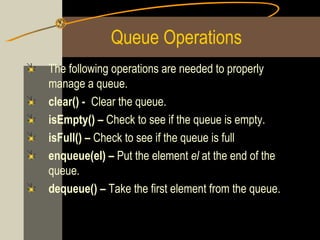
The following operations are needed to properly
manage a queue.
clear() - Clear the queue.
isEmpty() – Check to see if the queue is empty.
isFull() – Check to see if the queue is full
enqueue(el) – Put the element el at the end of the
queue.
dequeue() – Take the first element from the queue.
Queue Operations

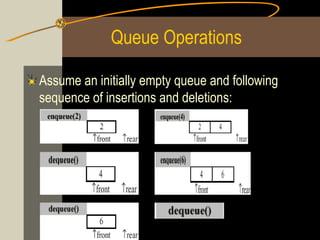
Assume an initially empty queue and following
sequence of insertions and deletions:
Queue Operations
Implementations of Queues
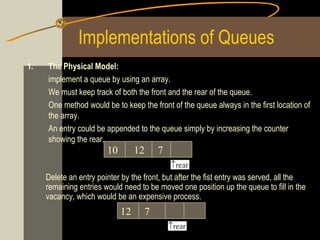
1.   The Physical Model:
     implement a queue by using an array.
     We must keep track of both the front and the rear of the queue.
     One method would be to keep the front of the queue always in the first location of
     the array.
     An entry could be appended to the queue simply by increasing the counter
     showing the rear.
                        10        12    7

     Delete an entry pointer by the front, but after the fist entry was served, all the
     remaining entries would need to be moved one position up the queue to fill in the
     vacancy, which would be an expensive process.
                             12     7
Implementations of Queues
2.   Linear Implementation
     In this implementation an array with two indices will be used.
     One index indicates front of queue and second index indicates rear of
     queue.
     using front and rear indices there is no need of moving any entries.
     To enqueue an entry to the queue, we simply increase the rear by one and
     put the entry in that position

     12     7                                   12      7      8

     To dequeue an entry, we take it from the position at the front and then
     increase the front by one.

                                         7     8
Implementations of Queues
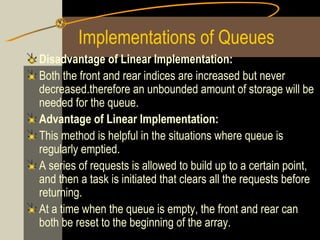
Disadvantage of Linear Implementation:
Both the front and rear indices are increased but never
decreased.therefore an unbounded amount of storage will be
needed for the queue.
Advantage of Linear Implementation:
This method is helpful in the situations where queue is
regularly emptied.
A series of requests is allowed to build up to a certain point,
and then a task is initiated that clears all the requests before
returning.
At a time when the queue is empty, the front and rear can
both be reset to the beginning of the array.
Implementations of Queues
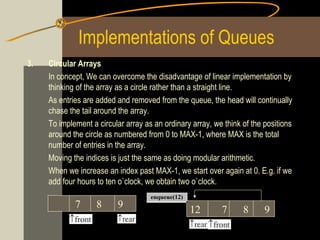
3.   Circular Arrays
     In concept, We can overcome the disadvantage of linear implementation by
     thinking of the array as a circle rather than a straight line.
     As entries are added and removed from the queue, the head will continually
     chase the tail around the array.
     To implement a circular array as an ordinary array, we think of the positions
     around the circle as numbered from 0 to MAX-1, where MAX is the total
     number of entries in the array.
     Moving the indices is just the same as doing modular arithmetic.
     When we increase an index past MAX-1, we start over again at 0. E.g. if we
     add four hours to ten o`clock, we obtain two o`clock.

             7      8     9                      12        7      8      9
Implementations of Queues
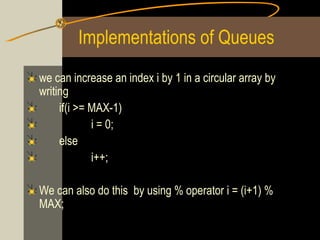
we can increase an index i by 1 in a circular array by
writing
     if(i >= MAX-1)
             i = 0;
     else
             i++;

We can also do this by using % operator i = (i+1) %
MAX;
Implementations of Queues

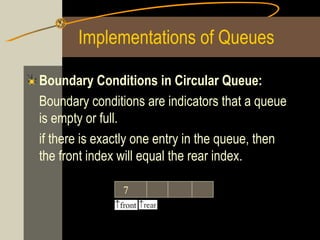
Boundary Conditions in Circular Queue:
Boundary conditions are indicators that a queue
is empty or full.
if there is exactly one entry in the queue, then
the front index will equal the rear index.

                7
Implementations of Queues

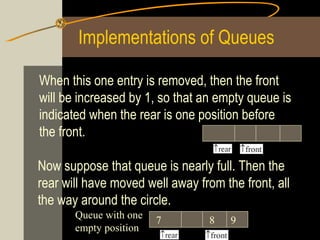
When this one entry is removed, then the front
will be increased by 1, so that an empty queue is
indicated when the rear is one position before
the front.

Now suppose that queue is nearly full. Then the
rear will have moved well away from the front, all
the way around the circle.
       Queue with one   7         8   9
       empty position
Implementations of Queues

When the array is full the rear will be exactly one
position before the front.
              Full Queue   7    12   8    9

Now we have another difficulty: the front and rear
indices are in exactly the same relative positions
for an empty queue and full queue.
    Empty Queue
Implementations of Queues : Static
  One possible queue implementation is an array.
  Elements are added to the end of the queue, but
  They may be removed from its beginning, thereby releasing array
  cells.
  These cells should not be wasted. Therefore,
  They are utilized to enqueue new elements,
  Whereby the end of the queue may occur at the beginning of the
  array.                                                        firs
                                                 last
  This situation is pictured in following figure            4
                                                        8
 The queue is full if the first element                       2
immediately precedes in the                           6
counterclockwise direction the last element.            10 11 15
Implementations of Queues : Static

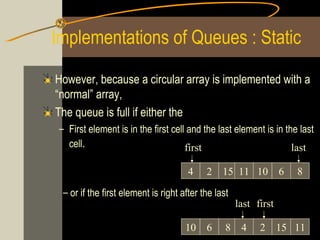
However, because a circular array is implemented with a
“normal” array,
The queue is full if either the
 – First element is in the first cell and the last element is in the last
   cell.                             first                         last

                                       4    2    15 11 10          6   8
  – or if the first element is right after the last
                                                      last first

                                      10    6     8    4    2      15 11
Implementations of Queues : Static
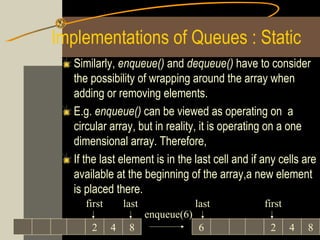
   Similarly, enqueue() and dequeue() have to consider
   the possibility of wrapping around the array when
   adding or removing elements.
   E.g. enqueue() can be viewed as operating on a
   circular array, but in reality, it is operating on a one
   dimensional array. Therefore,
   If the last element is in the last cell and if any cells are
   available at the beginning of the array,a new element
   is placed there.
     first       last                last         first
                        enqueue(6)
       2     4    8                  6             2      4   8
Implementations of Queues : Static
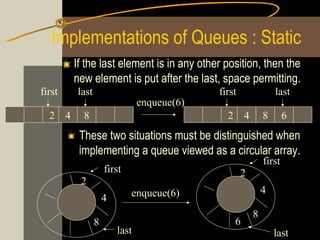
            If the last element is in any other position, then the
            new element is put after the last, space permitting.
first       last                               first                 last
                                  enqueue(6)
  2     4     8                                  2       4       8       6
             These two situations must be distinguished when
             implementing a queue viewed as a circular array.
                                                                 first
                       first                           2
             2
                               enqueue(6)                        4
                       4
                                                             8
                   8                                 6
                           last                                      last
Implementations of Queues : Static
template<class T, int size = 100>
class ArrayQueue {
   public:
        ArrayQueue() { InRef = OutRef = -1; }
        void enqueue(T);
         T dequeue();
        bool isFull() { return OutRef == 0 && InRef == size-1 ||
                          OutRef == InRef + 1; }
         bool is Empty() { return OutRef == -1; }
   private:
        int InRef, OutRef;
        T storage[size];
};
Insert Element in a Queue : Static
void template<class T, int size > ArrayQueue<T, size> :: enqueue(T el)
 { if(!isFull())
          if(InRef == size –1 || InRef == -1) {
                   storage[0] = el;
                   InRef = 0;
                   if(OutRef == -1)
                            OutRef = 0;
          }
          else storage[++InRef] = el;
   else
          cout << “Full queue. n”;
}
Remove Element From a Queue
T template<class T, int size > ArrayQueue<T, size> :: dequeue()
{ T tmp;
   if(!isempty())
   {
          tmp = storage[OutRef];
          if(InRef == OutRef)
                    InRef = OutRef = -1;
          else if (OutRef== size – 1)
                    OutRef = 0;
          else      OutRef++;
          return tmp;
   }
   else
          cout<<“queue is empty”;

Data Structure Lecture 4

  • 1.
  • 2.
    Problem to beSolved It is so often necessary to wait one’s turn before having access to something. We may want to simulate a real life situation of a waiting line, like – A line of people waiting to purchase tickets, where the first person in line is the first person served. With in a computer system there may be lines of tasks – Waiting for the printer – Waiting for access to disk storage
  • 3.
    Queue We define aqueue to be a list in which – All additions to the list are made at one end, and – All deletions from the list are made at the other end Queues are also called first-in, first-out lists, or FIFO for short. The entry in a queue ready to be served, will be – the first entry that will be removed from the queue, – We call this the front of the queue.
  • 4.
    Queue Insertion (enqueue) occursat the front location of a queue. Deletion (dequeue) occurs at the rear location of a queue The general queue model is Queue Q Dequeue( ) Enqueue (x)
  • 5.
  • 6.
    Queue Operations The followingoperations are needed to properly manage a queue. clear() - Clear the queue. isEmpty() – Check to see if the queue is empty. isFull() – Check to see if the queue is full enqueue(el) – Put the element el at the end of the queue. dequeue() – Take the first element from the queue.
  • 7.
    Queue Operations Assume aninitially empty queue and following sequence of insertions and deletions:
  • 8.
  • 9.
    Implementations of Queues 1. The Physical Model: implement a queue by using an array. We must keep track of both the front and the rear of the queue. One method would be to keep the front of the queue always in the first location of the array. An entry could be appended to the queue simply by increasing the counter showing the rear. 10 12 7 Delete an entry pointer by the front, but after the fist entry was served, all the remaining entries would need to be moved one position up the queue to fill in the vacancy, which would be an expensive process. 12 7
  • 10.
    Implementations of Queues 2. Linear Implementation In this implementation an array with two indices will be used. One index indicates front of queue and second index indicates rear of queue. using front and rear indices there is no need of moving any entries. To enqueue an entry to the queue, we simply increase the rear by one and put the entry in that position 12 7 12 7 8 To dequeue an entry, we take it from the position at the front and then increase the front by one. 7 8
  • 11.
    Implementations of Queues Disadvantageof Linear Implementation: Both the front and rear indices are increased but never decreased.therefore an unbounded amount of storage will be needed for the queue. Advantage of Linear Implementation: This method is helpful in the situations where queue is regularly emptied. A series of requests is allowed to build up to a certain point, and then a task is initiated that clears all the requests before returning. At a time when the queue is empty, the front and rear can both be reset to the beginning of the array.
  • 12.
    Implementations of Queues 3. Circular Arrays In concept, We can overcome the disadvantage of linear implementation by thinking of the array as a circle rather than a straight line. As entries are added and removed from the queue, the head will continually chase the tail around the array. To implement a circular array as an ordinary array, we think of the positions around the circle as numbered from 0 to MAX-1, where MAX is the total number of entries in the array. Moving the indices is just the same as doing modular arithmetic. When we increase an index past MAX-1, we start over again at 0. E.g. if we add four hours to ten o`clock, we obtain two o`clock. 7 8 9 12 7 8 9
  • 13.
    Implementations of Queues wecan increase an index i by 1 in a circular array by writing if(i >= MAX-1) i = 0; else i++; We can also do this by using % operator i = (i+1) % MAX;
  • 14.
    Implementations of Queues BoundaryConditions in Circular Queue: Boundary conditions are indicators that a queue is empty or full. if there is exactly one entry in the queue, then the front index will equal the rear index. 7
  • 15.
    Implementations of Queues Whenthis one entry is removed, then the front will be increased by 1, so that an empty queue is indicated when the rear is one position before the front. Now suppose that queue is nearly full. Then the rear will have moved well away from the front, all the way around the circle. Queue with one 7 8 9 empty position
  • 16.
    Implementations of Queues Whenthe array is full the rear will be exactly one position before the front. Full Queue 7 12 8 9 Now we have another difficulty: the front and rear indices are in exactly the same relative positions for an empty queue and full queue. Empty Queue
  • 17.
    Implementations of Queues: Static One possible queue implementation is an array. Elements are added to the end of the queue, but They may be removed from its beginning, thereby releasing array cells. These cells should not be wasted. Therefore, They are utilized to enqueue new elements, Whereby the end of the queue may occur at the beginning of the array. firs last This situation is pictured in following figure 4 8  The queue is full if the first element 2 immediately precedes in the 6 counterclockwise direction the last element. 10 11 15
  • 18.
    Implementations of Queues: Static However, because a circular array is implemented with a “normal” array, The queue is full if either the – First element is in the first cell and the last element is in the last cell. first last 4 2 15 11 10 6 8 – or if the first element is right after the last last first 10 6 8 4 2 15 11
  • 19.
    Implementations of Queues: Static Similarly, enqueue() and dequeue() have to consider the possibility of wrapping around the array when adding or removing elements. E.g. enqueue() can be viewed as operating on a circular array, but in reality, it is operating on a one dimensional array. Therefore, If the last element is in the last cell and if any cells are available at the beginning of the array,a new element is placed there. first last last first enqueue(6) 2 4 8 6 2 4 8
  • 20.
    Implementations of Queues: Static If the last element is in any other position, then the new element is put after the last, space permitting. first last first last enqueue(6) 2 4 8 2 4 8 6 These two situations must be distinguished when implementing a queue viewed as a circular array. first first 2 2 enqueue(6) 4 4 8 8 6 last last
  • 21.
    Implementations of Queues: Static template<class T, int size = 100> class ArrayQueue { public: ArrayQueue() { InRef = OutRef = -1; } void enqueue(T); T dequeue(); bool isFull() { return OutRef == 0 && InRef == size-1 || OutRef == InRef + 1; } bool is Empty() { return OutRef == -1; } private: int InRef, OutRef; T storage[size]; };
  • 22.
    Insert Element ina Queue : Static void template<class T, int size > ArrayQueue<T, size> :: enqueue(T el) { if(!isFull()) if(InRef == size –1 || InRef == -1) { storage[0] = el; InRef = 0; if(OutRef == -1) OutRef = 0; } else storage[++InRef] = el; else cout << “Full queue. n”; }
  • 23.
    Remove Element Froma Queue T template<class T, int size > ArrayQueue<T, size> :: dequeue() { T tmp; if(!isempty()) { tmp = storage[OutRef]; if(InRef == OutRef) InRef = OutRef = -1; else if (OutRef== size – 1) OutRef = 0; else OutRef++; return tmp; } else cout<<“queue is empty”;