COMPUTER
NUMBER
SYSTEM
1. Explain the basics of number systems and
their significance in computing.
2. Identify the steps in the conversion of
Decimal to Binary.
3.Convert Decimal to Binary
• LEARNING
OBJECTIVES:
4. Identify steps in the conversion of
binary to decimal.
5. Convert Binary to Decimal.
6. Identify steps in the conversion of Decimal
to Octal.
• LEARNING
OBJECTIVES:
7. Convert Decimal to Octal.
8. Identify steps in the conversion of Octal
to Decimal.
9. Convert Octal to Decimal
• LEARNING
OBJECTIVES:
SHORT REVIEW
WHAT WE ARE WORKING ON SNEAK PEEK
PROJECT STAGES
OUR TEAM
MAJOR REQUIREMENT
OUR GOALS
SHORT REVIEW
In the world of computers, numbers are
represented using different systems. The
most common system is the binary system,
which uses only the digits 0 and 1 to
represent all numbers and data. Each digit in
a binary number is called a bit. Another
important system is the hexadecimal system,
which uses the digits 0-9 and letters A-F to
represent numbers. Computers also use the
octal system, which uses digits 0-7.
NUMBER SYSTEM
a method of representing numbers using
specific rules. It provides a consistent way to
express numerical values. In mathematics, we
use various number systems to represent and
manipulate numbers. Here are the four most
common types:
DECIMAL NUMBER SYSTEM
(BASE-10):
• The decimal system uses ten digits: 0, 1, 2,
3, 4, 5, 6, 7, 8, and 9.
• Each position to the left of the decimal
point represents powers of 10 (units, tens,
hundreds, thousands, etc.).
BINARY NUMBER SYSTEM
(BASE-2):
• The binary system uses only two digits: 0
and 1.
• It is widely used in computer science and
digital electronics.
OCTAL NUMBER SYSTEM
(BASE-8):
• The octal system uses eight digits: 0, 1, 2,
3, 4, 5, 6, and 7.
• It is less common but still used in some
contexts.
HEXADECIMAL NUMBER
SYSTEM (BASE-16):
• The hexadecimal system uses sixteen
digits: 0–9 and A–F (where A represents
10, B represents 11, and so on).
• It is commonly used in computer
programming and memory addressing.
HEXADECIMAL NUMBER
SYSTEM (BASE-16):
• The hexadecimal system uses sixteen
digits: 0–9 and A–F (where A represents
10, B represents 11, and so on).
• It is commonly used in computer
programming and memory addressing.
NUMBER SYSTEM ROLE IN
MATHEMATICS AND OUR DAILY
LIVES.
1.REPRESENTATION OF
QUANTITIES:
A number system provides a way to
represent quantities. Whether it’s counting
objects, measuring distances, or
calculating time, numbers allow us to
express these concepts precisely.
NUMBER SYSTEM ROLE IN
MATHEMATICS AND OUR DAILY
LIVES.
1.REPRESENTATION OF
QUANTITIES:
For example, when you count the number
of apples in a basket or measure the
length of a room, you’re using the number
system.
NUMBER SYSTEM ROLE IN
MATHEMATICS AND OUR DAILY
LIVES.
2. FOUNDATION FOR MATHEMATICAL
CONCEPTS:
All mathematical concepts and formulas
are based on the number system. Whether
you’re solving equations, working with
geometry, or analyzing data, numbers are
fundamental.
NUMBER SYSTEM ROLE IN
MATHEMATICS AND OUR DAILY
LIVES.
From basic arithmetic operations (addition,
subtraction, multiplication, division) to
advanced calculus and algebra, numbers
underpin mathematical reasoning.
2. FOUNDATION FOR MATHEMATICAL
CONCEPTS:
NUMBER SYSTEM ROLE IN
MATHEMATICS AND OUR DAILY
LIVES.
From basic arithmetic operations (addition,
subtraction, multiplication, division) to
advanced calculus and algebra, numbers
underpin mathematical reasoning.
2. FOUNDATION FOR MATHEMATICAL
CONCEPTS:
NUMBER SYSTEM ROLE IN
MATHEMATICS AND OUR DAILY
LIVES.
• Counting Numbers: These start with 1
and continue indefinitely (1, 2, 3, …).
• Whole Numbers: Include all counting
numbers along with zero (0, 1, 2, …).
3. Types of Numbers:
NUMBER SYSTEM ROLE IN
MATHEMATICS AND OUR DAILY
LIVES.
• Integers: Positive and negative whole
numbers, including zero (-3, -2, -1, 0, 1,
2, 3, …).
• Rational Numbers: Expressible as
fractions (e.g., 3/4, -2/5).
3. Types of Numbers:
NUMBER SYSTEM ROLE IN
MATHEMATICS AND OUR DAILY
LIVES.
• Irrational Numbers: Cannot be
expressed as fractions (e.g., 2, π).
√
• Real Numbers: Encompass both
rational and irrational numbers.
3. Types of Numbers:
NUMBER SYSTEM ROLE IN
MATHEMATICS AND OUR DAILY
LIVES.
• Even Numbers: Divisible by 2 (e.g., 2, 4,
6, …).
• Odd Numbers: Not divisible by 2 (e.g.,
3, 5, 7, …).
3. Types of Numbers:
NUMBER SYSTEM ROLE IN
MATHEMATICS AND OUR DAILY
LIVES.
• Prime Numbers: Divisible only by 1 and
themselves (e.g., 5, 7, 13).
• Composite Numbers: Have multiple
factors (e.g., 10, 15, 28).
3. Types of Numbers:
NUMBER SYSTEM ROLE IN
MATHEMATICS AND OUR DAILY
LIVES.
• Understanding number systems is
essential for digital systems (like
computers) because they process data
using binary representation (base-2).
4. Digital Systems and Data Representation:
NUMBER SYSTEM ROLE IN
MATHEMATICS AND OUR DAILY
LIVES.
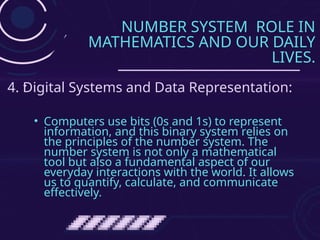
• Computers use bits (0s and 1s) to represent
information, and this binary system relies on
the principles of the number system. The
number system is not only a mathematical
tool but also a fundamental aspect of our
everyday interactions with the world. It allows
us to quantify, calculate, and communicate
effectively.
4. Digital Systems and Data Representation:
NUMBER SYSTEM ROLE IN
MATHEMATICS AND OUR DAILY
LIVES.
• Computers use bits (0s and 1s) to represent
information, and this binary system relies on
the principles of the number system. The
number system is not only a mathematical
tool but also a fundamental aspect of our
everyday interactions with the world. It allows
us to quantify, calculate, and communicate
effectively.
4. Digital Systems and Data Representation:
UNLOCKING
VOCABULARY
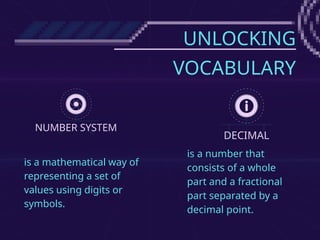
NUMBER SYSTEM
DECIMAL
is a mathematical way of
representing a set of
values using digits or
symbols.
is a number that
consists of a whole
part and a fractional
part separated by a
decimal point.
UNLOCKING
VOCABULARY
BINARY
OCTAL
is a number expressed in
the base-2 numeral
system, in this system, we
use only two symbols:
typically, "0" (zero) and "1"
(one).
is a type of numeral
system that uses a
base of eight, in this
system, the digits
range from 0 to 7.
UNLOCKING
VOCABULARY
HEXADECIMAL
is a base-16 numeral system. Unlike our everyday
decimal system (base 10), which uses ten symbols (0-
9), hexadecimal employs sixteen symbols. These
symbols represent values from 0 to 15.
BINARY NUMBER SYSTEM
a fundamental concept in computer science and
digital electronics. It uses a base-2 numeral
system, which means it only employs two distinct
symbols: 0 (zero) and 1 (one). Here are the key
points about binary numbers:
REPRESENTATION:
In binary, each digit is called a bit.
The binary system is used internally by
almost all modern computers and electronic
devices because it directly maps to electronic
circuits using logic gates.
Unlike our everyday decimal system (base
10), which uses ten symbols (0-9), binary uses
only two symbols (0 and 1).
CONVERSION:
To convert a decimal number to
binary, follow these steps:
Divide the decimal number by 2.
Use the integer quotient obtained as the
dividend for the next step.
CONVERSION:
Continue dividing until the quotient
becomes 0.
Write down the remainders in reverse order
to get the binary representation.
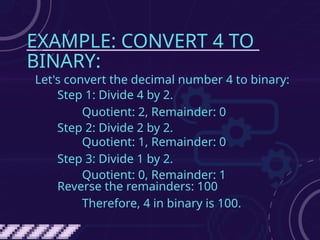
EXAMPLE: CONVERT 4 TO
BINARY:
Let's convert the decimal number 4 to binary:
Step 1: Divide 4 by 2.
Quotient: 2, Remainder: 0
Step 2: Divide 2 by 2.
Quotient: 1, Remainder: 0
Step 3: Divide 1 by 2.
Quotient: 0, Remainder: 1
Reverse the remainders: 100
Therefore, 4 in binary is 100.
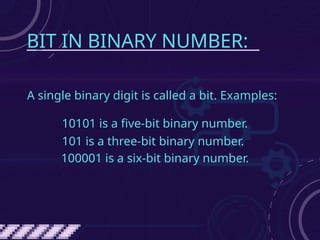
BIT IN BINARY NUMBER:
A single binary digit is called a bit. Examples:
10101 is a five-bit binary number.
101 is a three-bit binary number.
100001 is a six-bit binary number.
QUESTIONS:
How many different digits are used in the binary
number system?
Can you explain the concept of place value in
binary numbers?
Why is the binary number system important in
computing and digital technology?
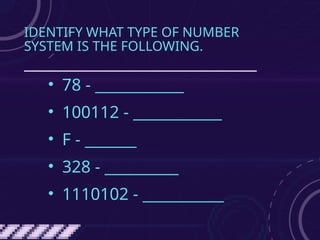
IDENTIFY WHAT TYPE OF NUMBER
SYSTEM IS THE FOLLOWING.
• 78 - ____________
• 100112 - ____________
• F - _______
• 328 - __________
• 1110102 - ___________
LESSON ACTIVITY
1.Decimal Number System:
• Explain its base-10 structure
and usage in everyday life.
LESSON ACTIVITY
2.Binary Number System:
• Discuss its base-2 structure
and significance in computer
processing.
• Practice converting binary to
decimal and vice versa.
LESSON ACTIVITY
3. Octal Number System:
• Describe its base-8 structure
and where it's used.
• Convert octal numbers to
binary and decimal.
LESSON ACTIVITY
4. Hexadecimal Number System:
• Explain its base-16 structure
and usage in memory
addressing.
• Practice converting
hexadecimal to binary and
decimal.
LESSON ACTIVITY
4. Hexadecimal Number System:
• Explain its base-16 structure
and usage in memory
addressing.
• Practice converting
hexadecimal to binary and
decimal.
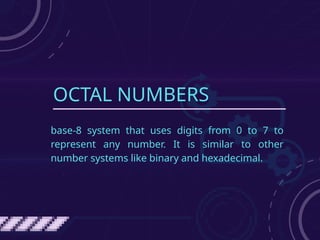
OCTAL NUMBERS
base-8 system that uses digits from 0 to 7 to
represent any number. It is similar to other
number systems like binary and hexadecimal.
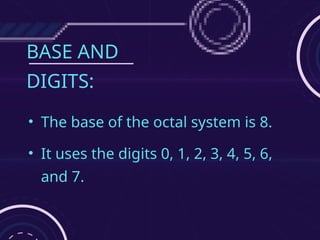
BASE AND
DIGITS:
• The base of the octal system is 8.
• It uses the digits 0, 1, 2, 3, 4, 5, 6,
and 7.
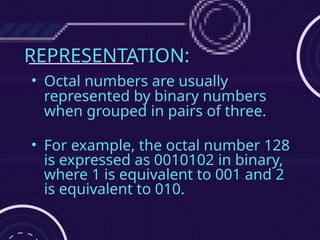
REPRESENTATION:
• Octal numbers are usually
represented by binary numbers
when grouped in pairs of three.
• For example, the octal number 128
is expressed as 0010102 in binary,
where 1 is equivalent to 001 and 2
is equivalent to 010.
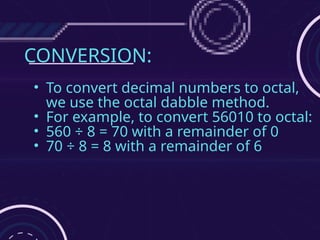
CONVERSION:
• To convert decimal numbers to octal,
we use the octal dabble method.
• For example, to convert 56010 to octal:
• 560 ÷ 8 = 70 with a remainder of 0
• 70 ÷ 8 = 8 with a remainder of 6
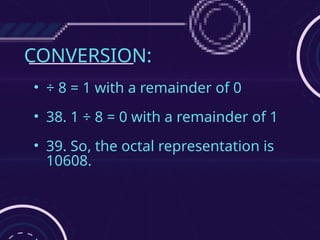
CONVERSION:
• ÷ 8 = 1 with a remainder of 0
• 38. 1 ÷ 8 = 0 with a remainder of 1
• 39. So, the octal representation is
10608.
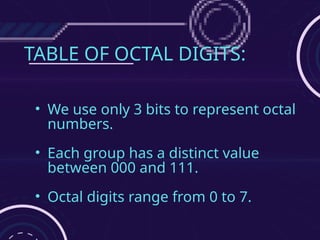
TABLE OF OCTAL DIGITS:
• We use only 3 bits to represent octal
numbers.
• Each group has a distinct value
between 000 and 111.
• Octal digits range from 0 to 7.
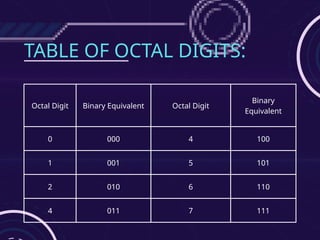
Octal Digit Binary Equivalent Octal Digit
Binary
Equivalent
0 000 4 100
1 001 5 101
2 010 6 110
4 011 7 111
TABLE OF OCTAL DIGITS:
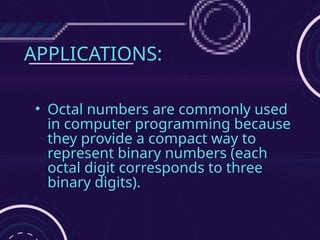
APPLICATIONS:
• Octal numbers are commonly used
in computer programming because
they provide a compact way to
represent binary numbers (each
octal digit corresponds to three
binary digits).
QUESTIONS
• 1. How many symbols are used in
octal numbering system?
• 2. Can you explain the concept of
place value in octal numbers?
• 3. Why are octal numbers often used
in computer programming?
WORKED EXAMPLE
• Explain the purpose of dividing the
decimal number by 8 in the
conversion process.
• Describe how the remainders of the
divisions are used to form the octal
number.
• Why is it important to write the digits
of the octal number in reverse order?
LESSON ACTIVITY
1. Understanding Binary Place Values:
• Explain the binary place values (1, 2, 4, 8, 16,
etc.) and how they relate to the decimal
system.
2. The Conversion Process:
• Demonstrate the process of converting a
decimal number to binary using the division-
by-2 method.
• Work through several examples as a class,
converting simple decimal numbers to binary.
DECIMAL NUMBERS
a number that consists of a whole number and a
fractional part separated by a point (often called
the decimal point).
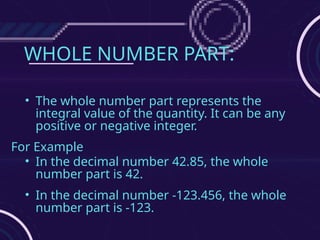
WHOLE NUMBER PART:
• The whole number part represents the
integral value of the quantity. It can be any
positive or negative integer.
For Example
• In the decimal number 42.85, the whole
number part is 42.
• In the decimal number -123.456, the whole
number part is -123.
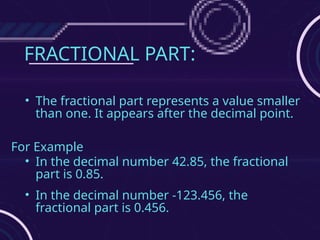
FRACTIONAL PART:
• The fractional part represents a value smaller
than one. It appears after the decimal point.
For Example
• In the decimal number 42.85, the fractional
part is 0.85.
• In the decimal number -123.456, the
fractional part is 0.456.
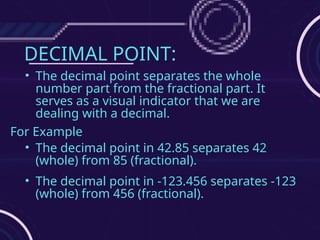
DECIMAL POINT:
• The decimal point separates the whole
number part from the fractional part. It
serves as a visual indicator that we are
dealing with a decimal.
For Example
• The decimal point in 42.85 separates 42
(whole) from 85 (fractional).
• The decimal point in -123.456 separates -123
(whole) from 456 (fractional).
DECIMAL POINT:
• allow us to express quantities that are whole
plus some part of a whole. They are
commonly encountered in everyday
situations, such as grocery shopping,
measurements, and financial calculations.
QUESTIONS:
• What is the definition of a decimal number?
• Can you explain how decimal numbers are
different from whole numbers?42 (whole)
from 85 (fractional).
• How are decimal numbers represented on a
number line?
DECIMAL POINT:
• are an important part of mathematics and are
used in many everyday situations. They
represent values that are between whole
numbers, allowing for more precise
measurements and calculations.
QUESTIONS:
• Explain the difference between a whole
number and a decimal number.
• Describe the steps to round a decimal
number to the nearest hundredth.
• How would you add two decimal numbers
with different numbers of digits to the right of
the decimal point?
LESSON ACTIVITY
• Start with an overview of different number
systems, emphasizing the decimal and octal
systems. Explain the base-10 nature of the
decimal system and the base-8 nature of the
octal system.
LESSON DEVELOPMENT:
1.Decimal Number System:
• Discuss the use of the decimal system in
daily life and its base-10 structure.
2. Octal Number System:
• Introduce the octal system, explaining its
base-8 structure and usage in computing.
3. Conversion Process:em:
• Teach the steps to convert a decimal
number to its octal equivalent:
HEXADECIMAL NUMBER
• often simply called “hex,” is a base-16
numeral system. Unlike our familiar base-10
(decimal) system, which uses ten symbols (0
to 9) to represent numbers, hexadecimal
employs sixteen symbols. These symbols
include the numerals 0 to 9 and the letters A
to F. Each digit in a hexadecimal number
corresponds to a specific value, allowing us to
express quantities in a compact and efficient
manner
BASE-16 REPRESENTATION:
• Hexadecimal uses a base value of 16. This
means that each column in a hexadecimal
number represents a power of 16
• The sixteen symbols used in hexadecimal are:
0, 1, 2, 3, 4, 5, 6, 7, 8, 9, A, B, C, D, E, and F.
• For example, the hexadecimal number “1A”
represents 1 × 16 + 10 = 26 in decimal.
CONVERSION TO OTHER
SYSTEMS:
• Hexadecimal numbers can be converted to
other number systems:
• To decimal (base-10): Each digit is multiplied
by the corresponding power of 16 and
summed.
• To binary (base-2): Each hexadecimal digit
corresponds to a 4-bit binary representation.
CONVERSION TO OTHER
SYSTEMS:
• To octal (base-8): First convert to decimal,
then to octal.
• These conversions are essential in computer
science and digital systems.
• Hexadecimal provides a convenient way to
work with binary data and efficiently
represent values in various contexts.
WORKED EXAMPLE
• 1.What is the base of a hexadecimal number
system?
• 2.How many unique symbols are used in
hexadecimal numbers?
• 3.Can you explain why hexadecimal numbers
are commonly used in computer science and
digital systems?
WORKED EXAMPLE
• Example: Convert the decimal number 456 to
hexadecimal
1. Divide the decimal number by 16 and record
the quotient and remainder.
2. Repeat the division using the quotient from the
previous step until the quotient is zero.
3. The hexadecimal number is formed by the
remainders read from bottom to top.
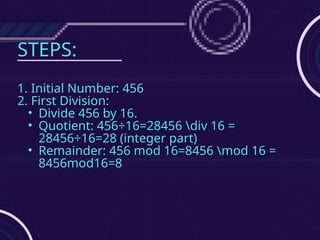
STEPS:
1. Initial Number: 456
2. First Division:
• Divide 456 by 16.
• Quotient: 456÷16=28456 div 16 =
28456÷16=28 (integer part)
• Remainder: 456 mod 16=8456 mod 16 =
8456mod16=8
STEPS:
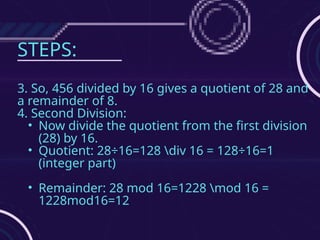
3. So, 456 divided by 16 gives a quotient of 28 and
a remainder of 8.
4. Second Division:
• Now divide the quotient from the first division
(28) by 16.
• Quotient: 28÷16=128 div 16 = 128÷16=1
(integer part)
• Remainder: 28 mod 16=1228 mod 16 =
1228mod16=12
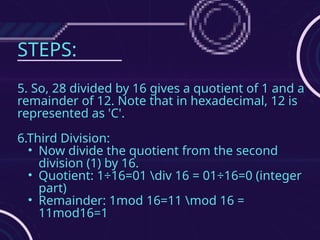
STEPS:
5. So, 28 divided by 16 gives a quotient of 1 and a
remainder of 12. Note that in hexadecimal, 12 is
represented as 'C'.
6.Third Division:
• Now divide the quotient from the second
division (1) by 16.
• Quotient: 1÷16=01 div 16 = 01÷16=0 (integer
part)
• Remainder: 1mod 16=11 mod 16 =
11mod16=1
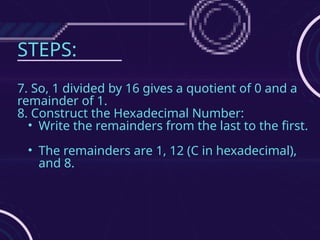
STEPS:
7. So, 1 divided by 16 gives a quotient of 0 and a
remainder of 1.
8. Construct the Hexadecimal Number:
• Write the remainders from the last to the first.
• The remainders are 1, 12 (C in hexadecimal),
and 8.
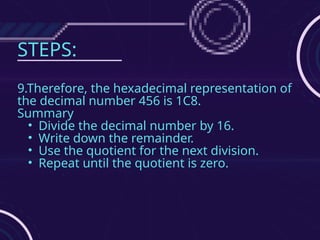
STEPS:
9.Therefore, the hexadecimal representation of
the decimal number 456 is 1C8.
Summary
• Divide the decimal number by 16.
• Write down the remainder.
• Use the quotient for the next division.
• Repeat until the quotient is zero.
STEPS:
●The hexadecimal number is the remainders
read from bottom to top.
• The steps above show the conversion process
clearly. This method can be used for any
decimal number to convert it to hexadecimal.
LESSON ACTIVITY
• Directions: Converting Decimal Numbers to
Hexadecimal and Hexadecimal to Decimal.
1. What is the hexadecimal equivalent of the
decimal number 27?
a. 1B
b. 1F
c. 23
d. 2E
LESSON ACTIVITY
• Directions: Converting Decimal Numbers to
Hexadecimal and Hexadecimal to Decimal.
2. Which of the following is a correct hexadecimal
representation of the decimal number 50?
a. 30
b. 32
c. 35
d. 38
LESSON ACTIVITY
• Directions: Converting Decimal Numbers to
Hexadecimal and Hexadecimal to Decimal.
3. If the hexadecimal number 3D is converted to
decimal, what is the result?
a. 53
b. 61
c. 57
d. 59
LESSON ACTIVITY
• Directions: Converting Decimal Numbers to
Hexadecimal and Hexadecimal to Decimal.
4. What is the decimal value of the hexadecimal
number A4?
a. 161
b. 164
c. 166
d. 168
LESSON ACTIVITY
• Directions: Converting Decimal Numbers to
Hexadecimal and Hexadecimal to Decimal.
5. Convert the decimal number 95 to
hexadecimal.
a. 5D
b. 60
c. 61
d. 65
TAKEAWAYS
• recap the concept of the different computer
number systems and the conversion of
decimal number to binary, octal, and
hexadecimal.
REFLECTION
• How do you find today’s lesson? Was it hard?
Which part of the lesson do you find difficult?
LESSON ACTIVITY
• Directions: Choose the correct answer from
the choices for each question.
1.Which of the following best describes the binary
number system?
• a) A number system that uses 0-9
• b) A number system that uses 0-7
• c) A number system that uses 0-1
• d) A number system that uses o-F
LESSON ACTIVITY
• Directions: Choose the correct answer from
the choices for each question.
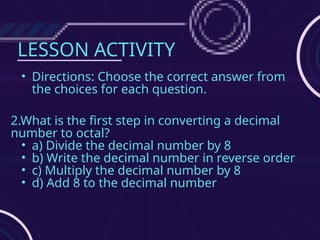
2.What is the first step in converting a decimal
number to octal?
• a) Divide the decimal number by 8
• b) Write the decimal number in reverse order
• c) Multiply the decimal number by 8
• d) Add 8 to the decimal number
LESSON ACTIVITY
• Directions: Choose the correct answer from
the choices for each question.
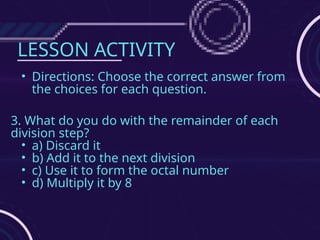
3. What do you do with the remainder of each
division step?
• a) Discard it
• b) Add it to the next division
• c) Use it to form the octal number
• d) Multiply it by 8
LESSON ACTIVITY
• Directions: Choose the correct answer from
the choices for each question.
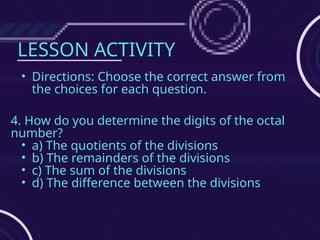
4. How do you determine the digits of the octal
number?
• a) The quotients of the divisions
• b) The remainders of the divisions
• c) The sum of the divisions
• d) The difference between the divisions
LESSON ACTIVITY
• Directions: Choose the correct answer from
the choices for each question.
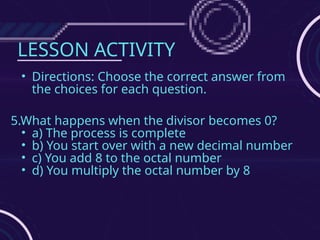
5.What happens when the divisor becomes 0?
• a) The process is complete
• b) You start over with a new decimal number
• c) You add 8 to the octal number
• d) You multiply the octal number by 8
LESSON ACTIVITY
• Directions: Choose the correct answer from
the choices for each question.
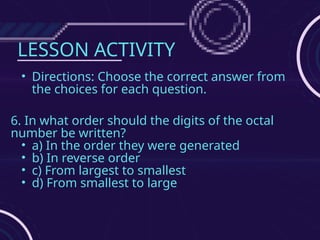
6. In what order should the digits of the octal
number be written?
• a) In the order they were generated
• b) In reverse order
• c) From largest to smallest
• d) From smallest to large
LESSON ACTIVITY
• Directions: Choose the correct answer from
the choices for each question.
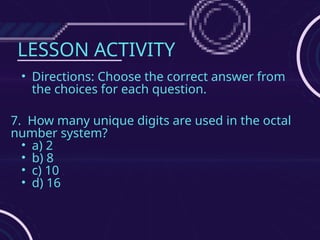
7. How many unique digits are used in the octal
number system?
• a) 2
• b) 8
• c) 10
• d) 16
LESSON ACTIVITY
• Directions: Choose the correct answer from
the choices for each question.
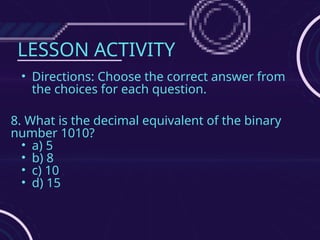
8. What is the decimal equivalent of the binary
number 1010?
• a) 5
• b) 8
• c) 10
• d) 15
LESSON ACTIVITY
• Directions: Choose the correct answer from
the choices for each question.
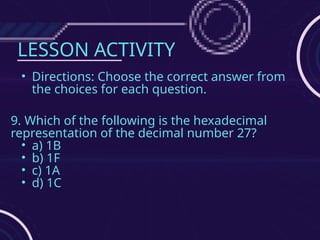
9. Which of the following is the hexadecimal
representation of the decimal number 27?
• a) 1B
• b) 1F
• c) 1A
• d) 1C
LESSON ACTIVITY
• Directions: Choose the correct answer from
the choices for each question.
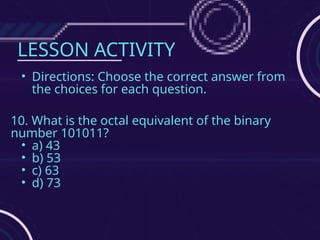
10. What is the octal equivalent of the binary
number 101011?
• a) 43
• b) 53
• c) 63
• d) 73
THANK YOU
FOR LISTENING

ICT 7 WEEK 3.pptx matatag curriculum educational technology

  • 1.
  • 2.
    1. Explain thebasics of number systems and their significance in computing. 2. Identify the steps in the conversion of Decimal to Binary. 3.Convert Decimal to Binary • LEARNING OBJECTIVES:
  • 3.
    4. Identify stepsin the conversion of binary to decimal. 5. Convert Binary to Decimal. 6. Identify steps in the conversion of Decimal to Octal. • LEARNING OBJECTIVES:
  • 4.
    7. Convert Decimalto Octal. 8. Identify steps in the conversion of Octal to Decimal. 9. Convert Octal to Decimal • LEARNING OBJECTIVES:
  • 5.
    SHORT REVIEW WHAT WEARE WORKING ON SNEAK PEEK PROJECT STAGES OUR TEAM MAJOR REQUIREMENT OUR GOALS
  • 6.
    SHORT REVIEW In theworld of computers, numbers are represented using different systems. The most common system is the binary system, which uses only the digits 0 and 1 to represent all numbers and data. Each digit in a binary number is called a bit. Another important system is the hexadecimal system, which uses the digits 0-9 and letters A-F to represent numbers. Computers also use the octal system, which uses digits 0-7.
  • 7.
    NUMBER SYSTEM a methodof representing numbers using specific rules. It provides a consistent way to express numerical values. In mathematics, we use various number systems to represent and manipulate numbers. Here are the four most common types:
  • 8.
    DECIMAL NUMBER SYSTEM (BASE-10): •The decimal system uses ten digits: 0, 1, 2, 3, 4, 5, 6, 7, 8, and 9. • Each position to the left of the decimal point represents powers of 10 (units, tens, hundreds, thousands, etc.).
  • 9.
    BINARY NUMBER SYSTEM (BASE-2): •The binary system uses only two digits: 0 and 1. • It is widely used in computer science and digital electronics.
  • 10.
    OCTAL NUMBER SYSTEM (BASE-8): •The octal system uses eight digits: 0, 1, 2, 3, 4, 5, 6, and 7. • It is less common but still used in some contexts.
  • 11.
    HEXADECIMAL NUMBER SYSTEM (BASE-16): •The hexadecimal system uses sixteen digits: 0–9 and A–F (where A represents 10, B represents 11, and so on). • It is commonly used in computer programming and memory addressing.
  • 12.
    HEXADECIMAL NUMBER SYSTEM (BASE-16): •The hexadecimal system uses sixteen digits: 0–9 and A–F (where A represents 10, B represents 11, and so on). • It is commonly used in computer programming and memory addressing.
  • 13.
    NUMBER SYSTEM ROLEIN MATHEMATICS AND OUR DAILY LIVES. 1.REPRESENTATION OF QUANTITIES: A number system provides a way to represent quantities. Whether it’s counting objects, measuring distances, or calculating time, numbers allow us to express these concepts precisely.
  • 14.
    NUMBER SYSTEM ROLEIN MATHEMATICS AND OUR DAILY LIVES. 1.REPRESENTATION OF QUANTITIES: For example, when you count the number of apples in a basket or measure the length of a room, you’re using the number system.
  • 15.
    NUMBER SYSTEM ROLEIN MATHEMATICS AND OUR DAILY LIVES. 2. FOUNDATION FOR MATHEMATICAL CONCEPTS: All mathematical concepts and formulas are based on the number system. Whether you’re solving equations, working with geometry, or analyzing data, numbers are fundamental.
  • 16.
    NUMBER SYSTEM ROLEIN MATHEMATICS AND OUR DAILY LIVES. From basic arithmetic operations (addition, subtraction, multiplication, division) to advanced calculus and algebra, numbers underpin mathematical reasoning. 2. FOUNDATION FOR MATHEMATICAL CONCEPTS:
  • 17.
    NUMBER SYSTEM ROLEIN MATHEMATICS AND OUR DAILY LIVES. From basic arithmetic operations (addition, subtraction, multiplication, division) to advanced calculus and algebra, numbers underpin mathematical reasoning. 2. FOUNDATION FOR MATHEMATICAL CONCEPTS:
  • 18.
    NUMBER SYSTEM ROLEIN MATHEMATICS AND OUR DAILY LIVES. • Counting Numbers: These start with 1 and continue indefinitely (1, 2, 3, …). • Whole Numbers: Include all counting numbers along with zero (0, 1, 2, …). 3. Types of Numbers:
  • 19.
    NUMBER SYSTEM ROLEIN MATHEMATICS AND OUR DAILY LIVES. • Integers: Positive and negative whole numbers, including zero (-3, -2, -1, 0, 1, 2, 3, …). • Rational Numbers: Expressible as fractions (e.g., 3/4, -2/5). 3. Types of Numbers:
  • 20.
    NUMBER SYSTEM ROLEIN MATHEMATICS AND OUR DAILY LIVES. • Irrational Numbers: Cannot be expressed as fractions (e.g., 2, π). √ • Real Numbers: Encompass both rational and irrational numbers. 3. Types of Numbers:
  • 21.
    NUMBER SYSTEM ROLEIN MATHEMATICS AND OUR DAILY LIVES. • Even Numbers: Divisible by 2 (e.g., 2, 4, 6, …). • Odd Numbers: Not divisible by 2 (e.g., 3, 5, 7, …). 3. Types of Numbers:
  • 22.
    NUMBER SYSTEM ROLEIN MATHEMATICS AND OUR DAILY LIVES. • Prime Numbers: Divisible only by 1 and themselves (e.g., 5, 7, 13). • Composite Numbers: Have multiple factors (e.g., 10, 15, 28). 3. Types of Numbers:
  • 23.
    NUMBER SYSTEM ROLEIN MATHEMATICS AND OUR DAILY LIVES. • Understanding number systems is essential for digital systems (like computers) because they process data using binary representation (base-2). 4. Digital Systems and Data Representation:
  • 24.
    NUMBER SYSTEM ROLEIN MATHEMATICS AND OUR DAILY LIVES. • Computers use bits (0s and 1s) to represent information, and this binary system relies on the principles of the number system. The number system is not only a mathematical tool but also a fundamental aspect of our everyday interactions with the world. It allows us to quantify, calculate, and communicate effectively. 4. Digital Systems and Data Representation:
  • 25.
    NUMBER SYSTEM ROLEIN MATHEMATICS AND OUR DAILY LIVES. • Computers use bits (0s and 1s) to represent information, and this binary system relies on the principles of the number system. The number system is not only a mathematical tool but also a fundamental aspect of our everyday interactions with the world. It allows us to quantify, calculate, and communicate effectively. 4. Digital Systems and Data Representation:
  • 26.
    UNLOCKING VOCABULARY NUMBER SYSTEM DECIMAL is amathematical way of representing a set of values using digits or symbols. is a number that consists of a whole part and a fractional part separated by a decimal point.
  • 27.
    UNLOCKING VOCABULARY BINARY OCTAL is a numberexpressed in the base-2 numeral system, in this system, we use only two symbols: typically, "0" (zero) and "1" (one). is a type of numeral system that uses a base of eight, in this system, the digits range from 0 to 7.
  • 28.
    UNLOCKING VOCABULARY HEXADECIMAL is a base-16numeral system. Unlike our everyday decimal system (base 10), which uses ten symbols (0- 9), hexadecimal employs sixteen symbols. These symbols represent values from 0 to 15.
  • 29.
    BINARY NUMBER SYSTEM afundamental concept in computer science and digital electronics. It uses a base-2 numeral system, which means it only employs two distinct symbols: 0 (zero) and 1 (one). Here are the key points about binary numbers:
  • 30.
    REPRESENTATION: In binary, eachdigit is called a bit. The binary system is used internally by almost all modern computers and electronic devices because it directly maps to electronic circuits using logic gates. Unlike our everyday decimal system (base 10), which uses ten symbols (0-9), binary uses only two symbols (0 and 1).
  • 31.
    CONVERSION: To convert adecimal number to binary, follow these steps: Divide the decimal number by 2. Use the integer quotient obtained as the dividend for the next step.
  • 32.
    CONVERSION: Continue dividing untilthe quotient becomes 0. Write down the remainders in reverse order to get the binary representation.
  • 33.
    EXAMPLE: CONVERT 4TO BINARY: Let's convert the decimal number 4 to binary: Step 1: Divide 4 by 2. Quotient: 2, Remainder: 0 Step 2: Divide 2 by 2. Quotient: 1, Remainder: 0 Step 3: Divide 1 by 2. Quotient: 0, Remainder: 1 Reverse the remainders: 100 Therefore, 4 in binary is 100.
  • 34.
    BIT IN BINARYNUMBER: A single binary digit is called a bit. Examples: 10101 is a five-bit binary number. 101 is a three-bit binary number. 100001 is a six-bit binary number.
  • 35.
    QUESTIONS: How many differentdigits are used in the binary number system? Can you explain the concept of place value in binary numbers? Why is the binary number system important in computing and digital technology?
  • 36.
    IDENTIFY WHAT TYPEOF NUMBER SYSTEM IS THE FOLLOWING. • 78 - ____________ • 100112 - ____________ • F - _______ • 328 - __________ • 1110102 - ___________
  • 37.
    LESSON ACTIVITY 1.Decimal NumberSystem: • Explain its base-10 structure and usage in everyday life.
  • 38.
    LESSON ACTIVITY 2.Binary NumberSystem: • Discuss its base-2 structure and significance in computer processing. • Practice converting binary to decimal and vice versa.
  • 39.
    LESSON ACTIVITY 3. OctalNumber System: • Describe its base-8 structure and where it's used. • Convert octal numbers to binary and decimal.
  • 40.
    LESSON ACTIVITY 4. HexadecimalNumber System: • Explain its base-16 structure and usage in memory addressing. • Practice converting hexadecimal to binary and decimal.
  • 41.
    LESSON ACTIVITY 4. HexadecimalNumber System: • Explain its base-16 structure and usage in memory addressing. • Practice converting hexadecimal to binary and decimal.
  • 42.
    OCTAL NUMBERS base-8 systemthat uses digits from 0 to 7 to represent any number. It is similar to other number systems like binary and hexadecimal.
  • 43.
    BASE AND DIGITS: • Thebase of the octal system is 8. • It uses the digits 0, 1, 2, 3, 4, 5, 6, and 7.
  • 44.
    REPRESENTATION: • Octal numbersare usually represented by binary numbers when grouped in pairs of three. • For example, the octal number 128 is expressed as 0010102 in binary, where 1 is equivalent to 001 and 2 is equivalent to 010.
  • 45.
    CONVERSION: • To convertdecimal numbers to octal, we use the octal dabble method. • For example, to convert 56010 to octal: • 560 ÷ 8 = 70 with a remainder of 0 • 70 ÷ 8 = 8 with a remainder of 6
  • 46.
    CONVERSION: • ÷ 8= 1 with a remainder of 0 • 38. 1 ÷ 8 = 0 with a remainder of 1 • 39. So, the octal representation is 10608.
  • 47.
    TABLE OF OCTALDIGITS: • We use only 3 bits to represent octal numbers. • Each group has a distinct value between 000 and 111. • Octal digits range from 0 to 7.
  • 48.
    Octal Digit BinaryEquivalent Octal Digit Binary Equivalent 0 000 4 100 1 001 5 101 2 010 6 110 4 011 7 111 TABLE OF OCTAL DIGITS:
  • 49.
    APPLICATIONS: • Octal numbersare commonly used in computer programming because they provide a compact way to represent binary numbers (each octal digit corresponds to three binary digits).
  • 50.
    QUESTIONS • 1. Howmany symbols are used in octal numbering system? • 2. Can you explain the concept of place value in octal numbers? • 3. Why are octal numbers often used in computer programming?
  • 51.
    WORKED EXAMPLE • Explainthe purpose of dividing the decimal number by 8 in the conversion process. • Describe how the remainders of the divisions are used to form the octal number. • Why is it important to write the digits of the octal number in reverse order?
  • 52.
    LESSON ACTIVITY 1. UnderstandingBinary Place Values: • Explain the binary place values (1, 2, 4, 8, 16, etc.) and how they relate to the decimal system. 2. The Conversion Process: • Demonstrate the process of converting a decimal number to binary using the division- by-2 method. • Work through several examples as a class, converting simple decimal numbers to binary.
  • 53.
    DECIMAL NUMBERS a numberthat consists of a whole number and a fractional part separated by a point (often called the decimal point).
  • 54.
    WHOLE NUMBER PART: •The whole number part represents the integral value of the quantity. It can be any positive or negative integer. For Example • In the decimal number 42.85, the whole number part is 42. • In the decimal number -123.456, the whole number part is -123.
  • 55.
    FRACTIONAL PART: • Thefractional part represents a value smaller than one. It appears after the decimal point. For Example • In the decimal number 42.85, the fractional part is 0.85. • In the decimal number -123.456, the fractional part is 0.456.
  • 56.
    DECIMAL POINT: • Thedecimal point separates the whole number part from the fractional part. It serves as a visual indicator that we are dealing with a decimal. For Example • The decimal point in 42.85 separates 42 (whole) from 85 (fractional). • The decimal point in -123.456 separates -123 (whole) from 456 (fractional).
  • 57.
    DECIMAL POINT: • allowus to express quantities that are whole plus some part of a whole. They are commonly encountered in everyday situations, such as grocery shopping, measurements, and financial calculations.
  • 58.
    QUESTIONS: • What isthe definition of a decimal number? • Can you explain how decimal numbers are different from whole numbers?42 (whole) from 85 (fractional). • How are decimal numbers represented on a number line?
  • 59.
    DECIMAL POINT: • arean important part of mathematics and are used in many everyday situations. They represent values that are between whole numbers, allowing for more precise measurements and calculations.
  • 60.
    QUESTIONS: • Explain thedifference between a whole number and a decimal number. • Describe the steps to round a decimal number to the nearest hundredth. • How would you add two decimal numbers with different numbers of digits to the right of the decimal point?
  • 61.
    LESSON ACTIVITY • Startwith an overview of different number systems, emphasizing the decimal and octal systems. Explain the base-10 nature of the decimal system and the base-8 nature of the octal system.
  • 62.
    LESSON DEVELOPMENT: 1.Decimal NumberSystem: • Discuss the use of the decimal system in daily life and its base-10 structure. 2. Octal Number System: • Introduce the octal system, explaining its base-8 structure and usage in computing. 3. Conversion Process:em: • Teach the steps to convert a decimal number to its octal equivalent:
  • 63.
    HEXADECIMAL NUMBER • oftensimply called “hex,” is a base-16 numeral system. Unlike our familiar base-10 (decimal) system, which uses ten symbols (0 to 9) to represent numbers, hexadecimal employs sixteen symbols. These symbols include the numerals 0 to 9 and the letters A to F. Each digit in a hexadecimal number corresponds to a specific value, allowing us to express quantities in a compact and efficient manner
  • 64.
    BASE-16 REPRESENTATION: • Hexadecimaluses a base value of 16. This means that each column in a hexadecimal number represents a power of 16 • The sixteen symbols used in hexadecimal are: 0, 1, 2, 3, 4, 5, 6, 7, 8, 9, A, B, C, D, E, and F. • For example, the hexadecimal number “1A” represents 1 × 16 + 10 = 26 in decimal.
  • 65.
    CONVERSION TO OTHER SYSTEMS: •Hexadecimal numbers can be converted to other number systems: • To decimal (base-10): Each digit is multiplied by the corresponding power of 16 and summed. • To binary (base-2): Each hexadecimal digit corresponds to a 4-bit binary representation.
  • 66.
    CONVERSION TO OTHER SYSTEMS: •To octal (base-8): First convert to decimal, then to octal. • These conversions are essential in computer science and digital systems. • Hexadecimal provides a convenient way to work with binary data and efficiently represent values in various contexts.
  • 67.
    WORKED EXAMPLE • 1.Whatis the base of a hexadecimal number system? • 2.How many unique symbols are used in hexadecimal numbers? • 3.Can you explain why hexadecimal numbers are commonly used in computer science and digital systems?
  • 68.
    WORKED EXAMPLE • Example:Convert the decimal number 456 to hexadecimal 1. Divide the decimal number by 16 and record the quotient and remainder. 2. Repeat the division using the quotient from the previous step until the quotient is zero. 3. The hexadecimal number is formed by the remainders read from bottom to top.
  • 69.
    STEPS: 1. Initial Number:456 2. First Division: • Divide 456 by 16. • Quotient: 456÷16=28456 div 16 = 28456÷16=28 (integer part) • Remainder: 456 mod 16=8456 mod 16 = 8456mod16=8
  • 70.
    STEPS: 3. So, 456divided by 16 gives a quotient of 28 and a remainder of 8. 4. Second Division: • Now divide the quotient from the first division (28) by 16. • Quotient: 28÷16=128 div 16 = 128÷16=1 (integer part) • Remainder: 28 mod 16=1228 mod 16 = 1228mod16=12
  • 71.
    STEPS: 5. So, 28divided by 16 gives a quotient of 1 and a remainder of 12. Note that in hexadecimal, 12 is represented as 'C'. 6.Third Division: • Now divide the quotient from the second division (1) by 16. • Quotient: 1÷16=01 div 16 = 01÷16=0 (integer part) • Remainder: 1mod 16=11 mod 16 = 11mod16=1
  • 72.
    STEPS: 7. So, 1divided by 16 gives a quotient of 0 and a remainder of 1. 8. Construct the Hexadecimal Number: • Write the remainders from the last to the first. • The remainders are 1, 12 (C in hexadecimal), and 8.
  • 73.
    STEPS: 9.Therefore, the hexadecimalrepresentation of the decimal number 456 is 1C8. Summary • Divide the decimal number by 16. • Write down the remainder. • Use the quotient for the next division. • Repeat until the quotient is zero.
  • 74.
    STEPS: ●The hexadecimal numberis the remainders read from bottom to top. • The steps above show the conversion process clearly. This method can be used for any decimal number to convert it to hexadecimal.
  • 75.
    LESSON ACTIVITY • Directions:Converting Decimal Numbers to Hexadecimal and Hexadecimal to Decimal. 1. What is the hexadecimal equivalent of the decimal number 27? a. 1B b. 1F c. 23 d. 2E
  • 76.
    LESSON ACTIVITY • Directions:Converting Decimal Numbers to Hexadecimal and Hexadecimal to Decimal. 2. Which of the following is a correct hexadecimal representation of the decimal number 50? a. 30 b. 32 c. 35 d. 38
  • 77.
    LESSON ACTIVITY • Directions:Converting Decimal Numbers to Hexadecimal and Hexadecimal to Decimal. 3. If the hexadecimal number 3D is converted to decimal, what is the result? a. 53 b. 61 c. 57 d. 59
  • 78.
    LESSON ACTIVITY • Directions:Converting Decimal Numbers to Hexadecimal and Hexadecimal to Decimal. 4. What is the decimal value of the hexadecimal number A4? a. 161 b. 164 c. 166 d. 168
  • 79.
    LESSON ACTIVITY • Directions:Converting Decimal Numbers to Hexadecimal and Hexadecimal to Decimal. 5. Convert the decimal number 95 to hexadecimal. a. 5D b. 60 c. 61 d. 65
  • 80.
    TAKEAWAYS • recap theconcept of the different computer number systems and the conversion of decimal number to binary, octal, and hexadecimal.
  • 81.
    REFLECTION • How doyou find today’s lesson? Was it hard? Which part of the lesson do you find difficult?
  • 82.
    LESSON ACTIVITY • Directions:Choose the correct answer from the choices for each question. 1.Which of the following best describes the binary number system? • a) A number system that uses 0-9 • b) A number system that uses 0-7 • c) A number system that uses 0-1 • d) A number system that uses o-F
  • 83.
    LESSON ACTIVITY • Directions:Choose the correct answer from the choices for each question. 2.What is the first step in converting a decimal number to octal? • a) Divide the decimal number by 8 • b) Write the decimal number in reverse order • c) Multiply the decimal number by 8 • d) Add 8 to the decimal number
  • 84.
    LESSON ACTIVITY • Directions:Choose the correct answer from the choices for each question. 3. What do you do with the remainder of each division step? • a) Discard it • b) Add it to the next division • c) Use it to form the octal number • d) Multiply it by 8
  • 85.
    LESSON ACTIVITY • Directions:Choose the correct answer from the choices for each question. 4. How do you determine the digits of the octal number? • a) The quotients of the divisions • b) The remainders of the divisions • c) The sum of the divisions • d) The difference between the divisions
  • 86.
    LESSON ACTIVITY • Directions:Choose the correct answer from the choices for each question. 5.What happens when the divisor becomes 0? • a) The process is complete • b) You start over with a new decimal number • c) You add 8 to the octal number • d) You multiply the octal number by 8
  • 87.
    LESSON ACTIVITY • Directions:Choose the correct answer from the choices for each question. 6. In what order should the digits of the octal number be written? • a) In the order they were generated • b) In reverse order • c) From largest to smallest • d) From smallest to large
  • 88.
    LESSON ACTIVITY • Directions:Choose the correct answer from the choices for each question. 7. How many unique digits are used in the octal number system? • a) 2 • b) 8 • c) 10 • d) 16
  • 89.
    LESSON ACTIVITY • Directions:Choose the correct answer from the choices for each question. 8. What is the decimal equivalent of the binary number 1010? • a) 5 • b) 8 • c) 10 • d) 15
  • 90.
    LESSON ACTIVITY • Directions:Choose the correct answer from the choices for each question. 9. Which of the following is the hexadecimal representation of the decimal number 27? • a) 1B • b) 1F • c) 1A • d) 1C
  • 91.
    LESSON ACTIVITY • Directions:Choose the correct answer from the choices for each question. 10. What is the octal equivalent of the binary number 101011? • a) 43 • b) 53 • c) 63 • d) 73
  • 92.