Downloaded 147 times
![NEED FOR
LIMITED SLIP DIFFERENTIAL
[Author, Presentation name]2
Limited slip differentials use various mechanisms
to allow normal differential action during turns,
while also solving the problem of slippage.
When one powered tire slips, the LSD transfers
more torque to the non-slipping wheel.
It provides better traction .](https://image.slidesharecdn.com/lsdppt-150422125345-conversion-gate01/85/Limited-slip-differential-2-320.jpg)
![PRINCIPLE
OF
OPERATION
[Author, Presentation name]4
LSD mechanism applies a torque (internal to the differential) that resists
the relative motion of the output shafts.
In simple terms, this means they have some mechanism which resists
a speed difference between the outputs, by creating a resisting torque
between either the two outputs, or the outputs and the differential
housing. There are many mechanisms used to create this resisting
torque.
Example-viscous and clutch-based LSDs.
The amount of limiting torque provided by these mechanisms varies by
design](https://image.slidesharecdn.com/lsdppt-150422125345-conversion-gate01/85/Limited-slip-differential-4-320.jpg)
![TYPES
OF LIMIT DIFFERENTIALS
[Author, Presentation name]6
1. VISCOUS TYPE
2. HELICAL TYPE
3. TORQUE SENSITIVE TYPE
4. CLUTCH TYPE
5. 2-WAY,1-WAY,1.5 WAY
6. ELECTRONIC](https://image.slidesharecdn.com/lsdppt-150422125345-conversion-gate01/85/Limited-slip-differential-6-320.jpg)
![[Author, Presentation name]7
CLUTCH TYPE LIMIT SWITCH DIFFERENTIAL](https://image.slidesharecdn.com/lsdppt-150422125345-conversion-gate01/85/Limited-slip-differential-7-320.jpg)
![[Author, Presentation name]8](https://image.slidesharecdn.com/lsdppt-150422125345-conversion-gate01/85/Limited-slip-differential-8-320.jpg)
![[Author, Presentation name]9
TORQUE SENSITIVE LIMIT SWITCH
DIFFERENTIAL](https://image.slidesharecdn.com/lsdppt-150422125345-conversion-gate01/85/Limited-slip-differential-9-320.jpg)
![[Author, Presentation name]10](https://image.slidesharecdn.com/lsdppt-150422125345-conversion-gate01/85/Limited-slip-differential-10-320.jpg)
![[Author, Presentation name]11
Thank You](https://image.slidesharecdn.com/lsdppt-150422125345-conversion-gate01/85/Limited-slip-differential-11-320.jpg)

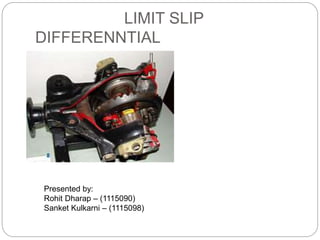
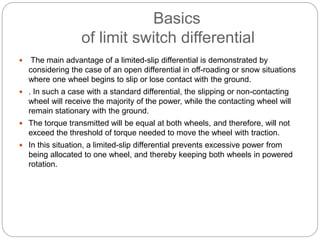
This presentation discusses limited slip differentials. It begins by explaining the need for limited slip differentials and how they transfer more torque to the non-slipping wheel when one powered tire slips. It then discusses the basics of how a limited slip differential works, explaining that it prevents excessive power from being allocated to the slipping wheel. The presentation goes on to describe the different principles and mechanisms by which limited slip differentials operate and distribute torque between the wheels, such as viscous couplings or clutch packs. It also outlines several common types of limited slip differentials, such as viscous, helical, torque-sensitive, and clutch-type differentials.


![Limited slip-differential swap and theoretical report Big pres [Autosaved]](https://cdn.slidesharecdn.com/ss_thumbnails/2ef7260c-08ca-47a2-ad53-bb66831e2599-170105234753-thumbnail.jpg?width=640&height=640&fit=bounds)


![Evolution_of_Rear_Differential_Systems[1] - Copy.pptx](https://cdn.slidesharecdn.com/ss_thumbnails/evolutionofreardifferentialsystems1-copy-241219071715-5a59a15d-thumbnail.jpg?width=640&height=640&fit=bounds)


