Chapter 2 
Mechanical Behavior, Testing, and 
Manufacturing Properties of Materials 
Manufacturing, Engineering & Technology, Fifth Edition, by Serope Kalpakjian and Steven R. Schmid. 
ISBN 0-13-148965-8. © 2006 Pearson Education, Inc., Upper Saddle River, NJ. All rights reserved.
Relative Mechanical Properties of Materials 
Manufacturing, Engineering & Technology, Fifth Edition, by Serope Kalpakjian and Steven R. Schmid. 
ISBN 0-13-148965-8. © 2006 Pearson Education, Inc., Upper Saddle River, NJ. All rights reserved.
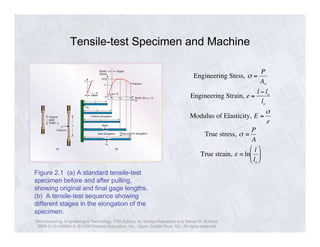
Tensile-test Specimen and Machine 
Figure 2.1 (a) A standard tensile-test 
specimen before and after pulling, 
showing original and final gage lengths. 
(b) A tensile-test sequence showing 
different stages in the elongation of the 
specimen. 
! 
Engineering Stess, " = 
Manufacturing, Engineering & Technology, Fifth Edition, by Serope Kalpakjian and Steven R. Schmid. 
ISBN 0-13-148965-8. © 2006 Pearson Education, Inc., Upper Saddle River, NJ. All rights reserved. 
P 
A 
o 
Engineering Strain, e = 
l # l 
o 
l 
o 
Modulus of Elasticity, E = 
" 
e 
True stress, " = 
P 
A 
True strain, $ = ln 
l 
l 
o 
% 
' 
& 
( 
* 
)
Tension Test Stress-strain Curve 
Figure 2.2 A typical stress-strain curve obtained 
from a tension test, showing various features 
Manufacturing, Engineering & Technology, Fifth Edition, by Serope Kalpakjian and Steven R. Schmid. 
ISBN 0-13-148965-8. © 2006 Pearson Education, Inc., Upper Saddle River, NJ. All rights reserved.
Mechanical Properties of Materials 
Manufacturing, Engineering & Technology, Fifth Edition, by Serope Kalpakjian and Steven R. Schmid. 
ISBN 0-13-148965-8. © 2006 Pearson Education, Inc., Upper Saddle River, NJ. All rights reserved.
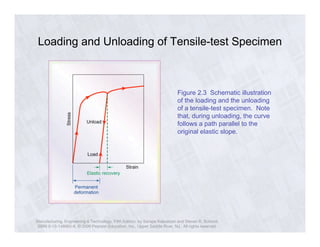
Loading and Unloading of Tensile-test Specimen 
Figure 2.3 Schematic illustration 
of the loading and the unloading 
of a tensile-test specimen. Note 
that, during unloading, the curve 
follows a path parallel to the 
original elastic slope. 
Manufacturing, Engineering & Technology, Fifth Edition, by Serope Kalpakjian and Steven R. Schmid. 
ISBN 0-13-148965-8. © 2006 Pearson Education, Inc., Upper Saddle River, NJ. All rights reserved.
Elongation vs. Tensile-reduction 
Figure 2.4 Approximate relationship between elongation 
and tensile reduction of area for various groups of metals 
Manufacturing, Engineering & Technology, Fifth Edition, by Serope Kalpakjian and Steven R. Schmid. 
ISBN 0-13-148965-8. © 2006 Pearson Education, Inc., Upper Saddle River, NJ. All rights reserved.
Tension and Stress Curves 
Figure 2.5 (a) Load elongation 
curve in tension testing of a 
stainless steel specimen. (b) 
Engineering stress-engineering 
strain curve, drawn from the data 
in Fig. 2.5a. (c) True stress-true 
strain curve, drawn from the data 
in Fig. 2.5b. Note that this curve 
has a positive slope, indicating 
that the material is becoming 
stringer as it is strained. (d) 
True stress-true strain curve 
plotted on the log-log paper and 
based on the corrected curve in 
Fig. 2.5c. The correction is due 
to the triaxial state of stress tat 
exists in the necked region of the 
specimen. 
Manufacturing, Engineering & Technology, Fifth Edition, by Serope Kalpakjian and Steven R. Schmid. 
ISBN 0-13-148965-8. © 2006 Pearson Education, Inc., Upper Saddle River, NJ. All rights reserved.
Power Law Constitutive Model 
! 
Manufacturing, Engineering & Technology, Fifth Edition, by Serope Kalpakjian and Steven R. Schmid. 
ISBN 0-13-148965-8. © 2006 Pearson Education, Inc., Upper Saddle River, NJ. All rights reserved. 
" = K#n 
where 
K = strength coefficient 
n = strain hardening 
exponent
True Stress-strain Curves 
Figure 2.6 True stress-strain 
Manufacturing, Engineering & Technology, Fifth Edition, by Serope Kalpakjian and Steven R. Schmid. 
ISBN 0-13-148965-8. © 2006 Pearson Education, Inc., Upper Saddle River, NJ. All rights reserved. 
curves in tension at 
room temperature for 
various metals. The 
curves start at a finite level 
of stress: The elastic 
regions have too steep a 
slope to be shown in this 
figure, and thus each 
curve starts at the yield 
stress, Y, of the material
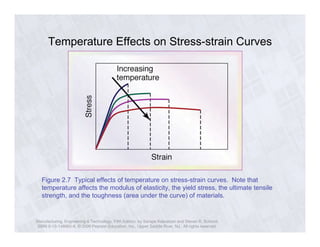
Temperature Effects on Stress-strain Curves 
Figure 2.7 Typical effects of temperature on stress-strain curves. Note that 
temperature affects the modulus of elasticity, the yield stress, the ultimate tensile 
strength, and the toughness (area under the curve) of materials. 
Manufacturing, Engineering & Technology, Fifth Edition, by Serope Kalpakjian and Steven R. Schmid. 
ISBN 0-13-148965-8. © 2006 Pearson Education, Inc., Upper Saddle River, NJ. All rights reserved.
Strain and Deformation Rate in Manufacturing 
Manufacturing, Engineering & Technology, Fifth Edition, by Serope Kalpakjian and Steven R. Schmid. 
ISBN 0-13-148965-8. © 2006 Pearson Education, Inc., Upper Saddle River, NJ. All rights reserved.
Effect of Strain Rate on Tensile Strength of Al 
Figure 2.8 The effect of strain 
rate on the ultimate tensile 
strength for aluminum. Note 
that, as the temperature 
increases, the slopes of the 
curves increase; thus, strength 
becomes more and more 
sensitive to strain rate as 
temperature increases. 
Source: After J.H. Holloman 
Manufacturing, Engineering & Technology, Fifth Edition, by Serope Kalpakjian and Steven R. Schmid. 
ISBN 0-13-148965-8. © 2006 Pearson Education, Inc., Upper Saddle River, NJ. All rights reserved.
Disk Test 
Figure 2.9 Disk test on a brittle material, 
showing the direction of loading and the 
fracture path. 
! 
Tensile stress, " = 
Manufacturing, Engineering & Technology, Fifth Edition, by Serope Kalpakjian and Steven R. Schmid. 
ISBN 0-13-148965-8. © 2006 Pearson Education, Inc., Upper Saddle River, NJ. All rights reserved. 
2P 
#dt 
where 
P = load at fracture 
d = diameter of disk 
t = thickness of disk
Torsion-Test Specimen 
Figure 2.10 A typical torsion-test specimen; it 
is mounted between the two heads of a testing 
machine and twisted. Note the shear 
deformation of an element in the reduced 
section of the specimen. 
! 
Shear stress, " = 
Manufacturing, Engineering & Technology, Fifth Edition, by Serope Kalpakjian and Steven R. Schmid. 
ISBN 0-13-148965-8. © 2006 Pearson Education, Inc., Upper Saddle River, NJ. All rights reserved. 
T 
2#r2t 
Shear strain, $ = 
r% 
l 
where 
T = torque 
r = average tube radius 
t = thickness of tube at 
narrow section 
l = length of tube subjected 
to torsion 
φ = angle of twist
Bend-test Methods 
Figure 2.11 Two bend-test methods for brittle materials: (a) three-point 
bending; (b) four-point bending. The areas on the beams represent the 
bending-movement diagrams, described in texts on mechanics of solids. Note 
the region of constant maximum bending movement in (b); by contrast, the 
maximum bending moment occurs only at the center of the specimen in (a). 
Manufacturing, Engineering & Technology, Fifth Edition, by Serope Kalpakjian and Steven R. Schmid. 
ISBN 0-13-148965-8. © 2006 Pearson Education, Inc., Upper Saddle River, NJ. All rights reserved.
Hardness-testing Methods and Formulas 
Figure 2.12 General characteristics of hardness-testing 
methods and formulas for calculating hardness. 
Manufacturing, Engineering & Technology, Fifth Edition, by Serope Kalpakjian and Steven R. Schmid. 
ISBN 0-13-148965-8. © 2006 Pearson Education, Inc., Upper Saddle River, NJ. All rights reserved.
Indentation Geometry for Brinnel Testing 
Figure 2.13 Indentation 
geometry in Brinell hardness 
testing: (a) annealed metal; (b) 
work-hardened metal; (c) 
deformation of mild steel under a 
spherical indenter. Note that the 
depth of the permanently 
deformed zone is about one 
order of magnitude larger that the 
depth of indentation. For a 
hardness test to be valid, this 
zone should be developed fully in 
the material. Source: Courtesy 
of M.C. Shaw and C.T. Yang 
Manufacturing, Engineering & Technology, Fifth Edition, by Serope Kalpakjian and Steven R. Schmid. 
ISBN 0-13-148965-8. © 2006 Pearson Education, Inc., Upper Saddle River, NJ. All rights reserved.
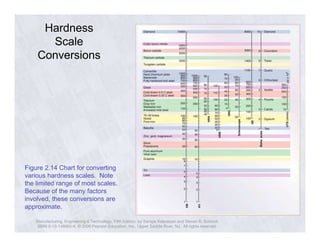
Hardness 
Scale 
Conversions 
Figure 2.14 Chart for converting 
various hardness scales. Note 
the limited range of most scales. 
Because of the many factors 
involved, these conversions are 
approximate. 
Manufacturing, Engineering & Technology, Fifth Edition, by Serope Kalpakjian and Steven R. Schmid. 
ISBN 0-13-148965-8. © 2006 Pearson Education, Inc., Upper Saddle River, NJ. All rights reserved.
S-N Curves 
Figure 2.15 (a) Typical S-N curves for two metals. Note that, unlike steel, 
aluminum does not have an endurance limit. (b) S-N curves for common polymers 
Manufacturing, Engineering & Technology, Fifth Edition, by Serope Kalpakjian and Steven R. Schmid. 
ISBN 0-13-148965-8. © 2006 Pearson Education, Inc., Upper Saddle River, NJ. All rights reserved.
Endurance Limit vs. Tensile Strength 
Figure 2.16 Ratio of 
endurance limit to tensile 
strength for various metals, 
as a function of tensile 
strength. Because 
aluminum does not have an 
endurance limit, the 
correlations for aluminum 
are based on a specific 
number of cycles, as is 
seen in Fig. 2.15. 
Manufacturing, Engineering & Technology, Fifth Edition, by Serope Kalpakjian and Steven R. Schmid. 
ISBN 0-13-148965-8. © 2006 Pearson Education, Inc., Upper Saddle River, NJ. All rights reserved.
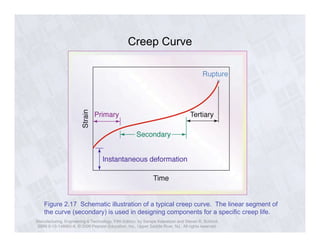
Creep Curve 
Figure 2.17 Schematic illustration of a typical creep curve. The linear segment of 
the curve (secondary) is used in designing components for a specific creep life. 
Manufacturing, Engineering & Technology, Fifth Edition, by Serope Kalpakjian and Steven R. Schmid. 
ISBN 0-13-148965-8. © 2006 Pearson Education, Inc., Upper Saddle River, NJ. All rights reserved.
Impact Test Specimens 
Figure 2.18 Impact test specimens: (a) Charpy; (b) Izod. 
Manufacturing, Engineering & Technology, Fifth Edition, by Serope Kalpakjian and Steven R. Schmid. 
ISBN 0-13-148965-8. © 2006 Pearson Education, Inc., Upper Saddle River, NJ. All rights reserved.
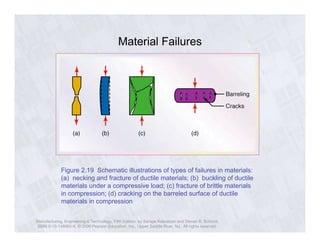
Material Failures 
Figure 2.19 Schematic illustrations of types of failures in materials: 
(a) necking and fracture of ductile materials; (b) buckling of ductile 
materials under a compressive load; (c) fracture of brittle materials 
in compression; (d) cracking on the barreled surface of ductile 
materials in compression 
Manufacturing, Engineering & Technology, Fifth Edition, by Serope Kalpakjian and Steven R. Schmid. 
ISBN 0-13-148965-8. © 2006 Pearson Education, Inc., Upper Saddle River, NJ. All rights reserved.
Fracture Types in Tension 
Figure 2.20 Schematic illustration of the types of fracture in tension: (a) brittle 
fracture in polycrystalline metals; (b) shear fracture in ductile single crystals – see 
also Fig 1.6a; (c) ductile cup-and-cone fracture in polycrystalline metals; (d) 
complete ductile fracture in polycrystalline metals, with 100% reduction of area. 
Manufacturing, Engineering & Technology, Fifth Edition, by Serope Kalpakjian and Steven R. Schmid. 
ISBN 0-13-148965-8. © 2006 Pearson Education, Inc., Upper Saddle River, NJ. All rights reserved.
Ductile Fracture in Low-carbon Steel 
Manufacturing, Engineering & Technology, Fifth Edition, by Serope Kalpakjian and Steven R. Schmid. 
ISBN 0-13-148965-8. © 2006 Pearson Education, Inc., Upper Saddle River, NJ. All rights reserved. 
Figure 2.21 Surface of 
ductile fracture in low-carbon 
steel, showing 
dimples. Fracture 
usually is initiated at 
impurities, inclusions, 
or preexisting voids 
(microporosity) in the 
metal. Source: 
Courtesy of K. H. 
Habig and D. Klaffke
Progression of a Fracture 
Figure 2.22 Sequence of events in the necking and fracture of a tensile-test specimen: 
(a) early stage of necking; (b) small voids begin to form within the necked region; (c) 
voids coalesce, producing an internal crack; (d) the rest of the cross-section begins to 
fail at the periphery, by shearing; (e) the final fracture surfaces, known as cup- (top 
fracture surface) and cone- (bottom surface) fracture. 
Manufacturing, Engineering & Technology, Fifth Edition, by Serope Kalpakjian and Steven R. Schmid. 
ISBN 0-13-148965-8. © 2006 Pearson Education, Inc., Upper Saddle River, NJ. All rights reserved.
Deformation of Inclusions and Their Effect on Void Formation 
Figure 2.23 Schematic illustration of the deformation of soft and hard inclusions and of 
their effect on void formation in plastic deformation. Note that, because they do not 
conform to the overall deformation of the ductile matrix, hard inclusions can cause 
internal voids. 
Manufacturing, Engineering & Technology, Fifth Edition, by Serope Kalpakjian and Steven R. Schmid. 
ISBN 0-13-148965-8. © 2006 Pearson Education, Inc., Upper Saddle River, NJ. All rights reserved.
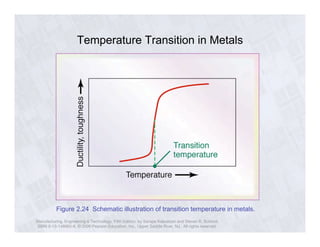
Temperature Transition in Metals 
Figure 2.24 Schematic illustration of transition temperature in metals. 
Manufacturing, Engineering & Technology, Fifth Edition, by Serope Kalpakjian and Steven R. Schmid. 
ISBN 0-13-148965-8. © 2006 Pearson Education, Inc., Upper Saddle River, NJ. All rights reserved.
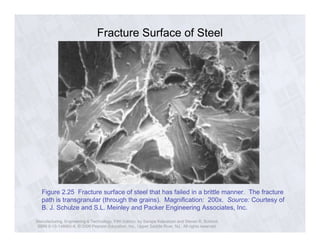
Fracture Surface of Steel 
Figure 2.25 Fracture surface of steel that has failed in a brittle manner. The fracture 
path is transgranular (through the grains). Magnification: 200x. Source: Courtesy of 
B. J. Schulze and S.L. Meinley and Packer Engineering Associates, Inc. 
Manufacturing, Engineering & Technology, Fifth Edition, by Serope Kalpakjian and Steven R. Schmid. 
ISBN 0-13-148965-8. © 2006 Pearson Education, Inc., Upper Saddle River, NJ. All rights reserved.
Intergranular Fracture 
Figure 2.26 Intergranular fracture, at two different magnifications. Grains and grain 
boundaries are clearly visible in this micrograph. The fracture path is along the grain 
boundaries. Magnification: left, 100x; right, 500x. Source: Courtesy of B.J. Schulze 
and S.L. Meiley and Packer Engineering Associates, Inc. 
Manufacturing, Engineering & Technology, Fifth Edition, by Serope Kalpakjian and Steven R. Schmid. 
ISBN 0-13-148965-8. © 2006 Pearson Education, Inc., Upper Saddle River, NJ. All rights reserved.
Fatigue-Fracture Surface 
Figure 2.28 Typical fatigue-fracture surface on metals, showing beach marks. 
Magnification: left, 500x; right, 1000x. Source: Courtesy of B.J. Schulze and S.L. 
Meiley and Packer Engineering Associates, Inc. 
Manufacturing, Engineering & Technology, Fifth Edition, by Serope Kalpakjian and Steven R. Schmid. 
ISBN 0-13-148965-8. © 2006 Pearson Education, Inc., Upper Saddle River, NJ. All rights reserved.
Reduction in Fatigue Strength vs. Ultimate Tensile Strength 
Figure 2.28 Reductions in fatigue 
strength of cast steels subjected to 
various surface-finishing operations. 
Note that the reduction becomes 
greater as the surface roughness 
and the strength of steel increase. 
Source: Courtesy of M. R. Mitchell 
Manufacturing, Engineering & Technology, Fifth Edition, by Serope Kalpakjian and Steven R. Schmid. 
ISBN 0-13-148965-8. © 2006 Pearson Education, Inc., Upper Saddle River, NJ. All rights reserved.
Residual Stresses in Bending a Beam 
Figure 2.29 Residual stresses developed in bending a beam having a 
rectangular cross-section. Note that the horizontal forces and moments 
caused by residual stresses in the beam must be balanced internally. 
Because of nonuniform deformation and especially during cold-metalworking 
operations, most parts develop residual stresses. 
Manufacturing, Engineering & Technology, Fifth Edition, by Serope Kalpakjian and Steven R. Schmid. 
ISBN 0-13-148965-8. © 2006 Pearson Education, Inc., Upper Saddle River, NJ. All rights reserved.
Distortion with Residual Stresses 
Figure 2.30 Distortion of parts, with residual stresses, after cutting or slitting: 
(a) flat sheet or plate; (b) solid round rod; (c) thin-walled tubing or pipe. 
Manufacturing, Engineering & Technology, Fifth Edition, by Serope Kalpakjian and Steven R. Schmid. 
ISBN 0-13-148965-8. © 2006 Pearson Education, Inc., Upper Saddle River, NJ. All rights reserved.

Ch2 mechanical behaviour Erdi Karaçal Mechanical Engineer University of Gaziantep

  • 1.
    Chapter 2 MechanicalBehavior, Testing, and Manufacturing Properties of Materials Manufacturing, Engineering & Technology, Fifth Edition, by Serope Kalpakjian and Steven R. Schmid. ISBN 0-13-148965-8. © 2006 Pearson Education, Inc., Upper Saddle River, NJ. All rights reserved.
  • 2.
    Relative Mechanical Propertiesof Materials Manufacturing, Engineering & Technology, Fifth Edition, by Serope Kalpakjian and Steven R. Schmid. ISBN 0-13-148965-8. © 2006 Pearson Education, Inc., Upper Saddle River, NJ. All rights reserved.
  • 3.
    Tensile-test Specimen andMachine Figure 2.1 (a) A standard tensile-test specimen before and after pulling, showing original and final gage lengths. (b) A tensile-test sequence showing different stages in the elongation of the specimen. ! Engineering Stess, " = Manufacturing, Engineering & Technology, Fifth Edition, by Serope Kalpakjian and Steven R. Schmid. ISBN 0-13-148965-8. © 2006 Pearson Education, Inc., Upper Saddle River, NJ. All rights reserved. P A o Engineering Strain, e = l # l o l o Modulus of Elasticity, E = " e True stress, " = P A True strain, $ = ln l l o % ' & ( * )
  • 4.
    Tension Test Stress-strainCurve Figure 2.2 A typical stress-strain curve obtained from a tension test, showing various features Manufacturing, Engineering & Technology, Fifth Edition, by Serope Kalpakjian and Steven R. Schmid. ISBN 0-13-148965-8. © 2006 Pearson Education, Inc., Upper Saddle River, NJ. All rights reserved.
  • 5.
    Mechanical Properties ofMaterials Manufacturing, Engineering & Technology, Fifth Edition, by Serope Kalpakjian and Steven R. Schmid. ISBN 0-13-148965-8. © 2006 Pearson Education, Inc., Upper Saddle River, NJ. All rights reserved.
  • 6.
    Loading and Unloadingof Tensile-test Specimen Figure 2.3 Schematic illustration of the loading and the unloading of a tensile-test specimen. Note that, during unloading, the curve follows a path parallel to the original elastic slope. Manufacturing, Engineering & Technology, Fifth Edition, by Serope Kalpakjian and Steven R. Schmid. ISBN 0-13-148965-8. © 2006 Pearson Education, Inc., Upper Saddle River, NJ. All rights reserved.
  • 7.
    Elongation vs. Tensile-reduction Figure 2.4 Approximate relationship between elongation and tensile reduction of area for various groups of metals Manufacturing, Engineering & Technology, Fifth Edition, by Serope Kalpakjian and Steven R. Schmid. ISBN 0-13-148965-8. © 2006 Pearson Education, Inc., Upper Saddle River, NJ. All rights reserved.
  • 8.
    Tension and StressCurves Figure 2.5 (a) Load elongation curve in tension testing of a stainless steel specimen. (b) Engineering stress-engineering strain curve, drawn from the data in Fig. 2.5a. (c) True stress-true strain curve, drawn from the data in Fig. 2.5b. Note that this curve has a positive slope, indicating that the material is becoming stringer as it is strained. (d) True stress-true strain curve plotted on the log-log paper and based on the corrected curve in Fig. 2.5c. The correction is due to the triaxial state of stress tat exists in the necked region of the specimen. Manufacturing, Engineering & Technology, Fifth Edition, by Serope Kalpakjian and Steven R. Schmid. ISBN 0-13-148965-8. © 2006 Pearson Education, Inc., Upper Saddle River, NJ. All rights reserved.
  • 9.
    Power Law ConstitutiveModel ! Manufacturing, Engineering & Technology, Fifth Edition, by Serope Kalpakjian and Steven R. Schmid. ISBN 0-13-148965-8. © 2006 Pearson Education, Inc., Upper Saddle River, NJ. All rights reserved. " = K#n where K = strength coefficient n = strain hardening exponent
  • 10.
    True Stress-strain Curves Figure 2.6 True stress-strain Manufacturing, Engineering & Technology, Fifth Edition, by Serope Kalpakjian and Steven R. Schmid. ISBN 0-13-148965-8. © 2006 Pearson Education, Inc., Upper Saddle River, NJ. All rights reserved. curves in tension at room temperature for various metals. The curves start at a finite level of stress: The elastic regions have too steep a slope to be shown in this figure, and thus each curve starts at the yield stress, Y, of the material
  • 11.
    Temperature Effects onStress-strain Curves Figure 2.7 Typical effects of temperature on stress-strain curves. Note that temperature affects the modulus of elasticity, the yield stress, the ultimate tensile strength, and the toughness (area under the curve) of materials. Manufacturing, Engineering & Technology, Fifth Edition, by Serope Kalpakjian and Steven R. Schmid. ISBN 0-13-148965-8. © 2006 Pearson Education, Inc., Upper Saddle River, NJ. All rights reserved.
  • 12.
    Strain and DeformationRate in Manufacturing Manufacturing, Engineering & Technology, Fifth Edition, by Serope Kalpakjian and Steven R. Schmid. ISBN 0-13-148965-8. © 2006 Pearson Education, Inc., Upper Saddle River, NJ. All rights reserved.
  • 13.
    Effect of StrainRate on Tensile Strength of Al Figure 2.8 The effect of strain rate on the ultimate tensile strength for aluminum. Note that, as the temperature increases, the slopes of the curves increase; thus, strength becomes more and more sensitive to strain rate as temperature increases. Source: After J.H. Holloman Manufacturing, Engineering & Technology, Fifth Edition, by Serope Kalpakjian and Steven R. Schmid. ISBN 0-13-148965-8. © 2006 Pearson Education, Inc., Upper Saddle River, NJ. All rights reserved.
  • 14.
    Disk Test Figure2.9 Disk test on a brittle material, showing the direction of loading and the fracture path. ! Tensile stress, " = Manufacturing, Engineering & Technology, Fifth Edition, by Serope Kalpakjian and Steven R. Schmid. ISBN 0-13-148965-8. © 2006 Pearson Education, Inc., Upper Saddle River, NJ. All rights reserved. 2P #dt where P = load at fracture d = diameter of disk t = thickness of disk
  • 15.
    Torsion-Test Specimen Figure2.10 A typical torsion-test specimen; it is mounted between the two heads of a testing machine and twisted. Note the shear deformation of an element in the reduced section of the specimen. ! Shear stress, " = Manufacturing, Engineering & Technology, Fifth Edition, by Serope Kalpakjian and Steven R. Schmid. ISBN 0-13-148965-8. © 2006 Pearson Education, Inc., Upper Saddle River, NJ. All rights reserved. T 2#r2t Shear strain, $ = r% l where T = torque r = average tube radius t = thickness of tube at narrow section l = length of tube subjected to torsion φ = angle of twist
  • 16.
    Bend-test Methods Figure2.11 Two bend-test methods for brittle materials: (a) three-point bending; (b) four-point bending. The areas on the beams represent the bending-movement diagrams, described in texts on mechanics of solids. Note the region of constant maximum bending movement in (b); by contrast, the maximum bending moment occurs only at the center of the specimen in (a). Manufacturing, Engineering & Technology, Fifth Edition, by Serope Kalpakjian and Steven R. Schmid. ISBN 0-13-148965-8. © 2006 Pearson Education, Inc., Upper Saddle River, NJ. All rights reserved.
  • 17.
    Hardness-testing Methods andFormulas Figure 2.12 General characteristics of hardness-testing methods and formulas for calculating hardness. Manufacturing, Engineering & Technology, Fifth Edition, by Serope Kalpakjian and Steven R. Schmid. ISBN 0-13-148965-8. © 2006 Pearson Education, Inc., Upper Saddle River, NJ. All rights reserved.
  • 18.
    Indentation Geometry forBrinnel Testing Figure 2.13 Indentation geometry in Brinell hardness testing: (a) annealed metal; (b) work-hardened metal; (c) deformation of mild steel under a spherical indenter. Note that the depth of the permanently deformed zone is about one order of magnitude larger that the depth of indentation. For a hardness test to be valid, this zone should be developed fully in the material. Source: Courtesy of M.C. Shaw and C.T. Yang Manufacturing, Engineering & Technology, Fifth Edition, by Serope Kalpakjian and Steven R. Schmid. ISBN 0-13-148965-8. © 2006 Pearson Education, Inc., Upper Saddle River, NJ. All rights reserved.
  • 19.
    Hardness Scale Conversions Figure 2.14 Chart for converting various hardness scales. Note the limited range of most scales. Because of the many factors involved, these conversions are approximate. Manufacturing, Engineering & Technology, Fifth Edition, by Serope Kalpakjian and Steven R. Schmid. ISBN 0-13-148965-8. © 2006 Pearson Education, Inc., Upper Saddle River, NJ. All rights reserved.
  • 20.
    S-N Curves Figure2.15 (a) Typical S-N curves for two metals. Note that, unlike steel, aluminum does not have an endurance limit. (b) S-N curves for common polymers Manufacturing, Engineering & Technology, Fifth Edition, by Serope Kalpakjian and Steven R. Schmid. ISBN 0-13-148965-8. © 2006 Pearson Education, Inc., Upper Saddle River, NJ. All rights reserved.
  • 21.
    Endurance Limit vs.Tensile Strength Figure 2.16 Ratio of endurance limit to tensile strength for various metals, as a function of tensile strength. Because aluminum does not have an endurance limit, the correlations for aluminum are based on a specific number of cycles, as is seen in Fig. 2.15. Manufacturing, Engineering & Technology, Fifth Edition, by Serope Kalpakjian and Steven R. Schmid. ISBN 0-13-148965-8. © 2006 Pearson Education, Inc., Upper Saddle River, NJ. All rights reserved.
  • 22.
    Creep Curve Figure2.17 Schematic illustration of a typical creep curve. The linear segment of the curve (secondary) is used in designing components for a specific creep life. Manufacturing, Engineering & Technology, Fifth Edition, by Serope Kalpakjian and Steven R. Schmid. ISBN 0-13-148965-8. © 2006 Pearson Education, Inc., Upper Saddle River, NJ. All rights reserved.
  • 23.
    Impact Test Specimens Figure 2.18 Impact test specimens: (a) Charpy; (b) Izod. Manufacturing, Engineering & Technology, Fifth Edition, by Serope Kalpakjian and Steven R. Schmid. ISBN 0-13-148965-8. © 2006 Pearson Education, Inc., Upper Saddle River, NJ. All rights reserved.
  • 24.
    Material Failures Figure2.19 Schematic illustrations of types of failures in materials: (a) necking and fracture of ductile materials; (b) buckling of ductile materials under a compressive load; (c) fracture of brittle materials in compression; (d) cracking on the barreled surface of ductile materials in compression Manufacturing, Engineering & Technology, Fifth Edition, by Serope Kalpakjian and Steven R. Schmid. ISBN 0-13-148965-8. © 2006 Pearson Education, Inc., Upper Saddle River, NJ. All rights reserved.
  • 25.
    Fracture Types inTension Figure 2.20 Schematic illustration of the types of fracture in tension: (a) brittle fracture in polycrystalline metals; (b) shear fracture in ductile single crystals – see also Fig 1.6a; (c) ductile cup-and-cone fracture in polycrystalline metals; (d) complete ductile fracture in polycrystalline metals, with 100% reduction of area. Manufacturing, Engineering & Technology, Fifth Edition, by Serope Kalpakjian and Steven R. Schmid. ISBN 0-13-148965-8. © 2006 Pearson Education, Inc., Upper Saddle River, NJ. All rights reserved.
  • 26.
    Ductile Fracture inLow-carbon Steel Manufacturing, Engineering & Technology, Fifth Edition, by Serope Kalpakjian and Steven R. Schmid. ISBN 0-13-148965-8. © 2006 Pearson Education, Inc., Upper Saddle River, NJ. All rights reserved. Figure 2.21 Surface of ductile fracture in low-carbon steel, showing dimples. Fracture usually is initiated at impurities, inclusions, or preexisting voids (microporosity) in the metal. Source: Courtesy of K. H. Habig and D. Klaffke
  • 27.
    Progression of aFracture Figure 2.22 Sequence of events in the necking and fracture of a tensile-test specimen: (a) early stage of necking; (b) small voids begin to form within the necked region; (c) voids coalesce, producing an internal crack; (d) the rest of the cross-section begins to fail at the periphery, by shearing; (e) the final fracture surfaces, known as cup- (top fracture surface) and cone- (bottom surface) fracture. Manufacturing, Engineering & Technology, Fifth Edition, by Serope Kalpakjian and Steven R. Schmid. ISBN 0-13-148965-8. © 2006 Pearson Education, Inc., Upper Saddle River, NJ. All rights reserved.
  • 28.
    Deformation of Inclusionsand Their Effect on Void Formation Figure 2.23 Schematic illustration of the deformation of soft and hard inclusions and of their effect on void formation in plastic deformation. Note that, because they do not conform to the overall deformation of the ductile matrix, hard inclusions can cause internal voids. Manufacturing, Engineering & Technology, Fifth Edition, by Serope Kalpakjian and Steven R. Schmid. ISBN 0-13-148965-8. © 2006 Pearson Education, Inc., Upper Saddle River, NJ. All rights reserved.
  • 29.
    Temperature Transition inMetals Figure 2.24 Schematic illustration of transition temperature in metals. Manufacturing, Engineering & Technology, Fifth Edition, by Serope Kalpakjian and Steven R. Schmid. ISBN 0-13-148965-8. © 2006 Pearson Education, Inc., Upper Saddle River, NJ. All rights reserved.
  • 30.
    Fracture Surface ofSteel Figure 2.25 Fracture surface of steel that has failed in a brittle manner. The fracture path is transgranular (through the grains). Magnification: 200x. Source: Courtesy of B. J. Schulze and S.L. Meinley and Packer Engineering Associates, Inc. Manufacturing, Engineering & Technology, Fifth Edition, by Serope Kalpakjian and Steven R. Schmid. ISBN 0-13-148965-8. © 2006 Pearson Education, Inc., Upper Saddle River, NJ. All rights reserved.
  • 31.
    Intergranular Fracture Figure2.26 Intergranular fracture, at two different magnifications. Grains and grain boundaries are clearly visible in this micrograph. The fracture path is along the grain boundaries. Magnification: left, 100x; right, 500x. Source: Courtesy of B.J. Schulze and S.L. Meiley and Packer Engineering Associates, Inc. Manufacturing, Engineering & Technology, Fifth Edition, by Serope Kalpakjian and Steven R. Schmid. ISBN 0-13-148965-8. © 2006 Pearson Education, Inc., Upper Saddle River, NJ. All rights reserved.
  • 32.
    Fatigue-Fracture Surface Figure2.28 Typical fatigue-fracture surface on metals, showing beach marks. Magnification: left, 500x; right, 1000x. Source: Courtesy of B.J. Schulze and S.L. Meiley and Packer Engineering Associates, Inc. Manufacturing, Engineering & Technology, Fifth Edition, by Serope Kalpakjian and Steven R. Schmid. ISBN 0-13-148965-8. © 2006 Pearson Education, Inc., Upper Saddle River, NJ. All rights reserved.
  • 33.
    Reduction in FatigueStrength vs. Ultimate Tensile Strength Figure 2.28 Reductions in fatigue strength of cast steels subjected to various surface-finishing operations. Note that the reduction becomes greater as the surface roughness and the strength of steel increase. Source: Courtesy of M. R. Mitchell Manufacturing, Engineering & Technology, Fifth Edition, by Serope Kalpakjian and Steven R. Schmid. ISBN 0-13-148965-8. © 2006 Pearson Education, Inc., Upper Saddle River, NJ. All rights reserved.
  • 34.
    Residual Stresses inBending a Beam Figure 2.29 Residual stresses developed in bending a beam having a rectangular cross-section. Note that the horizontal forces and moments caused by residual stresses in the beam must be balanced internally. Because of nonuniform deformation and especially during cold-metalworking operations, most parts develop residual stresses. Manufacturing, Engineering & Technology, Fifth Edition, by Serope Kalpakjian and Steven R. Schmid. ISBN 0-13-148965-8. © 2006 Pearson Education, Inc., Upper Saddle River, NJ. All rights reserved.
  • 35.
    Distortion with ResidualStresses Figure 2.30 Distortion of parts, with residual stresses, after cutting or slitting: (a) flat sheet or plate; (b) solid round rod; (c) thin-walled tubing or pipe. Manufacturing, Engineering & Technology, Fifth Edition, by Serope Kalpakjian and Steven R. Schmid. ISBN 0-13-148965-8. © 2006 Pearson Education, Inc., Upper Saddle River, NJ. All rights reserved.