GROUP 4
Erika Jean Z. Chavez
Renelyn Joyce Guevarra
Jhon Albie Nepomuceno
TOPICS TO BE DISCUSSED
Mechanical
Properties of
Metals
Application &
Processing
Alloys
01 02
MECHANICAL
PROPERTIES OF
METALS
TYPES OF MECHANICAL PROPERTIES
 Defined as those properties which completely
define its behavior under action of external load or
forces.
 Those properties which associated with :
- Its ability to resist failure
- Its behavior under action of external forces
 Knowledge of mechanical properties :
- Essential for engineers in selecting suitable
materials for various applications.
MECHANICAL PROPERTIES
 STRENGTH - Ability to withstand or support
external forces or load without rupture.
 HARDNESS - Ability to resist deformation by
abrasion, indentation or penetration and
scratching by harder bodies.
 DUCTILITY - Ability to undergo appreciable
plastic deformation before rupture.
 BRITTLENESS - Ability to fracture when
deformed . Opposite to ductility
 TOUGHNESS - Ability to absorb maximum
energy up to fracture. Must be strong & ductile to
be tough. Shows ability to withstand impact.
Value increase when temperature increases.
 ELASTICITY - Ability to retain its original shape
& size after removal of load.
 PLASTICITY - Ability to experience permanent
deformation without fracture when subjected to
external forces.
 RESILIENCE - Ability to absorb energy when it
is elastically deformed.
 MALLEABILITY - Ability to be deformed into
thin sheets by rolling or hammering without
fracture
 MACHINABILITY - Ability to be cut or removed
by cutting tools in various ,machining operations.
 WELDABILITY - Ability of 2 similar or
dissimilar metals to be joined by fusion& with or
without filler.
 CASTABILITY - Ability to be formed into
different shapes & sizes from its liquid state.
MECHANICAL TEST OF METALS
 All mechanical properties of metal- established by
conducting tests on various testing machines.
 Types of mechanical test :
- Tensile test - Creep test
- Hardness test
- Impact test
- Compressive test
- Fatigue test
TENSILE TEST
 Tensile test understand mechanical
behavior by stress-strain test.
 3 ways of load application –tension,
shear, compression
 Most common mechanical stress-
strain performed in tension
 Performed to determined ;
- Elastic limit
- Yield point
- Ultimate tensile strength
- % of elongation & reduction
of area
STANDARD TENSILE
SPECIMEN
 Circular cross section
 Reduced section diameter = 12.8
mm
 Reduce section length = 60mm
 Gauge length = 50mm
STANDARD TENSILE SPECIMEN
 Procedure :
 Specimen held in holding grips of
apparatus
 Load applied gradually at a constant
rate
 Specimen will be elongated until
fracture
DATA RECORDED – LOAD vs.
ELONGATION :
 Normalized to engineering stress &
engineering strain.
ENGINEERING STRESS :
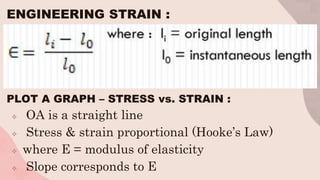
ENGINEERING STRAIN :
PLOT A GRAPH – STRESS vs. STRAIN :
 OA is a straight line
 Stress & strain proportional (Hooke’s Law)
 where E = modulus of elasticity
 Slope corresponds to E
ENGINEERING STRESS vs. STRAIN :
Engineering stress is the applied
load divided by the original cross-
sectional area of a material. Also
known as nominal stress.
Engineering strain is the amount
that a material deforms per unit
length in a tensile test.
PLOT A GRAPH – STRESS vs. STRAIN :
 Called elastic deformation
 When applied load is released, specimen returns
to its original shape.
AB IS A SMALL CURVE :
 A is a point where elastic deformation end and
plastic deformation begin.
- Phenomenon of yielding occurs.
- Called proportional limit.
- Initial departure from linearity
AB IS A SMALL CURVE :
 To determine yielding point precisely.
- Construct straight line parallel to elastic portion
of σ-∊ curve at a specified strain offset (0.002)
- B is the intersection of parallel line with curve
- The stress defined as a yield strength, σy
σ-∊ behavior for some steels :
 Elastic-plastic transition
- well defined
- occurs abruptly
 Yield point phenomenon
- Upper yield point – plastic deformation
initiated. σ decrease.
- Lower yield point – deformation fluctuated at
constant σ
- Yield strength σy , average σ of lower yield
point
BC IS AN UPWARD CURVE
 Stress increase to maximum limit (point C)
 Called tensile strength , TS
 Corresponds to maximum σ that can be
sustained by a structure in tension .
 Necking begin to form- decrease of cross-
sectional area
CD IS A DOWNWARD CURVE
 Specimen continues to elongate
 Requires lesser load to continue
deformation. σ decrease.
 D is a point of fracture or rupture
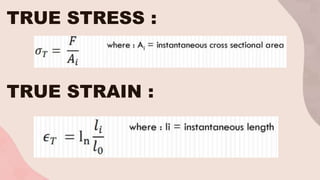
TRUE STRESS :
TRUE STRAIN :
TRUE STRESS vs. STRAIN :
True stress is determined by
dividing the tensile load by the
instantaneous area.
True strain is the natural
logarithm of the ratio of the
instantaneous gauge length to the
original gauge length.
DUCTILITY
 Measure degree of plastic
deformation that has been
sustained at fracture
 Can be expressed as :
- % elongation
- % area reduction
% elongation (% E)
% area reduction (%AR)
BRITTLE MATERIAL
 Has little or no plastic
deformation upon fracture
 Has less than 5% elongation
HARDNESS TEST
 Hardness test
 Measure hardness by forcing an
indenter into materials surface.
 Indenter – made of harder material
– usually in form of ball.
pyramid or cone
HARDNESS TEST
 Early Hardness Test
- Done by comparing with 10
standard mineral
- Increasing hardness on Moh’s scale
1. talc 6. orthoclase
2. Gypsum 7. quartz
3. Calcite 8. topaz
4. Fluorite 9. corundum
5. Apatite 10. diamond
IMPORTANT TEST
 Brinell Hardness Test
 Rockwell Hardness Test
 Viekers Hardness Test
 Knoop Hardness Test
BRINELL HARDNESS TEST
 By Dr Johan August Brinell in
1900
 Performed by pressing steel ball
into surface of test pieces using
appropriate force.
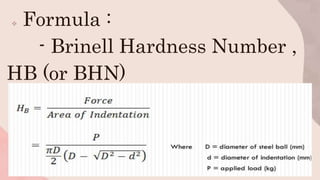
 Formula :
- Brinell Hardness Number ,
HB (or BHN)
ROCKWELL HARDNESS TEST
 Devised in the USA
 The most common method:
 Simple to perform
 Require no special skills
 Quick & direct reading
 Performed when hardness is beyond
range of Brinell’s
 load is smaller than Brinell’s
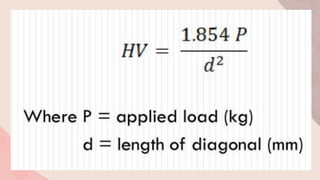
VIEKERS HARDNESS TEST
 The most accurate test
- Has continuous scale of hardness (10
to 1000)
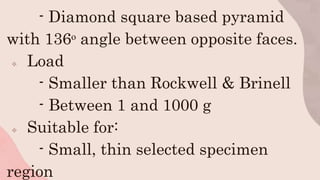
 Indenter
- Diamond square based pyramid
with 136ᵒ angle between opposite faces.
 Load
- Smaller than Rockwell & Brinell
- Between 1 and 1000 g
 Suitable for:
- Small, thin selected specimen
region
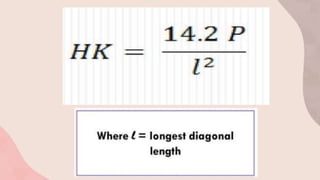
KNOOP HARDNESS TEST
 Very much similar to Vickers
 Indenter :
- Diamond pyramid with short depth and
diagonal in ratio in ratio of 7:1
 Measure diagonal length under
microscope.
 Knoop hardness number designated by HK
 Hardness scale for Knoop & Vickers
- Approximately equivalent
 Both are referred as micro hardness testing
- Basis of reload & indenter size
 Suitable for testing
- Brittle materials (ceramics)
- Extremely thin metal
- Exceptionally hard, very shallow
carburized or nitride surface
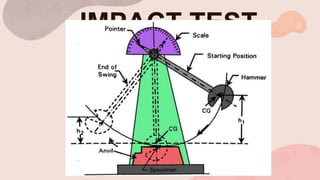
IMPACT TEST
 Many machine parts are subjected to
sudden applied loads – impact loads
 Important engineering wise to have :
- Material that can withstand impact
load without fracturing
 A hard, strong may not be suitable
when subjected to sharp sudden load.
 Capacity of metals to withstands impact
without fracture
- Impact resistance or impact strength
- Indication of toughness
 Method of measuring toughness
- Impact- testing apparatus
 Types of impact-testing apparatus
- Charpy
- Izod
IMPACT TEST
TEST
APPLICATION &
PROCESSING
ALLOYS
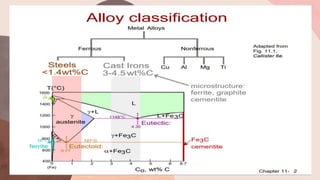
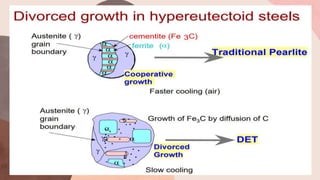
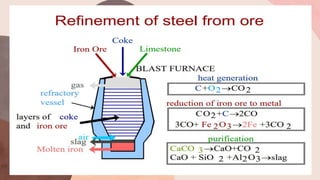
Example : Damascus Steel
 Produced from high carbon
(hypereutectic) steel -1.5% C bloom, or
cake (wootz – produced in India exported
to Damascus)
 Characteristic surface pattern
(damascene) produced by microstructure
bands of Fe3C
– Band formations favored by some
carbide forming elements, e.g, V, Mn, Cr,
Nb, Mo
– Vanadium and other carbide-
forming impurities
existed in iron ores from South India
THANK
YOU!

METALS_GROUP4.pptx

  • 1.
    GROUP 4 Erika JeanZ. Chavez Renelyn Joyce Guevarra Jhon Albie Nepomuceno
  • 2.
    TOPICS TO BEDISCUSSED Mechanical Properties of Metals Application & Processing Alloys 01 02
  • 3.
  • 4.
    TYPES OF MECHANICALPROPERTIES  Defined as those properties which completely define its behavior under action of external load or forces.  Those properties which associated with : - Its ability to resist failure - Its behavior under action of external forces  Knowledge of mechanical properties : - Essential for engineers in selecting suitable materials for various applications.
  • 5.
    MECHANICAL PROPERTIES  STRENGTH- Ability to withstand or support external forces or load without rupture.  HARDNESS - Ability to resist deformation by abrasion, indentation or penetration and scratching by harder bodies.  DUCTILITY - Ability to undergo appreciable plastic deformation before rupture.  BRITTLENESS - Ability to fracture when deformed . Opposite to ductility
  • 6.
     TOUGHNESS -Ability to absorb maximum energy up to fracture. Must be strong & ductile to be tough. Shows ability to withstand impact. Value increase when temperature increases.  ELASTICITY - Ability to retain its original shape & size after removal of load.  PLASTICITY - Ability to experience permanent deformation without fracture when subjected to external forces.
  • 7.
     RESILIENCE -Ability to absorb energy when it is elastically deformed.  MALLEABILITY - Ability to be deformed into thin sheets by rolling or hammering without fracture  MACHINABILITY - Ability to be cut or removed by cutting tools in various ,machining operations.
  • 8.
     WELDABILITY -Ability of 2 similar or dissimilar metals to be joined by fusion& with or without filler.  CASTABILITY - Ability to be formed into different shapes & sizes from its liquid state.
  • 9.
    MECHANICAL TEST OFMETALS  All mechanical properties of metal- established by conducting tests on various testing machines.  Types of mechanical test : - Tensile test - Creep test - Hardness test - Impact test - Compressive test - Fatigue test
  • 10.
    TENSILE TEST  Tensiletest understand mechanical behavior by stress-strain test.  3 ways of load application –tension, shear, compression  Most common mechanical stress- strain performed in tension
  • 11.
     Performed todetermined ; - Elastic limit - Yield point - Ultimate tensile strength - % of elongation & reduction of area
  • 12.
    STANDARD TENSILE SPECIMEN  Circularcross section  Reduced section diameter = 12.8 mm  Reduce section length = 60mm  Gauge length = 50mm
  • 13.
    STANDARD TENSILE SPECIMEN Procedure :  Specimen held in holding grips of apparatus  Load applied gradually at a constant rate  Specimen will be elongated until fracture
  • 14.
    DATA RECORDED –LOAD vs. ELONGATION :  Normalized to engineering stress & engineering strain. ENGINEERING STRESS :
  • 15.
    ENGINEERING STRAIN : PLOTA GRAPH – STRESS vs. STRAIN :  OA is a straight line  Stress & strain proportional (Hooke’s Law)  where E = modulus of elasticity  Slope corresponds to E
  • 16.
    ENGINEERING STRESS vs.STRAIN : Engineering stress is the applied load divided by the original cross- sectional area of a material. Also known as nominal stress. Engineering strain is the amount that a material deforms per unit length in a tensile test.
  • 17.
    PLOT A GRAPH– STRESS vs. STRAIN :  Called elastic deformation  When applied load is released, specimen returns to its original shape. AB IS A SMALL CURVE :  A is a point where elastic deformation end and plastic deformation begin. - Phenomenon of yielding occurs. - Called proportional limit. - Initial departure from linearity
  • 18.
    AB IS ASMALL CURVE :  To determine yielding point precisely. - Construct straight line parallel to elastic portion of σ-∊ curve at a specified strain offset (0.002) - B is the intersection of parallel line with curve - The stress defined as a yield strength, σy σ-∊ behavior for some steels :  Elastic-plastic transition - well defined - occurs abruptly
  • 19.
     Yield pointphenomenon - Upper yield point – plastic deformation initiated. σ decrease. - Lower yield point – deformation fluctuated at constant σ - Yield strength σy , average σ of lower yield point BC IS AN UPWARD CURVE  Stress increase to maximum limit (point C)  Called tensile strength , TS
  • 20.
     Corresponds tomaximum σ that can be sustained by a structure in tension .  Necking begin to form- decrease of cross- sectional area CD IS A DOWNWARD CURVE  Specimen continues to elongate  Requires lesser load to continue deformation. σ decrease.  D is a point of fracture or rupture
  • 21.
  • 22.
    TRUE STRESS vs.STRAIN : True stress is determined by dividing the tensile load by the instantaneous area. True strain is the natural logarithm of the ratio of the instantaneous gauge length to the original gauge length.
  • 23.
    DUCTILITY  Measure degreeof plastic deformation that has been sustained at fracture  Can be expressed as : - % elongation - % area reduction
  • 24.
    % elongation (%E) % area reduction (%AR)
  • 25.
    BRITTLE MATERIAL  Haslittle or no plastic deformation upon fracture  Has less than 5% elongation
  • 26.
    HARDNESS TEST  Hardnesstest  Measure hardness by forcing an indenter into materials surface.  Indenter – made of harder material – usually in form of ball. pyramid or cone
  • 27.
    HARDNESS TEST  EarlyHardness Test - Done by comparing with 10 standard mineral - Increasing hardness on Moh’s scale 1. talc 6. orthoclase 2. Gypsum 7. quartz
  • 28.
    3. Calcite 8.topaz 4. Fluorite 9. corundum 5. Apatite 10. diamond IMPORTANT TEST  Brinell Hardness Test  Rockwell Hardness Test  Viekers Hardness Test  Knoop Hardness Test
  • 29.
    BRINELL HARDNESS TEST By Dr Johan August Brinell in 1900  Performed by pressing steel ball into surface of test pieces using appropriate force.
  • 30.
     Formula : -Brinell Hardness Number , HB (or BHN)
  • 31.
    ROCKWELL HARDNESS TEST Devised in the USA  The most common method:  Simple to perform  Require no special skills  Quick & direct reading
  • 32.
     Performed whenhardness is beyond range of Brinell’s  load is smaller than Brinell’s VIEKERS HARDNESS TEST  The most accurate test - Has continuous scale of hardness (10 to 1000)  Indenter
  • 33.
    - Diamond squarebased pyramid with 136ᵒ angle between opposite faces.  Load - Smaller than Rockwell & Brinell - Between 1 and 1000 g  Suitable for: - Small, thin selected specimen region
  • 35.
    KNOOP HARDNESS TEST Very much similar to Vickers  Indenter : - Diamond pyramid with short depth and diagonal in ratio in ratio of 7:1  Measure diagonal length under microscope.  Knoop hardness number designated by HK
  • 37.
     Hardness scalefor Knoop & Vickers - Approximately equivalent  Both are referred as micro hardness testing - Basis of reload & indenter size  Suitable for testing - Brittle materials (ceramics) - Extremely thin metal - Exceptionally hard, very shallow carburized or nitride surface
  • 38.
    IMPACT TEST  Manymachine parts are subjected to sudden applied loads – impact loads  Important engineering wise to have : - Material that can withstand impact load without fracturing
  • 39.
     A hard,strong may not be suitable when subjected to sharp sudden load.  Capacity of metals to withstands impact without fracture - Impact resistance or impact strength - Indication of toughness
  • 40.
     Method ofmeasuring toughness - Impact- testing apparatus  Types of impact-testing apparatus - Charpy - Izod
  • 41.
  • 42.
  • 43.
  • 46.
    Example : DamascusSteel  Produced from high carbon (hypereutectic) steel -1.5% C bloom, or cake (wootz – produced in India exported to Damascus)  Characteristic surface pattern (damascene) produced by microstructure bands of Fe3C
  • 47.
    – Band formationsfavored by some carbide forming elements, e.g, V, Mn, Cr, Nb, Mo – Vanadium and other carbide- forming impurities existed in iron ores from South India
  • 63.