ITM UNIVERSE
Rolling Process
Subject : Metal Forming Analysis
By :
Pankil Shah (130950119115)
Mech : B 7th Sem
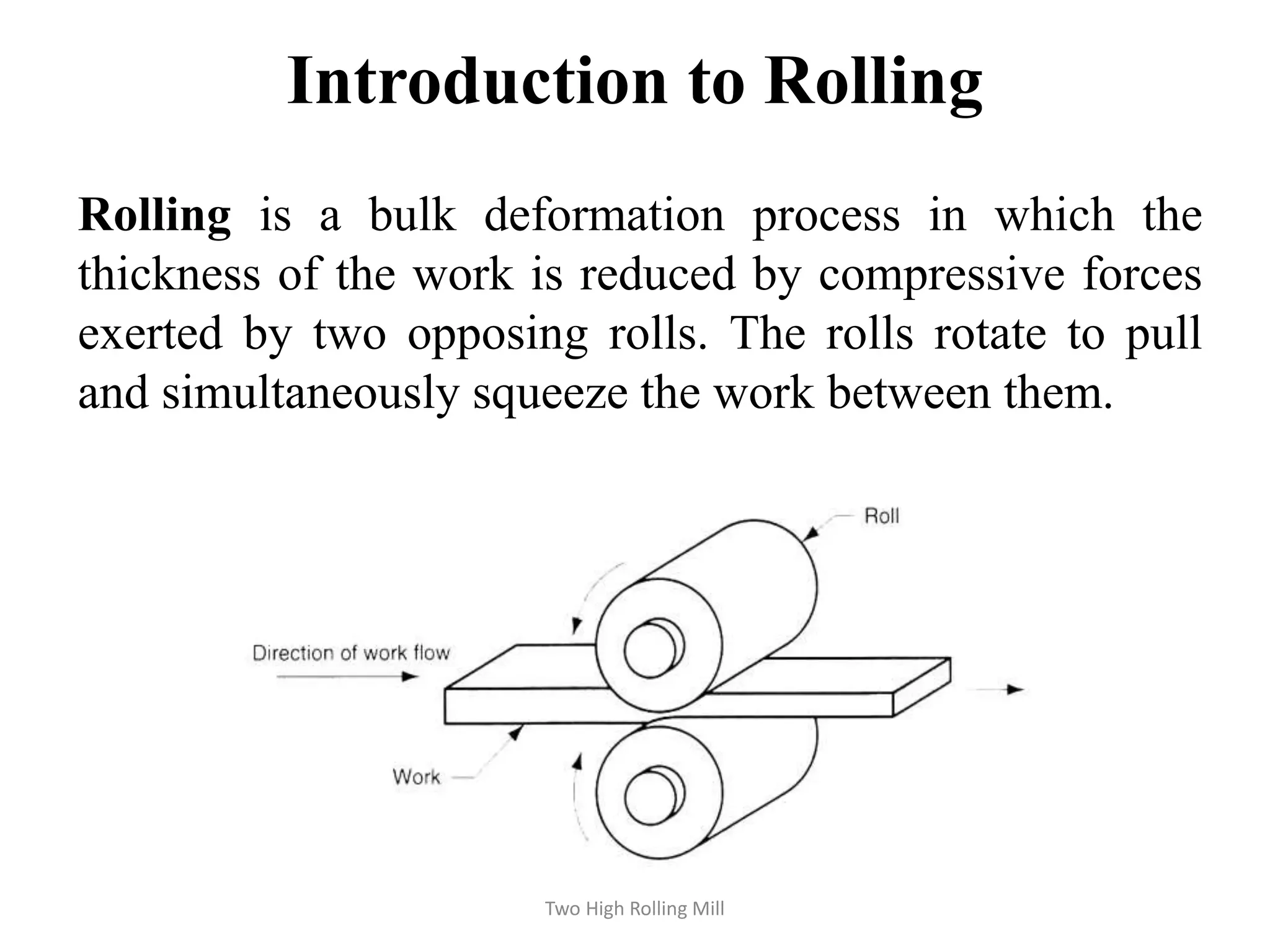
Two High Rolling Mill
Rolling is a bulk deformation process in which the
thickness of the work is reduced by compressive forces
exerted by two opposing rolls. The rolls rotate to pull
and simultaneously squeeze the work between them.
Introduction to Rolling
Continue…
The basic process shown in the previous figure is “Flat
Rolling”, used to reduce the thickness of a rectangular cross
section. A closely related process is “shape rolling”, in
which a square cross section is formed into a shape such as
an I-beam.
Shape Rolling
Flat Rolling
Shape Rolling
4
Continue…
After casting, ingots are rolled into one of three intermediate shapes
called blooms, billets, and slabs:
• Blooms have square cross section 6” x 6” or larger. They are rolled
into structural shapes.
• Billets have square cross section 1.5” x 1.5” or larger. they are
rolled into bars and rods.
• Slabs have rectangular cross section 10” x 1.5” or larger. They are
rolled into plates, sheets and strips.
•Plate is the product with a thickness > 6 mm.
•Sheet is the product with a thickness < 6 mm
and width > 600 mm.
•Strip is the product with a thickness < 6 mm
and width < 600 mm.
6
Types of Rolling
•Based on work piece geometry :
•Flat rolling - used to reduce thickness of a
rectangular cross section
•Shape rolling - square cross section is formed into a
shape such as an I-beam
•Based on work temperature :
•Hot Rolling – most common due to the large amount
of deformation required
•Cold rolling – produces finished sheet and plate
stock
7
Roll configurations in rolling mills
Two High Rolling Mill. Three High Rolling Mill
Continue...
Cluster Rolling Mill.
Tandem Rolling Mill.
Hot rolling
• Hot rolling is a metalworking process that occurs above the
recrystallization temperature of the material.
• Hot rolled metals generally have little directionality in their
mechanical properties and deformation induced residual
stresses.
• However, in certain instances non-metallic inclusions will
impart some directionality
• Hot rolling is used mainly to produce sheet metal or simple
cross sections, such as rail tracks.
Cold rolling
•Cold rolling occurs with the metal below its recrystallization
temperature (usually at room temperature).
•Due to smaller size of the work pieces and their greater strength
than hot rolled stock, four-high or cluster mills are used.
•Commonly cold-rolled products include sheets, strips and rods;
products being smaller than the same products that are hot rolled.
Types of rolling processes
• Continuous
• Transverse
• Section or shape
• Ring
• Continuous casting and hot rolling
• Thread
Continuous
• The objective is to decrease the thickness of the metal with an
increase in length and with little increase in width.
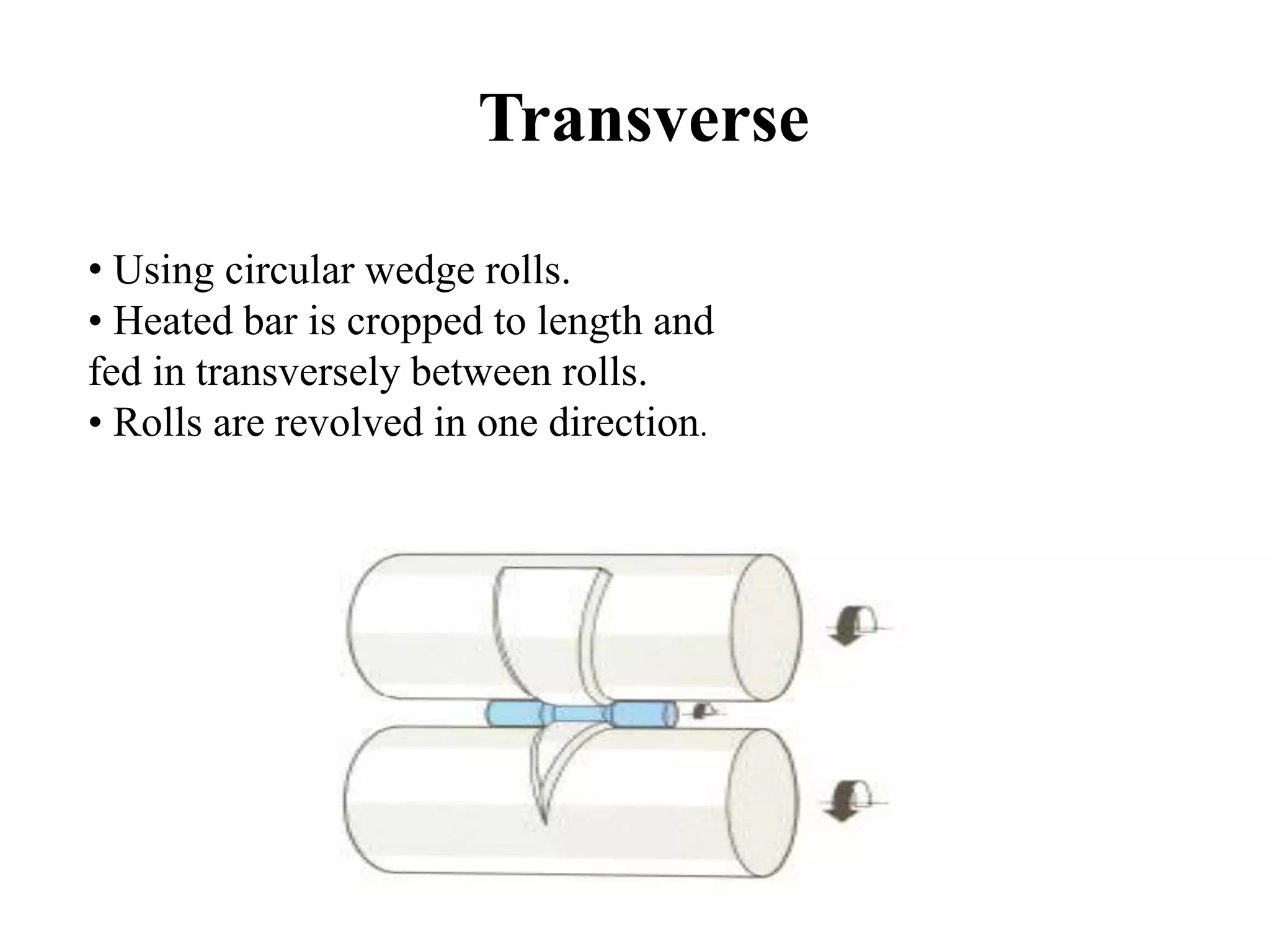
Transverse
• Using circular wedge rolls.
• Heated bar is cropped to length and
fed in transversely between rolls.
• Rolls are revolved in one direction.
SECTION or SHAPE
• Flat slap is progressively bent into complex shapes.
• Suitable for producing moulded sections such as irregular
shaped channels and trim.
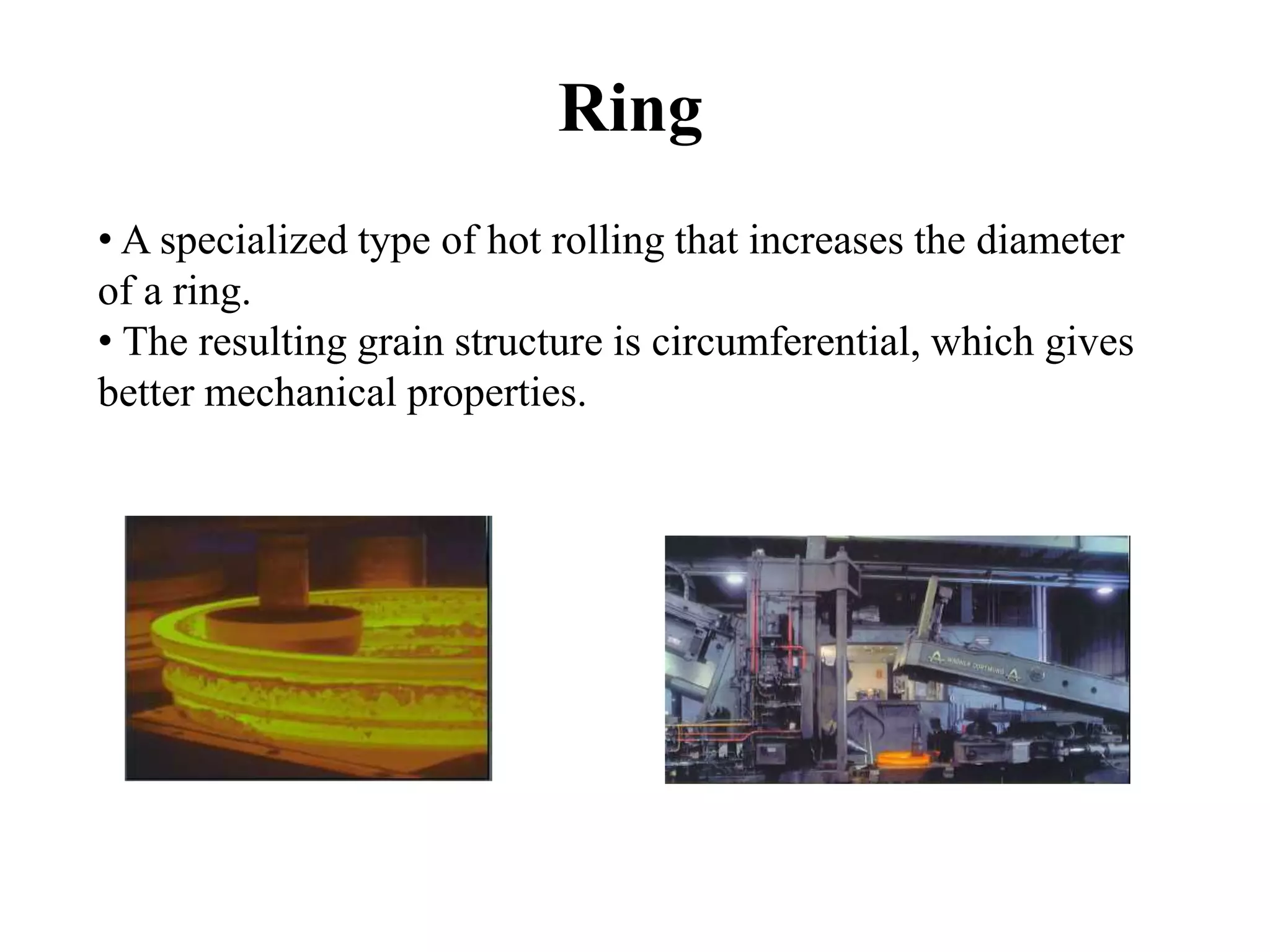
Ring
• A specialized type of hot rolling that increases the diameter
of a ring.
• The resulting grain structure is circumferential, which gives
better mechanical properties.
Continuous casting and hot rolling
Metal is melted, cast and hot rolled continuously through a
series of rolling mills within the same process.
Thread
Rolled threads are produced in a single pass at speeds far in excess
of those used to cut threads. Dies are pressed against the surface of
cylindrical blank. As the blank rolls against the in feeding die
faces, the material is displaced to form the roots of the thread, and
the displaced material flows radially outward to form the thread's
crest.
THANK YOU

Rolling process

  • 1.
    ITM UNIVERSE Rolling Process Subject: Metal Forming Analysis By : Pankil Shah (130950119115) Mech : B 7th Sem
  • 2.
    Two High RollingMill Rolling is a bulk deformation process in which the thickness of the work is reduced by compressive forces exerted by two opposing rolls. The rolls rotate to pull and simultaneously squeeze the work between them. Introduction to Rolling
  • 3.
    Continue… The basic processshown in the previous figure is “Flat Rolling”, used to reduce the thickness of a rectangular cross section. A closely related process is “shape rolling”, in which a square cross section is formed into a shape such as an I-beam. Shape Rolling Flat Rolling Shape Rolling
  • 4.
    4 Continue… After casting, ingotsare rolled into one of three intermediate shapes called blooms, billets, and slabs: • Blooms have square cross section 6” x 6” or larger. They are rolled into structural shapes. • Billets have square cross section 1.5” x 1.5” or larger. they are rolled into bars and rods.
  • 5.
    • Slabs haverectangular cross section 10” x 1.5” or larger. They are rolled into plates, sheets and strips. •Plate is the product with a thickness > 6 mm. •Sheet is the product with a thickness < 6 mm and width > 600 mm. •Strip is the product with a thickness < 6 mm and width < 600 mm.
  • 6.
    6 Types of Rolling •Basedon work piece geometry : •Flat rolling - used to reduce thickness of a rectangular cross section •Shape rolling - square cross section is formed into a shape such as an I-beam •Based on work temperature : •Hot Rolling – most common due to the large amount of deformation required •Cold rolling – produces finished sheet and plate stock
  • 7.
    7 Roll configurations inrolling mills Two High Rolling Mill. Three High Rolling Mill
  • 8.
  • 9.
    Hot rolling • Hotrolling is a metalworking process that occurs above the recrystallization temperature of the material. • Hot rolled metals generally have little directionality in their mechanical properties and deformation induced residual stresses. • However, in certain instances non-metallic inclusions will impart some directionality • Hot rolling is used mainly to produce sheet metal or simple cross sections, such as rail tracks.
  • 10.
    Cold rolling •Cold rollingoccurs with the metal below its recrystallization temperature (usually at room temperature). •Due to smaller size of the work pieces and their greater strength than hot rolled stock, four-high or cluster mills are used. •Commonly cold-rolled products include sheets, strips and rods; products being smaller than the same products that are hot rolled.
  • 11.
    Types of rollingprocesses • Continuous • Transverse • Section or shape • Ring • Continuous casting and hot rolling • Thread
  • 12.
    Continuous • The objectiveis to decrease the thickness of the metal with an increase in length and with little increase in width.
  • 13.
    Transverse • Using circularwedge rolls. • Heated bar is cropped to length and fed in transversely between rolls. • Rolls are revolved in one direction.
  • 14.
    SECTION or SHAPE •Flat slap is progressively bent into complex shapes. • Suitable for producing moulded sections such as irregular shaped channels and trim.
  • 15.
    Ring • A specializedtype of hot rolling that increases the diameter of a ring. • The resulting grain structure is circumferential, which gives better mechanical properties.
  • 16.
    Continuous casting andhot rolling Metal is melted, cast and hot rolled continuously through a series of rolling mills within the same process.
  • 17.
    Thread Rolled threads areproduced in a single pass at speeds far in excess of those used to cut threads. Dies are pressed against the surface of cylindrical blank. As the blank rolls against the in feeding die faces, the material is displaced to form the roots of the thread, and the displaced material flows radially outward to form the thread's crest.
  • 18.