THE HIKE WAS INEVITABLE;   WHAT’S NEXT? Presented by: (sop-A2) AJITH.S SUSAN JACOB SHAIFUDHEEN.N.M RAKHI RAJ HARIKRISHNAN.S SATHEESH.K.V (Under guidance of Mr.Sudheesh J Sadanandan)
CONTENTS Introduction Review on KSRTC Current Scenario Problems faced Causes of Hike Effects of Hike Analysis Suggestions Conclusion
Introduction The hike in bus fare was unavoidable, On looking forward, can KSRTC attain profit; and thereby benefiting the public
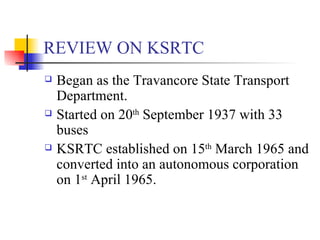
REVIEW ON KSRTC Began as the Travancore State Transport Department. Started on 20 th  September 1937 with 33 buses KSRTC established on 15 th  March 1965 and converted into an autonomous corporation on 1 st  April 1965.
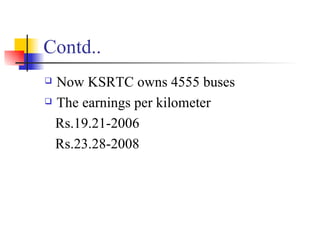
Contd.. Now KSRTC owns 4555 buses The earnings per kilometer Rs.19.21-2006 Rs.23.28-2008
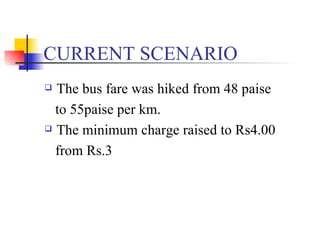
CURRENT SCENARIO The bus fare was hiked from 48 paise to 55paise per km. The minimum charge raised to Rs4.00 from Rs.3
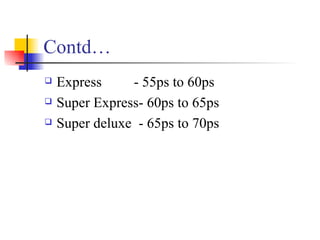
Contd… Express  - 55ps to 60ps Super Express- 60ps to 65ps Super deluxe  - 65ps to 70ps
Contd… Comparing with Tamil Nadu Minimum rate is 2rs. Rate per km is 28 ps. 79% of the total buses are government  undertaken
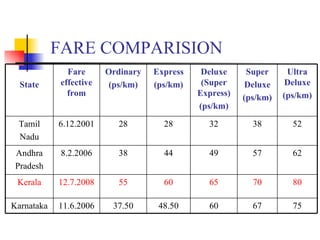
FARE COMPARISION 75 67 60 48.50 37.50 11.6.2006 Karnataka 80 70 65 60 55 12.7.2008 Kerala 62 57 49 44 38 8.2.2006 Andhra Pradesh 52 38 32 28 28 6.12.2001 Tamil Nadu Ultra Deluxe (ps/km) Super Deluxe (ps/km) Deluxe (Super Express) (ps/km) Express (ps/km) Ordinary (ps/km) Fare effective from State
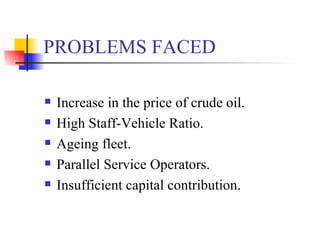
PROBLEMS FACED Increase in the price of crude oil. High Staff-Vehicle Ratio. Ageing fleet. Parallel Service Operators. Insufficient capital contribution.
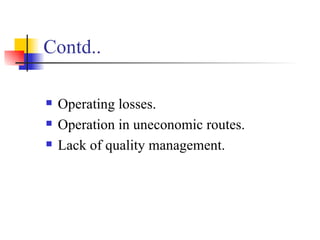
Contd.. Operating losses. Operation in uneconomic routes. Lack of quality management.
CAUSES FOR HIKE Hike in fuel price. Increase in operational cost.
EFFECTS OF HIKE Affects family budget. Private buses owners. Average additional income from each bus put on Rs.1350 a day.
ANALYSIS Strength: Government support. Tax Concession. Concession from oil companies. Low Interest Rate.
Weakness: Mismanagement. Lack of Sufficient Fund. Corruption and Political Interference. Poor condition of Roads.
Opportunities: Introduction of new services. Daily / Monthly passes. City Bus Corporation.
Threats: Competition from Private buses. Parallel Services. Railways.
SUGGESTIONS Nationalizing more routes. Maintain Staff-Vehicle Ratio. Effective Management. Adopting successful techniques.
CONCLUSION Various methods can be adopted for the proper functioning of KSRTC and favoring  the society but it has to be implemented with mutual support of the government as well as the public.
Bibliography www.keralrtc.com www.thehindubusinessline.com www.natpac.org

Ksrtc

  • 1.
    THE HIKE WASINEVITABLE; WHAT’S NEXT? Presented by: (sop-A2) AJITH.S SUSAN JACOB SHAIFUDHEEN.N.M RAKHI RAJ HARIKRISHNAN.S SATHEESH.K.V (Under guidance of Mr.Sudheesh J Sadanandan)
  • 2.
    CONTENTS Introduction Reviewon KSRTC Current Scenario Problems faced Causes of Hike Effects of Hike Analysis Suggestions Conclusion
  • 3.
    Introduction The hikein bus fare was unavoidable, On looking forward, can KSRTC attain profit; and thereby benefiting the public
  • 4.
    REVIEW ON KSRTCBegan as the Travancore State Transport Department. Started on 20 th September 1937 with 33 buses KSRTC established on 15 th March 1965 and converted into an autonomous corporation on 1 st April 1965.
  • 5.
    Contd.. Now KSRTCowns 4555 buses The earnings per kilometer Rs.19.21-2006 Rs.23.28-2008
  • 6.
    CURRENT SCENARIO Thebus fare was hiked from 48 paise to 55paise per km. The minimum charge raised to Rs4.00 from Rs.3
  • 7.
    Contd… Express - 55ps to 60ps Super Express- 60ps to 65ps Super deluxe - 65ps to 70ps
  • 8.
    Contd… Comparing withTamil Nadu Minimum rate is 2rs. Rate per km is 28 ps. 79% of the total buses are government undertaken
  • 9.
    FARE COMPARISION 7567 60 48.50 37.50 11.6.2006 Karnataka 80 70 65 60 55 12.7.2008 Kerala 62 57 49 44 38 8.2.2006 Andhra Pradesh 52 38 32 28 28 6.12.2001 Tamil Nadu Ultra Deluxe (ps/km) Super Deluxe (ps/km) Deluxe (Super Express) (ps/km) Express (ps/km) Ordinary (ps/km) Fare effective from State
  • 10.
    PROBLEMS FACED Increasein the price of crude oil. High Staff-Vehicle Ratio. Ageing fleet. Parallel Service Operators. Insufficient capital contribution.
  • 11.
    Contd.. Operating losses.Operation in uneconomic routes. Lack of quality management.
  • 12.
    CAUSES FOR HIKEHike in fuel price. Increase in operational cost.
  • 13.
    EFFECTS OF HIKEAffects family budget. Private buses owners. Average additional income from each bus put on Rs.1350 a day.
  • 14.
    ANALYSIS Strength: Governmentsupport. Tax Concession. Concession from oil companies. Low Interest Rate.
  • 15.
    Weakness: Mismanagement. Lackof Sufficient Fund. Corruption and Political Interference. Poor condition of Roads.
  • 16.
    Opportunities: Introduction ofnew services. Daily / Monthly passes. City Bus Corporation.
  • 17.
    Threats: Competition fromPrivate buses. Parallel Services. Railways.
  • 18.
    SUGGESTIONS Nationalizing moreroutes. Maintain Staff-Vehicle Ratio. Effective Management. Adopting successful techniques.
  • 19.
    CONCLUSION Various methodscan be adopted for the proper functioning of KSRTC and favoring the society but it has to be implemented with mutual support of the government as well as the public.
  • 20.