Indian Textile Industry Syndicate I
Multi - Fibre Arrangement Quotas on imports of textile from more competitive developing countries. Dismantling of quota on Jan 1,2005 Increased opportunities Competition
 
Perspective of the Economy Total market size (2006-07): Exports: USD 18.73 bn Strong contribution to Indian Economy 14% contribution to industrial production 4% contribution to GDP 17% contribution to export earnings Direct employment to more than 35 million people
Sector is diverse   hand-spun and hand woven sector  capital intensive, sophisticated mill sector
Segments  Organized Cotton/ Man-Made Fibre Textiles Mill Industry  Man-made Fibre/ Filament Yarn Industry Wool and Woolens Textiles Industry  Sericulture and Silk Textiles Industry  Handlooms  Handicrafts  Jute and Jute Textiles Industry  Textiles Exports
SWOT Analysis
Strengths India’s strong base in raw-materials   Cotton dominates the industry  Nearly 56% of yarn produced is made of cotton Country produces nearly 23 varieties of cotton India is the second largest player in the world cotton trade
India’s position is strong vis-à-vis other countries in most raw materials  Largest producer of jute Second largest producer of silk Third largest producer of cotton, accounting for nearly 16% of global production Third largest producer of cellulosic fibre/yarn Fifth largest producer of synthetic fibres/yarn Eleventh largest producer of wool
Low cost skilled labour Presence across the value chain Reduced lead time Growing domestic market
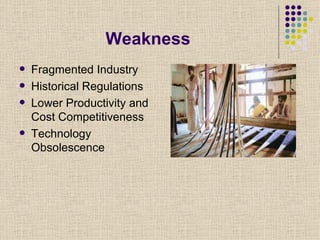
Weakness Fragmented Industry Historical Regulations Lower Productivity and Cost Competitiveness Technology Obsolescence
Opportunities New Product Development Stress on product development New specialized fabrics Investing in design centers and sampling labs Increased use of CAD to develop designing capabilities Investing in trend forecasting
Threats Competition in domestic market Ecological and social awareness Regional alliances China
Major Players of Indian Textile Industry Arvind Mills Raymonds Reliance Textiles Vardhaman Spinning  Welspun India
Comments "We need to maintain and manufacture high quality products. We have timely deliveries because India is recognized as major player in international textile market. So, if we maintain our competitiveness, we'll be able to regain some markets, we have lost to China,"  K V Srinivasan, Chairman, South India Mills
The Meltdown In US Rising Commodity Prices Credit Crunch
Impact on Indian Textile Industry Decreasing demand in European and US markets Decreasing demand for retail garments Mills in Rajasthan and Tamil Nadu  reduced shifts (resulting in job loss) cut down capacity
India was losing out to countries like Bangladesh, Vietnam and Cambodia  The chairman, Confederation of Indian Textile Industry (CITI), R.K. Dalmiya
Conclusion A huge window of opportunity has opened up for the Indian textile industry which is fast closing up. Various players need to get act together. It’s now for players to make investments in building the capacities and making them integrated manufacturers. They need to invest more in R&D. This is the only way they can compete with the Chinese dragon.

Textile Industry

  • 1.
  • 2.
    Multi - FibreArrangement Quotas on imports of textile from more competitive developing countries. Dismantling of quota on Jan 1,2005 Increased opportunities Competition
  • 3.
  • 4.
    Perspective of theEconomy Total market size (2006-07): Exports: USD 18.73 bn Strong contribution to Indian Economy 14% contribution to industrial production 4% contribution to GDP 17% contribution to export earnings Direct employment to more than 35 million people
  • 5.
    Sector is diverse hand-spun and hand woven sector capital intensive, sophisticated mill sector
  • 6.
    Segments OrganizedCotton/ Man-Made Fibre Textiles Mill Industry Man-made Fibre/ Filament Yarn Industry Wool and Woolens Textiles Industry Sericulture and Silk Textiles Industry Handlooms Handicrafts Jute and Jute Textiles Industry Textiles Exports
  • 7.
  • 8.
    Strengths India’s strongbase in raw-materials Cotton dominates the industry Nearly 56% of yarn produced is made of cotton Country produces nearly 23 varieties of cotton India is the second largest player in the world cotton trade
  • 9.
    India’s position isstrong vis-à-vis other countries in most raw materials Largest producer of jute Second largest producer of silk Third largest producer of cotton, accounting for nearly 16% of global production Third largest producer of cellulosic fibre/yarn Fifth largest producer of synthetic fibres/yarn Eleventh largest producer of wool
  • 10.
    Low cost skilledlabour Presence across the value chain Reduced lead time Growing domestic market
  • 11.
    Weakness Fragmented IndustryHistorical Regulations Lower Productivity and Cost Competitiveness Technology Obsolescence
  • 12.
    Opportunities New ProductDevelopment Stress on product development New specialized fabrics Investing in design centers and sampling labs Increased use of CAD to develop designing capabilities Investing in trend forecasting
  • 13.
    Threats Competition indomestic market Ecological and social awareness Regional alliances China
  • 14.
    Major Players ofIndian Textile Industry Arvind Mills Raymonds Reliance Textiles Vardhaman Spinning Welspun India
  • 15.
    Comments "We needto maintain and manufacture high quality products. We have timely deliveries because India is recognized as major player in international textile market. So, if we maintain our competitiveness, we'll be able to regain some markets, we have lost to China," K V Srinivasan, Chairman, South India Mills
  • 16.
    The Meltdown InUS Rising Commodity Prices Credit Crunch
  • 17.
    Impact on IndianTextile Industry Decreasing demand in European and US markets Decreasing demand for retail garments Mills in Rajasthan and Tamil Nadu reduced shifts (resulting in job loss) cut down capacity
  • 18.
    India was losingout to countries like Bangladesh, Vietnam and Cambodia The chairman, Confederation of Indian Textile Industry (CITI), R.K. Dalmiya
  • 19.
    Conclusion A hugewindow of opportunity has opened up for the Indian textile industry which is fast closing up. Various players need to get act together. It’s now for players to make investments in building the capacities and making them integrated manufacturers. They need to invest more in R&D. This is the only way they can compete with the Chinese dragon.