Wireless
Channel
Impairment
Mitigation
Techniques
Reference: Haesik Kim, “ Wireless Communications Systems Design-
From Theory to Design”, Ch. 5, 2015 1
There are many types of wireless channel impairments
such as noise, path loss, shadowing, and fading and
impairment Mitigation techniques should be adopted
according to system requirements and channel
environments.
There are many techniques to mitigate wireless
channel impairments. For example: For the purpose of
mitigating delay spreads, Global System for Mobile
Communications (GSM) system uses adaptive channel
equalization techniques and Code Division Multiple
Access (CDMA) system uses a rake receiver.
Introduction
2
Diversity Techniques
3
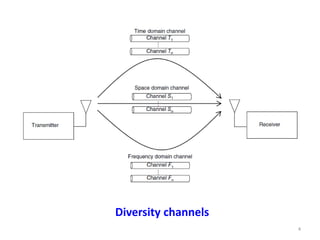
Diversity techniques mitigate multipath fading effects
and improve the reliability of a signal by utilizing
multiple received signals with different characteristics.
Space diversity uses multiple antennas
Time diversity uses different time slots
Frequency diversity uses different frequency
slots.
4
Diversity channels
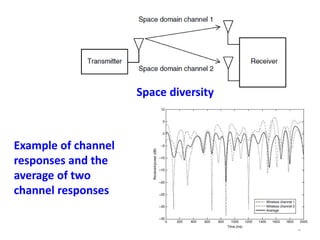
Space diversity
5
Space diversity uses multiple antennas and is classified
into macroscopic diversity and microscopic diversity.
Macroscopic diversity mitigates large‐scale fading
caused by log normal fading and shadowing. To achieve
macroscopic diversity, antennas are spaced far enough
and we select an antenna which is not shadowed. Thus,
we can increase the signal to noise ratio.
 Microscopic diversity mitigates small‐scale fading
caused by multipath. To achieve microscopic diversity, a
multiple antenna technique is used as well and an
antenna is selected to have a signal with small fading
effect.
6
Space diversity
Example of channel
responses and the
average of two
channel responses
Time diversity
7
Time diversity uses different time slots.
Basically, consecutive signals are highly
correlated in wireless channels. Thus, a time
diversity technique transmits same signal
sequences in different time slots. The time
sequence difference should be larger than the
channel coherence time. An interleaving
technique is one of time diversity techniques.
8
Time diversity
Frequency diversity
9
Frequency diversity uses different frequency
slots. It transmits a signal through different
frequencies or spreads it over a wide frequency
spectrum. Frequency diversity is based on he
fact that the fading effect is differently
appeared in different frequencies separated by
more than the channel coherence bandwidth.
When the channel coherence he transmission
bandwidth is greater than bandwidth (namely,
it is a broadband system), the frequency
diversity Technique is useful.
10
Frequency diversity
Combining Techniques for Diversity
11
Maximal Ratio Combining(MRC)
Equal Gain Combining (EGC)
Selection Combining (SC)
The signal, s(t), is transmitted through L different
channels. The each received signal, rl(t), through
different channels is represented by Channel: gain
(αl) and phase
rotation (φl)
nl(t) : Gaussian
noise
12
MRC technique
13
The received signal,
r(t), is weighted by wl
SNR, γ, of the
received
signal, r(t),
14
Schwartz’s
inequality
The equality holds if
for all l, where K is an arbitrary complex constant
15
The maximum SNR, γmax, can be found when
16
EGC technique
Combining all signals using phase estimation and
unitary weight to achieve a high SNR
17
the SNR, γ, of the
received signal, r(t),
SC technique
18
Summary: Diversity techniques
19
Multi-Input Multi-OutPut Techniques
20
MIMO techniques use the multiple antennas at a
transmitter and receiver.
They are very effective to mitigate the degradation of
fading channels and enhance the link quality between a
transmitter and a receiver. Especially, they improve
Signal to Noise Ratio (SNR), Signal to Interference plus
Noise Ratio (SINR), spectral efficiency, and error
probability.
The MIMO techniques are classified into spatial
diversity techniques, spatial multiplexing techniques,
and beamforming techniques.
Spatial diversity
21
•Spatial diversity techniques target to decrease the error
probability. A transmitter sends multiple copies of the
same data sequence and a receiver combines them.
MIMO as spatial diversity technique
22
Transmit diversity: The transmitter has multiple
antennas and pre‐processing blocks for combining the
multiple same data sequences. We typically assume
the receiver has channel knowledge. Several
well‐known spatial diversity techniques are
Space‐Time Block Codes (STBCs) and Space‐Time
Trellis Codes (STTCs) for improving the reliability of
the data transmission. The STBC provides us with
diversity gain only. However, the STTC uses
convolutional codes and provides us with both code
gain and diversity gain.
Receiver diversity: The receiver has multiple antennas
and combining techniques such as MRC, EGC, and SC.
Spatial multiplexing
23
Spatial multiplexing techniques substantially increase
spectral efficiency. A transmitter sends Nt data
sequences simultaneously in the different antennas and
same frequency band and a receiver detects them using
an interference cancellation algorithm.
MIMO as spatial multiplexing technique
24
This technique improves spectral efficiency because
multiple data sequences are transmitted in parallel.
Thus, the spectral efficiency is improved by increasing
the number of the transmit antennas (Nt). In addition,
It can be expanded into multi‐user MIMO or Space‐
Division Multiple Access (SDMA). Multi‐user MIMO
techniques assign each data sequence to each user.
Multiuser MIMO
Beamforming techniques
25
They are signal processing techniques for directional
transmission The beamformer with Nt antenna elements
combines Radio Frequency (RF) signals of each antenna
element to have a certain direction by adjusting phases
and weighting of RF signals. Thus, this technique brings
antenna gain and suppresses interferences in multiuser
environments.
In the modern wireless communications, the cell size is getting
smaller and the number of cells is getting bigger. The
interferences among cells became serious problem. Thus, the
interference mitigation technique among cells is an essential part
of wireless communication systems. The beamforming technique
is very effective to mitigate interferences.
26
MIMO as beamforming technique
Fundamentals of MIMO Techniques
27
Spatial diversity techniques: MISO
Alamouti scheme with 2 × 1 antennas
Signal mapping of Alamouti scheme with 2 × 1 antennas
28
Each symbol experiences different channel responses
(h1 and h2). The received symbols
“*” =
complex
conjugate
29
In matrix form
The combining technique in the receiver is performed.
Based on the orthogonal properties of H matrix
30
The combined symbols are sent to ML detector and we
estimate the transmitted symbol
ML detection
The
combined
symbols
Spatial diversity Techniques: SIMO
31
We transmit s[t] and receive yi[t] via receive
antenna i at the time index t.
The receiver collects yi[t] using combining techniques
and obtains more reliable received symbols.
When dealing with spatial diversity techniques, it is
important to maintain uncorrelated antennas. Under
the uncorrelated condition, we can obtain diversity gain
which means SNR or SINR increases. If antennas are
strongly correlated, we cannot obtain diversity gain.
32
Spatial diversity technique with 1 × Nr antennas
Spatial multiplexing techniques: BLAST & D-BLAST
33
BLAST : Bell laboratories layered space time
D-BLAST: Diagonal BLAST V-BLAST: Vertical BLAST
 It is especially useful for uplink systems due to the
limited number of antennas at mobile stations.
Sometime, this is called collaborative MIMO or
collaborative spatial multiplexing.
34
D‐BLAST and V‐BLAST transmitter
with four antennas
35
D‐BLAST and V‐BLAST transmitted data sequences
( Four-antenna Example)
Homework 1
36
Show with mathematical analysis how Channel
Impairment Mitigated in BLAST system.
• MIMO: A communications
technology that enhances the
transmission
• data rate without increasing the
signal bandwidth by
• combining multiple transmitters and
receivers.
37
Beamforming Techniques
38
They use array gain and control the direction of
signals by adjusting the magnitude and phase at each
antenna array. The array gain means a power gain of
multiple antennas with respect to single antenna.
Simple beamformer
Plane wave
departs from
omnidirectional
antennas
39
The delay of departure
among antennas
Each signal si(t) at each omnidirectional antenna
40
a= Antenna array
steering vector
controls the
direction of the
signals
Add the weighting vector w
41
Thus, the signal power is strengthened in the desired
direction and weakened in the undesired direction. The
beamforming performance depends on finding the
suitable weighting vector w, antenna array
arrangement, distance d between antenna arrays, and
signal correlation.
Summary: MIMO
42
Orthogonal Frquency-Division Multiplexing
43
The OFDM technique is based on Frequency Division
Multiplexing (FDM) which transmits multiple signals in
multiple frequencies simultaneously.
FDM with three carriers
44
One disadvantage of the FDM is a long guard band
between the carriers which makes spectral efficiency
of the FDM system worse. The OFDM uses the similar
concept but increases the spectral efficiency by
reducing the guard band between the subcarriers. This
can be achieved by orthogonality characteristic of the
OFDM system.
The OFDM system uses multiple subcarriers. Thus, it
needs multiple local oscillators to generate them and
multiple modulators to transmit them. However, a
practical OFDM system uses Fast Fourier Transform
(FFT) to generate this parallel data sequences.
45
OFDM with three subcarriers
Advantages and Disadvantages of OFDM
46
The OFDM equalizer is much simpler to
implement than those in Code Division Multiple
Access (CDMA).
The OFDM system is almost completely
resistant to multipath fading due to very long
symbols.
The OFDM system is ideally suited to MIMO
techniques due to easy matching of transmit
signals to the uncorrelated wireless channel.
Advantages
47
It is sensitive to frequency errors and phase
noises due to close subcarrier spacing.
It is sensitive to the Doppler shift which creates
interferences between subcarriers.
It creates a high peak to average power ratio.
It is more complex than other communication
systems when handling interferences at the cell
edge.
Disadvantage
System Modeling and implementation
48
Using Fast Fourier Transform (FFT) to implement
OFDM system is a big benefit because a local oscillator
is expensive and not easy to implement.
 In the transmitter of the OFDM system, the data
sequences are passed to Inverse FFT (IFFT) and these
data sequences are converted into parallel data
sequences which are combined by multiple subcarriers
with maintaining the orthogonality between
subcarriers.
In the receiver, the parallel data sequences are
converted into the serial data sequences by FFT.
49
Although the OFDM system overcomes interferences
in frequency domain by orthogonality, the interference
problem still exists in time domain.
 One of the major problems in wireless
communication systems is Inter‐ISI. This is caused by
multipath and considered one important reason is a
distorted original signal.
 In the OFDM system, a Cyclic Prefix (CP) or Zero
Padding (ZP) is used to mitigate the effects of
multipath propagation. This can be represented as a
guard period which is located just in front of the data
and is able to mitigate delay spreads.
50
OFDM transmitter with N parallel data sequence
51
The baseband modulated symbol of the OFDM
Xk is the baseband modulated symbol such as BPSK,
QPSK, or QAM and N is the total number of subcarriers
52
The subcarrier spacing
53
In addition, we can regard this signal as a discrete OFDM
symbol when sampling the signal in every Ts/N.
54
The OFDM transmitter
can be represented using
IFFT (Inverse Discrete
Fourier Transform, IDFT)
Cyclic prefix as a guard interval
55
When a cyclic prefix is inserted as a guard interval
Tg is a cyclic prefix length
The OFDM symbol
56
Summary: OFDM
Transmitted OFDM Signal
57
This baseband signal is up‐converted to a carrier frequency fc
and we obtain the following the transmitted OFDM signal
The complex baseband signal x(t)
The received signal
58
Up‐conversion
from the base
band signal to
the passband
signal
Down‐conver
sion from the
pass band
signal to the
baseband
signal
59
Synchronization process is performed at trhe receiver using the
baseband signal y(t). The OFDM signal is very sensitive to
synchronization errors such as ISI and inter‐carrier interference.
Thus, this process is very important and should be implemented
very carefully. Generally, the synchronization of the OFDM
system is composed of three stages which are symbol Timing
synchronization, carrier frequency/phase offset
synchronization, and sampling clock/sampling frequency
synchronization.
The orthogonal frequency division multiple access
(OFDMA) is a multiple access scheme based on the
OFDM technique. The subcarriers in the OFDM
system are shared by multiple users in the OFDMA
system.
60OFDM‐based communication system
Equalization
61
Due to a time dispersive channel by multipath fading,
Inter‐Symbol Interference (ISI) occurs and an equalizer
plays an important role in ISI compensation.
Channel model for equalization
62
The frequency response of the equalizer should be
designed to satisfy the following equation
F(f) = Combined frequency response of the transmit
filter, channel, and receive filter
Zero Forcing Equalizer
63
One of simple equalizers using the inverse of the
channel frequency response.
Channel model for zero forcing equalizer
64
This technique basically ignores AWGN.
The complexity is low but the performance is not
good.
However, the equalization in the OFDM system is not
much important because multipath fading is
compensated in the OFDM system itself. Each
subcarrier of the OFDM symbol experiences a flat
fading channel. Thus, the OFDM system does not need
a strong equalization and the one‐tap zero forcing
equalizer in frequency domain is enough to compensate
subcarrier distortions.
65
In order to estimate how well an equalizer works, the
Mean Squared Error (MSE) is used as the metric. It is
defined as the mean squared error between the
received signal and the desired signal as follows
Channel Estimation
66
estimate the channel
response Hc(f )
The first type is to use training symbols (preambles) or
pilot symbols and the other type is a blind channel
estimation. The method using preambles in the OFDM
system is to reserve several OFDM symbols. The receiver
knows which symbol the transmitter sends without
interpolation.
Frame structure including preambles and data symbols
Types of Pilot Structures in the OFDM System
67
Block‐type pilot structure in the OFDM system
68
Comb‐type pilot structure in the OFDM system
69
Lattice‐type pilot structure in the OFDM system
70
Block‐type pilot structure
Suitable for a frequency selective channel. The pilot
interval in time domain should be satisfied by
fd = Doppler spread and TOFDM
= OFDM symbol duration
Comb‐type pilot structure
Suitable for a time selective channel
τmax = Maximum delay spread
Δf = Subcarrier spacing in
frequency domain
71
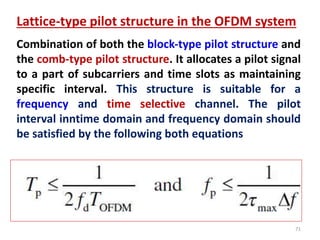
Lattice‐type pilot structure in the OFDM system
Combination of both the block‐type pilot structure and
the comb‐type pilot structure. It allocates a pilot signal
to a part of subcarriers and time slots as maintaining
specific interval. This structure is suitable for a
frequency and time selective channel. The pilot
interval inntime domain and frequency domain should
be satisfied by the following both equations
Homework 2
72
The Least Square (LS)
estimation and the MMSE
estimation are important
channel estimations based on
the training symbols or pilot
symbols.
Discuss with aid of mathematical analysis
Summary: Equalization
73

Wireless Channel Impairment Mitigation Techniques

  • 1.
    Wireless Channel Impairment Mitigation Techniques Reference: Haesik Kim,“ Wireless Communications Systems Design- From Theory to Design”, Ch. 5, 2015 1
  • 2.
    There are manytypes of wireless channel impairments such as noise, path loss, shadowing, and fading and impairment Mitigation techniques should be adopted according to system requirements and channel environments. There are many techniques to mitigate wireless channel impairments. For example: For the purpose of mitigating delay spreads, Global System for Mobile Communications (GSM) system uses adaptive channel equalization techniques and Code Division Multiple Access (CDMA) system uses a rake receiver. Introduction 2
  • 3.
    Diversity Techniques 3 Diversity techniquesmitigate multipath fading effects and improve the reliability of a signal by utilizing multiple received signals with different characteristics. Space diversity uses multiple antennas Time diversity uses different time slots Frequency diversity uses different frequency slots.
  • 4.
  • 5.
    Space diversity 5 Space diversityuses multiple antennas and is classified into macroscopic diversity and microscopic diversity. Macroscopic diversity mitigates large‐scale fading caused by log normal fading and shadowing. To achieve macroscopic diversity, antennas are spaced far enough and we select an antenna which is not shadowed. Thus, we can increase the signal to noise ratio.  Microscopic diversity mitigates small‐scale fading caused by multipath. To achieve microscopic diversity, a multiple antenna technique is used as well and an antenna is selected to have a signal with small fading effect.
  • 6.
    6 Space diversity Example ofchannel responses and the average of two channel responses
  • 7.
    Time diversity 7 Time diversityuses different time slots. Basically, consecutive signals are highly correlated in wireless channels. Thus, a time diversity technique transmits same signal sequences in different time slots. The time sequence difference should be larger than the channel coherence time. An interleaving technique is one of time diversity techniques.
  • 8.
  • 9.
    Frequency diversity 9 Frequency diversityuses different frequency slots. It transmits a signal through different frequencies or spreads it over a wide frequency spectrum. Frequency diversity is based on he fact that the fading effect is differently appeared in different frequencies separated by more than the channel coherence bandwidth. When the channel coherence he transmission bandwidth is greater than bandwidth (namely, it is a broadband system), the frequency diversity Technique is useful.
  • 10.
  • 11.
    Combining Techniques forDiversity 11 Maximal Ratio Combining(MRC) Equal Gain Combining (EGC) Selection Combining (SC) The signal, s(t), is transmitted through L different channels. The each received signal, rl(t), through different channels is represented by Channel: gain (αl) and phase rotation (φl) nl(t) : Gaussian noise
  • 12.
  • 13.
    13 The received signal, r(t),is weighted by wl SNR, γ, of the received signal, r(t),
  • 14.
    14 Schwartz’s inequality The equality holdsif for all l, where K is an arbitrary complex constant
  • 15.
    15 The maximum SNR,γmax, can be found when
  • 16.
    16 EGC technique Combining allsignals using phase estimation and unitary weight to achieve a high SNR
  • 17.
    17 the SNR, γ,of the received signal, r(t),
  • 18.
  • 19.
  • 20.
    Multi-Input Multi-OutPut Techniques 20 MIMOtechniques use the multiple antennas at a transmitter and receiver. They are very effective to mitigate the degradation of fading channels and enhance the link quality between a transmitter and a receiver. Especially, they improve Signal to Noise Ratio (SNR), Signal to Interference plus Noise Ratio (SINR), spectral efficiency, and error probability. The MIMO techniques are classified into spatial diversity techniques, spatial multiplexing techniques, and beamforming techniques.
  • 21.
    Spatial diversity 21 •Spatial diversitytechniques target to decrease the error probability. A transmitter sends multiple copies of the same data sequence and a receiver combines them. MIMO as spatial diversity technique
  • 22.
    22 Transmit diversity: Thetransmitter has multiple antennas and pre‐processing blocks for combining the multiple same data sequences. We typically assume the receiver has channel knowledge. Several well‐known spatial diversity techniques are Space‐Time Block Codes (STBCs) and Space‐Time Trellis Codes (STTCs) for improving the reliability of the data transmission. The STBC provides us with diversity gain only. However, the STTC uses convolutional codes and provides us with both code gain and diversity gain. Receiver diversity: The receiver has multiple antennas and combining techniques such as MRC, EGC, and SC.
  • 23.
    Spatial multiplexing 23 Spatial multiplexingtechniques substantially increase spectral efficiency. A transmitter sends Nt data sequences simultaneously in the different antennas and same frequency band and a receiver detects them using an interference cancellation algorithm. MIMO as spatial multiplexing technique
  • 24.
    24 This technique improvesspectral efficiency because multiple data sequences are transmitted in parallel. Thus, the spectral efficiency is improved by increasing the number of the transmit antennas (Nt). In addition, It can be expanded into multi‐user MIMO or Space‐ Division Multiple Access (SDMA). Multi‐user MIMO techniques assign each data sequence to each user. Multiuser MIMO
  • 25.
    Beamforming techniques 25 They aresignal processing techniques for directional transmission The beamformer with Nt antenna elements combines Radio Frequency (RF) signals of each antenna element to have a certain direction by adjusting phases and weighting of RF signals. Thus, this technique brings antenna gain and suppresses interferences in multiuser environments. In the modern wireless communications, the cell size is getting smaller and the number of cells is getting bigger. The interferences among cells became serious problem. Thus, the interference mitigation technique among cells is an essential part of wireless communication systems. The beamforming technique is very effective to mitigate interferences.
  • 26.
  • 27.
    Fundamentals of MIMOTechniques 27 Spatial diversity techniques: MISO Alamouti scheme with 2 × 1 antennas
  • 28.
    Signal mapping ofAlamouti scheme with 2 × 1 antennas 28 Each symbol experiences different channel responses (h1 and h2). The received symbols “*” = complex conjugate
  • 29.
    29 In matrix form Thecombining technique in the receiver is performed. Based on the orthogonal properties of H matrix
  • 30.
    30 The combined symbolsare sent to ML detector and we estimate the transmitted symbol ML detection The combined symbols
  • 31.
    Spatial diversity Techniques:SIMO 31 We transmit s[t] and receive yi[t] via receive antenna i at the time index t. The receiver collects yi[t] using combining techniques and obtains more reliable received symbols. When dealing with spatial diversity techniques, it is important to maintain uncorrelated antennas. Under the uncorrelated condition, we can obtain diversity gain which means SNR or SINR increases. If antennas are strongly correlated, we cannot obtain diversity gain.
  • 32.
    32 Spatial diversity techniquewith 1 × Nr antennas
  • 33.
    Spatial multiplexing techniques:BLAST & D-BLAST 33 BLAST : Bell laboratories layered space time D-BLAST: Diagonal BLAST V-BLAST: Vertical BLAST  It is especially useful for uplink systems due to the limited number of antennas at mobile stations. Sometime, this is called collaborative MIMO or collaborative spatial multiplexing.
  • 34.
    34 D‐BLAST and V‐BLASTtransmitter with four antennas
  • 35.
    35 D‐BLAST and V‐BLASTtransmitted data sequences ( Four-antenna Example)
  • 36.
    Homework 1 36 Show withmathematical analysis how Channel Impairment Mitigated in BLAST system.
  • 37.
    • MIMO: Acommunications technology that enhances the transmission • data rate without increasing the signal bandwidth by • combining multiple transmitters and receivers. 37
  • 38.
    Beamforming Techniques 38 They usearray gain and control the direction of signals by adjusting the magnitude and phase at each antenna array. The array gain means a power gain of multiple antennas with respect to single antenna. Simple beamformer Plane wave departs from omnidirectional antennas
  • 39.
    39 The delay ofdeparture among antennas Each signal si(t) at each omnidirectional antenna
  • 40.
    40 a= Antenna array steeringvector controls the direction of the signals Add the weighting vector w
  • 41.
    41 Thus, the signalpower is strengthened in the desired direction and weakened in the undesired direction. The beamforming performance depends on finding the suitable weighting vector w, antenna array arrangement, distance d between antenna arrays, and signal correlation.
  • 42.
  • 43.
    Orthogonal Frquency-Division Multiplexing 43 TheOFDM technique is based on Frequency Division Multiplexing (FDM) which transmits multiple signals in multiple frequencies simultaneously. FDM with three carriers
  • 44.
    44 One disadvantage ofthe FDM is a long guard band between the carriers which makes spectral efficiency of the FDM system worse. The OFDM uses the similar concept but increases the spectral efficiency by reducing the guard band between the subcarriers. This can be achieved by orthogonality characteristic of the OFDM system. The OFDM system uses multiple subcarriers. Thus, it needs multiple local oscillators to generate them and multiple modulators to transmit them. However, a practical OFDM system uses Fast Fourier Transform (FFT) to generate this parallel data sequences.
  • 45.
    45 OFDM with threesubcarriers
  • 46.
    Advantages and Disadvantagesof OFDM 46 The OFDM equalizer is much simpler to implement than those in Code Division Multiple Access (CDMA). The OFDM system is almost completely resistant to multipath fading due to very long symbols. The OFDM system is ideally suited to MIMO techniques due to easy matching of transmit signals to the uncorrelated wireless channel. Advantages
  • 47.
    47 It is sensitiveto frequency errors and phase noises due to close subcarrier spacing. It is sensitive to the Doppler shift which creates interferences between subcarriers. It creates a high peak to average power ratio. It is more complex than other communication systems when handling interferences at the cell edge. Disadvantage
  • 48.
    System Modeling andimplementation 48 Using Fast Fourier Transform (FFT) to implement OFDM system is a big benefit because a local oscillator is expensive and not easy to implement.  In the transmitter of the OFDM system, the data sequences are passed to Inverse FFT (IFFT) and these data sequences are converted into parallel data sequences which are combined by multiple subcarriers with maintaining the orthogonality between subcarriers. In the receiver, the parallel data sequences are converted into the serial data sequences by FFT.
  • 49.
    49 Although the OFDMsystem overcomes interferences in frequency domain by orthogonality, the interference problem still exists in time domain.  One of the major problems in wireless communication systems is Inter‐ISI. This is caused by multipath and considered one important reason is a distorted original signal.  In the OFDM system, a Cyclic Prefix (CP) or Zero Padding (ZP) is used to mitigate the effects of multipath propagation. This can be represented as a guard period which is located just in front of the data and is able to mitigate delay spreads.
  • 50.
    50 OFDM transmitter withN parallel data sequence
  • 51.
    51 The baseband modulatedsymbol of the OFDM Xk is the baseband modulated symbol such as BPSK, QPSK, or QAM and N is the total number of subcarriers
  • 52.
  • 53.
    53 In addition, wecan regard this signal as a discrete OFDM symbol when sampling the signal in every Ts/N.
  • 54.
    54 The OFDM transmitter canbe represented using IFFT (Inverse Discrete Fourier Transform, IDFT)
  • 55.
    Cyclic prefix asa guard interval 55 When a cyclic prefix is inserted as a guard interval Tg is a cyclic prefix length The OFDM symbol
  • 56.
  • 57.
    Transmitted OFDM Signal 57 Thisbaseband signal is up‐converted to a carrier frequency fc and we obtain the following the transmitted OFDM signal The complex baseband signal x(t) The received signal
  • 58.
    58 Up‐conversion from the base bandsignal to the passband signal Down‐conver sion from the pass band signal to the baseband signal
  • 59.
    59 Synchronization process isperformed at trhe receiver using the baseband signal y(t). The OFDM signal is very sensitive to synchronization errors such as ISI and inter‐carrier interference. Thus, this process is very important and should be implemented very carefully. Generally, the synchronization of the OFDM system is composed of three stages which are symbol Timing synchronization, carrier frequency/phase offset synchronization, and sampling clock/sampling frequency synchronization. The orthogonal frequency division multiple access (OFDMA) is a multiple access scheme based on the OFDM technique. The subcarriers in the OFDM system are shared by multiple users in the OFDMA system.
  • 60.
  • 61.
    Equalization 61 Due to atime dispersive channel by multipath fading, Inter‐Symbol Interference (ISI) occurs and an equalizer plays an important role in ISI compensation. Channel model for equalization
  • 62.
    62 The frequency responseof the equalizer should be designed to satisfy the following equation F(f) = Combined frequency response of the transmit filter, channel, and receive filter
  • 63.
    Zero Forcing Equalizer 63 Oneof simple equalizers using the inverse of the channel frequency response. Channel model for zero forcing equalizer
  • 64.
    64 This technique basicallyignores AWGN. The complexity is low but the performance is not good. However, the equalization in the OFDM system is not much important because multipath fading is compensated in the OFDM system itself. Each subcarrier of the OFDM symbol experiences a flat fading channel. Thus, the OFDM system does not need a strong equalization and the one‐tap zero forcing equalizer in frequency domain is enough to compensate subcarrier distortions.
  • 65.
    65 In order toestimate how well an equalizer works, the Mean Squared Error (MSE) is used as the metric. It is defined as the mean squared error between the received signal and the desired signal as follows
  • 66.
    Channel Estimation 66 estimate thechannel response Hc(f ) The first type is to use training symbols (preambles) or pilot symbols and the other type is a blind channel estimation. The method using preambles in the OFDM system is to reserve several OFDM symbols. The receiver knows which symbol the transmitter sends without interpolation. Frame structure including preambles and data symbols
  • 67.
    Types of PilotStructures in the OFDM System 67 Block‐type pilot structure in the OFDM system
  • 68.
  • 69.
  • 70.
    70 Block‐type pilot structure Suitablefor a frequency selective channel. The pilot interval in time domain should be satisfied by fd = Doppler spread and TOFDM = OFDM symbol duration Comb‐type pilot structure Suitable for a time selective channel τmax = Maximum delay spread Δf = Subcarrier spacing in frequency domain
  • 71.
    71 Lattice‐type pilot structurein the OFDM system Combination of both the block‐type pilot structure and the comb‐type pilot structure. It allocates a pilot signal to a part of subcarriers and time slots as maintaining specific interval. This structure is suitable for a frequency and time selective channel. The pilot interval inntime domain and frequency domain should be satisfied by the following both equations
  • 72.
    Homework 2 72 The LeastSquare (LS) estimation and the MMSE estimation are important channel estimations based on the training symbols or pilot symbols. Discuss with aid of mathematical analysis
  • 73.